
State Trooper Calendar: Texas, Florida, Carolina & More — Your Complete Guide
State trooper calendar guide covering TX, FL, NC, IL & more. Salaries, schedules, and exam prep tips. 🎯 Everything you need to plan your law enforcement...
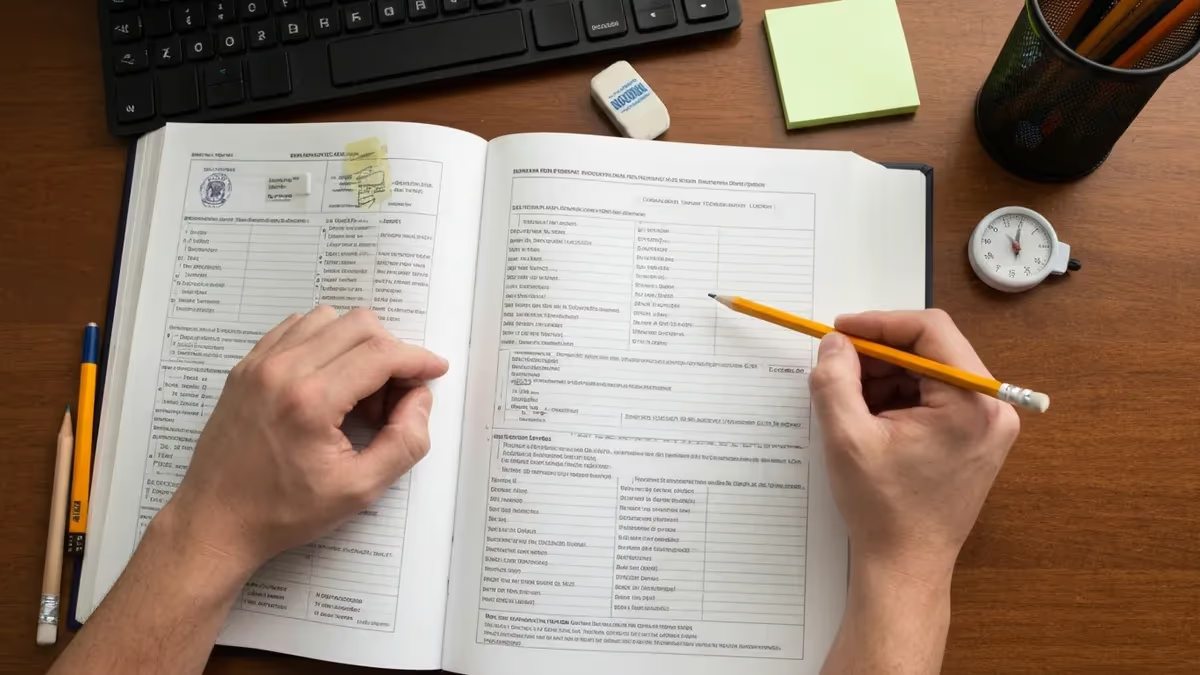
The state trooper calendar is the backbone of law enforcement planning across the United States, governing everything from academy enrollment windows to patrol shift rotations. Whether you're researching a state trooper at texas a posting or comparing opportunities in the Carolinas, Florida, or Illinois, understanding how recruitment cycles, training timelines, and testing dates align is critical. In states like Texas, the Department of Public Safety typically opens application windows two to four times per year, meaning missing a deadline can cost you six months or more of waiting.
For aspiring troopers in Texas, the "state trooper texas a" search trend reflects enormous interest in the Texas DPS Highway Patrol division, which is one of the largest and best-compensated state law enforcement agencies in the country. Texas A&M University System campuses also host cadet training programs, adding another layer to the recruitment calendar. The state trooper salary in Texas starts around $65,000 annually for newly commissioned officers and can climb well past $80,000 with tenure and specialty assignments, making it an attractive destination for candidates nationwide.
Florida state trooper recruitment calendars differ significantly from Texas. The Florida Highway Patrol runs an ongoing "continuous recruitment" model for much of the year but still batches cadets into academy classes that start at specific intervals — usually January, May, and September. Missing the intake paperwork deadline by even a few days can push a candidate back to the next class. Knowing the Florida state trooper calendar in advance gives applicants a meaningful competitive edge when preparing their physical fitness, written exam, and background investigation materials.
The Carolina state trooper systems — both North Carolina and South Carolina — operate on structured biannual cycles. NC state trooper recruitment typically opens in the spring and fall, with the State Highway Patrol Academy in Raleigh running classes that last approximately 24 weeks. Candidates who track the nc state trooper calendar carefully can align their preparation — including physical conditioning, exam study, and document gathering — to the precise intake window, dramatically improving their readiness score on day one of processing.
Illinois state trooper recruitment adds a Midwest dimension to the calendar picture. Illinois State Police opens competitive examinations roughly once every 18 to 24 months, meaning each testing cycle serves a large pool of candidates. The written examination is typically held at regional sites statewide on a single weekend, and scores remain valid for the duration of that hiring cycle. Because the illinois state trooper process is highly competitive, candidates who begin preparing 6 to 12 months before the announced test date consistently outperform last-minute applicants.
Arizona state trooper calendars are managed by the Arizona Department of Public Safety (AZDPS), which uses a rolling application model similar to Florida. However, academy start dates are announced only a few months in advance, requiring candidates to maintain a state of exam and fitness readiness at all times. The arizona state trooper hiring process involves a polygraph examination, psychological evaluation, and extensive background check that together can take three to six months to complete after the written exam, meaning a candidate who applies in January might not start the academy until the following autumn.
Understanding the state trooper calendar holistically — across Texas, Florida, the Carolinas, Illinois, and Arizona — empowers candidates to make strategic decisions about when to apply, how to prepare, and which state's opportunity fits their personal timeline. This guide breaks down each major state's scheduling patterns, salary benchmarks, and exam preparation strategies so you can plan your path to the badge with confidence and precision.
State Trooper Calendar by the Numbers

State-by-State Recruitment Timelines
Opens 2–4 application windows per year. Academy classes start roughly quarterly. Candidates should monitor the Texas DPS careers portal and allow 4–6 months for the full vetting process before an academy start date.
Continuous recruitment with batch academy starts in January, May, and September. Candidates must complete fitness, written exam, and background checks before their designated class date to avoid rollover.
Biannual cycles in spring and fall. The 24-week Raleigh academy is highly structured; candidates who miss a paperwork deadline are typically deferred to the next cycle six months later.
Competitive written exam every 18–24 months, held statewide on a single weekend. Scores are valid for that hiring cycle only, so timing your preparation to the announced exam date is essential.
Rolling applications with academy start dates announced 2–3 months in advance. The extended background and psych evaluation timeline (3–6 months) means applicants should stay exam-ready year-round.
State trooper salary structures are closely tied to the recruitment and promotional calendars maintained by each state's highway patrol or state police agency. Understanding how pay scales advance over time helps candidates select not just the right agency but the right moment to enter the pipeline. Texas, for example, ties automatic step increases to annual performance reviews, which are scheduled on a calendar-year basis. A trooper who joins in October may receive their first merit review after only two months if the agency uses a fixed January evaluation cycle rather than an anniversary-date model.
In Florida, the state trooper salary starts at approximately $48,000 during the academy training period, then jumps to around $55,000 upon commissioning. Annual raises are negotiated through collective agreements and typically take effect each July 1, aligning with the state's fiscal year. This means a Florida state trooper who times their academy entry for the January class will be commissioned just in time for the July pay adjustment, giving them a small but meaningful financial advantage over someone who enters the May class and has to wait a full fiscal year for the next increase.
North Carolina state trooper compensation follows the State Human Resources Act, with pay raises often tied to legislative budget cycles rather than agency discretion. The carolina state trooper base salary for a newly commissioned trooper sits around $46,000, but longevity pay, shift differentials, and hazard pay can push total compensation to $55,000 or more in the first year. NC troopers also receive state-funded health insurance and participation in the Teachers' and State Employees' Retirement System — one of the more generous pension plans in the Southeast.
Illinois state trooper salaries are governed by collective bargaining agreements between the Illinois State Police and the Illinois State Police Merit Board. Starting pay is approximately $56,000, with negotiated increases over a five-step progression that typically takes seven to eight years to complete. The competitive exam calendar is critical here because the rank-order score from the written test determines placement on the hiring list — a candidate who scores in the 95th percentile will be called for the background investigation months before someone who scored at the 80th percentile, even if both applied on the same day.
Arkansas state trooper pay and calendar schedules are managed by the Arkansas State Police, which conducts academy classes roughly twice per year. The arkansas state trooper eup (Emergency Uniform Patrol) organizational structure divides the state into troops, and new hires are generally assigned to a troop based on vacancies at the time of graduation. Starting salary in Arkansas is lower than most peer states at around $42,000, but the agency offers excellent housing allowances and relocation benefits that partially offset the gap, particularly for candidates willing to serve in rural troop areas.
Arizona DPS compensation is among the more competitive in the Southwest. The arizona state trooper starting salary is approximately $62,000, with a series of step increases over the first five years that can bring pay to $75,000 or more. Arizona also offers a Deferred Retirement Option Plan (DROP), allowing troopers who have reached retirement eligibility to keep working while accumulating retirement credits — a benefit that makes long-term career planning and understanding the Arizona trooper calendar especially valuable for mid-career lateral candidates.
Salary transparency is increasingly important for law enforcement recruitment, and many state agencies now publish full pay tables online. Candidates are advised to download the current pay table when they initiate their application, since rates can change between application and commissioning. Budgeting for the training period — during which pay is typically lower — is a crucial part of calendar planning that first-time applicants sometimes overlook until it creates a financial hardship partway through the academy.
Florida, Carolina & Illinois State Trooper Calendars Explained
The Florida state trooper recruitment calendar operates on a continuous intake model, but cadets are grouped into academy classes that begin three times per year — typically in January, May, and September. Candidates must complete a multi-phase application process including a written exam, physical fitness test, medical screening, and comprehensive background investigation before they are conditionally offered a class seat. Processing time from application submission to a confirmed class offer averages four to six months for qualified candidates.
Florida's fiscal year begins July 1, which affects salary increases and budget-driven hiring surges. The Florida Highway Patrol frequently posts its highest cadet class counts in the January and September cohorts because these align with post-budget-approval staffing plans. Candidates aiming for the January academy should submit applications by mid-August to allow sufficient background check time. Those targeting September entry should apply no later than April to avoid being bumped to the next cycle.

Is a State Trooper Career Worth the Calendar Commitment?
- +Competitive starting salaries ranging from $42,000 in Arkansas to $65,000+ in Texas
- +Defined academy calendars allow candidates to plan preparation months in advance
- +Annual step increases and collective bargaining provide predictable long-term income growth
- +Generous pension and retirement systems unavailable in most private-sector careers
- +Physical fitness culture promoted during and after training keeps troopers healthy
- +Career advancement calendars (sergeant, lieutenant) provide clear promotional goals
- −Academy timelines of 20–26 weeks require a major life and family commitment
- −Missing a single application deadline can delay entry by 6 to 12 months
- −Starting salaries in some states are below regional private-sector equivalents
- −Background and psychological vetting timelines (3–6 months) create financial uncertainty
- −Shift work, holidays, and overnight patrols disrupt personal and family schedules
- −Statewide Illinois-style exam cycles mean waiting up to two years for the next opportunity
Pros and Cons at a Glance
| Pros | Cons |
|---|---|
| Defined academy calendars allow candidates to plan preparation months in advance | Starting salaries in some states are below regional private-sector equivalents |
| Annual step increases and collective bargaining provide predictable long-term income growth | Shift work, holidays, and overnight patrols disrupt personal and family schedules |
| Generous pension and retirement systems unavailable in most private-sector careers | Statewide Illinois-style exam cycles mean waiting up to two years for the next opportunity |
State Trooper Calendar Prep Checklist: 10 Steps Before You Apply
- ✓Identify your target state agency and bookmark the official careers portal for deadline alerts.
- ✓Download the current pay table and benefits summary to verify the salary aligns with your financial goals.
- ✓Confirm the next academy class start date and count backward to set your application submission deadline.
- ✓Begin a structured physical fitness program at least four months before your target application window.
- ✓Order certified copies of all required documents: birth certificate, driving record, military DD-214 if applicable.
- ✓Start a dedicated exam study schedule using official study guides and practice tests at least three months out.
- ✓Clear any outstanding financial obligations or legal issues that could surface during background investigation.
- ✓Gather character reference contacts and notify them in advance that they may be contacted by investigators.
- ✓Schedule a vision and hearing exam to confirm you meet the agency's medical standards before applying.
- ✓Set calendar reminders 30 days, 14 days, and 7 days before the application portal closes to avoid missing the window.
The 90-Day Rule: Apply 90 Days Before You Want to Start
Most state trooper agencies require a minimum of 90 days from application submission to academy seat confirmation. In states with longer background check processes — such as Arizona (3–6 months) or Illinois (post-exam register processing) — the realistic timeline is 120 to 180 days. Building this buffer into your calendar planning is the single most impactful scheduling decision you can make as an applicant.
Arizona and Arkansas represent two distinct approaches to the state trooper calendar, and understanding the differences is essential for candidates considering either state. The state trooper texas a&m resource illustrates how training programs and cadet equipment requirements vary dramatically between agencies, and Arizona's calendar reflects that complexity. The Arizona DPS releases academy class announcements with relatively short lead times — sometimes only 60 to 90 days before the class start date — which means candidates need to be in a perpetual state of readiness rather than treating the process as a sequential checklist they can start when the announcement drops.
Arizona's extended vetting process is driven partly by the state's proximity to the international border and the resulting need for thorough background investigations into candidates' international travel, foreign contacts, and financial histories. The polygraph examination alone can take several hours and may result in a temporary hold while examiners review responses with agency psychologists. Candidates who enter the Arizona process should plan for a minimum of four months between initial application and a conditional academy offer, and many experience five to seven months of processing time.
Arkansas state trooper recruitment operates on a more traditional cycle, with two academy classes per year. The Arkansas State Police Academy in Little Rock runs approximately 16 to 18-week programs that combine classroom instruction, physical training, firearms qualification, and vehicle operations. Arkansas has in recent years used a "continuous application" model where the portal stays open but applications are reviewed in batches that correspond to upcoming class dates. This approach gives candidates more flexibility in timing their submission but requires careful attention to the batch review cutoff dates published on the ASP careers page.
One often-overlooked aspect of the Arkansas and Arizona calendars is the post-commission field training period. Both states require newly graduated troopers to complete a structured Field Training Officer (FTO) program ranging from 12 to 16 weeks before receiving solo patrol status. This FTO calendar is assigned based on post availability, not the trooper's preference, meaning a graduate may be stationed 200 miles from their preferred area depending on where vacancies exist at graduation time. Researching troop vacancy patterns before applying can inform both the application timing and the personal logistics planning.
The texas a&m state trooper connection is worth exploring in depth. Texas A&M University System includes the Texas A&M Engineering Extension Service (TEEX), which provides law enforcement training programs used by Texas DPS and other agencies. The TEEX Law Enforcement Management Institute of Texas (LEMIT) offers calendared courses for in-service troopers seeking supervisory certifications, while the basic academy for new Texas DPS troopers is conducted at the DPS Training Academy in Austin. Understanding which training entity governs which part of the calendar prevents confusion for candidates researching the full Texas trooper preparation pathway.
For candidates in both Arizona and Arkansas, the written examination is only one component of a multi-stage selection process. Arizona DPS uses the National Police Officer Selection Test (POST) as its written exam, which assesses reading comprehension, arithmetic, writing, and human relations skills. Arkansas uses a similar standardized assessment. Both exams reward consistent reading and analytical skills practice over rote memorization of specific content, making a long-term study calendar — rather than a last-minute cram session — the most effective preparation strategy for high scores.
Candidates researching the texas a&m state trooper training materials will find that the overlap between state exam content and federally standardized law enforcement competencies is substantial. Skills tested in Texas — including criminal law application, traffic code interpretation, and report writing — mirror the content tested in Arizona, Arkansas, and most other states. This means that a candidate who begins exam preparation using multi-state resources is simultaneously building readiness for several agencies, providing valuable flexibility if one state's calendar doesn't align with their personal timeline.

In states like Illinois, the written exam occurs only once every 18 to 24 months. Missing the registration window — which may be open for as little as two to three weeks — means waiting nearly two years for the next opportunity. Set digital calendar reminders on the agency's Merit Board website as soon as any future exam is announced, and confirm your registration receipt immediately after submitting.
Exam preparation strategy is inseparable from calendar strategy for state trooper candidates. The most successful applicants treat the written exam not as a one-time event but as the culmination of a months-long, structured study program. Research into state trooper written exam formats across Texas, Florida, North Carolina, Illinois, Arizona, and Arkansas reveals that core content clusters — reading comprehension, mathematical reasoning, law enforcement situational judgment, and report writing — appear consistently across virtually all state exams, though weighting varies by agency.
Building a study calendar should start with a realistic self-assessment. Candidates who have been out of academic environments for several years often underestimate the time needed to rebuild test-taking stamina and analytical reading skills. A 90-day study plan that dedicates 45 to 60 minutes per day to structured practice covers far more ground than a two-week cram session before the exam date. Breaking the 90 days into three phases — foundational skill building (days 1–30), content-specific law enforcement knowledge (days 31–60), and timed practice testing (days 61–90) — mirrors the preparation approaches used by top-scoring candidates.
For candidates targeting the Texas DPS, the Frontline National exam is the primary written assessment tool. This exam evaluates reading comprehension, data interpretation, and writing skills in a law enforcement context. Texas-specific candidates should also familiarize themselves with the Texas Penal Code and Texas Transportation Code, since situational judgment questions are often grounded in state-specific legal frameworks. Practice tests that use Texas-coded scenarios are more useful for final preparation than generic law enforcement exams, though the generic practice builds the foundational skills needed to process Texas-specific content efficiently.
Florida Highway Patrol uses the Florida Department of Law Enforcement (FDLE) Criminal Justice Basic Abilities Test (CJBAT) as its entry exam. The CJBAT tests memorization, visualization, written composition, and human relations skills in addition to basic math and reading. Florida candidates should obtain the official CJBAT candidate preparation guide — available free on the FDLE website — and use it as the anchor of their study calendar. Supplementing with broader law enforcement practice tests builds versatility and prevents over-fitting to any single format.
North Carolina's entry examination for state highway patrol candidates assesses general reasoning and law enforcement aptitude. NC candidates benefit from reviewing the state's motor vehicle laws and general statutes, since many situational judgment questions in the oral interview portion of the selection process reference specific NC legal codes. The oral board interview — a formal panel interview conducted after written exam passage — is a calendar milestone that candidates sometimes fail to prepare for adequately because they focus exclusively on the written test and physical fitness components.
Illinois State Police candidates face the most calendar-constrained exam preparation challenge because the statewide exam is announced with roughly 60 to 90 days of notice and then administered on a single weekend. This compressed timeline rewards candidates who maintain ongoing exam readiness rather than beginning preparation only after the announcement. The Illinois exam tests reading comprehension, arithmetic, verbal reasoning, and situational judgment, with scores rank-ordered to create the hiring register that drives all subsequent processing. A five-point score difference can mean being called six months earlier or later than a peer who applied on the same day.
For all states, using online practice tests consistently in the weeks before the exam builds both content knowledge and time management skills. The exam environment is timed, and candidates who have practiced answering questions under time pressure perform significantly better than those who have only studied content in an untimed review format.
Setting a timer for each practice session — and tracking both accuracy and pace — is a small calendar discipline that produces measurable score improvements on exam day. Explore the Florida state trooper requirements page for state-specific details on how exam scores integrate into the overall selection ranking in Florida.
Practical tips for managing the state trooper calendar come from candidates who have successfully navigated the process and from the pattern analysis of which applicants get selected first. The single most consistent finding is that organization beats talent in the early stages. Candidates who build a personal application tracking spreadsheet — listing every deadline, every required document, every scheduled test date, and every contact person at the agency — are far less likely to miss a critical step than candidates who rely on memory or scattered notes.
Physical fitness preparation should be treated as a parallel calendar track that runs alongside exam study, not as something to address after the written test is passed. Most state trooper physical fitness tests assess a combination of push-up endurance, sit-up endurance, a timed 1.5-mile run, and sometimes an agility course or swimming component. The minimum standards are achievable for most healthy adults with 8 to 12 weeks of targeted training, but exceeding the minimums — rather than barely passing — signals commitment and reduces injury risk during the demanding academy physical training program.
Background investigation preparation is a calendar item that many candidates underestimate. The background packet typically requires a 10-year employment history, a 10-year residence history, a list of all criminal contacts including arrests without convictions, and character references who have known the candidate for at least five years.
Gathering this information can take two to four weeks if any records need to be obtained from former employers, educational institutions, or government agencies. Starting this document collection on the day you submit your application — rather than waiting for the background investigator to contact you — can shave weeks off your processing timeline.
Networking with current troopers at the agency you're targeting is an underutilized calendar strategy. Most state trooper agencies encourage candidates to attend recruiting events, and many allow informal informational interviews with active troopers. These conversations often reveal unpublished information about anticipated class sizes, typical processing timelines, and which parts of the background investigation most commonly cause delays. A candidate who learns in October that the agency's background unit is currently processing applications submitted in July can accurately forecast when they will be called for their own background interview and plan accordingly.
Financial planning for the academy period is a practical calendar consideration that catches many candidates by surprise. Academy pay is typically lower than full commissioned pay — sometimes significantly so. Texas DPS cadets, for example, earn approximately $3,600 per month during the 18-week academy, compared to the roughly $5,400 per month a commissioned trooper earns.
Planning for this income gap requires starting the financial preparation process at least three months before the academy start date, which means it needs to appear on the calendar alongside fitness training and exam study rather than being deferred until after the academy offer is received.
For candidates considering multiple states, maintaining parallel application tracks requires careful calendar management to avoid confusion between agencies. Creating a separate folder — digital and physical — for each state, with its own deadline tracker and document checklist, prevents the common mistake of submitting a document formatted for one state's requirements to a different agency. It also ensures that if one state's calendar slips due to budget constraints or hiring freezes, the candidate has an active alternative pipeline that can potentially be accelerated.
Final preparation in the 30 days before a major exam or selection event should shift from broad content review to specific, timed simulations. Take full-length practice exams under realistic conditions: no phone, no music, timed to match the actual exam duration. Review every incorrect answer to understand the reasoning error, not just the right answer.
In the final week, reduce study intensity and prioritize sleep, nutrition, and light physical activity — research consistently shows that rest and physical wellbeing in the week before an exam contribute more to performance than any last-minute content review can offset. Enter the exam date with preparation already complete and confidence grounded in months of deliberate, calendar-driven work.
Sample State Trooper Practice Questions
Try these questions from our free State Trooper practice tests. The correct answer and an explanation follow each question.
A report reads: 'Trooper Davis issued 12 citations in January, 9 in February, and 15 in March. Trooper Reyes issued 10 in January, 12 in February, and 11 in March.' Which trooper issued more citations in the first quarter, and by how much?
- A. Davis by 3
- B. Reyes by 3
- C. Davis by 4
- D. They issued the same number
Answer: A. Davis by 3
Davis totaled 36 citations (12+9+15) versus Reyes's 33 (10+12+11), so Davis issued 3 more in the first quarter.
Fentanyl is a synthetic opioid that is approximately how many times more potent than morphine?
- A. 5 to 10 times
- B. 50 to 100 times
- C. 200 to 300 times
- D. 10 to 20 times
Answer: B. 50 to 100 times
Fentanyl is approximately 50 to 100 times more potent than morphine, making even trace amounts potentially lethal.
Read this excerpt: 'Officers who accumulate three or more unexcused absences within a 90-day period are subject to a formal review. Officers with five or more are subject to suspension.' A trooper has had four unexcused absences in 60 days. What action applies?
- A. No action, as the 90-day period is not complete
- B. A formal review
- C. Immediate suspension
- D. Both a formal review and suspension
Answer: B. A formal review
Four unexcused absences exceeds the threshold of three within the 90-day window, triggering a formal review but not yet the five required for suspension.
Passage: 'No trooper may work more than 16 consecutive hours without a mandatory 8-hour rest period. Exceptions require written approval from the shift commander.' Trooper Park has worked 15 hours. How many more hours can she work without an exception?
- A. 0 hours — she must rest now
- B. 1 hour
- C. 8 hours
- D. As many as needed during an emergency
Answer: B. 1 hour
The limit is 16 consecutive hours — after 15 hours, she may work 1 more hour before the mandatory rest period applies.
State Trooper Questions and Answers

State Police Troop Locations: A Complete Guide to Troops Across the US

State Trooper Reports: Duties, Salaries & Career Guide Across Every State

State Trooper Practice Test PDF 2026

Arizona State Trooper Uniform: Complete Guide to Design, Requirements & Career Prep

Florida State Trooper Requirements: Complete Training & Career Guide 2026
About the Author

Educational Psychologist & Academic Test Preparation Expert
Columbia University Teachers CollegeDr. Lisa Patel holds a Doctorate in Education from Columbia University Teachers College and has spent 17 years researching standardized test design and academic assessment. She has developed preparation programs for SAT, ACT, GRE, LSAT, UCAT, and numerous professional licensing exams, helping students of all backgrounds achieve their target scores.
Join the Discussion
Connect with other students preparing for this exam. Share tips, ask questions, and get advice from people who have been there.
View discussion (3 replies)