
State Trooper Reports: Duties, Salaries & Career Guide Across Every State
Alaska state trooper report, Texas, Florida & more — 🧠 full career guide covering duties, salaries, and requirements by state for 2026 September.

When most people think about a state trooper texas a assignment or an alaska state trooper report filed after a highway incident, they picture a solo officer managing a multi-lane collision in freezing temperatures. That image captures only a fraction of what state troopers actually do.
These highly trained law-enforcement professionals patrol thousands of miles of rural and interstate highways, investigate serious crashes, enforce commercial vehicle regulations, execute felony arrests, and act as the primary law-enforcement authority in counties that lack fully staffed local police departments. Understanding what troopers do — and how their work is documented — is essential for anyone considering this career path.
State trooper programs exist in all 50 states, but they are organized and branded differently. In Texas, the agency is called the Texas Department of Public Safety (TxDPS), and its Highway Patrol troopers are the officers most commonly associated with the phrase "state trooper texas a" in search data.
In Alaska, the Division of Alaska State Troopers (AST) covers an enormous geographic footprint where no municipal police force operates, meaning AST troopers often handle everything from wildlife poaching investigations to missing-persons searches in remote wilderness. These variations make it critical to research the specific requirements and report-filing procedures for your target state before applying.
Report writing sits at the heart of state trooper work. Every traffic stop, crash response, criminal arrest, and use-of-force incident must be documented with precision. A poorly written report can derail a prosecution, expose an agency to civil liability, or cost an officer their career.
Troopers use agency-specific software platforms and standardized form sets — such as the MMUCC (Model Minimum Uniform Crash Criteria) crash report framework adopted by most states — to ensure that data is consistent and admissible. New recruits spend weeks inside the academy focused exclusively on report-writing techniques before they ever write a real one in the field.
The salary picture for state troopers varies enormously by state. A state trooper at texas a&M-trained agency like TxDPS earns a starting wage around $52,000, while California Highway Patrol troopers can exceed $100,000 annually after step increases and overtime. The national average state trooper salary hovers near $64,000, but location, assignment type, shift differentials, and years of service all push final compensation well above or below that midpoint. Benefits packages — including defined-benefit pensions, full medical coverage, and paid academy training — add tens of thousands of dollars of annual value on top of base pay.
For career-changers and new recruits alike, the path to becoming a state trooper follows a predictable pipeline: submit an application, pass a written entrance exam, complete a physical fitness test, survive a background investigation, and graduate from a residential academy that typically lasts 16 to 26 weeks depending on the state.
Some states require a two- or four-year college degree; others accept a GED with qualifying military service. Age cutoffs, vision standards, and prior criminal history rules vary widely. The written exam is often the first hard filter in the process, and most departments do not publish answer keys, making structured practice essential.
This article covers the full landscape of state trooper reports, duties, and career outcomes. We examine how troopers in Texas, Florida, Illinois, North Carolina, Arizona, and Arkansas approach their work differently, what the salary scales look like in each state, and what candidates must do to pass the written entrance exam on their first attempt. Whether you are just exploring a law-enforcement career or are actively preparing for your exam date, the information here will give you an accurate, state-by-state picture of one of America's most demanding and respected professions.
Throughout this guide we reference publicly available government pay scales, academy syllabi, and crash-reporting standards so you can verify every data point independently. We also link to practice tests aligned with the actual question formats used on state trooper written exams, because reading about the job is only half the preparation — the other half is drilling the content until it becomes second nature.
State Trooper Career by the Numbers

State Trooper Agencies: A State-by-State Breakdown
The largest state trooper force in the South, TxDPS Highway Patrol troopers operate across 254 counties. Entry salary starts near $52,000 and climbs rapidly with shift pay and specialization. The written exam tests law, judgment, and reading comprehension.
FHP troopers patrol over 122,000 miles of roads and must complete a 24-week training academy. A Florida state trooper earns approximately $50,000 to $75,000 depending on seniority, with a strong pension and health plan included.
An illinois state trooper enforces traffic and criminal law across the full state. ISP troopers start around $62,000 and receive step increases every year. The agency has recently increased recruitment bonuses to address staffing shortfalls.
An nc state trooper is among the best-compensated entry-level officers in the Southeast, starting at roughly $48,000 but with rapid step increases. North Carolina runs a competitive 30-week residential academy at the SHP Training Academy in Raleigh.
An arizona state trooper with DPS covers one of the hottest and most geographically diverse patrol environments in the country. Starting pay is approximately $55,000, and DPS offers specialty units in narcotics, aviation, and criminal investigations.
State trooper salary figures headline most recruiting conversations, and for good reason: compensation drives career decisions. But raw salary numbers rarely tell the complete story. When evaluating whether becoming a nc state trooper or joining another agency makes financial sense, you need to factor in pension multipliers, academy pay, health insurance premiums, overtime availability, take-home vehicle allowances, and geographic cost-of-living adjustments. A trooper earning $58,000 in rural Arkansas has significantly more purchasing power than a trooper earning $70,000 in suburban Chicago.
Texas offers one of the most transparent salary structures in the country. TxDPS publishes a step-pay table showing that a new Highway Patrol trooper starts at approximately $52,000 and reaches $76,000 after ten years of continuous service without any promotion. Troopers who move into specialty units — commercial vehicle enforcement, criminal interdiction, criminal investigations — receive additional pay supplements ranging from $3,000 to $8,000 annually. Evening and overnight shift differentials add another 5 to 10 percent on top of base pay for most TxDPS troopers who work non-standard hours.
Florida's salary structure for FHP troopers is anchored by the state's career service pay plan. Entry-level troopers earn in the $48,000 to $52,000 range during their first three years, but those who achieve corporal or sergeant rank see their base pay jump to $65,000 and $78,000 respectively.
Florida also provides troopers with a take-home Crown Victoria or Ford Explorer, saving officers roughly $6,000 to $9,000 per year in commuting costs. The Florida Retirement System offers a defined-benefit pension at 3 percent per year of service, meaning a 25-year trooper retires with 75 percent of their final average salary — a benefit that is increasingly rare in the private sector.
Illinois State Police troopers currently earn among the highest base salaries in the Midwest. The Collective Bargaining Agreement between ISP and the troopers' union sets starting pay at $62,000, rising to $86,000 after eight years for master troopers who have completed all required training milestones. Illinois adds a 2.5 percent annual cost-of-living adjustment compounded over a 20-year pension, which can produce retirement income that rivals active-duty salaries at many smaller agencies. ISP has also introduced a $10,000 lateral-hire bonus for certified officers from other jurisdictions to address high attrition rates since 2022.
North Carolina and Arizona sit in a similar salary band. NC State Highway Patrol troopers start near $48,000 but reach $72,000 within seven years under a structured step plan. Arizona DPS troopers begin at $54,000 with annual merit raises that top out around $80,000 for senior patrol officers. Both states supplement base pay with bilingual pay — important in North Carolina's growing Latino communities and Arizona's substantial Spanish-speaking population — as well as tuition reimbursement for officers pursuing criminal justice degrees while on the job.
Arkansas offers a different financial calculus. The arkansas state trooper eup (employee unit pay) system provides structured supplements for hazardous-duty assignments, K-9 handling, and crash reconstruction. Starting pay is lower than most neighboring states at approximately $43,000, but Arkansas troopers carry minimal student debt because the state funds the full 14-week residential academy and pays recruits a training stipend during attendance. For candidates who value debt-free entry into law enforcement over a higher initial salary, Arkansas represents a genuinely attractive option — especially in rural counties where cost of living is extremely low.
Regardless of which state you target, understanding the full compensation package is essential. Total compensation for a ten-year trooper typically runs 35 to 50 percent above base salary when pension contributions, health benefits, training stipends, overtime, and take-home vehicle allowances are included. Candidates who compare only base salaries are systematically undervaluing public safety careers relative to private-sector alternatives, and that misperception leads many qualified people to overlook law enforcement entirely.
State Trooper Reporting Duties: Texas, Florida & Carolina State Trooper Roles
Crash report documentation is one of the most time-intensive daily duties for any state trooper. Using MMUCC-compliant forms, troopers must record driver information, vehicle identification data, road conditions, weather, contributing factors, and injury severity codes for every reportable accident. Texas troopers use the TxDOT CR-3 form, while Florida uses the Long Form Traffic Crash Report. Accuracy is critical — errors can invalidate insurance claims and derail criminal proceedings. Troopers typically spend 45 to 90 minutes on a complex multi-vehicle crash report before it can be submitted electronically to the state database.
Most states now use electronic field reporting software loaded onto a laptop or tablet mounted in the patrol vehicle. Systems like Tyler Technologies' New World CAD or Axon Records allow troopers to input crash data in the field, reducing transcription errors and cutting report review cycles from days to hours. A carolina state trooper who files a clean crash report within two hours of clearing the scene will have that data published in state traffic safety dashboards the same business day, contributing directly to infrastructure and enforcement policy decisions made in Raleigh or Columbia.

Is a State Trooper Career Right for You?
- +Competitive salary with annual step increases and specialty pay supplements
- +Defined-benefit pension ensures retirement income regardless of market conditions
- +Full medical, dental, and vision coverage often extended to family members at low cost
- +Take-home vehicle allowance saves significant personal transportation expenses
- +Career advancement into investigations, aviation, canine, and command-staff roles
- +Strong sense of mission and community impact in rural areas with limited policing resources
- −Night, weekend, and holiday shift requirements disrupt personal and family schedules
- −High-stress incidents — fatal crashes, armed confrontations — accumulate psychological toll
- −Academy commitment of 16–26 weeks requires full-time residential absence from family
- −Physical fitness standards must be maintained throughout the career, not just at hiring
- −Starting salaries in many states lag behind private-sector alternatives for college graduates
- −Public scrutiny of law enforcement has intensified, affecting officer morale and recruiting
State Trooper Exam Prep Checklist: 10 Steps to Pass the Written Test
- ✓Download your target agency's official candidate information bulletin and read every page before studying.
- ✓Identify the exam content areas — typically reading comprehension, math reasoning, law concepts, and situational judgment.
- ✓Complete at least one full-length timed practice test before beginning any topic-specific review.
- ✓Study your state's Vehicle Code and any statutes specifically listed in the candidate bulletin.
- ✓Practice reading passages under timed conditions — most exams allow only 60 to 90 seconds per question.
- ✓Drill arithmetic and basic algebra for math sections; focus on rate/time/distance and percentage problems.
- ✓Review situational judgment scenarios and practice selecting the response that balances officer safety with de-escalation.
- ✓Take a minimum of three full-length timed practice tests under real exam conditions with no notes.
- ✓Identify your weakest content area after each practice test and devote your next study session to that topic.
- ✓Get a full night of sleep the two nights before the exam — fatigue reduces reading comprehension by a measurable margin.
Scoring in the Top 10% Can Cut Your Wait Time by 12–18 Months
Most state trooper agencies hire from a ranked eligibility list. A candidate who scores in the 95th percentile may receive a conditional offer within 60 days of testing. A candidate who passes at the 60th percentile may wait 18 to 24 months for the same position. Every point matters — treat the written exam like the most important test of your career, because for state trooper hiring, it genuinely is.
Becoming a state trooper is not simply a matter of passing a written test. The full hiring pipeline typically spans eight to fourteen months from application submission to academy graduation, and attrition occurs at every stage. Understanding the shape of the process — and where most candidates wash out — helps applicants allocate their preparation time strategically. The written exam is the first filter, but it is far from the last, and candidates who treat early-stage testing as their only concern often find themselves unprepared for the psychological evaluation, polygraph, or background investigation that follows.
The physical fitness test (PFT) is a common elimination point for candidates who pass the written exam but have not maintained consistent conditioning. Most state agencies use the Cooper Standards or a customized battery that includes a timed 1.5-mile run, push-ups, sit-ups, and an obstacle course. Minimum standards are set at the 40th to 50th percentile for the applicant's age and sex, which sounds modest — but candidates who have been sedentary for months often discover that passing the push-up component requires dedicated weeks of progressive resistance training.
Background investigations are rigorous and wide-ranging. A single agency may verify ten to fifteen years of employment history, conduct interviews with neighbors and former coworkers, audit financial records for signs of debt stress that could create bribery vulnerability, and run criminal history checks in every state the applicant has lived in.
Candidates with prior drug use face the most scrutiny: most states have moved away from blanket marijuana disqualification, but recent or frequent use still leads to denial in the majority of agencies. Full disclosure, even for incidents the candidate believes are unknown, is always the safer strategy — background investigators routinely discover information that applicants omitted, and the omission itself becomes a disqualifying integrity issue.
The psychological evaluation typically involves a standardized personality inventory — most often the MMPI-2-RF or the PAI — plus a structured interview with a licensed psychologist. These assessments are designed to identify candidates who demonstrate emotional instability, excessive aggression, anti-authority attitudes, or a tendency toward dishonesty. There is no meaningful way to prepare for or game a well-administered psychological evaluation. The most effective approach is to be rested, honest, and consistent across all components of the process. Candidates who attempt to present an idealized false self frequently create inconsistencies that the psychologist flags for follow-up.
The academy itself represents the final and most sustained evaluation period. Residential academies range from 16 weeks for states like Arkansas to 30 weeks for North Carolina. Academic components cover criminal law, motor vehicle law, first aid, defensive driving, firearms qualification, and report writing. Failure on any academic test below a threshold score — typically 70 to 80 percent — results in remediation, and a second failure in the same subject usually means termination from the program. Physical training continues throughout the academy, with progressive intensity that weeds out candidates whose conditioning was marginal at entry.
Firearms qualification is another common attrition point at the academy level. Recruits must demonstrate safe handling, accurate shooting at multiple distances, and the ability to reload and clear malfunctions under stress — all while maintaining composure. Agencies do not expect candidates to arrive as expert marksmen, but they do expect candidates to follow instruction, accept correction, and improve steadily. Recruits who resist coaching or plateau early in firearms training are often counseled out before they create a range safety issue.
The entire process demands physical and mental endurance over a sustained period, not just a peak performance on a single test day. Candidates who approach trooper hiring as a marathon — pacing their preparation, managing stress, and maintaining consistency across all components — dramatically outperform those who sprint for the written exam and then coast. That long-game mentality is, in many ways, exactly what state police academies are designed to evaluate and develop from day one.

State trooper background investigators are trained to find information candidates believe is hidden. If you omitted a prior arrest, an unreported job termination, or past drug use from your application, and the investigator discovers it — you will be disqualified for dishonesty, not for the underlying incident. Full, voluntary disclosure gives your application the best possible chance of surviving the background review, even when the disclosed history is imperfect.
Once a trooper completes the academy and begins field training, the reality of the job sets in quickly. Field training programs pair a new trooper with an experienced field training officer (FTO) for 10 to 16 weeks of supervised patrol. During this period, the probationary trooper is evaluated on every dimension of performance — driving skill, radio communication, report quality, use of force decision-making, and public interaction. FTO evaluations are formal documents that accumulate in a probationary file and can be used to extend or terminate probation if performance is consistently below standard.
For a texas a&m state trooper applicant who has moved through the TxDPS hiring process, the field training assignment typically places new troopers in areas of the state experiencing the highest staffing deficits — which often means rural West Texas, the Rio Grande Valley corridor, or East Texas timber-country assignments. Urban preferences are accommodated over time as seniority accumulates, but new troopers should expect geographic assignments that may require relocation away from their home community for at least the first two to three years of service.
The daily workflow of a working trooper is considerably less structured than academy life. A typical eight-hour shift might include three to five traffic stops, one or two crash responses, a commercial vehicle inspection, a assist-other-agency call from a county sheriff, and an hour of administrative time completing reports and clearing paperwork backlogs. In rural states like Alaska and Arkansas, troopers may handle calls that municipal officers in urban areas never encounter — livestock-vehicle collisions, missing hikers, domestic disputes on properties 40 miles from the nearest backup unit.
Specialty assignment opportunities typically open after two to four years on patrol. Most agencies offer positions in criminal investigations (plainclothes detective work), commercial vehicle enforcement, school safety programs, K-9 handling, accident reconstruction, hostage negotiation, and SWAT support teams. These assignments come with additional pay supplements, specialized training, and in many cases a shift to day-work schedules that dramatically improve quality of life for troopers with families. Competition for specialty slots is often intense, and performance evaluations from field training and early patrol years weigh heavily in selection decisions.
Promotion follows a separate track. Most agencies require a minimum of three to five years in grade before a trooper is eligible to test for sergeant. Promotion exams test law knowledge, supervisory judgment, agency policy, and administrative procedures. Written exam scores are combined with supervisor evaluations, seniority points, and sometimes an oral board interview to produce a ranked promotion list. The structured nature of promotional advancement means that troopers who invest early in their educational credentials — completing a bachelor's or associate's degree while on the job — tend to score higher and advance faster than those who delay.
Retirement eligibility typically kicks in after 20 to 25 years of service, depending on the state. Most state trooper pension systems use a defined-benefit formula: years of service multiplied by a pension multiplier (commonly 2.5 to 3.5 percent) multiplied by the final average salary. A trooper who serves 25 years at an agency with a 3 percent multiplier retires with 75 percent of their final average salary as a lifetime annual payment — an increasingly rare form of retirement security that makes the trooper career path compelling from a long-term financial planning perspective.
Beyond the financial case, state troopers consistently report high levels of career satisfaction in independent surveys, with the strongest positive responses clustering around mission alignment (doing meaningful work), camaraderie with colleagues, and the diversity of daily challenges. The hardest aspects of the job — exposure to traumatic incidents, shift work, and public scrutiny — are real and should not be minimized, but they are also the aspects of the career that effective recruiting, mentoring, and peer-support programs are actively working to address across agencies nationwide.
Practical exam preparation comes down to three principles: simulate the real test, identify your gaps, and close them systematically before test day. Most state trooper written exams include sections on reading comprehension, basic mathematics, grammar and writing mechanics, map reading, memory and observation, and situational judgment. Each section requires a different preparation strategy, and candidates who treat all sections as interchangeable — studying the same way regardless of content type — consistently underperform relative to their actual ability level.
Reading comprehension sections present a passage and then ask three to five questions about its content. The passage is usually from a law enforcement policy document, a state statute excerpt, or a public safety report. Speed is the primary constraint: most exams allocate less than 90 seconds per question on average, which means a candidate reading every passage twice will run out of time before completing the section.
The most effective preparation strategy is to practice active reading — scanning for key facts on the first pass and only returning to the passage for specific detail questions that cannot be answered from memory. This approach takes weeks of consistent practice to execute smoothly under pressure.
Mathematics sections on state trooper exams rarely go beyond eighth-grade algebra. Common question types include rate-time-distance problems (how long before a suspect vehicle reaches a checkpoint at 75 mph from 12 miles away), percentage calculations (if a crime rate drops by 12 percent from a baseline of 450 incidents, what is the new number), and basic unit conversions.
Candidates who have been out of formal schooling for more than five years consistently report that these sections feel harder than expected — not because the math is advanced, but because the mental arithmetic speed required under timed conditions takes practice to rebuild.
Situational judgment questions present a scenario — a supervisor gives a clearly unethical order, a citizen makes a complaint about a fellow officer, a traffic stop reveals an ambiguous situation requiring a use-of-force decision — and ask the candidate to select the best response from four options.
These sections are designed to assess whether a candidate's instincts align with agency values around integrity, de-escalation, chain-of-command respect, and community trust. There is no reliable way to cram the right answers; rather, candidates should study the agency's mission statement, code of conduct, and any published core values documents before the exam to anchor their reasoning in the agency's own language.
Memory and observation sections are timed exercises in which candidates study a crime scene photograph, a list of names and vehicle descriptions, or a written incident summary for a fixed period — typically 90 seconds to three minutes — and then answer questions about what they observed without access to the original material.
These sections reward candidates who have developed active encoding habits: narrating the details to themselves while studying, organizing information into mental categories, and creating brief mental stories that make isolated facts easier to retrieve. Candidates who passively read or stare at images typically score 15 to 20 percentage points below those who actively encode.
Map reading and spatial reasoning sections ask candidates to interpret simple street maps, determine optimal patrol routes, or identify addresses from a grid. These sections appear straightforward but consistently trip up candidates who have grown reliant on GPS navigation and no longer practice reading static maps. A week of daily map exercises — tracing routes, identifying intersections, and orienting compass directions without digital assistance — is usually sufficient to bring most candidates to a competitive level on these sections.
In the final two weeks before your exam, shift from learning new content to reviewing what you already know. Take one full-length timed practice test every two to three days. After each test, spend more time analyzing why you got wrong answers than memorizing new facts — understanding your error pattern (time pressure, misreading the question, gaps in a specific topic) is more valuable than accumulating more information.
Rest, hydration, and stress management in the 72 hours before the exam are not soft-skills advice; they are directly measurable performance factors that candidates who score at the top of their cohort consistently prioritize.
State Trooper Questions and Answers

State Trooper Tickets: Louisiana State Trooper Ticket Lookup & Traffic Laws by State

Prepare for the State Trooper Entrance Exam - JobTestPrep
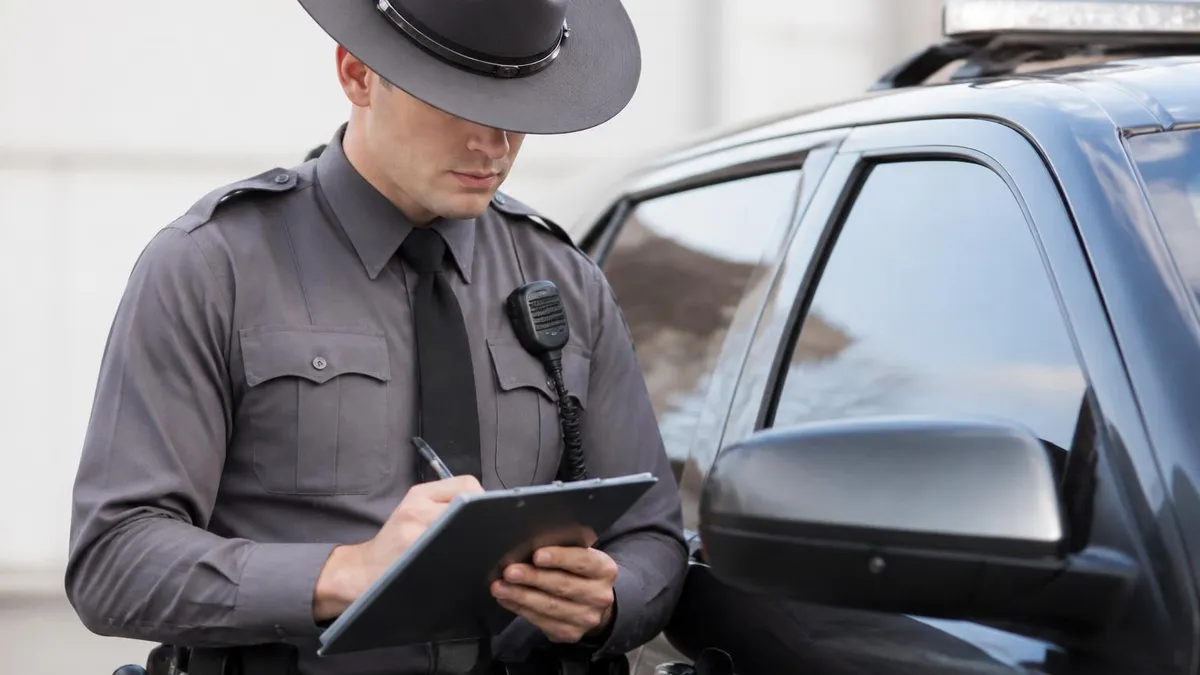
State Trooper Requirements: Age, Height & State Rules 2026

Florida State Trooper Salary 2026: Pay, Benefits, and Career Path

State Trooper Application: Complete Step-by-Step Guide for 2026
About the Author

Educational Psychologist & Academic Test Preparation Expert
Columbia University Teachers CollegeDr. Lisa Patel holds a Doctorate in Education from Columbia University Teachers College and has spent 17 years researching standardized test design and academic assessment. She has developed preparation programs for SAT, ACT, GRE, LSAT, UCAT, and numerous professional licensing exams, helping students of all backgrounds achieve their target scores.
Join the Discussion
Connect with other students preparing for this exam. Share tips, ask questions, and get advice from people who have been there.
View discussion (3 replies)