
State Trooper Requirements: Age, Height & State Rules 2026 October
State trooper requirements explained: ❓ age, education, physical, polygraph, plus state-by-state rules for NJ, NY, TX, OK, AK, NC and FL.
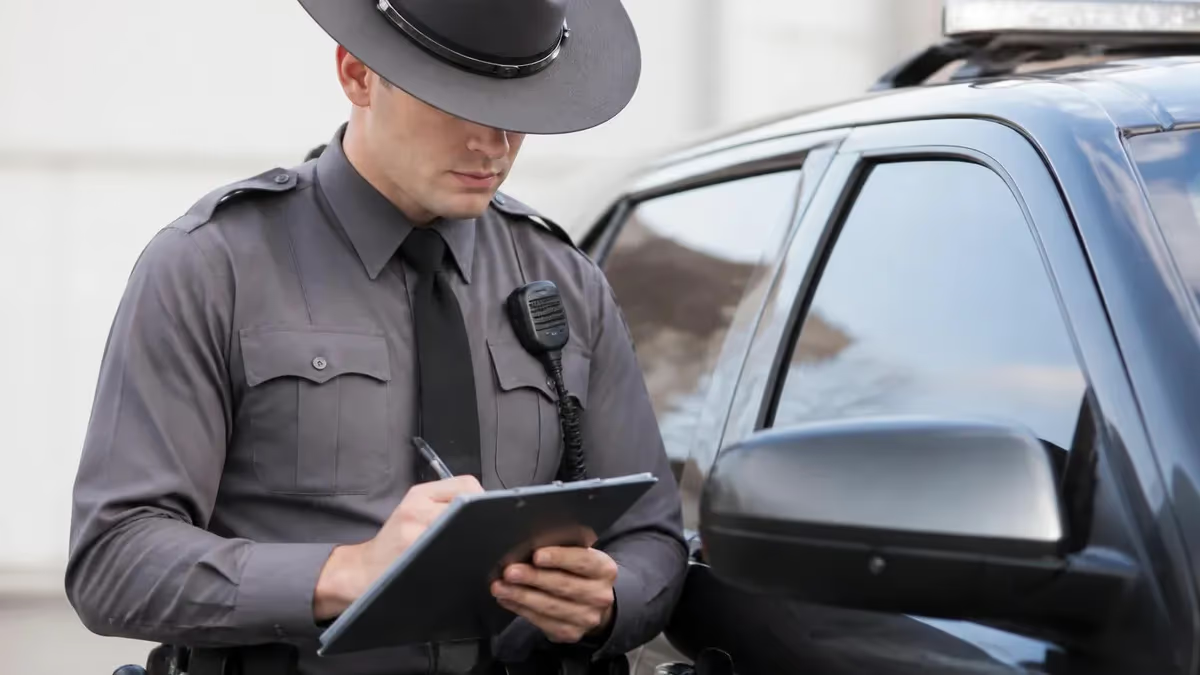
You want to wear the campaign hat. Patrol the interstate. Maybe one day work narcotics or aviation or the executive protection detail. Before any of that, you have to clear the gate — and the gate is a list of state trooper requirements that varies, sometimes wildly, from one state to the next. Florida will not ask you the same questions Alaska does. New Jersey runs a different physical from Texas. Oklahoma weighs your credit report a little harder than most.
The baseline is consistent though. Across almost every state agency you will need US citizenship, a clean criminal history, a valid driver's license, a high school diploma or equivalent, and a body that can pass a physical agility test designed by people who clearly hate burpees. From there it splits.
This guide pulls the common floor together first, then breaks out the seven states applicants ask about most: New Jersey, New York, Texas, Oklahoma, Alaska, North Carolina, and Florida. Each one has a quirk. Each one has a deal-breaker. Knowing them before you submit an application saves you the gut-punch of being disqualified six months in.
And one bit of straight talk up front. Recruiters will not lie to you, but they will not volunteer every wrinkle either. If you have a tattoo on your neck, an old marijuana possession charge, three speeding tickets in the last two years, or a credit score under 600, ask the question early. Pretending it will not matter is the most expensive mistake a candidate can make.

State Trooper Requirements at a Glance
Start with the floor. Every state police or highway patrol agency in the country expects the same handful of things from every candidate, regardless of which uniform they hand out at the end. Get these wrong and the rest does not matter.
You must be a US citizen. Permanent residents need not apply — this is the only consistent absolute in the whole system. A handful of agencies accept naturalised citizens with a minimum time since naturalisation, but the citizenship requirement itself never bends.
You must be at least 21 years old, in most states. Some let you apply at 20 and turn 21 before graduation from the academy. Texas and a couple of others quietly allow 18-year-olds in, but the trend has moved toward 21 because younger candidates wash out at higher rates. Maximum age is usually 35 or 37 at hire, though a growing list of states have removed that cap entirely to comply with federal age-discrimination guidance.
You need a high school diploma or GED. Increasingly, a two-year associate degree or 60 college credits is either required outright or counted as a meaningful tiebreaker. New Jersey raised the bar in 2009 to a four-year bachelor's degree for entry-level troopers — the only state with that hard ceiling, though Connecticut and Massachusetts come close in practice.
You need a valid driver's license, no DUIs within a window that varies (usually five years, sometimes ten, occasionally never), and a criminal history that is essentially clean. Felonies are absolute disqualifiers everywhere. Misdemeanours depend on the type, the recency, and how honestly you disclose them. Lying on the application is itself a disqualifier — recruiters have been doing this long enough to spot it.
Why most states dropped the rules
Fifty years ago, every state police agency had a minimum height — usually 5'8" or 5'9" — and a strict weight-for-height table. The Americans with Disabilities Act and a series of federal civil-rights cases in the 1970s and 1980s gutted those standards because they disproportionately excluded women and certain ethnic groups. Today the height requirement has been formally eliminated in almost every state. What replaced it is the physical agility test — a body-neutral way of measuring whether you can actually do the job. A 5'2" candidate who can clear the obstacle course in time passes; a 6'4" candidate who cannot keep up does not. Body composition, grip strength, sprint speed, and pull-up count matter. Height, for legal and practical reasons, no longer does.
The physical agility test is where the real screening happens. Every state runs its own version, but the components are remarkably consistent: a timed run (usually 1.5 miles in 13–15 minutes for males under 30, slightly longer for women and older candidates), push-ups to a minimum count, sit-ups in a minute, and often a grip-strength reading or vertical jump.
Texas DPS uses an obstacle course that mimics fence-climbs, vehicle extraction, and dummy drags — the kind of work an actual trooper might do on a bad day. New Jersey uses a similar scenario-based test plus a 300-metre sprint. Florida runs a 1.5-mile run, 30 push-ups, and 38 sit-ups for the entry standard; agility tests at the academy are tougher still.
The trap people fall into is assuming you can train for this once you get in. You cannot. Most states require you to pass the physical before you are invited to the academy, sometimes as part of the application itself, sometimes at a separate testing event. Show up unfit and you are sent home with a polite recommendation to come back in six months.
Practical advice: start training the day you decide to apply. The minimum standards are not designed to flatter; they are designed to find candidates who can already meet them. Six months of consistent strength and conditioning work is usually enough for someone in average shape. Twelve months is more realistic if you are starting from sedentary.
The medical exam runs alongside the physical. You will be checked for vision (typically 20/40 uncorrected, correctable to 20/20, with full colour vision — partial colour-blindness disqualifies in most states because of traffic-signal recognition), hearing (no significant loss in either ear), blood pressure, cardiovascular health, and a urinalysis for drugs.
Six Gates You Must Clear
Reading comprehension, situational judgement, basic math, and report writing. Pass cut typically 70 percent. Some states use the National Police Officer Selection Test (POST), others run a proprietary exam designed in-house by the agency.
Run, push-ups, sit-ups, often a dummy drag or obstacle course. Scored against age and gender norms in most states, against a single standard in a few. Show up unfit and the application ends here, no second chances offered.
Criminal history, credit report, driving record, employment history, social media review, and interviews with neighbours and former co-workers. The deepest dive most people will ever experience — expect six to ten weeks of investigators talking to people you have not seen in years.
Polygraph examines truthfulness on the application; psych eval (MMPI-2 or similar) screens for personality traits incompatible with policing. Both are pass/fail; failing either generally ends the process with no appeal.
Vision, hearing, blood pressure, cardiovascular, drug screen, and full physical workup. Disqualifying conditions include uncorrected vision worse than 20/100, certain types of colour blindness, and any condition that prevents safe firearm handling or vehicle operation.
Oral board interview with senior officers, conditional offer, then a residential academy lasting 22 to 28 weeks. Academy washout rates run 15 to 30 percent depending on the state; the first six weeks are by design the hardest.

Now to the states applicants ask about by name. The order below follows the search-volume of the questions people actually type. Each state has its own application portal, its own physical standard, and its own academy — treat what follows as a starting point, then go straight to the agency website before you submit anything.
One general note before the state breakdown. Every agency has its own preferred pathway in. The New Jersey State Police runs scheduled recruit classes; you cannot apply outside the open window. Texas DPS operates rolling admissions but only takes recruits when academy slots open. Florida Highway Patrol does both. Plan around the schedule the agency uses, not the schedule that would suit you.
And the timeline. From application to graduation usually runs 12 to 18 months. Six to nine months for the application, background, and pre-academy testing. Six to seven months at the academy itself. Then field training for another three to six months before you patrol solo. If you cannot commit to that long a runway with reduced (or zero) income, the time to know is now, not after you have quit your current job.
State-by-State Requirements
Minimum age 21 at appointment; maximum 35 (waivable for veterans with qualifying service). Four-year bachelor's degree required — the highest formal education floor of any US state police agency. US citizen, valid driver's license, NJ residency at appointment (not at application). The physical includes the standard run plus a 300m sprint and dummy drag. Background investigation is famously deep — expect investigators to interview your high-school teachers. Academy runs roughly 24 weeks at Sea Girt.
A few patterns emerge from the state spotlights worth pulling out. First, the formal education trend is upward. New Jersey already requires a bachelor's degree. Connecticut, Massachusetts, and Minnesota now strongly prefer one. Most other states accept HS or GED but quietly favour candidates with college credits at the oral-board stage. If you are 19 or 20 and weighing community college versus immediate application, the college route almost always pays off.
Second, the credit check matters more than candidates expect. Roughly a third of states formally include a credit report in the background investigation; almost all the rest pull one anyway for the discretionary portion. The logic is simple: financial pressure is one of the better predictors of corruption risk in policing.
You do not need a perfect score — investigators are looking for patterns of irresponsibility rather than a single bad month. Steady payment history matters more than the number itself. If your score is below 600 because of medical debt or a divorce, document the cause and be ready to talk about it.
Third, the tattoo policy. Twenty years ago, visible tattoos were a near-automatic disqualifier. Today most states allow them as long as they are not above the collar, on the hands (some states), or contain offensive imagery. Florida, Texas, and most western states are relaxed; New Jersey and a few northeastern agencies still require any visible tattoo to be covered while in uniform. If you have face, neck, or hand tattoos, check the specific policy before you spend six months training for the physical.
- Any felony conviction, anywhere, ever. No exceptions, no waivers in any US state agency. Sealed or expunged records still surface on the polygraph and the background investigation.
- DUI within five years (sometimes ten). One DUI more than ten years ago with no repeat is usually survivable; anything recent is almost always fatal to the application.
- Pattern of credit defaults. A single late payment will not end your candidacy; bankruptcy plus repossessions plus a collections history will. Repair before applying.
- Recent recreational drug use. Marijuana use within one to three years is disqualifying in most states even where the drug is now legal. Hard drugs are usually a permanent disqualifier with no time limit.
- Lying on the application or polygraph. Even disclosable items become disqualifying if you tried to hide them. Honesty is the test, not the content of the answer.
The written exam comes early in the process and screens out roughly half the applicant pool. Most states use either the National Police Officer Selection Test (POST), the FrontLine National exam, or a proprietary test built in-house. All of them cover the same four areas: reading comprehension, situational judgement, basic mathematics, and grammar or report writing.
Reading comprehension is the section that decides most outcomes. You will read short passages — usually a paragraph or two of dense policy text or witness statements — and answer questions about what they said, what they implied, and what an officer should reasonably conclude.
The trap is that the right answer is often the most boring and literal interpretation; candidates who like to read between the lines do worse than candidates who stick to what the text actually says. If you are not a regular reader, six weeks of daily reading practice meaningfully improves scores. Pick longer-form journalism (newspaper feature pieces, magazine essays) rather than novels or social media.
Situational judgement is where the test designers separate candidates who think like officers from candidates who think like civilians. You will be given a scenario — a domestic dispute, a traffic stop with an uncooperative driver, a child in danger — and asked to rank possible responses from best to worst.
There is no shortcut here. The "right" answers reflect both the policy of the agency and the temperament of an experienced officer, which is why agencies use scenarios drawn from their own actual incidents.
Basic math is exactly what it sounds like: percentages, simple algebra, unit conversions. Nothing exotic. The grammar and report-writing section asks you to identify and correct errors in sample reports. Both sections reward steady preparation; both punish overconfidence.

State Trooper Application Readiness Checklist
- ✓US citizenship documented — original birth certificate or naturalisation papers in hand
- ✓Driver's license clean for at least three years, no DUI within five years, ideally none ever
- ✓High school diploma or GED on file; college credits or degree gathered if pursuing competitive states
- ✓Criminal history reviewed by an attorney if you have any prior arrests, even dismissed ones
- ✓Credit report pulled and reviewed; any errors disputed and any pattern issues documented
- ✓Physical fitness baseline: 1.5-mile run under 13 minutes, 30+ push-ups, 40+ sit-ups consistently
- ✓Vision tested by a licensed optometrist; correctable to 20/20, full colour vision confirmed
- ✓Social media accounts cleaned of anything that would embarrass you in front of a recruiter
- ✓Honest list of every past job, every address since 18, every relationship of any length, for background packet
- ✓Twelve to eighteen months of savings or a working partner; the hiring pipeline is long and pays nothing until academy
The polygraph examination is where applications most often die. Not because candidates have something disqualifying in their past — many do not — but because they tried to hide something they should have just disclosed.
Polygraphs do not detect lies in the way television suggests. They detect physiological responses to questions the subject has elected to be evasive about. An honest disclosure of a fifteen-year-old drug experiment, on the pre-polygraph paperwork, is almost always survivable. The same admission, dragged out of you during the exam after a flagged response, ends the application.
The agency knows you are not perfect. The agency wants to know whether you will tell the truth when the truth is uncomfortable. That is the entire test.
Psychological evaluation runs in parallel and uses standardised instruments — usually the MMPI-2 or a similar inventory — plus a structured interview with a licensed psychologist. The screen is not for psychiatric illness in the clinical sense; it is for personality traits that correlate with bad policing outcomes: extreme aggression, social withdrawal, rigidity in decision-making, low frustration tolerance.
You cannot study for it. You can prepare by being honest in your answers, taking your time on questions that seem to repeat themselves (they repeat for a reason), and not trying to game the test. Psychologists who do these for a living can spot a candidate trying to present an idealised version of themselves inside the first ten minutes.
If the psych eval flags issues, some states allow a second opinion with a different evaluator. Most do not. The result is final and not subject to appeal in almost every jurisdiction.
Becoming a State Trooper: The Honest Trade-Off
- +Stable government employment with full pension after 20 to 25 years of service
- +Salary starts around $50,000–$70,000 with benefits; senior troopers and detectives earn $90,000+
- +Specialised assignments available after probation: aviation, narcotics, executive protection, K-9, accident reconstruction
- +Strong union representation in most states, with negotiated overtime, healthcare, and disability protection
- +Genuine variety in daily work; rarely two identical shifts in a calendar month
- +Path to federal law enforcement (FBI, DEA, ATF) after several years of trooper experience
- −Shift work including nights, weekends, and holidays; promotion does not eliminate it for years
- −Physical and psychological toll is real — divorce, alcohol abuse, and PTSD rates run above population norms
- −Pay is modest for the risk profile, especially in the early years
- −Relocation may be required — many state agencies post new troopers wherever they need bodies
- −Background scrutiny continues throughout your career; off-duty conduct is monitored
- −Public hostility toward law enforcement in some communities is part of the job and shapes the daily experience
Pros and Cons at a Glance
| Pros | Cons |
|---|---|
| Strong union representation in most states, with negotiated overtime, healthcare, and disability protection | Shift work including nights, weekends, and holidays; promotion does not eliminate it for years |
| Genuine variety in daily work; rarely two identical shifts in a calendar month | Physical and psychological toll is real — divorce, alcohol abuse, and PTSD rates run above population norms |
| Path to federal law enforcement (FBI, DEA, ATF) after several years of trooper experience | Pay is modest for the risk profile, especially in the early years |
So where does this leave you. If you have read this far and the requirements still feel reasonable, the next step is not yet the application. The next step is to pick the one or two states you would actually move to, then go to those agency websites and read the candidate guide cover to cover. Print it. Highlight the disqualifiers. Compare against your own history line by line.
If anything is borderline — a misdemeanour from a decade ago, a recent ticket, an old credit problem — call the recruiter and ask before you spend six months training. Recruiters are paid to fill classes; they will tell you the truth about your specific situation when you ask directly. Surprise nobody, get caught off guard by nothing.
Then begin the physical training. Six months minimum, twelve months ideal. Run three times a week, lift two or three times a week, work on body composition if you need to. The candidates who pass the physical on the first attempt are the candidates who treated it like a job for half a year before they ever showed up.
One last thing worth saying out loud. The career is not for everyone, and the people who flourish in it tend to share a small number of traits regardless of the state they patrol. They are comfortable making consequential decisions on short notice. They handle stress without needing to talk about it constantly. They have a strong inner read on whether a situation is escalating or de-escalating. They are patient with paperwork.
None of that is on the application. None of it is on the physical. It shows up at the academy, in field training, and in your first solo patrol shift. The candidates who realise on day one of the academy that they do not actually want this work — and there are always some — cost themselves nothing more than time. Better to know before you give notice at your current job.
If, on the other hand, the work calls to you, the requirements are clearable. The standards are real but not magical. People with ordinary backgrounds and average athletic ability pass them every year, in every state, in every academy class. They prepare. They are honest. They keep showing up.
That is the entire formula. The rest is paperwork.
For candidates who want to test their readiness for the written exam before they apply, our state trooper practice tests cover the same four areas the real exam tests — reading, situational judgement, math, and grammar — with timed conditions and the same answer style. Start there, see where you score, and use the gaps to focus your final weeks of study.
And one note on appeals. If you are disqualified at any point in the process — written test, physical, background, polygraph, psych — ask whether re-application is allowed and on what timeline. Most states allow it after a waiting period of six to twenty-four months. Some disqualifications are permanent (felony, deception on the polygraph, certain medical findings); most are not.
A failed first attempt is not the end of the road unless you make it one. Candidates who fail the physical on the first try and pass on the second often turn out to be the strongest troopers because they had to want it more.
For a deeper look at this topic, see our guide to state trooper requirements.
Sample State Trooper Practice Questions
Try these questions from our free State Trooper practice tests. The correct answer and an explanation follow each question.
A state trooper observes a vehicle weaving between lanes on the highway. The most appropriate initial action is to:
- A. Immediately initiate a traffic stop with lights and siren
- B. Follow at a safe distance and continue to observe the driving behavior
- C. Radio dispatch and request a K-9 unit before stopping
- D. Block the vehicle using a PIT maneuver
Answer: B. Follow at a safe distance and continue to observe the driving behavior
Troopers should observe and document erratic driving behavior before initiating a stop to build probable cause and assess safety.
A trooper discovers a suspect vehicle abandoned in a wooded area. Before approaching, the trooper should:
- A. Immediately enter the vehicle to look for the driver
- B. Establish a perimeter, request backup, and treat the vehicle as potentially occupied
- C. Call for a tow truck and document the VIN from a safe distance without backup
- D. Announce their presence over the patrol vehicle's PA system from close range
Answer: B. Establish a perimeter, request backup, and treat the vehicle as potentially occupied
An abandoned suspect vehicle should be treated as occupied until confirmed otherwise; perimeter and backup protect against ambush.
A driver presents an out-of-state license during a stop. The trooper should:
- A. Refuse to accept it and require a local ID
- B. Run the out-of-state license through NCIC/NLETS
- C. Immediately summon the driver's home state authorities
- D. Accept it without verification since it is foreign
Answer: B. Run the out-of-state license through NCIC/NLETS
NCIC and NLETS allow troopers to verify out-of-state and foreign licenses and check for outstanding warrants.
During a foot pursuit, a trooper loses sight of the suspect in a residential neighborhood. The trooper should:
- A. Continue running in the direction the suspect was last seen
- B. Stop, broadcast the suspect's description and last known location, and set up a containment perimeter
- C. Search every yard alone until the suspect is found
- D. Return to the patrol vehicle and resume normal patrol
Answer: B. Stop, broadcast the suspect's description and last known location, and set up a containment perimeter
Broadcasting the description and establishing a perimeter uses available resources effectively while avoiding the dangers of solo searching.
State Trooper Questions and Answers
About the Author

Educational Psychologist & Academic Test Preparation Expert
Columbia University Teachers CollegeDr. Lisa Patel holds a Doctorate in Education from Columbia University Teachers College and has spent 17 years researching standardized test design and academic assessment. She has developed preparation programs for SAT, ACT, GRE, LSAT, UCAT, and numerous professional licensing exams, helping students of all backgrounds achieve their target scores.
Join the Discussion
Connect with other students preparing for this exam. Share tips, ask questions, and get advice from people who have been there.
View discussion (3 replies)