
State Trooper Hat: Stetson Style, History, and Why Troopers Wear It 2026 October
State trooper hat guide: 🗨️ the campaign-style Stetson, history, chin strap, tilt, state variations, and why troopers must wear it on duty.
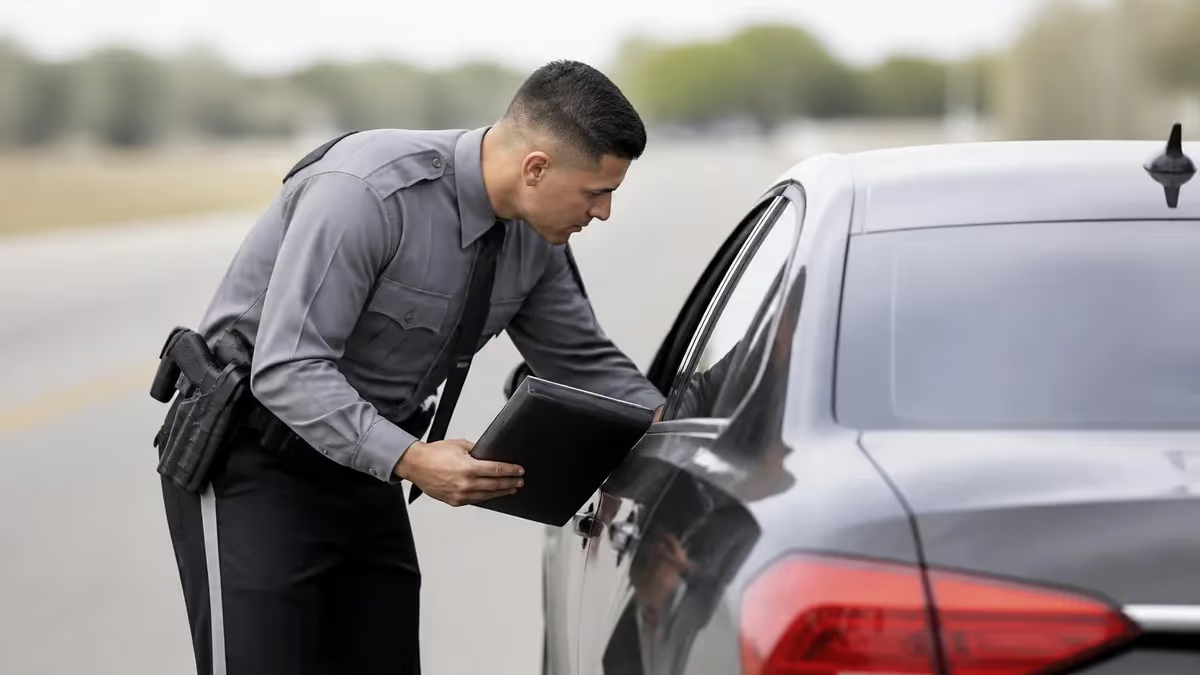
The state trooper hat is one of the most recognizable pieces of American law-enforcement uniform. That wide, flat brim. The high, four-pinch crown. The leather chin strap that rides just under the lip. You see it from two blocks away, and you know — that's a trooper.
It isn't just decoration. The hat carries history, regulation, and a working purpose. Most state police agencies still require it on uniformed patrol, traffic stops, ceremonies, and court appearances. Drop the hat, and you drop a layer of authority that took the agency a century to build.
This guide walks through everything candidates and curious readers ask about the trooper hat: the exact name, the classic Stetson story, state-by-state variations, why some troopers tilt it, and what the rules actually say about wearing it. If you're prepping for a state police hiring board, knowing this stuff also helps — recruiters love candidates who already understand the uniform culture.
State Trooper Hat by the Numbers

What Is the State Trooper Hat Actually Called?
The proper name is the campaign hat. Some call it a Montana Peak, some call it a "smokey" — that one comes from Smokey Bear, who wears the same style. Inside trooper culture, you'll hear it called a "lid," a "cover," or simply "the hat." All correct. All the same piece of gear.
The signature shape is a stiff, flat brim sitting horizontal to the ground, with a tall crown pinched at four corners — that's the Montana Peak or Montana Pinch. Drill instructors at boot camp wear the same hat. So do Royal Canadian Mounted Police. So do U.S. Park Rangers. The look is intentional: tall, sharp, all-business.
Why "Stetson"?
John B. Stetson built his hat company in Philadelphia in 1865. His "Boss of the Plains" was made for cowboys, but the wide brim and durability made it perfect for outdoor police work too. State police agencies adopted the campaign style in the early 1900s, and Stetson became the default supplier. Today the brand is still common — but agencies also buy from Akubra, Bailey, and Major as long as the spec matches. So every trooper hat is a "campaign hat," but not every campaign hat is a real Stetson.
Campaign hat — the official term used in uniform manuals.
Stetson — the brand most often associated with the style; sometimes used as a generic term.
Smokey / Smokey Bear hat — slang, after the wildfire-prevention mascot.
Montana Peak — the four-pinch crown shape.
A Short History of the Trooper Hat
The campaign hat earned its name in the U.S. military during the Spanish-American War. Soldiers needed a wide-brim hat that shed rain and shaded the eyes — a "campaign" hat for field campaigns. The Army formalized it in 1911, with the four-corner Montana Peak crease.
State police agencies, which were largely formed in the same era, borrowed the look. Pennsylvania created the first modern state police force in 1905. New York followed in 1917. Massachusetts in 1921. By the late 1920s, the campaign hat was the standard. It signaled discipline. It signaled the military lineage these agencies wanted to project.
That look has barely changed in 100 years. Some agencies tweaked the band color, added a state seal, or shifted from felt to a straw summer version. The silhouette stayed identical. That continuity is part of why the hat reads as authority — it's one of the few uniform pieces in modern law enforcement that hasn't been redesigned every decade.
There were a few moments when agencies experimented. In the 1980s and 1990s, several state forces tested baseball-style caps for "modern" patrol looks. Highway Patrol units in two or three states even dropped the campaign hat for a brief stretch. It didn't stick. By the early 2000s, every one of those agencies had quietly brought the campaign hat back. The public response — and the troopers' own pride — pushed the return. Some senior commanders, asked about it later, said the same thing: when you take the hat away, you take part of the trooper identity with it.
Anatomy of the Trooper Hat
The tall top section, pinched into four corners (Montana Peak). Usually 4 to 5 inches high.
Flat and stiff, typically 3.5 to 4 inches wide. Holds its shape in rain — that's the design.
A ribbon or leather strip around the base of the crown. Color often signals rank.
Leather strap worn under the lower lip — not under the chin. Keeps the hat secure on windy traffic stops.
Inside leather sweatband and silk or cotton liner. Where the trooper's name is often written.
Some states add a small metal badge or state seal to the front of the crown.

Felt or Straw? Winter vs Summer Hats
Most state police agencies issue two versions of the campaign hat. The winter version is felt — usually wool or fur felt — in dark colors like navy, black, gray, or olive depending on the agency. The summer version is straw, woven from milan or rush, lighter on the head, and shaped to the same dimensions.
The switchover dates are written into uniform regs. New York State Police, for example, traditionally switches between felt and straw on set dates each spring and fall. Pennsylvania, Michigan, and many other agencies follow similar calendar rules. Wear the wrong one outside the window and you'll get a quiet word from a sergeant.
Who Pays for It?
The first hat is almost always issued at the academy. Replacement hats are usually a mix: the agency provides a uniform allowance, and the trooper picks up the difference. Quality matters. A cheap campaign hat sags after one rainy shift. A real Stetson holds shape for years.
State-by-State Hat Variations
The New York state trooper hat is a dark gray felt campaign hat with a thin black band and the state seal on the front. NY troopers are famous for their sharp uniform presentation, and the hat is part of why. Straw version is worn from spring through fall.
Why Do State Troopers Wear the Hat?
Three reasons, in order of how often they're cited inside academies.
1. Authority and identity. The campaign hat is unique to state police and a few federal agencies. It separates troopers from city police, sheriffs, and security guards at a glance. On a dark highway shoulder, the silhouette matters — drivers recognize a trooper from inside their car.
2. Function. Wide brim sheds rain off the face and away from the eyes. Shades the sun during traffic enforcement. Protects the back of the neck. Keeps water from running down the collar onto the body armor. Old design, but it works.
3. Discipline and tradition. Putting the hat on is a small ritual. It says the trooper is on duty, in public, and representing the agency. Agencies that ditched the campaign hat for ball caps in the 1990s mostly brought it back, because it changed how the public read their officers.
Does a State Trooper Have to Wear the Hat?
Mostly yes. Uniform regulations at most state agencies require the campaign hat any time the trooper is out of the vehicle in uniform — traffic stops, foot patrol, court appearances, public events. Inside the cruiser, the hat usually rides on the passenger seat or hangs on a hook behind the driver. There are exceptions: tactical situations, K-9 work, motorcycle units, and certain plainclothes assignments. But for road troopers, the hat goes on with the boots.

One of the most common mistakes you'll see in movies and TV: the strap drawn tight under the chin. Wrong. On a campaign hat, the leather strap rides under the lower lip, not under the jaw. That's the historic cavalry style, and every state police academy still teaches it. New recruits get corrected on it within the first week.
The Tilt: Why Some Troopers Wear It Forward
Look at photos of state troopers and you'll see something consistent — the hat sits low and slightly forward, often down to the eyebrows. There's a reason. The forward tilt:
- Forces the trooper to lift the chin and make eye contact at distance, which projects confidence.
- Shadows the eyes — useful at traffic stops where you want to read the driver without being read back.
- Looks sharp on parade, where uniformity is everything.
Some academies actually teach the tilt as part of the dress standard. The hat should sit roughly two finger-widths above the eyebrows in front, with the brim cutting a clean horizontal line. New troopers spend weeks getting it right.
Mustaches, Haircuts, and the Whole Trooper Look
The hat is one piece. Agencies tend to keep the rest of the look just as tight. Hair is short on the sides and back, flat or low fade on top. Mustaches are allowed at most state agencies, though they must be neatly trimmed and not extend past the corner of the mouth. Beards are usually prohibited except for medical or religious accommodation. The total package — hat, hair, mustache, uniform, boots — is meant to read as squared away from across a parking lot.
Trooper Hat Care: 7-Point Maintenance Checklist
- ✓Hang the hat on a peg or store on a wide-brim hat rack, never crown-down on a flat surface.
- ✓Brush felt hats with a soft-bristle hat brush, always counter-clockwise.
- ✓Let wet hats air-dry crown-up at room temperature — never near a heater.
- ✓Steam minor dents back into shape using a kettle and gentle pressure.
- ✓Polish the leather chin strap with neutral shoe wax every few weeks.
- ✓Replace the sweatband when it cracks; it's usually field-replaceable.
- ✓Carry the hat in a hard-shell hat carrier when off-duty or traveling.
Buying a State Trooper Hat (Civilian and Collector Notes)
Real issued trooper hats are not sold to the public. Agencies treat them as restricted uniform items, and the cap badge or hat band can be considered restricted insignia. That said, you can buy a generic Stetson Campaign style — same shape, no agency insignia — from Stetson, Major Uniform, or specialty retailers. Expect to pay $200 to $400 for a felt version and around $150 for the straw summer version.
Collectors look for vintage agency-marked hats, but selling or buying one with the original badge intact can be a legal gray zone in some states because of impersonation laws. The safest collectible is a hat with the agency insignia removed. If you collect police memorabilia and you're uncertain whether a hat is legal to own in your state, contact the state agency directly — most have a public information officer who can clarify the rules in writing.
Common Sizes and Fit
Campaign hats are sold in standard hat sizes (6 7/8 through 7 5/8 covers most adults). Fit should be snug but not tight — tight hats cause headaches on long shifts. A proper hat sits flat on the head, not pinching the temples, with the brim level. Most retailers will steam-fit the hat to your head shape. Long-shift troopers often request a slightly larger size than their measured head, because the felt softens over time and a too-tight hat becomes unwearable by hour eight.
What About Texas State Troopers?
Texas is the outlier. The Texas DPS issues a true western Stetson cowboy hat — cattleman's crease, curled brim, tan or white felt — not a campaign hat. The design pays tribute to the Texas Rangers, who have worn similar hats since the late 1800s.
Texas troopers are arguably the only state police force in the country whose hat reads more "ranger" than "trooper." The Texas state trooper hat is iconic in its own right and shows up in films, country music videos, and tourist photos across the state. The shape is different from a New York or Pennsylvania campaign hat, but the cultural function is the same: instant identification of state police authority.
What This Means for Future Troopers
If you're reading this because you're thinking about applying to a state police agency, here's the practical takeaway. The hat — and everything around it — signals what your day-to-day uniform life will look like. Pressed shirts. Polished boots. Inspection-ready cover. Some applicants love that culture. Others realize it isn't for them. Better to know now.
Academy training will cover uniform wear in detail in week one. You'll be issued a campaign hat, taught the chin strap rule, and inspected daily. Showing up already familiar with the gear — knowing the difference between felt and straw, knowing where the strap goes — is the kind of small thing that makes a good first impression on the drill instructors.
The written exam, of course, is the bigger hurdle. Most state police hiring tests cover reading comprehension, grammar, reasoning, situational judgment, and basic math. The state trooper exam 2026 study materials walk through every section, and the linked complete study guide goes deeper on the topics agencies test most often. Combined with the career and salary guide, you'll have a clear picture of what the job pays, what it asks, and what the path looks like.
Common Hat Questions From Applicants
Recruiters hear the same hat questions over and over from applicants. Yes, you do have to wear it on patrol. Yes, the chin strap really does sit under the lip. No, you can't customize the band — the agency dictates the spec. Yes, female troopers wear the same campaign hat as male troopers; there is no gender-specific version at any state agency. And yes, turbans and other religious headwear have been accommodated by a growing number of agencies, with the cap badge transferred onto the religious head covering.
Another common question — does the hat come off when you're running? Yes. Foot pursuits, fight situations, and any emergency where the hat would be a liability are clear exceptions. Most troopers wear a thin elastic cord under the crown to keep the hat secure during quick movements, but in a real chase the hat goes on the cruiser seat and stays there until the situation is back under control.
Trooper Hat Etiquette: When It Comes On and Off
Inside agency uniform manuals there are specific rules about when the hat is worn and when it isn't. Standard practice across most state police agencies looks like this: hat on when out of the cruiser in public; hat off when entering a private residence, a courtroom (unless testifying in formal uniform), a place of worship, or any indoor setting outside the agency's own buildings.
In the cruiser, hat off and placed crown-up on the passenger seat or in a hat rack behind the headrest. At funerals and memorials, the hat is held in the left hand against the chest during prayers, then placed back on for the salute.
These details get drilled into recruits at the academy and become second nature within a few months on the road. Veteran troopers can shift from hat-on patrol stance to hat-off interview stance without thinking about it — the muscle memory is that strong.
The Bottom Line
The state trooper hat is more than a hat. It's a 100-year piece of American police uniform that signals authority, discipline, and tradition the second a driver spots it in the rearview mirror. The shape is the Montana Peak campaign style. The brand is most often Stetson. The chin strap sits under the lip. The brim is flat. The tilt is forward. And under the felt, a trooper who knows their uniform and their job.
For candidates working toward a state police badge, the hat is the final reward of academy graduation. By then, you'll have earned every inch of it.
The Campaign Hat: Working Pros and Cons
- +Instantly identifies a state trooper at a distance
- +Wide brim sheds rain and shades the eyes
- +Tradition that links modern agencies to 100+ years of state police history
- +Projects authority and discipline at traffic stops
- +Holds shape for years if cared for properly
- −Felt versions are hot in summer climates
- −Easy to knock off in physical altercations
- −Replacement cost can run $200 to $400 out-of-pocket
- −Requires care and inspection-ready maintenance
- −Not practical for tactical, K-9, or motorcycle assignments
Pros and Cons at a Glance
| Pros | Cons |
|---|---|
| Instantly identifies a state trooper at a distance | Felt versions are hot in summer climates |
| Wide brim sheds rain and shades the eyes | Easy to knock off in physical altercations |
| Projects authority and discipline at traffic stops | Requires care and inspection-ready maintenance |
Sample State Trooper Practice Questions
Try these questions from our free State Trooper practice tests. The correct answer and an explanation follow each question.
A State Trooper initiates a traffic stop based on 'Reasonable Suspicion.' What does this standard legally permit the trooper to do?
- A. Arrest the driver and search the entire vehicle.
- B. Conduct a full search of the driver's person and belongings.
- C. Issue a traffic citation without any further investigation.
- D. Briefly detain the driver and conduct a limited investigation, including a pat-down for weapons if there's a safety concern.
Answer: D. Briefly detain the driver and conduct a limited investigation, including a pat-down for weapons if there's a safety concern.
Reasonable suspicion is a legal standard that allows law enforcement to briefly stop and detain a person for investigative purposes if they have specific, articulable facts suggesting criminal activity is afoot. It justifies a temporary stop and limited investigation, such as a 'Terry frisk' or pat-down for weapons if the officer reasonably believes the person is armed and dangerous, but it does not automatically provide grounds for a full search or an arrest.
A regulation states: 'Troopers shall not make public statements about ongoing investigations without prior authorization from the Public Affairs Office.' A reporter asks a trooper at a crime scene for details about suspects. The trooper should:
- A. Share general details to maintain community trust
- B. Decline to comment and refer the reporter to Public Affairs
- C. Confirm or deny details already reported by other media
- D. Answer only questions unrelated to suspects
Answer: B. Decline to comment and refer the reporter to Public Affairs
The regulation prohibits public statements about ongoing investigations without authorization, so the trooper must decline and refer the reporter appropriately.
A memo states: 'All troopers working overtime on holidays will receive time-and-a-half pay. Troopers who volunteer for holiday overtime will also receive a meal allowance.' A trooper is ordered (not volunteered) to work a holiday. What compensation applies?
- A. Regular pay only
- B. Time-and-a-half pay only
- C. Time-and-a-half pay plus a meal allowance
- D. Meal allowance only
Answer: B. Time-and-a-half pay only
The meal allowance is only for volunteers; ordered overtime on a holiday qualifies only for time-and-a-half pay.
A state trooper observes a suspect fleeing from a convenience store with merchandise. Under what circumstances can the trooper use deadly force?
- A. When the suspect poses an imminent threat of serious bodily harm to others
- B. Whenever the suspect refuses to stop running
- C. Only after verbal warnings have been issued three times
- D. Only if the stolen merchandise exceeds $500 in value
Answer: A. When the suspect poses an imminent threat of serious bodily harm to others
Under Tennessee v. Garner, deadly force is justified only when the suspect poses a significant threat of death or serious physical injury.
State Trooper Questions and Answers
About the Author

Educational Psychologist & Academic Test Preparation Expert
Columbia University Teachers CollegeDr. Lisa Patel holds a Doctorate in Education from Columbia University Teachers College and has spent 17 years researching standardized test design and academic assessment. She has developed preparation programs for SAT, ACT, GRE, LSAT, UCAT, and numerous professional licensing exams, helping students of all backgrounds achieve their target scores.
Join the Discussion
Connect with other students preparing for this exam. Share tips, ask questions, and get advice from people who have been there.
View discussion (3 replies)