
Trooper Vehicles by State: Patrol Fleets and Famous Cars 2026 October
State trooper vehicles by state: Dodge Charger, Ford Interceptor Utility, Chevy Tahoe PPV, plus the FL Corvette, AL Javelin, and NY history. 💡
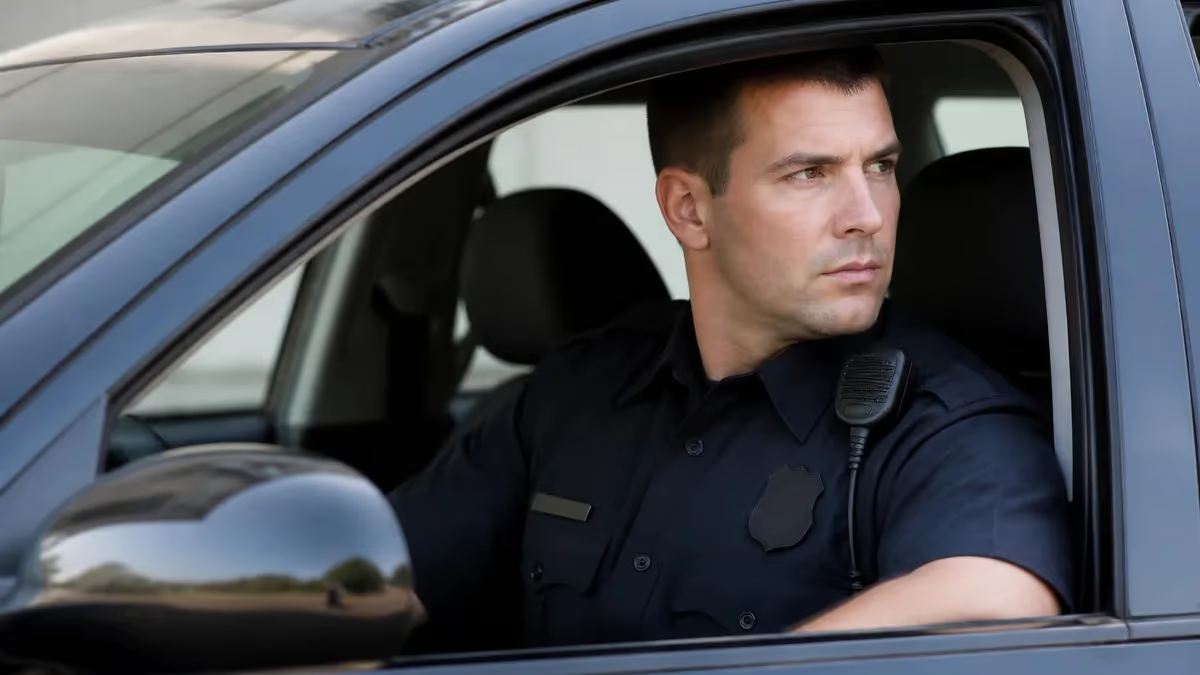
Pull up alongside a dusty rest stop on I-10 in Texas and the trooper next to the pumps is probably leaning on a white Ford Police Interceptor Utility with a black wrap across the hood. Drive north on the Florida Turnpike and the cruiser that just passed you doing 95 might be a Chevy Tahoe PPV, but if it was bright yellow with a blue trooper stripe and looked like a missile, that was the Florida Highway Patrol Corvette.
Each state runs its own fleet, picks its own colors, and protects its own traditions. The result is one of the more interesting sub-cultures inside American policing — a rolling museum of pursuit cars, decommissioned muscle, and surplus utility vehicles, all wearing different livery.
This guide is the full state-by-state breakdown. What state trooper vehicles actually look like in 2026, which workhorse models almost every agency runs, which states keep one or two ceremonial showpieces in the fleet, and what the historic Crown Vic era looked like before it ended. If you have ever wondered why the Alabama State Trooper still occasionally rolls out an AMC Javelin at parades, or why Florida picked a Corvette instead of another Charger for its anti-aggressive-driving program, the answers are below.
Worth saying up front — the term "state trooper vehicles" covers a wide range. Most agencies run a primary patrol sedan or SUV, a secondary supervisor unit, special-use vehicles for K-9 handlers and motor units, undercover interdiction cars on the interstate, and surplus museum pieces kept around for community events. The fleet that pulls you over for speeding is rarely the same fleet that appears on a recruitment poster. We will cover both. The marked patrol cars you see every day, and the famous one-off cars that became state-police pop culture.
The big shift in the last ten years has been the death of the Ford Crown Victoria Police Interceptor. Ford ended production in 2011. The last working Crown Vics rolled out of agency fleets between 2018 and 2022. The replacements split three ways. State troopers by state who picked the rear-drive sedan path went to the Dodge Charger Pursuit.
Agencies that wanted AWD and a higher seating position went to the Ford Police Interceptor Utility (the police version of the Explorer). And a smaller group picked the Chevy Tahoe PPV for its towing capacity and rear cargo room. Almost every state runs at least two of the three.

The Ford Police Interceptor Utility is the most-used state trooper vehicle in America right now. Built on the Explorer chassis, hybrid V6 standard, AWD, roughly 285 horsepower in standard trim and 400 hp in the optional 3.0L EcoBoost. The reason every agency from California Highway Patrol to North Carolina State Highway Patrol has moved this direction is simple.
The SUV body holds more equipment, sits higher so the trooper can see over traffic on rural interstates, handles ice and snow without drama, and the hybrid trim cut fuel costs about 41% versus the old V8 Crown Vic. It is not as fast as a Charger Pursuit in a straight line, but on a long-shift basis, it has won the procurement battles state after state.
The Dodge Charger Pursuit is the other dominant model. Rear-drive standard, AWD optional, 5.7L Hemi V8 producing 370 hp in the most common Pursuit trim. Top speed governed at 150 mph for the V8 model. Texas DPS, Georgia State Patrol, Indiana State Police, Arkansas State Police, and several others run Chargers as their primary highway-patrol unit.
The car has an enormous trunk for radar gear and prisoner-transport partitions, a wide rear seat for backseat passengers in cuffs, and the kind of presence that ends a lot of pursuits before they start. Dodge has confirmed the Charger Pursuit will continue through the 2025 model year despite the consumer Charger nameplate moving to electric.
And then the Chevrolet Tahoe PPV. The Police Pursuit Vehicle version of the full-size SUV. 5.3L V8, 355 hp, RWD or 4WD. Massive interior, towing capacity over 8,000 pounds, the kind of fleet vehicle a sergeant takes when he or she needs to haul gear to a long manhunt or pull a department trailer to a public-safety event.
New York State Police, Michigan State Police, and Virginia State Police use Tahoes heavily for supervisor units. The Chevy Silverado SSV (Special Service Vehicle) shows up in pickup trucks roles — Texas DPS uses Silverados for border-zone patrols where the ride needs to handle dirt roads.
The Three Workhorse Models in 2026
Ford Police Interceptor Utility — AWD SUV on the Explorer platform, hybrid V6 standard or 3.0L EcoBoost optional. Now the single most-used trooper vehicle in America. Dodge Charger Pursuit — rear-drive sedan with the 5.7L Hemi V8, 370 hp, 150 mph governed top speed. The classic interstate pursuit car, especially common in Texas, Georgia, Indiana, Arkansas, and the Carolinas. Chevrolet Tahoe PPV — full-size SUV, 5.3L V8, picked for supervisor roles, gear-hauling, and snow states like Michigan and New York. Most state agencies run a mix of all three rather than picking just one — the Ford SUV for daily patrol, the Charger for highway interdiction, the Tahoe for sergeants and special details.
Outside the big three there is a long tail of specialty vehicles. The Chrysler 300 served as a supervisor sedan in several states through the 2010s and early 2020s — California Highway Patrol used the 300 for unmarked traffic enforcement, and a number of state agencies kept a small number for executive transport.
Production ended in 2023 so the 300 is being phased out, but it will appear in fleet photos for several more years. The Ford Police Interceptor Sedan (the Taurus-based sedan) was the bridge model between the Crown Vic and the Utility — it sold poorly with state agencies because the Utility offered a better package, and Ford ended sedan production in 2019.
Motor units — the trooper on two wheels — almost universally run Harley-Davidson Electra Glide or Road King Police models, with BMW R 1250 RT-P used by a few coastal agencies. Florida Highway Patrol, California Highway Patrol, and Texas DPS all maintain motorcycle traffic-enforcement units. The bikes are not just for show — they get into traffic gridlock the cruisers cannot, and they work major-event security where a four-wheel unit cannot fit.
K-9 units use the same Tahoe PPV or PI Utility chassis but with a modified rear compartment. The back seat is removed, the floor is reinforced, and a climate-controlled K-9 box with rear-window release is installed. The Tahoe is the more common K-9 vehicle because the larger interior gives the dog room to stand up and turn around on long shifts.
Interdiction units — troopers working the interstate looking for drug couriers — often run unmarked Chargers in colors that look like rental cars. White, gray, or silver Chargers with no light bar, no police antenna, federal-style government plates. They run radar and lidar from the passenger seat and only show their lights once a stop is initiated.
The car you actually see on the highway. Ford Police Interceptor Utility or Dodge Charger Pursuit in most states, full marked livery, dual light bar, push bar, rifle rack in the cabin.
Chevy Tahoe PPV or Ford Expedition. More room for incident command equipment and meetings on scene. Often unmarked or with low-profile livery.
Unmarked Chargers or Tahoes for highway interdiction work. K-9 units use Tahoes or PI Utilities with the rear seat removed and climate-controlled dog compartments installed.
Each state keeps one or two showpieces. Florida had the Corvette. Alabama keeps a restored AMC Javelin. New York preserves Crown Vics for parades. These cars are why state troopers have such a strong identity.

The state-by-state breakdown is where this gets interesting. Each agency has its own livery rules, its own primary vehicle picks, and almost always one or two famous cars that show up in recruiting materials. We will walk through nine of the most-asked-about states. Texas DPS, Florida Highway Patrol, Georgia State Patrol, New York State Police, Alabama State Troopers, Virginia State Police, Alaska State Troopers, Arkansas State Police, Illinois State Police, and Indiana State Police.
The tabs below cover the daily fleet for each. The famous-car write-ups follow afterward. If you only want to know what the trooper that just pulled you over is driving, scan the tabs. If you want the deeper story of the Corvettes and Javelins and Crown Vics, keep scrolling.
One thing worth saying about livery. Texas DPS troopers run a white-on-black two-tone with the gold star on the door — that color scheme has not changed in decades. Florida Highway Patrol uses the famous tan-and-black with the bright yellow trooper stripe on the rear quarter panel. Georgia runs gray on dark blue. New York is purple and gold (technically "royal purple" but it looks dark in most light). Alabama runs the classic gray-on-black trooper livery. Each color set is recognizable from a mile back on the highway, which is part of the design — visible deterrence works.
Texas state trooper vehicles — the Texas Department of Public Safety runs one of the largest highway-patrol fleets in the US. Primary patrol cars are Dodge Charger Pursuits in white over black two-tone with the gold five-point star on the door. The fleet also includes Ford Police Interceptor Utilities for trooper units in metro divisions and Chevy Silverado SSVs for border-zone work along the Rio Grande. Texas DPS uses dark-tinted unmarked Charger Pursuits for highway interdiction along I-10, I-20, and I-35. The agency's K-9 program runs Tahoe PPVs. Total fleet is well over 4,000 vehicles statewide across all divisions.
The Florida Highway Patrol Corvette story is worth a separate paragraph because it became the most-photographed state police program of the 2010s. FHP did not buy the Corvettes new. The cars came from civil asset forfeiture — drug-trafficking cases where the courts awarded the seized vehicles to the agency. The first batch was a 2008 Corvette Z06 used in the Aggressive Driving Enforcement Program.
That car got the standard FHP livery — tan over black with the yellow trooper stripe — and put 100,000+ miles on Florida's interstate system. FHP then added several C6 and C7 Corvettes through the early 2020s. None were used as primary pursuit vehicles. They served as high-visibility deterrent units that traveled to schools, community events, and special enforcement weekends on I-95 and I-75. The last seized Corvette aged out in 2024.
The Alabama AMC Javelin story is the older legend. In 1971 and 1972, Alabama State Troopers became one of the few agencies in America to run AMC Javelin pony cars as primary patrol vehicles. Alabama bought roughly 132 Javelins in the early 1970s, equipped them with the 401 V8, and ran them on interstate enforcement until the mid-1970s when fuel-economy concerns ended the program.
The agency restored one Javelin to original 1972 livery and keeps it as a museum and parade piece. That single restored car is the reason "Alabama state trooper Javelin patrol car" is still a searched term decades later.
New York State Police preserved a different kind of legend with the Crown Vic. The Ford Crown Victoria Police Interceptor was the dominant police sedan from 1992 through 2011. NY State Police ran fleets of Crown Vics in the royal-purple-and-gold livery for almost two decades.
When Ford ended production, NY phased the cars out gradually — the last working Crown Vics on patrol were retired around 2020. The agency kept a small museum fleet that still appears at recruiting events and trooper-day parades. Several other states do the same — Massachusetts State Police, Michigan State Police, and Texas DPS all preserve at least one Crown Vic for ceremonial use.
A few common mistakes about state trooper vehicles worth flagging. First, the "state trooper Corvette" was almost exclusively a Florida Highway Patrol program — no other US state agency ran Corvettes as part of regular fleet operations. Photos of Corvettes in other state liveries are usually private cars repainted by enthusiasts or movie props, not real patrol cars. Second, the Dodge Charger Pursuit and the consumer Dodge Charger SXT are not the same car — the Pursuit has reinforced suspension, upgraded cooling, a heavy-duty alternator, calibrated brakes, and a 150 mph governed speed limiter. Third, the "Crown Vic" in current state police service is almost always a museum or ceremonial car. Production ended in 2011 and the last working units left fleet service by 2022.
What makes a Police Pursuit Vehicle different from the showroom version is worth a closer look because most drivers do not realize how heavily modified these cars are. Take the Dodge Charger Pursuit as the case study. The Pursuit trim starts with the same Hemi V8 as a consumer Charger R/T but adds a 220-amp heavy-duty alternator (versus 160 amp standard) to power radio, lights, computer, radar, and dashcam.
The cooling system gets an upgraded radiator, a transmission cooler, and a separate engine-oil cooler so the car can idle for hours at a scene without overheating. The brakes are upgraded to a pursuit-rated system with vented rotors front and rear. The suspension gets heavy-duty springs, sway bars, and shocks rated for sustained high-speed cornering. The interior gets a column-shift transmission (to clear the center-mounted laptop), a stripped-down rear seat package, and reinforced floor pans for the prisoner partition.
Ford does similar things to the Police Interceptor Utility. The PI Utility is not a wrapped Explorer. The body is reinforced, the AWD system is calibrated for pursuit duty, the hybrid system is tuned for police duty cycles, the brakes are pursuit-rated, the seats are designed to accept a Sam Browne belt and trooper holster, and the rear cargo area is reinforced to mount the radio gear, weapon storage, and a slide-out cage for K-9 units.
The cars look similar to civilian Explorers from the outside, but they are different vehicles on the showroom floor — agency fleet buyers order them through Ford Police Bid programs, not regular dealers.
Chevy does the same with the Tahoe PPV. Reinforced frame, pursuit-tuned suspension, heavy-duty alternator, transmission cooler, vented brake rotors, calibrated stability control that allows higher slip angles before intervention. The PPV trim is also offered with the optional Surveillance Mode package that kills all interior lights when a door is opened — letting a trooper open the door without giving away position.
- ✓Look for the dual-light bar configuration — state troopers run full-width LED bars across the roof, not the slim covert bars city PD uses
- ✓Check the trunk lid or rear hatch for an upward-angled antenna cluster — federal-frequency police radios use larger antennas than consumer CB or amateur gear
- ✓Watch for the rear-quarter panel state-trooper stripe — Florida tan/yellow, New York purple/gold, Texas white/black, Alabama gray/black, Georgia blue/gray
- ✓Scan the front bumper for a push bar (also called a brush guard or PIT bar) — state troopers use these for highway interdiction and to perform PIT maneuvers in pursuits
- ✓Look for a center-mounted spotlight on the A-pillar — almost every trooper car has at least one A-pillar spotlight for traffic stops at night
- ✓Notice the wheel covers — fleet PI Utilities and Charger Pursuits use specific police-issue steel wheels with simple hub caps, not the alloy wheels you see in dealer stock
- ✓Watch for government license plates — most states issue special trooper plates with the agency seal or distinctive numbering
- ✓Listen for the air-conditioning compressor — pursuit cars idle constantly during shifts and the upgraded HVAC is one of the more audible differences
- ✓Check the windshield for the radar antenna mount — most trooper vehicles run windshield-mounted radar with a small dome antenna behind the rearview mirror
- ✓Look for the rear-window K-9 release latch — if the car is set up for K-9 duty, there is a remote-release pull cord visible on the back hatch
Procurement matters because it explains why states keep buying the same three or four models. Police vehicle procurement is highly regulated and bid-based — agencies do not just walk into a dealership. Each state runs its own bid cycle, usually annually, where Ford, GM, Chrysler/Stellantis, and a handful of upfitters submit fleet pricing for marked, unmarked, and special-service vehicles. The bids include the base vehicle, factory-installed police options (heavy-duty cooling, AWD, EcoBoost or V8, governed top speed), plus the package of optional add-ons (push bars, partitions, gun racks, computer mounts, radio wiring use pre-installs).
The upfitting — adding the light bars, the radios, the laptop mounts, the trunk equipment storage, the prisoner partitions — gets done after delivery by certified upfit shops. The upfitting cost typically runs $15,000 to $25,000 per vehicle on top of the base $35,000 to $45,000 vehicle cost. So a fully-deployed Ford PI Utility runs $50,000 to $70,000 by the time it is rolling on patrol. A Charger Pursuit comes in slightly cheaper. A Tahoe PPV with K-9 conversion can hit $80,000 to $90,000 fully loaded.
This is why states are conservative with fleet changes. A typical state-trooper agency has 500 to 2,000 patrol vehicles. Switching from one vendor to another is a multi-year transition because the upfitting equipment, the mechanic training, the parts inventory, and the procurement contracts all reset. When California Highway Patrol moved from Crown Vic to Ford PI Utility, the transition took roughly four years. New York State Police did the Tahoe shift over six years. Texas DPS rotates fleet on a five-year cycle.
Patrol SUV vs Patrol Sedan — Why Agencies Pick Each
- +SUVs (PI Utility, Tahoe PPV) — more interior room for gear, taller seating for visibility, AWD standard, snow capability
- +SUVs hold K-9 setup, prisoner partitions, and rifle racks without crowding the trooper
- +SUVs handle long-shift comfort better — bigger seats, taller cabin, more headroom for body armor
- +Sedans (Charger Pursuit) — faster straight-line speed (150 mph governed), lower center of gravity for high-speed pursuit
- +Sedans cost less per unit upfront and burn less fuel under non-emergency driving
- +Sedans give the classic interstate-pursuit silhouette that intimidates drivers from a mile back
- −SUVs cost more upfront and burn more fuel — hybrid trims help but do not close the gap
- −SUVs have a higher rollover risk in tight pursuit driving — agencies train troopers on this
- −SUVs cannot match a Charger Pursuit in straight-line speed on a flat interstate
- −Sedans have smaller trunks once radio gear, partition, weapons rack, and computer dock are installed
- −Sedans handle snow and ice poorly even with AWD options — Alaska and Michigan barely use Chargers
- −Sedans run hotter on long idles at scenes — the cooling system has to work harder than the SUV cooling stack
The future of state trooper vehicles is now being shaped by two big shifts. First, the consumer Dodge Charger is going electric — the 2025 Charger Daytona EV will replace the gas Charger in showrooms — but Stellantis has confirmed the Charger Pursuit will continue with the Hemi V8 through the 2026 model year for fleet customers.
Beyond that, the path is unclear. Some states are testing the Ford F-150 Police Responder (the pursuit-rated version of the F-150) and the Ford Mustang Mach-E GT as fleet pilots. New York State Police ran a small pilot of Mustang Mach-E patrol cars in 2023 to test charging logistics; results have not yet driven a wide adoption.
Second, the hybrid Ford PI Utility is reshaping fleet math. Agencies that switched to the hybrid trim are reporting 40-45% reductions in fuel costs versus the V8 Crown Vic era, with no measurable drop in pursuit performance. California Highway Patrol switched its entire fleet to the hybrid PI Utility starting in 2020 and is now the largest hybrid-police fleet in America. Other states are following — Washington State Patrol, Oregon State Police, and Colorado State Patrol are all on aggressive hybrid transitions.
The full-electric future is further out. Pursuit-rated EVs do not yet exist at the scale of police fleets — charging time, sustained high-speed range, and cold-weather performance are still issues. But Ford, GM, and Stellantis are all running police-EV development programs. The first widely-deployed full-electric trooper vehicle is probably 4-6 years away. The hybrid sedan and SUV are the transition bridge.
If you are reading this because you want to become a state trooper and you are wondering what you will actually drive, the answer depends entirely on where you serve. Texas, Georgia, Indiana, Arkansas — you will probably spend most of your career in a Charger Pursuit on the interstate.
California, New York, Washington, Oregon, Colorado, Michigan — you will probably drive a Ford PI Utility hybrid for most of your shifts. Alaska, Wyoming, Montana — you will be in a Tahoe or PI Utility because nothing else handles the roads. The state trooper career and salary guide walks through the application path, training timeline, and what the first year on patrol actually looks like.
For the broader context on what state troopers do and how the role differs from county sheriffs and city police, the state trooper by state guide covers the requirements, salary ranges, and recruiting calendars for all 50 state agencies.
And if the badge and uniform side interests you, the state trooper hat guide explains why almost every state trooper still wears the Stetson and what the side-of-brim history is. The vehicles are only one piece of a much bigger identity, but they are the most visible piece — the car parked on the shoulder is what most drivers see first, and that is by design.
State Trooper Questions and Answers
About the Author

Educational Psychologist & Academic Test Preparation Expert
Columbia University Teachers CollegeDr. Lisa Patel holds a Doctorate in Education from Columbia University Teachers College and has spent 17 years researching standardized test design and academic assessment. She has developed preparation programs for SAT, ACT, GRE, LSAT, UCAT, and numerous professional licensing exams, helping students of all backgrounds achieve their target scores.
Join the Discussion
Connect with other students preparing for this exam. Share tips, ask questions, and get advice from people who have been there.
View discussion (3 replies)