
What Does a Sheriff Do? Roles, Duties and Authority 2026 October
What does a sheriff do? Sheriffs run the county jail, 🏆 secure courts, patrol unincorporated areas, serve civil process, and answer to voters.
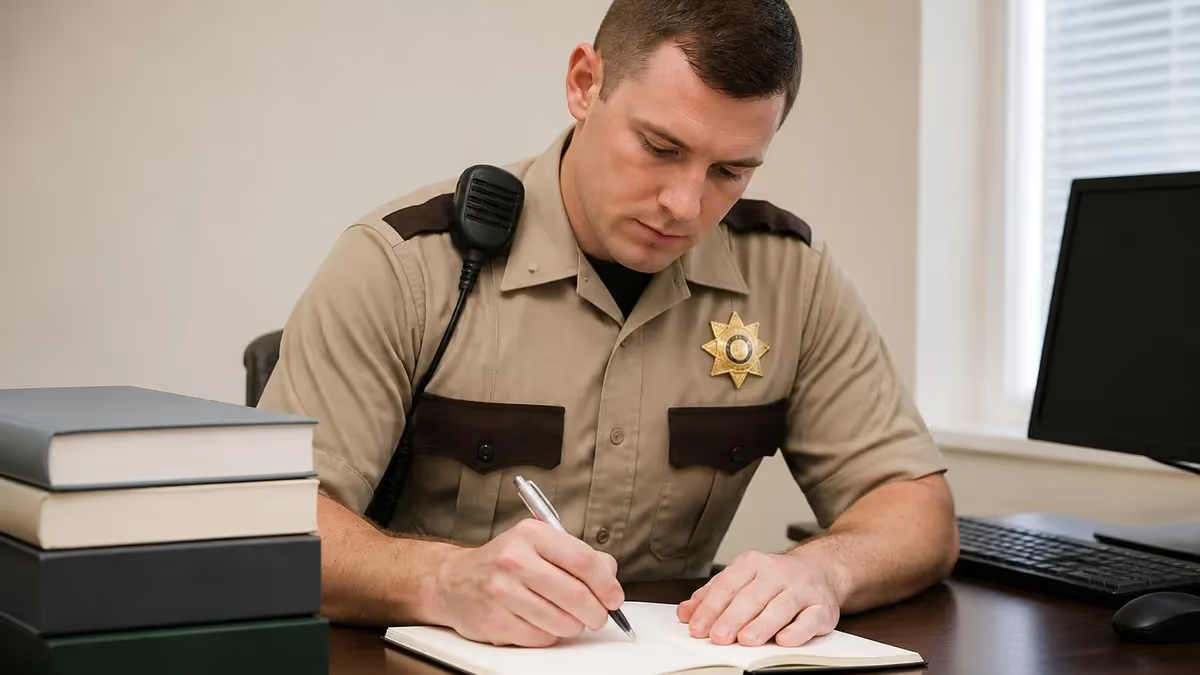
What Does a Sheriff Do? The Three Jobs Behind One Badge
You picture a sheriff and your brain probably jumps straight to the cowboy hat. Maybe a star on the chest. Maybe a movie scene. Real sheriffs do almost none of that. They run buildings, fleets, and budgets, and they answer to voters every four years.
Ask ten people what a sheriff actually does and you'll get ten partial answers. The job is wider than people think. In most US states the sheriff is the top law enforcement officer of the county, elected directly by residents, and responsible for three very different operations at the same time.
Those three jobs are running the county jail, providing security for the courts, and patrolling the parts of the county no city police force covers. On top of that, the sheriff's office serves civil paperwork — subpoenas, eviction orders, foreclosure notices — that keeps the civil justice system moving.
The Quick Answer: What a Sheriff Actually Does
A sheriff runs the county sheriff's office. That office handles jail operations, court security, civil process, and rural patrol. The sheriff is elected, not hired. That's the single biggest difference between a sheriff and a police chief, and it shapes everything else.
If you're comparing roles, our breakdown of sheriff vs police goes deeper on jurisdiction and authority. If you're trying to understand the rank below the elected sheriff, the page on the deputy sheriff role covers day-to-day field duties.
Sheriff Job at a Glance

Three Core Duties Almost Every Sheriff Performs
Most sheriff's offices in the United States are built around the same three pillars. The titles change, the unit names change, but the work is the same.
1. Running the County Jail
This is the duty most people forget. The sheriff is usually the warden of the county jail. That means hiring corrections officers, managing inmate intake, running medical and food services, transporting prisoners to court, and meeting state inspection standards. In smaller counties the jail eats up over half the budget. It's not glamorous work and it almost never makes the news — until something goes wrong.
2. Securing the Courts
Walk into any county courthouse and the uniformed officers running the metal detectors, escorting jurors, and standing behind the judge are usually sheriff's deputies. Court security is a statutory duty in most states. The sheriff staffs the courthouse, transports defendants between jail and courtroom, and protects judges and witnesses.
3. Patrolling Unincorporated County
Cities have their own police departments. But large parts of every US county sit outside any city limit. Those areas — farms, ranches, small unincorporated towns, rural highways — are patrolled by the sheriff. The same office answers 911 calls there, investigates crimes, runs traffic enforcement, and works fatal collisions on county roads.
For background on the office itself, see what is a sheriff. It covers the constitutional roots of the position and why it exists separately from city police.
Civil Process: The Paperwork That Keeps Courts Running
Civil process is the quiet engine of the sheriff's office. It's not the part of the job that ends up on a uniform patch, but in many counties it's a major workload — and a major revenue stream.
When a court issues a subpoena, a summons, a writ of execution, a writ of restitution, or a foreclosure order, somebody has to physically deliver it. That somebody is usually a sheriff's deputy or a dedicated civil process server working inside the sheriff's office.
Evictions are the most visible civil process work. When a landlord wins an unlawful detainer case, the court signs a writ telling the tenant to leave. If they don't leave by the deadline, the sheriff carries out the lockout. Deputies show up with the writ, escort the tenant off the property, and stand by while a locksmith changes the locks. They don't move belongings — that's not their job — but they do enforce the legal removal itself.
Foreclosure sales, garnishment of wages, repossession of property under court order, and seizure of assets to satisfy a judgment also go through the sheriff. Civil process fees pay for a real chunk of these operations, which is why some counties run civil divisions almost as a separate business unit inside the office.
Not every state runs it this way. Some states use marshals, constables, or private process servers for some of these tasks. But the default — and the most common arrangement — is the county sheriff carries the paperwork and enforces the orders.
Civil Process Documents a Sheriff Serves
- What It Is: Order to appear in court or produce documents
- Who Receives: Witnesses, defendants, third parties
- Deputy Role: Hand-deliver and confirm service
- What It Is: Court order to remove a tenant
- Trigger: Landlord wins unlawful detainer case
- Deputy Role: Supervise lockout, stand by for safety
- What It Is: Order to seize property to pay a judgment
- Common Targets: Vehicles, bank accounts, business assets
- Deputy Role: Take possession on behalf of creditor
- What It Is: Notice of sale or possession transfer
- Trigger: Mortgage default, lender judgment
- Deputy Role: Post notice, conduct sheriff's sale
Sheriff vs Police Chief: One Is Elected, the Other Is Hired
This is the difference that matters most. A police chief is appointed. A city council or mayor hires the chief, sets the salary, and can fire the chief — sometimes overnight after a bad headline. The chief reports up through a city government structure.
A sheriff is elected. Voters in the county pick the sheriff for a fixed term, usually four years. Nobody can fire the sheriff for a bad week. Removing an elected sheriff mid-term takes a recall election, criminal conviction, or a state-level removal procedure. That independence cuts both ways. It insulates the sheriff from political pressure, but it also means accountability runs through elections, not through a boss.
The other practical difference is jurisdiction. A police chief's authority stops at the city limit. A sheriff's authority covers the entire county, including every city inside that county. In practice the sheriff usually defers to city police inside city limits, but the legal authority is countywide.
Pay differences are real. Sheriff pay varies wildly by county size and tax base. If you're trying to understand the numbers, the sheriff salary guide breaks out averages by state and rank.
One more piece: a chief usually came up through that same city department. A sheriff might have spent years as a deputy in the same county — or might be a political outsider who won the badge on a campaign about jail reform, immigration enforcement, or county budget priorities. Voters decide.

Four Divisions Inside a Sheriff's Office
Patrol is the most visible piece. Sheriff's deputies on patrol cover unincorporated areas of the county — farms, ranches, rural highways, small towns without their own police departments. They respond to 911 calls, investigate property crimes and assaults, run traffic enforcement on county and state roads, and provide first response to fires, medical emergencies, and mutual aid requests from city departments.
In small counties, a single patrol deputy might cover hundreds of square miles per shift. Response times of 20 to 45 minutes are normal in rural America. That reality shapes everything from how deputies are trained to what they carry in the trunk of their car.
Sheriff Duties Vary by State — Sometimes Dramatically
"What does a sheriff do" doesn't have one US-wide answer. The position is set in each state's constitution or laws, and the details swing hard from state to state.
Hawaii: No County Sheriffs at All
Hawaii is the famous exception. The state has a Department of Public Safety Sheriff Division at the state level, but no elected county sheriffs the way the mainland does. Court security and warrant service are handled by state employees instead of an elected county official.
Alaska: Same Idea, Different Solution
Alaska also has no county sheriffs. The Alaska State Troopers cover what county sheriffs handle elsewhere. With borough governments instead of counties, the political structure simply doesn't support the office.
Connecticut and Massachusetts: Stripped Down
Connecticut abolished the elected county sheriff in 2000. Massachusetts kept the sheriff but limited the role mostly to running the jail and serving civil process — no patrol, no street enforcement. The state police and city departments handle everything else.
Texas, Florida, California: Full Authority
In big southern and western states, the sheriff is enormous. Los Angeles County Sheriff's Department, Harris County Sheriff's Office in Texas, and Broward County in Florida each run thousands of deputies, multiple jails, and budgets bigger than entire state police agencies in smaller states.
If this is starting to sound like a path you might want, the how to become a deputy sheriff guide walks through training, academy, hiring tests, and what to expect in the first year.
What a Sheriff's Day Actually Looks Like
Elected sheriffs run an organization. Deputies run the street. So "what does a sheriff do" splits in two depending on which you mean.
A sheriff's day is usually administrative. Budget meetings with the county commissioners. Personnel decisions. Sitting in front of the media after a serious incident. Visiting the jail, the patrol shifts, the civil division. Answering letters from citizens. Showing up at county events because the sheriff is, by definition, a politician with constituents.
That doesn't mean sheriffs never put on a uniform. In smaller counties a sheriff might still respond to scenes, lead investigations, and stand a patrol shift when staffing runs thin. In a county of three thousand people, the sheriff and two deputies might be the entire department. In a county of three million, the sheriff is a CEO who hasn't worked a traffic stop in twenty years.
Deputies are different. A patrol deputy's day looks like a city police officer's day with more driving. Long stretches of rural road. Calls that take 45 minutes to reach. Mutual aid with state troopers and neighboring counties. Domestic disturbances on isolated properties. Welfare checks. Animal calls because there's nobody else to send.
Jail deputies — corrections officers in the sheriff's office — run booking, classification, supervision, headcounts, transport, and visitation. Their job is closer to a federal correctional officer than to a patrol deputy. Civil deputies serve papers all day. The work splits cleanly by division, and most deputies stay in their division for years.
Typical Tasks in a Sheriff's Week
- ✓Brief county commissioners on monthly crime numbers and jail population
- ✓Sign off on patrol shift assignments and overtime approvals
- ✓Review use-of-force incidents from the past week
- ✓Meet with the jail commander on inmate medical and food contracts
- ✓Speak at a community meeting in a town with rising property crime
- ✓Approve civil process service schedules for the week ahead
- ✓Sit in on a felony arraignment to show the office's presence
- ✓Coordinate mutual aid with neighboring sheriffs on a multi-county case
- ✓Respond to a media inquiry about a high-profile arrest
- ✓Sign warrants requested by detectives in the criminal investigations division

The Controversial Pieces: Immigration, Election Security, Constitutional Sheriffs
Three duties make sheriffs political in a way most law enforcement positions aren't.
Immigration Cooperation
Because the sheriff runs the county jail, decisions about cooperating with federal immigration enforcement land on the sheriff's desk. Honoring ICE detainers, sharing booking data, signing 287(g) agreements that deputize jail staff for limited immigration work — these are sheriff decisions, and they vary county by county. Voters often pick a sheriff specifically because of where that candidate stands on this question.
Election Security
Some states give sheriffs a role in election security — patrolling polling places, transporting ballots, or investigating election complaints. That role expanded in some counties after 2020 and remains a live debate about where law enforcement should and shouldn't be on Election Day.
Constitutional Sheriff Movement
A subset of US sheriffs identify with the "constitutional sheriff" movement, arguing the elected sheriff has the authority to refuse to enforce state or federal laws the sheriff deems unconstitutional. This is contested — most legal scholars say a sheriff can't simply nullify federal law — but the political philosophy shows up in sheriff campaigns and policy decisions, especially around gun laws and pandemic orders.
You don't have to agree with any of this to understand it matters when you ask what a sheriff does. Because the office is elected, sheriffs answer to voters first and to other government officials second. That structural fact drives policy in ways an appointed police chief simply can't match.
Working in a Sheriff's Office: Honest Trade-offs
- +Steady county employment with strong pension benefits in most states
- +Variety — patrol, jail, civil, courts all sit in one organization, so internal transfers are real
- +Direct community impact in rural areas where you're often the only law enforcement around
- +Promotion paths into specialized units: SWAT, K-9, dive team, marine patrol, aviation
- +Civil process work pays steady fees and runs on a predictable schedule
- +The elected structure means voters can drive real reform when an office goes off track
- −Jail duty is the most common starting assignment and many new deputies dislike it
- −Rural patrol means long response times alone with minimal backup
- −Pay in small counties trails city police departments by 20-40%
- −Political turnover at the top can shake up policy and personnel after every election
- −Courthouse security can feel monotonous if you wanted street work
- −Civil process deputies sometimes face confrontational evictions and foreclosure scenes
Pros and Cons at a Glance
| Pros | Cons |
|---|---|
| Steady county employment with strong pension benefits in most states | Jail duty is the most common starting assignment and many new deputies dislike it |
| Variety — patrol, jail, civil, courts all sit in one organization, so internal transfers are real | Rural patrol means long response times alone with minimal backup |
| Direct community impact in rural areas where you're often the only law enforcement around | Political turnover at the top can shake up policy and personnel after every election |
| Civil process work pays steady fees and runs on a predictable schedule | Courthouse security can feel monotonous if you wanted street work |
| The elected structure means voters can drive real reform when an office goes off track | Civil process deputies sometimes face confrontational evictions and foreclosure scenes |
Where Does a Sheriff's Authority Stop?
Legally? Almost nowhere inside the county. Practically? Plenty of places, by mutual agreement.
A sheriff's deputy can pull you over on the interstate, in a city, in an unincorporated subdivision, on tribal land if there's a cross-deputization agreement, and on private property. The badge isn't restricted to "rural" parts of the county even though that's where most patrol happens.
What stops them, usually, is policy and politics. Inside a city, the city's police department handles most calls. The sheriff's office responds when asked, when the call falls in their wheelhouse — fugitive warrants, court orders, evidence transport, dive team callouts — or when city police are tied up.
State lines do stop a sheriff. A deputy can't drive across the state border and make an arrest. Hot pursuit doctrine has narrow exceptions, but for the most part the sheriff's authority ends at the state line.
Federal property is more complicated. Federal courthouses, military bases, and national parks have their own law enforcement. The sheriff has concurrent jurisdiction in some of those places, no jurisdiction in others.
Inside the County, Outside the City
Here's the easy mental map: cities police themselves. Counties police what's between the cities. The sheriff is the county's police force for everywhere not covered by a city department. That includes farmland, ranchland, rural highways, water bodies in some states, and any unincorporated community.
So — Do Sheriffs Just Do Cowboy Hat Stuff?
No. The cowboy hat is a costume choice that a lot of sheriffs out west still use, and a lot of sheriffs back east don't. It's a uniform decision, not a job description. Whether the hat is on the head or in the closet, the same job is waiting underneath.
The job itself is a hybrid of corrections warden, court security manager, civil bailiff, rural police chief, and elected county official. Few other roles in American government combine that many functions in one office. Fewer still are directly accountable to voters every four years.
Who Pays for All This?
County taxpayers, mostly. The sheriff's budget comes from the county general fund, supplemented by civil process fees, jail booking fees (in some states), and federal grants. The county commission or board of supervisors approves the budget, which means the sheriff has to negotiate every year with a body the sheriff doesn't report to. That tension is structural and won't go away.
Who Holds Sheriffs Accountable?
Voters first. Civil lawsuits second. The state attorney general or governor in extreme cases. And in some states, an independent inspector general or civilian review board for the jail operation specifically. Internal affairs handles deputy misconduct; the sheriff handles the sheriff's own conduct unless removed by the state or by a recall.
Federal Money, Federal Strings
Most sheriff's offices take federal grants — Byrne JAG funds, COPS hiring grants, DOJ jail mental health programs, opioid response money. Each grant comes with reporting requirements and audits. Big urban counties have full-time grant writers and compliance staff. Small counties chase the same money with a single deputy juggling the paperwork on top of patrol shifts.
What "Other Duties" Actually Means
Most state statutes hand sheriffs a list of duties and end with the phrase "and any other duties prescribed by law." That clause does heavy lifting. Search and rescue in counties with mountains or water. Animal control where no separate agency exists. School resource officers. Concealed carry permit processing. Sex offender registration. Death notifications. Pet licensing in a few oddball states. The list is long, varied, and almost always growing.
Where to Go Next
If you're thinking about a career as a deputy, start with the deputy sheriff exam guide — it covers the hiring test, the physical, the background check, and the interview steps. The badge starts there.
Sample Sheriff - Deputy Sheriff Exam Practice Questions
Try these questions from our free Sheriff - Deputy Sheriff Exam practice tests. The correct answer and an explanation follow each question.
While off-duty and in plain clothes, you witness a heated argument in a parking lot that does not involve physical violence. What is the most prudent initial action?
- A. Immediately intervene, identify yourself as a deputy, and order them to stop.
- B. Ignore the argument as you are off-duty.
- C. Draw your weapon and hold it at a low-ready position in case things escalate.
- D. Observe from a safe distance and call 911 to report the incident to on-duty officers.
Answer: D. Observe from a safe distance and call 911 to report the incident to on-duty officers.
When off-duty, an officer's primary role is to be a good witness unless immediate intervention is required to prevent serious injury or death. Intervening in a non-violent situation can escalate it, especially when your status as an officer is unknown. Observing and contacting on-duty officers is the safest and most effective response.
What is one of the primary responsibilities of a Deputy Sheriff?
- A. Drafting legal documents for civil cases
- B. Providing security in courtrooms and transporting prisoners
- C. Managing the financial budget of the Sheriff's Office
- D. Training new recruits in administrative tasks
Answer: B. Providing security in courtrooms and transporting prisoners
A primary responsibility of a Deputy Sheriff often includes providing security within courtrooms and safely transporting prisoners between correctional facilities, court appearances, and other necessary locations. These duties are vital for maintaining order in the judicial system and ensuring public safety. They are distinct from administrative tasks or drafting legal documents.
What legal standard must a Deputy Sheriff meet to conduct a lawful arrest?
- A. Probable cause
- B. Reasonable suspicion
- C. Mere suspicion
- D. Absolute certainty
Answer: A. Probable cause
To conduct a lawful arrest, a Deputy Sheriff must meet the legal standard of probable cause. Probable cause means there are sufficient facts and circumstances to believe that a crime has been committed and that the person to be arrested committed it. This standard is higher than reasonable suspicion but less than absolute certainty.
The SARA model is a problem-solving method used in community policing. What does the 'A' in SARA stand for?
- A. Action
- B. Arrest
- C. Analysis
- D. Assessment
Answer: D. Assessment
The SARA model consists of four stages: Scanning (identifying the problem), Analysis (analyzing the causes of the problem), Response (implementing a solution), and Assessment (evaluating the effectiveness of the response). Assessment is critical to determine if the solution worked.
Sheriff Questions and Answers
About the Author
Law Enforcement Trainer & Civil Service Exam Specialist
John Jay College of Criminal JusticeMarcus B. Thompson earned his Master of Arts in Criminal Justice from John Jay College of Criminal Justice and served 12 years as a law enforcement officer before transitioning to full-time academy instruction. He is a POST-certified instructor who has prepared candidates for police entrance exams, firefighter assessments, and civil service examinations across dozens of agencies.
Join the Discussion
Connect with other students preparing for this exam. Share tips, ask questions, and get advice from people who have been there.
View discussion (7 replies)