
What Is a Sheriff? Duties, Jurisdiction, Election, and How Sheriffs Differ from Police
🎯 What is a sheriff: elected county law enforcement officer with jurisdiction over unincorporated areas, jail operations, court security, and civil
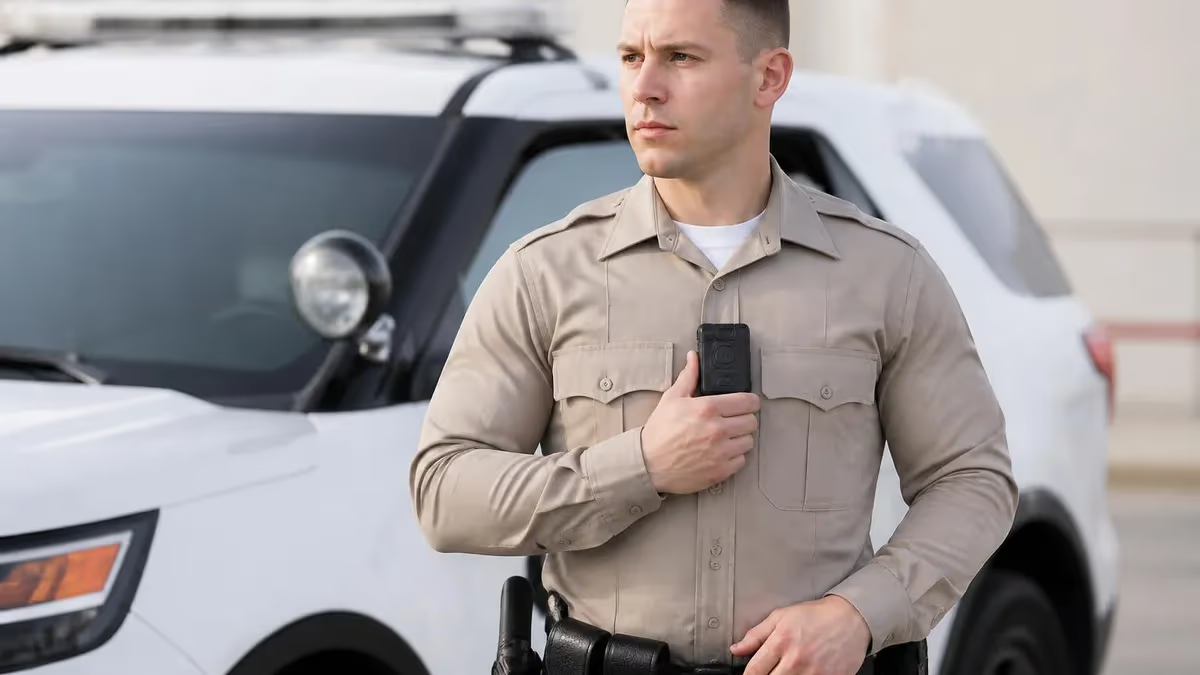
A sheriff is the chief law enforcement officer of a U.S. county, almost always elected directly by the county's voters. Unlike police chiefs (who are appointed by city governments), sheriffs answer directly to the electorate. This single fact — elected, not appointed — shapes nearly everything about how the sheriff's office operates and how it differs from municipal police departments. Sheriffs in the U.S. exist in 47 of 50 states (Alaska, Connecticut, and Hawaii don't have them); the role has been part of American law enforcement since colonial times and traces back to medieval English county "shire-reeves".
Sheriffs typically have three main responsibilities: law enforcement in unincorporated areas of the county (places not part of any city), operation of the county jail, and service of civil process (delivering subpoenas, eviction notices, court orders, etc.). The specific mix varies by county — large urban sheriff's offices may focus more on jail operations and court security, while rural sheriff's offices handle most law enforcement directly because there's no municipal police force in unincorporated farming or ranching areas.
The jurisdiction of a sheriff is the entire county, including inside city limits where municipal police also operate. In practice, sheriffs usually defer to local police inside city limits unless specifically requested or for county-wide functions. Outside cities, the sheriff's office is typically the primary law enforcement agency. The sheriff's office may also operate specialized units — SWAT teams, search and rescue, marine patrol on county waters, K-9 units, and others — depending on county needs and budget.
Sheriffs are elected for fixed terms (most commonly 4 years; some counties use 2 or 6 year terms). The election is partisan in most states (the sheriff runs as a Republican or Democrat or other party affiliation) but several states have non-partisan sheriff elections. Term limits are unusual — most sheriffs can serve indefinitely as long as they keep winning elections. This has consequences: longtime sheriffs accumulate significant institutional power and become difficult to challenge politically.
The sheriff personally is generally a sworn law enforcement officer (deputy sheriffs are the rank-and-file officers under the sheriff). Deputy sheriffs do the day-to-day patrol, investigation, and arrest work. The sheriff is responsible for overall agency direction, budget management, hiring and firing of deputies, and public accountability. The relationship between the sheriff and the deputies parallels how a mayor relates to a city's police chief — but with the sheriff being both the elected official AND the senior officer.
This guide covers what sheriffs actually do, how they differ from police, the jurisdiction and authority of sheriff's offices, the election process and political role of sheriffs, and the relationship between sheriffs and other levels of law enforcement. It's intended for citizens trying to understand local law enforcement, people considering careers as deputies, and anyone interested in the structure of American policing.

Sheriff Role at a Glance
- Role: Chief law enforcement officer of a U.S. county. Elected by county voters.
- Term: Typically 4 years; some 2 or 6 years. Usually no term limits — can serve indefinitely.
- Where: 47 of 50 states have sheriffs. Alaska, Connecticut, Hawaii don't.
- Main duties: Law enforcement in unincorporated areas, county jail operation, civil process service, court security
- vs Police Chief: Sheriff is elected; police chief is appointed by city government. Different accountability structure.
- Jurisdiction: Entire county, including cities (usually defers to local PD inside cities)
- Deputies: Rank-and-file officers who report to the sheriff. Do most of the actual law enforcement work.
- Special units: SWAT, search/rescue, marine, K-9, etc. Vary by county size and budget.
Sheriff vs. police chief — the elected-vs-appointed distinction matters significantly. Police chiefs are hired by city governments (typically the mayor or city manager) and can be fired by the same. They serve at the pleasure of city leadership. Their professional career depends on maintaining good working relationships with city government and avoiding controversy that would prompt the mayor or council to remove them.
Sheriffs answer to county voters directly. They can lose re-election but typically can't be fired by anyone short of impeachment or criminal conviction. This independence has both upsides and downsides. Upside: sheriffs can resist political pressure from county commissioners, mayors of cities within the county, or state-level politicians. Downside: a sheriff who behaves badly can stay in office until the next election, with no intermediate accountability mechanism.
For citizens dealing with both sheriff's office and city police, the practical implications: if you live inside a city, the police are your primary law enforcement contact. If you live in an unincorporated area (typical for rural and suburban-edge locations), the sheriff's office handles your 911 calls, traffic, and crimes. The county jail (where people arrested anywhere in the county are held pre-trial or for short sentences) is operated by the sheriff's office regardless of which agency made the arrest.
The civil process function is unique to sheriffs (not handled by police). When someone is sued, the lawsuit must be formally "served" on the defendant — handing them legal papers in person. In most counties, the sheriff's office handles this through civil deputies. Eviction notices, restraining orders, subpoenas, and many other court papers go through the sheriff. This is one of the reasons sheriff's offices exist as a separate institution from police — the civil process function predates modern policing and has remained with sheriffs throughout the centuries.
Court security is another sheriff function in most counties. Bailiffs in county courthouses are typically deputy sheriffs. Transportation of prisoners from jail to courtroom and back is sheriff's office responsibility. The sheriff coordinates with the county courts on security planning, witness protection, and emergency response.
Sheriff's Office Functions
Primary law enforcement in areas outside city limits. Traffic enforcement, criminal investigation, 911 response, community policing.
Operating the county jail. Booking, housing pre-trial detainees and short-sentence inmates. Healthcare and security inside jail.
Serving legal papers — lawsuits, subpoenas, eviction notices, restraining orders. Unique to sheriffs (not police function).
Bailiffs in county courtrooms. Transporting prisoners between jail and court. Courthouse perimeter and emergency response.
SWAT, search and rescue, marine patrol, K-9, mounted patrol, gang task forces. Vary by county size and budget.
In some states, sheriff also serves as coroner. Death investigations and certifications. Varies by state law.
Becoming a deputy sheriff (not the sheriff themselves) is a career path that's similar to but distinct from becoming a police officer. The requirements typically include: U.S. citizenship, high school diploma (some agencies require associates or bachelor's degree), age 21+ at hire, no felony convictions, valid driver's license, ability to pass physical fitness tests, ability to pass background investigation, ability to pass medical and psychological evaluations. After hire, new deputies attend a state-certified law enforcement academy (typically 16-24 weeks) covering law, defensive tactics, firearms, driving, and patrol procedures.
Salary for deputy sheriffs varies significantly by county and state. Median pay for sheriff's deputies and patrol officers is approximately $68,000 (BLS data for police and sheriff's patrol officers combined). Major metropolitan sheriff's offices (Los Angeles County, Cook County in Chicago, Harris County in Houston) pay higher — $80,000-$110,000 typical with overtime. Rural sheriff's deputies earn less ($45,000-$60,000 in some areas).
The career path within a sheriff's office: Deputy → Sergeant → Lieutenant → Captain → Major → Chief Deputy (often the second-in-command to the sheriff). Promotions are typically based on time-in-service and competitive examinations. Some sheriff's offices have specialized career tracks — detectives, narcotics officers, K-9 handlers, SWAT team members — that follow somewhat different advancement patterns.
Becoming the sheriff (not a deputy) requires winning the election. In small rural counties, candidates often have decades of law enforcement experience as a deputy in that same county. In large urban counties, candidates may come from outside law enforcement (former prosecutors, military leaders, even occasionally politicians without law enforcement background). The candidate must be elected by county voters; sheriff elections often run alongside other county-level elections during normal election cycles.
Campaign finance for sheriff elections is significant in larger counties. Major county sheriff races can involve $500,000-$2,000,000 in campaign spending. Most campaign funding comes from local business interests, law enforcement unions, and political party organizations. Smaller rural sheriff races have much smaller budgets — sometimes under $50,000.

Sheriff Roles in Detail
- Selection: Sheriff elected by voters; police chief appointed by city government
- Jurisdiction: Sheriff = entire county. Police = city limits only.
- Accountability: Sheriff to voters at election. Police chief to mayor/council.
- Duties: Sheriff handles jail and civil process. Police generally don't.
- Cooperation: Most areas have mutual aid agreements. Agencies typically assist each other across jurisdictions.
The political nature of sheriff elections has significant consequences. Sheriffs are accountable to voters in ways that police chiefs aren't. A sheriff who's controversial — whether for being too tough or too lenient on crime, for political activism, or for management issues — can lose re-election. Voters in some counties have ousted long-serving sheriffs over specific incidents or policy disagreements.
This has shaped sheriff politics in complicated ways. Sheriffs sometimes take strong public positions on contentious issues — immigration enforcement cooperation with ICE, refusing to enforce specific state gun laws, or other policy positions — that wouldn't be appropriate for an appointed chief but are entirely within a sheriff's prerogative as an elected official. Some sheriffs have become highly visible political figures, including Joe Arpaio (Maricopa County, AZ) and several California sheriffs in recent years.
The constitutional sheriff movement is a political/ideological movement among some sheriffs that claims sheriffs have authority to refuse enforcement of federal laws they consider unconstitutional. The movement has been controversial — legal scholars generally reject the underlying constitutional theory, but the movement has political traction in some rural counties. This is one of the more visible examples of the political nature of sheriff offices.
For most citizens, the day-to-day relationship with their sheriff's office is straightforward — call 911 for emergencies, attend community meetings, receive county-wide alerts. The political tensions around sheriffs surface mostly during elections or when specific incidents become news. For most law enforcement interactions in unincorporated areas, the sheriff's deputies who respond function similarly to police officers in cities.
For rural communities, the sheriff's office is often the most consequential institution of local government. The sheriff personally is often well-known in the community, attends local events, and has significant authority over how law is enforced. The relationship between rural sheriffs and their communities can be close and personal — for better or worse, depending on the sheriff and the community.
For larger metropolitan counties (Los Angeles County, Cook County, Maricopa County), the sheriff's office is a major bureaucratic organization with thousands of deputies and complex jail operations. The sheriff personally is more of an executive role, like running a large city department. These metropolitan sheriff offices have budgets in the hundreds of millions or billions of dollars and operate at scale comparable to major city police departments.
Most U.S. sheriffs have no term limits — they can be re-elected indefinitely. Some long-serving sheriffs have held office for 20+ years. This creates significant institutional knowledge and continuity but also means that challenging an incumbent sheriff is difficult. Incumbents typically have name recognition, established donor networks, and the institutional backing of the existing sheriff's office. Most challengers to long-serving sheriffs lose; the few who win usually do so because of a specific controversy that turned voters against the incumbent. Term limits exist in a handful of states or counties but are the exception, not the rule.
Sheriff's office funding comes primarily from county budgets, which in turn come from property taxes, sales taxes, and state revenue sharing. The sheriff submits an annual budget request to the county commission/board of supervisors; the commission ultimately decides funding levels. In counties where the sheriff and county commission have political disagreements, budget disputes are common.
Federal grants supplement local funding for specific purposes — drug enforcement, gang task forces, school safety programs, equipment purchases. The federal funding can be significant for some agencies but isn't reliable from year to year. The 1033 program (transfer of military surplus equipment to local law enforcement) has provided vehicles, armor, and equipment to many sheriff's offices; the program has been controversial over the past decade.
Sheriff's deputies typically have law enforcement union representation similar to police officers. The Fraternal Order of Police is the largest national organization. State-specific organizations like CALPELRA (California) and SHERIFF'S TRAINING ASSOCIATIONS in various states provide professional development. Union representation affects pay, benefits, and disciplinary procedures.
Training requirements for deputies are state-regulated, not federal. Each state has a Police Officer Standards and Training (POST) board that sets minimum training requirements. Initial academy training is typically 16-24 weeks. Continuing education hours are required annually (typically 24-40 hours per year). Specialized roles (SWAT, K-9, detectives) require additional certified training beyond the basic academy.
Inter-agency cooperation between sheriff's offices is generally good. Sheriff's deputies from adjacent counties routinely assist each other during emergencies, manhunts, or major events. State-level sheriff associations help communication and training across counties. The cooperation is often less formalized than between metropolitan police departments but works effectively in practice.

Deputy Sheriff Career
U.S. citizen, age 21+, high school diploma (some require associate's), no felonies, pass physical/psychological/background checks.
State-certified law enforcement academy. 16-24 weeks. Law, defensive tactics, firearms, driving, patrol procedures.
~$68,000 nationally (BLS for police and sheriffs combined). Urban county sheriffs $80K-$110K. Rural deputies $45K-$60K.
Detective, K-9 handler, SWAT, narcotics, gang unit, traffic, marine patrol. Each has additional training and pay premiums.
Deputy → Sergeant → Lieutenant → Captain → Major → Chief Deputy. Promotions based on time and competitive exams.
Jail operations, civil process, court security are sheriff functions. Some deputies prefer the variety; others prefer pure patrol.
Becoming a Deputy Sheriff
Meet Basic Requirements
Apply to Sheriff's Office
Pass Hiring Process
Attend Academy (16-24 weeks)
Field Training Officer (FTO) Period
Solo Patrol
Inside city limits, the city police department is generally your primary law enforcement. Outside city limits (unincorporated areas), the sheriff's office is primary. If you're in a rural area or on county-only roads, your 911 call goes to the sheriff's office. The county jail (where anyone arrested in the county may be held) is operated by the sheriff regardless of which agency made the arrest. For civil legal matters (lawsuits, eviction notices, court papers), the sheriff handles serving these — police do not. Understanding which agency handles what saves time and gets you to the right office faster.
The future of sheriff's offices in the U.S. is shaped by several ongoing trends. Demographic shifts: as suburban areas grow and former unincorporated areas get incorporated into cities, sheriff jurisdiction shrinks in some metropolitan counties. Rural sheriff's offices face shrinking budgets as rural populations decline.
Technology adoption: body cameras, data-driven policing, integration with state and federal databases, social media engagement — all are evolving. Sheriff's offices vary widely in technological sophistication. Major urban offices are typically advanced; rural offices may lag significantly.
Accountability discussions: as with police, sheriff accountability has been a subject of public debate, particularly around use-of-force incidents and jail operations. Some counties have introduced civilian oversight boards; others have resisted. The elected nature of sheriffs makes traditional accountability structures harder to apply — the sheriff isn't an employee anyone can discipline beyond the next election.
Immigration enforcement cooperation: post-2015, sheriff's offices have been at the center of debates over cooperation with federal Immigration and Customs Enforcement (ICE). Some sheriffs cooperate fully through programs like 287(g) and ICE detainer requests; others have policies limiting cooperation. The variation among counties on this issue is substantial.
Jail operations and bail reform: the county jail operations are increasingly under scrutiny. Pre-trial detention reform, jail population reduction, mental health crisis response, and jail conditions have become significant political issues. Sheriffs are central to these debates because they actually run the jails.
For prospective deputies, the long-term outlook is moderate — comparable to police career outlook. Employment is expected to grow slightly. Pay is generally stable with cost-of-living adjustments. The work itself is consistent in core duties but evolves with new technology and policing approaches. For citizens, understanding what sheriffs do and what authority they have helps navigate local issues — and is particularly important for voters making election decisions about who to elect as their county sheriff.
What Pros and Cons
- +What has a publicly available content blueprint — you know exactly what to prepare for
- +Multiple preparation pathways accommodate different schedules and budgets
- +Clear score reporting shows specific strengths and weaknesses
- +Study communities share current insights from recent test-takers
- +Retake policies allow recovery from a difficult first attempt
- −Tested content scope requires substantial preparation time
- −No single resource covers everything optimally
- −Exam-day performance can differ from practice test performance
- −Registration, prep, and retake costs accumulate significantly
- −Content changes between versions can make older materials less reliable
Pros and Cons at a Glance
| Pros | Cons |
|---|---|
| What has a publicly available content blueprint — you know exactly what to prepare for | Tested content scope requires substantial preparation time |
| Multiple preparation pathways accommodate different schedules and budgets | No single resource covers everything optimally |
| Clear score reporting shows specific strengths and weaknesses | Exam-day performance can differ from practice test performance |
| Study communities share current insights from recent test-takers | Registration, prep, and retake costs accumulate significantly |
| Retake policies allow recovery from a difficult first attempt | Content changes between versions can make older materials less reliable |
Sample Sheriff - Deputy Sheriff Exam Practice Questions
Try these questions from our free Sheriff - Deputy Sheriff Exam practice tests. The correct answer and an explanation follow each question.
What action should a Deputy Sheriff take upon arriving at a crime scene?
- A. Secure the scene to preserve evidence
- B. Immediately arrest any individuals present
- C. Begin interviewing witnesses without securing the scene
- D. Call the media to report the incident
Answer: A. Secure the scene to preserve evidence
Upon arriving at a crime scene, the immediate priority for a Deputy Sheriff is to secure the area. This action prevents contamination, destruction, or removal of crucial evidence, which is vital for a successful investigation. Securing the scene ensures that all potential evidence is preserved in its original state for forensic analysis.
What legal standard must a Deputy Sheriff meet to conduct a lawful arrest?
- A. Probable cause
- B. Reasonable suspicion
- C. Mere suspicion
- D. Absolute certainty
Answer: A. Probable cause
To conduct a lawful arrest, a Deputy Sheriff must meet the legal standard of probable cause. Probable cause means there are sufficient facts and circumstances to believe that a crime has been committed and that the person to be arrested committed it. This standard is higher than reasonable suspicion but less than absolute certainty.
When dealing with a domestic disturbance call, what is an important responsibility of a Deputy Sheriff?
- A. Arresting all individuals involved regardless of the situation
- B. Taking statements only from the individuals who made the call
- C. Ignoring the dispute if it seems minor
- D. Mediate the situation to ensure the safety of all parties involved
Answer: D. Mediate the situation to ensure the safety of all parties involved
When responding to a domestic disturbance, a Deputy Sheriff's important responsibility is to mediate the situation and ensure the safety of all parties involved. This involves de-escalating tensions, assessing for any immediate threats, and impartially gathering information from everyone present. The goal is to resolve the conflict peacefully and protect potential victims.
What is the primary responsibility of a Deputy Sheriff Correctional Officer?
- A. Conducting criminal investigations
- B. Enforcing traffic laws
- C. Maintaining the safety and security of the correctional facility
- D. Serving civil process papers
Answer: C. Maintaining the safety and security of the correctional facility
The primary responsibility of a Deputy Sheriff Correctional Officer is to maintain the safety and security of the correctional facility. This includes supervising inmates, preventing escapes, responding to emergencies, and ensuring a secure environment for both inmates and staff. Their role is critical for the orderly operation of the detention center.
SHERIFF Questions and Answers
Sheriffs occupy a distinctive position in American law enforcement — elected officials with significant independent authority, operating at the county level between state and city jurisdictions. The role combines law enforcement, jail management, and judicial support functions in ways that distinguish it from purely police-style agencies. For most citizens, understanding the sheriff's office becomes relevant when navigating local issues, considering law enforcement careers, or making election decisions.
For people considering law enforcement careers, deputy sheriff is a viable path with several advantages over city police — diverse duties (patrol, jail, courts, civil process), opportunities for specialization, and stable employment. The disadvantages parallel any law enforcement career — shift work, physical and emotional demands, exposure to traumatic situations, and the inherent risks of the profession. The fit depends on individual preferences and circumstances. The work is meaningful and well-compensated relative to education requirements; the lifestyle is demanding and not for everyone.
About the Author
Law Enforcement Trainer & Civil Service Exam Specialist
John Jay College of Criminal JusticeMarcus B. Thompson earned his Master of Arts in Criminal Justice from John Jay College of Criminal Justice and served 12 years as a law enforcement officer before transitioning to full-time academy instruction. He is a POST-certified instructor who has prepared candidates for police entrance exams, firefighter assessments, and civil service examinations across dozens of agencies.
Join the Discussion
Connect with other students preparing for this exam. Share tips, ask questions, and get advice from people who have been there.
View discussion (7 replies)