
Sheriff vs Police: Differences in Jurisdiction & Authority 2026 October
What's the difference between sheriff and police? Compare jurisdiction, authority, duties, and career paths for sheriff deputies and police officers. 🎯
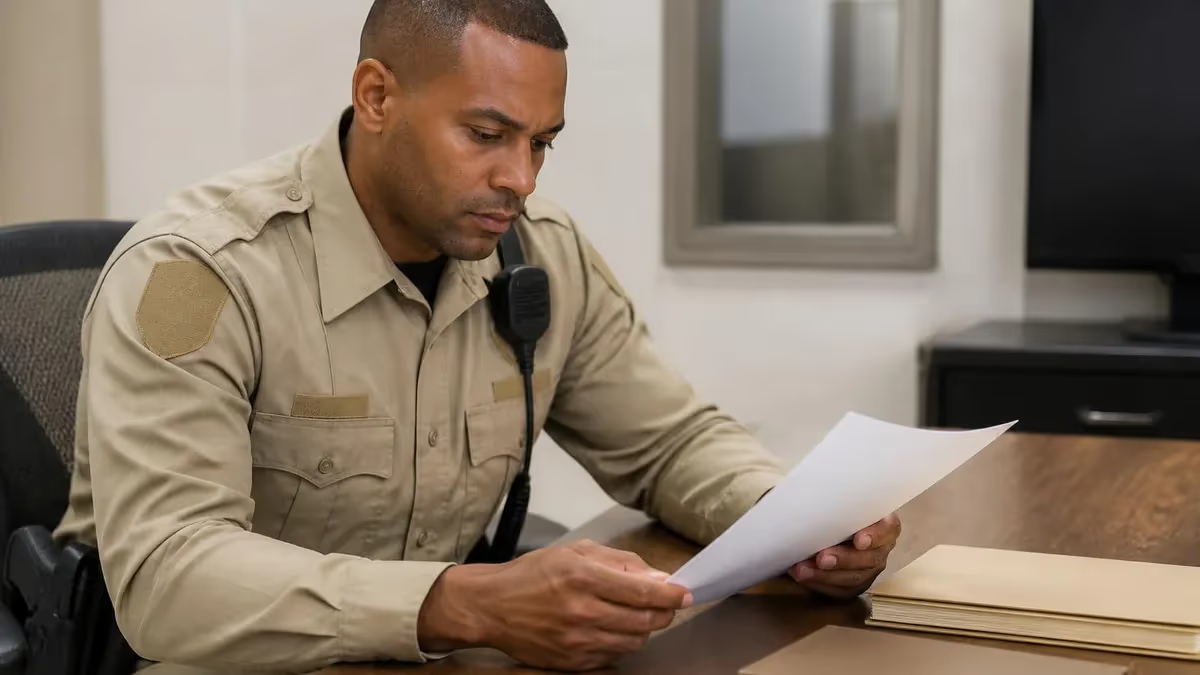
Ask ten Americans what's the difference between sheriff and police, and you'll probably get ten slightly different answers. People use the words interchangeably, especially in movies where the badge always looks the same. But the two roles are not the same job. They answer to different bosses, cover different territory, and carry different responsibilities under the law. The confusion is forgivable, because both wear uniforms, both carry guns, both arrest people, and both show up when you call 911. The lines blur on television. They are sharper in real life.
The shortest version: a sheriff is a county-level officer who is almost always elected by the voters of that county. A police chief runs a city police department and is appointed by the mayor or city council. Sheriffs and their deputies usually patrol unincorporated land, run the county jail, and provide security for the local courts. City police patrol the streets, neighborhoods, and businesses inside city limits. Sit those two job descriptions side by side and the lines start to come into focus.
Federal and state law enforcement add another layer. The FBI, DEA, ATF, and US Marshals work for the federal government and enforce federal law across all 50 states. State troopers, highway patrol, and state bureaus of investigation work for the governor and enforce state law. Sheriffs and city police are local. They share the same towns and roads with federal and state agents, but their authority comes from a different place. If you're studying for the sheriff or deputy sheriff exam, knowing where one badge ends and another begins is more than trivia, it's part of the job.
This guide walks through the differences in plain language, with a focus on the questions that come up most often. By the end, you should be able to explain to someone at a barbecue why the deputy who patrols the county road is not the same as the officer who patrols downtown, and why the sheriff on the ballot every four years has a job no police chief in the country has to win at the polls.

Those numbers tell a story. The country has roughly six times more police chiefs than sheriffs because almost every incorporated town and city in America runs its own department. Sheriffs cover the gaps, the unincorporated stretches between towns, the rural roads, the small townships that contract their policing out to the county. In some western states, the sheriff covers thousands of square miles and a handful of deputies handle calls that would be split across a dozen city agencies in the northeast.
Is a sheriff a cop? In the everyday sense, yes. Sheriffs and their sworn deputies are peace officers with full arrest powers, they carry firearms, and they investigate crimes. They wear uniforms, drive marked cruisers, and respond to emergencies. The differences are about who they answer to and where they work, not whether they count as police in the broad sense. Anyone asking is a sheriff a police officer is really asking about structure, and that's where it gets interesting.
Take a typical mid-size county. Inside the county seat, a city of maybe forty thousand people, the city police department fields a hundred sworn officers, a detective bureau, a traffic unit, and a K-9 team. Outside the city limits, the sheriff's office runs patrol with sixty deputies, operates a four-hundred-bed jail, staffs the courthouse, and serves civil paperwork for the whole county.
The two agencies share dispatch on some frequencies, share intelligence on local cases, and back each other up when a chase crosses a city line. They are separate organizations with separate budgets, separate uniforms, separate vehicles, and separate leadership. They cooperate constantly without merging.
The Quick Answer
What's the difference between a sheriff and a police officer? The sheriff is elected by the county and works at the county level, running jails and courts as well as patrol. A police officer is hired by a city department and works inside city limits, mostly focused on patrol and investigation. Both are sworn law enforcement, but they answer to different bosses and cover different ground.
The election piece matters more than people realize. A sheriff is the only law enforcement leader in the country who has to face voters every few years. That means a sheriff has to campaign, take public positions on policing, and answer to citizens directly at the ballot box. A police chief reports up through city hall, so political pressure travels through the mayor's office, the council, or a police commission. Both setups have tradeoffs, neither is automatically better, but they create real differences in how the two organizations behave day to day. Sheriffs face the voters. Chiefs face the mayor.
What's the difference between a police officer and a sheriff in terms of training? In most states, very little at the entry level. Both attend a state-certified law enforcement academy, both have to pass background checks, fitness tests, and written exams. After the academy, the work splits. A new deputy might rotate through the county jail for a year or two before moving to patrol, because corrections is part of the sheriff's mandate. A new police officer almost always starts on patrol. The career ladders inside each agency look different even when the starting line is shared.
That early jail assignment is one of the most underrated parts of a deputy's career. Working corrections teaches a young officer how to talk people down, how to read a room, how to spot trouble before it explodes, and how to manage paperwork at the volume the rest of policing demands.
By the time a deputy hits patrol, they've already had two years of high-stress interpersonal practice that most city officers pick up gradually on the street. Some sheriff's offices treat corrections as a stepping stone, others treat it as its own career track with separate promotion paths. The model varies county to county, but the dual mandate of policing plus corrections is built into the office.
Sheriffs win their job in a county-wide election, usually for a four-year term. Police chiefs are hired by a mayor, city manager, or commission and serve at their pleasure.
Sheriffs have authority across an entire county, including unincorporated areas. City police have authority inside the boundaries of a single municipality.
Sheriffs run patrol, the county jail, court security, civil process, and inmate transport. City police focus on patrol, investigation, and community policing.
FBI, DEA, US Marshals work federally. State troopers work statewide. Sheriffs and city police are local, not part of the federal or state systems.
The civil process piece is one of the most overlooked duties on the sheriff side. Deputies serve subpoenas, deliver eviction notices, enforce restraining orders, conduct foreclosure sales, and execute civil warrants. City police rarely touch any of that, because civil work belongs to the county courts and the county courts use the sheriff.
If you've ever seen a process server hand someone a folded packet on a stoop, in most places that role is filled by a uniformed deputy or by a civilian working under the sheriff. The paperwork side of the job rarely makes the news, but it is constant, and in many counties it generates more daily contact with citizens than patrol does.
Court security is another sheriff staple. The deputies you see at the courthouse metal detectors, sitting behind the judge, and walking the defendants from holding cells to the courtroom, are usually sheriff's personnel. Some larger counties have a separate court services division, but it still reports to the sheriff. City police rarely staff courthouses.
They show up to testify in cases they investigated, then they leave. The sheriff's relationship with the local judiciary is built into the job and goes back centuries. In some states the sheriff is technically an officer of the court as well as a law enforcement officer, and that dual identity shapes how the office runs.

A sheriff's office juggles three core functions. First is patrol and law enforcement across the county, including unincorporated areas and contract towns. Second is corrections, running the county jail and processing arrestees from every agency in the county. Third is courts and civil process, including security, transport, and serving paperwork. Larger sheriff's offices also run K-9 units, dive teams, search and rescue, marine patrol, and investigative bureaus.
Who is more powerful police or sheriff? It depends on what you mean by powerful. A sheriff has broader territorial jurisdiction inside a county, because the sheriff's authority covers every square mile, including the cities. A city police chief has narrower territory but more direct authority over how policing happens inside the city. In a practical sense, neither outranks the other.
They run parallel agencies with overlapping turf. If a city police officer pulls someone over on a city street, the sheriff doesn't override that stop. If a deputy responds to a call in unincorporated land, the city chief has no say. The two share radio channels, share intelligence, and back each other up on dangerous calls.
There is one quirk worth knowing. In most states, the sheriff is the chief law enforcement officer of the county by state constitution or statute. That title carries a symbolic weight, even when the practical authority is shared. In a major emergency that crosses jurisdictional lines, the sheriff often becomes the coordinating authority. That doesn't make the sheriff the boss of the police chief, but it does explain why sheriffs are usually at the table for county-wide planning.
Budget authority is another piece of the puzzle. A sheriff's budget is set by the county board of supervisors or county commissioners, but the sheriff has independent hiring and policy authority because the position is elected. A police chief works inside the city budget process and answers to the city manager or mayor on hiring, discipline, and policy.
The chief can be fired by the appointing authority. The sheriff can only be removed by the voters at the next election, by recall in some states, or by court action in extreme cases. That structural independence shapes the way each leader handles controversy.
If you're studying for a deputy sheriff exam, expect questions on the three-part mandate of the sheriff's office: patrol, corrections, and courts. Candidates who only know the patrol piece often miss easy points on civil process and jail operations.
The badge and the uniform are part of where the confusion starts. A sheriff's deputy wears a star-shaped badge in most jurisdictions, often with the county name engraved on it. A city police officer wears a shield-shaped badge with the city name. Uniforms vary, but tan and brown are common in sheriff offices, blue and black are common in city departments.
None of these are universal, and plenty of agencies break the pattern. Pay attention to the patch on the shoulder and the agency name on the vehicle, that's the surest way to tell who you're dealing with. A five-point or six-point star usually means county. A shield usually means city. Always check the lettering before drawing a conclusion.
What's the difference between a cop and a sheriff in court? When deputies and officers testify, they identify their employing agency. Cases originating from city arrests usually involve city officers. Cases from county arrests usually involve deputies. Civil cases almost always involve a sheriff's representative if any law enforcement is needed at all.
Judges and clerks rely on the sheriff's office for in-court security, paperwork service, and prisoner transport regardless of which agency arrested the defendant. That relationship between the sheriff and the courthouse is one of the oldest in American local government, and it has not changed much in two hundred years.
- ✓Sheriff is elected by county voters, police chief is appointed by city government
- ✓Sheriff covers the entire county, police cover only inside city limits
- ✓Sheriff runs the county jail, police only hold prisoners briefly before transfer
- ✓Sheriff handles court security and civil process, police do not
- ✓Sheriff is named in most state constitutions, police chiefs are not
- ✓Sheriff badges are usually stars, police badges are usually shields
- ✓Sheriff deputies often start in corrections, police officers start on patrol

If you're weighing a career between the two, the choice often comes down to the kind of work you want to do. The sheriff's office offers more variety inside one agency. A deputy can spend five years in the jail, five on patrol, then move into court services, civil process, or investigations without ever changing employers.
The pension stays intact, the seniority carries over, and the chain of command is familiar. City policing tends to be more specialized. An officer might spend the whole career on patrol and detective work, with promotion ladders inside those tracks. Neither path is better, they just suit different temperaments.
Pay and benefits are roughly comparable in most regions, though city departments in big metros often pay more than the rural sheriff's office down the road. That gap can run twenty or thirty percent in the largest cities. Smaller cities and counties pay closer to each other, and in some rural areas the sheriff's office pays better because it's the only sworn agency around.
Look at the actual contracts and union agreements before assuming one pays more than the other. Ask current officers in both agencies what overtime looks like, what court pay looks like, and what the shift differential is. Those add-ons often matter more than the base salary on the brochure.
- +Sheriff: Wider variety of assignments inside one agency
- +Sheriff: Civil process and court work add desk-job options later in career
- +Sheriff: Often less competitive entry in rural and mid-size counties
- +Sheriff: Connection to elected office can mean clearer community accountability
- −Police: Bigger departments offer more specialized units and faster promotion tracks
- −Police: Urban policing exposes officers to higher call volume and faster career experience
- −Police: Pay in major metros usually beats the local sheriff's office
- −Police: Less time required in corrections before patrol assignment
One last point on terminology. The word sheriff comes from the old English shire-reeve, the officer responsible for keeping order in a shire, which is the rough equivalent of a modern county. That history is why almost every state in the country has sheriffs, even when their duties vary. The word police comes from the Greek polis, meaning city. The etymology lines up with the modern division. Sheriffs are the county officers, police are the city officers. Even the language remembers the split, and the difference dates back well before the United States existed as a country.
What's the difference between a policeman and a sheriff in the smaller details? A policeman in a city patrol car has dispatch routing them to calls inside city limits. A deputy in a sheriff's cruiser can be sent anywhere in the county. If the call is at a house on a county road, the deputy responds. If the call is in a downtown business district, the city officer responds. Mutual aid agreements blur the lines when backup is needed, but the primary responsibility falls along jurisdictional boundaries.
For exam candidates, the practical takeaway is this. Know the three core functions of the sheriff's office. Know the jurisdictional difference between county and city. Know that the sheriff is elected and the police chief is appointed. Know that federal and state law enforcement work alongside both, not above either. Most multiple-choice questions in this area boil down to one of those four facts. Examiners like to test the corrections piece because candidates from a patrol mindset often forget it. They also like to test civil process because it is the duty most often forgotten in test prep.
For citizens reading this without any plan to take an exam, the takeaway is simpler and easier to remember in everyday life. If you live inside a city or town, your day-to-day police service comes from city officers. If you live in an unincorporated area, your day-to-day service comes from deputies. If you go to court, get evicted, get served a subpoena, or end up in the county jail, you'll meet the sheriff's office.
Everyone meets law enforcement at different points, and knowing who does what saves time and confusion when you need help. The two badges work together more often than they work apart, and that cooperation, more than any difference in titles, is what keeps the broader public safety system running smoothly across the country.
SHERIFF Questions and Answers
About the Author

Law Enforcement Trainer & Civil Service Exam Specialist
John Jay College of Criminal JusticeMarcus B. Thompson earned his Master of Arts in Criminal Justice from John Jay College of Criminal Justice and served 12 years as a law enforcement officer before transitioning to full-time academy instruction. He is a POST-certified instructor who has prepared candidates for police entrance exams, firefighter assessments, and civil service examinations across dozens of agencies.
Join the Discussion
Connect with other students preparing for this exam. Share tips, ask questions, and get advice from people who have been there.
View discussion (7 replies)