
Iowa State Sheriffs and Deputies Association: A Complete Guide to Deputy Sheriff Careers, Roles, and Exam Prep
Learn about deputy sheriff roles, salary, and how the Iowa State Sheriffs and Deputies Association supports law enforcement careers. 🎯 Start your prep today.
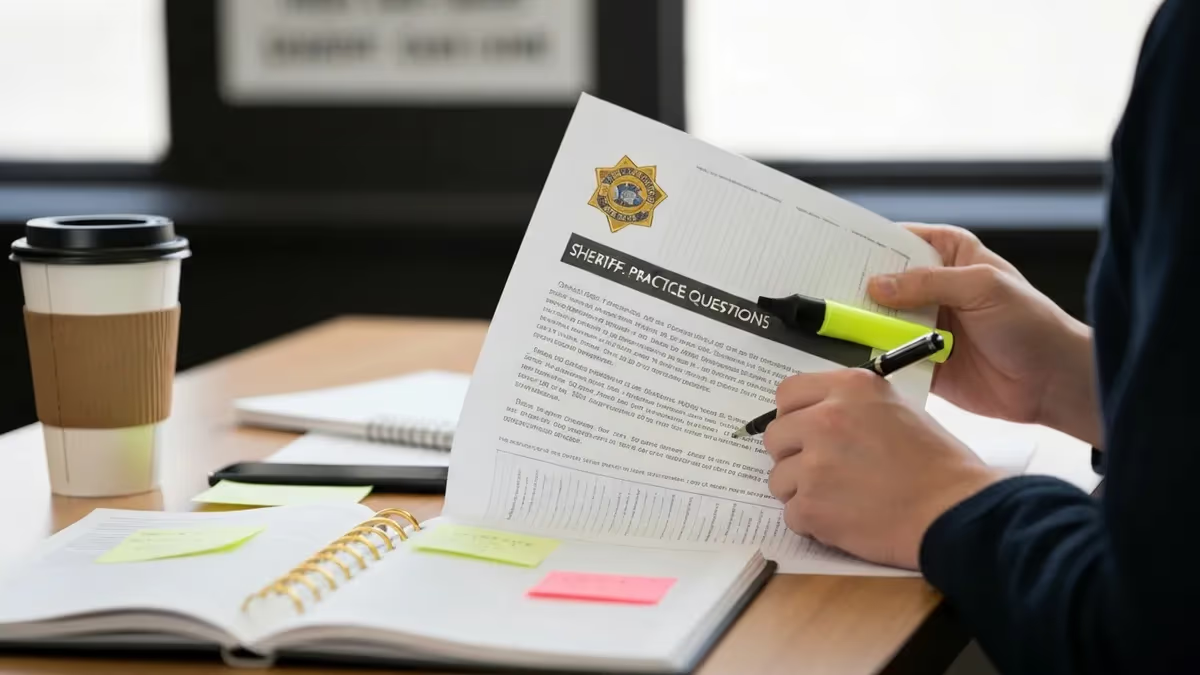
The Iowa State Sheriffs and Deputies Association (ISSDA) stands as one of the most respected professional organizations for law enforcement in the Midwest, providing training, advocacy, and community resources for every deputy sheriffs working across Iowa's 99 counties. Founded to unify county law enforcement professionals, the ISSDA has shaped state policy on everything from officer wellness programs to criminal investigation standards, making it a cornerstone of professional development for anyone pursuing a deputy sheriff career in Iowa or the broader Midwest region.
Understanding what a deputy sheriff does — and how organizations like the ISSDA support their work — is essential context whether you are preparing for a civil service exam, considering a law enforcement career, or simply trying to understand how county-level policing works in America. A deputy sheriff is a sworn law enforcement officer who serves under the authority of an elected county sheriff, performing patrol duties, serving civil process, operating county jails, and responding to emergencies across jurisdictions that range from dense suburban corridors to remote rural landscapes far from city police coverage.
The deputy sheriff role is distinct from municipal police officers in important ways. Deputies draw their authority from the county government and the elected sheriff, not a city or town administration. This means they can operate across an entire county without jurisdictional limits, respond to calls in unincorporated areas where no municipal police exist, and assist other agencies through mutual aid agreements. The scope of this authority is a defining feature of the position and one that professional associations like the ISSDA work hard to protect and define through legislative advocacy at the state capitol.
Salary and compensation are major factors for anyone exploring this career. Nationally, deputy sheriff salary figures vary considerably by region, population density, and department size. In Iowa and comparable Midwestern states, entry-level deputies typically earn between $42,000 and $58,000 annually, while experienced officers in larger counties can reach $70,000 or more when overtime, hazard pay, and benefits are factored into total compensation packages. The ISSDA regularly publishes salary surveys that help county boards benchmark compensation and recruit competitive candidates in a tight labor market.
Professional associations for deputy sheriffs serve functions that go well beyond salary advocacy. The ISSDA, like similar organizations in states such as California, Texas, Florida, and New York, provides continuing education credits, sponsors legislative testimony, organizes regional training academies, and connects deputies with legal defense resources when incidents lead to civil litigation. For newer officers especially, membership in a professional association provides mentorship networks and access to specialized training that might otherwise be unavailable in smaller rural departments with limited budgets and staffing resources.
Career advancement for deputy sheriffs often runs through certifications and specialized assignments that associations help help. Deputies can pursue roles in criminal investigations, K-9 units, SWAT teams, school resource programs, civil process enforcement, and corrections management within county jails. Each specialty requires additional training hours, and state sheriffs associations frequently coordinate multi-county training events that make these opportunities accessible to officers in counties that could not afford to host the programs independently. This cooperative model strengthens rural law enforcement across the entire state.
If you are preparing for a deputy sheriff exam — whether in Iowa or another state — understanding the professional landscape, including the role that state associations play in setting standards and advocating for the profession, will make you a stronger candidate in oral board interviews and written examinations alike. This guide walks through the structure of the deputy sheriff profession, key compensation benchmarks, career pathways, and practical exam preparation strategies so you can approach the hiring process with both knowledge and confidence.
Deputy Sheriff Career by the Numbers

What Does a Deputy Sheriff Association Actually Do?
State sheriffs and deputies associations lobby legislatures on funding, liability protections, civil service rules, and pension benefits. The Iowa State Sheriffs and Deputies Association actively testifies before the Iowa General Assembly on bills affecting county law enforcement operations and officer safety standards.
Associations coordinate regional academies, continuing education events, and specialized certification programs. This is especially valuable for small rural departments that cannot afford to host stand-alone training programs and rely on statewide networks to keep their deputies current on legal and tactical standards.
Modern associations address mental health, peer support, and critical incident stress management. The ISSDA and similar organizations partner with behavioral health providers to offer confidential counseling resources for deputies dealing with the psychological demands of law enforcement work in both urban and rural settings.
Annual salary surveys give county boards and sheriffs data to set competitive pay scales. These benchmarking tools help Iowa counties compete with municipal police departments and state agencies for qualified candidates in a national labor market that is increasingly competitive for sworn law enforcement personnel.
Associations support public safety education campaigns, youth programs, and community policing initiatives across member counties. The ISSDA has sponsored scholarship programs for students pursuing criminal justice degrees and internship pipelines that feed directly into deputy sheriff hiring processes statewide.
Deputy sheriff salary is one of the first questions candidates research when exploring this career, and for good reason — compensation varies dramatically depending on geography, county size, years of experience, and the specific duties attached to the role.
Nationally, the Bureau of Labor Statistics reports that patrol officers and detectives at the county level earn a median salary in the range of $60,000 to $67,000, but this figure masks an enormous range that stretches from under $40,000 in some rural Southern counties to well over $100,000 in high-cost metropolitan areas like Los Angeles, San Jose, or New York's suburban counties.
In Iowa specifically, the ISSDA's salary data consistently shows that larger counties such as Polk, Linn, and Scott offer starting salaries between $52,000 and $62,000 for new deputies, with step increases tied to years of service pushing senior officers into the $70,000 to $85,000 range. Smaller rural counties face more constrained budgets and may start deputies at $38,000 to $46,000, though many offset lower base pay with lower costs of living, reduced call volumes, and stronger community relationships that appeal to officers who prefer a different kind of policing environment than urban departments offer.
Beyond base salary, deputy sheriffs typically receive comprehensive benefits packages that add significant economic value. Health insurance, pension contributions, paid leave, and uniform allowances can add $15,000 to $25,000 in annual value above the base wage. Many departments also offer overtime opportunities, particularly for deputies working special events, court security details, or filling staffing gaps in county jails, which are often managed by the same sheriff's office that handles patrol operations. When overtime is accounted for, total annual earnings for experienced deputies regularly exceed published salary figures by meaningful margins.
The deputy sheriff and sheriff relationship directly affects compensation structures at the county level. Because sheriffs are elected officials, they have considerable discretion over department operations and budget requests to county supervisors, but their actual funding depends on county board approval.
This political dimension means that deputy pay in a given county can fluctuate based on election outcomes, county revenue health, and the negotiating skill of professional associations that advocate on behalf of rank-and-file officers. Understanding this dynamic helps explain why the Iowa State Sheriffs and Deputies Association invests heavily in relationships with county boards and state legislators rather than focusing exclusively on training programs.
Career advancement opportunities also affect long-term earnings. Deputies who earn investigator, sergeant, or lieutenant promotions access higher pay grades with corresponding supervisory responsibilities. Specialized assignments such as detective work, K-9 handling, or SWAT team participation often come with pay differentials or assignment pay that supplements base salary. Some officers pursue dual tracks within their departments, combining patrol leadership with specialized skills to maximize both their career impact and their compensation over a 20-to-30-year law enforcement career.
For candidates researching the riverside county sheriff says no immigration enforcement by deputies and similar policy debates, it is worth noting that political decisions made by elected sheriffs can directly affect department culture, deputy workload, and even recruitment priorities. When a sheriff makes a high-profile policy declaration, it reflects the unique elected nature of the position — a feature that distinguishes sheriffs from appointed police chiefs and shapes the working environment for every deputy in the department. This elected dynamic is something professional associations navigate carefully when engaging in public advocacy.
The path from entry-level deputy to senior investigator or command staff typically spans 10 to 15 years of active service, punctuated by promotional exams, performance evaluations, and opportunities to take on specialized roles that build supervisory credentials. Professional associations like the ISSDA accelerate this pathway by providing leadership training, connecting deputies with mentors in other counties, and sponsoring programs that develop the next generation of county law enforcement leaders before they are needed to fill vacant command positions.
Deputy vs Sheriff: Understanding the Key Differences
A sheriff is a constitutionally recognized elected official in most U.S. states, deriving authority directly from the state constitution rather than from a city council or appointed board. This gives sheriffs a unique form of independence — they answer to voters, not to appointed administrators. Deputies, by contrast, derive their authority from the sheriff who appoints them, meaning their powers are essentially delegated from the elected official above them in the organizational structure.
Jurisdictionally, both sheriffs and deputies operate across the entire county, including unincorporated areas outside city limits where no municipal police have authority. This county-wide reach is a defining feature of the sheriff model and means that deputies regularly work in rural territories, state highways, and small communities that may have volunteer fire departments but no local police force of their own. The broad geographic scope makes the deputy role uniquely varied compared to city police assignments.

Pros and Cons of a Deputy Sheriff Career
- +County-wide jurisdiction gives deputies broad law enforcement authority without city limits restrictions
- +Diverse daily duties spanning patrol, investigations, civil process, and jail management build versatile skills
- +Stable government employment with defined pension benefits and health insurance provides long-term financial security
- +Professional associations like the ISSDA provide ongoing training, mentorship, and legislative advocacy support
- +Opportunities to specialize in K-9, SWAT, investigations, or school resource programs within a single department
- +Strong community connections in rural counties create meaningful, lasting relationships with the public served
- −Entry-level salaries in rural counties may be significantly lower than urban police departments in the same region
- −Rotating shift work including nights, weekends, and holidays creates personal and family scheduling challenges
- −Exposure to traumatic incidents requires active mental health management and peer support resources over a full career
- −Elected sheriff leadership means department priorities can shift substantially after each election cycle
- −County budget constraints can limit staffing, equipment upgrades, and specialized training opportunities
- −Civil liability exposure in high-profile incidents requires careful documentation and awareness of evolving legal standards
Pros and Cons at a Glance
| Pros | Cons |
|---|---|
| County-wide jurisdiction gives deputies broad law enforcement authority without city limits restrictions | Entry-level salaries in rural counties may be significantly lower than urban police departments in the same region |
| Diverse daily duties spanning patrol, investigations, civil process, and jail management build versatile skills | Rotating shift work including nights, weekends, and holidays creates personal and family scheduling challenges |
| Stable government employment with defined pension benefits and health insurance provides long-term financial security | Exposure to traumatic incidents requires active mental health management and peer support resources over a full career |
| Professional associations like the ISSDA provide ongoing training, mentorship, and legislative advocacy support | Elected sheriff leadership means department priorities can shift substantially after each election cycle |
| Strong community connections in rural counties create meaningful, lasting relationships with the public served | County budget constraints can limit staffing, equipment upgrades, and specialized training opportunities |
Deputy Sheriff Career Requirements Checklist
- ✓Verify minimum age requirement — most departments require candidates to be at least 21 years old at time of appointment
- ✓Confirm U.S. citizenship or permanent legal resident status as required by your target county's application
- ✓Obtain a valid driver's license with a clean driving record and no disqualifying traffic violations
- ✓Complete a high school diploma or GED — many departments now prefer or require some college coursework
- ✓Pass a background investigation covering criminal history, financial records, employment, and personal references
- ✓Successfully complete the written civil service examination covering reading comprehension, math, and situational judgment
- ✓Pass a physical fitness evaluation meeting department standards for strength, endurance, and agility
- ✓Complete a psychological evaluation conducted by a licensed mental health professional approved by the department
- ✓Pass a medical examination including vision, hearing, and general health standards required for duty status
- ✓Graduate from a state-certified law enforcement training academy following conditional offer of employment
Association Membership Can Start Before You Are Hired
Many state sheriffs and deputies associations offer student membership or affiliate status for criminal justice students and exam candidates. Joining before you are hired gives you access to training resources, networking events, and industry publications that provide real insight into the profession — and signals to interviewers that you are serious about a long-term career, not just a first job in law enforcement.
Training and professional development form the backbone of a successful deputy sheriff career, and organizations like the Iowa State Sheriffs and Deputies Association play a critical role in making high-quality training accessible to departments of every size. Initial academy training typically spans 16 to 24 weeks and covers criminal law, defensive tactics, firearms qualification, emergency vehicle operations, first aid, and report writing — but the real learning accelerates dramatically once a new deputy begins field training under the supervision of an experienced training officer who evaluates performance across dozens of documented evaluation categories.
Field training programs, commonly structured as 12-to-16-week rotations following academy graduation, expose new deputies to the full spectrum of call types they will encounter independently once released to solo patrol. Training officers evaluate decision-making under pressure, communication with emotionally distressed individuals, documentation accuracy, and the ability to de-escalate volatile situations without unnecessary use of force. These structured evaluations are the primary filter between academy graduates and officers who are genuinely ready to protect the public independently, and failing to meet field training standards is one of the most common reasons new hires do not complete their probationary period.
Continuing education requirements keep experienced deputies current on changing laws, court rulings, and emerging threats. Iowa mandates ongoing training hours for all certified peace officers, and the ISSDA coordinates much of this continuing education through regional training events that bring deputies from multiple counties together. Topics covered in recent years have included implicit bias awareness, crisis intervention team certification, active threat response protocols, cybercrime investigation basics, and trauma-informed interviewing techniques for working with victims of domestic violence and human trafficking.
Specialized training beyond the mandatory minimums distinguishes deputies who advance quickly from those who remain in general patrol for their entire careers. Officers interested in detective work pursue investigator training programs through organizations like the Iowa Division of Criminal Investigation or national bodies such as the International Association of Chiefs of Police. K-9 handlers complete multi-week courses with their assigned dogs, building the communication skills and legal knowledge needed to deploy narcotics or tracking animals in compliance with Fourth Amendment search-and-seizure requirements that courts scrutinize closely in drug cases.
Leadership development is an area where professional associations add value that individual departments struggle to replicate internally. The ISSDA sponsors supervisory skills programs, command staff development seminars, and partnerships with colleges that offer criminal justice degrees with law enforcement professional credit. Deputies who invest in these programs early in their careers position themselves for promotional opportunities years before those positions open, arriving at the examination process with demonstrated leadership experience rather than relying solely on seniority and institutional memory.
Mental health and resilience training has emerged as a priority area for both departments and professional associations over the past decade. Research consistently shows that law enforcement officers face improved rates of PTSD, depression, and substance use disorders compared to the general population, driven by cumulative exposure to traumatic incidents rather than any single defining event.
Associations like the ISSDA have responded by funding peer support specialist training programs, partnering with employee assistance providers, and advocating for state legislation that protects officers who seek mental health treatment from career consequences — a cultural shift that has meaningful implications for officer retention and long-term wellness.
Technology training is increasingly central to the modern deputy sheriff role. Body-worn cameras, electronic citation systems, computerized dispatch interfaces, license plate readers, and digital evidence management platforms all require proficiency that was not part of the academy curriculum a generation ago. The ISSDA works with technology vendors and state agencies to ensure that training on new systems reaches deputies in even the smallest and most resource-constrained Iowa counties, preventing a two-tier system where larger departments operate sophisticated technology while rural officers lag years behind in capability and legal compliance.

Most deputy sheriff applications are disqualified during background investigation for issues candidates did not expect to be disqualifying. These include undisclosed prior drug use, financial delinquencies such as serious debt or bankruptcy, dishonesty on the application itself, domestic violence convictions (which prohibit firearm possession under federal law), and social media posts demonstrating bias or unprofessional conduct. Review your digital footprint and be completely honest on all application materials — investigators will find discrepancies, and dishonesty is an automatic disqualifier in virtually every department.
The practical distinction between deputy vs sheriff becomes clearest when examining how authority flows through a county law enforcement organization on a day-to-day operational basis. The elected sheriff sets policy, manages the budget, and serves as the public face of the department, but it is the deputies who actually execute that policy on every shift — making independent judgments about when to arrest, when to warn, when to use force, and how to balance community relationships with enforcement priorities. This operational reality makes the quality of deputy training and professional standards absolutely central to the reputation of any sheriff's office.
The Iowa State Sheriffs and Deputies Association has historically been most influential in the legislative arena, working to ensure that Iowa law supports the operational needs of county law enforcement rather than creating bureaucratic obstacles to effective policing. Key victories over the years have included securing state funding for county jail modernization, establishing clear legal frameworks for drone use in law enforcement investigations, and creating statutory protections for the confidentiality of officer personnel records that shield deputies from politically motivated disclosure requests targeting their employment histories.
Community policing initiatives championed by professional associations represent another dimension of the deputy sheriff's evolving role. Unlike reactive enforcement models that prioritize rapid response to calls for service, community policing asks deputies to build proactive relationships with community members, identify underlying causes of recurring crime, and partner with social service agencies on interventions that address root causes rather than cycling the same individuals through the justice system repeatedly without addressing the behavioral health, housing, or substance use issues driving their contact with law enforcement.
The sheriff's association model has proven resilient because it addresses a fundamental challenge of county law enforcement: the structural isolation of small departments. A county with 15 sworn deputies does not have the internal infrastructure to develop comprehensive training programs, conduct competitive salary research, monitor legislative developments, or provide legal support when deputies face civil suits.
By pooling resources across all 99 Iowa counties, the ISSDA creates a level of institutional capacity that no individual small department could replicate, ensuring that a deputy working in rural Monona County has access to the same professional resources as a colleague in Des Moines's much larger Polk County Sheriff's Office.
National-level professional organizations complement state associations by providing broader research, model policies, and cross-state networking. The National Sheriffs' Association, headquartered in Alexandria, Virginia, serves as the federal advocacy voice for the sheriff model of law enforcement and publishes training standards and policy research that state associations like the ISSDA adapt to local contexts.
Deputies who engage with both state and national organizations build professional networks that transcend county and state lines, creating connections that can help lateral hiring, information sharing on criminal investigations, and collaborative responses to regional threats like drug trafficking networks that operate across multiple county and state jurisdictions simultaneously.
Understanding the institutional ecosystem surrounding the deputy sheriff profession — from county departments to state associations to national organizations — prepares exam candidates to answer oral board questions about professionalism, career goals, and community engagement with substance and depth. Interviewers consistently report that candidates who demonstrate awareness of the professional landscape, including how associations shape training standards and legislative priorities, distinguish themselves from applicants who can only discuss their personal motivations for wanting the job without articulating how they understand the broader institutional context they would be entering.
Compensation advocacy remains one of the most tangible functions professional associations perform for working deputies. When county budget negotiations arise, having documented salary benchmark data from the ISSDA gives sheriffs credible evidence to bring to county supervisors — moving the conversation from abstract appeals to fairness toward concrete comparisons with neighboring counties and competing employers. Deputies who understand this advocacy function are better positioned to engage constructively with union representatives, association leadership, and supervisors on compensation matters throughout their careers rather than remaining passive recipients of whatever salary the county chooses to offer.
Preparing effectively for the deputy sheriff civil service examination requires a structured study approach that goes beyond simply reviewing criminal law textbooks. Modern deputy exams assess a broad range of cognitive and situational competencies including reading comprehension, written communication, logical reasoning, basic mathematics, map reading, memory and observation, and scenario-based judgment that tests candidates' ability to make sound decisions under pressure with incomplete information. Understanding the specific format of your target county's exam is the essential first step in designing a preparation strategy that addresses the actual content you will face.
Reading comprehension sections on deputy sheriff exams typically present candidates with law enforcement policy excerpts, incident reports, or general-interest passages and then ask questions that test whether the candidate understood both the explicit content and the implicit implications of what they read. Many candidates underperform on these sections not because they lack intelligence but because they rush through passages without reading carefully. Practicing with timed reading exercises — setting a stopwatch and reading a 300-word passage before answering five questions in under four minutes — builds the paced focus that high-stakes exam conditions require.
Mathematics on deputy exams is generally not advanced — expect basic arithmetic, percentages, ratios, and simple data interpretation from tables or charts rather than algebra or calculus. However, candidates who have been out of school for several years often find that basic calculation fluency has eroded, particularly for questions involving percentages of populations, speed-distance-time calculations relevant to vehicle pursuit scenarios, or proportional reasoning applied to evidence measurements. Dedicating two to three weeks of focused practice to mathematics fundamentals produces significant score improvements for most candidates who identify this as a weak area early in their preparation timeline.
Situational judgment tests (SJTs) present realistic law enforcement scenarios and ask candidates to select the most appropriate response from four or five options. These questions assess values alignment, decision-making under pressure, ethical reasoning, and understanding of professional standards — competencies that training can reinforce but that are difficult to fake when the scenarios are well-constructed. Preparing for SJTs involves reading your target department's published core values and policy priorities, reviewing basic law enforcement ethics frameworks, and practicing with realistic scenarios until your instinctive responses align with professional standards rather than raw personal reaction.
Physical fitness preparation should begin at least 60 to 90 days before your scheduled physical ability test, not the week before. Most deputy sheriff fitness standards assess push-up and sit-up repetitions within timed intervals, a 1.5-mile run, and an obstacle course or job task simulation that tests functional movement. Candidates who treat the physical test as an afterthought consistently underperform relative to their peers who maintained structured fitness programs throughout the application process. Your physical fitness is also a signal to evaluators about discipline and self-management — qualities that every law enforcement agency values highly in new hires.
The oral board interview represents the stage where intellectually well-prepared candidates most commonly lose ground to competitors who invested equivalent time in practice. Oral boards typically consist of three to five evaluators who present structured behavioral and situational questions, rating each response on dimensions like communication clarity, professional judgment, and alignment with department values.
Practicing responses aloud — with a timer, with a recording device, or with a partner — is qualitatively different from reviewing answers silently in your head, and the difference shows clearly in actual interview performance when anxiety activates and mental scripts dissolve under the pressure of real-time evaluation by senior officers whose opinions will directly determine your hiring outcome.
Background investigation preparation is an often overlooked component of exam success. Candidates who proactively gather employment records, reference contact information, and documentation of any prior legal issues or financial difficulties will move through the background process faster and with less anxiety than those who scramble to locate records during the investigation period. Being thoroughly honest and well-organized during background investigation demonstrates the integrity and attention to detail that law enforcement employers want to see demonstrated before they issue a badge and a firearm to a new officer who will exercise enormous independent authority in their community.
Sample Sheriff - Deputy Sheriff Exam Practice Questions
Try these questions from our free Sheriff - Deputy Sheriff Exam practice tests. The correct answer and an explanation follow each question.
Under the 'good faith' exception established in United States v. Leon (1984), illegally obtained evidence may still be admitted if:
- A. Officers acted in objectively reasonable reliance on a warrant that was later found to be defective
- B. The officer personally believed the search was morally justified
- C. The suspect has a prior criminal record that makes guilt probable
- D. The prosecution can show the evidence would have been found eventually
Answer: A. Officers acted in objectively reasonable reliance on a warrant that was later found to be defective
Leon's good faith exception holds that the exclusionary rule does not apply when officers reasonably rely on a search warrant issued by a neutral magistrate, even if the warrant is subsequently invalidated.
Which of the following is NOT a typical duty of a Deputy Sheriff?
- A. Enforcing traffic laws and issuing citations
- B. Conducting criminal investigations
- C. Resolving disputes and maintaining public order
- D. Serving as a personal bodyguard for private individuals
Answer: D. Serving as a personal bodyguard for private individuals
Serving as a personal bodyguard for private individuals is not a typical duty of a Deputy Sheriff, as their role is to uphold public law and order. While they enforce laws, conduct investigations, and maintain public peace, providing private security falls outside their official public service responsibilities. This type of service is usually handled by private security firms or off-duty officers hired for specific events.
The penal code states that for a person to be guilty of burglary, they must (1) enter a structure without permission and (2) do so with the intent to commit a crime therein. A deputy finds a suspect inside a homeowner's garage. Which of the following facts, if true, would allow the deputy to make a deductive conclusion that a burglary did *not* occur?
- A. The suspect provides definitive proof that he entered only to seek shelter from a sudden, life-threatening hailstorm.
- B. The suspect entered through an unlocked door.
- C. The homeowner did not see the suspect take anything.
- D. The suspect has no prior criminal record for theft.
Answer: A. The suspect provides definitive proof that he entered only to seek shelter from a sudden, life-threatening hailstorm.
Deductive reasoning requires applying a general rule to a specific instance. The law (general rule) requires the element of 'intent to commit a crime'. If it is definitively proven that the suspect's intent was something else (seeking shelter), then a key element of the crime is missing, and a deductive conclusion can be made that the act did not meet the legal definition of burglary. The other options do not definitively negate the element of intent.
What is the role of a Deputy Sheriff in community policing?
- A. Conducting undercover operations exclusively
- B. Engaging with the community to build trust and address local concerns
- C. Monitoring social media activity for potential threats
- D. Focusing solely on administrative tasks within the Sheriff's Office
Answer: B. Engaging with the community to build trust and address local concerns
In community policing, a Deputy Sheriff's role is to actively engage with the community to build trust and address local concerns. This involves fostering positive relationships, understanding neighborhood issues, and working collaboratively with residents to prevent crime and improve public safety. It moves beyond traditional enforcement to proactive problem-solving and partnership.
Sheriff Questions and Answers

What Is a Sheriff Deputy? Role, Duties, Salary, and Career Overview
Ace the Sheriff (Deputy Sheriff Exam): Your Guide

What Happens When a Sheriff Comes to Evict You: A Complete Guide to the Eviction Process

Deputy Sheriff: Roles, Elections, Salary, and Career Guide

How Does a Sheriff Serve Papers? Civil Process, Cost, and What to Expect
About the Author
Law Enforcement Trainer & Civil Service Exam Specialist
John Jay College of Criminal JusticeMarcus B. Thompson earned his Master of Arts in Criminal Justice from John Jay College of Criminal Justice and served 12 years as a law enforcement officer before transitioning to full-time academy instruction. He is a POST-certified instructor who has prepared candidates for police entrance exams, firefighter assessments, and civil service examinations across dozens of agencies.
Join the Discussion
Connect with other students preparing for this exam. Share tips, ask questions, and get advice from people who have been there.
View discussion (7 replies)