
South Dakota ServSafe: Complete Training & Certification Guide 2026 September
Pass your South Dakota ServSafe exam with our free servsafe practice test, study tips, and state requirements. 🎯 Start prepping today!
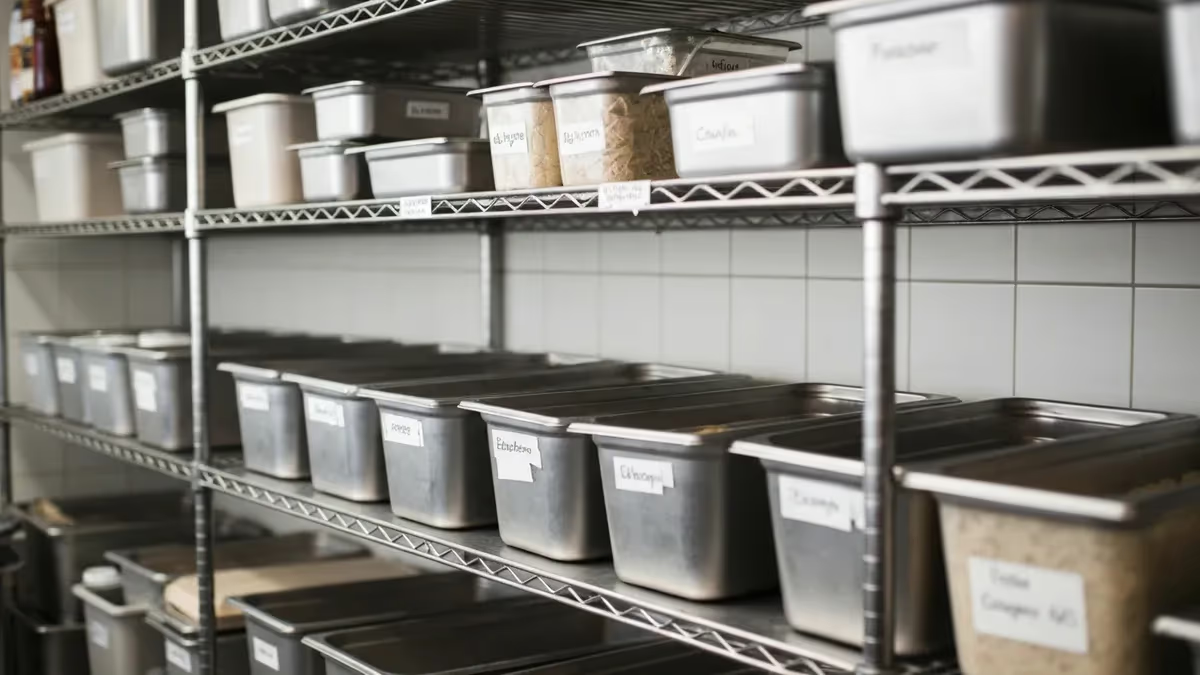
If you are preparing for the south dakota servsafe certification, you are taking the right step toward a safer food service career. ServSafe is the nationally recognized food safety program developed by the National Restaurant Association Educational Foundation, and it is the benchmark credential for food managers across the country. Whether you work in a restaurant, school cafeteria, hospital kitchen, or catering operation, earning this certification shows employers and health inspectors that you understand how to prevent foodborne illness and maintain a safe environment for every customer you serve.
The servsafe practice test is one of the most powerful tools available to help you prepare. By working through realistic exam-style questions before your official test date, you train your brain to recall food safety principles under pressure. Many candidates who rely only on reading the textbook are surprised by the scenario-based questions on the real exam. Practice tests bridge that gap, turning passive knowledge into active recall so you can answer confidently when the clock is ticking on exam day.
South Dakota does not mandate a single statewide certification, but most counties and municipalities align with the FDA Food Code and strongly encourage or require at least one certified food protection manager per establishment. The South Dakota Department of Health enforces these standards through local environmental health departments, and inspectors routinely look for evidence of manager-level food safety knowledge during routine inspections. Having a valid ServSafe Manager certificate on file is the fastest way to demonstrate compliance and avoid costly violations.
The servsafe manager exam consists of 90 questions drawn from eight knowledge domains: the importance of food safety, forms of contamination, the safe food handler, the flow of food, food safety management systems, safe facilities and pest management, cleaning and sanitizing, and food safety regulations. You have 90 minutes to complete the exam, and you need a score of 75 percent or higher — correctly answering at least 68 of 75 scored questions — to pass. Ten of the 90 questions are unscored pilot questions that do not affect your result.
Many South Dakota food service workers ask whether they should pursue the Food Handler certificate or the Manager certificate. The answer depends on your role. If you supervise others, set food safety policies, or manage a kitchen, the Manager certificate is the right choice and is typically required by employers in cities like Sioux Falls, Rapid City, Aberdeen, and Watertown. If you work as a line employee without supervisory duties, the Food Handler certificate may suffice, but the Manager credential always adds value to your resume and can accelerate your path to promotion.
One of the best starting points for your study journey is to review servsafe manager test questions so you understand exactly what topics appear most frequently and how the exam is structured. Knowing the format in advance removes uncertainty and lets you allocate your study time where it matters most. Combine that overview with regular practice sessions using the free quizzes on this site, and you will be well on your way to earning your South Dakota ServSafe certification with confidence.
This guide covers everything you need to know about South Dakota's food safety requirements, how to register for the ServSafe Manager exam, what to expect on test day, and proven study strategies that help candidates pass on their first attempt. Bookmark this page, grab a notebook, and let's get started on building the food safety knowledge that will carry you through your exam and your entire career.
South Dakota ServSafe by the Numbers
South Dakota Food Safety Requirements for Managers
South Dakota follows the FDA Food Code and enforces food safety through local county environmental health offices. While there is no single statewide mandate for a specific brand of certification, the Food Code requires at least one certified food protection manager per establishment in most jurisdictions.
ServSafe Manager is among the most widely accepted certifications in South Dakota. Other ANSI/CFP-accredited programs such as Prometric and 360training are also recognized, but ServSafe's national reputation and widespread proctor network make it the most common choice for SD food workers.
Cities like Sioux Falls and Rapid City may have additional local requirements on top of state standards. Always verify with your local environmental health department to confirm exactly which certificate is required, how many certified managers your establishment must have on staff, and whether reciprocity from another state applies.
South Dakota health inspectors may ask to see your food manager certificate during routine inspections. Keep a copy on file at the establishment and ensure it is not expired. A lapsed certificate can result in a violation notice and require immediate corrective action before your next scheduled re-inspection.
Registering for the ServSafe Manager exam in South Dakota is a straightforward process, but understanding your options upfront saves time and money. There are two primary ways to take the exam: through an in-person proctored session hosted by an authorized ServSafe instructor, or through an online proctored exam you complete at home or at a testing center. Both versions cover the same content and carry the same nationally recognized weight, so the choice comes down to your learning style and schedule flexibility.
To find an in-person session near you, visit the official ServSafe website and use the class locator tool to search by zip code. South Dakota regularly hosts sessions in Sioux Falls, Rapid City, Brookings, Aberdeen, Mitchell, and Watertown. Seats fill up quickly during the spring and fall seasons when food service hiring peaks, so register at least three to four weeks in advance. Most in-person sessions include an optional training course the day before the exam, which is highly recommended if you are a first-time test taker or have been out of a formal study routine for a while.
The online proctored exam requires a computer with a webcam, a stable internet connection, and a quiet private space. A live remote proctor monitors you via webcam during the entire exam session. Before your appointment, run the system check tool on the ServSafe portal to confirm your hardware meets the requirements. Technical problems on exam day can eat into your testing time or, in rare cases, invalidate the session, so always do a full tech check 24 hours in advance.
Understanding the cost structure helps you budget appropriately. The exam fee alone is approximately $36 when purchased separately from a training course. If you purchase an exam voucher bundled with the online study materials, costs typically range from $70 to $110. Full instructor-led courses with the exam included can run $150 to $179 depending on the provider. If cost is a concern, you can find a servsafe manager practice exam bundle that includes discounted access to both study materials and the official exam voucher, helping you save on your total investment while still getting the prep resources you need.
On exam day, arrive or log in at least 15 minutes early. Bring a government-issued photo ID to in-person exams. For online sessions, have your ID ready for the webcam check-in process. You are not permitted to use notes, textbooks, or any reference materials during the exam. The exam is closed-book, which is why thorough advance preparation using a servsafe manager practice test is so critical. Calculators are not required since the exam focuses on conceptual understanding, not math calculations.
Results are typically available immediately after you complete the computer-based exam. If you pass, you will receive a score report and instructions for ordering your official ServSafe Manager certificate from the National Restaurant Association. The certificate arrives by mail within two to four weeks and is valid for five years from the date of the exam. If you do not pass on your first attempt, you may retake the exam after waiting 24 hours, and there is no limit to the number of retakes, though each attempt requires a new exam fee payment.
Knowing what to expect before, during, and after the exam eliminates the anxiety that trips up even well-prepared candidates. The more you simulate real exam conditions during your study sessions — timing yourself, avoiding reference materials, answering questions one by one without going back — the more comfortable and efficient you will be when it counts. That mental rehearsal is what separates candidates who pass on the first try from those who need a second or third attempt.
ServSafe Test Prep Strategies That Work
A focused four-week study plan gives most candidates enough time to master all eight ServSafe knowledge domains without burning out. In week one, read chapters one through three of the ServSafe Manager textbook, covering food safety importance, contamination, and safe food handling. Take a baseline practice test to identify your weakest areas so you can prioritize them in weeks two and three.
In weeks two and three, dive deep into the flow of food, HACCP principles, and food safety management systems — the domains that carry the most exam weight. Use flashcards for temperature thresholds, time-temperature abuse rules, and critical control points. In week four, shift entirely to timed practice tests. Aim to complete at least three full 90-question practice exams under realistic conditions, reviewing every missed question the same day you take the test.

ServSafe Manager Certification: Is It Worth It for South Dakota Workers?
- +Nationally recognized credential accepted by employers in all 50 states, including South Dakota
- +Demonstrates compliance with FDA Food Code requirements and reduces inspection violations
- +Increases earning potential — certified managers often command higher wages than uncertified peers
- +Five-year validity period means you do not need to recertify frequently
- +Online exam option provides flexible scheduling for busy food service professionals
- +Comprehensive curriculum covers all eight food safety domains relevant to real-world kitchen management
- −Exam fee of $36 to $179 can be a financial burden for hourly workers without employer reimbursement
- −90-question exam in 90 minutes is time-pressured and stressful for test-anxious candidates
- −Textbook and study materials are an additional cost on top of the exam fee
- −In-person testing sessions in rural South Dakota may require significant travel to the nearest city
- −Certificate expires after five years, requiring paid renewal and possible retesting
- −South Dakota lacks a single clear statewide mandate, creating confusion about which certification is required
South Dakota ServSafe Exam Prep Checklist
- ✓Obtain the current edition of the ServSafe Manager textbook (7th edition or newer) and read all eight chapters.
- ✓Take a timed baseline practice test in the first week to identify which knowledge domains need the most attention.
- ✓Create flashcards for all temperature thresholds: danger zone, cooking temps, cooling temps, and reheating temps.
- ✓Memorize the seven HACCP principles and be able to identify critical control points in a written scenario.
- ✓Practice identifying the Big 9 food allergens and describe the difference between cross-contamination and cross-contact.
- ✓Complete at least three full 90-question servsafe manager practice tests under timed, closed-book conditions.
- ✓Review every incorrect answer immediately after each practice session and write down the correct rule.
- ✓Confirm your exam registration at least one week before your test date and verify your photo ID is current and valid.
- ✓Run the system check tool 24 hours before an online proctored exam to ensure your hardware and internet connection qualify.
- ✓Get a full night of sleep before exam day and eat a balanced meal to support optimal cognitive performance during the test.
The Temperature Danger Zone Appears on Almost Every Exam
ServSafe data consistently shows that temperature control questions are the most frequently missed items on the Manager exam. Focus extra study time on the range of 41°F to 135°F, the two-hour rule for foods in the danger zone, and the specific internal cooking temperatures for poultry (165°F), ground meat (155°F), and whole-muscle beef (145°F). Mastering these numbers alone can add five to ten points to your score.
Understanding the most common reasons candidates fail the ServSafe Manager exam is just as important as knowing what to study. The number one mistake is underestimating the scenario-based format. Unlike a simple memorization quiz, the ServSafe exam presents realistic kitchen situations and asks you to apply food safety principles to solve them. Candidates who only memorize facts without practicing their application frequently find themselves confused by questions where multiple answers seem plausible. The key is to identify the specific risk or principle at the heart of each scenario before evaluating any answer choice.
The second most common mistake is ignoring the eight-domain structure of the exam. Many first-time test takers spend the majority of their study time on topics they find interesting — typically cooking temperatures and personal hygiene — and neglect domains like pest management, facility design, and food safety regulations. The exam allocates questions proportionally across all eight domains, so a weak performance in any one area can pull your total score below the 75 percent passing threshold even if you excel in your favorite topics.
Time management during the actual exam is another area where prepared candidates stumble. With 90 questions in 90 minutes, you have approximately one minute per question. Many candidates spend too long on difficult scenario questions early in the exam, then rush through the final 20 questions and make careless errors. Practice taking full 90-question tests at home with a strict timer to develop a natural pace that lets you work through every question methodically without feeling rushed at the end.
A surprisingly large number of South Dakota candidates also lose points on the cleaning and sanitizing domain. This section covers sanitizer concentration levels in parts per million, contact time requirements, the proper three-compartment sink process, and the difference between cleaning and sanitizing. These concepts require precise numerical knowledge and are tested in a highly specific way. Flashcards work particularly well for memorizing sanitizer concentrations: chlorine-based sanitizers should be used at 50 to 99 ppm, iodine at 12.5 to 25 ppm, and quaternary ammonium compounds per the manufacturer's instructions.
Personal hygiene rules are another rich source of exam questions that candidates often get partially right. Know not just that employees must wash their hands, but exactly when: after using the restroom, after handling raw meat, after touching the face or hair, after taking out garbage, after handling money, and after any activity that could contaminate hands. Know which illnesses — Hepatitis A, Salmonella Typhi, Shigella, E. coli O157:H7, and Norovirus — require employees to be excluded from the food service operation entirely until they are cleared by a medical professional.
Reading the servsafe exam answers explanation pages for questions you missed during practice is a highly effective but often overlooked strategy. When the official materials explain why the correct answer is correct and why the wrong answers are wrong, you gain insight into the reasoning framework the exam uses. This is more valuable than simply noting the right answer, because the same reasoning framework will help you decode novel scenarios on the real exam that you have never seen before in any practice material.
Finally, build a short pre-exam routine that helps you enter a calm and focused mental state. Review your temperature flashcards one final time the morning of the exam, but do not try to cram new material. Eat a protein-rich breakfast, stay hydrated, and arrive or log in with time to spare.
Candidates who rush into the exam feeling frazzled tend to second-guess correct answers and change them to wrong ones. Trust your preparation, read each question twice before answering, and remember that a 75 percent passing score means you can miss up to 22 questions and still earn your South Dakota ServSafe Manager certification.

The ServSafe Manager certificate is valid for exactly five years from the date of your exam. South Dakota health inspectors may cite an establishment during a routine inspection if the certificate on file is expired, even by a single day. Set a calendar reminder 90 days before your expiration date so you have plenty of time to schedule and complete your renewal exam without any gap in your certified status.
Renewing your South Dakota ServSafe Manager certification before the five-year expiration date is a professional responsibility that protects both your career and your establishment's compliance standing. The renewal process is identical to the initial certification process: you must pass the 90-question ServSafe Manager exam with a score of 75 percent or higher. There is no shortened renewal exam or exemption for experienced food service professionals, which means your renewal prep should be treated just as seriously as your original certification effort.
One advantage you have during renewal is your practical experience. After five years of applying food safety principles on the job, many of the exam scenarios will feel familiar. However, food safety regulations do evolve, and each new edition of the ServSafe Manager textbook incorporates updates to the FDA Food Code and emerging foodborne illness research. Always study from the most current edition of the materials when preparing for your renewal exam, because questions are updated to reflect any changes to temperature thresholds, time limits, or regulatory requirements since the previous edition.
Employers in South Dakota are increasingly reimbursing the cost of ServSafe renewal for managers who remain in good standing. Before paying out of pocket, check with your HR department or general manager about whether your company covers exam fees or provides paid study time. Many large restaurant chains, healthcare food service operators, and school nutrition programs have formal policies for covering certification costs as part of their food safety compliance programs. If your employer does not yet have such a policy, renewing your certification and then making the case for reimbursement is a reasonable professional development conversation to have.
If you work in multiple food service roles across different establishments in South Dakota — as some part-time or contract workers do — your single ServSafe Manager certificate is valid everywhere. You do not need to obtain separate certifications for each employer. Simply provide each establishment with a copy of your certificate and ensure that the copy on file is always your most current, unexpired credential. Some establishments will want to verify your certificate directly through the ServSafe website, which maintains an online certificate verification tool for exactly this purpose.
For food service professionals who are also interested in expanding their credentials, ServSafe offers additional certificates beyond the Manager level. The ServSafe Alcohol certificate is relevant for establishments that serve wine, beer, or spirits. The ServSafe Allergens certificate is increasingly in demand as food allergy awareness grows and restaurants face legal liability for allergen-related incidents.
Earning these supplementary certificates while your Manager certification is current demonstrates a comprehensive commitment to food safety that can distinguish you in a competitive job market. You can access servsafe test 90 questions and answers pdf free download resources and full course listings to explore all available training options and find the program that best fits your career goals and schedule.
Continuing education in food safety also makes practical sense beyond the exam. Foodborne illness outbreaks remain a costly and preventable problem for South Dakota restaurants and food service operations. According to CDC data, approximately 48 million Americans experience foodborne illness each year, and a significant percentage of outbreaks are traced to improper food handling practices that certified food protection managers are specifically trained to prevent. Your certification is not just a piece of paper — it represents the knowledge and judgment that protects every customer who walks through your door.
As you plan your renewal timeline, remember that many South Dakota food service workers choose to retake the ServSafe exam six to eight months before their current certificate expires. This gives you a comfortable buffer in case you do not pass on the first renewal attempt. It also means your new five-year certificate begins from the date of the renewal exam, effectively extending your coverage rather than simply picking up where the old certificate left off. Plan strategically and renew early to maximize the value of every exam fee you pay.
Building a consistent daily study habit is the single most effective thing you can do to improve your ServSafe Manager exam score. Research in cognitive science consistently shows that distributed practice — studying in shorter sessions over a longer period — produces significantly better long-term retention than cramming the night before an exam. For ServSafe, this means committing to 30 to 45 minutes of focused study each day for three to four weeks, rather than trying to power through the entire textbook in a single weekend marathon session.
Start each study session with a brief review of the previous session's material before introducing new content. This spaced repetition approach activates your memory of older information right before it would naturally begin to fade, reinforcing it and moving it from short-term to long-term storage. Flashcard apps like Anki are particularly effective for ServSafe because they automatically schedule reviews based on how well you recalled each card, prioritizing the concepts you find most difficult and reducing time spent on things you already know well.
Group study sessions can add another layer of effectiveness to your preparation, particularly for scenario-based questions. When you talk through a food safety scenario with a study partner and explain why you would choose a particular corrective action, you are engaging the same higher-order reasoning skills the exam tests. Teaching a concept to someone else is one of the most reliable ways to identify gaps in your own understanding, because you cannot fake your way through an explanation the way you might talk yourself into a wrong answer on a practice test.
The ServSafe Manager textbook includes a practice test at the end of each chapter, and these chapter tests are often overlooked by candidates who jump straight to full-length practice exams. Use the chapter tests first to verify your mastery of each domain before moving on. If you score below 80 percent on any chapter test, revisit that chapter before attempting a full-length practice exam. This diagnostic approach ensures you are not carrying unresolved knowledge gaps into your timed simulations, where they can distort your overall score and give you a false sense of readiness.
Pay special attention to the vocabulary used in ServSafe questions. Terms like "sanitize," "clean," "sterilize," "calibrate," "reject," and "discard" all have specific meanings in the food safety context that differ from everyday usage. For example, cleaning removes dirt and food residue, while sanitizing reduces microbial contamination to safe levels — and neither term is interchangeable with sterilizing, which eliminates all microorganisms including spores. Misreading these terms in a question can lead you to the wrong answer even when you know the underlying food safety principle perfectly well.
In the final week before your exam, shift your focus from learning new content to building test-taking stamina and confidence. Take one complete 90-question practice test every other day under strict timed conditions. On the off days, review your error log and do targeted flashcard review for your weakest domains.
Avoid introducing any major new topics in this final week — your brain needs consolidation time, not more new information. Enter the exam day with the confidence that comes from having already proven to yourself, through practice, that you can complete 90 questions in 90 minutes and score above 75 percent.
South Dakota food service professionals who earn and maintain their ServSafe Manager certification join a community of trained food safety advocates who collectively make the food supply safer for everyone. Whether you manage a busy downtown Sioux Falls restaurant, oversee a school cafeteria in the Black Hills region, or run a catering operation serving events across the state, your certification represents a commitment to excellence that goes beyond regulatory compliance. Use the resources on this page, take advantage of every free practice question available, and approach your exam with the preparation and confidence your future customers deserve.
ServSafe Questions and Answers




About the Author

Registered Sanitarian & Food Safety Certification Expert
Cornell University College of Agriculture and Life SciencesThomas Wright is a Registered Sanitarian and HACCP-certified food safety professional with a Bachelor of Science in Food Science from Cornell University. He has 17 years of experience in food safety auditing, regulatory compliance, and foodservice management training. Thomas prepares food industry professionals for ServSafe Manager, HACCP certification, and state food handler examinations.
Join the Discussion
Connect with other students preparing for this exam. Share tips, ask questions, and get advice from people who have been there.
View discussion (7 replies)