
ServSafe Food Safety Study Guide: Complete Certification Prep for 2026 October
Master the ServSafe exam with our food safety study guide. Topics, tips, schedules & practice tests. ✅ Everything you need to pass in 2026 October.

The ServSafe food safety study guide is the single most important resource you can use when preparing for the National Restaurant Association's ServSafe Manager Certification exam. This credential is recognized by health departments in all 50 states and is often required for restaurant managers, food service supervisors, and anyone responsible for overseeing safe food handling operations in a commercial kitchen. Without a structured study plan, many candidates underestimate the breadth of content covered — and end up retaking the exam unnecessarily.
The ServSafe Manager exam covers eight major content domains, ranging from basic microbiology and foodborne illness to complex temperature control requirements, personal hygiene standards, and facility sanitation procedures. Each domain carries its own weight on the 90-question exam, and you need to answer at least 75% of the questions correctly to earn a passing score. Understanding how these domains interconnect — and where the exam tends to concentrate its hardest questions — is the strategic edge that separates first-time passers from repeat test-takers.
One of the most important things candidates discover early in their study process is that ServSafe is not simply a memorization test. The exam includes scenario-based questions that require you to apply food safety principles to realistic situations: a delivery driver arrives with product stored at the wrong temperature, a prep cook is showing symptoms of illness, or a sanitizer solution tests outside the correct concentration range. You must know not just the rules, but how to act on them in real kitchen environments.
This guide is organized to walk you through every major topic area in the right sequence, with practical study strategies built in at each stage. We will cover the core content domains, introduce you to effective study techniques that work for food service professionals, and provide a week-by-week schedule to help you pace your preparation. Whether you are a new kitchen manager studying for the first time or a veteran renewing your credential, this resource will give you a clear roadmap to exam day.
Understanding chemical hazards is one area where candidates frequently lose points, because the topic overlaps with both food safety and regulatory compliance knowledge. If you want to go deeper on that specific subject, our servsafe food safety study guide companion article walks through chemical contamination scenarios in detail. Reviewing that content alongside the broader material here will give you a complete picture of the physical, biological, and chemical hazard categories you will see on the real exam.
The ServSafe certification is administered through the National Restaurant Association Educational Foundation (NRAEF), and the exam itself is available in both a proctored in-person format and an online proctored version. The study materials sold through ServSafe — including the Manager Textbook, 7th Edition — are the official primary source for exam content. However, using practice tests, flashcards, and structured study guides like this one will dramatically increase your comprehension and retention of the material, especially for candidates who do not have a formal food science background.
By the time you finish working through this guide, you will have a clear understanding of every major topic tested on the ServSafe exam, a realistic study timeline calibrated to your available prep time, and access to targeted practice questions for the areas most likely to trip you up. Let us start building that foundation right now, starting with the big picture of what this certification means for your career and your workplace.
ServSafe Certification by the Numbers
ServSafe Study Schedule: Week-by-Week Plan
- ▸Read ServSafe Manager Textbook chapters on microbiology and contamination
- ▸Learn the Big 6 pathogens and their associated foods
- ▸Study FAT TOM conditions that support bacterial growth
- ▸Complete 20-question practice quiz on foodborne illness basics
- ▸Review handwashing procedures and when they are required
- ▸Study policies for ill employees and when to restrict or exclude
- ▸Learn receiving temperature requirements for all food categories
- ▸Practice identifying signs of food spoilage and supplier fraud
- ▸Memorize minimum internal cooking temperatures for all proteins
- ▸Study FIFO rotation and correct storage order by temperature
- ▸Review Time-Temperature Control for Safety (TCS) food rules
- ▸Complete practice questions on cooling methods and timelines
- ▸Study the three-compartment sink procedure step by step
- ▸Review sanitizer types, concentrations, and testing procedures
- ▸Learn the seven HACCP principles and how to apply them
- ▸Take a full-length 90-question practice exam under timed conditions
The ServSafe exam is organized around eight content domains, each of which tests a different dimension of food safety management. The first domain covers the fundamentals of food safety itself — why pathogens thrive, how foodborne illness spreads, and what conditions managers must control to prevent outbreaks. This is foundational knowledge that underpins every other domain, so candidates who master this material early in their studies tend to find the rest of the content much easier to absorb and connect.
Domain two focuses on personal hygiene and employee health management. This section tests whether you know when workers must wash their hands, what constitutes proper handwashing technique, and critically, when an ill employee must be restricted from working with food versus excluded from the facility entirely. The distinction between restriction and exclusion is a high-frequency exam topic. For example, an employee with a sore throat and fever should be restricted from working with exposed food, while someone diagnosed with Salmonella Typhi must be excluded entirely until medically cleared.
Domain three covers the purchasing, receiving, and storage of food products. This section requires you to know the correct receiving temperatures for every major food category — whole muscle beef must arrive at 41°F or below, raw poultry at 41°F or below, and shell eggs at 45°F or below as an air temperature standard. You will also need to understand how to reject a delivery: what signs of temperature abuse, physical damage, or supplier fraud should trigger a refusal, and how to document the rejection correctly.
The fourth domain addresses food preparation safety, including thawing methods, marinating procedures, and the prevention of cross-contamination during prep. Five safe thawing methods are tested: under refrigeration at 41°F or below, submerged under running potable water at 70°F or below, as part of the cooking process, in a microwave if immediately cooked, and commercially packaged methods. Using any other approach — such as thawing on a countertop at room temperature — is a critical violation that exam questions will specifically probe.
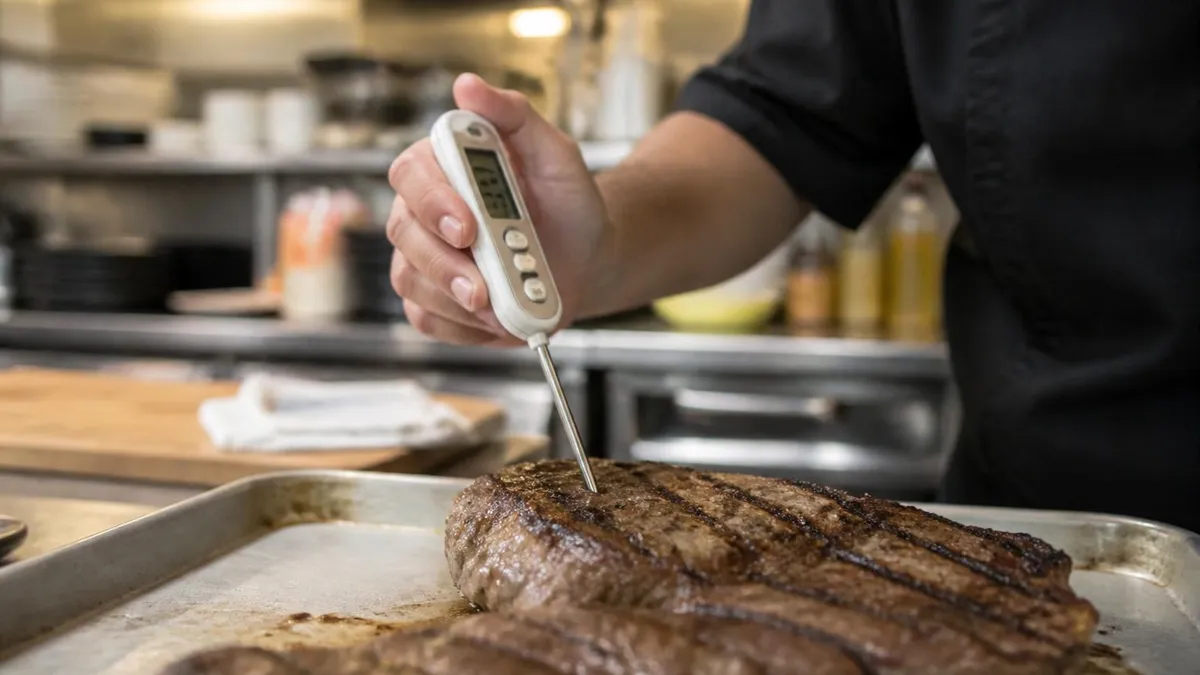
Domain five covers cooking and holding temperatures, which is arguably the most memorization-intensive section of the entire exam. You must know minimum internal cooking temperatures for poultry (165°F), ground meat (155°F), whole muscle proteins and seafood (145°F), and ready-to-eat foods that are simply being reheated for hot holding (165°F within two hours). These numbers must be recalled instantly under exam pressure, because scenario questions will embed them inside realistic cooking narratives designed to test whether you can apply them correctly.
Domains six and seven address facility design, pest control, and the cleaning and sanitization of equipment and surfaces. The three-compartment sink procedure — wash, rinse, sanitize — is a cornerstone topic, and candidates must know the correct water temperatures and sanitizer concentrations for chemical sanitizers including chlorine (50–99 ppm), iodine (12.5–25 ppm), and quaternary ammonium (200–400 ppm depending on the product). Pest management, ventilation requirements, and proper plumbing configurations for preventing backflow are also covered in this domain cluster.
The eighth domain is HACCP — Hazard Analysis and Critical Control Points. This is the systematic approach that food service operations use to identify, evaluate, and control food safety hazards throughout the flow of food. The seven HACCP principles are tested directly: conduct a hazard analysis, identify critical control points (CCPs), establish critical limits, establish monitoring procedures, establish corrective actions, establish verification procedures, and establish record-keeping procedures. Understanding how these seven steps function together as a management system — rather than as isolated rules — is what will earn you points on the most challenging exam questions in this domain.
Best Study Methods for the ServSafe Exam
Active recall is the most evidence-backed study technique for certification exams like ServSafe. Instead of re-reading your textbook passively, active recall means closing the book and forcing yourself to retrieve information from memory. Create flashcards for every cooking temperature, sanitizer concentration, and HACCP principle — then quiz yourself daily. Research consistently shows that students who use active recall outperform passive readers by a significant margin on retention and exam performance.
The most effective implementation of active recall for ServSafe is to pair your flashcard practice with scenario-based questions. After you have drilled a temperature with flashcards, immediately apply it: given a specific protein and cooking method, what temperature must the thermometer read? This two-layer approach — first recall the rule, then apply it — mirrors exactly how the exam tests your knowledge and builds the neural pathways needed to answer quickly and confidently under timed conditions.

Official ServSafe Materials vs. Third-Party Study Guides
- +Official textbook is the authoritative source for all exam content
- +Third-party guides often distill dense chapters into digestible summaries
- +Practice test platforms provide immediate feedback that textbooks cannot
- +Using multiple resources reinforces learning through varied presentation
- +Third-party flashcard decks save hours of card-creation time
- +Online practice quizzes are available 24/7 for flexible study scheduling
- −Official materials cost $90-$150 and may not be reusable after exam
- −Third-party guides can contain outdated information from older editions
- −Free online practice tests vary widely in accuracy and question quality
- −Relying solely on third-party summaries risks missing critical exam details
- −The official textbook is dense and can be difficult to study without guidance
- −Not all practice question platforms align with the current 9th edition content
ServSafe Exam Day Prep Checklist
- ✓Complete at least one full 90-question timed practice exam in the final week
- ✓Review all minimum internal cooking temperatures until recall is instant
- ✓Memorize sanitizer concentration ranges for chlorine, iodine, and quaternary ammonium
- ✓Know the seven HACCP principles and be able to apply them to a scenario
- ✓Study the Big 6 pathogens: Salmonella Typhi, Hepatitis A, Norovirus, Shigella, E. coli O157:H7, Nontyphoidal Salmonella
- ✓Confirm your exam registration, location, and photo ID requirements at least 48 hours before
- ✓Bring two valid forms of identification to the testing center
- ✓Arrive at the testing location at least 15 minutes before your scheduled start time
- ✓Review FAT TOM conditions one final time the morning of the exam
- ✓Get at least 7 hours of sleep the night before — fatigue significantly impairs recall
Temperature Control Accounts for the Largest Share of Exam Points
Across all eight content domains, questions related to temperature control for safety — including cooking temperatures, cooling timelines, holding temperatures, and the temperature danger zone — appear more frequently than any other topic cluster. Candidates who can instantly recall that the temperature danger zone runs from 41°F to 135°F, and that food must pass through this range within specific time limits during cooling, are positioned to earn 15 to 20 additional points compared to candidates who leave these questions to guesswork.
Time and temperature control for safety — commonly abbreviated as TCS — is the single most tested concept on the entire ServSafe Manager exam. TCS foods are those that support the growth of pathogens and therefore require strict management of both temperature and time during every phase of the flow of food: receiving, storage, preparation, cooking, holding, cooling, and reheating. Understanding which foods qualify as TCS, why they qualify, and what the specific rules are for each phase is essential for earning a high score.
The temperature danger zone is defined as 41°F to 135°F. Within this range, bacteria can multiply rapidly — under ideal conditions, some pathogens can double in number every 20 minutes. Food that remains in the danger zone for more than four cumulative hours is considered unsafe and must be discarded, not salvaged. This four-hour limit is cumulative: a piece of chicken that sat at room temperature during receiving for 45 minutes, then during prep for another 30 minutes, is accumulating time against that four-hour clock even if it is refrigerated in between.
Cooling cooked food correctly is one of the most commonly failed practical skills in food service, and it is heavily tested on the ServSafe exam. The two-stage cooling method requires food to be brought from 135°F to 70°F within two hours, and then from 70°F to 41°F or below within an additional four hours — for a total maximum cooling time of six hours.
The first two-hour window is the critical one, because bacterial growth accelerates most rapidly in the upper portion of the danger zone. Approved cooling methods include ice baths, blast chillers, ice paddles, and dividing food into shallow pans to increase surface area for heat transfer.
Hot holding requires that food be maintained at 135°F or above at all times once it leaves the cooking process. Cold holding requires food to be maintained at 41°F or below. Both of these thresholds are tested directly, but the exam also probes candidates on what to do when a holding unit fails: if a hot holding unit breaks down and food temperatures drop below 135°F, the food is not automatically discarded. It must be reheated to 165°F within two hours and then returned to proper hot holding temperature. If two hours pass without reheating, the food must be discarded.
Reheating for hot holding carries its own specific requirement: food must reach an internal temperature of 165°F within two hours. This is distinct from the minimum cooking temperature for that same food item. A piece of chicken that was originally cooked to 165°F and then properly cooled and stored must still be reheated to 165°F — not its minimum cooking temperature — before it can be placed back in hot holding service. The exam uses subtle variations like this to distinguish candidates who truly understand the principles from those who have only memorized isolated facts.
The use-by date and discard rules for ready-to-eat TCS foods stored under refrigeration are also tested on the exam. Once a ready-to-eat TCS food has been prepared or a commercially sealed package has been opened, it must be date-marked and used within seven days if held at 41°F or below. If held between 41°F and 45°F — an older standard still applicable in some jurisdictions — the maximum holding time is reduced to four days. Candidates must know both windows because exam questions sometimes specify the holding temperature and ask for the correct maximum hold time.
Thermometers are the practical tool that makes temperature control actionable, and the ServSafe exam includes several questions on correct thermometer use and calibration. Bimetallic stemmed thermometers are the most common type in food service and must be calibrated regularly using either the ice-point method (32°F in an ice-water slurry) or the boiling-point method (212°F at sea level, adjusted for altitude). Thermocouples and thermistors are faster and more accurate alternatives, and infrared thermometers can measure surface temperatures but cannot be used to verify internal cooking temperatures — a nuance the exam tests specifically.
ServSafe exam seats at proctored testing centers can fill up quickly, particularly in urban areas during peak hiring seasons in spring and fall. Many state health departments require food managers to hold a valid certification before they can legally supervise food service operations, meaning that delays in scheduling can have direct professional consequences. Register for your exam at least three to four weeks in advance to ensure you have adequate preparation time and a confirmed seat on your preferred date.
Understanding food safety hazards across all three categories — biological, chemical, and physical — is essential for achieving a passing score on the ServSafe Manager exam. Biological hazards include bacteria, viruses, parasites, and fungi. Chemical hazards include cleaning agents, sanitizers, pesticides, and naturally occurring toxins. Physical hazards include foreign objects such as glass, metal fragments, bone chips, and plastic pieces that can cause injury when consumed. Each hazard category has its own prevention strategies, and the exam tests all three with equal rigor.
Biological hazards represent the most complex category because they require understanding of microbiology, transmission routes, and pathogen-specific characteristics. The Big 6 pathogens — Salmonella Typhi, Hepatitis A virus, Norovirus, Shigella spp., Shiga toxin-producing E. coli (STEC), and Nontyphoidal Salmonella — are specifically identified by the FDA as requiring immediate exclusion of infected food handlers from the facility. Other pathogens cause illness but do not necessarily trigger the same exclusion requirements. Knowing which pathogens fall into the Big 6 category and which associated foods they contaminate is a high-frequency exam topic.
Viruses are the leading cause of foodborne illness in the United States, and Norovirus is the single most common culprit. Unlike bacteria, viruses cannot reproduce outside of a living host, but they can survive on surfaces and in food products and remain infective at very low doses — as few as 18 to 20 viral particles can cause illness in a susceptible individual. This extraordinarily low infectious dose makes Norovirus particularly dangerous in food service settings, where an ill employee touching food contact surfaces or ready-to-eat foods can trigger a large-scale outbreak within hours.
Parasites represent a smaller but important subset of biological hazards. Anisakis simplex is associated with raw or undercooked fish, Cryptosporidium parvum with contaminated water sources, Cyclospora cayetanensis with fresh produce, and Toxoplasma gondii with raw or undercooked meat. The primary control for parasites in fish served raw or undercooked — such as sushi or ceviche — is freezing at -4°F (-20°C) for seven days or -31°F (-35°C) for 15 hours, which kills the parasitic larvae. This freezing requirement is frequently tested on the exam in the context of sushi and sashimi preparation.
Chemical contamination is a critical area of study, and our companion resource on ServSafe chemical contamination scenarios walks through specific examples in detail. In general, chemical hazards fall into three subcategories: naturally occurring chemicals (such as the toxin produced by toxic mushrooms or histamine in scombroid fish), intentionally added chemicals (pesticides, food additives used incorrectly), and incidentally added chemicals (cleaning agents or sanitizers that contaminate food through improper storage, labeling, or use). The most preventable chemical contamination incidents involve storing chemicals above or alongside food — a basic but critically important separation requirement.
Physical hazards are perhaps the most straightforward category from a prevention standpoint, but they are still tested on the exam. The primary prevention strategies include using equipment with smooth, sealed surfaces that do not shed fragments, maintaining cutting boards in good condition and replacing them when they develop deep grooves, requiring employees to remove jewelry before working with food, using metal detectable bandages that can be caught by food processing safety systems, and inspecting incoming food deliveries for signs of contamination from broken packaging or embedded foreign objects.
Allergen management represents a fourth hazard category that has grown in prominence in recent editions of the ServSafe curriculum. The FDA's Big 9 food allergens — milk, eggs, fish, shellfish, tree nuts, peanuts, wheat, soybeans, and sesame — must be disclosed to guests upon request, and cross-contact between allergenic and non-allergenic foods must be prevented through dedicated equipment, separate preparation areas, and thorough staff training. Unlike cross-contamination with pathogens, cross-contact with allergens cannot be eliminated by cooking — even trace amounts of an allergen in a finished dish can trigger a life-threatening anaphylactic reaction in a sensitized individual.
Building an effective final-week review strategy is just as important as the month of preparation that precedes it. By the time you reach the seven days before your exam, you should have already completed a thorough review of all eight content domains and taken at least one full-length practice exam. The final week is not the time to learn new material — it is the time to consolidate, identify persistent gaps, and build the mental confidence that will carry you through 90 questions under timed pressure.
Start the final week by reviewing your most recent practice test results. Sort the questions you missed by content domain and identify which two or three domains account for the majority of your errors. Spend the first two days of the final week doing targeted review of those weak areas only, using flashcards, the textbook, and additional practice questions in those specific domains. Resist the temptation to re-read chapters you already know well — time spent on mastered content is time not spent strengthening genuine weak spots.
On day three or four of the final week, take a second full-length practice exam under realistic conditions. Sit somewhere quiet, set a two-hour timer, and do not use any reference materials. When you finish, immediately review every question — not just the ones you missed. For each question you answered correctly, confirm that you knew the answer with certainty rather than guessing. For guessed correct answers, treat those questions as missed ones for review purposes, because a guess that happened to be right provides no reliable protection on the real exam.
Spend days five and six doing a rapid-fire review of your highest-priority flash cards: cooking temperatures, sanitizer concentrations, Big 6 pathogens, FAT TOM conditions, HACCP principles, and cooling timeline requirements. At this stage, your review sessions should feel fast and almost effortless — if they do not, that is useful diagnostic information pointing to an area that needs one more pass. Keep sessions to 45 minutes or less to avoid mental fatigue, and take breaks that involve physical activity rather than screen time to support cognitive consolidation.
On the day before the exam, do not study. This sounds counterintuitive, but the evidence from cognitive psychology research is clear: studying intensively the day before a high-stakes exam increases anxiety and impairs performance more than it helps. Instead, confirm your exam registration details, lay out your identification documents, plan your route to the testing center, and get a normal dinner and a full night of sleep. Your brain needs rest to consolidate everything you have learned, and the time spent worrying the night before is time your memory consolidation systems cannot use effectively.
On exam day itself, arrive early and give yourself time to get settled before the exam begins. Read each question carefully — ServSafe questions are deliberately worded to test comprehension, and rushing leads to misreads that cost easy points. When you encounter a question you are uncertain about, eliminate obviously wrong answers first and then choose the best remaining option. Do not change answers unless you have a specific reason — your first instinct is usually correct when you have prepared thoroughly. Mark any question you found difficult and return to it at the end if time allows.
After the exam, regardless of whether you passed on the first attempt, take time to reflect on your preparation process. What study techniques worked best for you? Which content domains were your strongest and which needed more time? Documenting these observations will make you a more effective learner for future certifications and continuing education requirements. ServSafe certification must be renewed every five years, and the habits you build now — structured study schedules, active recall, timed practice tests — will serve you well across your entire food service career.
ServSafe Questions and Answers

Which Is an Example of Possible Chemical Contamination ServSafe: Complete Guide

ServSafe Montana: Complete Food Handler Training & Certification Guide

Are You ServSafe Certified? What It Means and Why It Matters

ServSafe Certification Michigan: Complete Training Guide & Requirements
How Long Does ServSafe Certification Last? Validity Periods by Credential and State
About the Author

Registered Sanitarian & Food Safety Certification Expert
Cornell University College of Agriculture and Life SciencesThomas Wright is a Registered Sanitarian and HACCP-certified food safety professional with a Bachelor of Science in Food Science from Cornell University. He has 17 years of experience in food safety auditing, regulatory compliance, and foodservice management training. Thomas prepares food industry professionals for ServSafe Manager, HACCP certification, and state food handler examinations.
Join the Discussion
Connect with other students preparing for this exam. Share tips, ask questions, and get advice from people who have been there.
View discussion (8 replies)