
How to Pass the ServSafe Exam: Complete Study Guide 2026
Learn how to pass the ServSafe exam with free practice tests, study tips & manager exam prep. ✅ 2,400+ word guide for 2026.

Knowing how to pass the ServSafe exam the first time can save you weeks of frustration, retake fees, and delayed job opportunities. The ServSafe Manager certification is one of the most recognized food safety credentials in the United States, required by employers in restaurants, hotels, healthcare food service, and catering across all 50 states.
Thousands of food service professionals sit for this exam every month, and a solid grasp of food safety principles — combined with smart test prep — is what separates those who pass from those who have to retake it. Our free servsafe manager test questions give you a realistic preview of exactly what the real exam looks like.
The ServSafe Manager exam consists of 90 questions, 80 of which are scored and 10 of which are unscored pilot questions. You need a score of at least 70percent — that means answering at least 56 of the 80 scored scored questions correctly. The exam is administered by the National Restaurant Association Educational Foundation (NRAEF) and covers eight core content areas ranging from foodborne illness prevention and personal hygiene to HACCP principles and food regulations. Understanding the structure of the exam before you sit for it is one of the highest-use moves you can make as a test-taker.
Many candidates underestimate how much material the ServSafe Manager exam covers. The official ServSafe Manager textbook runs to over 300 pages, and the exam draws questions from every chapter. Key topic areas include the temperature danger zone (41°F to 135°F), proper cooling and reheating procedures, cross-contamination prevention, approved food sources, pest control, and the responsibilities of the person in charge during a health inspection.
Each of these topic areas carries a different weight on the exam, so strategic studying — focusing more time on high-weight domains — is far more efficient than reading the textbook cover to cover at the same pace.
A servsafe practice test is the single most effective study tool you can use. Research in cognitive science consistently shows that practice testing (also called retrieval practice) produces dramatically better long-term retention than passive rereading. When you take a practice test, you force your brain to actively retrieve information, strengthening the neural pathways that make recall faster and more reliable under exam-day pressure. Aim to take at least three to five full-length servsafe practice tests before your exam date, reviewing every wrong answer to understand not just the correct choice but why the other options were incorrect.
Timing matters too. The ServSafe Manager exam gives you 120 minutes to answer 90 questions, which works out to about 80 seconds per question. That is generous by most exam standards, but candidates who are unprepared sometimes get bogged down on tricky scenario-based questions and run short on time toward the end. Practice tests help you develop the pacing instincts you need so that you can move through straightforward recall questions quickly and save more time for the multi-step reasoning questions that require you to apply HACCP logic or interpret a temperature log.
Your study timeline matters just as much as your study method. Most food service professionals who pass the ServSafe Manager exam on their first attempt report studying for two to four weeks before the exam, dedicating between one and two hours per day. If you have prior food service experience, you may be able to compress that timeline.
If you are brand new to the industry or the concepts feel unfamiliar, budget closer to four to six weeks. Either way, spreading your study sessions over multiple days is far more effective than a last-minute cramming session the night before the exam.
This guide will walk you through everything you need to know: the official exam format, the highest-yield study strategies, a week-by-week study schedule, a breakdown of the most frequently tested concepts, and a curated set of free servsafe manager practice tests you can take right now. Whether you are preparing for your first attempt or coming back after a failed retake, the strategies in this guide will give you a clear, actionable path to passing.
ServSafe Manager Exam by the Numbers
Key Facts at a Glance
| Item | Value | Details |
|---|---|---|
| Total Questions | 90 | 80 scored + 10 unscored pilot |
| Time Allowed | 120 min | ~80 seconds per question |
| Passing Score | 70% | 56 of the 80 scored scored questions |
| Certification Valid | 5 years | Renewal required after expiration |
ServSafe Manager Exam Format
| Section | Questions | Time | Weight | Notes |
|---|---|---|---|---|
| Providing Safe Food | 15 | — | 15% | Foodborne illness causes and prevention |
| Forms of Contamination | 12 | — | 14% | Biological, chemical, physical hazards |
| The Safe Food Handler | 8 | — | 9% | Personal hygiene, handwashing, illness policies |
| Flow of Food | 28 | — | 31% | Purchasing through service — highest weight domain |
| Food Safety Management Systems | 10 | — | 11% | HACCP, active managerial control |
| Safe Facilities & Pest Management | 7 | — | 8% | Equipment, cleaning, pest control |
| Unscored Pilot Questions | 10 | — | 0% | Not counted — cannot be identified |
| Total | 90 | 2 hours | 100% |
The single biggest predictor of passing the ServSafe Manager exam is how you study — not just how long. Passive reading is the least effective study method for this kind of certification exam, yet it is what most people default to. They read the ServSafe Manager textbook from start to finish, highlight key terms, and feel prepared — only to struggle when they face application-level questions that require them to apply food safety principles to realistic kitchen scenarios. Effective servsafe test prep requires active engagement with the material through practice questions, spaced repetition, and deliberate review of weak areas.
The most important active study technique is the practice test feedback loop. Take a full-length servsafe manager practice test, then spend as much time reviewing it as you spent taking it. For every question you got wrong, ask three follow-up questions: What was the correct answer and why? What principle or rule does this question test? What are the other scenarios in which this rule applies? This analytical approach transforms a wrong answer from a discouraging failure into a targeted learning opportunity that makes you stronger for the real exam.
Spaced repetition is the second pillar of effective study. Instead of studying the same topic for three hours in one sitting, distribute your study sessions across multiple days and revisit earlier material as you move forward. For example, if you study the temperature danger zone on Monday, revisit it briefly on Wednesday and again on Saturday. This spaced exposure pattern dramatically improves long-term retention compared to massed practice in a single session. Digital flashcard apps like Anki use spaced repetition algorithms automatically, making them excellent supplements to practice tests.
Focus your effort where the exam focuses its questions. The "Flow of Food" domain — covering purchasing, receiving, storage, preparation, cooking, holding, cooling, reheating, and service — accounts for approximately 31 percent of scored questions. That means nearly one-third of the entire exam comes from this single domain.
Master the temperature checkpoints for each stage of the food flow: receiving temperatures for different food types, proper refrigeration and freezer storage temperatures, minimum internal cooking temperatures for poultry, ground beef, pork, fish, and eggs, and the two-stage cooling method (135°F to 70°F within two hours, then 70°F to 41°F within the next four hours).
Understanding HACCP (Hazard Analysis and Critical Control Points) is essential for the Food Safety Management Systems domain. HACCP is a systematic, science-based approach to identifying, evaluating, and controlling food safety hazards. The exam tests your knowledge of all seven HACCP principles: conduct a hazard analysis, identify critical control points, establish critical limits, establish monitoring procedures, establish corrective actions, verify the system works, and keep records.
Scenario questions in this domain often ask you to identify which HACCP principle is being violated or what corrective action a manager should take in a given situation. Studying the servsafe manager practice exam options available through authorized providers can help you access high-quality HACCP scenario questions.
Personal hygiene questions are among the most straightforward on the exam but also among the most commonly missed because candidates overlook edge cases.
Key rules to memorize include: hands must be washed for at least 20 seconds using soap and warm water; hand sanitizer is not a substitute for handwashing but can be used after washing; food handlers must stay home if they have been diagnosed with Norovirus, Hepatitis A, Shigella, Salmonella Typhi, or E. coli O157:H7; and bare-hand contact with ready-to-eat food is generally prohibited unless the establishment has a variance from the regulatory authority. These five pathogens — often called the Big 5 — require immediate exclusion from the workplace, not just restriction.
Cross-contamination prevention is another high-frequency topic. The exam tests your knowledge of how to prevent cross-contamination through proper food storage (raw meats stored below ready-to-eat foods, in order of required minimum cooking temperature from bottom to top: whole muscle beef, ground beef and pork, poultry), the use of color-coded cutting boards, proper cleaning and sanitizing of food contact surfaces between uses, and the role of time and temperature control for safety (TCS) foods. TCS foods are those that support the growth of pathogens and include meat, poultry, fish, dairy, eggs, cooked rice and pasta, cut melons, and cut leafy greens.
ServSafe Test Prep: Study Methods Compared
Taking full-length servsafe manager practice tests under timed conditions is the most effective single study method available. The key is not just taking the test but reviewing every incorrect answer immediately afterward. When you miss a question, write down the correct answer, the rule it tests, and one real-world example of how that rule applies in a commercial kitchen. This three-part review process anchors the concept in memory far more reliably than simply re-reading the correct answer.
Aim for at least five practice tests before exam day, and track your scores over time. If your scores are not improving between tests, that is a signal to shift your study strategy — spend more time reviewing the ServSafe Manager textbook chapters covering your weakest domains before taking the next practice test. Most candidates see significant improvement between their third and fifth practice tests once the feedback loop is working correctly.

ServSafe Certification: Is It Worth the Effort?
- +Nationally recognized credential accepted by employers in all 50 states
- +Required or strongly preferred by most food service employers for management roles
- +Demonstrates commitment to food safety, which differentiates you in competitive job markets
- +Certification is valid for five years, providing long-term value from a one-time investment
- +Passing the exam can qualify you for higher pay and supervisory responsibilities
- +Comprehensive study process teaches food safety skills directly applicable on the job every day
- −Exam fee plus study materials can cost $150 or more out of pocket if not employer-sponsored
- −The 300-page textbook and broad content scope require significant time investment to study properly
- −First-time pass rate is below 60 percent for unprepared candidates, making retakes common
- −Certification must be renewed every five years, requiring ongoing time and financial investment
- −The exam is only available at authorized proctoring sites, which may require travel in rural areas
- −Some jurisdictions require state-specific certifications in addition to or instead of ServSafe
ServSafe Manager Test Prep Checklist
- ✓Obtain the current edition of the ServSafe Manager textbook (9th edition for 2026 exams).
- ✓Create a four-week study schedule allocating at least one hour per day to exam prep.
- ✓Complete a diagnostic practice test on Day 1 to identify your weakest content domains.
- ✓Study the Flow of Food chapter first since it accounts for 31 percent of scored questions.
- ✓Memorize all minimum internal cooking temperatures and the two-stage cooling method.
- ✓Learn the Big 5 pathogens and the specific exclusion rules that apply to each.
- ✓Take at least five full-length servsafe manager sample tests under timed, exam-like conditions.
- ✓Review every incorrect answer immediately after each practice test using the three-question method.
- ✓Create flashcards for all temperature thresholds, time limits, and numerical rules tested on the exam.
- ✓Confirm your exam site location, registration deadline, and acceptable forms of ID one week in advance.

Master the Flow of Food First
The Flow of Food domain — covering every step from purchasing through service — accounts for approximately 31 percent of scored questions on the ServSafe Manager exam. If you only have limited study time, prioritize cooking temperatures, cooling procedures, and cross-contamination prevention in this domain above all other topics. Mastering this single domain puts you nearly one-third of the way to a passing score before you have studied anything else.
Temperature control is the backbone of food safety and the most heavily tested technical area on the ServSafe Manager exam. The temperature danger zone — the range between 41°F and 135°F — is where foodborne pathogens grow most rapidly, and the entire ServSafe temperature framework is built around keeping TCS foods out of this range. Understanding not just the numbers but the reasoning behind them will help you answer both straightforward recall questions and complex scenario-based questions that ask you to identify what went wrong in a temperature log or cooling record.
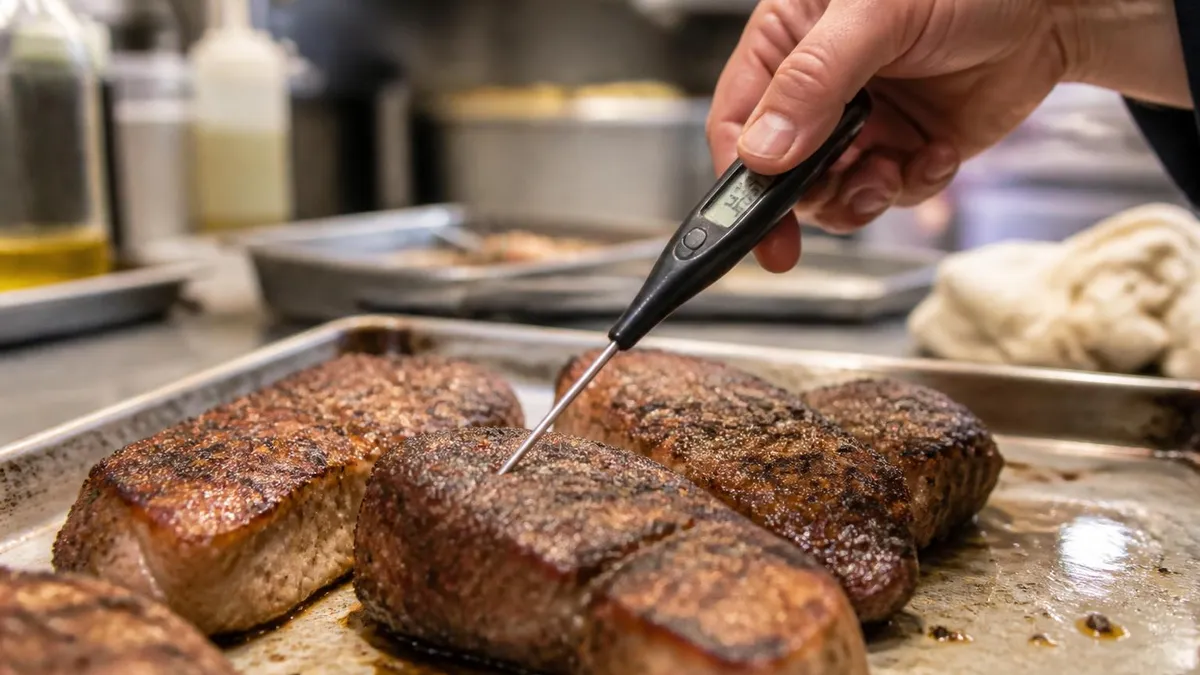
Minimum internal cooking temperatures are tested repeatedly throughout the exam, and memorizing them precisely is non-negotiable. Poultry (chicken, turkey, duck) must reach 165°F for 15 seconds. Ground meats, including ground beef and ground pork, must reach 155°F for 15 seconds. Whole muscle beef (steaks and chops), pork (non-ground), and fish must reach 145°F for 15 seconds.
Shell eggs cooked for immediate service must also reach 145°F. Roasts may be cooked to lower temperatures if held at those temperatures for longer times (for example, 130°F for 121 minutes), but this cook-and-hold method appears less frequently on the exam than the standard instantaneous temperature requirements.
The two-stage cooling method is one of the most commonly missed topics on the ServSafe exam. Hot foods must be cooled from 135°F to 70°F within two hours, then from 70°F to 41°F within the next four hours, for a total cooling time of six hours. The two-hour window for the first stage is critical: if food has not reached 70°F within two hours, it must be reheated to 165°F for 15 seconds and the cooling process restarted.
Approved cooling methods include ice-water baths, blast chillers, dividing food into shallow pans, and using metal containers (which conduct cold more efficiently than plastic). Putting a large pot of hot soup directly into the walk-in cooler is a classic ServSafe wrong answer because the mass of the food prevents rapid cooling.
Reheating rules are equally important. Foods that were cooked, cooled, and stored properly must be reheated to 165°F for 15 seconds within two hours. This applies to all TCS foods being reheated for hot holding, regardless of their original cooking temperature. Commercial steam tables, chafing dishes, and warming drawers are not approved reheating equipment because they do not heat food rapidly enough — these are holding equipment only. The exam tests this distinction repeatedly: equipment that can hold food at 135°F is not the same as equipment that can safely reheat food to 165°F.
Proper receiving practices are another high-yield area. When shipments arrive, managers must verify that TCS foods arrive at the correct temperatures: fresh meat and poultry at 41°F or below, shellfish at 45°F or below (and cooled to 41°F within four hours), and frozen foods frozen solid with no signs of thawing and refreezing. Canned goods should be rejected if they are dented along seams or ends, swollen, or leaking.
Dry goods should be inspected for signs of pest activity, moisture damage, or expired use-by dates. The FIFO (First In, First Out) method requires that older stock be used before newer stock, which is implemented by dating all received items and rotating stock so that older items are at the front of storage areas.
Food allergen awareness has grown in importance on recent ServSafe exams, reflecting changes in the FDA Food Code and increased public attention to food allergy incidents. The nine major food allergens recognized by the FDA are milk, eggs, fish, shellfish, tree nuts, peanuts, wheat, soybeans, and sesame (added in 2023). The exam tests your knowledge of cross-contact (the unintentional transfer of allergens from one food to another) and how it differs from cross-contamination.
Unlike pathogens, allergens cannot be destroyed by cooking, and washing equipment may not fully remove allergen proteins — dedicated equipment or thorough cleaning and sanitizing procedures are required. You can review more about how the exam addresses allergen topics by checking the servsafe exam answers resource on temperature and contamination topics.
Pest control and facility management questions appear in smaller numbers but are worth reviewing because they are often straightforward point-getters for prepared candidates. The exam tests your knowledge of Integrated Pest Management (IPM), a systematic approach that emphasizes prevention through denying pests access, food, water, and shelter rather than relying primarily on pesticides.
Signs of pest infestation include droppings, gnaw marks, nests, and visible insects or rodents. Only licensed pest control operators (PCOs) should apply pesticides in food service establishments. Storing food at least six inches off the floor, sealing gaps around pipes and utility lines, and maintaining positive air pressure to discourage flying insect entry are all preventive measures the exam may ask about.
You can continue preparing with the servsafe practice test 90 questions, which includes answer explanations for every question.
ServSafe Manager exam vouchers are valid for one year from the date of purchase. If you purchase a voucher and do not schedule your exam within 12 months, the voucher expires and you will need to purchase a new one at full price. Schedule your exam date as soon as you purchase your voucher to avoid losing your investment — and use that scheduled date as a deadline to keep your study plan on track.
Many candidates find that the hardest questions on the ServSafe Manager exam are not the ones that test raw memorization but the ones that require you to apply multiple principles simultaneously in a realistic scenario. These scenario-based questions describe a situation in a commercial kitchen — a cook who develops symptoms during a shift, a walk-in cooler that malfunctions overnight, a shipment that arrives at an unexpected temperature — and ask you what the correct managerial response is. Preparing for these questions requires a different kind of practice than flashcard review.
The most effective way to prepare for scenario questions is to practice thinking through the decision tree that ServSafe expects managers to follow. When a food handler reports illness symptoms, the first question is: which symptoms does the person have, and which of the Big 5 pathogens might be responsible?
Symptoms like jaundice point to Hepatitis A, which requires exclusion and reporting to the regulatory authority. Symptoms like vomiting and diarrhea without a confirmed diagnosis may require restriction (preventing the employee from working with food) rather than full exclusion, depending on local regulatory requirements. The ServSafe exam expects you to know these distinctions precisely.
Time management during the exam is a skill that practice tests help you build. The 120-minute time limit for 90 questions is generous, but many candidates report feeling rushed because they spend too long deliberating on difficult questions. The recommended approach is to work through the exam at a steady pace, answering questions you know confidently and marking unclear questions for review. After completing all 90 questions, return to the marked questions with fresh eyes. Often, a question you were uncertain about becomes clearer after reading the surrounding questions have primed your memory for related concepts.
One of the most common mistakes on ServSafe scenario questions is choosing the most dramatic-sounding answer rather than the most procedurally correct one. ServSafe questions are written to test whether you know the appropriate standard operating procedure, not whether you can identify the worst-case outcome.
For example, if a question asks what a manager should do when a food handler's temperature log shows food was held at 50°F for three hours, the correct answer is to discard the food — not to reheat it, not to use it immediately, and not to test it for safety. When in doubt on ServSafe questions, choose the most conservative, risk-averse option consistent with food safety principles.
The financial investment in ServSafe certification is real, and many candidates want to understand all the costs involved before committing. If you want a comprehensive breakdown of exam fees, textbook costs, and renewal expenses, the servsafe test 90 questions and answers pdf free download and cost guide covers everything in detail. Understanding your total investment upfront helps you build a study plan that treats the exam as a serious commitment worth preparing for thoroughly.
After you pass the ServSafe Manager exam, your certification is immediately valid and will be reflected in the NRAEF's national database within a few business days. Your employer can verify your certification status through the ServSafe website by searching your name and certification number. You will also receive a physical certificate by mail within four to six weeks.
Some states and local jurisdictions have additional requirements — for example, California requires an additional state food handler certification for all food service employees, and some counties have local food manager certification exams that must be passed separately from the ServSafe Manager exam. Check with your local health department to confirm whether any supplemental requirements apply in your jurisdiction.
Renewal is required every five years from your original certification date, not from any renewal date. If your certification has already expired, you cannot simply renew it — you must retake the full ServSafe Manager exam. This makes it especially important to track your expiration date and schedule a renewal exam well in advance, ideally two to three months before the expiration date.
Many employers require their certified managers to complete a refresher course before retaking the renewal exam, which is a good practice regardless of whether it is required — the ServSafe program updates its content periodically to reflect changes in the FDA Food Code, so some material you studied five years ago may have changed.
The week before your ServSafe Manager exam is not the time to learn new material — it is the time to consolidate what you already know and arrive at the exam center in the best possible mental and physical state. If you have followed a structured study schedule over the previous three to four weeks, you should enter the final week feeling confident rather than frantic.
Use this week to take one or two more full-length practice tests, review your flashcards for the temperature thresholds and numerical rules that most commonly appear on the exam, and spend some time revisiting the topics where your practice test scores have been weakest.
Sleep is one of the most underrated exam-prep tools available to you. Memory consolidation — the neurological process by which newly learned information is stabilized into long-term memory — happens primarily during sleep, particularly during the deep slow-wave sleep stages.
Multiple research studies have shown that sleeping for seven to nine hours in the nights before a major exam produces significantly better recall than staying up late to cram. If you have studied consistently in the weeks leading up to your exam, a good night of sleep will do more for your score than two additional hours of review the night before.
On exam day, arrive at the testing center at least 15 minutes early to allow time for check-in procedures. Most ServSafe exam sites require a valid government-issued photo ID, and some sites have specific policies about what you can bring into the testing room — typically no personal notes, food, or electronic devices other than approved calculator models.
Read the site's rules in advance so you are not caught off guard. If you are taking a proctored paper-and-pencil exam, bring two sharpened pencils and a simple calculator if the site allows it (though the ServSafe Manager exam does not require complex calculations, a calculator can be useful for verifying temperature conversion questions).
During the exam, trust your preparation. First-instinct answers are correct more often than changed answers for well-prepared candidates. Research on multiple-choice test performance consistently shows that answer changes from correct to incorrect are more common than changes from incorrect to correct, especially for candidates who have studied thoroughly. Change an answer only when you have a clear, specific reason based on information in the question — not just because a question feels uncertain. If two answers both seem plausible, ask yourself which one aligns more precisely with the specific rules and procedures covered in the ServSafe Manager textbook.
After submitting your exam, you will receive your score either immediately (for computer-based testing) or within a few days (for paper-based testing that requires manual grading). If you passed — congratulations, your certification is now active. If you did not pass, do not be discouraged. Review your score report to identify which content domains were weakest, update your study plan to address those specific areas, and schedule a retake.
There is no limit to the number of times you can take the ServSafe Manager exam, though each attempt requires payment of the exam fee. Many candidates who do not pass on the first attempt find that targeted remediation in their weakest domain, combined with additional practice tests, results in a passing score on the second attempt.
Building a culture of food safety awareness does not stop when you pass your exam and receive your certificate. The most valuable outcome of ServSafe certification is not the credential itself but the knowledge and judgment you develop through the preparation process.
Managers who truly understand why food safety rules exist — not just what the rules say — make better decisions in the moment, train their teams more effectively, and create the kind of food safety culture that prevents incidents rather than just responding to them. Use the knowledge you gained preparing for this exam as the foundation for ongoing learning and leadership in food safety throughout your career.
Whether you are a first-time test-taker working toward your initial certification or an experienced manager refreshing your credential, consistent practice with high-quality materials is the most reliable path to success. Our free servsafe manager practice tests are designed to mirror the real exam's question style, difficulty level, and topic distribution as closely as possible. Take as many as you need, review your results carefully, and approach your exam with the confidence that comes from thorough, strategic preparation.
Sample ServSafe Practice Questions
Try these questions from our free ServSafe practice tests. The correct answer and an explanation follow each question.
How does the presence of carbonation in a drink affect alcohol absorption?
- A. Carbonation slows alcohol absorption
- B. Carbonation has no effect on alcohol absorption
- C. Carbonation speeds up alcohol absorption into the bloodstream
- D. Carbonation reduces the alcohol content of a drink
Answer: C. Carbonation speeds up alcohol absorption into the bloodstream
Carbonated mixers can speed up alcohol absorption by causing the stomach to empty faster into the small intestine.
What is the maximum amount of time cooked potentially hazardous food (TCS food) can remain in the temperature danger zone during the cooling process?
- A. 6 hours total (135°F to 70°F in 2 hours, then to 41°F in 4 more hours)
- B. 4 hours total at any point in the cooling process
- C. 8 hours total provided the food stays below 70°F within 3 hours
- D. 2 hours total from 135°F to 41°F
Answer: A. 6 hours total (135°F to 70°F in 2 hours, then to 41°F in 4 more hours)
According to the FDA Food Code, TCS food must be cooled from 135°F to 70°F within 2 hours, then from 70°F to 41°F or below within the next 4 hours — a total maximum cooling time of 6 hours. The two-stage process is designed to move food quickly through the range where bacterial growth is fastest (between 70°F and 125°F).
Who typically conducts routine inspections of local restaurants?
- A. State and local regulatory authorities
- B. The FBI
- C. The USDA only
- D. The president
Answer: A. State and local regulatory authorities
State and local health departments perform routine restaurant inspections.
Which of the following foods contains a hidden source of a major allergen?
- A. Grilled chicken breast seasoned with salt and pepper
- B. Caesar salad dressing made with anchovies
- C. Steamed broccoli with olive oil
- D. Plain white rice
Answer: B. Caesar salad dressing made with anchovies
Traditional Caesar salad dressing contains anchovies, which are a fish — a major food allergen. Guests who order Caesar salad may not be aware of this hidden fish ingredient, making it critical for staff to disclose all allergen-containing components.
ServSafe Questions and Answers





About the Author

Registered Sanitarian & Food Safety Certification Expert
Cornell University College of Agriculture and Life SciencesThomas Wright is a Registered Sanitarian and HACCP-certified food safety professional with a Bachelor of Science in Food Science from Cornell University. He has 17 years of experience in food safety auditing, regulatory compliance, and foodservice management training. Thomas prepares food industry professionals for ServSafe Manager, HACCP certification, and state food handler examinations.