
Real Estate Online Course: Complete Guide to Getting Licensed in 2026 September
Master real estate law and get licensed fast. 🎯 Compare online courses, costs, timelines, and exam tips for aspiring agents in 2026 September.
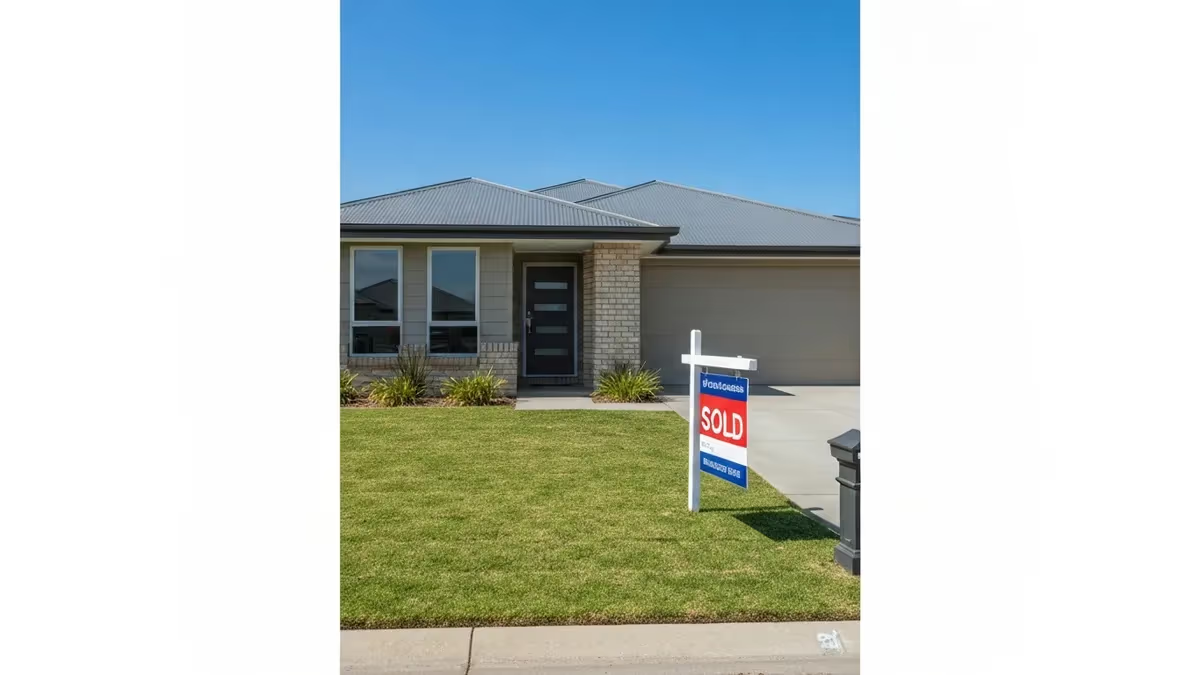
Real estate law forms the backbone of every successful agent's career, and understanding it begins long before you show your first property. Enrolling in a real estate online course is now the most popular path for aspiring agents across the United States, giving students the flexibility to study around work and family commitments while meeting state-mandated pre-licensing hour requirements. Whether you want to work with buyers, sellers, investors, or commercial clients, the right online course sets the foundation for everything that follows.
Choosing an online program means weighing curriculum depth, state approval, instructor quality, pass-guarantee policies, and price. The best platforms combine video lectures, interactive quizzes, live webinars, and downloadable study guides so that learners can engage with the material in multiple formats. Because pre-licensing requirements differ significantly from state to state — ranging from 40 hours in some states to 180 hours in California — it is critical to confirm that your chosen program is approved by your state's real estate commission before you purchase.
One of the most common misconceptions new students have is that an online course alone is enough to pass the licensing exam. In reality, the coursework covers the concepts you need to know, but dedicated exam prep — including timed practice tests, flash cards, and repeated review of difficult topics like agency relationships, contract law, financing, and property valuation — is what separates first-time passers from those who have to retake the exam. Consider your online course the starting line, not the finish line.
The financial commitment involved in getting licensed varies widely. Tuition for online pre-licensing courses typically ranges from $150 to $900 depending on the state and the provider. On top of tuition, candidates must budget for the state licensing exam fee ($50–$100 in most states), a background check, fingerprinting, and the initial license application fee. Many students also invest in additional exam prep courses or cram packages that cost an extra $50–$200 and can meaningfully improve pass rates on the first attempt.
Beyond the cost, the time investment is significant. Most students complete their required pre-licensing education in eight to sixteen weeks when studying part-time, though motivated learners who dedicate fifteen or more hours per week have finished approved coursework in as little as three to four weeks. Once coursework is complete, scheduling the state exam, receiving results, and completing the license activation process typically adds another four to eight weeks to the timeline — meaning the full journey from enrollment to active license often takes three to five months.
The good news is that the demand for licensed real estate professionals continues to be strong. According to the National Association of Realtors, there are approximately 1.5 million active REALTOR members in the United States, and the profession consistently attracts new entrants because of its income potential, independence, and low barrier to entry compared to other licensed professions. Understanding real estate lawreal estate law is the first and most important step in turning that career ambition into a reality.
This comprehensive guide walks you through everything you need to know about real estate online courses: how to choose the right program, what the curriculum covers, how to prepare for the licensing exam, what to expect in terms of cost and timeline, and how to launch your career once your license is in hand. Read every section carefully — the details here can save you time, money, and the frustration of a failed exam attempt.
Real Estate Online Courses by the Numbers

How Online Pre-Licensing Courses Are Structured
Most platforms break the required hours into short video lessons of 10–20 minutes each. Students can pause, rewind, and rewatch content as needed, making it easier to absorb complex topics like real estate contracts, financing instruments, and agency law without the pressure of live classroom attendance.
After each content module, embedded quizzes check comprehension before you advance. These low-stakes assessments reinforce retention and flag knowledge gaps early, giving students the chance to revisit weak areas before taking the state-approved final exam that unlocks their certificate of completion.
Premium online programs supplement recorded lessons with weekly live sessions where instructors answer student questions in real time. These sessions are invaluable for clarifying confusing regulations, understanding state-specific nuances, and getting motivation during the long weeks of pre-licensing study.
Most states require a proctored final exam at the end of the pre-licensing course to confirm that the student completed the hours honestly and understood the material. This exam is typically 50–100 questions with a 70–75% passing threshold and must be passed before you can sit for the state licensing exam.
Once you pass the final course exam, your school issues a certificate of completion that you submit to the state real estate commission. This certificate is a prerequisite for exam eligibility, so keeping a digital and physical copy is essential throughout the licensing process.
Understanding what a real estate online course actually teaches helps students prepare mentally and emotionally for the depth and breadth of content they will encounter. The curriculum is far broader than most new students expect. Rather than focusing exclusively on how to list properties or negotiate deals, pre-licensing education covers real estate law, property ownership, land use controls, finance, valuation, agency relationships, contracts, federal fair housing laws, and state-specific regulations — all of which appear on the licensing exam and are essential to practicing legally and ethically.
The section on real estate law is typically the most extensive and the most challenging for students without a legal background. You will study the types of property ownership (fee simple, life estate, leasehold), how title is transferred, what constitutes a valid contract, the difference between actual and constructive fraud, and how agency relationships are created and terminated. Many students are surprised to discover that real estate agents operate within a detailed legal framework that exposes them to significant liability if they misrepresent facts or fail to disclose known defects in a property.
Finance and economics represent another major content area. Online courses spend considerable time on mortgage types — fixed-rate, adjustable-rate, FHA, VA, conventional, and jumbo — as well as amortization, loan-to-value ratios, debt-to-income ratios, and the basics of the closing process. Agents are not expected to be loan officers, but clients frequently ask financing questions, and a licensed agent who cannot provide even basic guidance risks losing trust and referrals. Understanding the financial side of transactions also makes agents more credible when working with investment buyers or commercial clients tracking commercial real estate news.
Property valuation is another critical topic. Students learn the three traditional approaches to value — the sales comparison approach, the income approach, and the cost approach — and practice applying them to hypothetical properties. While full appraisals are performed by licensed appraisers, agents regularly perform comparative market analyses (CMAs) to help clients price properties competitively. A strong grasp of valuation principles allows agents to defend their pricing recommendations with data rather than gut instinct, which is particularly important in competitive markets like wake county real estate and similar high-demand regions.
The ethics and professional standards section of most online courses covers the National Association of Realtors Code of Ethics, anti-discrimination laws under the Fair Housing Act, and state-specific rules about advertising, disclosure, and record-keeping. Students learn which types of discriminatory conduct are illegal, how to handle dual agency situations ethically, and what fiduciary duties they owe to clients versus customers. These distinctions are tested heavily on the licensing exam and are equally important once you are working with real clients in real transactions.
Many online providers now include elective content beyond the minimum required hours, covering topics like social media marketing, negotiation skills, first-time homebuyer assistance programs, and property management basics. These bonus modules are not tested on the state exam, but they give students a head start on the practical skills that their first broker will expect them to bring to the table. The best platforms recognize that passing the exam is only the beginning — the real challenge is becoming a competent, client-focused professional who can build a sustainable business.
After completing the pre-licensing coursework, students are strongly advised to invest additional time in dedicated exam preparation before scheduling their state test. The state licensing exam tests many of the same concepts as the course but frames questions differently — often presenting scenario-based problems that require the student to apply a principle rather than simply recall it. Knowing the definition of "easement in gross" is not enough; you must be able to recognize when an easement in gross exists in a fact pattern and understand its implications for a property transaction.
Comparing Top Real Estate Online Course Providers
The leading online real estate schools — including Colibri Real Estate, The CE Shop, Kaplan Real Estate Education, and RealEstateU — all offer state-approved pre-licensing curricula, but they differ significantly in how deeply they cover key topics. Colibri and Kaplan are known for instructor-led components and robust exam prep packages, while The CE Shop emphasizes interactive learning tools and scenario-based modules that mirror the style of questions found on actual state licensing exams.
When evaluating content depth, look for programs that go beyond the minimum required hours and include supplemental materials on real estate law, financing, and ethics. Schools that offer pass guarantees — meaning they will refund your course fee or provide free retakes if you fail the state exam — tend to invest more in comprehensive, exam-aligned content. Read independent reviews on platforms like Trustpilot and Reddit's r/realestate forum before committing to any provider.

Online Real Estate Courses: Pros and Cons vs. Traditional Classroom
- +Study from anywhere on any device — no commute required
- +Self-paced learning lets you accelerate through familiar content and slow down on difficult topics
- +Generally 30–50% cheaper than in-person classroom programs
- +Access to recorded lectures means you can rewatch confusing material as many times as needed
- +Most platforms include built-in chapter quizzes that function as ongoing exam prep
- +Enrollment windows of 6–12 months accommodate busy schedules and life interruptions
- −Requires strong self-motivation and time-management skills to avoid procrastination
- −Less face-to-face interaction with instructors makes it harder to ask spontaneous follow-up questions
- −Some students find it difficult to absorb dense legal content through video alone without live discussion
- −Technology issues (poor internet, device problems) can disrupt study sessions at critical moments
- −Not all online courses include robust exam prep — some provide only the minimum required content
- −Proctored final exams may require scheduling in advance, which can slow progress
Real Estate Online Course & Exam Prep Checklist
- ✓Confirm your chosen online course is approved by your state's real estate commission before purchasing.
- ✓Verify the total pre-licensing hours required in your state and ensure the course meets that minimum.
- ✓Set a weekly study schedule of at least 10 hours to complete coursework within 8–12 weeks.
- ✓Complete every chapter quiz before advancing to the next module to catch knowledge gaps early.
- ✓Schedule your state-mandated proctored final exam as soon as you finish the last content module.
- ✓Submit your certificate of completion to the state commission promptly to unlock exam eligibility.
- ✓Purchase a dedicated exam prep package or use free practice tests to simulate exam conditions.
- ✓Focus extra study time on real estate law, contracts, finance, and federal fair housing rules.
- ✓Take at least three full-length timed practice exams before scheduling the actual state test.
- ✓Research broker sponsorship options before your exam date so you can activate your license quickly after passing.
Students Who Use Practice Exams Pass at Nearly Twice the Rate
Studies of real estate licensing outcomes consistently show that candidates who complete five or more full-length timed practice exams before their test date pass on the first attempt far more often than those who rely solely on coursework review. Timed practice simulates exam pressure, reveals recurring weak areas, and builds the pattern-recognition skills needed to decode complex scenario-based questions under time constraints. Do not skip this step.
The financial reality of becoming a real estate agent is one of the most important topics that online courses often underemphasize, even as it directly affects nearly every student's decision about when and how to pursue licensure. Understanding allegheny county real estate market dynamics, for instance, illustrates how local economic conditions can dramatically shape what an agent earns in their first year. The total cost of getting licensed — including education, exam fees, background checks, and initial broker fees — typically ranges from $500 to $1,500 depending on the state, making it one of the more accessible professional licenses available.
Beyond startup costs, new agents must budget for ongoing expenses that begin the moment they activate their license. These include National Association of Realtors membership fees (approximately $150 per year at the national level, plus state and local association dues that can total $500–$1,000 annually), MLS access fees ($25–$100 per month in most markets), errors and omissions insurance ($200–$600 per year), business cards and marketing materials, and a portion of any transaction-related technology tools their broker does not provide.
Many new agents are surprised to discover that real estate is a business, not a job, and that income arrives in irregular commission checks rather than predictable bi-weekly paychecks.
Income potential is one of the primary motivators for entering real estate, and the numbers are genuinely compelling for agents willing to put in the work. The median annual income for real estate salespersons in the United States is approximately $54,300 according to the Bureau of Labor Statistics, but that figure masks enormous variation.
New agents in their first year often earn significantly less while building their pipeline, while experienced agents in high-value markets can earn well into six figures. Top producers at companies like compass real estate and other major brokerages routinely earn $200,000 or more annually by combining volume, referrals, and repeat business.
Commission structures also directly affect earnings. Most residential transactions involve a total commission of 5–6% of the sale price, which is split between the buyer's and seller's agents. Each agent then typically splits their half with their broker according to a predetermined commission split agreement, which ranges from 50/50 for new agents at traditional brokerages to 90/10 or even 100% for experienced agents at flat-fee brokerages who pay a monthly desk fee instead. Understanding these structures before you sign with a broker is essential to projecting your realistic first-year income.
Geographic markets play an enormous role in income potential. An agent working in a high-cost market like San Francisco, Manhattan, or Aspen who closes even five transactions per year can earn more than an agent in a moderate market who closes twenty.
This is why many aspiring agents carefully research their local market dynamics — median home prices, average days on market, transaction volume, and competition from established agents — before investing in their license. Working with a mentor or doing a market analysis before committing to a niche can significantly shorten the time it takes to reach a sustainable income level.
Beyond traditional residential sales, licensed agents can explore commercial real estate, property management, real estate investment consulting, buyer's agency specialization, luxury markets, and relocation services. Each of these niches has its own income profile, skill requirements, and competitive dynamics. Commercial transactions, for example, often involve longer sales cycles but significantly larger commission checks, while property management offers stable monthly income from management fees rather than the feast-or-famine nature of transactional sales. A real estate attorney background or familiarity with commercial real estate law can open doors in high-value commercial deal-making.
The path to financial success in real estate is not guaranteed, but it is available to any agent who combines market knowledge with consistent prospecting, strong communication skills, and a commitment to client service. Online pre-licensing courses give you the legal and conceptual foundation you need; your brokerage, mentors, and daily habits will determine whether you build a thriving business or struggle to close your first deal. Approach the entire journey — from your first online lesson to your hundredth transaction — with the mindset of a long-term professional, and the income potential of this career becomes very real.

Real estate licenses are not permanent — most states require renewal every two to four years, with mandatory continuing education hours (typically 12–45 hours per cycle) as a condition of renewal. Missing a renewal deadline can result in license lapse, which requires additional fees and sometimes a partial or full retake of pre-licensing education before reinstatement. Mark your renewal date on your calendar the day you activate your license, and begin your continuing education requirements at least six months before the deadline to avoid last-minute scrambles.
Once you hold an active real estate license, the question of how to build a successful career becomes the central challenge. The transition from student to practicing agent is exciting but often jarring — coursework teaches you the rules, but nothing quite prepares you for the pace of real client relationships, the emotional weight of helping someone navigate the largest financial decision of their life, or the persistence required to turn cold prospects into closed transactions. The agents who thrive are those who treat their first year as an extension of their education rather than the beginning of easy money.
Selecting the right broker to work under is one of the most consequential decisions a new agent makes. Your sponsoring broker provides the legal umbrella under which you practice, and the best ones offer structured training programs, mentorship from experienced agents, transaction coordination support, and marketing resources that help new agents close their first deals without reinventing the wheel.
Interview at least three brokerages before signing — ask about their training program, commission splits, desk fees, culture, and average production per agent. A broker with a reputation for developing new talent is worth a lower commission split in your first year.
Building a sphere of influence is the most reliable long-term marketing strategy for new real estate agents. Your sphere consists of everyone you know — family, friends, former colleagues, neighbors, club members, and acquaintances — who might buy, sell, or refer someone who does. Consistent, non-pushy communication with your sphere through personal notes, market updates, community event invitations, and social media presence keeps you top of mind when someone in your network is ready to make a move. Agents who neglect their sphere in favor of expensive lead-generation tools often spend heavily while producing thin results.
Digital marketing has become an indispensable part of a modern agent's toolkit. A professional website with area-specific landing pages, active social media profiles (especially Instagram and Facebook for residential agents, LinkedIn for commercial), Google Business Profile optimization, and a basic email newsletter can generate consistent inbound inquiries without the ongoing cost of paid lead platforms. Search engine optimization matters here too — agents who create genuinely helpful local content about their target neighborhoods appear in searches by buyers and sellers actively looking for representation, much the way PracticeTestGeeks content helps students searching for exam guidance.
Understanding how to work with real estate agents near me searches and local SEO is increasingly important even for individual practitioners. Buyers and sellers often begin their agent search with a Google query, and agents who have strong profiles, genuine client reviews, and locally relevant content consistently outperform competitors who rely solely on referrals or paid leads. The investment required to build a solid digital presence is modest compared to the return — a single closed transaction from an organic lead typically covers months of content creation effort.
Continuing education and professional development should be ongoing priorities throughout your real estate career, not just a renewal requirement. Designations like the Accredited Buyer's Representative (ABR), Seller Representative Specialist (SRS), Certified Residential Specialist (CRS), or Graduate REALTOR Institute (GRI) signal specialized expertise that can justify higher commission rates and attract more sophisticated clients.
The real estate industry evolves constantly — new technology platforms, shifting market conditions, updated disclosure requirements, and changing consumer expectations mean that the agent who stops learning quickly falls behind. Explore how much do real estate agents make relative to the professional development investment, and you will find that continuing education consistently delivers a strong return.
Finally, maintaining your mental and physical health during the early years of a real estate career is not a soft suggestion — it is a practical necessity. Real estate is a high-stress, relationship-intensive profession with no guaranteed income, irregular hours, and frequent rejection. Agents who build sustainable schedules, maintain clear boundaries between work and personal time, invest in their own well-being, and cultivate a support network of fellow agents and mentors consistently outperform those who burn hot in the first year and flame out by year three. The career rewards patience, consistency, and professionalism over raw intensity every time.
Practical preparation strategies can make a decisive difference between passing your real estate licensing exam on the first attempt and having to retake it weeks later. The most effective approach begins with understanding the exam format for your state. Most state licensing exams consist of two portions: a national portion covering general real estate principles applicable across the country, and a state-specific portion covering your state's particular laws, regulations, and forms. Each portion has its own minimum passing score, and failing either one — even if you score excellently on the other — means you must retake the failed portion.
Time management during the exam is a skill that must be practiced, not improvised. Most state exams allow two to four hours for 100 to 150 questions, which sounds generous until you encounter a long scenario-based question that requires you to identify the type of agency relationship, the applicable legal duty, and the correct course of action — all from a single paragraph of facts.
Practicing under timed conditions teaches you when to move on from a question you are stuck on, how to flag questions for review, and how to pace yourself so that you are not rushing through the final thirty questions in the last ten minutes.
Reading questions carefully is another skill that separates first-time passers from repeat test-takers. Real estate licensing exams are notorious for including questions with tricky qualifiers like "EXCEPT," "NOT," "MOST likely," and "BEST describes." Missing a single word in the question stem can flip the correct answer entirely. During practice exams, develop the habit of underlining the key qualifier in every question before reading the answer choices. This slows you down slightly but dramatically reduces careless errors on questions you actually know the answer to.
On the day of the exam, arrive early, bring required identification, and leave your phone in the car or a locker — phones are not permitted in testing rooms and creating the habit of not relying on your phone during practice helps replicate real test conditions. Dress in comfortable layers since testing centers can be cold. Bring a light snack and water if the center permits it. These logistical details matter because physical discomfort and anxiety are amplified in high-stakes testing environments, and any preparation that reduces stress on exam day is preparation worth making.
After passing the exam, the steps to activate your license are specific and time-sensitive. You must typically submit your passing score certificate, application for licensure, proof of completed pre-licensing education, background check results, and the license fee to the state commission within a specified window — often 60 to 90 days from the exam date. You must also have a sponsoring broker identified and ready to sign your license application before it can be approved. Delaying this step is a common mistake that costs new agents weeks of otherwise productive time in the field.
The moment your license becomes active, the real education begins. Your first few transactions will be the most challenging and the most instructive of your career. Lean on your broker, ask questions constantly, and resist the temptation to project confidence you do not yet have — clients respect honesty and resourcefulness far more than bravado.
Every transaction will introduce you to scenarios that no online course covered: a buyer who wants to back out at the last minute, a seller who refuses to negotiate a valid repair request, a title issue that delays closing by three weeks. How you handle these situations will define your reputation faster than any marketing you do.
The best real estate agents never stop being students of their craft. They study market data, follow commercial real estate news, track changes in real estate law, build relationships with real estate attorneys and mortgage professionals, and consistently look for ways to serve their clients more effectively. The online course that launched your career is just the first chapter of an education that, at its best, lasts a lifetime. Approach it that way, and this profession will reward you in ways that go far beyond the commission check.
Real Estate License Questions and Answers

Real Estate Complete Guide: Licensing, Careers, Law, and How to Succeed
Real Estate License vs NMLS MLO: Which One Should You Choose?

How to Pass the Real Estate License Exam in 2026 — Complete Study Guide

Real Estate Agent Course: Everything You Need to Know to Get Licensed
Florida License Lookup: Verify Real Estate & Professional Licenses
About the Author

Licensed Real Estate Broker & Licensing Exam Specialist
University of Wisconsin School of BusinessSandra Taylor is a Graduate Realtor Institute (GRI) and Accredited Buyer's Representative (ABR) designee with an MBA in Real Estate from the University of Wisconsin School of Business. She has 18 years of residential and commercial real estate brokerage experience and coaches real estate license candidates through state salesperson and broker pre-license examinations across multiple states.
Join the Discussion
Connect with other students preparing for this exam. Share tips, ask questions, and get advice from people who have been there.
View discussion (7 replies)