
Real Estate Due Diligence Checklist: Everything You Need to Know Before Getting Licensed
Master the real estate due diligence checklist before exam day. Laws, steps, costs & tips to get licensed fast. ✅ Free practice tests included.
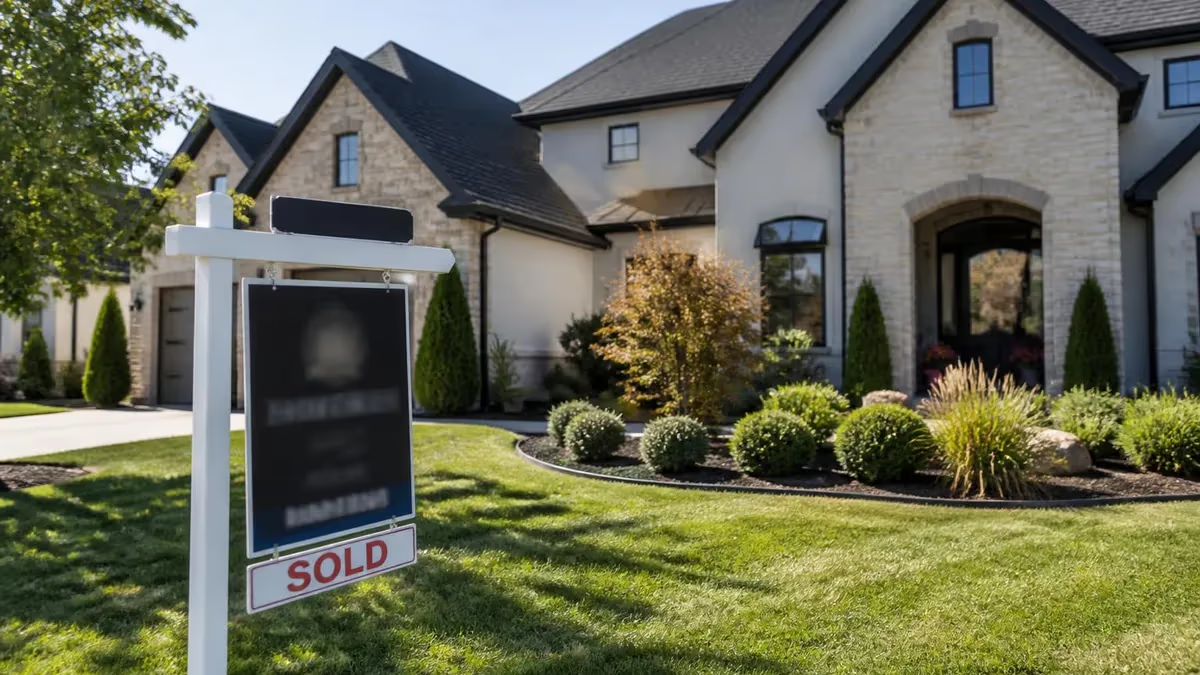
Understanding real estate law is the single most important foundation for anyone building a career in property transactions, and a solid real estate due diligence checklist is the tool that ties all of that legal knowledge together. Whether you are preparing for your state licensing exam or stepping into your first transaction as a newly licensed agent, due diligence is the professional standard that separates competent practitioners from negligent ones. This guide walks you through every layer of the checklist so you can approach both the exam and real-world closings with total confidence.
Due diligence in real estate refers to the thorough investigation a buyer, agent, or investor must perform before committing to a property transaction. The concept is rooted in real estate law and appears repeatedly on state licensing exams because regulators want agents who understand their obligations. Failing to disclose a known material defect, skipping a title search, or ignoring zoning restrictions can expose your client — and your license — to serious legal liability. The checklist format exists precisely to prevent those costly oversights.
For aspiring agents, the licensing exam tests not just definitions but the practical application of due diligence principles. You may see scenario-based questions where a seller's agent discovers a structural issue mid-transaction and must decide how to handle it under state disclosure law. You might also face questions about real estate attorney involvement, title insurance requirements, and the difference between general and specific liens. Knowing the checklist cold means you can answer those questions quickly and accurately, without second-guessing yourself.
The U.S. real estate market processed roughly $2.2 trillion in transaction volume in 2024, and the vast majority of those deals involved licensed agents who were legally obligated to guide their clients through due diligence steps. Markets like wake county real estate in North Carolina and metropolitan corridors across the country see thousands of closings every month, each one requiring a methodical review of title, physical condition, zoning, financing, and legal encumbrances. Agents who can execute that review efficiently become the practitioners clients trust and refer.
This article also addresses how due diligence intersects with licensing education requirements. Most states embed due diligence topics inside their pre-licensing curriculum under contract law, agency law, and property disclosure modules. When you study these concepts, you are not just memorizing rules for a test — you are building the muscle memory that will protect your clients and your career once you are active in the field. Reading this guide alongside your course materials will reinforce the connections between theory and practice.
One of the most common questions from exam candidates is how much do real estate agents make and whether the investment in licensing is worth it. The answer depends heavily on market conditions, brokerage choice, and how well an agent understands their legal obligations — including due diligence. Agents who skip steps or mishandle disclosures face complaints, fines, and license suspension, all of which devastate earning potential. Doing due diligence right is not just an ethical obligation; it is a business strategy that protects your income long term.
Throughout this guide you will find structured checklists, tabbed deep-dives into specific due diligence categories, and plain-language explanations of the legal concepts most likely to appear on your exam. By the time you finish reading, you will understand not only what the checklist contains, but why each item exists, how regulators expect agents to apply it, and how mastering these concepts can accelerate your path to licensure and a profitable real estate career.
Real Estate Due Diligence by the Numbers

The Due Diligence Process Step by Step
Mutual Acceptance & Period Opens
Physical Inspection & Environmental Review
Title Search & Lien Review
Zoning, Permits & HOA Review
Financing Contingency & Appraisal
Final Walkthrough & Closing Preparation
At its core, the real estate due diligence checklist is a legal instrument as much as a practical one, because every item on it corresponds to a specific area of real estate law that governing state agencies expect licensed agents to understand. When you study for your licensing exam, you are learning the statutory framework that makes each checklist item mandatory, enforceable, or professionally expected. The relationship between law and practice is inseparable, and your exam questions will frequently test your ability to apply legal principles to realistic transaction scenarios.
Property disclosure law is one of the most heavily tested areas in any state's licensing curriculum. Most states require sellers to complete a standardized disclosure form covering known material defects, environmental hazards, neighborhood nuisances, and any litigation or liens affecting the property. As an agent, your duty is not merely to hand over the form — you must review it for completeness, flag omissions, and advise your client on how disclosed defects affect value and negotiation. Missing this step can expose you to a liability claim even if the defect was disclosed by the seller but overlooked by you.
Title law forms another pillar of the due diligence checklist. A clean title means the seller has the legal right to convey the property free of undisclosed claims. Title issues range from simple clerical errors in the chain of title to complex disputes involving heirs, forged deeds, or unresolved mechanic's liens. Understanding the difference between a general warranty deed, a special warranty deed, and a quitclaim deed is essential exam knowledge — and each type of deed carries different levels of title protection for the buyer. Agents who understand these distinctions can counsel clients on title insurance decisions more effectively.
Zoning and land-use law is another dimension that appears on both the exam and in day-to-day practice. A property listed as residential cannot legally be converted to commercial use without a variance or rezoning approval, which can take months or years and is never guaranteed. Buyers who plan to run a home-based business, build an accessory dwelling unit, or subdivide a parcel must investigate applicable ordinances before committing. Agents working with investor clients — especially those tracking commercial real estate news and seeking development opportunities — must be particularly vigilant about zoning compliance during the due diligence period.
Environmental law intersects with due diligence in ways that can dramatically affect a property's value and saleability. The Comprehensive Environmental Response, Compensation, and Liability Act (CERCLA), commonly known as Superfund, can make a property owner liable for cleanup costs even if they did not cause the contamination. Properties near industrial sites, dry cleaners, gas stations, or agricultural operations may carry environmental risk that only a Phase I or Phase II Environmental Site Assessment can quantify. While residential transactions rarely require a full ESA, agents dealing with commercial or mixed-use properties must know when to recommend one.
Agency law shapes how agents execute due diligence on behalf of their clients. A buyer's agent owes fiduciary duties of loyalty, confidentiality, disclosure, obedience, reasonable care, and accounting. The duty of reasonable care specifically requires the agent to investigate material facts that a competent professional would investigate, even if the client does not ask. That means recommending inspections, reviewing the HOA financials, and flagging red flags in the seller's disclosure form — not just presenting offers. Understanding allegheny county real estate market conditions and local regulatory environments is part of meeting that standard of care.
Contract law governs the enforceability of the purchase agreement and its contingency clauses, which are the legal mechanism through which due diligence findings can modify or terminate a transaction. The inspection contingency, financing contingency, and title contingency each give the buyer a defined window and a defined procedure for exercising their rights. Agents who allow contingency deadlines to pass without written waivers or extensions can inadvertently remove their client's protection. Mastering the interplay between contract timelines and due diligence steps is essential both for passing the exam and for protecting clients in real transactions.
How to Become a Real Estate Agent: Due Diligence in Your Licensing Journey
Every state requires candidates to complete a minimum number of pre-licensing education hours before sitting for the exam, and due diligence concepts appear throughout that curriculum. In California, the requirement is three college-level courses covering real estate principles, practice, and a third elective such as real estate finance or property management. Texas mandates 180 hours across six specific courses, while New York requires 75 hours. These courses embed due diligence topics inside contract law, agency law, and financing modules — so studying the checklist actively while reading your textbook creates powerful cross-referencing that improves retention and exam performance significantly.
Most pre-licensing providers offer both in-person and online formats, and the online option has become the dominant choice since 2020. When selecting a provider, look for one whose practice questions are formatted to match your state exam — multiple choice with scenario-based stems — because recognizing question structure is half the battle. The due diligence topics most likely to appear on your exam include disclosure obligations, contingency clauses, title search procedures, and the agent's duty of reasonable care. Build a personal checklist of these topics and check off each one as you cover it in your course materials to ensure complete coverage before exam day.

Thorough Due Diligence vs. Rushing to Close: The Real Trade-offs
- +Identifies hidden defects before closing, preventing costly post-purchase surprises
- +Strengthens the buyer's negotiating position for price reductions or seller-paid repairs
- +Protects the agent from liability claims rooted in undisclosed or overlooked material facts
- +Builds long-term client trust and generates referrals from buyers who felt protected
- +Confirms clean title and clear zoning before the client commits irreversibly to a purchase
- +Satisfies lender requirements and reduces the risk of last-minute financing denials at closing
- −Extends the transaction timeline, which can frustrate sellers in competitive markets
- −Inspection and specialist fees add $500 to $2,000 or more to the buyer's upfront costs
- −Detailed findings can create negotiation friction that causes deals to fall apart entirely
- −In hot seller's markets, buyers who waive contingencies outcompete those who do full due diligence
- −Overly aggressive due diligence requests can signal buyer uncertainty and erode goodwill
- −Complex findings — especially environmental or title issues — can delay closing by weeks or months
Pros and Cons at a Glance
| Pros | Cons |
|---|---|
| Identifies hidden defects before closing, preventing costly post-purchase surprises | Extends the transaction timeline, which can frustrate sellers in competitive markets |
| Strengthens the buyer's negotiating position for price reductions or seller-paid repairs | Detailed findings can create negotiation friction that causes deals to fall apart entirely |
| Protects the agent from liability claims rooted in undisclosed or overlooked material facts | In hot seller's markets, buyers who waive contingencies outcompete those who do full due diligence |
| Builds long-term client trust and generates referrals from buyers who felt protected | Overly aggressive due diligence requests can signal buyer uncertainty and erode goodwill |
| Confirms clean title and clear zoning before the client commits irreversibly to a purchase | Complex findings — especially environmental or title issues — can delay closing by weeks or months |
The Complete Real Estate Due Diligence Checklist for Agents and Buyers
- ✓Order a professional home inspection from a state-licensed inspector within the first 3 days of the due diligence period.
- ✓Request and review the seller's property disclosure statement for completeness, accuracy, and any red-flag items.
- ✓Commission a title search through a licensed title company or real estate attorney to identify liens, easements, and encumbrances.
- ✓Confirm current zoning classification and verify that all existing structures and planned uses are compliant with local ordinances.
- ✓Pull all open and closed building permits to confirm no unpermitted additions, conversions, or structural alterations exist.
- ✓Review HOA documents including CC&Rs, bylaws, current financials, reserve study, and minutes from the last 12 months of board meetings.
- ✓Verify property survey boundaries and confirm no encroachments on adjacent parcels or public rights-of-way.
- ✓Confirm the financing contingency timeline aligns with the lender's appraisal and underwriting schedule to avoid deadline conflicts.
- ✓Investigate any environmental concerns including flood zone designation, radon levels, proximity to Superfund sites, or soil contamination history.
- ✓Conduct a final walkthrough within 48 hours of closing to confirm agreed repairs are complete and property condition matches the contract.
Due Diligence Deadlines Are Contractual — Missing Them Costs Your Client Their Rights
The most commonly tested due diligence concept on state licensing exams is the consequence of missing a contingency deadline. If a buyer's inspection contingency expires without a written waiver or extension, the buyer generally loses the right to terminate the contract based on inspection findings — even if a serious defect is discovered one day later. Agents who allow deadlines to pass without written confirmation from both parties expose their clients to the risk of losing their earnest money deposit, which can range from $1,000 to 3% or more of the purchase price on high-value properties.
Preparing for the real estate licensing exam requires understanding not just the isolated facts of due diligence law, but the systematic way those facts appear in exam question formats. Licensing exams in every state are written by professional test developers who follow a standardized blueprint, and that blueprint always allocates a significant percentage of questions to contracts, agency, and disclosure — the exact areas where due diligence knowledge is tested.
Knowing the structure of the exam lets you allocate your study time more efficiently and approach test day with a strategic advantage over candidates who simply read their textbook cover to cover without analyzing the question format.
The national portion of the real estate licensing exam, administered by testing vendors such as Pearson VUE and PSI, typically contains 80 to 100 questions and covers topics including property ownership, land-use controls, valuation and market analysis, financing, agency relationships, contracts, and federal legislation. Due diligence concepts appear most heavily in the contracts and agency sections, which together typically represent 25 to 35 percent of the total national score. That means investing disproportionate study time in those two areas — including practicing due diligence scenario questions — delivers the highest marginal return on your preparation effort.
State-specific portions of the exam are shorter — typically 30 to 50 questions — but they carry equal statistical weight per question because failing the state portion alone means failing the overall exam. State questions focus on licensing procedures, local disclosure requirements, state-specific contract forms, and any regulations unique to your jurisdiction. For example, California requires agents to use specific disclosure forms like the Transfer Disclosure Statement and the Natural Hazard Disclosure, and exam questions will test whether you know when each form is required, who completes it, and what happens legally if it is delivered late or omitted entirely.
Practice tests are the most effective tool for converting due diligence knowledge into exam performance, and the research on this is unambiguous. Candidates who complete 400 or more practice questions before their exam day pass at significantly higher rates than those who rely solely on reading. The reason is that practice questions force you to apply knowledge rather than simply recognize it, which is the cognitive process the actual exam demands.
When a question describes an agent who discovers a foundation crack during a listing appointment and asks what the agent must do, you need to recall the duty of disclosure under agency law, connect it to state disclosure statute requirements, and eliminate wrong answers quickly — all within roughly 90 seconds per question.
Understanding the financial reality of a real estate career also motivates the rigor of due diligence preparation. The licensing investment is substantial — education, exam fees, background checks, and initial brokerage costs can total $1,500 to $4,000 depending on state — and the ongoing income depends entirely on closing transactions successfully.
Agents who cut corners on due diligence face complaint filings, license suspension hearings, and civil liability suits that can erase years of commission income. By contrast, agents known for careful due diligence develop reputations that justify premium fees and generate steady referral pipelines from satisfied clients who felt protected throughout every transaction.
The intersection of real estate law and licensing exam preparation is also reflected in the real estate lawreal estate law distinctions that appear in pre-licensing curricula nationwide. Understanding how agency duties differ from contractual duties, and how both interact with state disclosure statutes, requires a layered study approach. Flashcard memorization of definitions is a starting point, but scenario-based practice — where you role-play as the agent in a complicated transaction — builds the applied understanding that both the exam and real practice demand.
One effective study strategy is to build a personal annotated version of the due diligence checklist by adding the specific legal rule or exam concept that each item represents. For instance, next to the title search item, you would write the relevant section of your state's recording act and a note about the difference between actual and constructive notice.
Next to the disclosure form item, you would note your state's specific disclosure statute, the delivery timeline requirements, and the penalty for non-compliance. This annotated checklist becomes a personalized reference document that encodes both practical and legal knowledge in a single portable format you can review in the days before your exam.

In competitive markets, buyers are sometimes pressured to waive inspection, financing, or appraisal contingencies to make their offer more attractive. While this strategy can help win bidding wars, it eliminates the legal protections those contingencies provide. Buyers who waive the inspection contingency and later discover a $30,000 foundation problem have no contractual right to exit or renegotiate. Licensed agents have a professional obligation to explain these risks clearly and in writing before a client signs any contingency waiver — failure to do so can result in a license complaint and civil liability.
Agents who work with investors — particularly those tracking commercial real estate news for acquisition opportunities — face a more complex due diligence environment than residential practitioners. Commercial transactions involve environmental assessments, lease audits, estoppel certificates from tenants, operating statement analysis, and cap rate verification.
The due diligence period for commercial deals is typically 30 to 90 days rather than 10 to 14, reflecting the greater volume and complexity of documents that must be reviewed. Licensing exams do include some commercial real estate content, particularly around valuation methods such as the income approach and concepts like net operating income and capitalization rates.
Compass Real Estate and other large national brokerages have invested heavily in technology platforms that systematize the due diligence process, providing agents with digital checklists, automated deadline reminders, and integrated document management tools. These platforms reduce the risk of missed deadlines and ensure that every required item is tracked and documented.
However, technology is only as effective as the agent's underlying understanding of what each checklist item means legally and contractually. An agent who does not understand why the title search must be completed before the contingency period expires will not use a deadline reminder effectively — they need the conceptual foundation to make sound professional judgments.
Finding qualified real estate agents near me is a common starting point for buyers who are new to the process, and one of the most reliable ways to evaluate an agent's competence is to ask them to walk you through their due diligence process before signing a buyer representation agreement. A skilled agent will describe each step, explain its purpose, and give you a realistic timeline for completion.
They will also explain what happens if findings require renegotiation and how they will communicate with you throughout. This kind of structured explanation signals professional competence and client-centered service — qualities that distinguish top-performing agents in every market.
The role of the real estate attorney in the due diligence process varies significantly by state. In attorney-closing states such as New York, Massachusetts, and South Carolina, an attorney must be present at closing and is responsible for reviewing the title, preparing the deed, and ensuring the legal validity of the transaction.
In escrow-closing states such as California and Washington, a title or escrow company handles closing without attorney involvement unless a dispute arises. Agents in attorney-closing states must be prepared to coordinate directly with legal counsel throughout the due diligence period, understanding the attorney's role without overstepping into the unauthorized practice of law.
Markets like those in major metropolitan areas frequently feature properties with complex title histories — multiple past owners, estate sales, foreclosures, or properties that have been subdivided and recombined over decades. In those scenarios, a standard 30-year title search may not be sufficient to uncover all defects, and the title company may recommend a full chain-of-title search going back to the original land grant.
Agents who work in these markets benefit from understanding the different types of title insurance policies — owner's policies versus lender's policies — and the specific exclusions that standard policies contain. This knowledge allows you to counsel clients on whether additional endorsements are warranted for their specific transaction.
Due diligence is not a static process — it evolves as markets change, regulations update, and new risk categories emerge. The rise of short-term rental platforms like Airbnb has created a new category of due diligence for investment buyers who plan to use a property as a vacation rental. Many municipalities have passed local ordinances restricting or banning short-term rentals, and HOAs often prohibit them entirely in their CC&Rs.
An agent representing an investor who intends to operate a short-term rental must verify local ordinance compliance, HOA rules, insurance requirements, and tax obligations as part of the due diligence checklist — or risk a client whose investment strategy collapses before the first guest checks in.
Climate risk is an emerging dimension of due diligence that regulators and lenders are beginning to formalize. Properties in flood zones, wildfire-interface areas, or coastal erosion zones face increasing insurance costs, reduced financing availability, and potential value depreciation as climate patterns shift.
Several states are updating their disclosure forms to require sellers to disclose climate-related risk factors, and savvy agents are incorporating flood zone verification, wildfire risk scores, and insurance cost estimates into their standard due diligence process. Exam questions on this topic are becoming more common as states revise their licensing curricula to reflect current market realities, making it a worthwhile area to study proactively as you prepare for licensure.
Building an effective personal study system for the real estate licensing exam starts with mapping your study schedule to the exam blueprint rather than to your textbook's table of contents. Most state licensing authorities publish a candidate handbook that specifies the exact percentage of questions allocated to each content domain.
Print that blueprint and use it as your master study plan. Allocate your weekly study hours in proportion to each domain's weight, with extra time devoted to contracts and agency — the areas where due diligence knowledge is most heavily tested and where most candidates lose points on their first attempt.
Active recall is the most effective learning technique for exam preparation and it is demonstrably superior to passive re-reading. After reading a section on property disclosure requirements, close the book and write down everything you remember about the agent's disclosure duties, the specific forms required, the delivery timeline, and the consequences of non-compliance.
Then open the book and check your recall against the source material. The gaps between what you remembered and what the text actually says are exactly the knowledge gaps that will cost you points on exam day. Closing those gaps through repeated active recall builds the durable, retrievable memory that holds up under exam pressure.
Time management during the actual exam is a skill that must be practiced deliberately. Most state exams allow roughly 90 seconds per question when you divide total time by total questions, but some questions — particularly complex scenario questions involving multiple legal concepts — require more time, while straightforward definition questions can be answered in 30 seconds.
Practice identifying question types quickly so you can allocate time appropriately. If a question requires you to recall multiple layers of due diligence law and apply them to a specific fact pattern, that is a question to slow down on. If a question simply asks you to define a term, answer it immediately and move on to preserve time for harder items.
On exam day, read every question stem carefully before looking at the answer choices. Real estate exam questions frequently include words like "must," "should," "never," or "always" that fundamentally change what the correct answer is. A question asking what an agent "must" do under agency law requires a different answer than one asking what an agent "should" do as a best practice.
Due diligence questions in particular often hinge on whether an action is legally required or merely recommended, and missing that distinction in the question stem is one of the most common ways candidates choose the wrong answer despite knowing the underlying material.
After passing the exam, the transition from exam knowledge to transaction competence happens fastest when new agents take a systematic approach to their first 20 deals. Keep a transaction journal that records every due diligence step, who was responsible for it, what happened when it was completed, and what you would do differently.
This journal becomes your own customized due diligence playbook within six months — a practical document built from real experience that supplements the statutory knowledge you acquired through licensing education. Agents who take this approach consistently report feeling professionally confident within their first year, rather than experiencing the anxiety that plagues practitioners who never fully internalized the due diligence framework.
Mentorship accelerates the development of due diligence competence more than almost any other factor. Seek out an experienced agent in your brokerage who handles transaction types similar to the ones you want to specialize in — whether residential resale, new construction, investment, or commercial — and ask to shadow their transactions with permission from their clients.
Pay specific attention to how they communicate due diligence findings to clients, how they handle difficult conversations about defects or title issues, and how they document every step. The professional habits formed in those early shadowing experiences shape your practice for years, so choose a mentor whose approach to due diligence reflects the standard of care you want to deliver to your own clients throughout your career.
The long-term professional rewards of mastering the real estate due diligence checklist extend well beyond passing the licensing exam. Agents who develop a reputation for thorough, competent due diligence become the practitioners that lenders, attorneys, and title companies prefer to work with — referral sources that generate consistent business independent of advertising spend.
They are also the agents who avoid the license complaints, civil suits, and regulatory proceedings that derail promising careers. In a profession where your license is both your primary asset and your primary liability, the discipline to do due diligence right every single time is the foundation on which sustainable success is built.
Real Estate License Questions and Answers

Real Estate License vs NMLS MLO: Which One Should You Choose?

PSI Real Estate Exam: Complete Guide to Passing in 2026

How to Pass the Real Estate License Exam in 2026 — Complete Study Guide

Real Estate Complete Guide: Licensing, Careers, Law, and How to Succeed

Keller Williams Real Estate Course: Complete Guide to Getting Licensed in 2026
About the Author

Licensed Real Estate Broker & Licensing Exam Specialist
University of Wisconsin School of BusinessSandra Taylor is a Graduate Realtor Institute (GRI) and Accredited Buyer's Representative (ABR) designee with an MBA in Real Estate from the University of Wisconsin School of Business. She has 18 years of residential and commercial real estate brokerage experience and coaches real estate license candidates through state salesperson and broker pre-license examinations across multiple states.
Join the Discussion
Connect with other students preparing for this exam. Share tips, ask questions, and get advice from people who have been there.
View discussion (7 replies)