
How to Get an RDA License: Complete Step-by-Step Guide for Registered Dental Assistants
Learn how to get an RDA license in 2026 October. Complete guide covering requirements, exams, costs & timelines for registered dental assistants. 🎯

Understanding how to get a RDA license is the first critical step toward a rewarding career as a registered dental assistant. The RDA meaning in the dental world is clear: it represents a credentialed professional who has demonstrated the clinical knowledge and hands-on competency to assist dentists in providing safe, effective patient care. Unlike uncertified dental assistants who may perform only basic tasks, an RDA can carry out a broader scope of expanded functions depending on the state, making the credential both professionally and financially valuable.
The path to becoming a registered dental assistant involves completing an approved educational program, accumulating hands-on clinical hours, passing a written examination, and submitting a state board application with the required fees. Each state regulates its own RDA dental requirements, so the exact steps you follow will depend on where you plan to practice. California, for example, operates one of the most rigorous RDA programs in the country, administered through the Dental Board of California. Texas, Oregon, and other states each have their own licensing bodies and requirements.
Many aspiring RDAs begin their journey by enrolling in an accredited dental assisting program at a community college, vocational school, or dental school. These programs typically run between 9 and 24 months and combine classroom instruction with supervised clinical practice. Coursework covers dental anatomy, infection control, radiology, chairside assisting, and dental materials — all topics that appear on the RDA licensure examination. Choosing an accredited program is not just recommended; in many states, graduation from an approved program is a mandatory prerequisite for sitting the exam.
Once you have completed your education, you will need to pass one or more written examinations. Most states require candidates to pass a state-specific written law and ethics exam plus a clinical skills examination. Some states also accept results from the Dental Assisting National Board (DANB) as part of the credentialing process. Studying strategically — using practice tests, flashcards, and review courses — is proven to significantly increase pass rates. Our free practice questions on PracticeTestGeeks are designed specifically to mirror the real exam format and difficulty level.
After passing your exams, you submit your application to the appropriate state dental board, provide proof of education and exam scores, pass a background check, and pay the licensing fee. Processing times vary by state but typically range from two to six weeks. Some states issue a temporary practice permit while your full license is being processed, allowing you to begin working under supervision while you await your official credential. Once issued, your RDA license must be renewed on a regular cycle — usually every one or two years — by completing continuing education requirements.
The investment of time and money required to earn your RDA license pays off quickly. According to national workforce data, registered dental assistants earn substantially more than their uncredentialed counterparts, and the demand for qualified dental professionals is projected to grow faster than average through 2032. If you are curious about earning potential alongside the licensing process, our comprehensive guide on how to get an rda license breaks down salary ranges by state and experience level.
This complete study guide walks you through every stage of the RDA licensure journey — from understanding the RDA definition and eligibility requirements, to decoding exam content, to building a study plan that fits your schedule. Whether you are just starting out or are a dental assistant preparing to upgrade your credentials, you will find everything you need here to earn your license with confidence.
Registered Dental Assistant: Key Numbers

Step-by-Step: How to Get Your RDA License
Research Your State's Requirements
Complete an Accredited Dental Assisting Program
Accumulate Required Clinical Hours
Pass the RDA Written & Clinical Exams
Submit Your License Application
Receive Your RDA License and Begin Practice
Choosing the right educational pathway is one of the most consequential decisions you will make on the road to becoming a registered dental assistant. The good news is that there are multiple routes — each suited to different schedules, budgets, and career goals. Community colleges offer the most common pathway, with dental assisting programs that combine general education requirements with specialized clinical training. These programs typically award a certificate or an associate degree and are often the most affordable option, with tuition ranging from $3,000 to $15,000 depending on the institution and program length.
Vocational and trade schools offer accelerated dental assisting programs that can be completed in as little as nine months. These intensive programs focus almost exclusively on dental-specific coursework and hands-on clinical skill development, making them ideal for career changers who want to enter the workforce quickly. While these programs are often more expensive per credit hour than community colleges, their shorter timeline means you can begin earning an RDA salary sooner, which frequently offsets the higher upfront tuition cost within the first year of employment.
Some dental schools affiliated with universities offer dental assisting programs that provide exposure to a wide range of dental specialties, including oral surgery, orthodontics, pediatric dentistry, and periodontics. Training in a dental school environment gives students experience with complex cases under the supervision of licensed dentists and dental faculty. This type of exposure can be particularly valuable if you aspire to work in a specialty dental practice or academic dental setting after earning your license.
Regardless of which type of program you choose, make sure it holds accreditation from the Commission on Dental Accreditation (CODA), the national accrediting body recognized by the U.S. Department of Education for dental education programs. Many state dental boards will not accept your educational credentials unless your program holds CODA accreditation. Before enrolling, verify the program's accreditation status on the CODA website and confirm with your state board that the program satisfies their specific educational prerequisites for RDA licensure.
During your program, you will cover all the foundational knowledge areas tested on the RDA examination. Core subjects include dental anatomy and tooth morphology, dental radiography techniques and safety, infection control and sterilization protocols, chairside assisting procedures, dental materials and their properties, preventive dentistry, and office management basics. Clinical components give you supervised practice placing dental dams, taking impressions, exposing and processing radiographs, applying topical anesthetics, and other expanded functions permitted by state law.
Students who perform best on the RDA exam are those who begin integrating practice questions into their study routine early — ideally during the educational program itself, not just in the weeks before the exam. Research on test preparation consistently shows that active recall through practice testing produces stronger long-term retention than passive review of notes or textbooks. PracticeTestGeeks offers free RDA practice tests across all major content domains, allowing you to identify knowledge gaps and focus your study time on areas where you need the most improvement before exam day.
Financial aid is available for students enrolled in accredited dental assisting programs. Federal Pell Grants, subsidized student loans, and institutional scholarships can substantially reduce out-of-pocket costs. Some dental employers also offer tuition reimbursement programs for employees who pursue RDA licensure while working as dental assistants. Exploring all available funding options before enrolling can make the difference between completing your education debt-free and carrying student loan obligations into your early career.
RDA Exam Content: What the Registered Dental Assistant Test Covers
The written general examination tests your knowledge across the broadest range of dental assisting topics. Content areas include dental anatomy and tooth morphology, dental materials, radiographic techniques and radiation safety, infection control and sterilization, chairside assisting procedures, prevention and education, specialty procedures, and office management. Questions are written at an application level — meaning you must not only recall facts but also apply knowledge to realistic patient care scenarios that mirror actual dental office situations.
In California, the written general exam consists of approximately 120 scored questions plus a small number of pilot questions that do not count toward your score. Candidates have 3 hours to complete the exam. The minimum passing score is set by the Dental Board of California through a criterion-referenced standard-setting process, and it varies slightly between exam administrations. Studying with full-length timed practice exams is the most effective way to build the stamina and time-management skills needed to succeed on test day.

Is Becoming a Registered Dental Assistant Worth It?
- +Higher earning potential than uncredentialed dental assistants — often $8,000–$15,000 more per year
- +Expanded scope of practice allows you to perform more complex clinical procedures independently
- +Strong job security with 11% projected growth in dental assistant employment through 2032
- +Portable credential that transfers to dental offices across the state and in many cases across state lines
- +Clear career ladder with pathways to dental hygiene, dental office management, or dental education
- +Professional recognition and patient trust that comes with a state-issued license and credential
- −Upfront investment of $3,000–$20,000 in tuition and program fees depending on school type
- −9 to 24 months of full- or part-time study required before you can sit for the licensing exam
- −Examination fees, application fees, and background check costs add $200–$600 to the total expense
- −Renewal requirements every 1–2 years, including continuing education hours and renewal fees
- −State-specific requirements mean you may need additional testing if you relocate to a different state
- −Clinical exam component requires access to patients and equipment not always available outside of formal programs
RDA License Application Checklist: Everything You Need
- ✓Confirm your state dental board's current RDA requirements on the official board website before starting.
- ✓Enroll in and complete a CODA-accredited dental assisting program that satisfies your state's educational requirements.
- ✓Document all supervised clinical hours with dated logs signed by your supervising dentist or program director.
- ✓Obtain current CPR/BLS certification from an American Heart Association or American Red Cross approved provider.
- ✓Register for and pass the required state written general examination and law and ethics examination.
- ✓Schedule and pass the clinical skills examination at an approved testing site with a valid photo ID.
- ✓Request official transcripts from your dental assisting program to be sent directly to the state board.
- ✓Complete and submit the official state license application form with all required signatures and notarizations.
- ✓Pay all required fees including the application fee, licensure fee, and any fingerprint or background check fees.
- ✓Submit fingerprints for the mandatory criminal background check through the state-approved fingerprinting service.
Practice Tests Are the Single Highest-Yield Study Strategy
Research consistently shows that taking practice tests — not rereading notes — produces the strongest long-term retention of exam material. Candidates who complete at least 500 practice questions before their RDA exam report significantly higher confidence and pass rates on their first attempt. Use PracticeTestGeeks free RDA practice exams across all six content domains to identify your weakest areas and target your remaining study time where it will have the greatest impact on your final score.
Building an effective study plan for the RDA examination requires more than simply reading your textbooks from cover to cover. The most successful candidates approach exam preparation with a structured, multi-modal strategy that combines content review, active recall practice, timed simulations, and targeted remediation of weak areas. Start by obtaining the official candidate handbook from your state dental board, which specifies exactly which content domains are covered, the relative weight of each domain, and the number of questions dedicated to each area. This document is your single most important planning tool.
Divide your available study time by domain weight. If radiographic techniques and errors account for 20% of exam questions, dedicate approximately 20% of your total study hours to that topic. Work through your dental assisting program notes, textbooks, and any state board study guides for each domain, creating concise summary sheets that highlight the highest-yield facts and clinical principles. Focus especially on areas that students commonly find difficult: local anesthesia administration procedures, infection control hierarchy (engineering controls versus administrative controls versus personal protective equipment), and the legal distinctions between RDA and dental hygienist scope of practice.
After completing your initial content review, shift to active practice testing. Take a full-length, timed practice exam under realistic conditions — no distractions, no open notes, adhering to the same time limit as the actual exam. Review every question you answered incorrectly, and critically, review the questions you answered correctly but were uncertain about. Understanding why an answer is correct matters as much as knowing which answer to choose. Uncertainty on test day costs time and increases anxiety, both of which degrade performance.
Create a weakness inventory after each practice test. List every content area where you scored below 70% correct and use that list to drive your next round of content review. Return to those topics in your textbook or notes, then take a targeted mini-quiz on that specific domain to confirm your understanding has improved before moving on. This iterative loop of test, review, re-test is called spaced repetition combined with retrieval practice, and it is the learning method most strongly supported by cognitive science research on durable memory formation.
Flashcards are particularly effective for memorizing dental anatomy terminology, radiographic landmark names, instrument classifications, and the specific expanded functions permitted at each level of dental assisting licensure. Digital flashcard apps allow you to carry your study materials anywhere and squeeze in productive review during commutes, lunch breaks, or waiting rooms. Over several weeks, even 15 to 20 minutes of daily flashcard review can add up to hours of high-quality study time that would otherwise be lost to dead time in your schedule.
Do not neglect the clinical skills component of your preparation. If your program offers simulation lab time beyond your regular clinical rotations, take full advantage of it. Practice each tested skill until the correct technique and infection control steps become automatic rather than effortful. On exam day, anxiety can disrupt the cognitive control you need to follow precise protocols, so the goal is to make proper technique a deeply ingrained habit through repetitive practice rather than a conscious checklist you must actively think through during evaluation.
In the final two weeks before your exam, reduce the introduction of new material and focus on reinforcing what you already know. Take two or three full-length timed practice exams, review your performance data, and shore up any remaining weak areas. Get adequate sleep in the days leading up to your exam — sleep deprivation has a measurable negative effect on recall accuracy and cognitive processing speed. Arrive at the testing center early with all required identification documents to avoid unnecessary stress that could compromise your performance right from the start.

Most state dental boards have specific application cycles and exam registration windows with firm deadlines. Missing a registration deadline can delay your licensure by several months. In California, the Dental Board typically opens RDA exam registration several months before each exam date, and seats are limited — late applicants are often moved to the next available exam cycle. Check your state board's website regularly and register as early as possible once you meet the educational eligibility requirements.
Once you have passed all required examinations and received your official RDA license, your professional obligations do not end there. Maintaining an active, valid license requires ongoing compliance with your state dental board's renewal requirements, continuing education mandates, and any updates to the Dental Practice Act that affect your scope of practice. Understanding these ongoing obligations from the start of your career helps you avoid the costly and stressful experience of allowing your license to lapse through oversight or neglect.
Most states require RDA license renewal on a one- or two-year cycle. Renewal typically involves completing a specified number of continuing education (CE) hours in approved topics, submitting a renewal application, and paying the renewal fee. In California, for example, RDAs must complete 25 hours of continuing education every two years, including mandatory units in infection control, California dental law, and basic life support. The remaining CE hours can be completed in elective dental topics of your choosing, including courses in expanded RDA functions, dental office management, or specialized procedures.
Continuing education for RDAs is available through a variety of formats. Dental associations such as the California Dental Association (CDA), the American Dental Assistants Association (ADAA), and state-specific dental assistant organizations offer live CE courses, hands-on workshops, and online self-study programs. Many community colleges and dental schools offer CE courses that count toward renewal requirements. Online CE providers have expanded access significantly, allowing busy RDAs to complete required coursework from home on a flexible schedule.
If you plan to move to a different state after earning your RDA license, investigate the new state's reciprocity or endorsement policies well in advance of your move. Some states have formal reciprocity agreements that allow RDAs licensed in one state to obtain licensure in another without retaking all examinations. Other states require applicants to meet their specific educational and examination requirements regardless of existing licensure status elsewhere. Contacting the destination state's dental board directly is the most reliable way to get accurate, current information about your specific situation.
Expanding your RDA skill set through additional certifications can increase your marketability and earning potential. The Dental Assisting National Board (DANB) offers specialty certifications in areas including orthodontic assisting, dental radiation health and safety, and infection control. Earning one or more DANB specialty certifications demonstrates advanced expertise to employers and positions you for higher-paying positions in specialty dental practices such as orthodontic offices, oral surgery centers, or pediatric dental clinics.
Networking within the dental assisting community is a valuable but often overlooked strategy for career advancement. Joining the American Dental Assistants Association (ADAA) connects you with colleagues, continuing education resources, legislative advocacy efforts, and mentorship opportunities. State dental assistant societies similarly offer local networking events, CE courses, and professional development resources. These connections can lead to job referrals, salary negotiation insights, and awareness of career advancement opportunities that are not publicly advertised.
Finally, keep thorough personal records of your licensure history, CE completions, examination results, and employer verification letters. Should you ever need to verify your credentials quickly for a new employer or in response to a board inquiry, having organized documentation readily available saves significant time and stress. Many states now offer online license verification tools — an RDA license lookup — that allow employers and the public to confirm your credential status in real time, so ensuring your board records are always current and accurate is an essential professional responsibility throughout your dental assisting career.
Practical test-day strategies can make a meaningful difference in your final score, even if your content knowledge is already strong. Experienced exam takers consistently recommend reading every question stem carefully before looking at the answer choices. The RDA exam often includes carefully worded questions where a single word — such as "first," "most," "least," or "except" — completely changes which answer is correct. Skimming questions quickly is one of the most common sources of preventable errors on licensing examinations, and it is entirely avoidable with disciplined, attentive reading habits.
When you encounter a difficult question, use a two-pass strategy. On your first pass through the exam, answer every question you feel confident about and mark difficult questions for review. On your second pass, return to the marked questions with fresh eyes. Often, information from later questions will trigger your memory of a concept relevant to an earlier question you marked as uncertain. Avoid spending so much time on any single difficult question during your first pass that you run out of time to answer questions you actually know well later in the exam.
Manage test anxiety proactively. Some degree of pre-exam anxiety is normal and even performance-enhancing at moderate levels, but high anxiety impairs working memory and slows cognitive processing speed. In the weeks before your exam, practice slow diaphragmatic breathing exercises for five minutes daily — this activates the parasympathetic nervous system and reduces the physiological stress response. On exam day, use this same technique during any moments of improved anxiety between question blocks to reset your mental state and maintain consistent performance throughout the full examination period.
Eat a nutritious meal before your exam and bring an approved snack if the testing center allows it. Glucose depletion during a three-hour examination has a measurable negative impact on cognitive performance. Avoid excessive caffeine, which can amplify test anxiety and cause difficulty concentrating. Dress in comfortable layers, as testing center temperatures can vary unpredictably, and physical discomfort during an already high-stakes exam is an unnecessary distraction that erodes focus.
After your exam, regardless of how you feel it went, resist the urge to discuss specific question content with other candidates. Most state dental boards and testing organizations have strict confidentiality agreements regarding exam content, and sharing specifics about exam questions — even informally — could constitute a violation of your testing agreement and potentially jeopardize your licensure. It is entirely fine to discuss general study strategies, content domains, or overall exam difficulty without referencing specific questions or answer choices.
If you do not pass on your first attempt, do not be discouraged. Many successful RDAs passed on their second or third attempt after using their score report to identify specific weak areas and dedicating additional focused study time to those domains. Your state dental board's score report will show your performance by content area, giving you a precise roadmap for remediation. Treat a first-attempt failure not as a judgment on your ability but as an extremely specific diagnostic tool that tells you exactly where to focus your energy before your next attempt.
The dental assisting profession is evolving rapidly, with technology playing an increasingly prominent role in clinical care. Digital radiography, CAD/CAM restorative systems, electronic health records, and intraoral scanners are now standard equipment in many dental offices. RDAs who invest in continuous learning — whether through formal CE courses, manufacturer training programs, or hands-on workshops — position themselves as invaluable members of the dental team and are far more likely to earn top-of-market compensation. Your RDA license is not a destination; it is the starting point of a career-long professional development journey.
Sample Registered Dental Assistant Practice Questions
Try these questions from our free Registered Dental Assistant practice tests. The correct answer and an explanation follow each question.
A dental assistant notices the sterilization pouch seal has partially opened after the cycle. What is the correct action?
- A. Use the instruments if the chemical indicator changed color
- B. Re-seal the pouch and use the instruments
- C. Repackage and re-sterilize the instruments
- D. Wipe instruments with disinfectant and use them
Answer: C. Repackage and re-sterilize the instruments
A compromised seal means sterility cannot be guaranteed, so instruments must be repackaged and run through another sterilization cycle.
Which of the following is a primary responsibility of a Registered Dental Assistant during a dental procedure?
- A. Performing root canals
- B. Handing instruments to the dentist
- C. Diagnosing dental conditions
- D. Administering anesthesia
Answer: B. Handing instruments to the dentist
During a dental procedure, a primary responsibility of a Registered Dental Assistant is to assist the dentist chairside, which includes efficiently handing instruments. This role requires excellent manual dexterity and anticipation of the dentist's needs to ensure smooth and timely treatment. RDAs also prepare materials, suction fluids, and ensure patient comfort throughout the procedure.
A patient with a history of angina pectoris complains of crushing chest pain. After the dentist administers one dose of nitroglycerin, the pain is not relieved. What is the next appropriate step?
- A. Administer a second dose of nitroglycerin after 5 minutes
- B. Immediately begin CPR
- C. Administer aspirin and wait 15 minutes
- D. Assume it is a heart attack and only administer oxygen
Answer: A. Administer a second dose of nitroglycerin after 5 minutes
Standard protocol for angina is to administer up to three doses of nitroglycerin, five minutes apart. If the pain persists after the first dose, a second dose should be given while preparing to activate emergency medical services (EMS), as the condition could be a more serious myocardial infarction (heart attack).
A dental assistant is using an ultrasonic cleaner. Which personal protective equipment (PPE) is MOST important to wear when removing instruments from the unit?
- A. Only a surgical mask is required
- B. Heavy-duty utility gloves, eye protection, and a mask
- C. Standard examination gloves with no eye protection needed
- D. A face shield only, since the unit is covered
Answer: B. Heavy-duty utility gloves, eye protection, and a mask
Heavy-duty utility gloves, eye protection, and a mask are required because ultrasonic cleaners can aerosolize contaminated particles when the lid is opened.
RDA Questions and Answers

Registered Dental Assistant Salary: 2026 Pay, Growth & Career Guide
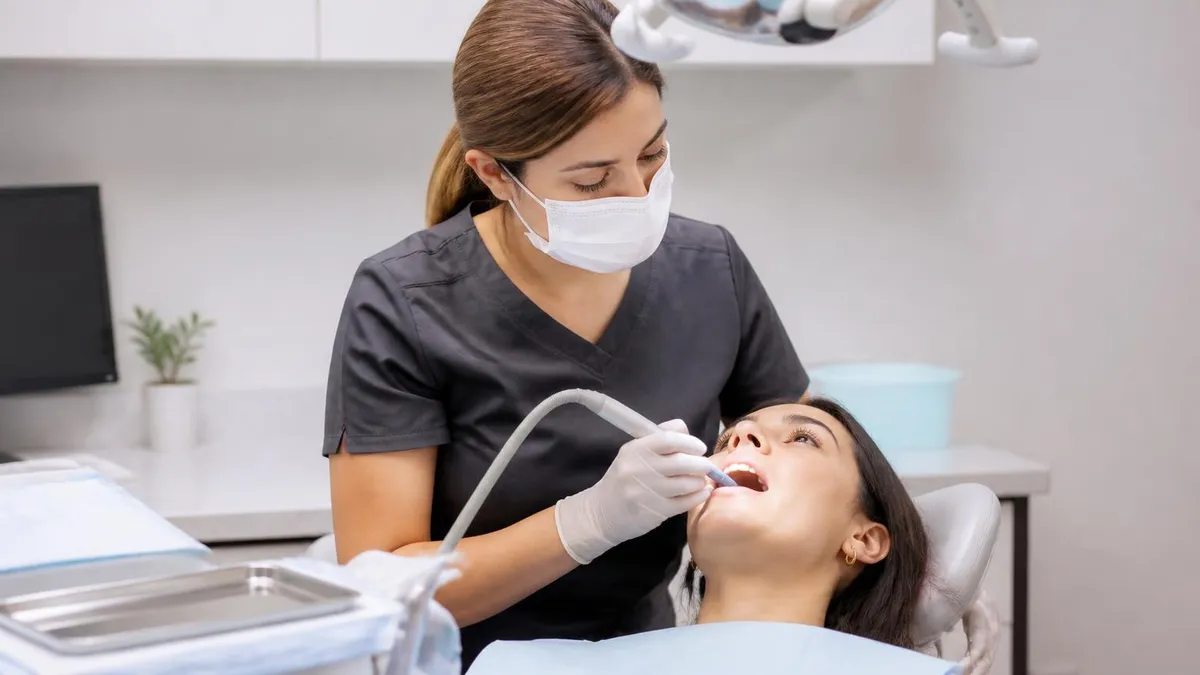
RDA Certification: Complete Guide to Becoming a Registered Dental Assistant in 2026

RDA Meaning Dental: Complete Guide to Becoming a Registered Dental Assistant

RDA License Lookup: How to Verify a Registered Dental Assistant's Credentials

How to Become an RDA in California: Step-by-Step Training Guide
About the Author

Educational Psychologist & Academic Test Preparation Expert
Columbia University Teachers CollegeDr. Lisa Patel holds a Doctorate in Education from Columbia University Teachers College and has spent 17 years researching standardized test design and academic assessment. She has developed preparation programs for SAT, ACT, GRE, LSAT, UCAT, and numerous professional licensing exams, helping students of all backgrounds achieve their target scores.
Join the Discussion
Connect with other students preparing for this exam. Share tips, ask questions, and get advice from people who have been there.
View discussion (8 replies)