
RCMP Officer: Career Overview, Duties, and How to Qualify 2026 September
Everything you need to know about becoming an RCMP officer — 🔎 duties, salary, qualifications, and how to ace the entrance exam in 2026 September.

Becoming an rcmp officer is one of the most respected career paths available in Canadian federal law enforcement. The Royal Canadian Mounted Police serves as Canada's national police service, operating across provinces, territories, municipalities, and Indigenous communities. RCMP officers handle everything from everyday traffic stops to complex national security investigations, making the role remarkably diverse. If you are a US resident interested in Canadian policing, understanding what this career entails can open pathways to careers in international policing or inform your understanding of North American law enforcement structures.
The RCMP is unlike most police services in North America because it operates at the federal, provincial, and municipal levels simultaneously. While American federal agencies like the FBI focus on federal crimes, RCMP officers can serve as local beat cops in rural Saskatchewan one year and cybercrime investigators the next. This flexibility is both a challenge and one of the biggest draws of the career. Officers must be adaptable, physically fit, and capable of navigating complex legal and social situations across vastly different communities.
Entry into the RCMP begins with a rigorous selection process that includes written aptitude tests, physical fitness assessments, background investigations, medical and psychological evaluations, and a formal interview panel. The written component is particularly important because it tests problem-solving, reading comprehension, memory, and situational judgment. Candidates who score poorly on the written test are eliminated early, regardless of how well they perform in other areas. Understanding the structure of these tests is therefore essential for any serious applicant.
The training program for new recruits is conducted at the RCMP Academy in Regina, Saskatchewan, commonly known as Depot Division. The program lasts approximately 26 weeks and is one of the most demanding police training programs in North America. Recruits are evaluated constantly on fitness, academics, and practical skills. Those who graduate are sworn in as constables and deployed to detachments across Canada. The rigorous training prepares them for the unpredictable and often dangerous nature of policing in remote and urban environments alike.
For American readers, understanding the RCMP's scope is important context. Canada has approximately 19,000 regular RCMP members, along with roughly 3,000 civilian employees and thousands of additional public service staff. This makes the RCMP one of the largest police organizations in the world by headcount. Officers serve in over 150 countries as part of international peacekeeping missions, adding a global dimension to the role that is rare in North American policing. The career offers genuine breadth of experience that few other law enforcement agencies can match.
Compensation for RCMP officers is competitive and includes a defined-benefit pension plan, health benefits, and incremental pay raises tied to years of service. Starting salaries for new constables have historically ranged from approximately $53,000 to $86,000 CAD annually, depending on posting and experience. Senior non-commissioned officers and inspectors can earn significantly more. For Americans considering law enforcement careers, comparing RCMP compensation to domestic federal agencies provides useful benchmarks for evaluating career options across the border.
This article provides a comprehensive overview of the RCMP officer role: what officers actually do day to day, how the rank structure works, what the selection process demands, and practical advice for preparing for the entrance exam. Whether you are a prospective recruit, a student researching Canadian law enforcement, or an American exploring comparative policing systems, this guide covers the essential information you need to understand and pursue this career path effectively.
RCMP Officer Career by the Numbers

Core Duties of an RCMP Officer
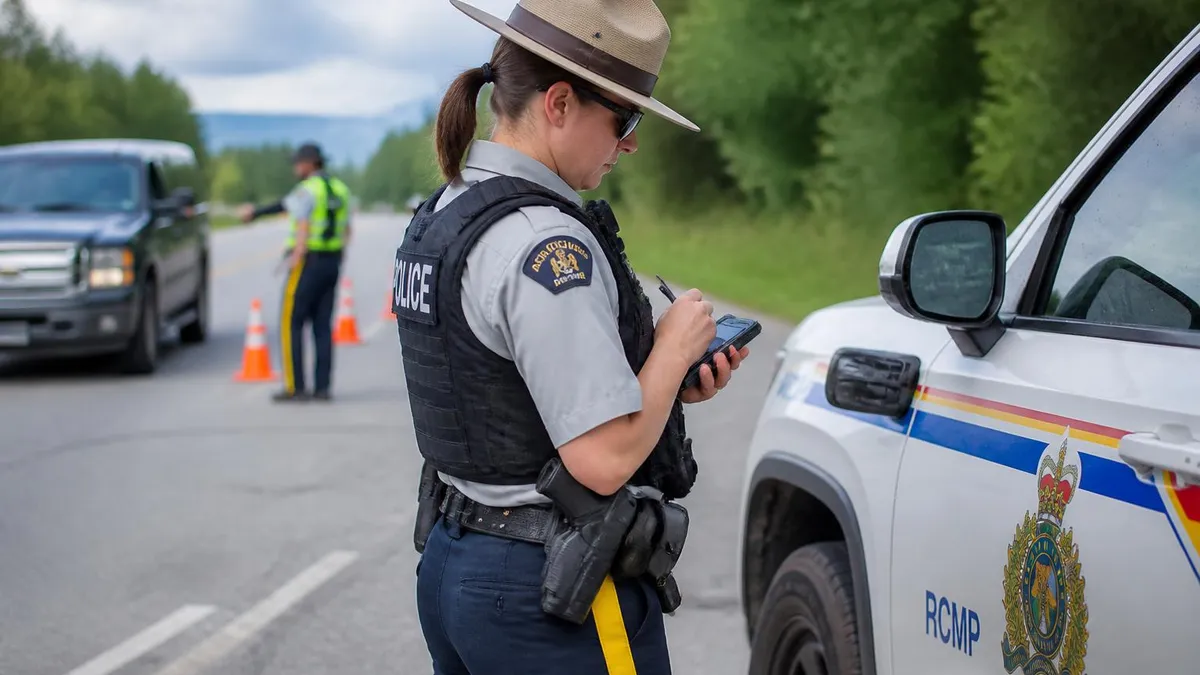
Officers respond to calls for service, conduct patrols, investigate crimes, and maintain order in assigned communities. This includes traffic enforcement, domestic disturbance response, and criminal investigations at the local level.
Specialized units tackle organized crime, drug trafficking, cybercrime, terrorism, and financial fraud. Officers in federal divisions work alongside CSIS, border agencies, and international law enforcement partners.
Many officers serve in Indigenous communities and remote regions under contract policing arrangements. Building trust, delivering social programs, and collaborating with community leaders are central responsibilities in these postings.
The RCMP deploys officers to UN and bilateral peacekeeping missions worldwide. Officers assist in training foreign police services, supporting democratic institutions, and maintaining order in post-conflict zones.
RCMP officers provide close protection for the Governor General, Prime Minister, foreign dignitaries, and other senior officials. This specialized role requires advanced tactical training and intelligence awareness.
The qualifications to become an RCMP officer are clearly defined, though demanding. Applicants must be Canadian citizens or permanent residents, at least 18 years of age, and hold a Canadian secondary school diploma or equivalent. A valid Canadian driver's license is required, and applicants must be proficient in English or French. A university degree is not mandatory for initial entry, though it is strongly preferred and may accelerate career progression. The RCMP places significant weight on life experience, community involvement, and demonstrated character during the selection process.
Physical fitness is a non-negotiable requirement. All applicants must pass the Physical Abilities Requirement Evaluation, commonly known as the PARE test. This circuit-style test simulates physical demands officers face on duty, including running, vaulting obstacles, pushing and pulling weighted sleds, and climbing stairs. The test must be completed within a specific time limit, and candidates who fail are not advanced. Regular fitness preparation — ideally beginning six to twelve months before applying — is strongly recommended for anyone who has not been consistently active.
Background investigations are thorough and extend to personal finances, relationship history, drug use, and social media activity. The RCMP requires a clean criminal record; any criminal convictions, including pardoned offenses, may disqualify a candidate depending on severity and recency. Financial integrity matters significantly — applicants with poor credit histories, unpaid judgments, or unresolved debt may be screened out. Social media profiles are reviewed and anything that undermines confidence in a candidate's judgment or character can be disqualifying. Honesty throughout the process is critical, as inconsistencies discovered during background checks lead to immediate elimination.
Medical and psychological evaluations are comprehensive. Candidates must meet vision standards without surgery restrictions, hearing thresholds, and general physical health requirements. The psychological assessment examines emotional resilience, decision-making under stress, impulse control, and interpersonal style. Candidates who present significant risk factors for burnout, aggression, or misconduct are screened out during this phase. These assessments are not pass/fail in the simplest sense — they are comparative evaluations designed to identify candidates most likely to succeed and thrive throughout a long policing career.
Language requirements deserve special attention from American applicants or prospective candidates unfamiliar with Canadian bilingualism policies. While you must be functionally proficient in either English or French, bilingual officers are in high demand and often receive preferred postings. Candidates who are bilingual at the time of application receive additional consideration during deployment discussions. Investing in French language skills before applying — particularly for those hoping to serve in Quebec, New Brunswick, or federal roles in Ottawa — is a strategic career decision with long-term benefits.
Academic performance matters even without a degree requirement. Candidates are expected to score well on the written entrance exam, which tests reading comprehension, numerical reasoning, problem-solving, and situational judgment. These skills directly reflect the ability to write clear police reports, analyze evidence, and make sound decisions in high-pressure situations. Candidates with post-secondary education in criminology, psychology, law, or social sciences often find the written components more intuitive. Self-study through practice tests and review of Canadian law basics is strongly recommended regardless of educational background.
References play a more significant role in RCMP selection than in many employment processes. The RCMP contacts references directly and asks detailed behavioral questions about the candidate's judgment, reliability, honesty, and how they handle conflict. Character witnesses should be people who have known the candidate well in professional or community contexts — not friends or family members. Preparing your references by discussing your motivations for joining the RCMP and reviewing your work history together can meaningfully improve how the reference call goes for both parties.
RCMP Officer Rank Structure and Career Path
All RCMP officers begin their career as Constable (Cst.), the entry-level rank. New constables are assigned to general duty postings, often in smaller communities or rural detachments, where they gain broad operational experience. After three years of service, eligible constables may apply for promotion to Corporal (Cpl.), a rank that comes with supervisory responsibilities, including mentoring junior officers and leading small teams during shifts.
Promotion to Corporal is competitive and requires demonstrated leadership potential, a strong performance record, and successful completion of promotional examinations. Corporals earn higher base pay and are often assigned specialized training opportunities in areas like traffic reconstruction, criminal intelligence, or community liaison work. This rank is a key stepping stone toward the non-commissioned officer ranks that follow.

Is an RCMP Officer Career Right for You?
- +Exceptional job security with federal government employment status and a defined-benefit pension plan
- +Unmatched career variety — from rural general duty to federal cybercrime to international peacekeeping
- +Competitive salary with automatic progression increases and generous benefits package
- +Opportunities for transfer and specialization across dozens of units and every province and territory
- +Strong fraternal community and institutional support systems for officers and their families
- +International service opportunities through UN peacekeeping missions and bilateral training programs
- −Initial postings are rarely in the officer's preferred location — remote assignments are common for new constables
- −Shift work, irregular hours, and on-call requirements significantly impact personal and family life
- −Exposure to trauma, violence, and human suffering creates significant mental health risks over a long career
- −The selection process is lengthy — often 12 to 18 months from application to Depot arrival
- −Physical demands are sustained throughout the career, not just during initial fitness testing
- −Organizational bureaucracy and hierarchical culture can frustrate officers seeking rapid advancement or change
RCMP Officer Application Checklist
- ✓Confirm Canadian citizenship or permanent resident status before submitting your application
- ✓Obtain a valid Canadian driver's license with no major violations in the past three years
- ✓Begin a structured physical training program targeting PARE completion well under the time limit
- ✓Review your credit report and resolve any outstanding debts or financial discrepancies
- ✓Audit all social media accounts and remove content that could be viewed as biased or unprofessional
- ✓Study Canadian criminal law fundamentals, including the Criminal Code and Charter of Rights
- ✓Prepare detailed references who can speak specifically to your judgment, reliability, and character
- ✓Complete the online RCMP application form honestly and thoroughly — inconsistencies are disqualifying
- ✓Practice written entrance exam components including reading comprehension, logic, and situational judgment
- ✓Schedule a medical examination and review RCMP vision and hearing standards in advance
The Written Test Is Your First Filter
Approximately 40% of RCMP applicants are eliminated after the written aptitude test stage. This is the largest single dropout point in the entire selection process. Candidates who prepare systematically — using practice tests, reviewing Canadian law, and building reading speed — consistently outperform those who assume their natural ability will carry them through. Treat the written test as a skill, not a measure of intelligence, and prepare accordingly.
RCMP officer salaries are structured on a progression pay scale tied to years of service rather than performance bonuses, reflecting the federal public service employment model. As of recent collective agreements, newly sworn Constables entering from Depot typically start at approximately $53,000 to $58,000 CAD annually. This figure increases through defined steps each year of service, reaching a maximum Constable pay of approximately $86,000 CAD after several years of progression. These figures represent base pay before overtime, allowances, or isolation pay — all of which can significantly increase take-home compensation for officers posted to remote or northern locations.
For American readers comparing RCMP salaries to US law enforcement, it is worth noting that Canadian dollar figures and Canadian costs of living require context. Major Canadian cities like Vancouver, Toronto, and Calgary have high costs of living comparable to major US metros. However, officers posted to smaller communities often receive housing allowances, cost-of-living supplements, and isolation pay that substantially increase their effective compensation. The defined-benefit pension plan — which guarantees a monthly retirement income based on years of service and final salary — represents enormous financial security that most private-sector workers and many American public employees lack.
Benefits beyond base salary are comprehensive. RCMP officers receive extended health and dental coverage, life insurance, long-term disability protection, and access to the Employee and Family Assistance Program, which provides mental health support services. Paid vacation starts at three weeks and increases with seniority. Officers also receive a uniform and equipment allowance, paid training opportunities, and access to physical fitness facilities at many detachments. These benefits collectively represent a compensation package that rivals or exceeds most comparable Canadian employment opportunities.
Overtime is a reality of policing, and RCMP officers are compensated for it through banked overtime hours that can be used as additional vacation or paid out, depending on the officer's preference and operational requirements. During major events, investigations, or periods of staff shortage, overtime accumulation can be significant. Some officers effectively earn 10–20% above their base salary through overtime compensation in a given year, particularly in understaffed northern and remote detachments where relief coverage is limited.
Promotion-based pay increases are substantial. Moving from Constable to Corporal brings a meaningful salary jump, as does each subsequent promotion through the NCO and commissioned officer ranks. Officers who progress to Staff Sergeant or Inspector roles can earn well in excess of $100,000 CAD annually, plus the full federal benefits package. Senior officers at the Assistant Commissioner and Commissioner levels earn executive-tier compensation commensurate with their national leadership responsibilities and accountability for large operational budgets.
Lateral entry programs and direct entry programs allow certain specialists — such as lawyers, accountants, engineers, and medical professionals — to join the RCMP in civilian or specialist roles that support frontline operations. While these roles are not classified as peace officer positions, they carry competitive federal government salaries, pension entitlements, and benefits equivalent to those of sworn members. For highly specialized professionals, these pathways offer a way to contribute to Canadian law enforcement without completing the standard peace officer training program at Depot.
Retirement benefits are a major factor in RCMP career longevity. Officers who complete 25 years of service can retire with a pension equal to approximately 50% of their best five-year average salary, paid monthly for life with cost-of-living adjustments. Thirty-five years of service can yield a pension of up to 70% of salary. These figures, combined with the Canada Pension Plan entitlement and potential bridging supplements, mean that retired RCMP officers typically receive comfortable and stable retirement incomes without depending solely on personal savings — a significant advantage compared to most private-sector careers.

The RCMP background investigation is exhaustive and cross-references financial records, employment history, travel history, and personal references. Any misrepresentation — including omitting past drug use, understating debt, or providing inaccurate dates of employment — will result in immediate disqualification. Candidates who are disqualified for dishonesty are typically banned from reapplying permanently. Be fully transparent in every part of your application, even if certain details seem unflattering.
Preparing for the RCMP entrance exam requires a structured approach because the test covers multiple distinct cognitive domains. The written component has historically included sections on reading comprehension, reasoning ability, situational judgment, and memory recall. Recent iterations of the RCMP entrance testing process have evolved, but the fundamental skills being assessed remain consistent: candidates must demonstrate that they can read and understand complex written material, apply logical reasoning to scenarios, recall details under pressure, and make sound judgments in ambiguous situations. Reviewing what the test covers before you begin preparing is the first step to building an effective study plan.
Reading comprehension is typically the largest and most heavily weighted section of the written test. Officers spend enormous amounts of time reading — reports, witness statements, legal briefs, policy documents, and briefing notes. Candidates who read extensively before their exam tend to perform better, not because they have memorized anything specifically useful, but because their reading speed and comprehension accuracy are higher. Reading newspapers, legal summaries, government reports, and analytical journalism in the weeks and months before the exam is a low-effort, high-return preparation habit. Targeting Canadian news sources helps expose you to relevant vocabulary and subject matter simultaneously.
Numerical reasoning and problem-solving sections assess the ability to work with data, identify patterns, and solve logical puzzles under time pressure. Unlike advanced mathematics, these sections test practical numerical literacy — the kind used in counting evidence inventory, estimating distances, reading budget reports, or analyzing crime statistics. Basic arithmetic, percentage calculations, ratio interpretation, and basic statistics are fair game. Flashcard-style drills and timed practice problem sets are the most effective preparation tools for these sections. Aim for accuracy first, then speed as your confidence builds.
Situational judgment questions present a scenario — a conflict between colleagues, a decision point in the field, an ethical dilemma — and ask candidates to identify the best course of action from a set of options.
These questions have no single obviously correct answer visible to an unprepared reader, but they do have defensible best answers based on policing values: de-escalation, respect for individual rights, following chain of command, and prioritizing public safety. Studying the RCMP's core values, code of conduct, and the guiding principles of community policing will help you identify the reasoning behind preferred answers on situational judgment questions.
Memory recall sections are unique to law enforcement testing and often catch candidates off guard. In these sections, you are shown a scene, passage, or set of facts for a limited time, then asked questions about those details without being able to refer back to the source material. Police officers must remember witness descriptions, license plates, scene details, and timelines with precision. Improving working memory through deliberate practice — describing images in detail from memory, memorizing number sequences, and practicing name-face associations — builds the cognitive habits these questions test. This is a learnable skill that improves with consistent practice.
Practice tests are the single most effective preparation tool because they simulate the actual experience of working through timed, structured test sections under conditions close to the real exam. Taking multiple full-length practice tests, reviewing every missed question with an explanation of why the correct answer is right, and tracking your performance over time allows you to identify and address your specific weaknesses.
Generic test preparation is less effective than targeted practice on the exact question types used in RCMP testing. Using resources designed specifically for RCMP exam preparation — rather than general aptitude test books — maximizes the relevance of your study time.
Test-day strategy matters as much as preparation. Arriving well-rested, nourished, and on time reduces the anxiety that degrades performance on timed assessments. Reading each question fully before looking at the answer choices prevents misinterpretation. Managing time deliberately — moving on from stuck questions rather than burning precious minutes — ensures you attempt every question. For multiple-choice sections where wrong answers are not penalized, always submit an answer even when uncertain. Educated guessing based on eliminating clearly wrong options improves your expected score on questions you do not immediately know the answer to.
Depot Division in Regina, Saskatchewan, is where RCMP officer candidates are transformed into sworn peace officers. The 26-week residential training program is intense by design — candidates are evaluated every week on academics, physical fitness, drill, defensive tactics, firearms proficiency, and professional conduct. The program is deliberately stressful because policing requires the ability to function effectively under sustained pressure. Understanding what Depot demands before you arrive helps you prepare mentally and physically so the experience builds rather than overwhelms you.
Physical training at Depot begins at an elevated baseline and escalates throughout the program. The PARE test must be passed multiple times during training, and candidates who cannot meet physical standards at any evaluation point risk being held back or released from the program. Arriving at Depot already physically capable — running multiple miles without stopping, completing bodyweight exercises with ease, and recovering quickly from physical exertion — puts you in a strong position from day one. Candidates who arrive barely meeting the minimum standard often struggle as training intensity increases.
Academic instruction at Depot covers Canadian criminal law, the Charter of Rights and Freedoms, provincial legislation, use-of-force theory, report writing, investigative techniques, and cultural awareness. Tests and practical exercises are frequent, and academic failure can result in removal from the program. The academic workload surprises many recruits who expected Depot to be primarily physical. Reviewing the Criminal Code of Canada, understanding Charter provisions, and familiarizing yourself with basic investigative principles before arriving gives you a meaningful head start on the academic component.
Mental preparation for policing work begins at Depot. Instructors expose recruits to challenging scenarios involving death, trauma, domestic violence, missing children, and human trafficking — the realities that officers encounter regularly throughout their careers. Building emotional resilience is not about becoming desensitized; it is about developing the capacity to process difficult experiences in healthy ways, maintain professional effectiveness during crises, and seek support appropriately when needed. The RCMP has invested heavily in mental health resources in recent years following high-profile discussions about officer burnout and PTSD, and accessing these resources throughout your career is a sign of strength, not weakness.
Building your professional network during Depot creates relationships that last an entire career. Classmates from your Depot troop will be posted across Canada, giving you a personal network with officers who understand your background and training. Former Depot classmates become reference contacts, mentors, collaborative colleagues in cross-jurisdictional investigations, and lifelong friends. Investing in those relationships during training — supporting classmates through difficult weeks, studying together, and building genuine trust — pays professional and personal dividends for decades after graduation.
After Depot graduation, new constables typically complete a six-month field coach period at their first posting. During this phase, experienced officers accompany and evaluate new constables on every call, providing real-time feedback and progressive independence as skills develop. This mentored entry into operational policing is a critical learning period — new officers who approach it with humility, ask questions freely, and absorb their coach's practical experience accelerate their development dramatically compared to those who assume Depot prepared them for everything.
Long-term career success in the RCMP rewards officers who are curious, adaptable, and proactive about their professional development. Seeking out specialized courses, volunteering for task force assignments, pursuing post-secondary education part-time, and taking on community leadership roles all signal ambition and capability to the organization. Officers who treat policing as a career to be actively shaped — rather than a job to be endured — consistently advance faster, achieve more satisfying postings, and build the kind of career that their communities and colleagues remember with genuine respect.
RCMP Questions and Answers


About the Author

Educational Psychologist & Academic Test Preparation Expert
Columbia University Teachers CollegeDr. Lisa Patel holds a Doctorate in Education from Columbia University Teachers College and has spent 17 years researching standardized test design and academic assessment. She has developed preparation programs for SAT, ACT, GRE, LSAT, UCAT, and numerous professional licensing exams, helping students of all backgrounds achieve their target scores.
Join the Discussion
Connect with other students preparing for this exam. Share tips, ask questions, and get advice from people who have been there.
View discussion (7 replies)