
Female RCMP Officers: History, Role, and How to Join Canada's National Police
Female RCMP officers have shaped Canadian policing since 1974. Learn their history, duties, pay, and how to qualify. 🎯
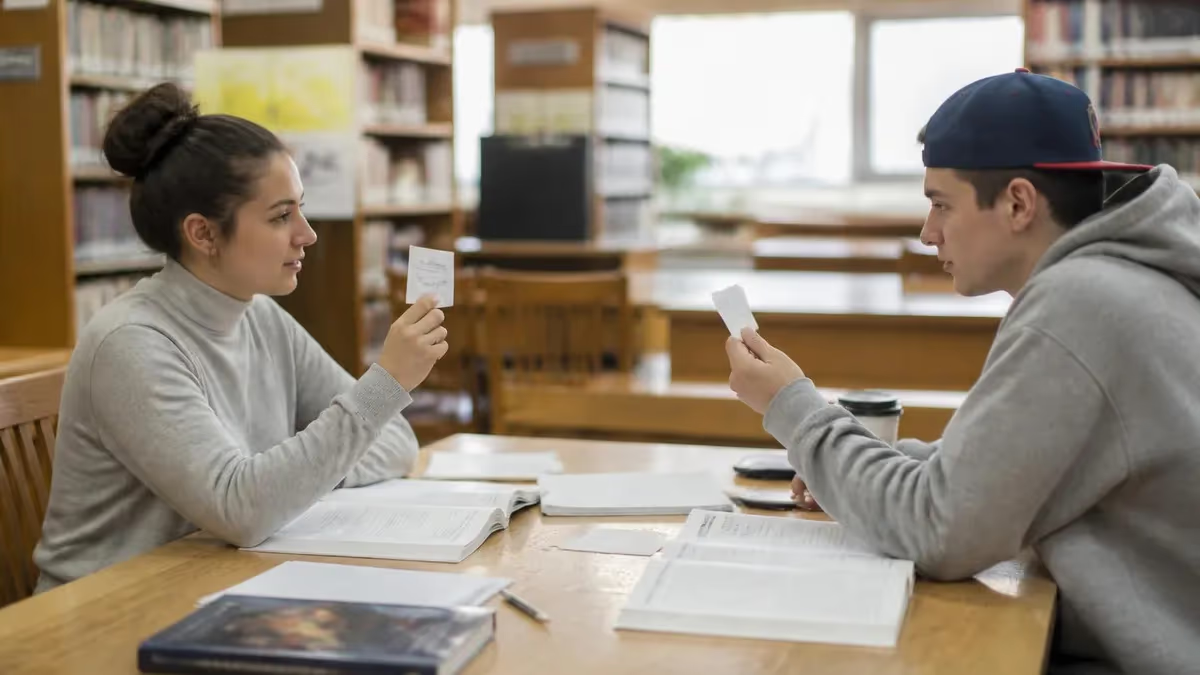
Female RCMP officers have played a significant role in Canadian law enforcement since the Royal Canadian Mounted Police first opened its ranks to women in 1974. That historic milestone — which came after decades of advocacy and societal change — fundamentally altered the character of Canada's national police service. Today, women serve in every division, rank, and specialty unit within the RCMP, from frontline patrol work in remote northern communities to leadership positions at the executive command level across the country.
The path to becoming an RCMP officer is the same for all applicants regardless of gender, and it is demanding by design. Candidates must pass a rigorous battery of written aptitude tests, a thorough background investigation, a medical and psychological evaluation, and a structured physical fitness assessment. The Cadet Training Program at Depot Division in Regina, Saskatchewan lasts approximately six months and is one of the most intensive police academy programs in North America, combining classroom instruction with hands-on scenario training.
Many aspiring female rcmp officers find that early, consistent preparation for the written entrance exams is one of the most important steps they can take on the road to Depot. The aptitude tests cover verbal reasoning, problem solving, memory retention, and situational judgment — areas that reward structured study over last-minute cramming. Starting practice several months before your application submission gives you a measurable advantage and reduces test-day anxiety significantly.
The RCMP's workforce diversity goals have driven genuine institutional change over the past two decades. The service has invested in targeted recruitment campaigns, mentorship programs for women already in service, and policy reforms designed to improve work-life balance for officers with family responsibilities. These efforts reflect a broader recognition that a police service reflecting the demographics of the communities it serves is better positioned to build public trust and solve complex crime problems.
Women in the RCMP work in an enormous range of roles. Some serve as general duty officers responding to calls in rural and urban communities alike. Others specialize in federal investigative work — organized crime, financial crime, national security, or cybercrime. Still others advance into forensic disciplines, victim services coordination, Indigenous community policing, or international peacekeeping missions. The breadth of career paths available within a single organization is one of the RCMP's most compelling recruiting advantages.
Compensation for RCMP officers is competitive within Canadian public sector standards. Starting salaries for constables after completing Depot typically sit in the mid-to-upper $60,000 range annually, with structured pay increments that move officers toward the $100,000+ threshold within a decade of service. Benefits include a defined pension plan, comprehensive health and dental coverage, and relocation support — important considerations for officers posted to communities far from where they trained or grew up.
Whether you are at the very beginning of your research or deep into your application process, understanding the full picture of what it means to serve as a female officer in the RCMP is essential. This guide covers the history of women in the force, the current recruitment process, physical and written standards, career advancement, and the practical realities of life on the job — giving you the complete context you need to make an informed decision about pursuing this career.
Women in the RCMP: By the Numbers

History of Women in the RCMP
1974 — The Breakthrough
1980s — Expanding Roles
1990s — Leadership Milestones
2000s — Executive Command
2010s–Present — Ongoing Reform
The recruitment process for the RCMP is uniform across all applicants — there are no gender-specific entry streams, separate physical standards for women, or different written test thresholds based on sex. This standardization reflects the RCMP's commitment to operational equity: every officer on the street must meet the same baseline capability requirements regardless of background. What the RCMP has done is invest heavily in targeted outreach to ensure that women are aware of and supported through the application pipeline from start to finish.
The first formal step is submitting an online application through the RCMP's official recruitment portal. Applicants provide basic eligibility information including Canadian citizenship status, age (18 years minimum, with no upper age limit), educational qualifications (a secondary school diploma is the minimum, though a post-secondary credential is strongly recommended), and a clean criminal record. The initial screening eliminates applicants who do not meet these baseline criteria before any testing begins.
After passing initial screening, candidates sit for the RCMP Police Aptitude Battery, commonly abbreviated as RPAB. This written test measures verbal reasoning, written composition, logic, memory recall, and spatial reasoning abilities. The RPAB is not a knowledge test about policing — it assesses raw cognitive aptitude. Scores are used to rank candidates and inform posting decisions, which means a higher score does not just pass you through the gate but may influence where you are offered a posting after Depot.
Candidates who pass the RPAB advance to a structured interview, where assessors evaluate communication skills, situational judgment, emotional resilience, and motivational alignment with RCMP values. This is followed by background checks that are among the most thorough of any law enforcement agency in North America — investigators examine financial records, employment history, personal references, social media activity, and in some cases travel records. Any history of significant dishonesty, violence, or serious financial irresponsibility can disqualify a candidate.
The Physical Abilities Requirement Evaluation, known as the PARE, is the RCMP's standardized physical fitness test. It simulates a realistic police pursuit and takedown scenario: candidates must complete a timed obstacle course involving pushing and pulling resistance loads, followed by a 20-meter sprint-based circuit. The pass time is set at 4 minutes and 45 seconds for all candidates regardless of gender or age. Female applicants sometimes underestimate how demanding the PARE is and benefit significantly from a structured cardiovascular and strength training program begun at least three to four months before the test date.
A comprehensive medical examination and psychological assessment are also mandatory components. The medical assessment evaluates vision, hearing, cardiovascular fitness, and the absence of conditions that could impair an officer's ability to perform duties safely under stress. The psychological component includes standardized personality inventories and, in many cases, a one-on-one interview with an RCMP psychologist who is specifically trained to identify traits associated with integrity, emotional stability, and suitability for police work.
Once all components are cleared, successful candidates receive a conditional offer of employment and are placed on a waiting list for a Depot intake. Wait times can range from several months to over a year depending on the volume of successful applicants and available training capacity. During this period, it is strongly advisable to continue your physical training and to review any aptitude areas where your RPAB performance was weaker — some candidates are asked to resit portions of the assessment battery before intake.
Physical, Written, and Psychological Standards Explained
The Physical Abilities Requirement Evaluation is a job-simulation test that replicates the physical demands of a real police response. Candidates must complete an obstacle course — including running, jumping, and vaulting — followed by a push-pull machine simulation of subduing a resisting subject, and a final sprint circuit. The pass threshold is 4 minutes 45 seconds for all applicants, and the test is conducted under the supervision of trained RCMP evaluators who can observe form and flag safety concerns.
Female applicants who invest time in building cardiovascular endurance and upper-body functional strength well before their test date consistently report better results and less anxiety on test day. Recommended preparation includes interval running, pull-up progressions, sled pushes, and agility ladder drills. Many RCMP detachments and recruitment offices hold informal PARE practice sessions open to pre-applicants — contacting your local recruiting office to ask about these sessions is a low-cost, high-value preparation strategy that can also give you a realistic sense of the test environment before your official attempt.

Pros and Cons of a Career as a Female RCMP Officer
- +Competitive, stable salary with structured annual increments reaching $100K+ within a decade
- +Defined benefit pension plan providing long-term financial security after a full career
- +Access to a broad range of specialized career paths from cybercrime to international peacekeeping
- +Strong job security as a federal government employee with Canada-wide posting opportunities
- +Meaningful public service work that directly impacts community safety and justice
- +Comprehensive benefits package including extended health, dental, and disability coverage
- −Mandatory geographic mobility — you may be posted far from home, family, and support networks
- −Shift work including nights, weekends, and statutory holidays is standard in general duty roles
- −Exposure to traumatic incidents, violence, and human suffering carries significant psychological risk
- −The application and screening process is lengthy, often taking 12 to 24 months from start to Depot
- −Historically documented workplace culture challenges, including harassment, though reforms are ongoing
- −Physical demands of the role require sustained fitness commitment throughout an entire career
RCMP Application Preparation Checklist for Female Candidates
- ✓Confirm you meet all basic eligibility criteria: Canadian citizenship, age 18+, valid driver's license, and clean criminal record.
- ✓Begin a structured PARE training program at least 12 weeks before your scheduled physical assessment.
- ✓Complete at least three full-length timed practice RPAB tests to benchmark your aptitude score.
- ✓Review all five RPAB domains (verbal, written, logic, memory, spatial) and prioritize your two weakest areas.
- ✓Compile a detailed personal history document covering all addresses, employers, and references for the background check process.
- ✓Research and connect with an RCMP Women's Recruiting Advisor or local recruiting office for region-specific guidance.
- ✓Prepare three to five concrete examples from your life that demonstrate RCMP core values such as integrity, compassion, and professionalism.
- ✓Schedule a vision and hearing check with your doctor to confirm you meet RCMP medical standards before submitting your application.
- ✓Review your social media profiles and remove any content that could be perceived as inconsistent with the values of a law enforcement officer.
- ✓Set up a dedicated application tracking document to monitor all deadlines, test dates, and required document submissions.
Early Preparation Is the Single Biggest Advantage
Candidates who begin practicing for the RCMP Police Aptitude Battery three to six months before their test date consistently outperform those who cram in the final weeks. The RPAB rewards pattern recognition and cognitive fluency that develops through repeated, spaced practice — not memorization. Starting early is the most reliable performance advantage available to any applicant.
Once you have completed Depot and received your badge, the range of career directions available within the RCMP is genuinely remarkable. Most new constables begin in general duty policing — responding to calls for service, conducting investigations, and building the community relationships that are the foundation of effective local law enforcement. General duty experience is considered essential groundwork regardless of where your long-term career interests lie, and the skills developed in those early years inform every subsequent posting.
Investigative specializations represent one of the most common career advancement paths for female officers with strong analytical abilities. The RCMP's federal mandate means it investigates crimes that fall outside provincial and municipal police jurisdiction: organized crime networks, immigration fraud, drug trafficking at the national level, financial crimes affecting federal institutions, and national security threats including terrorism and foreign interference. These investigative units are talent-competitive — officers typically need several years of general duty experience plus demonstrated performance before being considered for transfer into them.
Technology-focused roles have grown dramatically in importance over the past decade. The RCMP's cybercrime units, digital forensics sections, and signals intelligence functions are actively recruiting officers with backgrounds or strong aptitudes in technology. Female officers with computer science, engineering, or information security backgrounds are particularly well-positioned for these roles, which are increasingly central to the RCMP's operational effectiveness in an era where most serious crime has a digital dimension.
Community policing in Indigenous communities is a distinct and critically important career stream within the RCMP. The service has a long-standing responsibility to provide policing services to many First Nations, Métis, and Inuit communities — a role that requires exceptional intercultural communication skills, patience, and a deep understanding of historical context. Female officers often find that community members in remote and rural areas respond positively to their presence, and some Indigenous communities have specifically advocated for more female officers in recognition of culturally sensitive issues including family violence and the safety of Indigenous women.
Leadership and promotion within the RCMP follows a defined rank structure: Constable, Corporal, Sergeant, Staff Sergeant, Inspector, Superintendent, Chief Superintendent, Assistant Commissioner, Deputy Commissioner, and Commissioner. Advancement beyond the non-commissioned officer ranks (Corporal and Sergeant) requires passing written promotional examinations and demonstrating leadership competencies through performance evaluations. Female officers have reached every rank in the structure, including the position of Deputy Commissioner — the second-highest rank in the organization.
International assignments are another avenue open to experienced RCMP officers. Canada participates in numerous United Nations peacekeeping missions and bilateral policing capacity-building programs in countries undergoing post-conflict reconstruction. RCMP officers selected for international deployments serve as advisors, trainers, and embedded team members working alongside host-country police services. These assignments typically last from six months to two years and are considered significant career development opportunities that can accelerate promotion timelines and broaden an officer's professional network substantially.
Regardless of the path you choose, ongoing professional development is built into an RCMP career. Officers are expected to complete regular training updates in use of force, first aid, legal updates, and emerging crime methodologies. The RCMP also supports officers pursuing advanced education during their careers, with some divisions offering educational leave provisions or financial assistance for relevant degree programs — a meaningful benefit for officers who entered the service with a high school diploma and aspire to formal education in criminology, law, or public administration.

All RCMP regular members, regardless of gender, are subject to mandatory geographic mobility as a condition of employment. Your first posting after Depot is assigned by the RCMP based on operational need, not personal preference — you may be sent anywhere in Canada. While the RCMP attempts to accommodate personal circumstances where possible, applicants should genuinely prepare for the reality of relocation before committing to this career path.
Day-to-day life as a female RCMP officer varies enormously depending on division, posting location, and rank — but some common threads run through the experience regardless of where you serve. Shift work is a near-universal reality in general duty policing, meaning you will regularly work nights, weekends, and holidays, often on rotating schedules that change week to week. Managing sleep, fitness, nutrition, and relationships in the context of irregular hours is a skill that many officers describe as one of the most underestimated challenges of the profession — and one that rewards early, intentional habit development.
The psychological demands of policing are significant and real. Officers regularly encounter trauma, violence, grief, and human suffering in ways that can accumulate over a career. The RCMP has invested substantially in peer support programs, critical incident stress debriefings, and confidential employee assistance programs specifically designed to help officers process difficult experiences without career penalty. Female officers in particular have been vocal advocates for expanding these programs, and the cultural conversation around officer mental health within the force has shifted notably in recent years — though many would argue that meaningful stigma reduction remains an ongoing project.
Balancing family responsibilities with a policing career has historically been more challenging for female officers, particularly those in general duty roles where shift scheduling flexibility is limited. The RCMP has implemented improved parental leave policies, gradual return-to-work programs after extended leave, and in many divisions access to modified duty arrangements for pregnant officers or those returning from medical leave. These policies have improved the retention of female officers who might otherwise leave the service during child-rearing years, though their effectiveness varies considerably by local management culture.
Mentorship is widely cited by female RCMP officers as one of the most impactful resources available to women in the service. Many divisions have formal mentorship programs that pair new female constables with experienced female officers at the sergeant or inspector level. These relationships provide practical guidance, emotional support, and career navigation advice that formal training programs cannot replicate. If your posting does not have a formal mentorship structure, proactively seeking an informal mentor is a strategy that virtually every senior female officer recommends to new members.
Uniform and equipment standards have been progressively updated to better accommodate female officers. Body armor, duty belts, and tactical gear are now available in female-specific cuts and sizes — a change that may seem minor but has meaningful practical implications for comfort, range of motion, and the ability to carry equipment effectively during physically demanding situations. Female officers who encounter inadequate equipment sizing should escalate through their chain of command, as the RCMP is formally committed to providing properly fitted equipment to all members.
The community reception that female officers receive varies by location and community type. In many urban and suburban settings, community members have long been accustomed to female officers and interact with them as they would any other officer. In some rural, remote, or historically conservative communities, female officers may occasionally encounter skepticism or resistance — experiences that require professional confidence, patience, and the communication skills that effective policing demands in any context. Most female officers report that strong policing performance and genuine community engagement are the most reliable ways to build the trust that underpins successful local law enforcement.
Networking with other female officers — both within the RCMP and across Canadian law enforcement — is an underutilized resource that pays dividends throughout a career. Organizations such as the Canadian Association of Women in Law Enforcement provide professional development programming, conference opportunities, and cross-jurisdictional connections that can expand your perspective on policing challenges and career possibilities. Staying connected to these networks, even during demanding postings, helps counteract professional isolation and supports the kind of long-view career thinking that distinguishes officers who reach senior leadership from those who plateau early in their trajectories.
Practical preparation for the RCMP entrance process is not a last-minute endeavor — it is a months-long project that rewards systematic effort across physical, cognitive, and personal domains. The candidates who succeed are typically those who treat the application as seriously as any other high-stakes professional certification: they set a timeline, identify their weak points, build a structured improvement plan, and execute consistently rather than sporadically. Understanding the full scope of what the RCMP evaluates is the essential first step in that process.
On the physical side, candidates who are new to structured fitness training should begin with a baseline fitness assessment to understand where they stand relative to the PARE standard. A common mistake is to focus exclusively on running — PARE performance also depends heavily on functional strength, agility, and the ability to sustain effort under fatigue. A well-designed training program addresses all three dimensions and includes at least two to three sessions per week dedicated specifically to PARE simulation exercises in addition to general cardiovascular conditioning.
For the written aptitude assessment, the most efficient preparation strategy is to take a full diagnostic practice test first, score it honestly, and then allocate your study time in inverse proportion to your performance — spending the most time on your weakest domains. This targeted approach consistently outperforms unfocused review of all content equally. It also helps you develop test-taking pacing and stamina, which are separate skills from raw domain knowledge and are often underestimated by candidates who perform well in low-stakes practice but struggle under timed test conditions.
The background check component is one that many applicants underestimate until they are deep into the process and asked to produce documentation they assumed would be easy to locate. Employment records, landlord references, financial statements, and contact information for references going back five to ten years can require significant time to compile — especially for candidates who have moved frequently, worked in multiple countries, or had gaps in conventional employment. Starting this documentation process early, before you are under deadline pressure, significantly reduces the stress of this phase.
Connecting with the RCMP recruiting office in your region early in the process is a frequently underutilized strategy. Recruiting officers can provide specific guidance about current wait times, active intake needs, and division-specific information that is not always published on the national recruitment website. They can also point you toward community events, information sessions, and ride-along opportunities that can both inform your decision-making and demonstrate genuine interest and initiative to the assessors who will eventually evaluate your application file.
Finally, approach the process with realistic expectations about the timeline. The RCMP application process from initial submission to first day at Depot typically takes between 12 and 24 months for candidates who pass all components on the first attempt.
Factors outside your control — such as the volume of applications in a given intake cycle, the availability of assessment sessions in your region, and RCMP operational staffing priorities — can extend this timeline further. Maintaining fitness and continuing to develop professionally during the waiting period, rather than allowing readiness to lapse, is one of the most important and practically challenging aspects of a successful RCMP application journey.
The investment is substantial, but the career that awaits successful candidates is one of the most varied, meaningful, and professionally rewarding available within Canadian public service. Female officers who have navigated the full process consistently describe a sense of accomplishment and purpose that informs their work across an entire career — a testament to both the rigor of the selection process and the significance of the mission the RCMP undertakes on behalf of all Canadians every single day.
RCMP Questions and Answers


About the Author

Educational Psychologist & Academic Test Preparation Expert
Columbia University Teachers CollegeDr. Lisa Patel holds a Doctorate in Education from Columbia University Teachers College and has spent 17 years researching standardized test design and academic assessment. She has developed preparation programs for SAT, ACT, GRE, LSAT, UCAT, and numerous professional licensing exams, helping students of all backgrounds achieve their target scores.
Join the Discussion
Connect with other students preparing for this exam. Share tips, ask questions, and get advice from people who have been there.
View discussion (7 replies)