
Correctional Probation Officer: Complete Career Guide to Duties, Salary, and How to Get Hired
Learn what a correctional probation officer does, salary expectations, required qualifications, and how to launch your career in correctional supervision. ❓
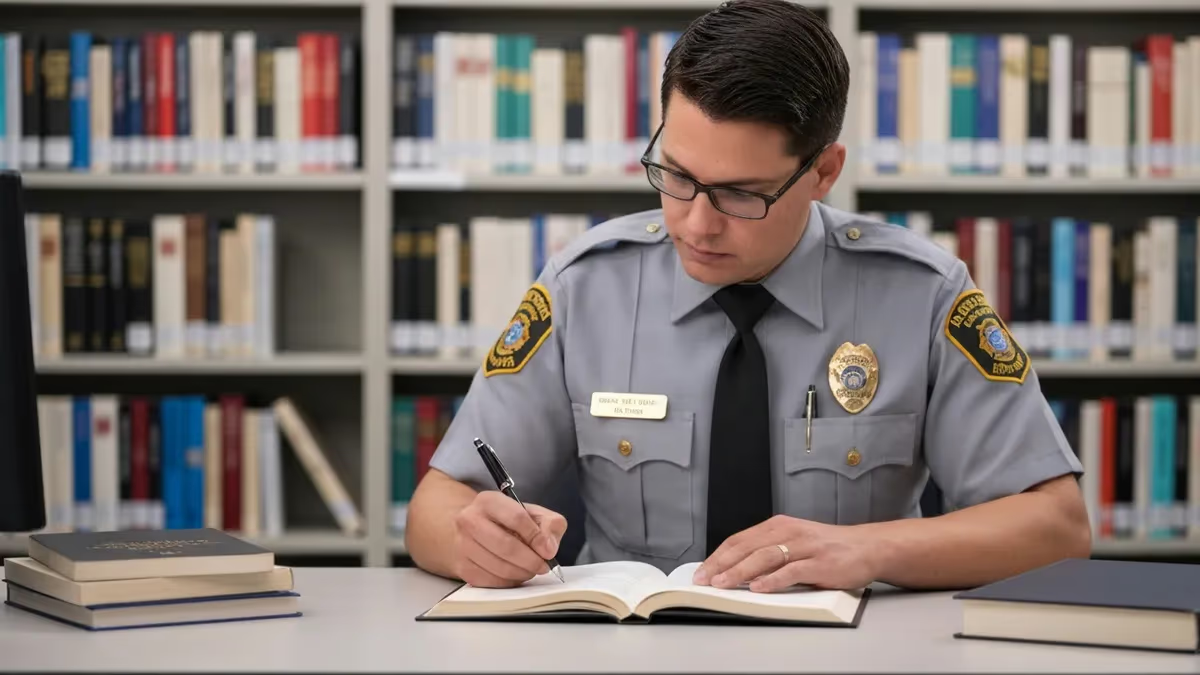
A correctional probation officer serves as a critical link between the criminal justice system and individuals who have been sentenced to community supervision instead of incarceration. These professionals monitor offenders released on probation, ensuring compliance with court-ordered conditions while supporting rehabilitation efforts that reduce recidivism rates across the country. Whether you are exploring this career for the first time or seeking to understand the role more deeply, this comprehensive guide covers every essential aspect of the correctional probation officer profession, from daily duties and educational requirements to salary expectations and practical tips for career success.
The demand for correctional probation officers continues to grow as states invest heavily in alternatives to incarceration that prioritize rehabilitation and community safety. According to the Bureau of Labor Statistics, approximately 91,300 probation officers and correctional treatment specialists worked in the United States as of 2024, with projected growth remaining steady through the end of the decade. This field offers meaningful work for individuals who are passionate about public safety, offender rehabilitation, and community well-being, making it an increasingly attractive career for criminal justice graduates and career changers alike.
Correctional probation officers differ from traditional probation officers in several important ways that prospective candidates should understand. While both roles involve supervising individuals on probation, correctional probation officers often work more closely with offenders who have committed serious crimes or who have transitioned directly from correctional facilities back into the community. This distinction means that correctional probation officers typically manage higher-risk caseloads and require specialized training in risk assessment, crisis intervention, and evidence-based supervision strategies that address complex behavioral challenges.
The daily responsibilities of a correctional probation officer extend far beyond simple check-in meetings with probationers. Officers conduct home visits, verify employment, administer drug tests, coordinate with treatment providers, and prepare detailed reports for the court. Each interaction with a probationer requires careful documentation and professional judgment, as the officer must balance strict accountability with genuine support. This dual mandate makes the role uniquely challenging and rewarding, offering professionals a chance to directly influence public safety outcomes in their local communities.
States like Florida, Texas, California, and New York employ the largest numbers of correctional probation officers, though opportunities exist in every state and at the federal level as well. Salary ranges vary significantly by jurisdiction, experience level, and agency size, but most officers earn competitive compensation packages that include benefits such as health insurance, retirement plans, and generous paid leave. Understanding the geographic and financial landscape of this career is essential for anyone seriously considering entry into the correctional probation profession.
Education requirements for correctional probation officers typically include a bachelor's degree in criminal justice, social work, psychology, or a closely related field. Some jurisdictions accept equivalent combinations of education and relevant work experience, while others mandate specific coursework in areas like criminology, sociology, or behavioral science. Graduate degrees can open doors to supervisory roles and specialized positions, making advanced education a worthwhile investment for anyone seeking long-term career advancement in the correctional probation field.
Throughout this article, you will find detailed information about job duties, qualification requirements, salary expectations, career advancement pathways, the hiring process, and practical tips for succeeding as a correctional probation officer. Whether you are preparing for a certification exam, applying for your first position, or considering a transition from another area of criminal justice, the sections below provide actionable guidance designed to help you make well-informed decisions about your professional future in this rewarding field.
Correctional Probation Officer by the Numbers

Key Qualifications and Requirements for Correctional Probation Officers
A bachelor's degree in criminal justice, social work, psychology, or sociology is required by most agencies. Some jurisdictions accept equivalent combinations of education and relevant field experience for entry-level positions.
Candidates must pass extensive background investigations, psychological evaluations, physical fitness assessments, and drug screenings. Felony convictions and patterns of dishonesty typically result in automatic disqualification from consideration.
Many states require officers to complete a certified training academy and obtain state licensure. Ongoing continuing education credits are usually mandatory to maintain active certification and remain eligible for advancement.
Strong written and verbal communication, critical thinking, cultural competency, crisis de-escalation, and proficiency with case management software are essential skills that hiring agencies evaluate throughout the selection process.
The core duties of a correctional probation officer revolve around community supervision, which involves monitoring offenders who have been placed on probation by the court. Officers are responsible for ensuring that probationers comply with all conditions of their supervision, including attending scheduled meetings, maintaining employment, completing community service hours, participating in mandated treatment programs, and abstaining from illegal substances. Each of these requirements demands consistent oversight and detailed record-keeping to maintain accountability throughout the entire supervision period and ensure public safety.
Risk assessment is a fundamental component of correctional probation work that influences virtually every supervision decision an officer makes. Officers use validated assessment tools such as the Level of Service Inventory-Revised and the Ohio Risk Assessment System to evaluate each probationer's likelihood of reoffending. These assessments guide supervision intensity, treatment referrals, and resource allocation decisions. High-risk offenders receive more frequent contact and closer monitoring, while lower-risk individuals may be placed on reduced supervision schedules that allow officers to concentrate their limited time where it matters most.
Court reporting represents another essential duty that correctional probation officers perform on a regular basis throughout their careers. Officers prepare pre-sentence investigation reports that provide judges with comprehensive information about offenders' backgrounds, criminal histories, and rehabilitation potential. These reports often influence sentencing decisions significantly, making accuracy and thoroughness absolutely critical. Additionally, officers submit violation reports when probationers fail to comply with their conditions, recommending appropriate sanctions that may range from increased supervision intensity to revocation of probation and commitment to a correctional facility.
Community collaboration is a cornerstone of effective correctional probation work that requires constant attention and relationship building. Officers develop and maintain partnerships with treatment providers, employers, housing agencies, law enforcement partners, and community organizations to create comprehensive support networks for their probationers. These partnerships enable officers to connect individuals with substance abuse counseling, mental health services, vocational training, and stable housing, all of which are proven protective factors against recidivism. Building and sustaining these community networks requires strong interpersonal skills and genuine commitment to rehabilitation.
Crisis intervention skills are particularly important for correctional probation officers who manage high-risk caseloads involving serious offenders. Officers may encounter situations involving domestic violence, substance abuse relapse, mental health crises, or direct threats to public safety during routine field contacts. Knowing how to de-escalate volatile situations, coordinate emergency responses with law enforcement, and connect individuals with immediate crisis services can be the difference between a successful intervention and a dangerous outcome. Many agencies now require officers to complete specialized training in crisis response techniques and motivational interviewing methods.
Documentation and case management consume a significant portion of a correctional probation officer's workday and demand careful attention to detail. Every contact with a probationer, treatment provider, or court official must be recorded in the electronic case management system with detailed notes about the interaction's content and outcomes. Officers also track deadlines for drug testing, treatment completion milestones, restitution payments, and community service hours. Maintaining organized and accurate case files is essential not only for effective supervision but also for legal compliance and institutional accountability during audits.
Technology has transformed many aspects of correctional probation work in recent years, creating both new capabilities and new challenges for officers. Electronic monitoring devices, GPS tracking systems, automated reporting kiosks, and sophisticated case management software have expanded officers' capacity to supervise larger caseloads more effectively and efficiently. While these technological tools enhance productivity, they cannot replace the human judgment, empathy, and relationship-building skills that remain at the heart of successful correctional probation practice. Officers must thoughtfully balance technological tools with personal engagement to achieve optimal outcomes.
Probation Officer Practice Test Questions
Prepare for the Probation Officer exam with our free practice test modules. Each quiz covers key topics to help you pass on your first try.
Probation Officer Advanced Topics
Probation Officer Exam Questions covering Advanced Topics. Master Probation Officer Test concepts for certification prep.
Probation Officer Case Management and Docu...
Free Probation Officer Practice Test featuring Case Management and Documentation. Improve your Probation Officer Exam score with mock test prep.
Probation Officer Community Supervision Te...
Probation Officer Mock Exam on Community Supervision Techniques. Probation Officer Study Guide questions to pass on your first try.
Probation Officer Core Concepts
Probation Officer Test Prep for Core Concepts. Practice Probation Officer Quiz questions and boost your score.
Probation Officer Exam Fundamentals
Probation Officer Questions and Answers on Exam Fundamentals. Free Probation Officer practice for exam readiness.
Probation Officer Industry Knowledge
Probation Officer Mock Test covering Industry Knowledge. Online Probation Officer Test practice with instant feedback.
Probation Officer Legal Framework and Offe...
Free Probation Officer Quiz on Legal Framework and Offender Rights. Probation Officer Exam prep questions with detailed explanations.
Probation Officer Practical Applications
Probation Officer Practice Questions for Practical Applications. Build confidence for your Probation Officer certification exam.
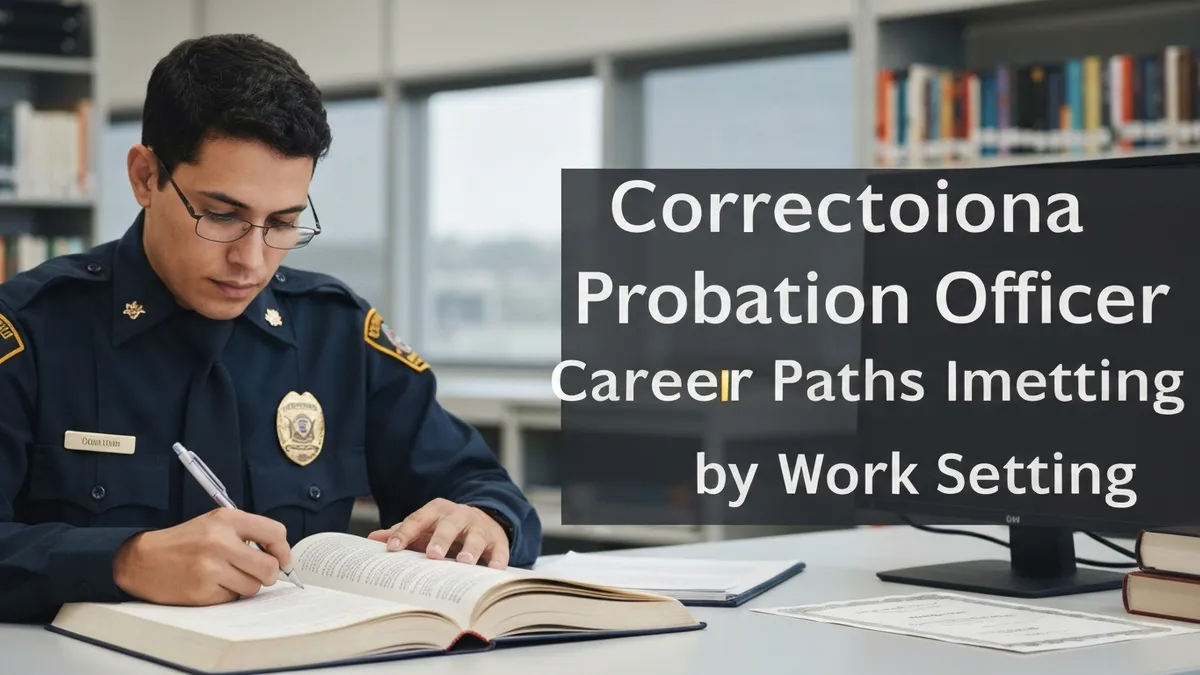
Correctional Probation Officer Career Paths by Work Setting
State-level correctional probation officers work within state departments of corrections or community supervision agencies. These positions typically offer structured pay scales, defined-benefit pension plans, and clear promotional pathways from entry-level officer through supervisory and administrative roles. States like Florida designate the title of correctional probation officer specifically, while other states use similar classifications. Caseloads at the state level often include a mix of felony and misdemeanor offenders requiring varied supervision intensity based on standardized risk assessment scoring.
State agencies generally provide comprehensive training academies for new hires that cover legal authority, supervision techniques, firearms qualification, report writing, and ethics. Officers benefit from statewide policy consistency and access to centralized resources such as electronic monitoring programs, specialized courts, and interagency task forces. Promotional opportunities include senior officer, supervisor, regional administrator, and headquarters policy positions that shape community supervision practices across the entire jurisdiction for thousands of probationers.
Advantages and Challenges of a Correctional Probation Officer Career
- +Meaningful work that directly contributes to public safety and offender rehabilitation in your community
- +Competitive government salary with comprehensive benefits including health insurance and pension plans
- +Diverse daily responsibilities that prevent monotony and offer continuous intellectual challenges
- +Strong job security in a field with consistent demand across all fifty states and federal agencies
- +Clear career advancement pathways from entry-level officer to supervisory and administrative positions
- +Opportunity to develop transferable skills in crisis intervention, communication, and case management
- −Emotionally demanding work involving regular exposure to trauma, addiction, and high-risk situations
- −High caseload volumes that create significant time pressure and administrative burden for officers
- −Potential safety risks during field visits to unfamiliar neighborhoods and volatile home environments
- −Bureaucratic constraints that can limit flexibility in supervision approaches and decision-making authority
- −Secondary traumatic stress and burnout risk from sustained engagement with challenging offender populations
- −Evening and weekend work requirements for conducting home visits and responding to emergency situations
Pros and Cons at a Glance
| Pros | Cons |
|---|---|
| Meaningful work that directly contributes to public safety and offender rehabilitation in your community | Emotionally demanding work involving regular exposure to trauma, addiction, and high-risk situations |
| Competitive government salary with comprehensive benefits including health insurance and pension plans | High caseload volumes that create significant time pressure and administrative burden for officers |
| Diverse daily responsibilities that prevent monotony and offer continuous intellectual challenges | Potential safety risks during field visits to unfamiliar neighborhoods and volatile home environments |
| Strong job security in a field with consistent demand across all fifty states and federal agencies | Bureaucratic constraints that can limit flexibility in supervision approaches and decision-making authority |
| Clear career advancement pathways from entry-level officer to supervisory and administrative positions | Secondary traumatic stress and burnout risk from sustained engagement with challenging offender populations |
| Opportunity to develop transferable skills in crisis intervention, communication, and case management | Evening and weekend work requirements for conducting home visits and responding to emergency situations |
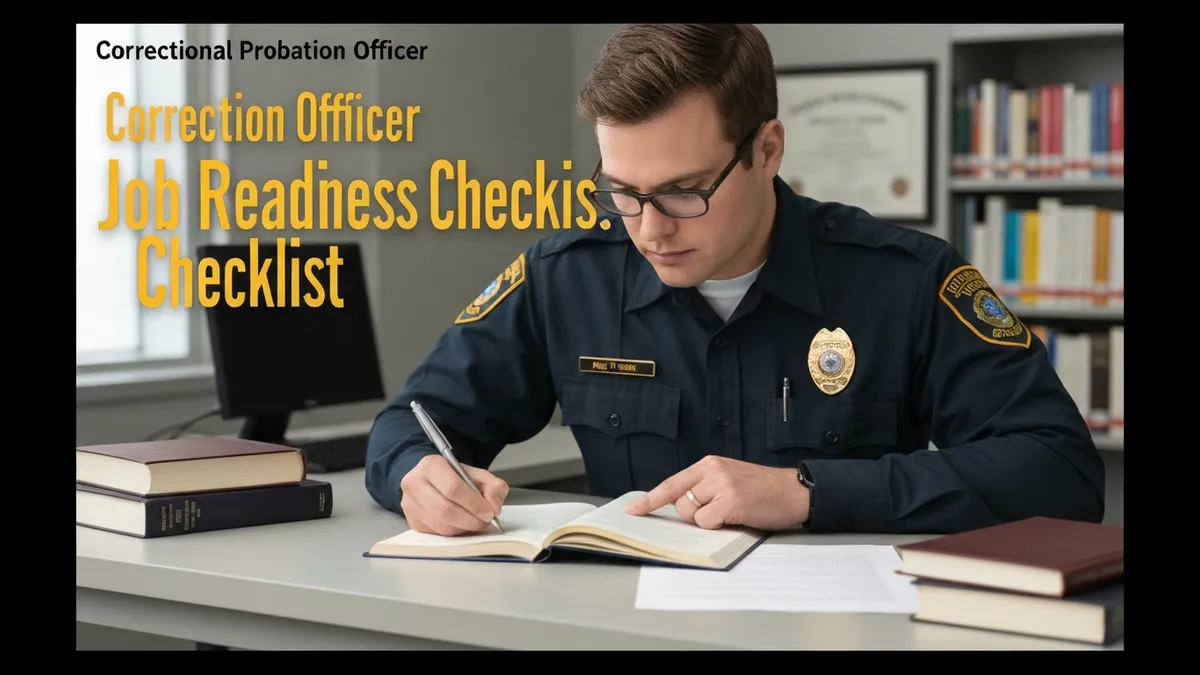
Correctional Probation Officer Job Readiness Checklist
- ✓Earn a bachelor's degree in criminal justice, social work, psychology, or a related field from an accredited institution.
- ✓Complete any state-specific coursework requirements in criminology, behavioral science, or corrections.
- ✓Gain relevant experience through internships, volunteer work, or entry-level positions in criminal justice settings.
- ✓Obtain and maintain a clean criminal record with no felony convictions or disqualifying offenses.
- ✓Develop proficiency in written communication and professional report-writing techniques.
- ✓Practice situational judgment and crisis de-escalation skills through role-playing exercises and training scenarios.
- ✓Research specific hiring requirements for your target agency, including physical fitness and testing standards.
- ✓Prepare professional references from supervisors, professors, or mentors who can speak to your character and abilities.
- ✓Create a polished resume highlighting relevant education, experience, and applicable skills for probation work.
- ✓Review common interview questions and practice articulating your motivation for pursuing correctional probation work.
Evidence-Based Practices Drive Modern Supervision
Research from the National Institute of Corrections shows that officers who implement evidence-based supervision strategies, including validated risk assessments, motivational interviewing, and cognitive-behavioral interventions, achieve recidivism reductions of 10 to 30 percent compared to traditional surveillance-only approaches. Mastering these techniques early in your career gives you a measurable professional advantage.
Salary expectations for correctional probation officers vary considerably based on geographic location, level of experience, and the specific employing agency. The Bureau of Labor Statistics reports that the median annual wage for probation officers and correctional treatment specialists was approximately $60,250 as of May 2024. However, officers in major metropolitan areas and states with higher costs of living often earn significantly more, with top earners in states like California, New Jersey, and New York bringing home annual salaries exceeding $85,000 once they have accumulated several years of experience in their positions.
Entry-level correctional probation officers typically start with salaries ranging from $38,000 to $48,000 annually, depending on the jurisdiction and the officer's educational background. Officers who hold master's degrees or possess specialized professional certifications may qualify for higher starting salaries or placement on accelerated pay scales. Most government agencies offer structured pay progression systems that reward tenure and strong performance evaluations, allowing officers to increase their earnings substantially over the course of their careers through regular step increases and competitive promotional opportunities.
Benefits packages for correctional probation officers generally include comprehensive health insurance, dental and vision coverage, employer-contributed retirement plans, and generous paid time off allocations. Many state agencies participate in defined-benefit pension systems that provide guaranteed retirement income based on years of service and final average salary calculations. These pension benefits represent significant long-term financial value and should be an important consideration for individuals evaluating the total compensation picture associated with correctional probation careers in the public sector compared to private employment options.
Career advancement opportunities within correctional probation are diverse, rewarding, and accessible to officers who demonstrate consistent performance. Officers who show strong leadership potential can advance to supervisory positions such as senior probation officer, unit supervisor, district manager, or chief probation officer. Some officers transition into specialized roles focused on sex offender management, drug court coordination, juvenile supervision, or pretrial services programs. Others use their extensive field experience to move into related careers such as parole supervision, court administration, law enforcement, or criminal justice policy development at the state or federal level.
Professional development plays a crucial role in career advancement for correctional probation officers who aspire to leadership positions. Many agencies require officers to complete a minimum number of continuing education hours annually, covering topics such as evidence-based supervision practices, cultural competency, legal updates, and emerging trends in community corrections. Officers who pursue voluntary certifications from organizations like the American Probation and Parole Association or the National Institute of Corrections enhance their credentials and demonstrate a commitment to professional excellence that distinguishes them from their peers during promotional considerations.
The emotional and psychological demands of correctional probation work should not be underestimated when evaluating this career path against other opportunities. Officers frequently work with individuals who have experienced trauma, addiction, mental illness, and chronic instability throughout their lives. Sustained exposure to these challenges can lead to secondary traumatic stress, compassion fatigue, and professional burnout if officers do not actively prioritize self-care and maintain healthy personal boundaries. Progressive agencies increasingly recognize these occupational risks and provide employee assistance programs, peer support networks, and comprehensive wellness initiatives.
Networking within the correctional probation community provides valuable opportunities for professional growth and long-term career development. Attending national conferences hosted by the American Probation and Parole Association, participating in regional training events and workshops, and joining professional organizations connect officers with peers and mentors who can share practical insights, recommend advancement strategies, and provide strong references for future opportunities. Building a strong professional network early in your career creates a solid foundation for sustained success throughout your tenure in the correctional probation field.
Candidates should be aware that the background investigation for correctional probation officer positions is extremely thorough and can take several months to complete. Investigators will examine your criminal history, financial records, employment history, educational credentials, and social media presence. Any dishonesty during the application process, including omissions, is grounds for immediate disqualification. Begin preparing your background well before you submit your first application to avoid preventable issues.
The hiring process for correctional probation officer positions typically involves multiple stages designed to identify candidates with the skills, temperament, and integrity necessary for the role. Most agencies require applicants to submit a formal application through their human resources portal, pass a written examination, complete one or more structured interviews, undergo an extensive background investigation, and pass both physical fitness and psychological evaluations. Understanding each stage of this comprehensive process and preparing thoroughly for every component significantly increases your chances of receiving a conditional offer of employment.
Written examinations for correctional probation officer positions typically assess reading comprehension, analytical reasoning, situational judgment, and foundational knowledge of criminal justice concepts and procedures. Some jurisdictions use standardized civil service exams administered by state or county testing authorities, while others develop agency-specific assessments tailored to the particular demands of correctional probation work. Preparing for these examinations by working through practice questions, studying criminal justice terminology, and familiarizing yourself with common supervision scenarios demonstrates initiative and can help you achieve competitive scores that place you favorably on eligibility lists.
The background investigation is one of the most thorough and consequential components of the correctional probation officer hiring process. Investigators examine your criminal history at local, state, and federal levels, your complete employment record, educational credentials, financial stability and credit history, personal references, and your social media presence across all platforms. Any history of felony convictions, documented substance abuse problems, dishonesty during the application process, or patterns of irresponsible behavior can result in disqualification. Maintaining a clean record and managing your finances responsibly well before you apply positions you for success.
Interview preparation should focus on demonstrating your understanding of the correctional probation officer role, your interpersonal communication skills, and your ability to handle challenging situations with professionalism and sound judgment under pressure. Expect scenario-based questions that require you to explain how you would respond to probationer noncompliance, safety threats during field visits, ethical dilemmas involving conflicting responsibilities, and competing priorities with limited time and resources. Practicing your responses with a mentor or interview coach helps you develop confident, articulate answers that convey both professional competence and genuine passion for community supervision work.
Physical fitness requirements vary by agency but generally include basic assessments of cardiovascular endurance, muscular strength, and overall agility. While correctional probation officers do not typically face the same intense physical demands as sworn law enforcement officers, they must be capable of conducting field visits in various environments and responding appropriately to emergencies when necessary. Maintaining a regular exercise routine and meeting minimum fitness standards before your assessment date demonstrates your readiness for the physical aspects of the position and reflects positively on your overall commitment to professional excellence.
Psychological evaluations assess candidates' emotional stability, stress tolerance, decision-making capacity, and overall suitability for working in a high-pressure criminal justice environment on a daily basis. These evaluations typically involve standardized psychological testing instruments followed by a clinical interview with a licensed psychologist experienced in public safety assessments. Candidates who approach the evaluation honestly and openly tend to perform significantly better than those who attempt to present an unrealistic or artificially positive image of themselves. Emotional maturity, genuine self-awareness, and demonstrated ability to manage stress effectively are key qualities that evaluators look for.
Post-hire training for correctional probation officers typically includes an intensive academy program lasting several weeks to several months, followed by a supervised field training period with an experienced mentor. Academy curricula cover essential topics such as legal authority and liability, supervision techniques and strategies, professional report writing, firearms qualification where applicable, defensive tactics, and ethical standards of conduct. Field training pairs new officers with seasoned mentors who model effective supervision practices and provide detailed feedback on performance. Successfully completing all training phases marks the important transition from recruit to independent officer.
Succeeding as a correctional probation officer requires deliberate attention to professional development, relationship building, and personal well-being from the very first day of your career. New officers often feel overwhelmed by the complexity of their caseloads and the sheer volume of administrative responsibilities they must manage simultaneously alongside field supervision duties. Developing effective time management strategies, creating organized systems for tracking deadlines and required contacts, and proactively seeking guidance from experienced colleagues helps you establish a strong operational foundation during your critical and formative first year in the profession.
Building genuine rapport with your probationers is one of the most important skills you can cultivate as a correctional probation officer working in any jurisdiction. Research consistently demonstrates that officers who combine firm accountability with authentic empathy achieve significantly better supervision outcomes than those who rely exclusively on surveillance, threats, and punitive sanctions. Using motivational interviewing techniques, demonstrating cultural sensitivity and awareness, and treating every individual with basic respect creates an environment where probationers feel genuinely supported in making positive behavioral changes while clearly understanding the real consequences of noncompliance with their supervision conditions.
Effective communication with the court, treatment providers, and law enforcement partners is essential for maintaining the collaborative relationships that support successful community supervision outcomes. Respond to judicial inquiries promptly and completely, keep treatment providers appropriately informed about probationer progress and setbacks, and coordinate closely with law enforcement agencies when legitimate safety concerns arise during supervision activities. Clear, professional, and timely communication reduces costly misunderstandings, strengthens your credibility with key stakeholders, and ensures that every member of the supervision team has the information they need to make sound decisions.
Staying current with developments in evidence-based practices is both a professional obligation and a practical necessity that directly impacts your effectiveness as a correctional probation officer. The field of community supervision continues to evolve rapidly as researchers identify new strategies for reducing recidivism and improving measurable public safety outcomes. Actively participating in training workshops, reading peer-reviewed professional publications, attending relevant webinars and online courses, and engaging with national organizations like the American Probation and Parole Association keeps you informed about best practices and helps you integrate proven approaches into your daily supervision work.
Managing stress proactively and preventing burnout should be top priorities from the beginning of your correctional probation career, not afterthoughts that you address only when serious problems have already developed. Establish healthy boundaries between your work responsibilities and personal life, develop coping strategies and outlets that work effectively for you, use your agency's employee assistance program when you need professional support, and maintain meaningful connections with friends and family who provide emotional grounding outside the workplace. Officers who invest consistently in their own well-being are demonstrably better equipped to serve their probationers and their communities effectively over the long term.
Documentation excellence distinguishes truly outstanding correctional probation officers from their peers and provides crucial legal protection for both the individual officer and the agency in judicial proceedings and administrative reviews. Write detailed case notes immediately after every significant contact while specific details remain fresh in your memory, use clear and objective language that avoids unnecessary jargon and subjective personal opinion, and ensure that every entry accurately and completely reflects the substance of the interaction that occurred. Thorough, consistent documentation creates an indisputable record of your supervision efforts and supports your formal recommendations to the court.
The correctional probation officer career offers a unique and deeply fulfilling combination of professional challenge, personal satisfaction, and meaningful public service that few other occupations in the criminal justice field can genuinely match.
By committing to continuous learning and skill development, maintaining the highest ethical standards in every interaction, building strong professional relationships with probationers and colleagues alike, and prioritizing your own physical and mental health and well-being, you position yourself for a long, successful, and impactful career in this vital public safety profession. The work you do every single day makes communities measurably safer and gives individuals genuine opportunities for positive change and redemption.
Sample Probation Officer Practice Questions
Try these questions from our free Probation Officer practice tests. The correct answer and an explanation follow each question.
Adult correctional institutions in the United States employ the most full-time personnel.
- A. custody and control of inmates.
- B. counseling and social work.
- C. education and counseling.
- D. health services and correctional administration.
Answer: A. custody and control of inmates.
Adult correctional institutions are primarily responsible for the secure housing and management of inmates. This core function requires the largest number of personnel for security, supervision, and daily operations, making custody and control the area with the most full-time employees. Other services, while important, typically involve fewer staff members.
What is the role of professional associations in a career?
- A. They are social clubs only
- B. They provide networking, continuing education, industry standards, certification, and career resources
- C. They are unnecessary
- D. They only benefit beginners
Answer: B. They provide networking, continuing education, industry standards, certification, and career resources
Professional associations serve as hubs for industry knowledge, networking, standards development, and career advancement opportunities.
How does specialization compare to generalization in career development?
- A. Specialization is always better
- B. Both have value — specialization provides depth and expertise, while generalization provides breadth and adaptability
- C. Generalization is always better
- D. Neither matters
Answer: B. Both have value — specialization provides depth and expertise, while generalization provides breadth and adaptability
The ideal often combines deep specialization in a core area with broad understanding of related fields (T-shaped skills), providing both expertise and versatility.
What is the main goal of restorative justice within community supervision?
- A. Maximize incarceration
- B. Repair harm to victims and community through offender accountability
- C. Eliminate probation entirely
- D. Increase fines collected
Answer: B. Repair harm to victims and community through offender accountability
Restorative justice focuses on repairing harm and reintegrating offenders through accountability and victim involvement.
Probation Officer Questions and Answers

Probation Officer Jobs: Requirements, Salary, and Career Paths

City Probation Officer: Career Guide, Duties, Salary, and How to Become One in 2026

Probation Officer Job Description: Duties and Daily Tasks

Probation Office Locations Across the US

Juvenile Probation Officer Jobs: Career Guide, Duties, Salary, and How to Get Hired in 2026
About the Author
Law Enforcement Trainer & Civil Service Exam Specialist
John Jay College of Criminal JusticeMarcus B. Thompson earned his Master of Arts in Criminal Justice from John Jay College of Criminal Justice and served 12 years as a law enforcement officer before transitioning to full-time academy instruction. He is a POST-certified instructor who has prepared candidates for police entrance exams, firefighter assessments, and civil service examinations across dozens of agencies.