
OSHA Standard 1910: Complete Guide to General Industry Safety Regulations
Master OSHA standard 1910 with our complete guide to general industry regulations, key subparts, compliance tips, and practice questions. ✅
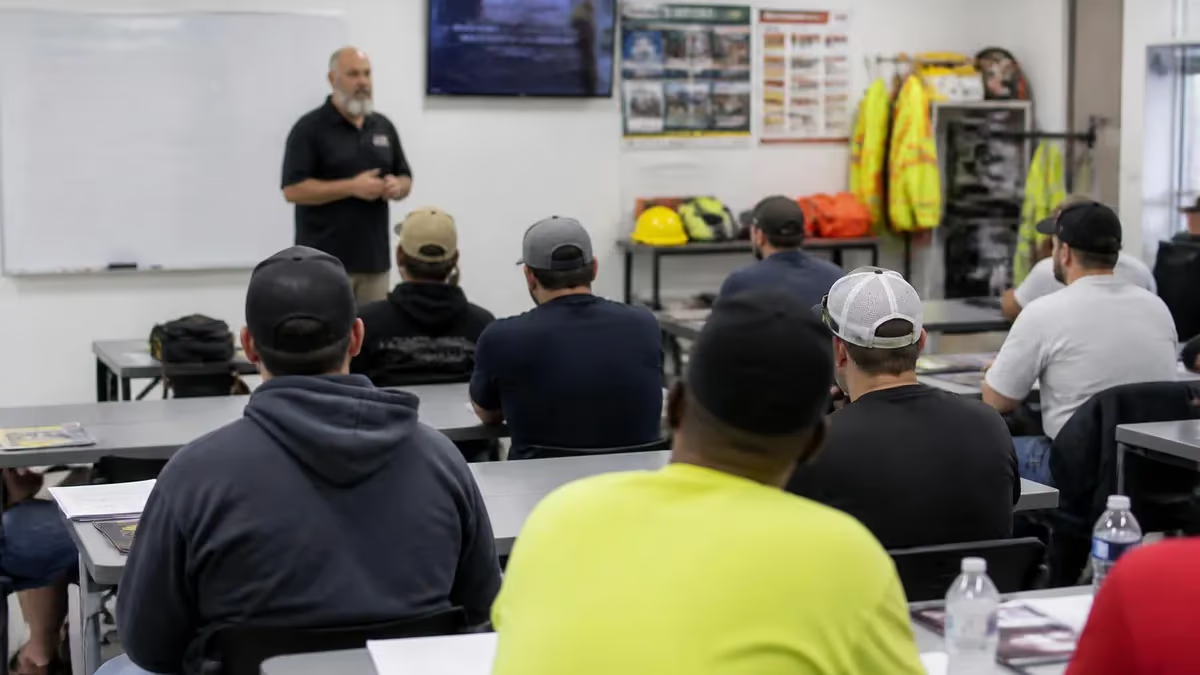
OSHA standard 1910 is the cornerstone of workplace safety regulation for general industry in the United States, covering everything from machine guarding to hazardous materials handling across millions of worksites nationwide. Formally known as Title 29 of the Code of Federal Regulations Part 1910, this sweeping body of rules was first codified in 1970 following the passage of the Occupational Safety and Health Act. Today it remains the primary federal framework that employers in manufacturing, warehousing, retail, healthcare, and dozens of other sectors must follow to protect their workers from recognized hazards.
Understanding the scope of 29 CFR 1910 is essential for safety officers, HR managers, supervisors, and frontline employees alike. The standard is organized into more than 20 lettered subparts, each addressing a distinct category of workplace risk. Subpart D covers walking and working surfaces, Subpart E governs exit routes and emergency planning, Subpart H addresses hazardous materials, and Subpart Z deals with toxic and hazardous substances. Each subpart contains dozens of individual standards with specific, enforceable requirements ranging from guardrail height minimums to permissible exposure limits for chemical contaminants.
Non-compliance with OSHA 1910 carries serious financial and legal consequences. OSHA can issue citations with penalties up to $16,550 per serious violation and up to $165,514 per willful or repeated violation as of 2024. Beyond fines, violations can trigger lawsuits, damage a company's reputation, and most importantly, result in worker injuries or fatalities that are entirely preventable. The agency conducts tens of thousands of inspections every year, and industries like manufacturing and healthcare consistently rank among the most frequently cited sectors.
For workers preparing for OSHA certifications or general industry compliance exams, mastering the structure and content of the 1910 standards is non-negotiable. Exam questions routinely test knowledge of specific subpart requirements, including the number of employees that trigger certain training mandates, the exact specifications for personal protective equipment, and the documentation employers must maintain. Knowing which standard applies in a given scenario — and why — separates candidates who pass on the first attempt from those who need to retake the exam.
One of the most practical aspects of studying OSHA 1910 is learning how the general duty clause interacts with specific standards. Section 5(a)(1) of the OSH Act requires employers to provide a workplace free from recognized hazards even when no specific standard applies. This catch-all provision is frequently cited by compliance officers and reinforces why a broad understanding of the 1910 framework matters — you cannot rely solely on memorizing individual rule numbers without grasping the underlying safety philosophy that connects them all.
This guide walks you through the most important subparts of OSHA 1910, explains how citations are classified and contested, details the training and recordkeeping requirements that catch employers off guard, and provides actionable strategies for staying compliant. Whether you are a safety professional building a compliance program from scratch or a worker studying for a certification, you will find the detailed explanations, real-world examples, and verified statistics you need to understand osha standard 1910 inside and out.
The information in this article reflects current OSHA regulations as of 2026. OSHA periodically updates penalty amounts for inflation and occasionally revises specific standards through rulemaking. Always verify the current version of any specific standard at osha.gov before making compliance decisions, and consult a qualified safety professional when addressing complex or high-hazard situations in your workplace.
OSHA Standard 1910 by the Numbers

Key Subparts of 29 CFR 1910
Sets requirements for floors, stairs, ladders, scaffolds, and elevated platforms. Covers guardrail systems, hole covers, and fall protection for surfaces four feet or more above lower levels in general industry settings.
Governs the storage, handling, and use of flammable liquids, compressed gases, explosives, and other dangerous substances. Includes specific requirements for container labeling, ventilation, and fire suppression systems.
Requires employers to assess hazards, select appropriate PPE, provide it at no cost in most cases, and train workers on its proper use, maintenance, and limitations for eye, face, head, foot, and hand protection.
Addresses sanitation, temporary labor camps, safety color codes, and the critical lockout/tagout standard (1910.147) for controlling hazardous energy during equipment maintenance and servicing operations.
Contains permissible exposure limits (PELs) for hundreds of chemicals, the Hazard Communication Standard (HazCom), and specific standards for asbestos, lead, bloodborne pathogens, and other substances.
Compliance with OSHA 1910 requires employers to take a systematic, documented approach to hazard identification, employee training, equipment inspection, and record maintenance. The standard does not simply require that workplaces be safe in a vague, general sense — it mandates specific, measurable actions that can be verified during an OSHA inspection. Understanding exactly what compliance looks like in practice is the first step toward building a program that protects workers and withstands regulatory scrutiny.
The Hazard Communication Standard under 1910.1200, commonly called HazCom or the Right to Know standard, is one of the most universally applicable requirements across all industries. It requires employers to maintain a complete inventory of hazardous chemicals used in the workplace, obtain Safety Data Sheets (SDS) for each chemical, properly label all containers, and provide comprehensive training to workers who may be exposed. The SDS format follows a 16-section structure aligned with the Globally Harmonized System, and employers must make these documents immediately accessible to employees at all times during the work shift.
Lockout/tagout (LOTO) under 1910.147 is another standard that generates a significant share of OSHA citations every year. This standard applies whenever workers service or maintain machinery where the unexpected energization, startup, or release of stored energy could cause injury. Employers must develop written energy control procedures for each piece of equipment, provide annual training to authorized employees who perform lockout, and conduct an annual inspection of each energy control procedure. Failure to have written procedures for even one machine can result in a separate citation for each deficiency.
Machine guarding under 1910.211 through 1910.219 requires that any machine part, function, or process that may cause injury be safeguarded. Guards must prevent contact with the point of operation, protect against flying chips and sparks, not create additional hazards themselves, and be durable enough to withstand normal industrial use. Point-of-operation guards on presses, saws, grinders, and similar equipment must meet specific design criteria, and employers cannot rely on workers simply being careful to avoid dangerous machine contact.
Personal protective equipment requirements under Subpart I begin with a written hazard assessment. The employer must survey the workplace to identify physical and health hazards, select appropriate PPE for those hazards, communicate the selection decisions to each employee, and document the assessment in writing. Many employers incorrectly believe that simply providing PPE satisfies the standard — but without the written assessment, training documentation, and evidence that PPE was properly fitted and maintained, an employer remains vulnerable to citation even if workers are actually wearing the equipment.
Electrical safety under Subpart S (1910.301 through 1910.399) establishes requirements for the design, installation, and use of electrical equipment in general industry. The standard covers everything from proper wiring methods and overcurrent protection to arc flash hazards and the use of ground-fault circuit interrupters. Employers must ensure that electrical equipment is listed or labeled by a nationally recognized testing laboratory and that workers who perform electrical work are classified as either qualified or unqualified workers based on their training and the tasks they perform.
Emergency action plans under 1910.38 are required for employers in any industry when OSHA standards require them and are strongly recommended for all workplaces. A compliant plan must include procedures for reporting fires and emergencies, evacuating employees with disabilities, accounting for employees after evacuation, and designating employees responsible for rescue and medical duties. Employers with more than 10 employees must maintain the plan in writing. Reviewing and updating the plan after any emergency event or significant change in facility layout is a best practice that many employers neglect until an inspection reveals the deficiency.
OSHA 1910 Training, Inspections, and Recordkeeping
OSHA 1910 training requirements vary by subpart but share a common structure: employers must train workers before they are exposed to a hazard, refresh training when procedures change or when a worker demonstrates inadequate knowledge, and document that training occurred. Many standards specify the exact topics to be covered, require that training be conducted in a language the employee understands, and distinguish between different classes of workers — for example, authorized vs. affected employees under lockout/tagout, or qualified vs. unqualified electrical workers under Subpart S.
Training documentation is a frequent citation target during OSHA inspections because many employers conduct training but fail to keep adequate records. A compliant training record should include the employee's name and job title, the date of training, the specific standard covered, a description of the content, and the name of the trainer. For standards like HazCom, bloodborne pathogens (1910.1030), and respiratory protection (1910.134), OSHA has established annual retraining requirements. Employers should calendar these retraining dates and build renewal reminders into their safety management systems to avoid lapses.

Strengths and Limitations of the OSHA 1910 Framework
- +Provides a comprehensive, enforceable baseline for general industry safety across all sectors
- +Specific numerical requirements (guardrail heights, PELs, training frequencies) remove ambiguity for employers
- +The general duty clause fills gaps where no specific standard exists, extending protection broadly
- +Regular penalty inflation adjustments maintain the deterrent effect of citations over time
- +Public inspection records create accountability and help workers research employer safety performance
- +Frequent regulatory guidance documents and letters of interpretation help employers understand how standards apply
- −Many permissible exposure limits (PELs) are based on 1970s science and are widely considered outdated by occupational health experts
- −The sheer volume of standards makes compliance complex for small employers without dedicated safety staff
- −Enforcement resources are limited, meaning many high-hazard workplaces go years without an inspection
- −State-plan states may have different standards, creating confusion for multi-state employers
- −The rulemaking process is slow, making it difficult to address emerging hazards like novel chemicals quickly
- −Penalty amounts, while significant, may not deter large corporations for whom fines represent a minor operating cost
OSHA 1910 Compliance Checklist for General Industry
- ✓Complete a written hazard assessment for PPE selection and document findings with employer certification.
- ✓Maintain a current chemical inventory and ensure Safety Data Sheets are accessible to all workers.
- ✓Develop written energy control (lockout/tagout) procedures for each piece of serviced equipment.
- ✓Conduct and document annual inspections of all lockout/tagout energy control procedures.
- ✓Post the OSHA 300A injury and illness summary in a visible location from February 1 through April 30.
- ✓Train all workers on HazCom, PPE, emergency action plans, and any other applicable 1910 standards before exposure.
- ✓Inspect all machine guards, safety devices, and barrier systems on a documented regular schedule.
- ✓Verify that all electrical equipment is properly labeled by a nationally recognized testing laboratory.
- ✓Conduct at least one emergency evacuation drill per year and document the drill date and outcome.
- ✓Review and update the written emergency action plan after any significant facility change or emergency event.
Lockout/Tagout Is Consistently Among OSHA's Top 10 Most Cited Standards
1910.147, the control of hazardous energy (lockout/tagout) standard, appears in OSHA's top 10 most-cited list virtually every year. The most common deficiency is not the absence of a LOTO program — it is the lack of written procedures for specific equipment. Auditing your written procedures against every serviced machine is the single fastest way to close a citation gap before an OSHA inspection.
OSHA's most-cited violations under the 1910 standards reveal a consistent pattern: the citations that occur most frequently are not for exotic or obscure hazards, but for fundamental safety failures that have been on the books for decades. Respiratory protection under 1910.134, hazard communication under 1910.1200, and lockout/tagout under 1910.147 appear in the top ten most-cited standards year after year. Understanding why these violations persist helps safety professionals target their compliance efforts where the risk of citation — and of worker harm — is highest.
Respiratory protection violations under 1910.134 are particularly revealing because the standard is detailed and requires multiple interacting elements. Employers must conduct initial medical evaluations before workers wear respirators, perform fit testing with the specific make, model, and size of respirator the worker will use, develop a written respiratory protection program, train workers on proper use and maintenance, and evaluate the program annually. Many employers provide respirators but fail to implement one or more of these required elements — a missing written program or an expired fit test can result in a citation even if workers are properly wearing their respirators.
Fall protection violations, while more prominent under the construction standard 1926, also appear in general industry under the walking-working surfaces standard updated in 2017. The revised Subpart D requires employers to provide fall protection for unprotected sides and edges four feet or more above a lower level, inspect walking surfaces regularly, and document those inspections. The standard introduced new flexibility — employers can now choose between guardrail systems, safety net systems, and personal fall protection systems in most situations — but that flexibility comes with corresponding documentation requirements for hazard assessments.
Electrical violations under Subpart S encompass a wide range of deficiencies, from exposed wiring and missing knockouts in electrical panels to failure to maintain the required clear working space around electrical equipment. One of the most commonly overlooked requirements is maintaining 36 inches of clear space in front of panels rated up to 150 volts to ground, 42 inches for panels rated 151 to 600 volts. Employers who allow storage in front of electrical panels — even temporarily — create a citation vulnerability that is easy for an inspector to spot and difficult to explain away.
Forklift safety violations under 1910.178 represent another persistent citation category, particularly in warehousing and manufacturing. The standard requires employers to evaluate each powered industrial truck operator's performance at least once every three years, document that evaluation, and ensure operators are trained on the specific types of trucks they operate in the specific conditions of the workplace. Generic forklift training that does not address the particular hazards of the employer's facility — uneven surfaces, pedestrian traffic patterns, load characteristics — does not satisfy the standard's specificity requirements.
Bloodborne pathogen violations under 1910.1030 are common in healthcare, but they also apply in any workplace where employees may be exposed to blood or other potentially infectious materials — including first aid responders in manufacturing plants. The standard requires a written exposure control plan, engineering controls like sharps disposal containers and needleless systems, training for all at-risk workers, and an offer of hepatitis B vaccination at no cost to the employee. Healthcare employers who conduct annual training but fail to update their written exposure control plan to reflect newly available engineering controls are a frequent citation target.
Chemical storage violations under Subpart H are often discovered during walkaround inspections when compliance officers observe flammable liquids stored in improper containers, quantities exceeding the limits for inside storage without a flammable liquid storage room, or missing bonding and grounding provisions on containers used for dispensing flammable liquids. The 1910.106 standard specifies maximum quantities of flammable and combustible liquids that may be stored outside of a dedicated storage room, and many employers who began with small quantities gradually accumulate storage that far exceeds these limits without realizing they have crossed a compliance threshold.

OSHA adjusts maximum civil penalty amounts each January based on the Consumer Price Index. The figures cited in this article reflect 2024 adjusted amounts, but penalties for violations cited in 2025 or later may be higher. Always check the OSHA website for current penalty amounts when estimating your compliance risk exposure or when contesting a citation.
Preparing for an OSHA certification exam requires more than memorizing regulation numbers — it demands a functional understanding of how standards interact, how compliance is demonstrated, and how OSHA evaluates employer performance during inspections. Candidates who score highest on OSHA certification exams are those who can apply regulatory knowledge to scenario-based questions, not just those who can recite the text of a given standard. Building that applied knowledge requires targeted study combined with substantial practice testing under realistic exam conditions.
Begin your exam preparation by mapping out the subparts of 1910 against the domains covered on the specific certification you are pursuing. For the OSHA 10-Hour and 30-Hour General Industry outreach programs, the required topics include an introduction to OSHA, walking-working surfaces, exit routes and emergency action plans, electrical safety, PPE, hazardous materials, and machine guarding. Understanding which subpart corresponds to each domain helps you organize your study materials and ensures you allocate adequate time to high-weight areas instead of spending disproportionate effort on lower-priority topics.
Practice tests are one of the most effective study tools available because they expose gaps in your knowledge, build familiarity with the format and phrasing of exam questions, and reduce test anxiety through repeated exposure to the testing environment. OSHA exam questions frequently test your knowledge of specific numerical thresholds — the height at which fall protection is required, the decibel level that triggers hearing conservation requirements, the number of employees that require a written emergency action plan — so drilling on these specifics through practice questions is time well spent before the actual exam.
Focus particular attention on the standards that generate the most citations, because these are also the standards most heavily tested on certification exams. Lockout/tagout, HazCom, respiratory protection, and machine guarding questions appear frequently across virtually all OSHA general industry certification formats. For each of these standards, you should be able to explain the core requirement, identify the specific elements of a compliant program, recognize scenarios where a violation exists, and describe the employer's obligation to document and train on the standard's requirements.
One study strategy that experienced safety professionals recommend is reviewing actual OSHA citation cases from the Occupational Safety and Health Review Commission (OSHRC). These public decisions explain how compliance officers interpret specific standard requirements, how employers successfully contest citations, and what evidence OSHA must present to sustain a penalty. Reading even a handful of OSHRC decisions related to the standards you are studying builds a level of interpretive depth that textbook study alone cannot provide and pays dividends when you encounter nuanced scenario-based exam questions.
Time management during the exam itself is a skill that requires practice. Many OSHA certification exams include questions that are intentionally ambiguous or that test fine distinctions between similar standards. When you encounter a question where two answers seem correct, use the process of elimination to identify which answer more precisely matches the language of the actual standard.
OSHA exam writers generally favor the most specific, protective answer choice over a more general one, reflecting the agency's worker-protective mission. If a question references a specific subpart, that is a strong signal to focus your reasoning on the exact requirements of that section rather than general safety principles.
After you earn your OSHA certification, maintaining currency with regulatory developments is an ongoing responsibility. OSHA publishes proposed and final rules in the Federal Register, and significant changes to the 1910 standards — such as the 2017 revision to the walking-working surfaces standard and the 2023 update to the electronic recordkeeping rule — can substantially change compliance obligations. Signing up for OSHA's email updates, following the agency's QuickTakes newsletter, and participating in industry safety associations are practical ways to stay informed about changes that may affect your workplace compliance program.
Building a durable OSHA 1910 compliance program is not a one-time project — it is an ongoing management discipline that requires clear ownership, regular auditing, and a workplace culture that treats safety as a core operational value rather than a regulatory burden. Organizations with strong safety cultures consistently outperform their peers on injury rates, workers' compensation costs, and OSHA citation history. The investment in compliance infrastructure pays returns in reduced incident costs, improved worker productivity, and protection from the reputational damage that follows high-profile OSHA citations.
Designating a competent person for each major hazard category is a practical starting point for structuring your compliance program. OSHA uses the term competent person throughout its standards to describe someone who is capable of identifying existing and predictable hazards and who has the authority to take prompt corrective action. Your competent persons for fall protection, confined space, and hazardous energy control should have documented training, clear authority to stop work when hazards exist, and regular opportunities to refresh their knowledge through continuing education and industry peer networks.
Conducting regular self-audits against the specific requirements of applicable 1910 standards is one of the most effective loss prevention strategies available. A structured audit checklist — organized by subpart — helps teams systematically verify compliance status, identify deficiencies before an OSHA inspector does, and prioritize corrective actions based on hazard severity. Many safety management software platforms now include 1910-specific audit templates that can be completed on mobile devices during walkaround inspections, automatically flagging deficiencies and generating corrective action workflows.
Employee involvement is a compliance multiplier that is often underutilized. Workers who understand OSHA standards and feel empowered to report hazards without fear of retaliation are one of the most effective early warning systems an employer can have. OSHA's Section 11(c) prohibits retaliation against workers who exercise their rights under the OSH Act, including reporting injuries, requesting inspections, or raising safety concerns. Employers who build genuine non-retaliation cultures — not just written policies — see higher near-miss reporting rates, which is consistently associated with lower serious injury rates in industrial safety research.
Vendor and contractor management is a compliance dimension that catches many employers off guard. When contractors work in your facility, you retain responsibility for ensuring they are not exposed to hazards that violate OSHA standards, and they may bring hazards into your workplace that affect your own employees. Multi-employer worksite rules require both the controlling employer and the creating employer to address hazardous conditions, and citation responsibility can attach to your organization even for conditions created by a contractor. Pre-qualification processes that verify contractor safety programs and on-site orientation requirements are standard practice in high-hazard industries for exactly this reason.
Technology is rapidly changing how employers approach 1910 compliance. Wearable sensors can now monitor worker exposure to noise, heat, and chemical hazards in real time, providing data that supports more defensible PEL compliance documentation. Computer vision systems are being deployed to detect missing machine guards or workers in exclusion zones before incidents occur. Electronic permit systems for confined space entry and hot work reduce the administrative errors that generate citations under 1910.146 and 1910.252. Employers who integrate these technologies with their safety management systems gain both compliance benefits and a competitive advantage in attracting safety-conscious workers.
Finally, remember that OSHA compliance and genuine worker safety are not identical goals — compliance is the floor, not the ceiling. The best safety programs go beyond regulatory minimums by conducting job hazard analyses for every task, investing in engineering controls before administrative controls or PPE, and measuring leading safety indicators like near-miss reports and safety observation rates alongside lagging indicators like injury rates.
This distinction matters both ethically and practically: employers who focus exclusively on avoiding citations tend to find themselves perpetually reactive, while employers who focus on genuinely protecting workers find that compliance follows naturally from their safety culture.
OSHA Questions and Answers

OSHA Approved Safety Glasses: Complete 2026 Guide to ANSI Z87.1 Eye Protection Standards, Selection, and Workplace Compliance

OSHA Lightning Safety: Standards, Rules & Outdoor Worker Protection Guide for 2026

OSHA 10 Hour General Industry: Complete 2026 Guide to Training, Topics, Costs, and DOL Card

Is OSHA a Government Agency? The Federal Body Behind US Workplace Safety

How to Get OSHA Certified: Complete 2026 Guide to Training, Cards & Compliance
About the Author

Certified Safety Professional & OSHA Compliance Expert
Indiana University of Pennsylvania Safety SciencesDr. William Foster holds a PhD in Safety Science from Indiana University of Pennsylvania and is a Certified Safety Professional (CSP) and Certified Hazardous Materials Manager. With 20 years of occupational health and safety management experience across construction, manufacturing, and chemical industries, he coaches safety professionals through OSHA certification, CSP, CHST, and safety management licensing programs.
Join the Discussion
Connect with other students preparing for this exam. Share tips, ask questions, and get advice from people who have been there.
View discussion (8 replies)