
OSHA Shoring Requirements: Complete Guide to Excavation Safety, Protective Systems, and Compliance Standards
Master OSHA shoring requirements for excavations. Learn soil types, protective systems, compliance standards, and avoid costly violations. ✅
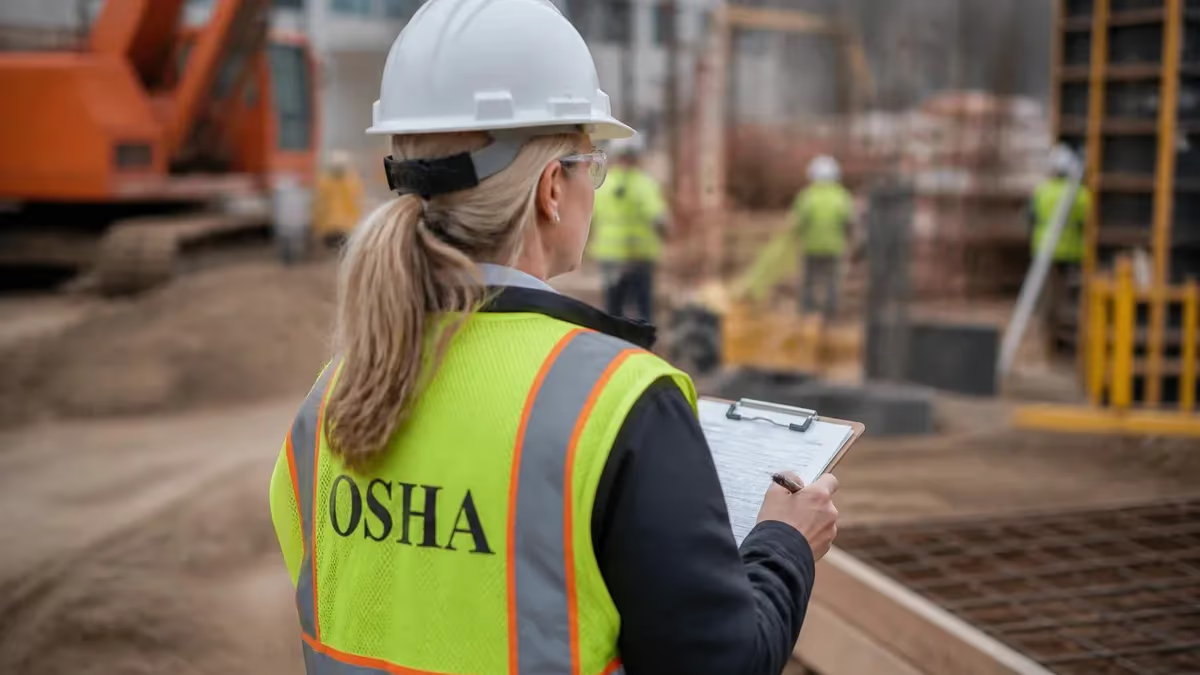
OSHA shoring requirements are among the most critical safety regulations governing construction sites across the United States. Every year, excavation cave-ins kill dozens of workers and injure hundreds more, making trenching and excavation one of the most hazardous operations in the construction industry. Understanding and properly implementing osha shoring requirements is not just a legal obligation — it is a life-saving practice that every competent person, crew supervisor, and crane operator working near excavations must master thoroughly before work begins.
OSHA's excavation and trenching standard, codified at 29 CFR 1926 Subpart P, sets the federal baseline for protective systems including shoring, sloping, and shielding. These rules apply to any excavation deeper than five feet, and to any trench of any depth where a competent person determines that hazardous conditions exist. The regulations are enforced by federal OSHA and state-plan agencies, and violations can result in fines ranging from thousands to hundreds of thousands of dollars per citation, alongside project shutdowns and criminal liability in cases involving worker fatalities.
Shoring itself refers to the installation of a system of supports — typically hydraulic, pneumatic, timber, or aluminum — designed to prevent the walls of an excavation from collapsing inward onto workers below. Proper shoring transfers the lateral earth pressure away from the trench walls and onto a structural framework that can safely bear the load. The type of shoring system required depends on multiple factors including soil classification, trench depth, nearby surcharge loads, and the presence of groundwater or vibration from equipment operations.
Soil classification is the foundational step in any shoring decision. OSHA recognizes four soil types: Stable Rock, Type A, Type B, and Type C, each representing progressively weaker and less stable ground conditions. Type C soil — which includes granular soils, submerged soil, soil from which water is freely seeping, and previously disturbed material — requires the most robust protective measures. A competent person must visually and manually test soil conditions before any workers enter an excavation and must reassess conditions whenever there is a change in weather, drainage, or nearby construction activity.
The stakes for getting shoring wrong are immediate and severe. A trench wall collapse happens in seconds, and the weight of soil — approximately 100 pounds per cubic foot — can pin a worker before rescue is possible. OSHA data consistently shows that most excavation fatalities occur in trenches between five and fifteen feet deep, precisely because crews often underestimate the danger of moderate-depth work. Compliance is not about passing an inspection; it is about ensuring every worker goes home at the end of the shift.
This guide walks through every dimension of OSHA's shoring requirements: the types of protective systems, how to classify soil, what a competent person must do before and during excavation work, how shoring integrates with other protective measures like sloping and shielding, and what crane operators and equipment operators need to know when working adjacent to open excavations. Whether you are preparing for the OSHA Certified Crane Operator exam or simply trying to run a safer job site, this resource gives you the technical grounding to make confident, compliant decisions.
Keeping pace with OSHA's shoring standards also matters for career advancement. Crane operators who understand excavation safety bring measurable value to their employers because they can identify hazardous proximity conditions before lowering loads near open trenches, coordinate lift plans that account for surcharge pressure on adjacent walls, and serve as an additional layer of competent oversight on complex sites. The intersection of crane operations and excavation safety is a high-stakes zone where mechanical hazards and geotechnical hazards converge simultaneously.
OSHA Excavation Safety by the Numbers
Types of Protective Shoring Systems
Uses hydraulic pistons or cylinders to apply lateral pressure against trench walls. Fast to install and adjustable in the field, hydraulic shoring is the most common modern system for utility and pipeline trenches in Type B and Type C soils.
A traditional method using wood uprights, walers, and cross braces designed per OSHA Appendix C tables. Timber shoring must be sized and spaced according to soil type and trench depth, and all members must be inspected for defects before installation.
Combines lightweight aluminum frames with hydraulic cylinders for rapid deployment. Manufacturer tabulated data governs installation rather than OSHA tables, and the competent person must ensure the system is used within its rated capacity at all times.
Air-powered cylinders expand against trench walls to provide lateral support. Pneumatic systems are frequently used in confined access conditions where hydraulic hose routing is difficult, but require a constant air supply and pressure monitoring during operations.
Pre-engineered steel or aluminum boxes lowered into excavations to protect workers inside. Shielding does not prevent wall movement — it protects workers if collapse occurs. Boxes must not extend above the adjacent soil by more than two feet.
Soil classification is the cornerstone of every shoring decision on a construction site, and OSHA's competent person requirement places direct legal responsibility on a qualified individual to perform this assessment before workers ever enter the excavation. Under 29 CFR 1926 Subpart P Appendix B, soil must be classified using at least one visual test and one manual test conducted on freshly excavated material. The results drive every downstream decision about which protective system to use, what angle to cut if sloping is chosen, and how frequently inspections must occur during the workday.
Type A soil is the most stable category and includes cohesive soils such as clay, silty clay, sandy clay, and clay loam that have an unconfined compressive strength of 1.5 tons per square foot (tsf) or greater.
However, soil cannot be classified as Type A if it is fissured, if it is subject to vibration from heavy construction traffic, if it has been previously disturbed, or if it is part of a sloped layered system where the layers dip into the excavation. These disqualifying conditions are commonly encountered on real job sites, meaning Type A is rarer in practice than it might appear on paper.
Type B soil occupies the middle ground and encompasses cohesive soils with an unconfined compressive strength greater than 0.5 tsf but less than 1.5 tsf. It also includes granular cohesionless soils such as angular gravel, silt, silt loam, and sandy loam, as well as previously disturbed soils not classified as Type C. Submerged rock that is not otherwise classified as Stable Rock also falls into this category. Because Type B covers such a wide range of conditions, competent persons must exercise careful professional judgment to avoid misclassifying borderline soils upward into Type A.
Type C is the weakest and most hazardous classification. It includes cohesive soil with an unconfined compressive strength of 0.5 tsf or less, granular soils including gravel and sand, submerged soil or soil from which water is freely seeping, unstable submerged rock, and material in a sloped layered system where the layers dip into the excavation. Any time a competent person is uncertain about soil strength, OSHA's guidance is clear: default to the more conservative Type C classification rather than risk worker lives on an optimistic soil assessment.
Manual soil tests include the thumb penetration test, where a competent person presses their thumb firmly into a fresh soil sample. If the thumb penetrates only with great effort, the soil likely qualifies as Type A. Easy thumb penetration suggests Type B, and very easy penetration with fingers rather than the thumb indicates Type C. More precise field instruments include the pocket penetrometer and the torvane shear device, both of which provide quantitative unconfined compressive strength readings that can be compared directly to OSHA's classification thresholds.
Visual tests examine the excavation walls and spoil pile for signs of fissuring, cracking, spalling, or layering. The presence of water seeping through the walls, evidence of prior disturbance such as utility backfill, and the overall geometry of any visible natural layering all inform the classification. A competent person must also observe whether the soil holds a vertical face or whether it tends to slump, crack, or flow — behaviors that immediately signal weaker Type B or Type C conditions regardless of what a pocket penetrometer reading might suggest in isolation.
Once soil is classified, OSHA provides specific tabulated data in Appendices B through F that prescribe exactly what protective measures are required. For sloping, the maximum allowable slope angles are 3/4:1 (horizontal to vertical) for Type B soil and 1½:1 for Type C soil, while Stable Rock can be cut vertically and Type A soil allows a 3/4:1 maximum slope.
For shoring, the tables specify the size, spacing, and arrangement of timber members based on soil type and trench geometry. Understanding these tables is essential for anyone managing excavation operations or preparing for examinations that cover OSHA excavation safety in depth.
Sloping, Shoring, and Shielding: Key Protective Methods
Sloping involves cutting the excavation walls back at an angle flat enough that the soil remains stable without additional support. OSHA requires Type C soil to be sloped at no steeper than 1½ horizontal to 1 vertical, which means a five-foot-deep trench would require the walls to be cut back 7.5 feet on each side — consuming significant workspace and right-of-way. Sloping is most practical in open areas where space is not constrained by roads, structures, or utilities running parallel to the trench.
The primary advantage of sloping is its simplicity: no equipment to buy, no hardware to install, and no risk of shoring system failure. The major disadvantage is space consumption. In urban utility work, the right-of-way rarely permits a proper Type C slope without disrupting traffic lanes, damaging adjacent structures, or undermining existing utilities. When space is tight, shoring or shielding becomes the only compliant option even when the soil might theoretically permit sloping on a less constrained site.

Shoring vs. Sloping: Advantages and Limitations
- +Shoring enables work in tight urban spaces where sloping would consume excessive right-of-way
- +Hydraulic systems install quickly from the surface, reducing worker exposure to unprotected conditions
- +Shoring provides quantifiable, documented support capacity for inspector review
- +Adjustable systems can respond to changing soil or groundwater conditions mid-project
- +Trench boxes protect workers even if a sudden unanticipated collapse occurs
- +Properly shored trenches allow vertical cuts that minimize soil disturbance to adjacent structures
- −Shoring equipment represents a significant upfront capital or rental cost compared to sloping
- −Hydraulic and timber shoring must be inspected by a competent person before every shift
- −Improper installation — including undersized members or incorrect spacing — creates a false sense of security
- −Shoring removal in weak soils carries risk if not performed in the correct sequence
- −Trench boxes do not prevent wall movement; adjacent utilities or structures can still be damaged by shifting soil
- −Manufacturer rated capacities must be on-site and verified; exceeding them even briefly can cause catastrophic failure
Competent Person Excavation Inspection Checklist
- ✓Classify soil using at least one visual test and one manual test on freshly excavated material before any worker entry.
- ✓Inspect the excavation at the start of each shift and after any event that could affect trench stability.
- ✓Verify that the protective system — shoring, sloping, or shielding — matches the soil classification and trench depth.
- ✓Check that all shoring members are properly seated, undamaged, and within the manufacturer's or OSHA's rated capacity.
- ✓Confirm that water accumulation is being controlled and that no workers are permitted in excavations with accumulated water.
- ✓Ensure spoil piles, equipment, and materials are kept at least two feet from the edge of the excavation.
- ✓Verify that workers have safe access and egress (ladders, stairs, or ramps) within 25 feet of travel in any direction.
- ✓Identify and document all surface encumbrances — overhead lines, underground utilities, nearby structures — that could create hazards.
- ✓Remove all workers immediately and correct conditions before re-entry if any indication of potential cave-in is observed.
- ✓Document daily inspection results in a written record and retain for the duration of the project.
The Two-Foot Rule Saves Lives
OSHA requires all spoil piles, equipment, and materials to be placed at least two feet back from the edge of any excavation. Soil displaced to the surface adds surcharge pressure to the trench walls from above, dramatically increasing cave-in risk. Even a single piece of heavy equipment parked closer than two feet can destabilize a shored trench that would otherwise be fully compliant and safe.
OSHA's enforcement data reveals a consistent pattern of violations in excavation and trenching work that leads to both worker fatalities and substantial financial penalties for contractors. The most frequently cited violation category under Subpart P is the complete absence of a protective system — workers simply excavating and entering trenches with no sloping, shoring, or shielding in place whatsoever. This type-1 violation accounts for a disproportionate share of fatal cave-in incidents because it reflects not a misapplication of protection but an outright disregard for the standard's most fundamental requirement.
The second most common violation category involves inadequate protective systems — cases where some attempt at protection is made but the system is improperly designed, undersized, or incorrectly installed. Examples include timber shoring with walers spaced too far apart, hydraulic shores set at pressures below what the soil load requires, or trench boxes that have been undermined at the base because the excavation was dug deeper than the box extends. These situations are particularly dangerous because the crew may believe they are protected when in fact the system will fail under the actual loading conditions it faces.
Failure to conduct adequate inspections by a competent person is the third major violation category. OSHA requires a competent person to inspect excavations before each shift starts, after rainstorms or other events that could destabilize the soil, and whenever conditions change. An inspector who walks by the trench once at the start of the week and never returns does not satisfy this requirement. OSHA's standard is unambiguous: the inspection must be conducted by a competent person — someone who has the knowledge and authority to identify hazards and correct them immediately without seeking management approval.
Lack of safe access and egress is another frequently cited violation. Every worker in a trench more than four feet deep must have a means of entering and exiting that does not require climbing shoring members or jumping. Ladders, stairs, or ramps must be positioned so that no worker is more than 25 feet of lateral travel from an access point. This requirement is often overlooked on fast-moving pipeline crews where productivity pressure leads supervisors to omit ladder placement in favor of having workers slide in and out from the spoil pile end of the trench.
Water accumulation violations occur when excavations fill with standing water from precipitation, groundwater seepage, or utility line breaks and work continues without adequate water control. Water weakens soil cohesion, increases lateral pressure on shoring systems, and creates drowning risk independent of cave-in hazard. OSHA requires that water accumulation be controlled before and during worker entry, which typically means pumping, dewatering, or in some cases waiting for conditions to improve before resuming excavation work.
Penalties for excavation violations have escalated significantly over the past decade. The Bipartisan Budget Act of 2015 empowered OSHA to adjust civil penalties annually based on the Consumer Price Index, and serious violation fines now reach $16,131 per instance.
Willful or repeat violations — those where the employer knew about the hazard and failed to correct it, or was previously cited for the same condition — carry penalties up to $161,323 per violation. When a worker fatality results from an excavation cave-in, OSHA typically opens a criminal referral to the Department of Justice, and individual supervisors have faced prison sentences in cases of egregious negligence.
Contractors can substantially reduce their violation risk by investing in competent person training, maintaining a written excavation safety plan for every project, and establishing a culture where any worker — including the most junior laborer — has both the expectation and the practical authority to stop work and call the competent person when conditions change. OSHA's General Duty Clause reinforces this framework by holding employers responsible for recognized hazards even when no specific regulation addresses the precise scenario, meaning the standard of care in excavation safety extends beyond the literal text of Subpart P to encompass any reasonably foreseeable risk.
OSHA requires all workers to exit an excavation immediately if any of these conditions appear: visible cracking or heaving of the trench walls, sudden changes in soil color or texture indicating water infiltration, unexpected water seepage, increased vibration from nearby equipment or traffic, or any indication that the shoring system has shifted, loosened, or partially failed. Do not re-enter until the competent person has inspected, identified the cause, and implemented corrective measures.
Crane operators working on or near active excavations face a unique intersection of mechanical and geotechnical hazards that requires specific awareness beyond standard lift planning procedures. The primary concern is ground bearing capacity: the outrigger pads or crawler tracks of a crane impose point loads on the ground surface that can dramatically increase the lateral pressure on adjacent trench walls, destabilizing shoring systems that would otherwise be adequate for the soil load alone. OSHA's standard at 29 CFR 1926.651(j) specifically addresses this by requiring that equipment and surcharge loads be kept at a safe distance from the excavation edge.
Determining a safe standoff distance for crane operations near excavations requires engineering analysis rather than a simple rule of thumb. The relevant factors include the crane's gross weight and outrigger pad size, the type and capacity of the shoring system, the soil classification, the trench depth and width, and the proximity of the crane's center of gravity to the excavation edge.
For routine operations, many contractors use the conservative guideline of keeping all heavy equipment at least one trench-depth back from the edge, but a licensed engineer should review the specific conditions whenever a critical lift is planned near an open excavation.
Signal communication between crane operators and ground personnel takes on added urgency near excavations because the consequences of a load swing error or tag line failure can send a moving load into an open trench, striking workers below or destabilizing the walls.
Pre-lift safety briefings on sites with adjacent excavations should specifically address swing arc restrictions, restricted zones around trench edges, emergency stop protocols, and the signal sequence for any load movement over or near the excavation. All signal persons must be trained to OSHA standards and the crane operator should never move a load without a clear signal from the designated signal person.
Vibration from crane operations — particularly from pile driving, dynamic compaction, or heavy track-mounted equipment traveling near excavation edges — can rapidly degrade soil classified as Type A or Type B to effectively Type C conditions.
OSHA Appendix B explicitly lists vibration as a disqualifying factor for Type A soil classification, which means a competent person who classified the soil at the beginning of a project may need to reclassify it as crane operations begin in the vicinity. Protective systems sized for Type B soil may be inadequate for the actual conditions once vibration is introduced, requiring immediate upgrades to shoring before work continues.
Crane operators should also be aware of overhead utility hazards that frequently coincide with underground utility corridors along which trenches are excavated. A trench cut along a utility right-of-way often runs directly beneath the same overhead power lines that govern the crane's maximum working radius.
The combination of restricted boom angle due to overhead lines and restricted position due to the adjacent trench can create situations where the crane must work in a very narrow operational envelope. Pre-planning these complex sites with the competent person, the utility owners, and a licensed crane consultant is essential to finding a configuration that complies with both excavation and electrical safety requirements simultaneously.
For crane operators pursuing or maintaining OSHA Certified Crane Operator credentials, understanding excavation safety is a genuine component of job competency rather than an academic side topic. CCO written examinations include questions on site hazard recognition, ground conditions, and the crane operator's responsibilities when working near hazardous conditions including open excavations. Reviewing OSHA Subpart P alongside the crane-specific standards in 29 CFR 1926 Subpart CC provides an integrated picture of how these two regulatory frameworks interact in real construction environments where cranes and excavations frequently coexist on the same site footprint.
Practical experience with excavation hazards also supports crane operators in their role as a second layer of site safety oversight. An experienced operator who understands shoring requirements can recognize when a trench box appears to be undersized for the trench depth, when spoil piles are dangerously close to the excavation edge, or when workers are operating in an unprotected portion of a trench — and can halt crane operations and notify the competent person before a hazard becomes a tragedy.
This kind of proactive safety culture is what distinguishes a professional operator from someone who simply runs the machine and considers everything else someone else's problem.
Preparing effectively for the OSHA Certified Crane Operator exam requires understanding how excavation and shoring concepts appear alongside the crane-specific technical content that forms the bulk of the test. The CCO exam administered by the National Commission for the Certification of Crane Operators tests candidates on site conditions, ground bearing pressure, safe approach distances to excavations and utilities, and the crane operator's responsibilities when unusual site conditions are encountered. Candidates who study OSHA Subpart P alongside Subpart CC gain a more complete picture of the regulatory framework and perform better on scenario-based questions that combine multiple safety domains.
Effective study for excavation-related exam questions should focus on the four soil classification categories and their distinguishing characteristics, the three types of protective systems and when each is required, the competent person's specific duties before and during excavation work, the minimum standoff distances for equipment and spoil piles, and the conditions that require immediate worker evacuation. These topics recur across multiple question types including direct knowledge questions, application scenarios, and multi-step problem questions that require candidates to apply the correct standard to a described field situation.
Practice tests are one of the most effective preparation tools available for crane operator certification candidates. Working through realistic questions under timed conditions builds both content knowledge and test-taking stamina, and reveals specific knowledge gaps that can then be addressed through targeted review. The quiz resources linked throughout this article cover the full range of OSHA crane operation topics, from signal communication and load handling to regulatory compliance and equipment inspection standards, giving candidates comprehensive practice across all major exam domains without needing to purchase multiple separate study materials.
Beyond exam preparation, the habits developed through rigorous study of OSHA safety standards pay dividends throughout a crane operator's career. Safety regulations evolve as new hazards are identified and new engineering solutions become available, and operators who understand the reasoning behind the rules — not just the specific numbers and tables — are better equipped to adapt when they encounter conditions that don't precisely match the examples in the standard. OSHA's intent in Subpart P is straightforward: no worker should ever be buried alive by a preventable cave-in. Every specific requirement flows from that single protective purpose.
Time management during the actual certification exam is critical, particularly for candidates who encounter questions about less familiar topics like soil classification or excavation protective systems. If you know the content well, these questions take no longer than crane-specific questions. If the content is unfamiliar, candidates sometimes spend excessive time on a single question and run short of time for questions they could answer confidently. The best strategy is to answer what you know first, flag uncertain questions for review, and return to flagged items with whatever time remains rather than getting stuck mid-exam on a single challenging item.
On the job, the most important thing to remember about OSHA shoring requirements is that compliance is not a one-time event at the start of excavation. It is a continuous process that requires daily inspection, ongoing monitoring, and immediate response to changing conditions.
The competent person must be genuinely competent — not just a supervisor who holds a certificate but someone who can look at a trench wall and accurately assess whether it is safe. Building that level of competency requires hands-on experience with soil conditions, familiarity with the available protective systems, and a deep understanding of what OSHA's standards actually require versus what is commonly assumed on busy job sites.
Whether you are studying for a certification exam, refreshing your knowledge of excavation safety requirements, or trying to understand how shoring standards interact with crane operations, the foundation is the same: know the regulations, understand their purpose, and apply them consistently in the field.
OSHA's Subpart P exists because the hazards of excavation work are severe, immediate, and often irreversible. A collapsed trench wall cannot be undone. The best outcome — the only acceptable outcome — is that the protective system works exactly as designed and every worker exits the excavation the same way they entered it, safely and on their own terms.
OSHA Questions and Answers
360 Training OSHA 10: Complete Guide to Online OSHA 10-Hour Construction and General Industry Certification Courses
OSHA (OSHA Certified Crane Operator) Test Guide

OSHA 1910.269: Complete Guide to Electric Power Generation, Transmission, and Distribution Safety Standards
OSHA Railing Requirements: Complete Guide to Guardrail Standards, Heights, Loads, and Fall Protection Compliance for Construction and General Industry

What Makes OSHA Requirements Applicable for Federal Agencies: A Complete Guide
About the Author

Certified Safety Professional & OSHA Compliance Expert
Indiana University of Pennsylvania Safety SciencesDr. William Foster holds a PhD in Safety Science from Indiana University of Pennsylvania and is a Certified Safety Professional (CSP) and Certified Hazardous Materials Manager. With 20 years of occupational health and safety management experience across construction, manufacturing, and chemical industries, he coaches safety professionals through OSHA certification, CSP, CHST, and safety management licensing programs.
Join the Discussion
Connect with other students preparing for this exam. Share tips, ask questions, and get advice from people who have been there.
View discussion (8 replies)