
OSHA Propane Tank Storage: Complete Guide to Regulations, Safety Requirements, and Compliance
Learn OSHA propane tank storage requirements, safety distances, ventilation rules & compliance tips. ✅ Complete guide for US workplaces.

Understanding osha propane tank storage regulations is essential for any employer or worker who handles liquefied petroleum gas on a job site or in a fixed facility. OSHA's standards — primarily drawn from 29 CFR 1910.110 for general industry and 29 CFR 1926.153 for construction — establish precise requirements for container placement, separation distances, ventilation, signage, and employee training. Violations can result in citations ranging from a few hundred dollars to $156,259 per willful or repeated infraction, making compliance both a safety imperative and a business necessity.
Propane, also known as liquefied petroleum gas (LPG), is stored under pressure as a liquid that vaporizes when released. A single 500-gallon tank contains roughly 2 million BTUs of potential energy, meaning even a small leak near an ignition source can produce a catastrophic fire or explosion. OSHA's storage rules are designed to create physical distance between fuel sources and heat, control vapor accumulation through ventilation, and ensure workers know exactly what to do when something goes wrong. Every rule in the standard traces back to one of these three engineering principles.
The scope of OSHA's propane storage rules extends far beyond the obvious cylinder cage behind a warehouse. Propane is used in construction heating, forklift fuel, torch operations, roofing, agricultural drying, and dozens of manufacturing processes. Each application carries its own subset of storage requirements because tank sizes, mounting configurations, and proximity to occupied structures differ dramatically across industries. A 1-pound camping-style cylinder used by a roofer is subject to different rules than a 30,000-gallon storage vessel at a propane distributor, yet OSHA's underlying logic is consistent throughout.
One area that frequently catches employers off guard is the requirement for qualified employee training. OSHA's Hazard Communication Standard (29 CFR 1910.1200) requires that workers who may be exposed to propane hazards receive instruction on the physical and health dangers of LPG, how to read Safety Data Sheets, and what emergency procedures to follow. This training obligation exists independently of the storage rules under 29 CFR 1910.110, meaning an employer cannot satisfy OSHA's expectations simply by installing the right equipment — documented training records are also mandatory.
Enforcement data from OSHA's inspection database shows that flammable/combustible liquid storage violations — a category that includes propane — consistently rank among the top ten most frequently cited standards in general industry. In fiscal year 2023, OSHA issued more than 1,400 citations related to flammable liquid and compressed gas storage, with proposed penalties exceeding $8.5 million across all affected employers. These numbers underscore that OSHA inspectors actively look for propane storage deficiencies during routine inspections and after incidents, making proactive compliance far less expensive than reactive remediation.
For workers studying for OSHA-related certifications or workplace safety roles, propane storage rules represent a cross-disciplinary topic that touches on fire protection, electrical safety, ventilation engineering, and hazardous materials management. Whether you are preparing for an OSHA 10-hour or 30-hour course, seeking certification as a safety professional, or simply trying to protect your team on a construction site, mastering the fundamentals of LPG storage compliance will distinguish you as a knowledgeable and credible safety advocate. The sections that follow break down each major regulatory requirement, common violations, and practical compliance strategies in plain language.
Finally, it is worth noting that OSHA's standards for propane storage are frequently supplemented — and occasionally superseded — by National Fire Protection Association (NFPA) 58, the Liquefied Petroleum Gas Code, which is adopted by reference in many states and local jurisdictions.
OSHA's own standard at 29 CFR 1910.110 was written with NFPA 58 as its foundation, but the NFPA code is updated on a four-year cycle and may impose stricter requirements in areas where the OSHA standard has not kept pace. Employers operating in states with their own OSHA-approved State Plans — California (Cal/OSHA), Michigan (MIOSHA), and 26 others — should also check for state-specific addenda that go beyond federal minimums.
OSHA Propane Tank Storage by the Numbers

Core OSHA Propane Storage Requirements
All propane containers must be designed, fabricated, and tested per ASME Boiler and Pressure Vessel Code or DOT specifications. Containers must bear the appropriate stamping or marking. Using unapproved vessels is an immediate serious violation under 29 CFR 1910.110(b)(3).
Containers stored outdoors must be placed on firm, level ground away from heavy traffic areas. They must be at least 10 feet from any building opening, air intake, or ignition source. Containers exceeding 125 gallons require additional setback distances based on aggregate water capacity.
All valves, regulators, and fittings must be protected from physical damage. Cylinders in use or storage must have protective caps on service valves when the cylinder is not connected to equipment. Damaged valves are a leading cause of propane releases.
Inside buildings, aggregate LP-gas stored in containers with more than 1 lb water capacity is strictly regulated. Generally no more than 300 lbs (about two 100-lb cylinders) may be stored inside without meeting enhanced ventilation, sprinkler, and separation requirements.
Portable cylinders must be secured upright during storage and transport to prevent tipping. Chains, straps, or purpose-built cylinder racks are all acceptable restraint methods. An unsecured cylinder that falls can shear the valve, creating an uncontrolled release.
Separation distance is the single most important variable in propane storage safety, and OSHA's rules in 29 CFR 1910.110(b)(6) establish minimum distances based on aggregate water capacity of the containers involved. For containers with a water capacity of 500 gallons or less, the minimum distance from any source of ignition, including open flames, electrical switchgear, and running engines, is 10 feet.
For containers between 501 and 2,000 gallons, the required setback increases to 25 feet. Containers exceeding 2,000 gallons must be 50 feet from the nearest ignition source or occupied building. These distances assume standard atmospheric conditions and no topographical barriers; in practice, site-specific hazard assessments may require larger buffers.
The concept of "aggregate water capacity" is critical to understanding how these distances are calculated. If an employer stores four 250-gallon propane tanks in a single outdoor cage, OSHA treats the aggregate capacity as 1,000 gallons — not 250 gallons per tank. This matters because the 1,000-gallon aggregate triggers the 25-foot separation requirement rather than the 10-foot requirement that would apply to a single 250-gallon vessel. Many employers make the mistake of evaluating each tank in isolation, then discover during an OSHA inspection that their outdoor storage configuration violates the distance rules when tanks are considered collectively.
Indoor propane storage introduces a different set of separation challenges because proximity to building materials, electrical systems, and occupants dramatically increases the consequences of a leak.
OSHA generally prohibits storing containers with more than 1 pound of LP-gas capacity inside buildings that are also used for other purposes, unless the building meets the ventilation and construction requirements outlined in 29 CFR 1910.110(b)(6)(ii). Where indoor storage is permitted — such as in dedicated LPG storage rooms — the room must be constructed of fire-resistive materials, ventilated at floor level (since propane vapor is heavier than air and pools low), and equipped with a self-closing fire door rated at not less than 1.5 hours.
Construction sites present a unique challenge for propane separation distances because the physical environment changes daily. A propane cylinder used to heat a structure may be compliant with distance requirements on Monday when it is placed 15 feet from framing lumber, but by Friday the lumber has been enclosed in drywall, creating a combustible pocket that was not previously present.
OSHA's construction standard at 29 CFR 1926.153(i) addresses this reality by requiring that containers used with construction heating equipment be positioned so that they are not closer than 6 feet to a doorway or window of any enclosed area that is being heated, and not closer than 3 feet from any non-fire-resistive wall or partition. Supervisors must reassess propane placement as construction progress changes the surrounding environment.
One frequently overlooked aspect of separation distance involves vehicle traffic. OSHA requires that outdoor propane storage areas be protected from vehicle damage by guard posts, curbing, or physical barriers, especially where forklifts or other heavy equipment operate. A forklift striking an unsecured propane cylinder at even low speed can shear the valve stem entirely, producing an uncontrolled release that can ignite instantly. Guard posts — typically 4-inch diameter steel pipe filled with concrete — are the industry-standard solution, and OSHA inspectors will specifically look for them during warehouse and distribution center inspections where propane-powered equipment is present.
Overhead utilities represent another dimension of separation compliance. Propane storage areas must maintain horizontal separation from overhead electrical lines based on voltage, and must never be placed directly below power lines where electrical arcing could reach the containers.
The NFPA 58 standard — frequently referenced by OSHA compliance officers — requires a horizontal clearance of at least 20 feet from overhead lines carrying less than 600 volts, with greater distances for higher-voltage transmission lines. Employers in areas subject to ice storms or high winds face an additional hazard: downed power lines that fall onto propane storage areas have caused catastrophic fires at agricultural facilities in several documented incidents.
Finally, separation distance requirements interact with fire suppression systems in important ways. When fixed automatic fire suppression covers a propane storage area, OSHA and NFPA 58 allow reduced setback distances in some configurations, recognizing that active suppression can control a fire before it reaches the containers.
However, activating this credit requires that the suppression system be specifically designed for LPG hazards, regularly tested and documented, and approved by the authority having jurisdiction (AHJ). Employers who believe their sprinkler system qualifies for the reduced-distance credit should obtain written confirmation from both their insurance carrier and the local fire marshal before repositioning any containers.
Ventilation, Signage & Container Markings for Propane Storage
Propane vapor is approximately 1.5 times heavier than air, which means it does not disperse upward like natural gas — it flows downhill and accumulates in pits, trenches, basements, and low-lying areas where ignition sources may be present. OSHA's ventilation rules for indoor propane storage require that openings be located at or near floor level, with a total net free area sufficient to prevent dangerous vapor accumulation. For dedicated LPG storage rooms, this typically means at least two ventilation openings — one near the floor on each exterior wall — to allow cross-ventilation that sweeps heavier-than-air vapor out before it can reach the lower flammability limit of 2.1% concentration.
Mechanical ventilation systems used in propane storage areas must be designed so that motors and fan blades are spark-proof or located outside the ventilated space, because propane vapor passing over an electrical motor can ignite. OSHA and NFPA 58 specify that fans moving LPG-contaminated air must use explosion-proof or totally enclosed non-ventilating (TENV) motors. Ventilation rates are calculated based on room volume and expected leak rate; most industrial applications specify a minimum of one air change per minute during normal operations, with higher rates triggered by leak detection alarms. Employers should document ventilation design calculations and retain them as part of their process safety records.
Propane as a Workplace Fuel: Safety Trade-Offs to Understand
- +Propane burns cleaner than diesel or gasoline, reducing worker exposure to carbon monoxide and particulate matter in partially enclosed spaces
- +Propane-powered forklifts and heaters can operate indoors with proper ventilation, giving employers more operational flexibility than liquid-fueled alternatives
- +Propane containers are designed to withstand significant physical abuse — DOT cylinders must pass drop, fire, and pressure tests before certification
- +Spilled propane does not contaminate soil or groundwater the way diesel and gasoline do, reducing environmental liability from minor leaks
- +Propane has a relatively narrow flammability range (2.1%–9.5% in air), meaning leaks must reach a specific concentration before they can ignite — easier to manage than hydrogen
- +OSHA's storage rules for propane are well-established and extensively documented, giving employers clear compliance targets and abundant guidance materials
- −Propane vapor is heavier than air and accumulates in low-lying areas, creating invisible explosion hazards that are difficult to detect without gas monitors
- −High-pressure storage means a mechanical failure — such as a sheared valve — can produce an extremely rapid uncontrolled release rather than a slow drip
- −Boiling Liquid Expanding Vapor Explosions (BLEVEs) can occur when fire heats an overfilled propane tank, producing catastrophic explosions that have killed firefighters
- −Indoor propane storage limits are strict and complex, making compliance difficult for facilities that need large quantities of fuel in confined spaces
- −Workers accustomed to gasoline or diesel may underestimate propane's hazards because the fuel is colorless and odorless in its natural state — the distinctive odorant is added artificially
- −Compliance with OSHA's propane storage rules requires ongoing maintenance, testing, and documentation, creating significant administrative burden for small employers
OSHA Propane Tank Storage Compliance Checklist
- ✓Verify all containers bear ASME or DOT certification markings and that markings are legible and undamaged.
- ✓Confirm outdoor storage setback distances match aggregate water capacity thresholds (10 ft, 25 ft, or 50 ft as applicable).
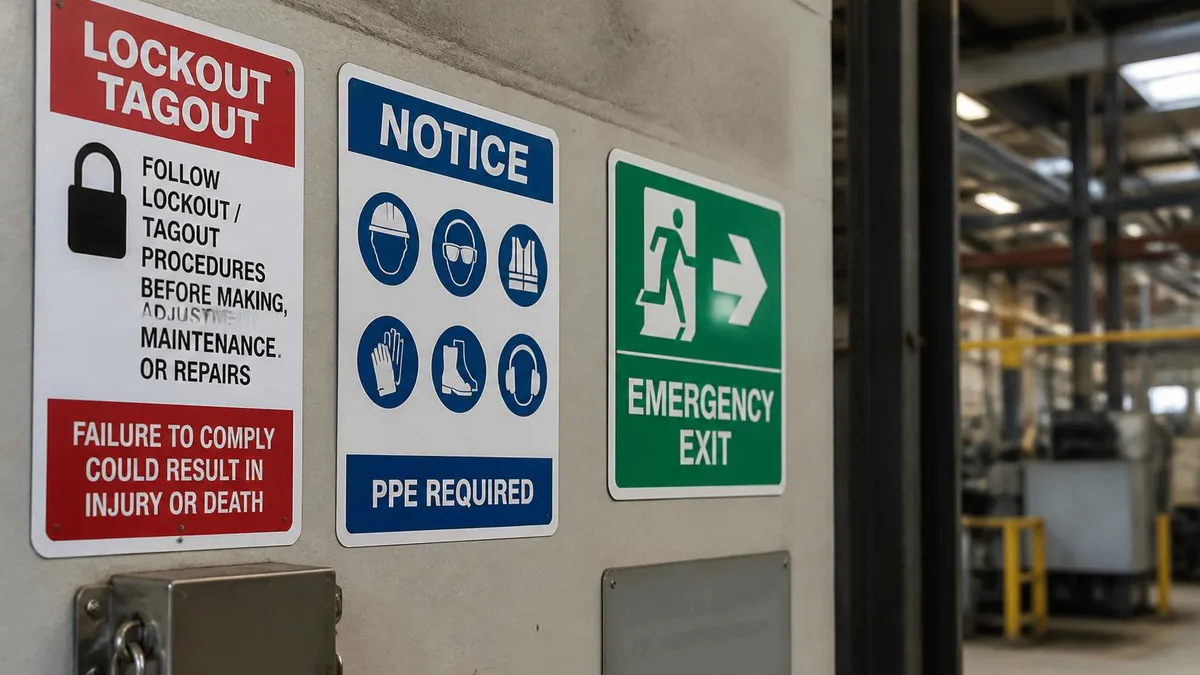
- ✓Post FLAMMABLE — NO SMOKING — NO OPEN FLAMES signs in letters at least 3 inches high on all sides of the storage area.
- ✓Secure all portable cylinders upright using chains, straps, or purpose-built cylinder racks to prevent tip-over.
- ✓Install vehicle barrier posts or curbing around outdoor storage areas accessible to forklifts or heavy vehicles.
- ✓Ensure indoor storage rooms have floor-level ventilation openings on at least two exterior walls for cross-ventilation.
- ✓Check that any mechanical ventilation fans in LPG storage areas use explosion-proof or TENV motors.
- ✓Document and retain employee training records showing completion of hazard communication training for propane.
- ✓Inspect regulator, valve, and fitting condition monthly and replace any components showing corrosion, damage, or leaks.
- ✓Verify that aggregate water capacity calculations include all containers stored in close proximity — not each tank in isolation.
Aggregate Capacity Changes Everything
OSHA calculates separation distance requirements based on the total aggregate water capacity of all containers in a storage area — not the size of individual tanks. Four 250-gallon tanks grouped together equal 1,000 gallons aggregate, triggering a 25-foot setback instead of the 10-foot rule that applies to a single 250-gallon vessel. Always evaluate your storage configuration as a whole before establishing setback distances.
Common OSHA violations in propane storage fall into predictable patterns that repeat across industries and inspection types. The most frequently cited deficiency is inadequate separation distance, usually because employers expanded their storage capacity over time without recalculating aggregate water capacity or adjusting the physical placement of containers.
An employer who began with two small cylinders may have gradually increased to eight or ten, but the storage location — and the setback from the building — never changed. By the time an OSHA inspector visits, the storage configuration is out of compliance even though no single decision was made to violate the standard.
Missing or inadequate signage is the second most common citation category in propane storage inspections. Employers often post signs when their storage area is first established, but signage deteriorates over time from UV exposure, weather, and physical contact with equipment. OSHA inspectors will cite employers when signs are faded to the point of illegibility, when they are partially obscured by stacked materials, or when they do not meet the minimum letter-height requirement. A simple monthly visual inspection of storage area signage, documented in writing, demonstrates good faith compliance and can mitigate proposed penalty amounts even when a citation is issued.
Improper container storage — specifically, storing cylinders horizontally rather than upright — is another frequently cited violation. Propane cylinders are engineered with relief valves positioned to vent vapor, not liquid. If a cylinder is stored on its side and the relief valve is submerged in liquid propane, a pressure event can expel liquid fuel rather than vapor, dramatically increasing the fire hazard. OSHA's standard requires upright storage for portable cylinders, and inspectors specifically look for cylinders that have been laid on their sides for convenience — a practice common in storage areas where vertical space is limited.
Valve protection failures represent a smaller but higher-consequence category of propane storage violations. When protective caps are missing from cylinders that are not actively connected to equipment, the valve stem is exposed to accidental impact. A dropped cylinder, a tipped forklift load, or even foot traffic in a crowded storage area can shear an unprotected valve, releasing propane instantly under full container pressure.
OSHA requires caps on all service valves when cylinders are not in use, and inspectors treat missing caps as a serious — rather than other-than-serious — violation when the storage context involves congested work areas or vehicle traffic.
Documentation deficiencies are a pervasive compliance gap that employers often overlook because they feel like administrative formality rather than physical safety. OSHA's propane storage standard requires that certain inspections and tests be documented, including container inspections by qualified personnel, pressure relief valve testing records, and employee training sign-in sheets.
When an inspector cannot locate these records, the employer loses the ability to demonstrate compliance with the inspection and testing requirements even if the actual physical condition of the containers is perfect. Maintaining a dedicated propane safety binder — or a digital equivalent — with all required records organized by date is one of the lowest-cost compliance investments an employer can make.
Temperature management is an often-overlooked compliance dimension. OSHA's standard prohibits exposing propane containers to temperatures above 125°F, because high temperatures increase internal pressure toward the relief valve set point. This restriction catches employers who store propane near steam pipes, industrial ovens, or — in outdoor environments — in enclosed metal sheds that act as solar collectors in summer months.
A well-ventilated shade structure over an outdoor storage cage costs relatively little to construct and can keep container temperatures within safe limits even in the hottest climates. Employers operating in desert Southwest environments should specifically assess their storage configurations for heat exposure risk as part of their annual safety review.
Finally, emergency response planning is an area where many employers have procedural gaps that only become apparent when an incident actually occurs. OSHA's Emergency Action Plan standard at 29 CFR 1910.38 requires that employers with ten or more employees maintain a written plan covering fire response, evacuation routes, and emergency contact procedures.
For facilities that store propane, this plan should specifically address the response to a propane leak or fire — including the decision about whether to attempt to shut off supply valves or to evacuate and allow the fire department to handle the incident. OSHA inspectors may review emergency action plans during propane-related inspections and will cite deficiencies in propane-specific emergency procedures as part of a broader compliance assessment.

A Boiling Liquid Expanding Vapor Explosion (BLEVE) can occur when fire heats an overfilled propane container, causing catastrophic failure within minutes. OSHA and NFPA guidance is unambiguous: if fire is impinging on a propane container and the container cannot be safely cooled and removed within 30 seconds, evacuate the area immediately and call 911. Firefighters have been killed attempting to cool propane tanks during structure fires — never assume a container can be safely vented or cooled by untrained personnel.
OSHA's training requirements for employees who work with or near propane storage are layered across multiple standards, and understanding which requirements apply to a given workplace begins with identifying the relevant industry classification. For general industry employers covered by 29 CFR 1910, the primary training obligations come from the Hazard Communication Standard (29 CFR 1910.1200), the Emergency Action Plan Standard (29 CFR 1910.38), and the LPG standard itself at 29 CFR 1910.110.
For construction employers covered by 29 CFR 1926, the primary references are 29 CFR 1926.153 and the construction Hazard Communication Standard at 29 CFR 1926.59. In both cases, training must be documented with the employee's name, the date of training, and a description of what was covered.
Hazard communication training specific to propane must cover the physical properties of LP-gas that make it hazardous — its flammability range, its vapor density relative to air, its lack of natural odor (and the significance of the added odorant), and its behavior under pressure.
Workers must also be trained on how to locate and interpret the Safety Data Sheet for propane, which contains critical information about emergency response, first aid, and firefighting measures. OSHA does not prescribe a minimum duration for hazard communication training, but the training must be "effective" — meaning workers must actually understand and be able to apply the information, not simply sit through a presentation.
Beyond basic hazard communication, employees who physically handle propane containers — connecting and disconnecting hoses, transporting cylinders, changing out forklift tanks — require additional hands-on training that hazard communication alone does not satisfy. OSHA's LPG standard requires that this handling be performed only by "qualified" personnel who understand proper connection and disconnection procedures, leak testing methods, and emergency shutoff locations. Many employers satisfy this requirement through vendor-provided training from their propane supplier, which typically includes both classroom instruction and practical demonstration. Retaining the training certificate and curriculum outline from the vendor is important for demonstrating compliance during an OSHA inspection.
For employers seeking a more systematic approach to propane safety competency, OSHA's 10-hour and 30-hour outreach training programs provide foundational knowledge that includes flammable and combustible liquids storage, hazard communication, and emergency response planning.
Workers and supervisors who complete the 30-hour program develop a broader understanding of how propane storage requirements fit within OSHA's overall safety management framework, which is valuable for facilities where LPG is just one of multiple chemical hazards. It is worth noting that OSHA outreach cards do not replace site-specific propane handling training — they complement it by providing context and background knowledge about the regulatory system.
State-plan states may impose training frequency requirements that exceed federal OSHA minimums. California's Cal/OSHA, for example, requires periodic refresher training for workers who handle compressed gases, with the frequency determined by the employer's Injury and Illness Prevention Program (IIPP). Washington State's WISHA program has similar provisions.
Employers with multi-state operations must audit training requirements in each state where they operate propane storage, because relying on federal OSHA minimums alone may leave them out of compliance with the applicable state standard. A simple matrix showing each state's LPG training requirements — updated annually as state standards are revised — is a practical administrative tool for multi-location employers.
Supervisor and safety officer training deserves special emphasis because supervisors are OSHA's primary target when compliance breakdowns occur at the management level. OSHA's multi-employer citation policy can hold general contractors, site supervisors, and safety managers personally liable for propane storage violations even when the physical non-compliance was created by a subcontractor or line employee. Supervisors who complete OSHA's 30-hour construction or general industry course demonstrate due diligence, but they must also be specifically trained on propane storage requirements and given the authority — and responsibility — to correct violations immediately when they observe them during site walks or facility inspections.
Certification as a Certified Safety Professional (CSP) or an Associate Safety Professional (ASP) through the Board of Certified Safety Professionals includes competency in flammable and combustible materials management, which encompasses propane storage. For workers and supervisors who want to formalize their safety knowledge into a recognized credential, these certifications provide both personal career advancement and organizational credibility with OSHA compliance officers.
Facilities with a CSP on staff may receive more favorable treatment during inspections — not because OSHA offers formal credit for credentials, but because credentialed safety professionals are typically more effective at identifying and correcting compliance gaps before an inspector finds them.
Practical compliance with OSHA propane tank storage rules comes down to four operational disciplines: regular inspection, accurate recordkeeping, employee accountability, and proactive hazard assessment. Employers who treat propane safety as a quarterly audit item — rather than a daily operational concern — consistently underperform on compliance metrics, because the conditions that create violations (added containers, shifted equipment, deteriorated signage, untrained new hires) accumulate gradually between audit cycles. Building propane storage checks into daily opening procedures takes less than five minutes per storage area and catches developing problems before they become OSHA citations.
Physical inspection of propane containers should follow a standardized checklist that covers the container exterior, valve condition, regulator function, connection integrity, and storage area condition. Inspectors should specifically check for signs of rust or corrosion on container shells — particularly at the base where moisture collects — as well as any discoloration that might indicate previous heat exposure.
Containers showing significant external corrosion should be removed from service and evaluated by the propane supplier before being returned to active use. Many suppliers offer free inspection services as part of their customer relationship, and employers should take advantage of these services rather than making compliance determinations based on visual inspection alone.
Leak testing is a specific inspection task that requires proper equipment and training. The correct method for leak testing propane connections is to apply an approved LPG leak detection solution — commonly a soapy liquid specifically formulated for gas service — to all connections and observe for bubble formation. Using open flame to detect propane leaks is absolutely prohibited and has caused fatalities.
Electronic combustible gas detectors are also acceptable for leak detection, but they must be calibrated for propane specifically, since detectors calibrated for methane (natural gas) may give inaccurate readings for LPG. Leak detection results should be logged in the propane maintenance record along with the date, the name of the person who performed the test, and any corrective actions taken.
Seasonal transition periods — particularly the transition into cold weather when construction heating equipment is activated — are high-risk times for propane storage compliance failures. As weather cools, employers often introduce additional propane cylinders to power heaters, temporarily store them in locations that were not previously used for propane, and connect equipment without reviewing OSHA's positioning requirements for construction heaters.
A pre-season propane safety review conducted in September or October — before heating season demand creates time pressure — allows employers to identify storage location issues, confirm equipment in good repair, and refresh employee training before the first cold snap creates operational urgency that crowds out safety considerations.
Contractors and employers who manage propane storage at multiple sites face the additional compliance challenge of ensuring that standards are applied consistently across locations with different physical configurations, different supervisory staff, and potentially different state regulatory requirements.
A standardized propane safety management program — a written procedure that specifies inspection frequency, documentation format, training requirements, and escalation protocols for identified deficiencies — provides the organizational backbone needed to maintain compliance at scale. This type of written program is not specifically required by OSHA's LPG standard, but it demonstrates the kind of systematic approach that OSHA compliance officers look for when evaluating whether an employer has made a good-faith effort to comply with the standard.
Emergency response drills specifically focused on propane scenarios provide practical value that tabletop exercises alone cannot deliver. Workers who have physically practiced locating the main shutoff valve, retreating to the designated assembly point, and accounting for all personnel in a simulated propane emergency respond more effectively when an actual incident occurs.
OSHA's Process Safety Management standard at 29 CFR 1910.119 requires emergency response drills for facilities that handle propane above the 10,000-pound threshold quantity, but even facilities below that threshold benefit from practical drill programs. Annual propane emergency drills, documented with attendance records and an after-action review, represent a best practice that exceeds OSHA's minimum requirements while providing genuine worker protection.
The intersection of propane storage compliance with broader workplace safety programs is worth highlighting for employers who are building or strengthening their overall safety management system. Propane storage deficiencies frequently co-occur with other flammable materials storage violations, inadequate fire extinguisher coverage, missing hot work permits, and gaps in emergency action planning — all of which OSHA inspectors will cite during the same inspection.
Addressing propane storage as part of a comprehensive flammable materials audit, rather than as a standalone compliance task, allows employers to identify systemic weaknesses in their fire prevention program and address them efficiently. Organizations that adopt OSHA's Voluntary Protection Programs (VPP) framework or implement the National Safety Council's hierarchy of controls approach report significantly fewer propane-related citations and near-miss incidents than those that manage compliance reactively.
OSHA Questions and Answers

360 Training OSHA 10: Complete Guide to Online OSHA 10-Hour Construction and General Industry Certification Courses

OSHA (OSHA Certified Crane Operator) Test Guide

OSHA 100: Complete Guide to Crane Safety Awareness Training and Certification

What Makes OSHA Requirements Applicable for Federal Agencies: A Complete Guide

Does OSHA Cover Maritime? Complete Guide to OSHA Maritime Coverage, Jurisdiction, and Worker Protections
About the Author

Certified Safety Professional & OSHA Compliance Expert
Indiana University of Pennsylvania Safety SciencesDr. William Foster holds a PhD in Safety Science from Indiana University of Pennsylvania and is a Certified Safety Professional (CSP) and Certified Hazardous Materials Manager. With 20 years of occupational health and safety management experience across construction, manufacturing, and chemical industries, he coaches safety professionals through OSHA certification, CSP, CHST, and safety management licensing programs.
Join the Discussion
Connect with other students preparing for this exam. Share tips, ask questions, and get advice from people who have been there.
View discussion (8 replies)