
OSHA Flammable Cabinet Rules: Complete Guide to Storage Requirements, Compliance, and Workplace Safety
Master OSHA flammable cabinet rules: storage limits, construction standards, labeling, and inspection tips. Stay compliant and protect your workplace. ✅
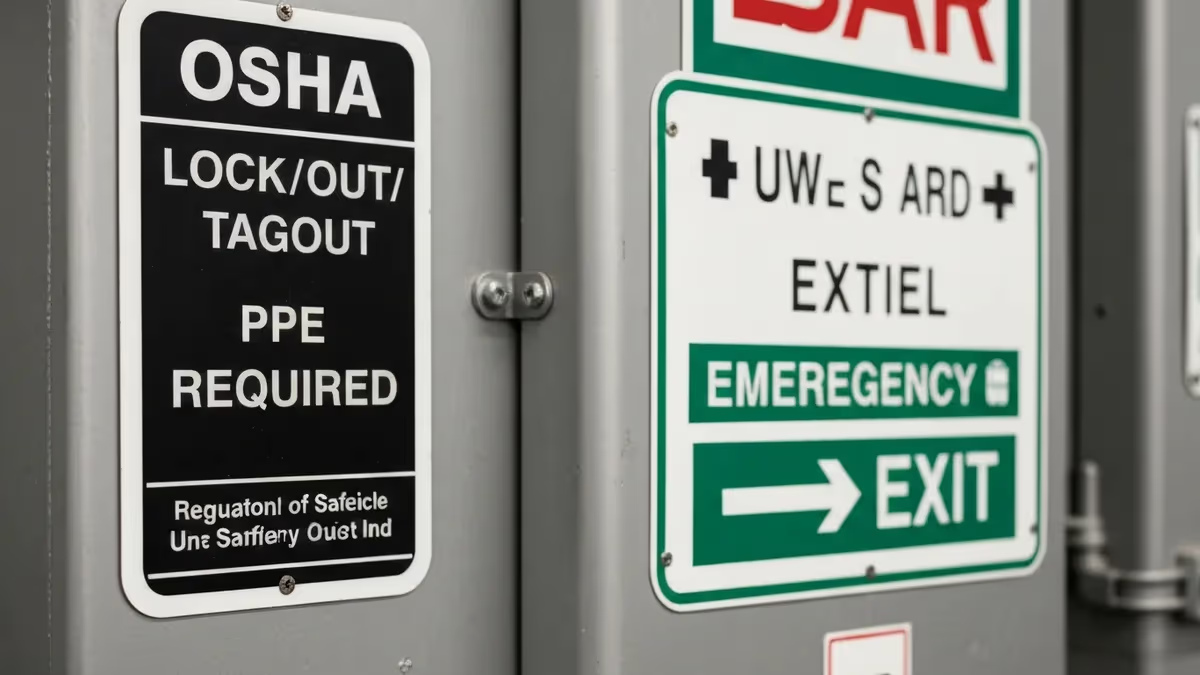
Understanding OSHA flammable cabinet rules is essential for any workplace that stores flammable or combustible liquids. OSHA's standards, primarily found in 29 CFR 1910.106, establish strict requirements for how flammable liquids must be stored, contained, and managed to prevent fires and explosions. Whether you work in manufacturing, automotive, chemical processing, or even healthcare, violations of these rules can result in fines exceeding $15,625 per citation, and repeat offenses can reach $156,259. Getting compliant starts with knowing exactly what the regulations demand.
Flammable storage cabinets serve as the first line of defense in protecting workers from the hazards of flammable liquids. These specially designed units are engineered to contain leaks, withstand fire exposure for a minimum of ten minutes, and prevent internal vapors from igniting due to external heat sources. OSHA mandates that all flammable liquid storage cabinets meet specific construction standards outlined in the National Fire Protection Association (NFPA) 30 standard, which OSHA has incorporated by reference into its own regulations.
Many employers mistakenly believe that simply purchasing any metal cabinet is sufficient for compliance. However, OSHA and NFPA 30 require cabinets to be listed and labeled by a nationally recognized testing laboratory (NRTL), such as UL (Underwriters Laboratories). An unlabeled cabinet, regardless of its material or appearance, does not satisfy the regulatory requirement. This distinction matters enormously during OSHA inspections, and employers who overlook it face significant exposure to citations and liability in the event of an incident.
The rules governing flammable cabinets also address quantity limits. No more than 60 gallons of Class I or Class II flammable or combustible liquids may be stored in a single approved metal cabinet, and no more than three such cabinets may be located in a single fire area without additional engineering controls. These limits reflect the real-world ignition and containment risks that quantity thresholds are designed to manage, ensuring that even a worst-case scenario remains survivable for occupants and emergency responders.
Ventilation requirements add another layer of complexity to compliance. While OSHA does not strictly require cabinets to be vented, any venting that is performed must be done correctly to prevent the accumulation of flammable vapors inside the cabinet. If a cabinet is vented to the outside, the vent openings must be sealed with a flame arrestor or bunged with the factory-supplied plugs when not actively vented. Improper venting can actually increase the risk of ignition, making it more dangerous than leaving the vent holes plugged.
Labeling is also a non-negotiable element of OSHA flammable cabinet compliance. Every flammable storage cabinet must be conspicuously labeled with the words "Flammable — Keep Fire Away" in red letters on a contrasting background. This labeling serves both a compliance function and a practical safety function, alerting workers, emergency responders, and visitors to the presence of hazardous materials inside. Employers who maintain multiple cabinets should ensure that every single unit carries this required marking, without exception.
For workplaces that handle a wide range of hazardous chemicals, understanding osha flammable cabinet rules alongside broader chemical management requirements helps build a comprehensive safety program. The interplay between storage cabinet rules, hazard communication standards, and emergency response planning creates a layered defense that significantly reduces the risk of fire-related injuries and fatalities in American workplaces each year.
OSHA Flammable Cabinet Rules by the Numbers

OSHA Cabinet Construction Standards You Must Know
Approved flammable cabinets must be constructed of at least 18-gauge sheet steel with double-wall construction and a 1.5-inch air space between walls. Door joints must be riveted or welded, and the cabinet must have a three-point latch system with a listed locking mechanism.
All OSHA-compliant flammable storage cabinets must be listed and labeled by a nationally recognized testing laboratory such as UL or FM Global. Unlabeled cabinets, regardless of construction material or appearance, do not satisfy OSHA's requirements under 29 CFR 1910.106.
OSHA permits wooden flammable cabinets if constructed with 1-inch exterior-grade plywood and fitted with self-closing doors with a three-point latch. Joints must be rabbeted and secured with wood screws. Wooden cabinets offer a lower-cost alternative when metal options are unavailable.
Cabinet doors must be self-closing and equipped with a positive-latching mechanism. This prevents doors from remaining open during a fire event, which could allow flames to reach stored liquids. Propping doors open for convenience is a common — and costly — compliance violation.
Cabinets must have a raised sill or sump of at least 2 inches to prevent the flow of liquid if a container spills inside. This containment feature is critical to keeping spilled flammable liquids from spreading onto the floor where ignition risk is dramatically higher.
OSHA's quantity limits for flammable liquid storage are among the most frequently cited aspects of 29 CFR 1910.106. The regulation draws a clear distinction between different classes of flammable and combustible liquids, and understanding these classes is fundamental to determining how much of each liquid you can store and where. Class I liquids — those with a flash point below 100°F — carry the highest ignition risk and therefore face the tightest storage restrictions under OSHA and NFPA 30 standards.
Class IA liquids, such as diethyl ether and carbon disulfide, have flash points below 73°F and boiling points below 100°F. Class IB liquids, including gasoline, acetone, and ethanol, have flash points below 73°F but boiling points at or above 100°F. Class IC liquids, like turpentine and isobutyl alcohol, fall in the 73°F to 100°F flash point range. Each subclass has its own storage hierarchy, and mixing classes within the same cabinet requires careful accounting of the aggregate quantity limits.
In storage areas outside of approved storage rooms, OSHA limits the total quantity of flammable liquids kept in containers and portable tanks to no more than 25 gallons of Class IA liquids in containers and 120 gallons of Class IB, IC, II, or III liquids combined. Inside an approved flammable cabinet, up to 60 gallons of Class I or Class II liquids may be stored. It is important to note that these limits apply per fire area — a term OSHA uses to describe a space bounded by fire-rated walls, floors, and ceilings that limits fire spread.
Portable containers used to store flammable liquids must also meet specific requirements. Metal containers must meet the specifications of OSHA-accepted standards such as DOT (Department of Transportation) specifications or those outlined in NFPA 30. Safety cans — which have spring-closing lids and flame arrestors — are required for quantities over one gallon of Class I liquids in areas outside of approved storage rooms. This requirement exists because safety cans dramatically reduce the risk of vapor release and ignition compared to standard open-top containers.
The location of flammable storage cabinets within the workplace matters as much as the cabinet's construction. Cabinets should be placed away from heat sources, electrical panels, doorways, and exit pathways. OSHA and fire codes prohibit storing flammable liquids in areas where they could obstruct emergency egress or expose workers to unnecessary ignition risks. For workplaces with multiple departments or storage areas, a site-specific hazardous materials inventory helps ensure that quantity limits are tracked across all fire areas simultaneously.
Compatibility between stored chemicals is another critical compliance factor. Certain flammable liquids react violently with other chemicals, and storing incompatible substances in the same cabinet can turn a minor leak into a catastrophic explosion. OSHA's Hazard Communication Standard (29 CFR 1910.1200) requires employers to review Safety Data Sheets (SDS) for all stored chemicals and ensure incompatible materials are segregated. A flammable cabinet should never contain oxidizers, acids, or corrosives alongside flammable liquids without specific engineering controls in place.
Inventory management plays an often-overlooked role in maintaining OSHA flammable cabinet compliance. Keeping only the minimum quantity needed for daily operations reduces both fire risk and regulatory exposure. Best practice calls for a formal check-in and check-out process for flammable liquids, with quantities logged daily. This not only helps prevent quantity limit violations but also supports emergency planning by giving first responders accurate information about what hazardous materials are present on site at any given time.
Ventilation, Labeling, and Inspection Requirements
OSHA does not mandate that flammable storage cabinets be vented, but it does regulate how venting must be performed if chosen. Cabinet vent openings must be kept sealed with factory-supplied bungs when not actively connected to a ventilation system. If venting is used, it must direct vapors safely away from ignition sources and outside the building, following local fire codes and NFPA 30 guidance on vent sizing and materials.
Improper ventilation is one of the most common sources of flammable cabinet violations during OSHA inspections. Drilling unauthorized holes, using incompatible tubing, or connecting vents to HVAC systems can all violate the cabinet's NRTL listing. Any modification that changes the cabinet's tested fire resistance rating renders the cabinet non-compliant, regardless of how well-intentioned the modification may have been. Always consult the cabinet manufacturer before making any changes to the unit's original design.

Flammable Cabinets: Benefits and Limitations for Workplace Safety
- +Contain spills and leaks from flammable liquid containers, preventing floor-level ignition risks
- +Provide at least 10 minutes of fire resistance, giving workers time to evacuate safely
- +Centralize hazardous material storage for easier inventory tracking and quantity limit compliance
- +Deter unauthorized access when equipped with locking mechanisms, reducing theft and misuse
- +Reduce liability exposure and insurance premiums when used as part of a documented safety program
- +Support OSHA Hazard Communication compliance by consolidating SDS-covered materials in one location
- −Properly listed metal cabinets can cost $500 to $2,000 or more depending on size and features
- −Quantity limits (60 gallons per cabinet) may be insufficient for operations with high flammable liquid turnover
- −Cabinets require regular inspection and maintenance to retain their NRTL listing validity
- −Ventilation requirements can be complex and costly to implement correctly in older facilities
- −Three-cabinet-per-fire-area rule may require facility layout changes or additional firewall construction
- −Wooden cabinets, while permitted, require precise construction standards that DIY builds often fail to meet
OSHA Flammable Cabinet Compliance Checklist
- ✓Verify each cabinet is listed and labeled by a nationally recognized testing laboratory (NRTL) such as UL or FM Global.
- ✓Confirm cabinet construction meets 18-gauge double-wall steel or approved 1-inch exterior plywood specifications.
- ✓Check that all three-point door latches function correctly and doors are fully self-closing.
- ✓Ensure no single cabinet contains more than 60 gallons of Class I or Class II flammable liquids.
- ✓Count the total number of cabinets in each fire area — no more than three without additional engineering controls.
- ✓Inspect cabinet labels to confirm 'Flammable — Keep Fire Away' text is legible, red, and prominently displayed.
- ✓Verify that unused vent openings are sealed with factory-supplied bungs or approved plugs.
- ✓Check the 2-inch sill/sump for damage, corrosion, or gaps that could allow liquid to escape the cabinet.
- ✓Review chemical inventory in each cabinet and confirm no incompatible materials (oxidizers, acids) are co-stored.
- ✓Document all inspection findings in a dated, signed inspection log and correct any deficiencies immediately.
The 60-Gallon Rule Is Per Cabinet, Not Per Room
Many employers misinterpret OSHA's 60-gallon limit as applying to the entire storage area, but it applies to each individual cabinet. A room may contain multiple approved cabinets up to the three-per-fire-area limit, meaning a compliant workspace could legally store up to 180 gallons in a single fire area without additional controls. However, exceeding three cabinets in one fire area without fire-rated separation walls triggers additional engineering and administrative requirements under 29 CFR 1910.106 and NFPA 30.
OSHA violations related to flammable liquid storage consistently rank among the most cited general industry hazards year after year. The most common violations involve improper storage quantities, non-compliant cabinet construction, missing labels, and improper container types for Class I liquids outside of storage rooms. Understanding these patterns helps employers prioritize their compliance efforts and address the highest-risk areas before an OSHA inspection occurs or, more critically, before an incident takes place.
Willful violations — those where the employer knew about a hazard and deliberately chose not to correct it — carry maximum penalties of $156,259 per violation as of 2024. OSHA defines "willful" broadly, and employers who have received prior citations or who were notified of a hazard by an employee or safety officer but failed to act are particularly vulnerable to this classification. The stakes are high enough that proactive compliance is almost always far less expensive than reactive correction after a citation or incident.
Repeat violations — issued when an employer is cited for the same or substantially similar hazard within five years of a prior citation — carry penalties of up to $156,259 per violation as well. OSHA tracks violations across an employer's entire establishment portfolio, not just individual facilities, so a violation at one plant can trigger enhanced penalties at a different facility under the same corporate umbrella if the same hazard exists there. Multi-site employers must therefore implement enterprise-wide compliance programs rather than site-specific fixes.
Failure-to-abate penalties are assessed at up to $15,625 per day beyond the citation's deadline when an employer does not correct a cited violation in time. These daily penalties can accumulate quickly into amounts that far exceed the original citation, particularly for structural compliance issues that require capital investment or facility renovation. Requesting an extension through OSHA's informal settlement process is always preferable to missing an abatement deadline without notice.
Beyond monetary penalties, OSHA violations involving flammable liquids can trigger enhanced scrutiny and follow-up inspections. An employer cited for a flammable storage violation may be placed on a targeted inspection list, meaning OSHA inspectors will return within months to verify correction and look for related hazards. This increased regulatory attention can disrupt operations, affect employee morale, and create negative publicity — consequences that are often more damaging to a business than the initial fine itself.
Worker complaints are the second most common trigger for OSHA inspections related to flammable storage, after programmed inspections in high-hazard industries. Employees who observe flammable cabinet violations — from overfull cabinets to unlabeled containers — are legally protected from retaliation when they file complaints under Section 11(c) of the OSH Act. Employers who take adverse action against complaining workers face additional OSHA investigations and potential reinstatement orders, adding yet another layer of legal and financial risk to non-compliance.
Insurance carriers have increasingly aligned their property and liability underwriting with OSHA flammable storage standards. Policyholders who cannot demonstrate compliance with 29 CFR 1910.106 and NFPA 30 may face higher premiums, coverage exclusions for fire-related losses, or outright policy cancellations. In some high-hazard industries, proof of OSHA-compliant flammable storage is a prerequisite for obtaining coverage from certain carriers, making regulatory compliance a business continuity issue as well as a legal one.

Using a non-NRTL-listed cabinet — even on a short-term or interim basis — exposes your workplace to both regulatory and physical risk. OSHA considers the use of non-compliant storage equipment a serious violation regardless of the duration, and an unlisted cabinet that fails during a fire event provides none of the protection a certified cabinet offers. Always use only listed, labeled cabinets, and never store flammable liquids in standard metal shelving units, tool chests, or general-purpose storage lockers as a substitute.
Implementing a practical, sustainable OSHA flammable cabinet compliance program requires more than simply purchasing the right cabinet. Employers need to build administrative systems around their physical storage infrastructure to maintain compliance as inventories change, employees turn over, and facility layouts evolve. The most effective programs combine written policies, employee training, periodic audits, and clear lines of accountability to ensure that flammable liquid storage remains compliant under all operating conditions.
Written standard operating procedures (SOPs) for flammable liquid management should specify which cabinets are designated for which chemical classes, establish maximum fill quantities per cabinet, define the process for introducing new chemicals into the storage inventory, and set inspection and documentation schedules. These SOPs should be reviewed annually and updated whenever OSHA or NFPA 30 standards change or when new chemicals are added to the workplace inventory. Linking SOP compliance to employee performance reviews gives the program organizational teeth.
Employee training is a non-negotiable element of any compliant flammable storage program. All workers who handle, store, or have access to flammable liquids must receive initial training that covers the hazards of the specific chemicals in use, the proper use of safety cans and approved containers, the location and capacity of all flammable cabinets, and emergency response procedures in the event of a spill or fire. Refresher training should occur annually and whenever a significant change in chemicals or procedures occurs.
Signage beyond the required cabinet labels also strengthens a compliance program. Posting NFPA 704 diamond placards near storage areas alerts emergency responders to the presence, quantity, and hazard class of stored materials. Floor markings, aisle clearance indicators, and maximum quantity signs posted at eye level reinforce compliance expectations for daily users of the storage area. These visual management tools reduce the likelihood that a worker will inadvertently overfill a cabinet or place incompatible materials inside.
Annual third-party audits of flammable storage practices are increasingly common in industries with high regulatory exposure, including pharmaceuticals, chemical manufacturing, and automotive repair. An independent safety consultant can identify compliance gaps that internal teams may overlook due to familiarity bias, and their reports provide valuable documentation of an employer's good-faith compliance efforts in the event of an OSHA investigation. Third-party audits also help benchmark a facility's practices against industry peers and current regulatory interpretations.
Digital compliance management tools now make it easier than ever to track flammable cabinet inventories, inspection records, and training completion across multiple facilities. Cloud-based safety management platforms can automate inspection reminders, generate compliance reports on demand, and flag quantity limit approach thresholds in real time. These tools are particularly valuable for multi-site employers who need to demonstrate enterprise-wide compliance to OSHA, insurance carriers, or corporate governance stakeholders simultaneously.
For food service and restaurant operators who may store flammable cleaning products or cooking fuels on site, the intersection of OSHA's flammable storage rules with food safety regulations creates unique compliance challenges. Understanding how osha flammable cabinet rules apply in commercial kitchen environments — where space is limited and ignition sources are abundant — requires particular attention to cabinet placement, ventilation, and quantity management to protect both workers and the public from fire-related harm.
Beyond the regulatory minimum, many safety professionals advocate for a performance-based approach to flammable cabinet management that goes above and beyond what OSHA technically requires. This approach recognizes that OSHA standards set a floor for worker protection, not a ceiling, and that truly excellent safety programs use the regulations as a starting point rather than a finish line. Quantifying near-misses, tracking chemical usage trends, and benchmarking against industry-leading practices all contribute to a safety culture that reduces risk more effectively than compliance alone.
One area where this performance-based mindset pays significant dividends is in the management of small quantities of flammable liquids used at individual workstations rather than in central storage areas. Even one-pint containers of acetone or isopropyl alcohol left on a workbench overnight represent a real ignition risk that compliant central storage cabinets cannot address. Establishing clear rules for how much flammable liquid can be kept at a workstation — and how it must be contained when not in use — closes a compliance gap that many employers miss entirely.
Spill response planning is another practical element of a comprehensive flammable cabinet safety program. Every workplace that stores flammable liquids should maintain appropriate spill containment supplies — absorbent materials rated for flammable liquids, non-sparking clean-up tools, and properly labeled waste containers — within easy reach of the storage area. Workers should know exactly what to do if a container spills inside or outside a cabinet, including evacuation procedures if the spill is large enough to create a vapor ignition risk in the immediate area.
Emergency action plans required under 29 CFR 1910.38 must account for the specific hazards presented by flammable liquid storage. Fire response procedures should address the location of fire extinguishers rated for Class B fires, evacuation routes that avoid flammable storage areas, and communication protocols for notifying local fire departments about the types and quantities of hazardous materials on site. The NFPA 704 placard information discussed earlier feeds directly into this emergency planning process, giving responders the data they need to fight a fire safely and effectively.
Contractor management is an often-overlooked compliance dimension for employers who allow outside vendors, maintenance crews, or temporary workers to access areas where flammable liquids are stored. Host employers bear OSHA responsibility for hazards that affect contractor employees on their premises, meaning that a contractor who violates flammable storage rules can create OSHA liability for the host company. Site-specific orientation for all contractors should include flammable storage location, quantity limits, and prohibited actions such as smoking or using open flames near storage cabinets.
Seasonal considerations affect flammable storage compliance more than most employers realize. Temperature fluctuations can increase vapor pressure inside storage cabinets, making it more likely that vapors will escape through seams, vent holes, or when the cabinet is opened. In hot climates or during summer months, cabinets placed near exterior walls or in non-climate-controlled areas may experience temperatures that significantly increase vapor generation rates. Relocating cabinets away from heat sources and ensuring adequate general ventilation in storage areas during warm months is a simple but effective risk reduction measure.
The return on investment for a robust OSHA flammable cabinet compliance program extends well beyond avoiding fines. Facilities that manage flammable liquids safely experience fewer fires, fewer injuries, lower workers' compensation costs, and reduced property damage. According to the National Safety Council, the average cost of a workplace fire-related injury exceeds $44,000 when medical costs, lost productivity, and administrative expenses are included. A comprehensive compliance program that prevents even one such injury each year typically pays for itself many times over, making flammable cabinet compliance not just a legal obligation but a sound business investment.
OSHA Questions and Answers

OSHA Restaurant Safety: Complete Guide to Workplace Compliance, Hazard Prevention, and Employee Training for Food Service Operations

360 Training OSHA 10: Complete Guide to Online OSHA 10-Hour Construction and General Industry Certification Courses

OSHA SDS Sheets: Complete Guide to Safety Data Sheets and Hazard Communication

OSHA (OSHA Certified Crane Operator) Test Guide

10 Hour OSHA Training: Complete Guide to the Construction Industry Outreach Program
About the Author

Certified Safety Professional & OSHA Compliance Expert
Indiana University of Pennsylvania Safety SciencesDr. William Foster holds a PhD in Safety Science from Indiana University of Pennsylvania and is a Certified Safety Professional (CSP) and Certified Hazardous Materials Manager. With 20 years of occupational health and safety management experience across construction, manufacturing, and chemical industries, he coaches safety professionals through OSHA certification, CSP, CHST, and safety management licensing programs.
Join the Discussion
Connect with other students preparing for this exam. Share tips, ask questions, and get advice from people who have been there.
View discussion (8 replies)