
OSHA Eyewash Station Requirements: Full ANSI Z358.1 Compliance Guide
OSHA requirements for eyewash stations decoded. ANSI Z358.1 distance, flow, tepid water, and inspection rules every safety manager needs. 🔎

Walk into almost any plant, lab, or chemical handling area and you will find a green-and-yellow eyewash station bolted to a wall somewhere. Most workers never give it a second look. That is exactly the problem.
The federal rule that puts it there, 29 CFR 1910.151(c), runs to a single sentence: where eyes or body may be exposed to injurious corrosive materials, the employer must provide "suitable facilities for quick drenching or flushing of the eyes and body of the person" within the work area for immediate emergency use. That is the entire OSHA text. Suitable. Quick. Immediate. No flow rates, no distance, no temperatures.
The technical spec lives in a separate document — ANSI/ISEA Z358.1-2014, the American National Standard for Emergency Eyewash and Shower Equipment. OSHA does not write Z358.1, but federal inspectors enforce it under the General Duty Clause and through interpretation letters dating back to 1992. When a citation lists 1910.151(c) on the front page, the inspector's actual benchmark is Z358.1. Get that distinction right and the rest of this guide will make sense.
The cost of getting it wrong is steep. A serious violation for an unflushed, blocked, or contaminated eyewash routinely runs around $15,000 per instance, and a willful citation tied to a permanent eye injury can multiply that by ten. More importantly, a worker hit in the face with battery acid or paint thinner has roughly ten to fifteen seconds before damage becomes permanent.
Below we break down every requirement that matters — distance, flow, temperature, signage, testing, and the industry rules that go beyond the federal minimum. For broader context on workplace osha standards for first aid kits, the federal text catalog is a useful companion.
Eyewash Station Compliance Snapshot

OSHA requires "suitable facilities for quick drenching or flushing of the eyes and body" under 29 CFR 1910.151(c) wherever workers face injurious corrosive materials. The enforced technical spec is ANSI Z358.1: within 10 seconds of the hazard, 15 minutes of continuous tepid (60-100 deg F) flow at 0.4 GPM minimum, hands-free activation, weekly testing.
What 29 CFR 1910.151(c) Actually Says
The full federal text is shorter than a tweet. "Where the eyes or body of any person may be exposed to injurious corrosive materials, suitable facilities for quick drenching or flushing of the eyes and body of the person shall be provided within the work area for immediate emergency use." That's it. No engineering detail, no flow chart, no inspection checklist. OSHA wrote it this way on purpose back in 1971 — performance based, not prescriptive. The agency wanted flexibility for different industries and a future-proof rule that would not lock employers into specific hardware.
The trade-off: when an inspector walks in, they need a yardstick. So OSHA leans on ANSI Z358.1, the consensus standard published by the International Safety Equipment Association. Z358.1 was first issued in 1981, revised in 2014, and a 2025 update is currently in committee. OSHA has cited it in dozens of Letters of Interpretation since 1992. The most-quoted line, from a 2002 interpretation to David Stewart, reads: "although ANSI Z358.1-1990 is a useful guideline for emergency eyewash and shower equipment, OSHA has not incorporated it by reference." Translation: it's not codified, but you will be measured against it anyway.
That gives compliance officers two enforcement tools. First, they can cite 1910.151(c) directly when an eyewash is missing, broken, or unreachable. Second, they can invoke the general duty clause when a station exists but falls short of Z358.1 — wrong location, wrong temperature, insufficient flow, no signage. Both paths land in the same place: the employer pays. A 2023 review of OSHA inspection data showed eyewash citations averaging $14,500 for serious violations and $54,000+ when willful. The lesson is simple: treat Z358.1 as if it were federal law, because in practice it is.
Types of Emergency Eyewash and Shower Equipment
Permanently connected to a potable water supply. Provides continuous flow at 0.4 GPM for eyewash and 20 GPM for emergency shower. Required where a steady flushing fluid source exists. Most common in plants, labs, and manufacturing.
Self-contained tank stations for remote sites, vehicles, or temporary worksites with no plumbing. Z358.1 requires the tank to deliver 15 minutes of continuous flow. Sealed cartridge units last six months; refillable tanks need water changes every three to six months with preservative.
Single fixture combining a drench shower above and an eyewash below. Required wherever exposure can hit both the eyes and the body — battery acid, large solvent splashes, caustic cleaning. Must deliver eyewash and shower flows simultaneously when activated.
Flexible handheld hose mounted next to or on an eyewash. Z358.1 explicitly classifies these as supplemental — they cannot replace a primary eyewash or shower. Useful for flushing specific body parts or assisting an incapacitated worker, never as the only fixture in a hazardous area.
Single-use 16 or 32 oz bottles meant only for first-flush use before reaching a real station. Holds less than two minutes of fluid. Never counts as the required eyewash under 1910.151(c). Cite them on an inspection as the primary and the citation writes itself.
Location: The 10-Second Rule Most Sites Get Wrong
Z358.1 puts the eyewash within 10 seconds of travel from the hazard. ANSI translates that into roughly 55 feet on a flat, unobstructed path, assuming an average adult walking pace. Both numbers matter, and so do the asterisks attached to them. The path must be on the same horizontal floor — no stairs, no ramps with rails, no ladder rungs to climb.
The route cannot pass through a door that requires more than five pounds of force to open. Self-closing fire doors, restricted-access doors, and security badge gates all disqualify a route, regardless of how close the station is in straight-line distance.
For strong acids, strong caustics, and substances with the OSHA "highly toxic" or "corrosive" Hazard Communication labels, the standard tightens further. Z358.1 Appendix B5 recommends the station be "immediately adjacent" to the hazard — meaning within the work envelope, not down the hall. Battery rooms charging lead-acid forklift batteries are the classic example. A 2018 inspection of a Midwest warehouse cited the employer for placing the eyewash 38 feet away "on a clear path" because the path crossed a forklift travel lane. Travel lanes count as obstructions.
Tepid Water: Why 60-100 Degrees Fahrenheit Matters
The most overlooked Z358.1 requirement is temperature. Flushing fluid must be "tepid" — defined as 60 to 100 degrees Fahrenheit (16 to 38 degrees Celsius). Below 60, hypothermic shock can force the victim to abandon the flush before the 15-minute clock finishes. Above 100, the warmer water increases chemical absorption into eye tissue and risks scald injury on top of the original burn.
Hitting that range is harder than it sounds. Cold-only plumbed stations in unheated warehouses will read 40 degrees in winter. Hot-side plumbed lines in southern facilities can deliver water at 130+ in summer. The fix is a thermostatic mixing valve at the supply, or in-line heaters for cold climates. The valve must fail open to cold water, not hot — Z358.1 is explicit on that point because a stuck-hot valve is more dangerous than no valve at all.
One last point on flow: pressure matters more than people think. The 0.4 GPM requirement assumes the supply line can deliver consistent pressure under load. Older buildings with corroded galvanized pipe often start strong, then drop to a trickle two minutes into the flush as upstream demand kicks in elsewhere on the same line. The annual inspection should check the eyewash flow with a typical plant load running, not first thing on a Sunday morning when the building is empty. Dedicated supply lines back to the main are worth the install cost wherever they are feasible.
Industry-Specific Eyewash Requirements
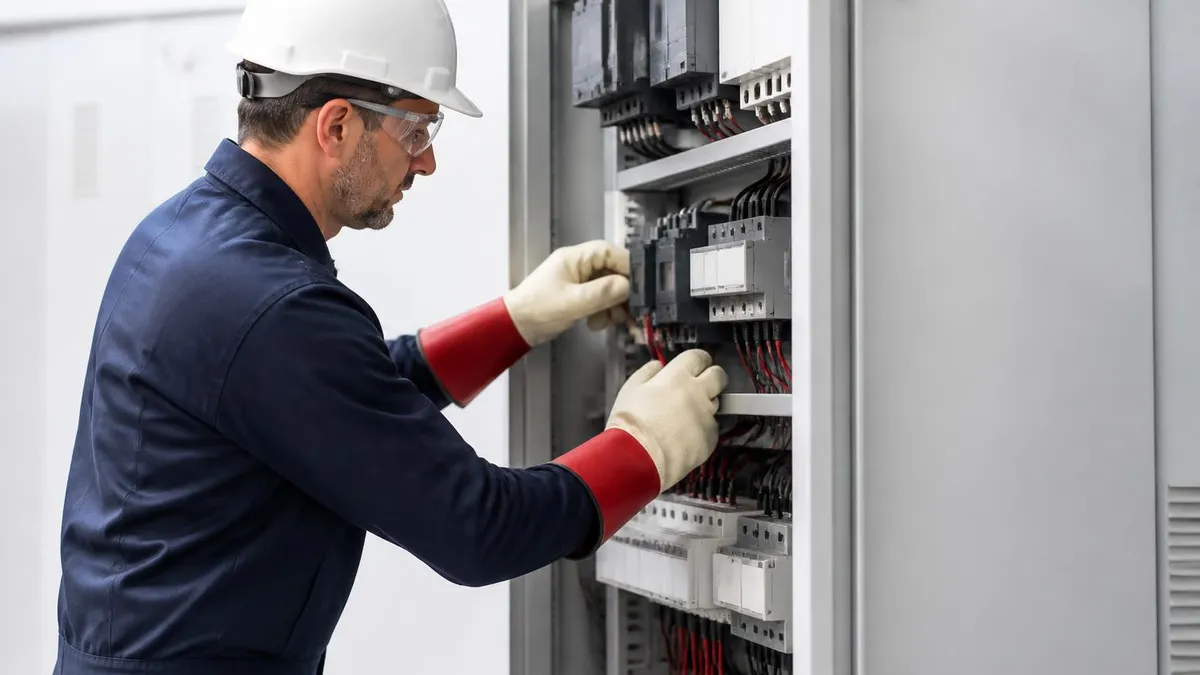
Forklift charging stations handling sulfuric acid require eyewash and drench shower within 10 seconds of the charger per Z358.1 B5 and the lead-acid battery industry consensus. OSHA's interpretation letters since 1995 have specifically called out battery rooms with no combination unit as a serious violation. Combination shower + eyewash is the norm here, not a single eyewash.
Plumbed vs. Gravity-Fed Portable Stations
- +Plumbed stations deliver unlimited flow — easy to hit the 15-minute requirement
- +Plumbed water stays clean as long as a weekly flush clears stagnant pipe sections
- +Lower lifetime cost — no cartridge refills, no preservative changes
- +Easier to add thermostatic mixing valve for tepid water compliance
- −Portable tanks need a refill or cartridge swap every three to six months
- −Sealed gravity-fed units cost $300-600 per refill, adding up over a fleet
- −Portable units rarely hit tepid water in unheated warehouses — extra heaters required
- −Tank capacity (6-15 gal) barely covers the 15-minute flush at 0.4 GPM minimum
Flow Rate, Activation, and the One-Second Rule
Three numbers anchor the hardware spec. An eyewash must deliver at least 0.4 gallons per minute (1.5 liters per minute) for 15 continuous minutes. An eye/face wash steps that up to 3.0 GPM. A drench shower needs 20 GPM. Combination units must hit eyewash and shower flows simultaneously when both are activated. Anything less and the inspector measures with a graduated cylinder right on site — most field inspections include a flow check.
Activation has to be hands-free within one second. That means a stay-open valve operated by a foot treadle, paddle, or push-bar that latches in the open position. Pull-chain showers must release with one pull, no holding. The reasoning is straightforward: a worker with chemical in both eyes cannot fumble with a knob. Once on, the valve stays on until manually shut off — and Z358.1 specifically prohibits a deadman-style handle for primary stations.
Protective covers on the eyewash nozzles are required to keep dust and airborne contaminants off the spray heads. The cover must come off automatically when the unit activates, or be easily removable by hand without tools. Screwed-on caps fail the standard. Most modern units use flip-up dust covers attached to the valve linkage so the cover lifts the instant the paddle moves.
Signage and Visibility
Z358.1 calls for highly visible signage at every station. The standard green-and-white ANSI safety sign with the eye/shower pictogram is the default, mounted directly above or beside the unit. Where the station is around a corner from the hazard area, additional directional signage must point the way.
Lighting at the station must be at least equal to the surrounding area, and the area immediately in front must be free of obstructions for at least 30 inches on every side. Bright yellow floor marking — the same paint used for forklift travel lanes — is recommended to deter pallet storage in front of the station.
Weekly Eyewash Activation Test
- ✓Activate the station and let it run for at least three minutes
- ✓Confirm flow starts within one second of activating the valve
- ✓Check that both nozzle covers lift cleanly and stay clear of the spray
- ✓Measure water temperature mid-stream — must be 60 to 100 deg F
- ✓Inspect the spray pattern — both streams should arc and meet in the eyewash bowl
- ✓Look for sediment, rust, or discoloration in the first 30 seconds of flow
- ✓Verify signage is clean, lit, and unobstructed
- ✓Confirm the 30-inch clear floor zone in front is free of pallets, boxes, or stored gear
- ✓Log the test date, tester initials, water temperature, and any defects
- ✓Tag the unit with a current dated inspection card
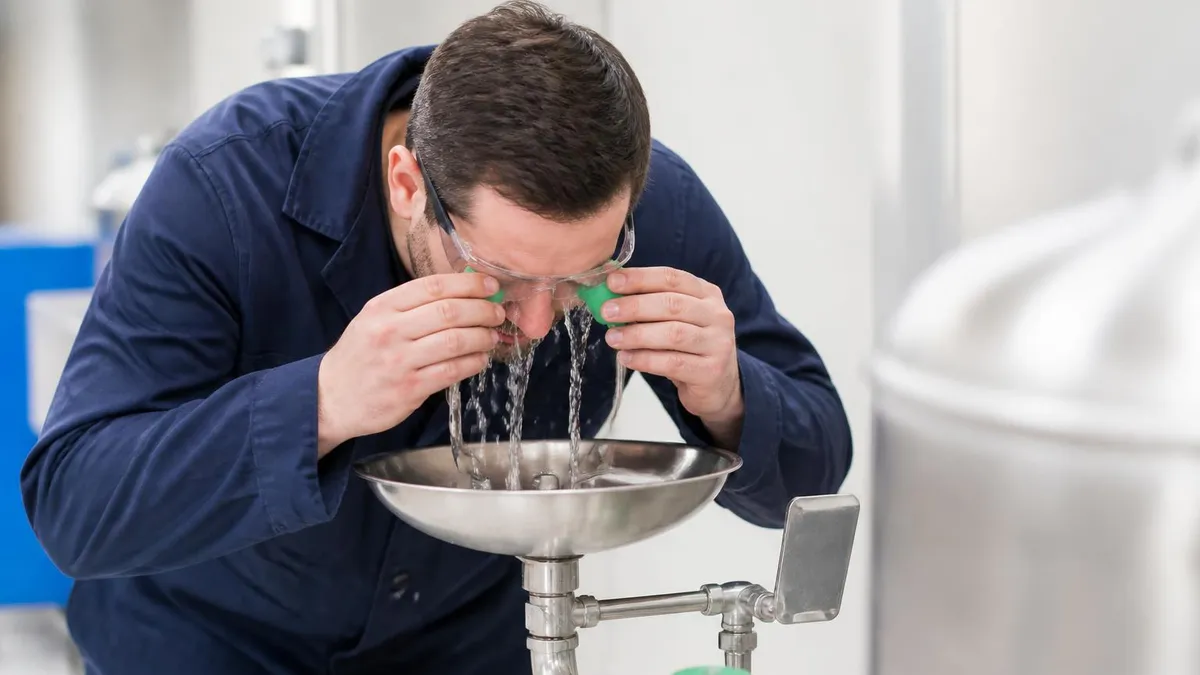
Get to the station within 10 seconds. Hold the eyes open with the fingers and flush for the full 15 minutes — set a timer. Do not stop because the burning eases. Many corrosives, especially alkalis and ammonia, continue to penetrate tissue for hours after contact. Call 911 or your medical response team while flushing, never before. After 15 minutes, transport with eyes still being rinsed by saline irrigation if possible. Save the SDS for the chemical and bring it to the ER.
Weekly and Annual Testing — The Paper Trail That Saves You
Z358.1 requires every plumbed eyewash and shower to be activated weekly. The point is twofold: confirm the unit still works, and flush stagnant water out of the supply line. Pipes feeding rarely-used stations grow Legionella and Pseudomonas biofilms within weeks. A weekly three-minute flush keeps the line clean. Sealed gravity-fed portables do not need the weekly flush but must be inspected for tank pressure, fluid clarity, and seal integrity.
The annual inspection is more involved. A qualified person — not necessarily a third-party contractor, but someone trained on Z358.1 — must verify flow rate with a calibrated bucket and stopwatch, water temperature with a thermometer, pattern dispersion in the bowl, and structural condition of all hardware. The annual check also covers the supply piping for the plumbed unit and the cartridge expiration date for the portable. Most OSHA citations for eyewash failures point not at the hardware but at the missing inspection log. Without the paperwork, the unit might as well not exist.
Citations and Penalties
OSHA's inspection database tracks 1910.151(c) violations under the Walking-Working Surfaces and General Environment category. Recent serious violations average around $15,000 per instance, and a willful citation tied to an actual eye injury can hit $156,259 (the 2026 maximum). The most common citation language: "Suitable facilities for quick drenching or flushing of the eyes were not provided within the work area for immediate emergency use." Right behind it: "The eyewash station was not maintained in a manner that ensured it functioned properly when needed."
Three recurring patterns drive most citations. First, the station exists but is blocked — pallets, boxes, or storage in front of it. Second, the water is freezing cold or scalding hot because no mixing valve was installed. Third, no inspection log exists and the unit has visible scale or discoloration in the bowl. Each of these is independently citable, and inspectors routinely write multiple line items off a single station. For broader workplace compliance context, the osha compliance first aid kit overview pairs well with this guide.
"Three out of four eyewash citations I write involve no inspection log. The station could be perfect, but if you can't show me a year of weekly tests on paper, it doesn't count." — Federal OSHA Compliance Officer, 2024
Eyewash Incident Response Timeline
0-10 seconds: Reach the station
1 second: Activate and flush
1-2 minutes: Notify response
0-15 minutes: Continuous flush
15 minutes: Transport with rinsing
Post-incident: Document and audit
Training Workers to Use the Station Correctly
Owning the right equipment is half the job. The other half is making sure the people working around the chemicals actually know how to use it. Training under 1910.151(c) is implicit — the rule itself says nothing about training — but compliance officers cite the general duty clause when workers in a recorded incident clearly did not know what to do. The standard training checklist is short: location of the nearest eyewash, how to activate it (foot, knee, push-bar), the 15-minute rule, do not stop because the burning eases, and how to get help while continuing to flush.
Live drills beat slide decks. Once a quarter, run a no-warning simulation. Pick a chemical area, tell a worker "you just got splashed," and time how long it takes them to reach the station, activate it, and report. Most facilities discover during the first drill that workers walk casually to the station, fumble with the valve, and stop flushing inside three minutes. Repeating the drill until everybody can hit ten seconds, one-second activation, and a full 15-minute timer turns the procedure into reflex. It also flushes the line — a useful side effect.
Common Mistakes That Trigger Citations
Beyond the inspection-log gap covered above, a handful of practical errors show up in nearly every eyewash citation. The first is storing items in front of the unit. Pallets, mop buckets, garbage cans, and rolling tool carts migrate into the 30-inch clear zone constantly — usually within days of a new shift starting. Painting a bright yellow box on the floor and writing the rule into shift handover notes is the only fix that survives more than a month.
The second is forgetting the dust cover. Maintenance crews remove the protective covers during a renovation, set them aside, then never put them back. The bowls fill with dust and biological growth, the first flush after an incident sprays that directly into the worker's eyes, and now the eyewash itself caused the injury. Tape the covers to the unit during any renovation work — Z358.1 inspectors look for this specifically after a building project.
The third is mixing valve drift. Thermostatic valves age. A unit that was reading 75 degrees five years ago may now be reading 52 degrees on a January morning, because the valve seat has worn and the cold-side bias has shifted. Annual calibration of every mixing valve, with the reading written into the inspection log, prevents the slow drift into noncompliance. Replacement valves cost under $200 and install in 20 minutes.
Putting It All Together
An eyewash station is one of the cheapest pieces of safety equipment a facility owns — a $400 to $1,200 plumbed unit, $50 a year in inspection time, maybe $200 a year in preservative or filter replacements. It also happens to be one of the easiest pieces to get wrong.
The hardware works fine for years sitting in the corner unused, then fails the moment a worker actually needs it. Cold water nobody noticed. A dust cover screwed on after a renovation. A pallet jack parked in the access zone. Every one of those is a citable violation. Worse, every one can turn a survivable chemical splash into permanent blindness.
The pattern that catches almost every employer who fails an OSHA visit is the same: the station was installed correctly the day the building opened, then nobody looked at it again. The fix is not complicated. Weekly activation, written log, annual qualified inspection, tepid water confirmation, signage check, and a tape line on the floor that nobody is allowed to cross with stored material. Train every new hire on where the station is, how to activate it, and that the 15-minute flush is not negotiable. Those five habits clear roughly 90 percent of the citations the agency writes each year.
Workers preparing for safety certifications cover this material on the OSHA 10 hour training curriculum and again in osha 30 training cost. Practice the chemical hazard portion of the Outreach course and the eyewash rules become muscle memory.
Sample OSHA Safety Certificate Practice Questions
Try these questions from our free OSHA Safety Certificate practice tests. The correct answer and an explanation follow each question.
Which OSHA standard specifically addresses the general requirements for machine guarding in general industry?
- A. 29 CFR 1910.147
- B. 29 CFR 1910.212
- C. 29 CFR 1926.502
- D. 29 CFR 1910.134
Answer: B. 29 CFR 1910.212
29 CFR 1910.212 establishes the general requirements for machine guarding to protect workers from hazards created by point of operation, ingoing nip points, and rotating parts.
What is the primary hazard addressed by OSHA's housekeeping requirements for walking-working surfaces?
- A. Fire
- B. Slips, trips, and falls
- C. Electrical shock
- D. Chemical exposure
Answer: B. Slips, trips, and falls
Good housekeeping keeps surfaces clean, dry, and orderly to prevent slips, trips, and falls.
Which OSHA standard specifically covers PPE requirements for general industry?
- A. 29 CFR 1926.100
- B. 29 CFR 1910.132
- C. 29 CFR 1904.7
- D. 29 CFR 1915.152
Answer: B. 29 CFR 1910.132
29 CFR 1910.132 establishes the general requirements for PPE in general industry workplaces, including hazard assessment and equipment selection.
How often must fire extinguishers be visually inspected according to OSHA requirements?
- A. Annually
- B. Monthly
- C. Weekly
- D. Every six months
Answer: B. Monthly
OSHA requires that portable fire extinguishers be visually inspected at least monthly to ensure they are accessible and functional.
OSHA Questions and Answers
About the Author

Certified Safety Professional & OSHA Compliance Expert
Indiana University of Pennsylvania Safety SciencesDr. William Foster holds a PhD in Safety Science from Indiana University of Pennsylvania and is a Certified Safety Professional (CSP) and Certified Hazardous Materials Manager. With 20 years of occupational health and safety management experience across construction, manufacturing, and chemical industries, he coaches safety professionals through OSHA certification, CSP, CHST, and safety management licensing programs.
Join the Discussion
Connect with other students preparing for this exam. Share tips, ask questions, and get advice from people who have been there.
View discussion (8 replies)