
OSHA Duty Clause: What Every US Worker and Employer Needs to Know 2026 September
Learn what the OSHA duty clause requires of US employers. General Duty Clause explained with examples, penalties, and compliance tips. ✅
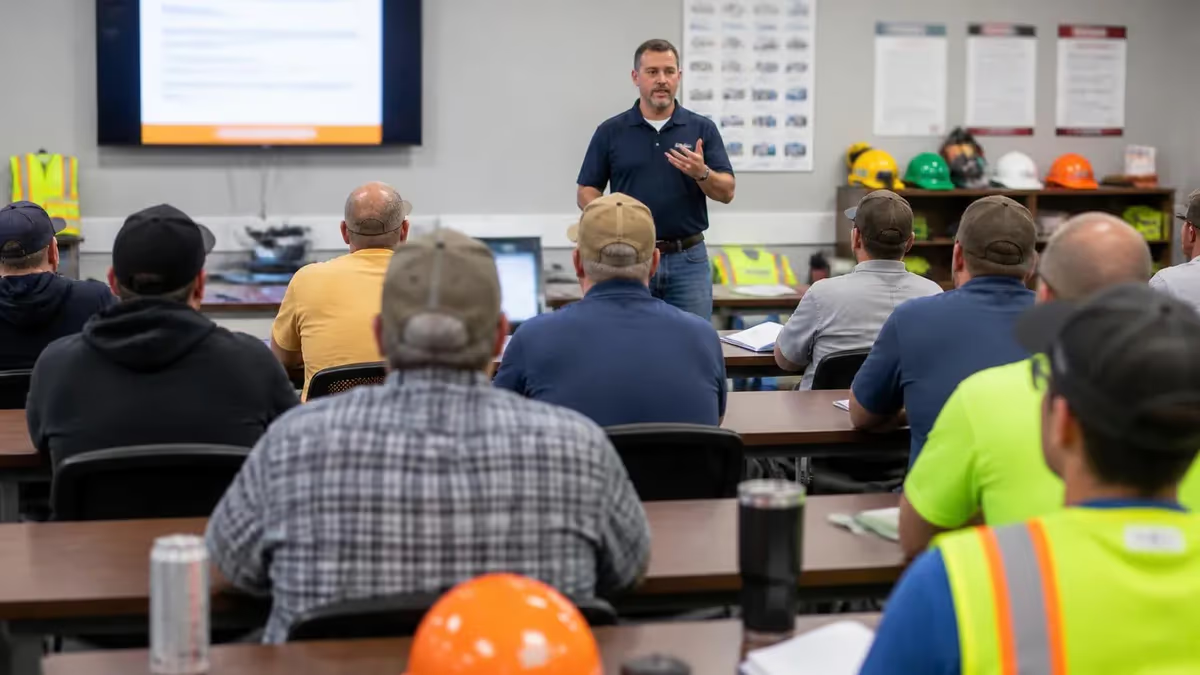
The OSHA duty clause, formally known as Section 5(a)(1) of the Occupational Safety and Health Act of 1970, is one of the most powerful and broadly applied provisions in American workplace safety law. Often called the General Duty Clause, this requirement mandates that every covered employer in the United States provide each of their employees with a workplace that is free from recognized hazards likely to cause death or serious physical harm. Understanding this clause is essential for any professional pursuing an osha duty clause compliance program or safety certification.
The General Duty Clause exists because Congress recognized it was impossible to write specific safety standards for every conceivable workplace hazard. Industries evolve, new technologies emerge, and novel risks arise faster than regulatory agencies can promulgate detailed rules. The clause fills these regulatory gaps, ensuring that employers cannot escape accountability simply because OSHA has not yet published a standard specifically addressing a particular danger on their job site. It is a catch-all provision that keeps the entire regulatory framework meaningful and enforceable across all sectors of the US economy.
From construction sites and manufacturing floors to hospitals, warehouses, and even office buildings, the General Duty Clause applies to virtually every private-sector employer in the country. Federal agencies are covered under a parallel provision, and many state-plan states have adopted equivalent language in their own occupational safety laws. This near-universal coverage means that whether you manage a small bakery in Ohio or a large chemical plant in Texas, you are legally obligated to identify and abate recognized hazards that pose a serious risk of injury or death to your workforce.
Enforcement of the General Duty Clause gives OSHA inspectors significant flexibility.
When a compliance officer visits a worksite and observes a dangerous condition for which no specific OSHA standard exists, they can still issue a citation under Section 5(a)(1). The agency must demonstrate four key elements: the employer failed to keep the workplace free of a hazard, the hazard was recognized by the employer or the industry, the hazard was causing or likely to cause death or serious physical harm, and a feasible and useful method existed to correct the hazard. Meeting all four elements is required for a valid citation.
Penalties for General Duty Clause violations can be substantial. As of recent adjustments, serious violations can result in fines up to $16,550 per violation, while willful or repeated violations can reach $165,514 per violation. These figures are adjusted periodically for inflation under the Federal Civil Penalties Inflation Adjustment Act. Beyond direct financial penalties, a General Duty Clause citation can trigger increased scrutiny of a company's entire safety program, leading to broader inspections and additional citations for other violations discovered in the process.
For workers, the General Duty Clause is a foundational protection. It means your employer cannot simply argue there is no rule against a specific dangerous practice. If a reasonable person in your industry would recognize the hazard as likely to cause serious injury, your employer has a legal obligation to address it. Knowing this clause exists empowers employees to speak up about unsafe conditions, report hazards to OSHA, and understand that the law is on their side even in the absence of a specific written standard covering their exact situation.
Employers who take a proactive approach to the General Duty Clause fare far better in inspections and in building a genuine safety culture. This means regularly conducting hazard assessments, training employees to recognize and report dangers, maintaining open communication between management and workers, and documenting every corrective action taken. A robust hazard identification and abatement program is the clearest evidence that an employer is meeting their General Duty Clause obligations and genuinely prioritizing the wellbeing of their team.
OSHA General Duty Clause by the Numbers

The Four Required Elements for a General Duty Clause Citation
OSHA must show the workplace contained a condition or activity that presented a hazard to employees. The hazard must be real and present at the time of inspection, not merely theoretical or hypothetical in nature.
The hazard must be recognized either by the specific employer or by the employer's industry as a whole. Evidence includes internal safety documents, industry trade publications, prior incidents, or common knowledge among workers in that field.
The hazard must be causing or likely to cause death or serious physical harm—not minor injuries. OSHA does not need to prove injury actually occurred, only that the potential for serious harm was real and foreseeable.
OSHA must identify at least one practical and useful method the employer could have used to materially reduce or eliminate the hazard. The abatement method must be both technically and economically feasible for the employer.
Understanding what constitutes a "recognized hazard" under the OSHA duty clause is critical for both employers and safety professionals. A hazard is considered recognized when the employer has actual knowledge of it, meaning they were aware the condition was dangerous, or when the condition is commonly known within the industry to be hazardous. Industry-wide recognition is often established through trade association publications, manufacturer warnings, professional safety organization guidelines, or historical incident data showing a pattern of injuries from similar conditions.
Actual knowledge can be demonstrated in several ways. If a supervisor observed an unsafe condition and failed to correct it, or if workers reported the hazard to management without receiving a response, OSHA can argue the employer had direct knowledge. Internal safety meeting minutes, incident reports, near-miss logs, and even email chains discussing dangerous conditions can all be used as evidence that an employer recognized a hazard but failed to act. This is why thorough and honest documentation is a double-edged sword that safety managers must handle carefully.
Industry recognition is a broader standard. It does not require that your specific company knew about the hazard — only that a reasonable person familiar with the industry would recognize the danger. For example, heat stress in outdoor agricultural work is an industry-recognized hazard even if a specific farm employer claims ignorance. National Institute for Occupational Safety and Health (NIOSH) publications, consensus standards from organizations like the American National Standards Institute (ANSI), and data from industry associations all serve as evidence of industry-wide hazard recognition.
One important nuance is that the General Duty Clause cannot be used when a specific OSHA standard already covers the hazard. If an applicable standard exists, OSHA must cite that standard rather than the catch-all provision. This rule protects employers from the ambiguity that would result if OSHA could simultaneously apply both a specific standard and the general clause to the same condition. However, where a specific standard exists but does not fully address a related hazard, both citations may sometimes be issued — a situation that has led to significant litigation over the years.
The severity threshold for General Duty Clause citations is also important to understand. The hazard must be one that could cause death or serious physical harm — conditions that might result in minor cuts, bruises, or brief discomfort generally do not meet this bar.
OSHA defines serious physical harm as permanent, prolonged, or temporary but significant impairment of a body part or function, or hospitalization for more than first aid treatment. This means slipping on a wet floor in a warehouse could qualify if the fall could cause a broken bone or traumatic brain injury, but a minor trip hazard over low carpet might not.
Feasible abatement is the final and often most contested element. OSHA compliance officers are required to suggest specific corrective measures when issuing a General Duty Clause citation. These might include engineering controls such as machine guarding or ventilation systems, administrative controls like work rotation schedules to reduce heat exposure, or personal protective equipment requirements. Critically, the suggested abatement must actually be capable of materially reducing the hazard — not just making it slightly less dangerous. Employers can and do successfully contest citations by arguing that the abatement method OSHA proposed was not technically or economically feasible for their specific operation.
Documenting your hazard abatement efforts is just as important as performing the abatement itself. Written records showing that you identified a hazard, assessed the risk, researched control options, implemented the most feasible controls, and then followed up to verify effectiveness form the backbone of a strong General Duty Clause defense. Companies that can present this documentation during an OSHA inspection are in a far stronger position than those that can only describe their actions verbally. A well-maintained safety management system is both a legal protection and a genuine tool for preventing workplace injuries.
Employer and Worker Responsibilities Under the OSHA Duty Clause
Employers covered by the OSH Act must take an active, ongoing role in identifying and eliminating recognized hazards. This means conducting regular workplace inspections, reviewing injury and illness records, consulting industry safety guidelines, and responding promptly whenever workers report dangerous conditions. Passive compliance — simply hoping nothing goes wrong — does not satisfy the General Duty Clause. Courts and OSHA review commissions consistently hold employers to a proactive standard of hazard management.
Beyond hazard identification, employers must implement feasible controls using the hierarchy of controls framework: eliminate the hazard first, then substitute safer alternatives, then apply engineering controls, followed by administrative controls, and finally personal protective equipment. Documenting each step of this process is critical. If OSHA visits and finds a hazard, showing that you assessed the risk and implemented the best available control measures provides a strong affirmative defense — even if the hazard has not been fully eliminated yet.

Benefits and Limitations of the General Duty Clause
- +Fills regulatory gaps where no specific OSHA standard exists for a given hazard
- +Provides broad coverage across virtually all industries and workplace types
- +Empowers workers to report hazards even without a specific rule being violated
- +Encourages employers to proactively address emerging and novel workplace dangers
- +Allows OSHA to respond quickly to new hazard types without waiting for rulemaking
- +Creates a consistent baseline safety obligation applicable to all covered employers
- −Broad language creates uncertainty about exactly what employers must do to comply
- −Cannot be cited when a specific standard already covers the same hazard condition
- −All four citation elements must be proven, making enforcement sometimes difficult
- −Employers may face inconsistent interpretation across different OSHA regional offices
- −Feasibility of abatement is heavily disputed, leading to costly and lengthy litigation
- −Small employers may struggle to identify industry-recognized hazards without resources
General Duty Clause Compliance Checklist for Employers
- ✓Conduct a comprehensive baseline hazard assessment of your entire workplace at least annually.
- ✓Document all identified hazards in writing with photographs, measurements, and risk ratings.
- ✓Research NIOSH, ANSI, and industry association publications to identify recognized hazards in your sector.
- ✓Implement hazard controls using the hierarchy: elimination, substitution, engineering, administrative, PPE.
- ✓Train all employees on recognized hazards specific to their job duties and work areas.
- ✓Establish a written procedure for workers to report unsafe conditions without fear of retaliation.
- ✓Investigate every reported hazard within 24 hours and document findings and corrective actions taken.
- ✓Review your injury and illness logs quarterly to identify hazard patterns requiring corrective action.
- ✓Update your hazard assessment whenever new equipment, processes, chemicals, or tasks are introduced.
- ✓Conduct a post-incident review after every injury or near-miss to determine root causes and prevent recurrence.
The Burden of Proof Is on OSHA — But Documentation Is Your Best Defense
While OSHA bears the legal burden of proving all four General Duty Clause citation elements, employers who maintain thorough written records of hazard identification, risk assessment, and corrective actions are dramatically better positioned to contest or mitigate citations. A well-documented safety management system is the single most effective tool for reducing both citation severity and penalty amounts during an OSHA inspection or appeal.
The financial consequences of General Duty Clause violations extend far beyond the initial OSHA penalty. When a company receives a citation, it is entered into OSHA's publicly accessible inspection database. This record can affect insurance premiums, bonding capacity, contract eligibility for government work, and the company's reputation with customers and potential employees. Major construction contracts, for example, routinely require bidders to disclose their OSHA citation history, and a pattern of serious violations can disqualify a company from consideration entirely.
Penalty amounts under the General Duty Clause are calculated based on the gravity of the violation, the employer's good faith in attempting to comply, the employer's history of prior violations, and the size of the business. Gravity is the most heavily weighted factor and is assessed on a scale of one to ten.
A violation rated at maximum gravity might start at $16,550 per instance, while lower-gravity violations begin at a lower base. Penalty reductions of up to 80% are available for small employers with ten or fewer employees, and good-faith reductions of up to 25% are available for employers with effective safety and health programs.
Willful violations deserve special attention because they carry dramatically higher penalties. A willful violation is one where the employer either knew their actions were in violation of the law or showed plain indifference to employee safety. For General Duty Clause citations characterized as willful, the minimum penalty is $11,524, with a maximum of $165,514 per violation. OSHA may also refer willful violations that result in worker deaths to the Department of Justice for criminal prosecution, which can result in fines and imprisonment for individual managers or executives.
Employers who receive a General Duty Clause citation have several options. They may accept the citation and penalty, negotiate an informal settlement with OSHA, or contest the citation before the Occupational Safety and Health Review Commission (OSHRC). The OSHRC is an independent federal agency that functions as an administrative court, hearing disputes between OSHA and employers. Administrative law judges conduct hearings, and their decisions can be appealed to the full commission and ultimately to federal circuit courts. Many employers choose to negotiate settlements because litigation is expensive and uncertain.
During settlement negotiations, employers can often obtain reductions in both the characterization of the violation (from willful to serious, for example) and the penalty amount in exchange for agreeing to specific corrective actions and timelines. These agreements, known as informal settlement agreements, are binding contracts with OSHA. Failure to complete the agreed corrective actions by the specified deadline can result in additional citations and penalties. Legal counsel experienced in OSHA matters is invaluable in navigating this process and achieving the best possible outcome.
Repeat violations represent another significant risk. If an employer receives a General Duty Clause citation and then receives a substantially similar citation at any facility within five years, the second citation may be characterized as a repeat violation with penalties up to $165,514. OSHA looks at citations company-wide, not just at the specific facility where the repeat violation occurred. This means a large company with multiple locations must ensure that corrective actions from citations at one site are implemented across all comparable sites — otherwise the entire enterprise remains at risk of enhanced penalties.
For companies operating in high-hazard industries — construction, oil and gas extraction, roofing, tree trimming, agricultural harvesting — General Duty Clause citations are relatively common because these environments inherently involve significant hazards that may not all be addressed by specific OSHA standards. Employers in these sectors benefit greatly from engaging with their industry trade associations, subscribing to OSHA's standard interpretation letters, and participating in OSHA's Voluntary Protection Programs (VPP), which recognize worksites that have implemented exemplary safety management systems and typically experience far fewer citations.

When a General Duty Clause violation is characterized as willful and results in a worker's death, OSHA may refer the case to the Department of Justice for criminal prosecution. Individual managers and company officers can face personal fines and up to six months in federal prison. This is not a hypothetical risk — criminal prosecutions arising from OSH Act violations have occurred and resulted in actual convictions and imprisonment.
Real-world General Duty Clause citations reveal the breadth of situations this provision covers. One of the most prominent modern examples involves heat-related illness in outdoor work environments. OSHA has cited numerous agricultural employers, construction contractors, and landscaping companies under the General Duty Clause for failing to protect workers from heat stress — even though the agency does not yet have a finalized specific heat standard. These citations have established that adequate water, shade, and rest breaks in extreme heat are recognized industry requirements, regardless of a specific written rule mandating them.
Another well-documented area involves workplace violence in healthcare settings. Hospital employers have been cited under the General Duty Clause for failing to protect nurses and other healthcare workers from violent patients. OSHA has cited facilities that lacked adequate security staffing, de-escalation training, alarm systems, and physical barriers to prevent attacks. These citations have helped drive the development of workplace violence prevention programs across the healthcare industry, demonstrating how the General Duty Clause can accelerate safety improvements even before formal standards are adopted.
Ergonomic hazards have a complicated history with the General Duty Clause. OSHA promulgated an ergonomics standard in 2000, but Congress overturned it in 2001 under the Congressional Review Act. Since then, OSHA has used the General Duty Clause to address ergonomic hazards — particularly musculoskeletal disorders caused by repetitive motion, awkward postures, and heavy lifting — in industries including poultry processing, automotive manufacturing, and grocery distribution. These citations have been contentious, with employers arguing that ergonomics standards were improperly imposed through the clause after Congress rejected a specific standard.
COVID-19 provided perhaps the most high-profile modern application of the General Duty Clause. When the pandemic began in 2020, no OSHA standard addressed infectious disease transmission in workplaces beyond healthcare settings. OSHA issued General Duty Clause citations against employers in meatpacking plants, warehouses, retail establishments, and other high-exposure environments for failing to implement engineering controls, administrative policies, and PPE requirements to reduce the transmission of the virus. These actions underscored how the clause allows OSHA to respond to genuine emergencies without waiting years for formal rulemaking.
The General Duty Clause has also been applied in cases involving chemical exposures that are not covered by specific permissible exposure limits (PELs). OSHA's PEL table, which sets maximum allowable air concentrations for hazardous substances, has not been comprehensively updated since 1971 and covers only about 500 chemicals.
Meanwhile, thousands of other potentially hazardous substances are used in US workplaces. When NIOSH or other authoritative bodies have identified substances as causing serious harm at concentrations below OSHA's dated PELs, or for chemicals with no PEL at all, OSHA has used the General Duty Clause to compel employers to control exposures to those levels that current science indicates are safe.
Falls remain the leading cause of death in construction, and the General Duty Clause has been cited in fall hazard cases where specific standards existed but did not fully address the specific configuration of the hazard.
For instance, a unique roofing configuration or a specialized piece of equipment creating a fall exposure not explicitly covered by the fall protection standard might still be cited under the General Duty Clause if industry practice and common sense recognize the danger. These overlapping applications underscore why safety professionals must be fluent in both specific standards and the general clause to provide comprehensive compliance guidance.
Employers can learn from these examples by proactively monitoring OSHA enforcement trends, reading inspection citation summaries published by OSHA, and subscribing to industry safety newsletters that track emerging enforcement priorities. When OSHA begins citing competitors or similar employers in your industry for a particular hazard, that is a strong signal that the hazard has achieved industry-recognized status and that your own operation should be reviewed for the same exposure. Staying ahead of enforcement trends is far less costly than responding to a citation after the fact and is the hallmark of a mature, effective safety management program.
Preparing for OSHA certification exams requires a solid understanding of not just the General Duty Clause text but also its practical application across industries and the legal standards that govern enforcement. Exam questions on this topic frequently test whether candidates can identify the four required elements of a valid citation, distinguish between situations where a specific standard applies versus when the General Duty Clause must be used, and understand the rights and responsibilities of both employers and workers under the OSH Act's foundational provisions.
A particularly effective study strategy is to review actual OSHA citation cases and inspection summaries, which are publicly available through OSHA's website. Reading real citations teaches you to think like a compliance officer — identifying hazards, assessing whether they meet the threshold for serious harm, and evaluating what feasible abatement options exist. Many OSHA training courses incorporate case studies for precisely this reason: abstract legal principles become concrete and memorable when you see them applied to real workplace scenarios involving real workers in real industries.
Practice tests remain one of the most reliable predictors of exam performance. Research consistently shows that active recall — retrieving information from memory through practice questions — produces better long-term retention than passive review of notes or textbooks. For OSHA certification candidates, working through questions on the General Duty Clause helps identify gaps in understanding, builds familiarity with the specific vocabulary OSHA uses, and reduces test anxiety by creating confidence through repeated successful recall. Targeting your practice to areas of weakness is more efficient than reviewing material you already know well.
Time management during OSHA certification exams is also critical. Many certification programs include both knowledge-based questions testing regulatory familiarity and scenario-based questions requiring you to apply concepts to novel situations. The General Duty Clause is ideally suited for scenario questions because it requires judgment rather than simple memorization. Practicing with timed question sets helps you develop the ability to quickly identify the relevant legal standard, apply it to the described situation, and select the best answer without second-guessing yourself under exam pressure.
Study groups and peer discussion can accelerate mastery of complex topics like the General Duty Clause. Explaining the four citation elements to a colleague, debating whether a described hazard meets the serious-harm threshold, or working through hypothetical employer scenarios with others forces you to organize and articulate your knowledge in ways that solo study does not. If formal study groups are not available, online forums, OSHA-focused LinkedIn groups, and professional associations like the American Society of Safety Professionals (ASSP) offer communities of practice where candidates share resources and discuss challenging concepts.
Candidates should also familiarize themselves with the Occupational Safety and Health Review Commission's decisions, which are published online and provide detailed analysis of how the four General Duty Clause elements are evaluated in contested cases. These decisions reveal how hearing judges and commissioners weigh evidence, assess employer credibility, and determine whether OSHA met its burden of proof. Understanding this adjudicative process not only enriches your knowledge for exam purposes but also provides practical insight for real-world safety management where the risk of citation and subsequent litigation is always present.
Finally, do not underestimate the importance of understanding OSHA's inspection process, citation issuance procedures, and the options available to employers after a citation is received. The OSHA 10 and 30-hour training programs cover these procedural topics in detail, and certification exams frequently include questions about timelines for contesting citations, the role of the Occupational Safety and Health Review Commission, and the employer's right to accompany the compliance officer during an inspection. A comprehensive understanding of both the substantive law and the procedural framework surrounding the General Duty Clause will serve you well on any OSHA certification exam.
OSHA Questions and Answers

OSHA Approved Safety Glasses: Complete 2026 Guide to ANSI Z87.1 Eye Protection Standards, Selection, and Workplace Compliance

OSHA Lightning Safety: Standards, Rules & Outdoor Worker Protection Guide for 2026

OSHA 10 Hour General Industry: Complete 2026 Guide to Training, Topics, Costs, and DOL Card

Is OSHA a Government Agency? The Federal Body Behind US Workplace Safety

How to Get OSHA Certified: Complete 2026 Guide to Training, Cards & Compliance
About the Author

Certified Safety Professional & OSHA Compliance Expert
Indiana University of Pennsylvania Safety SciencesDr. William Foster holds a PhD in Safety Science from Indiana University of Pennsylvania and is a Certified Safety Professional (CSP) and Certified Hazardous Materials Manager. With 20 years of occupational health and safety management experience across construction, manufacturing, and chemical industries, he coaches safety professionals through OSHA certification, CSP, CHST, and safety management licensing programs.
Join the Discussion
Connect with other students preparing for this exam. Share tips, ask questions, and get advice from people who have been there.
View discussion (8 replies)