
OSHA Confined Space Standard: Complete 2026 Guide to 29 CFR 1910.146, Permit Requirements, and Entry Procedures
🗨️ OSHA confined space standard explained: 29 CFR 1910.146 permit rules, entry procedures, atmospheric testing, rescue plans, and 2026 compliance tips.

The osha confined space training space standard, codified at 29 CFR 1910.146 for general industry and 29 CFR 1926 Subpart AA for construction, is one of the most consequential osha standards general enforced by the Occupational Safety and Health Administration. It governs how employers identify, evaluate, and control hazards inside spaces large enough to enter but not designed for continuous occupancy. Whether you operate a wastewater plant, refinery, food processing facility, or construction site, understanding this standard is essential because confined space incidents kill roughly 90 to 100 American workers every year. Practice with the free OSHA Safety Certificate practice test on PracticeTestGeeks (7 questions with answer explanations).
This 2026 guide unpacks the OSHA confined space standard in plain English, walking you through permit-required versus non-permit spaces, atmospheric testing thresholds, entry supervisor duties, attendant responsibilities, and the rescue planning requirements that frequently trip up otherwise compliant employers. We will also examine how the construction standard issued in 2015 differs from the older general industry rule, and why subcontractors on multi-employer worksites carry coordination obligations that did not exist twenty years ago.
If you have ever wondered why a manhole, a grain bin, a boiler, or a crawl space falls under the same regulatory umbrella as a chemical storage tank, the answer lies in three defining criteria OSHA established back in 1993. A space qualifies as confined when it is large enough for a worker to bodily enter and perform assigned work, has limited or restricted means of entry or egress, and is not designed for continuous human occupancy. All three conditions must be present simultaneously for the standard to apply.
From there, the analysis branches. If the space contains or has the potential to contain a hazardous atmosphere, engulfment material, internal configuration that could trap or asphyxiate, or any other recognized serious safety hazard, it becomes a permit-required confined space, often abbreviated as PRCS. Permit spaces trigger the full weight of OSHA documentation, training, atmospheric monitoring, and rescue planning. Non-permit spaces still require evaluation but carry lighter administrative burdens.
For workers preparing for certification exams or refresher training, mastering the OSHA confined space standard is non-negotiable. Questions about permit cancellation, oxygen-deficient atmospheres, lower explosive limits, and authorized entrant rights appear on virtually every OSHA 10, OSHA 30, and specialized confined space entry assessment. Reviewing osha 510 training can also help safety managers connect the standard to broader construction-industry compliance frameworks.
This article walks you through every operational element of the regulation, including the written permit space program, contractor coordination, entry supervisor signoff, blanking and blinding, lockout-tagout integration, atmospheric monitoring frequency, and what to do when a non-entry rescue becomes the only safe option. We will also cover the most-cited violations year over year so you know exactly where federal inspectors focus their attention during a compliance audit.
By the end of this guide, you will be able to identify any space at your facility, classify it correctly, build a written program that holds up to scrutiny, and train your workers to recognize the warning signs that precede the majority of confined space fatalities: oxygen deficiency, hydrogen sulfide accumulation, methane buildup, carbon monoxide intrusion, and the deceptively simple problem of nobody knowing how to get an injured coworker out.
- OSHA does not require a test or set a passing score to earn an OSHA 10-hour or 30-hour Outreach course completion card, but trainers may give a test to check learning. (U.S. Department of Labor, Occupational Safety and Health Administration (OSHA), Outreach Training Program)
- OSHA does not set one price for its 10-hour and 30-hour Outreach classes; the class fee is set by each independent OSHA-authorized trainer or online provider. (U.S. Department of Labor, Occupational Safety and Health Administration (OSHA), Outreach Training Program)
- An OSHA 10-hour or 30-hour card can be replaced only once per class and only within five years of the class; after that, the student has to retake the class to get a card. (U.S. Department of Labor, Occupational Safety and Health Administration (OSHA), Outreach Training Program)
- OSHA Outreach student course completion cards for Construction, General Industry, Maritime and Disaster Site do not have an expiration date, and Maritime cards stopped expiring as of April 1, 2019. (U.S. Department of Labor, Occupational Safety and Health Administration (OSHA), Outreach Training Program)
- Students do not renew OSHA Outreach cards, but OSHA-authorized Outreach trainers must complete an update course every four years to stay authorized. (U.S. Department of Labor, Occupational Safety and Health Administration (OSHA), Outreach Training Program)
- OSHA 10-hour and 30-hour Outreach classes are taught in person by OSHA-authorized trainers or online by OSHA-accepted independent providers; OSHA does not run online classes itself. (U.S. Department of Labor, Occupational Safety and Health Administration (OSHA), Outreach Training Program)
- The OSHA Outreach Training Program has no minimum age, but to get an OSHA card a student must complete the entire class, including all required topics and the minimum number of contact hours. (U.S. Department of Labor, Occupational Safety and Health Administration (OSHA), Outreach Training Program)
- After finishing an OSHA 10-hour or 30-hour Outreach class, students get their course completion card from the trainer or online provider, who has 90 days to issue it. (U.S. Department of Labor, Occupational Safety and Health Administration (OSHA), Outreach Training Program)
Facts verified Oct 16, 2026 against U.S. Department of Labor, Occupational Safety and Health Administration (OSHA), Outreach Training Program. Dates that have passed are removed automatically.
OSHA Exam at a Glance
Facts verified Oct 16, 2026 against U.S. Department of Labor, Occupational Safety and Health Administration (OSHA), Outreach Training Program. Dates that have passed are removed automatically.
Free OSHA Safety Certificate Study Tools
Interactive OSHA Safety Certificate resources on PracticeTestGeeks, free to start:
- OSHA Safety Certificate flashcards — review key terms and concepts card by card
- OSHA Safety Certificate study guide — topic-by-topic overview of what the exam covers
- OSHA Safety Certificate cheat sheet — one-page printable summary for last-minute review
OSHA Confined Space Standard by the Numbers
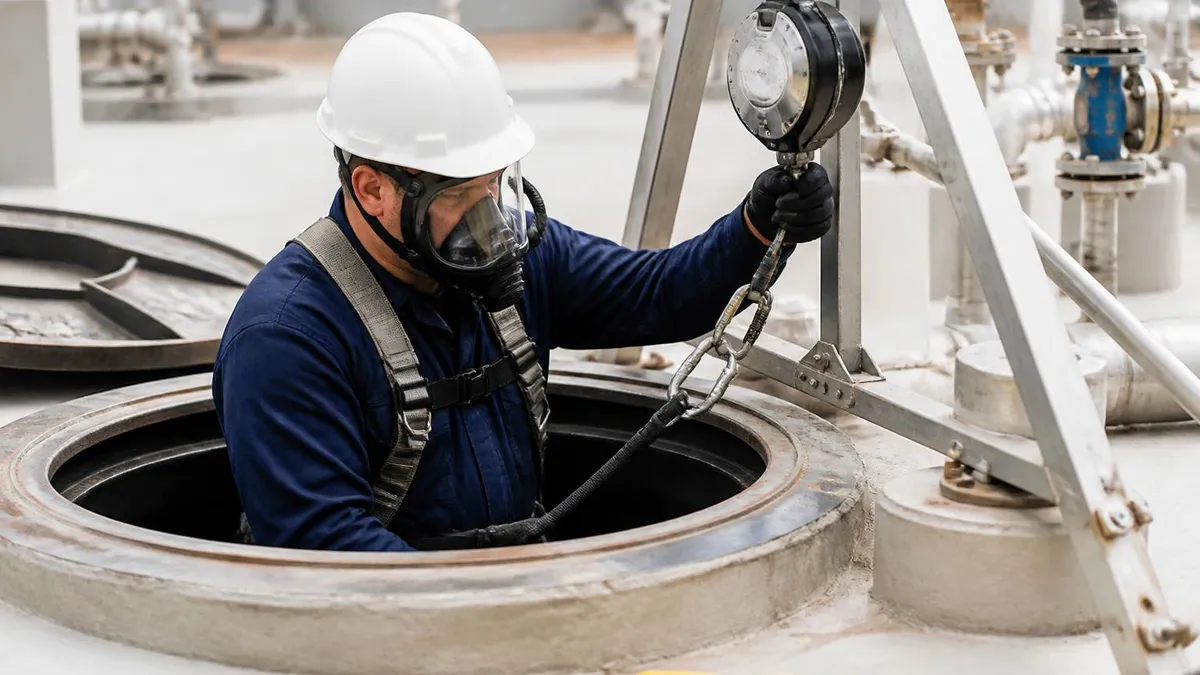
How OSHA Classifies Confined Spaces
A space large enough for a worker to enter, with limited entry or egress, and not designed for continuous occupancy. No serious hazards present, but evaluation is still required to confirm classification.
Contains or has potential to contain a hazardous atmosphere, engulfment material, entrapment configuration, or other serious recognized hazard. Triggers full written program, permits, and rescue planning.
A permit space that has been temporarily downgraded after all hazards are eliminated and documented. Reclassification certificate must be available to entrants and posted at the entry point.
Permit space where the only hazard is atmospheric and continuous forced ventilation alone keeps it safe. Allows entry without full permit if monitoring confirms control of atmospheric conditions.
Meets the three confined space criteria but contains no actual or potential serious hazards. Still requires identification, signage if needed, and worker awareness training under the standard.
The general industry version of the OSHA confined space standard, found at 29 CFR 1910.146, imposes a layered set of obligations that begin long before any worker actually enters a space. The employer must first conduct a workplace evaluation to identify all confined spaces, then assess whether each one is permit-required. This evaluation must be documented, dated, and available for inspection. Many citations stem not from poor entry procedures but from the simple failure to perform or update this initial site survey.
Once permit spaces are identified, the employer must inform exposed employees by posting danger signs or by another equally effective means. Workers who are not authorized to enter must understand that the space is off-limits. If the employer decides that no employee will ever enter a particular permit space, the obligation reduces to preventing entry. But the moment entry becomes part of an employee's job, the full written permit-required confined space program must be developed and implemented.
The written program is the spine of compliance. It must specify the means, procedures, and practices for safe entry, including identifying acceptable entry conditions, isolating the space, purging or ventilating to eliminate hazards, providing protective and rescue equipment, designating roles, conducting atmospheric testing, and verifying conditions before and during entry. Programs that lack any one of these elements are routinely cited under 1910.146(c) or (d).
OSHA also requires the employer to coordinate entry operations when employees of more than one employer will work in or near the permit space. This contractor coordination provision is critical on construction sites and refinery turnarounds, where multiple trades may rotate through the same vessel. The host employer must inform contractors of identified hazards, provide its evaluation, and debrief afterward on any incidents or near-misses. Reviewing OSHA.gov's official resources can help employers locate the latest interpretive letters on multi-employer coordination.
Atmospheric testing follows a strict sequence. Workers must test for oxygen first, then combustible gases and vapors, and finally toxic gases and vapors. The reason is practical: oxygen sensors can produce false readings in atmospheres with elevated combustible content, and many toxic sensors are calibrated assuming normal oxygen levels. Testing instruments must be calibrated according to manufacturer specifications, and a calibration log should be maintained as part of the written program.
Acceptable entry conditions under the general industry standard include oxygen between 19.5 percent and 23.5 percent, flammable gas concentration below 10 percent of the lower explosive limit, and toxic substance concentrations below their respective permissible exposure limits. If any one of these thresholds is exceeded at any point during entry, the permit must be canceled and entrants evacuated until conditions can be restored.
The construction standard, 29 CFR 1926 Subpart AA, adds requirements specific to that industry, including more explicit early-warning systems for engulfment hazards and stricter rules around continuous atmospheric monitoring when feasible. It also tightened contractor communication requirements, recognizing that construction worksites typically host more transient labor than a permanent industrial facility.
OSHA Practice Test Questions
Prepare for the OSHA - Safety Certificate exam with our free practice test modules. Each quiz covers key topics to help you pass on your first try.
OSHA Basic OSHA Practice
OSHA Exam Questions covering Basic OSHA Practice. Master OSHA Test concepts for certification prep.
OSHA Confined Space Entry
Free OSHA Practice Test featuring Confined Space Entry. Improve your OSHA Exam score with mock test prep.
OSHA Fall Protection
OSHA Mock Exam on Fall Protection. OSHA Study Guide questions to pass on your first try.
OSHA - Safety Certificate Electrical Safet...
Free OSHA Quiz on OSHA - Safety Certificate Electrical Safety Standards Questions and Answers. OSHA Exam prep questions with detailed explanations.
OSHA - Safety Certificate Emergency Action...
OSHA Practice Questions for OSHA - Safety Certificate Emergency Action and Fire Plans Questions and Answers. Build confidence for your OSHA certification exam.
OSHA - Safety Certificate Hazard Communica...
OSHA Test Online for OSHA - Safety Certificate Hazard Communication Standard Questions and Answers. Free practice with instant results and feedback.
OSHA - Safety Certificate Introduction to ...
OSHA Study Material on OSHA - Safety Certificate Introduction to OSHA Questions and Answers. Prepare effectively with real exam-style questions.
OSHA - Safety Certificate Lockout/Tagout P...
Free OSHA Test covering OSHA - Safety Certificate Lockout/Tagout Procedures Questions and Answers. Practice and track your OSHA exam readiness.
OSHA - Safety Certificate Machine Guarding...
OSHA Exam Questions covering OSHA - Safety Certificate Machine Guarding Requirements Questions and Answers. Master OSHA Test concepts for certification prep.
OSHA - Safety Certificate OSHA Recordkeepi...
Free OSHA Practice Test featuring OSHA - Safety Certificate OSHA Recordkeeping and Reporting Questions and Answers. Improve your OSHA Exam score with mock test prep.
OSHA - Safety Certificate Personal Protect...
OSHA Mock Exam on OSHA - Safety Certificate Personal Protective Equipment (PPE) Questions and Answers. OSHA Study Guide questions to pass on your first try.
OSHA - Safety Certificate Walking and Work...
OSHA Test Prep for OSHA - Safety Certificate Walking and Working Surfaces Questions and Answers. Practice OSHA Quiz questions and boost your score.
OSHA - Safety Certificate Electrical Safet...
OSHA Mock Test covering - Safety Certificate Electrical Safety Standards. Online OSHA Test practice with instant feedback.
OSHA - Safety Certificate Emergency Action...
Free OSHA Quiz on - Safety Certificate Emergency Action and Fire Plans. OSHA Exam prep questions with detailed explanations.
OSHA - Safety Certificate Hazard Communica...
OSHA Practice Questions for - Safety Certificate Hazard Communication Standard. Build confidence for your OSHA certification exam.
OSHA - Safety Certificate Introduction to ...
OSHA Test Online for - Safety Certificate Introduction to OSHA. Free practice with instant results and feedback.
OSHA - Safety Certificate Lockout/Tagout P...
OSHA Study Material on - Safety Certificate Lockout/Tagout Procedures. Prepare effectively with real exam-style questions.
OSHA - Safety Certificate Machine Guarding...
Free OSHA Test covering - Safety Certificate Machine Guarding Requirements. Practice and track your OSHA exam readiness.
OSHA - Safety Certificate OSHA Recordkeepi...
OSHA Exam Questions covering - Safety Certificate OSHA Recordkeeping and Reporting. Master OSHA Test concepts for certification prep.
Atmospheric Testing Under the OSHA Confined Space Standard
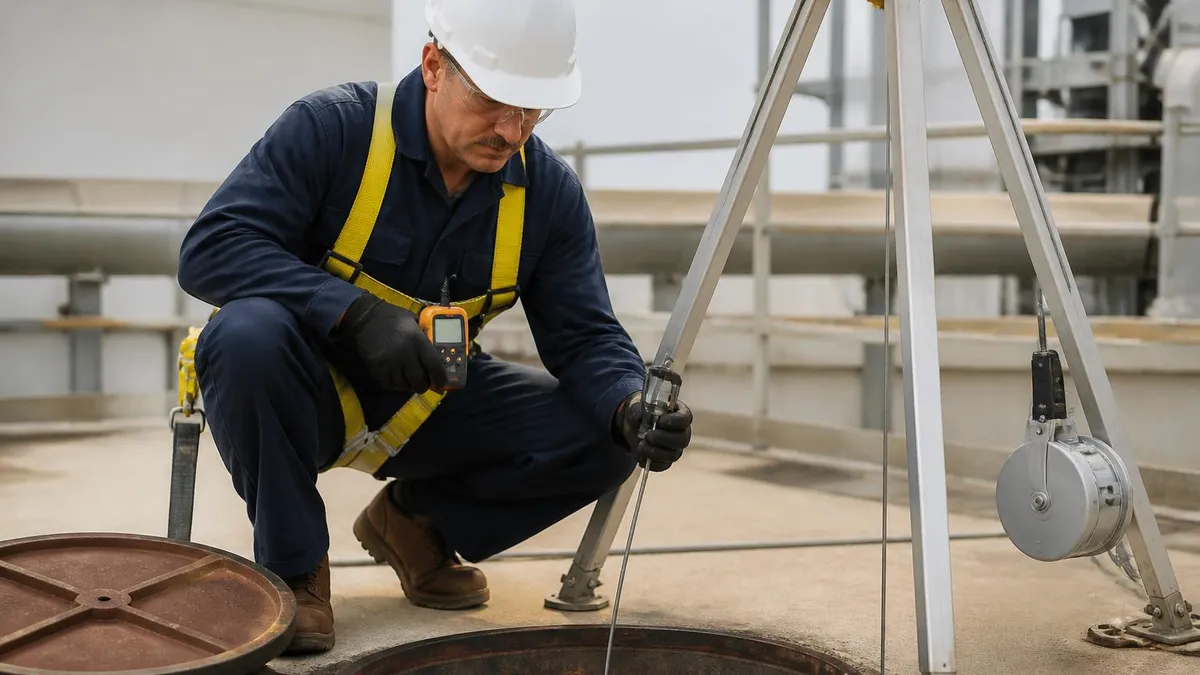
Oxygen testing is always the first reading taken inside a confined space because every other sensor in a four-gas monitor depends on a normal oxygen baseline to function correctly. Normal atmospheric oxygen sits at 20.9 percent. The OSHA confined space standard defines an oxygen-deficient atmosphere as below 19.5 percent and an oxygen-enriched atmosphere as above 23.5 percent. Both conditions are immediately dangerous and trigger evacuation.
Oxygen displacement is one of the most common killers in confined spaces. Inert gases like nitrogen, argon, and carbon dioxide can push oxygen out without giving workers any warning. A single breath in a fully nitrogen-purged tank can render an entrant unconscious in seconds. That is why pre-entry testing must extend through the full vertical depth of the space, not just at the opening.
Strengths and Weaknesses of the Current OSHA Confined Space Standard
- +Clear three-part definition makes space identification objective and consistent
- +Permit system creates a documented paper trail for every entry
- +Mandatory atmospheric testing sequence prevents sensor errors
- +Rescue planning requirements have reduced would-be rescuer fatalities
- +Construction-specific rule closed major gaps in residential and trench work
- +Contractor coordination provisions protect workers on multi-employer sites
- +Reclassification option gives flexibility without sacrificing safety
- −Many small employers struggle to develop a compliant written program
- −Training requirements lack specified minimum hours, leading to inconsistency
- −Older general industry rule has not been updated to match construction standard
- −Rescue service evaluation is often perfunctory rather than verified
- −Permit paperwork can become a check-the-box exercise rather than active control
- −Atmospheric monitoring equipment costs deter small contractors from compliance
- −Reciprocal communication between hosts and contractors is frequently incomplete
Pros and Cons at a Glance
| Pros | Cons |
|---|---|
| Clear three-part definition makes space identification objective and consistent | Many small employers struggle to develop a compliant written program |
| Permit system creates a documented paper trail for every entry | Training requirements lack specified minimum hours, leading to inconsistency |
| Mandatory atmospheric testing sequence prevents sensor errors | Older general industry rule has not been updated to match construction standard |
| Rescue planning requirements have reduced would-be rescuer fatalities | Rescue service evaluation is often perfunctory rather than verified |
| Construction-specific rule closed major gaps in residential and trench work | Permit paperwork can become a check-the-box exercise rather than active control |
| Contractor coordination provisions protect workers on multi-employer sites | Atmospheric monitoring equipment costs deter small contractors from compliance |
Pre-Entry Compliance Checklist for the OSHA Confined Space Standard
- ✓Confirm the space has been evaluated and classified in writing under 1910.146(c)(1)
- ✓Verify the entry permit is filled out completely and signed by the entry supervisor
- ✓Calibrate and bump-test all atmospheric monitoring instruments before use
- ✓Test oxygen first, then combustibles, then toxic gases at multiple depths
- ✓Isolate the space using lockout-tagout, blanking, blinding, or double block-and-bleed
- ✓Purge or ventilate the space until acceptable entry conditions are sustained
- ✓Verify rescue service availability and confirm response time meets program requirements
- ✓Brief authorized entrants, attendants, and the entry supervisor on identified hazards
- ✓Confirm communication method between attendant and entrants is functional
- ✓Stage rescue equipment, including retrieval systems, harnesses, and SCBA, at the entry point
- ✓Post the permit at the entry point and prohibit entry by unauthorized personnel
- ✓Continue atmospheric monitoring throughout the entire entry operation
Six in Ten Confined Space Deaths Are Rescuers
OSHA and NIOSH data consistently show that approximately 60 percent of confined space fatalities are would-be rescuers who entered without proper training or equipment. This single statistic is why the OSHA confined space standard mandates documented rescue planning, retrieval systems wherever feasible, and rigorous evaluation of any off-site rescue service before relying on it.
Rescue and emergency response is where the OSHA confined space standard most often diverges from real-world practice, and it is also where most fatalities cluster. The regulation requires the employer to designate a rescue method and to ensure that rescue personnel are equipped, trained, and capable of timely response. The phrase timely response is interpreted in context: a permit space with an immediately dangerous to life and health atmosphere may require rescue capability within minutes, while a non-IDLH space may tolerate a longer response window.
Three rescue options exist under the standard: non-entry rescue using retrieval lines and tripods, on-site entry rescue by trained employees, and off-site rescue by a contracted service such as a local fire department or specialty firm. Non-entry rescue is strongly preferred because it removes the need for additional people to enter a hazardous environment. Most vertical permit spaces less than five feet deep with a single entrant should use retrieval systems unless they would increase risk or be infeasible due to internal configuration.
When an employer chooses off-site rescue, the standard requires an evaluation of the service's ability to respond in time and to handle the specific hazards present. Simply calling 911 and hoping for the best does not satisfy the standard. The employer must coordinate in advance, ideally walking the rescue service through the spaces, sharing the written program, and conducting joint drills at least annually. Practice drills inside representative spaces are explicitly required.
Authorized entrants have rights as well as responsibilities. They must be trained to recognize hazards, use equipment correctly, communicate with the attendant, and exit immediately when ordered to do so or when they recognize warning signs of exposure. The attendant has a parallel set of duties, including continuous monitoring of conditions, summoning rescue when needed, and prohibiting unauthorized entry. Attendants may never enter the space to perform rescue unless they are relieved by another attendant and trained for entry rescue.
The entry supervisor signs the permit, verifies acceptable conditions before authorizing entry, terminates entry when work is complete or conditions change, and removes unauthorized personnel. The supervisor role can be filled by anyone with appropriate training, including foremen, safety coordinators, or shift leaders. What matters is that the responsibilities are documented and the individual is competent. Employers preparing supervisors often pair osha confined space training with broader certification pathways like OSHA 10 certification to ensure foundational knowledge is in place.
Documentation closes the loop. The permit must be retained for at least one year so that the program can be reviewed and revised based on actual entries, near-misses, and lessons learned. Annual review of canceled permits is explicitly required under 1910.146(d)(14). Employers who skip this annual review miss the chance to update their procedures and often find that program weaknesses surface only after a serious incident.
Finally, all training must be provided before initial assignment, before there is a change in duties, when there is a change in operations that presents a new hazard, and whenever the employer has reason to believe an employee's knowledge is inadequate. Training must establish proficiency, not just present material. Certificates documenting the trainee's name, signatures of trainers, and dates of training must be available for inspection.
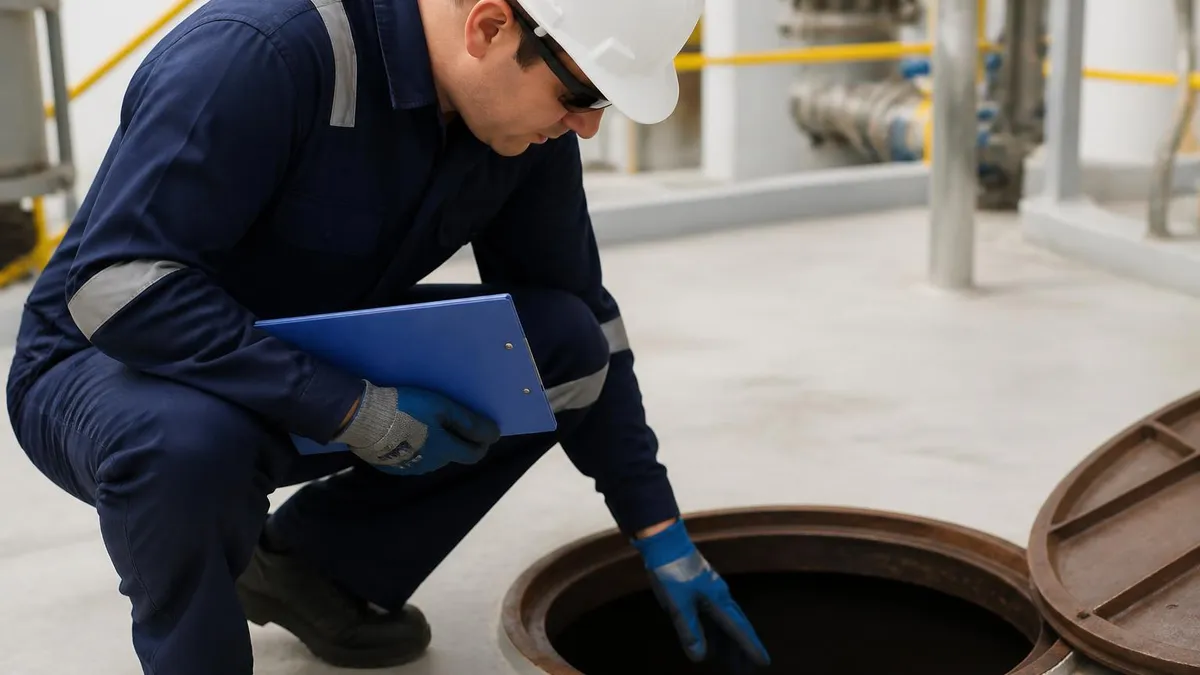
The most frequently cited paragraphs of 29 CFR 1910.146 are the lack of a written permit program, failure to provide adequate training to authorized entrants, and inadequate atmospheric testing before and during entry. Penalties for willful violations can exceed $160,000 per instance, and repeat violations carry similar exposure. Audit your program now rather than waiting for an inspector to find the gaps.
Enforcement of the OSHA confined space standard has intensified since 2020, with federal and state-plan OSHA offices coordinating Regional Emphasis Programs that specifically target confined space hazards in industries like grain handling, manhole work, shipbuilding, and oil and gas. Inspectors arrive armed with sample permits, looking for documentation gaps, training records, calibration logs, and evidence of rescue service coordination. The first paperwork they request is almost always the written permit program itself.
Common citation themes include programs that exist on paper but show no evidence of implementation, permits signed retroactively after an entry, attendants pulled away to do other tasks, atmospheric testing performed only at the opening rather than throughout the space, and rescue services that have never been evaluated. Each of these failures, taken alone, can support a serious citation; in combination, they often produce willful or repeat designations.
Multi-employer worksites carry additional enforcement risk. Under OSHA's multi-employer citation policy, a controlling employer can be cited for hazards created by a subcontractor if the controlling employer had the authority to correct them and failed to act. On refinery turnarounds and construction projects, this means the general contractor or facility owner bears responsibility for ensuring every subcontractor's confined space program meets the standard before work begins. Reviewing osha approved hard hats alongside confined space planning helps build a comprehensive site safety package.
State-plan states such as California, Michigan, Washington, and Oregon have adopted standards that are at least as effective as federal OSHA, and in some cases more stringent. Cal/OSHA, for example, requires more explicit emergency action provisions and stricter contractor notification protocols. Employers operating across state lines should map each facility to its governing standard and train accordingly, because compliance with the federal rule alone may leave gaps in state-plan jurisdictions.
Recordkeeping intersects with enforcement in ways that surprise some employers. Confined space incidents that result in days away from work, restricted duty, or transfer must be recorded on the OSHA 300 log. Fatalities and hospitalizations must be reported under the severe injury reporting rule, with timelines of eight hours for fatalities and 24 hours for in-patient hospitalizations, amputations, or eye loss. These reports almost always trigger inspections.
Penalty structures continue to rise with annual inflation adjustments. As of 2026, serious violations carry maximum penalties exceeding $16,000 per violation, while willful or repeat violations exceed $160,000 each. Small employers benefit from penalty reductions based on size, good faith, and history, but the abatement requirements that follow a citation often cost more than the penalty itself, particularly when a corporate-wide program rewrite is necessary.
The path to durable compliance starts with honest self-assessment. Walk every space, evaluate every hazard, document every decision, and rehearse every rescue. When the inspector arrives, your program will speak for itself. When the worker arrives, the program will protect them. Both audiences are reading the same document, but only the worker's life depends on whether it is more than ink on paper.
Practical implementation of the OSHA confined space standard separates compliant employers from cited ones, and small details often determine the difference. Start with a confined space inventory that lists every qualifying space in the facility, its classification, the hazards present, the rescue method assigned, and the date of the last evaluation. Update this inventory whenever processes change, new equipment is installed, or a near-miss reveals an overlooked condition. A living inventory beats a binder gathering dust on a shelf every time.
Invest in atmospheric monitoring equipment that matches your hazards. A basic four-gas monitor covering oxygen, lower explosive limit, hydrogen sulfide, and carbon monoxide handles the majority of general industry spaces, but specialized environments may demand sensors for ammonia, chlorine, sulfur dioxide, or volatile organic compounds. Keep two units on hand per crew to allow for rotation through calibration and bump testing without delaying work. Document every calibration in a log the inspector can review.
Training quality matters more than training quantity. Use realistic scenarios that mirror your actual spaces, including mock rescues with the equipment workers will use in the field. Tabletop exercises supplement but do not replace hands-on practice. Conduct annual refresher training even though the standard does not explicitly require an annual cadence, because skills decay and memory of procedural steps fades quickly. Document attendance, topics covered, and demonstrated proficiency for every session.
Build attendant discipline. The attendant is the single most important person at a confined space entry because they are the connection between entrants and the outside world. Brief attendants that they cannot leave the entry, cannot perform other tasks, cannot be distracted by phone calls, and cannot enter the space themselves except under defined rescue conditions. Make sure they have a stool, water, and weather protection so that physical discomfort does not erode their vigilance during long entries.
Coordinate with rescue providers in writing. Send your written program to the local fire department or contracted rescue service, request acknowledgment of their capability to respond, and schedule annual joint drills. Document the drills with photos, response times, and after-action notes. If the rescue service cannot meet the response time your hazards require, escalate to an on-site rescue team with appropriate training. The standard does not allow you to assume someone will show up; you must verify.
Review every canceled permit. After each entry, the entry supervisor should debrief with the attendant and entrants, capture any deviations from the permit, and note conditions that should be added to future permits. Aggregate these notes quarterly and use them to revise the written program. This review loop is the engine of continuous improvement and is the difference between a program that works and one that simply exists on paper.
Finally, anchor your program to leadership commitment. The OSHA confined space standard is a technical regulation, but its successful implementation depends on managers who refuse to let production pressure override safety controls. When supervisors and crews see leadership halt work for an unverified condition, they internalize the message that the program is real. Without that backing, even the best-written program will erode at the field level, and the next entry will become the next statistic.
Sample OSHA Safety Certificate Practice Questions
Try these questions from our free OSHA Safety Certificate practice tests. The correct answer and an explanation follow each question.
Who is responsible for signing and authorizing an entry permit for a permit-required confined space?
- A. The entry supervisor
- B. The attendant
- C. The authorized entrant
- D. The safety officer
Answer: A. The entry supervisor
The entry supervisor is responsible for signing the entry permit, verifying all conditions are acceptable, and authorizing entry into a permit-required confined space.
What does an entry permit for a confined space NOT need to include?
- A. The name of the space
- B. The employee's home address
- C. The hazards of the space
- D. The measures used to isolate the space
Answer: B. The employee's home address
OSHA's permit requirements include space identification, hazards, isolation measures, acceptable entry conditions, and personnel names — but not personal home addresses.
Under what condition may an employer reclassify a permit-required confined space to a non-permit space?
- A. When the space is less than 10 feet deep
- B. When all hazards have been eliminated and documented
- C. When a safety officer inspects the space annually
- D. When forced-air ventilation is running continuously
Answer: B. When all hazards have been eliminated and documented
A permit space can be reclassified as non-permit only after the employer can document that all hazards within the space have been eliminated, not merely controlled.
Under OSHA 29 CFR 1910.146, what is the definition of a permit-required confined space?
- A. A space large enough to enter, with limited entry/exit, and not designed for continuous occupancy, plus one or more serious hazard
- B. Any space that requires a ladder to enter
- C. Any underground vault or tank
- D. A space that requires two or more employees to access
Answer: A. A space large enough to enter, with limited entry/exit, and not designed for continuous occupancy, plus one or more serious hazard
OSHA defines a permit-required confined space as a space meeting all three size/entry criteria AND containing at least one serious hazard such as a hazardous atmosphere, engulfment risk, or converging walls.
OSHA Questions and Answers

OSHA Approved Hard Hats: Complete 2026 Guide to ANSI Z89.1 Compliance, Types, and Workplace Requirements

OSHA Logo: What It Means and How to Spot the Real Thing

OSHA.gov: Your Complete Guide to the Official OSHA Website

OSHA 510: Course Content, Path to Trainer, and Realistic Path

How to Get OSHA 10 Certified: Complete 2026 Guide to Enrolling, Passing, and Receiving Your DOL Card
How this page was made: written with AI tools. Exam facts are checked against the official sources listed below. Not reviewed by a subject-matter expert. Editorial policy
Sources & references
Exam facts on this page (fees, format, dates, passing scores) are checked against these official sources; the date is our last check. Editorial policy
- osha.gov — Test delivery, eligibility, fees, passing score, renewal, retake policy, score validity, score release · verified Oct 2026