
Confined Space Training OSHA: Complete 2026 Guide to Permit-Required Entry, Standards, and Certification Requirements
Confined space training OSHA guide covering 1910.146, 🔎 permit-required entry, attendant duties, rescue plans, and certification requirements for 2026

Confined space training OSHA requirements exist because these environments kill more workers than almost any other single hazard category in general industry. Every year, roughly 90 to 100 workers die in permit-required confined spaces across the United States, and over 60% of those fatalities are would-be rescuers who entered without training, equipment, or authorization. The Occupational Safety and Health Administration codified strict entry procedures in 29 CFR 1910.146 specifically to break this cycle of preventable deaths.
A confined space, by OSHA's definition, is any area large enough for a worker to bodily enter, with limited or restricted means of entry or exit, and not designed for continuous occupancy. Storage tanks, manholes, silos, vaults, pits, sewers, boilers, and crawl spaces all qualify. When you add an atmospheric hazard, engulfment risk, internal configuration that could trap a worker, or any other recognized serious safety hazard, the space becomes permit-required and triggers the full weight of the standard.
The training requirements are not optional, not negotiable, and not satisfied by a generic OSHA 10 or OSHA 30 card alone. Employers must provide space-specific instruction to every authorized entrant, attendant, entry supervisor, and rescue team member before initial assignment, whenever duties change, whenever there is a change in operations, and whenever the employer believes deficiencies exist in the worker's knowledge. Documentation must include the employee's name, the signature of the trainer, and the dates of training.
This guide walks you through everything a worker, supervisor, safety manager, or contractor needs to know about confined space training under federal OSHA jurisdiction. We will cover the four primary roles defined by the standard, the content elements your training program must include, how long courses typically take, what they cost, who needs certification, how often refreshers are required, and the most common compliance failures cited by OSHA inspectors during the 2024 and 2025 enforcement years.
You will also learn how confined space rules differ between general industry under 1910.146 and construction work under 29 CFR 1926 Subpart AA, which has been in effect since 2015 and adds requirements specifically tailored to construction site complexity. Multi-employer worksites, host-contractor communication, continuous atmospheric monitoring, and competent person designation all received expanded attention in the construction standard that goes beyond the general industry version.
Whether you are entering tanks at a chemical plant, descending into manholes for a utility crew, performing maintenance inside silos at a grain elevator, or supervising contractor work in any of those environments, the training framework follows the same logic. Identify the space, assess the hazards, eliminate or control them, designate qualified personnel, monitor conditions continuously, maintain rescue capability, and document everything. That is the entire safety system in one sentence, and the rest of this article unpacks how to actually do it.
By the end you should be able to determine whether your worksite has permit-required confined spaces, what training each of your workers needs, how to evaluate a third-party training provider, and what records to keep on hand for an OSHA inspection. We will also point you toward free practice questions and full-length quizzes that mirror the format of authorized entrant and attendant assessments used by major training organizations across the country.
Confined Space Training by the Numbers
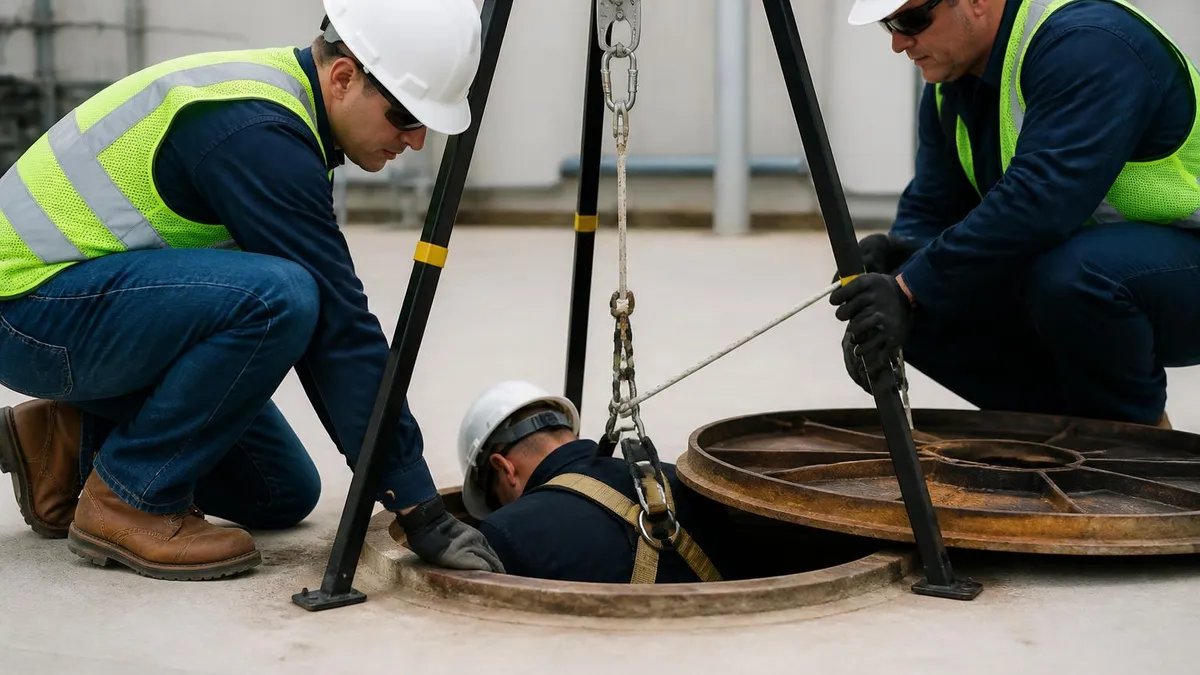
The Four Confined Space Roles Under OSHA
The worker who physically enters the permit-required confined space. Must know hazards, recognize exposure symptoms, use PPE correctly, communicate with the attendant, and self-evacuate when conditions change or when ordered out by the attendant or supervisor.
Stationed outside the space, the attendant continuously monitors entrants, controls who enters, summons rescue when needed, and never leaves the post until relieved. Cannot enter the space to perform rescue unless trained, equipped, and replaced by another attendant.
Authorizes entry, signs the permit, verifies all pre-entry conditions are met, ensures rescue services are available, and terminates entry when work is complete or unacceptable conditions develop. Often a foreman, lead, or safety coordinator with direct authority.
On-site or off-site team trained to perform retrieval. Must practice rescues at least every 12 months in representative spaces, be equipped with appropriate PPE and retrieval equipment, and respond in a timeframe appropriate to space hazards.
OSHA 29 CFR 1910.146, titled Permit-Required Confined Spaces for General Industry, has been the bedrock standard for tank, vessel, and vault entry work since its publication in January 1993. The rule was developed after years of multi-fatality incidents in which workers entered oxygen-deficient or toxic atmospheres without testing, then were followed by coworkers and emergency responders who suffered the same fate. The standard treats every permit space as guilty until proven safe through testing and engineering controls.
The standard begins by requiring employers to evaluate the workplace to determine whether confined spaces exist. If they do, the employer must determine which are permit-required by checking for the four trigger conditions: hazardous atmosphere potential, engulfment material, internal configuration that could trap or asphyxiate, and any other recognized serious hazard. If even one permit space exists, the employer must inform exposed employees by posting signs reading DANGER PERMIT-REQUIRED CONFINED SPACE DO NOT ENTER.
Once permit spaces are identified, the employer chooses one of three response paths. They can prevent employees from entering through physical barriers and training. They can develop a written permit space program covering testing, entry procedures, rescue, and documentation. Or, when conditions allow, they can reclassify the space to non-permit status by eliminating hazards or use alternate procedures under paragraph (c)(5) for spaces whose only hazard is atmospheric and can be controlled by continuous ventilation.
The written program is the heart of compliance. It must identify and evaluate permit space hazards, establish acceptable entry conditions, document who is authorized to enter and in what roles, provide equipment for testing and rescue at no cost to workers, designate rescue services and verify their capability, and require a written entry permit before each entry. The permit lists the space, purpose, date and duration, authorized entrants and attendants, hazards, isolation methods, acceptable entry conditions, atmospheric test results, and communication procedures.
Construction work falls under a parallel standard, 29 CFR 1926 Subpart AA, finalized in May 2015 after decades of debate over how construction sites differ from manufacturing. The construction rule adds requirements for competent person designation, continuous atmospheric monitoring whenever possible, early warning systems for engulfment hazards in spaces like sewer work, and explicit coordination requirements when multiple employers share a site. If you are training construction workers, your program must address the Subpart AA requirements, not just 1910.146.
If you want a refresher on basic OSHA structure and how confined space rules fit within the larger compliance ecosystem, the OSHA.gov: Your Complete Guide to the Official OSHA Website is a useful starting point because all current standards, letters of interpretation, and enforcement directives are published there. The agency also maintains free eTools, sample permit forms, and the Confined Spaces in Construction Frequently Asked Questions document that resolves dozens of common implementation questions.
Training requirements appear in paragraph (g) of the general industry standard. Employers must provide training to ensure all employees affected by the program acquire the understanding, knowledge, and skills necessary for safe performance. Training is mandatory before initial assignment, when duties change, when there is reason to believe a deviation has occurred, and when knowledge deficiencies appear. Refresher training is implicitly required whenever any of those triggers fires, even if the worker had recent initial training.
OSHA Practice Test Questions
Prepare for the OSHA - Safety Certificate exam with our free practice test modules. Each quiz covers key topics to help you pass on your first try.
OSHA Basic OSHA Practice
OSHA Exam Questions covering Basic OSHA Practice. Master OSHA Test concepts for certification prep.
OSHA Confined Space Entry
Free OSHA Practice Test featuring Confined Space Entry. Improve your OSHA Exam score with mock test prep.
OSHA Fall Protection
OSHA Mock Exam on Fall Protection. OSHA Study Guide questions to pass on your first try.
OSHA - Safety Certificate Electrical Safet...
Free OSHA Quiz on OSHA - Safety Certificate Electrical Safety Standards Questions and Answers. OSHA Exam prep questions with detailed explanations.
OSHA - Safety Certificate Emergency Action...
OSHA Practice Questions for OSHA - Safety Certificate Emergency Action and Fire Plans Questions and Answers. Build confidence for your OSHA certification exam.
OSHA - Safety Certificate Hazard Communica...
OSHA Test Online for OSHA - Safety Certificate Hazard Communication Standard Questions and Answers. Free practice with instant results and feedback.
OSHA - Safety Certificate Introduction to ...
OSHA Study Material on OSHA - Safety Certificate Introduction to OSHA Questions and Answers. Prepare effectively with real exam-style questions.
OSHA - Safety Certificate Lockout/Tagout P...
Free OSHA Test covering OSHA - Safety Certificate Lockout/Tagout Procedures Questions and Answers. Practice and track your OSHA exam readiness.
OSHA - Safety Certificate Machine Guarding...
OSHA Exam Questions covering OSHA - Safety Certificate Machine Guarding Requirements Questions and Answers. Master OSHA Test concepts for certification prep.
OSHA - Safety Certificate OSHA Recordkeepi...
Free OSHA Practice Test featuring OSHA - Safety Certificate OSHA Recordkeeping and Reporting Questions and Answers. Improve your OSHA Exam score with mock test prep.
OSHA - Safety Certificate Personal Protect...
OSHA Mock Exam on OSHA - Safety Certificate Personal Protective Equipment (PPE) Questions and Answers. OSHA Study Guide questions to pass on your first try.
OSHA - Safety Certificate Walking and Work...
OSHA Test Prep for OSHA - Safety Certificate Walking and Working Surfaces Questions and Answers. Practice OSHA Quiz questions and boost your score.
OSHA - Safety Certificate Electrical Safet...
OSHA Mock Test covering - Safety Certificate Electrical Safety Standards. Online OSHA Test practice with instant feedback.
OSHA - Safety Certificate Emergency Action...
Free OSHA Quiz on - Safety Certificate Emergency Action and Fire Plans. OSHA Exam prep questions with detailed explanations.
OSHA - Safety Certificate Hazard Communica...
OSHA Practice Questions for - Safety Certificate Hazard Communication Standard. Build confidence for your OSHA certification exam.
OSHA - Safety Certificate Introduction to ...
OSHA Test Online for - Safety Certificate Introduction to OSHA. Free practice with instant results and feedback.
OSHA - Safety Certificate Lockout/Tagout P...
OSHA Study Material on - Safety Certificate Lockout/Tagout Procedures. Prepare effectively with real exam-style questions.
OSHA - Safety Certificate Machine Guarding...
Free OSHA Test covering - Safety Certificate Machine Guarding Requirements. Practice and track your OSHA exam readiness.
OSHA - Safety Certificate OSHA Recordkeepi...
OSHA Exam Questions covering - Safety Certificate OSHA Recordkeeping and Reporting. Master OSHA Test concepts for certification prep.
Confined Space Training Content by Worker Role
Authorized entrant training must cover hazard recognition for the specific spaces the worker will enter, including how to read direct-reading gas meters for oxygen, flammable, and toxic gases. Workers learn to recognize early symptoms of overexposure such as headache, dizziness, and confusion, and to evacuate immediately when those symptoms or any alarm condition develops. Use of PPE, harnesses, retrieval lines, and communication equipment is taught hands-on, not just in lecture.
Entrants also learn the rules of engagement: never enter without a signed permit, never disable monitoring equipment, never re-enter after evacuation until conditions are reverified, and always maintain contact with the attendant. They must understand engulfment hazards in grain, sand, sludge, and liquids, the difference between IDLH and non-IDLH atmospheres, and the procedure for requesting emergency assistance through the attendant.
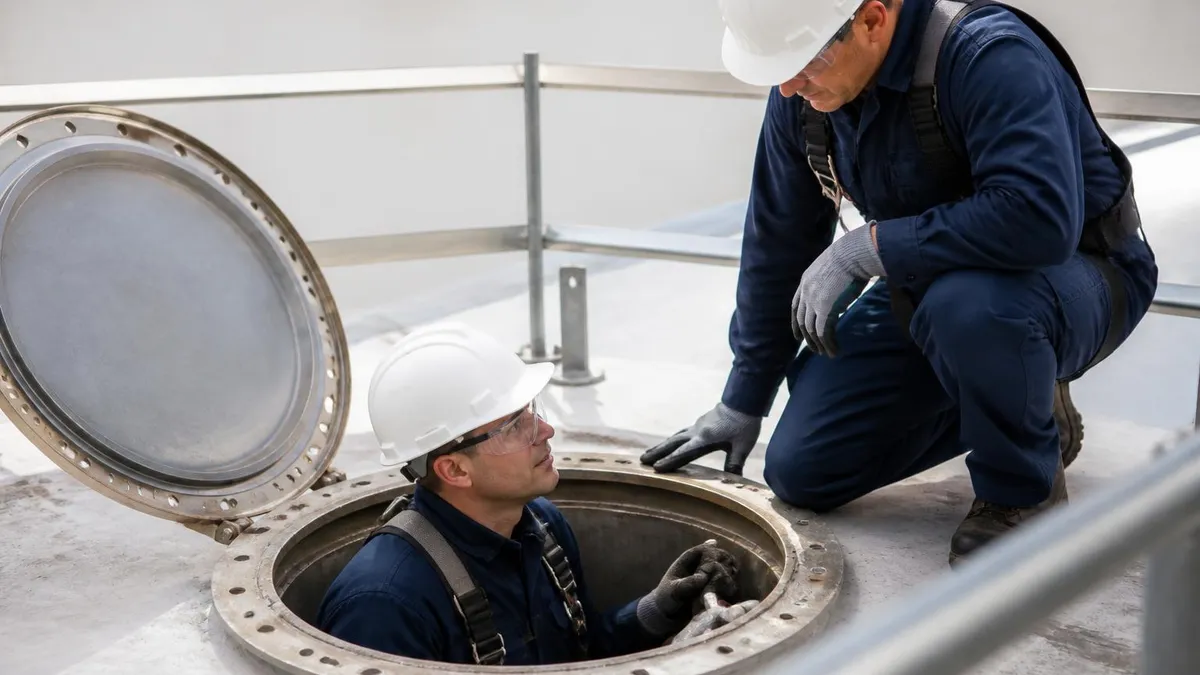
In-Person vs Online Confined Space Training: Which Works?
- +Hands-on equipment practice with real harnesses, tripods, winches, and gas monitors builds muscle memory online training cannot replicate
- +Live instructors can answer space-specific questions about your actual worksite and review your written program
- +Group rescue drills allow attendants and rescue teams to practice coordination under realistic conditions
- +Documentation includes signed attendance sheets, practical skills evaluations, and instructor credentials accepted by OSHA inspectors
- +Worker engagement is typically higher when training involves climbing into a mock vault or tripod-lowering a manikin
- +Mistakes during training generate teachable moments that classroom-only formats miss entirely
- +Most general contractors and chemical plants require in-person training before granting site access to contractor crews
- −Online modules cost 60-80% less per learner and can be completed on flexible schedules without travel
- −Self-paced learning lets workers replay difficult sections like gas meter calibration or permit completion as many times as needed
- −Online certificates are valid for awareness-level requirements at facilities without permit-required spaces
- −Hybrid programs combine online theory with a half-day in-person practical to balance cost and competency
- −Online platforms generate automatic completion records, quiz scores, and certificates ready for OSHA recordkeeping audits
- −Workers can refresh knowledge quickly between jobs without scheduling a full classroom session
- −OSHA does not require any specific delivery method; only that training achieves competency demonstrated through evaluation
Pre-Entry Confined Space Training Compliance Checklist
- ✓Verify the written permit space program identifies every space at your facility and classifies it correctly as permit or non-permit
- ✓Confirm all authorized entrants, attendants, and entry supervisors have completed initial training before assignment
- ✓Check that training records list employee name, trainer signature, dates, and topics covered for every certified worker
- ✓Calibrate every direct-reading gas monitor according to manufacturer specifications and document the bump test before each shift
- ✓Post DANGER PERMIT-REQUIRED CONFINED SPACE DO NOT ENTER signs at every entrance to a permit space
- ✓Verify rescue services have practiced in representative spaces within the last twelve months and respond in an appropriate timeframe
- ✓Conduct atmospheric testing for oxygen first, then flammable gases, then toxic gases, in that order before any worker enters
- ✓Issue a written entry permit signed by the entry supervisor listing all hazards, controls, and acceptable entry conditions
- ✓Maintain continuous communication between attendant and entrants through voice, visual, or electronic means at all times
- ✓Cancel and retain each permit for at least one year to support program review and OSHA recordkeeping requirements
Sixty percent of confined space deaths are would-be rescuers
The single most preventable confined space tragedy is the untrained coworker rushing in to save a downed entrant and becoming the second, third, or fourth fatality. OSHA explicitly prohibits entry rescue by attendants unless they are trained, equipped, and replaced. Your written program must designate a qualified rescue service and verify their capability before entry begins, not after an emergency develops.
Atmospheric testing is the most technically demanding part of confined space work and the area where untrained workers make the most dangerous mistakes. OSHA requires testing in a specific order because each gas creates a different category of risk: oxygen first to confirm a breathable atmosphere, flammable gases second to confirm the space is not at risk of explosion, then toxic gases third to confirm the air will not poison workers over the course of their shift.
The acceptable oxygen range is 19.5% to 23.5% by volume. Below 19.5% the atmosphere is oxygen-deficient and can cause rapid loss of consciousness without warning. Above 23.5% the atmosphere is oxygen-enriched, which dramatically increases fire risk because materials that normally smolder will burn aggressively. The most common cause of oxygen deficiency is rust formation inside steel tanks and vessels, which consumes oxygen over time even when the space has been empty for months.
Flammable gas measurement uses the Lower Explosive Limit, abbreviated LEL. A reading of 10% LEL or higher requires evacuation under most program standards, even though combustion technically cannot occur until 100% LEL. The 10% threshold gives a safety margin because gas concentrations can pocket and shift rapidly inside confined spaces. The sensor itself must be calibrated to the specific gas expected, since a methane-calibrated sensor will not read propane or gasoline vapors accurately.
Toxic gas testing depends on what is reasonably expected in the space. Hydrogen sulfide in sewers and oil operations, carbon monoxide where combustion engines or hot work occur, benzene in petrochemical facilities, and ammonia in refrigeration plants each require specific sensors with permissible exposure limits set by OSHA. The standard hydrogen sulfide PEL is 20 ppm ceiling with 50 ppm peak for ten minutes, and most monitors alarm at 10 ppm low and 15 ppm high to provide warning before the exposure limit is reached.
Continuous monitoring during entry is now strongly preferred over periodic testing, and is required under the construction standard whenever the equipment to do so is commercially available. Modern four-gas monitors with data logging capability cost between $400 and $1,200 and provide real-time alarms plus a complete record of atmospheric conditions throughout entry. The data log proves compliance during an OSHA inspection and helps identify trends that indicate worsening conditions.
Pre-entry purging and ventilation can transform a permit space into a workable environment, but only when done correctly. Mechanical ventilation requires sufficient air volume to actually exchange the atmosphere, ducting that reaches the bottom of the space where heavy gases collect, and monitoring to verify the ventilation is effective. Simply opening a manhole and pointing a fan at it rarely achieves adequate exchange in tanks or deep vaults, and creates false confidence that workers can then enter safely.
The training program must include hands-on practice with the actual monitors workers will use in the field. Reading a sensor display in a classroom is not the same as interpreting alarms while wearing gloves, hearing alerts through hearing protection, and communicating findings to an attendant through a radio. Skills evaluations should require workers to demonstrate calibration, bump testing, sampling sequence, alarm response, and proper documentation before they are signed off as competent.
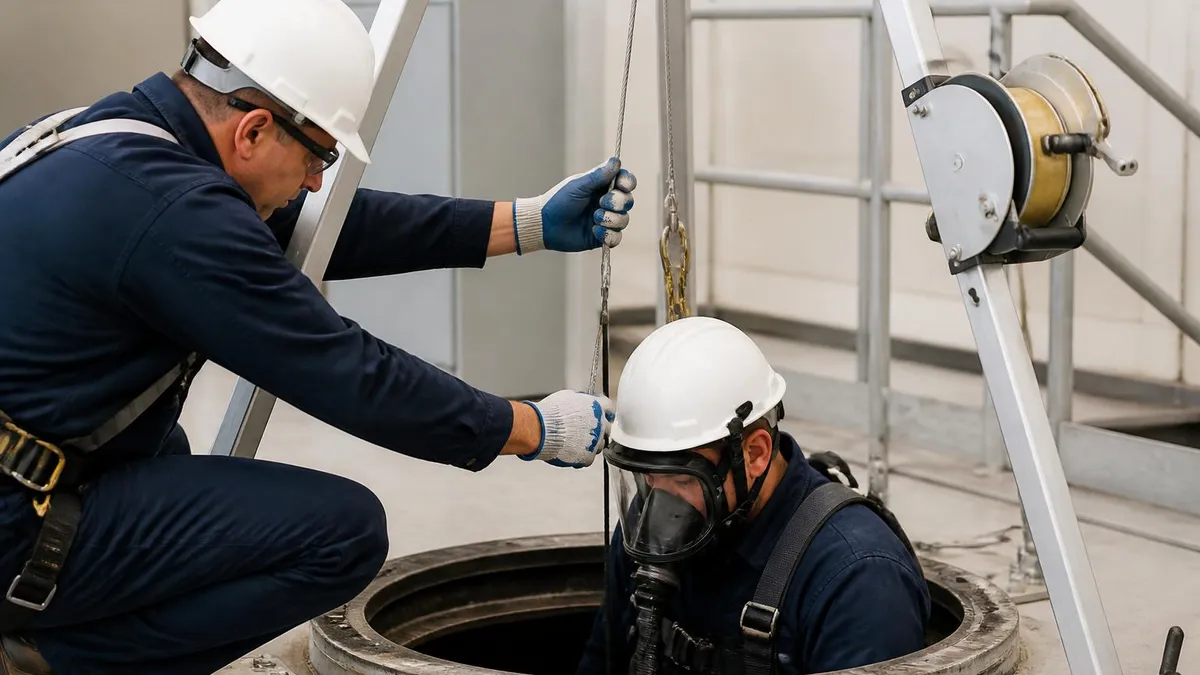
A space that tested safe yesterday is not necessarily safe today. Temperature changes, new product introductions, biological activity, and rust formation all shift atmospheric conditions. OSHA enforcement data shows that the deadliest entries occur when workers reopen a space they entered safely on a prior shift and skip retesting because the work seemed routine. Every entry requires a new test sequence.
Certification under confined space training OSHA standards is not a federal credential like a CDL or a contractor license. There is no national registry, no OSHA-issued card, and no fixed expiration date written into 29 CFR 1910.146. What the standard actually requires is that the employer certify in writing that each worker has received the required training, with the worker's name, the trainer's signature, and the date training was completed. That certification is the legal record.
In practice, third-party training providers issue wallet cards or completion certificates valid for one to three years, with annual or biennial refreshers strongly recommended. The wallet card is a useful artifact for site access at facilities that require proof of training, but the underlying employer certification is what OSHA actually inspects. If a worker shows up with a card but the employer cannot produce the training documentation, the citation falls on the employer, not the training provider.
Refresher training is required whenever any of four triggers occurs: a change in assigned duties, a change in permit space operations that presents a new hazard, a change in the entry program itself, or any reason to believe that there are deviations from program requirements or that worker knowledge is inadequate. Many employers default to annual refreshers regardless of these triggers because demonstrating ongoing competency is easier than defending why no refresher was provided after an incident.
Recordkeeping requirements extend beyond training certificates. Each cancelled entry permit must be retained for at least one year, atmospheric monitoring records should be kept for the duration relevant to potential exposure claims, and the written permit space program must be reviewed annually and revised as needed. Rescue service capability assessments, including documentation that rescue teams have practiced in representative spaces, are part of the inspectable record.
Cost varies widely depending on delivery method, audience, and location. A basic eight-hour authorized entrant course runs $150 to $300 per worker for in-person training, $50 to $125 for online-only modules, and $200 to $400 for hybrid programs that combine online theory with a half-day practical evaluation. Attendant and supervisor training adds two to four hours each. Rescue team training, which requires specialized equipment and practice scenarios, runs $400 to $900 per team member and typically takes two days.
If you are coordinating broader site safety training programs, the OSHA 510: Course Content, Path to Trainer, and Realistic Path guide explains how the OSHA Training Institute Education Center pathway works for safety professionals who want to deliver authorized OSHA 10 and 30-hour courses. Confined space training is a separate specialization, but many of the same safety professionals who become authorized OSHA outreach trainers also become recognized confined space trainers through provider-specific programs.
When evaluating a training provider, ask three questions: who developed the curriculum and what qualifications do they hold, what skills evaluations are conducted to verify competency, and what documentation is provided to satisfy 1910.146(g)(4) certification requirements. Providers that cannot answer those questions clearly are providing awareness content, not the program-specific training the standard actually requires. The best providers will visit your site, review your spaces, and customize the practical portion to your actual equipment and hazards.
Practical preparation for confined space training assessments comes down to mastering five categories of content that appear on virtually every written examination and skills evaluation: the definition triggers that distinguish permit from non-permit spaces, the testing sequence and acceptable atmospheric limits, the responsibilities of each role under 1910.146, the components of a valid entry permit, and the rescue capability requirements. Drilling these five categories accounts for the majority of test items.
Memorize the four trigger conditions verbatim: hazardous atmosphere potential, engulfment material, internal configuration that could trap or asphyxiate an entrant, and any other recognized serious safety or health hazard. Any single trigger converts a confined space into a permit-required confined space, and the test questions almost always probe whether you recognize that all four conditions are independent triggers, not cumulative requirements. The construction standard uses identical trigger language with minor additions.
For atmospheric testing, commit the numbers to memory: oxygen 19.5% to 23.5%, flammable gases 10% LEL evacuation, and the toxic gas PELs relevant to your industry. Hydrogen sulfide at 10 ppm low alarm and 15 ppm high alarm, carbon monoxide at 35 ppm action level and 50 ppm PEL, and benzene at 0.5 ppm action level and 1 ppm PEL appear most often. Knowing the test sequence, oxygen then flammable then toxic, is also frequently tested because the order matters operationally.
Understand the permit content requirements line by line. A valid permit lists the space identification, purpose of entry, date and authorized duration, authorized entrants and attendants by name, entry supervisor signature, hazards present, isolation methods, acceptable entry conditions, atmospheric test results with the tester's initials, rescue and emergency procedures, communication procedures, equipment required, and any additional permits issued. Each item appears in 1910.146 Appendix D and is testable.
For practice quizzes, use the dedicated confined space entry tests linked in this guide. They mirror the question format used by major training providers including the National Safety Council, the National Institute for Occupational Safety and Health training partners, and trade association programs. Take each test twice: once cold to identify weak areas, then again after reviewing the specific paragraphs of 1910.146 that cover the missed topics. This two-pass approach typically lifts scores by 15 to 25 percentage points.
On exam day or evaluation day, slow down on the scenario questions. Most confined space test items present a fact pattern and ask which of four responses is correct. The wrong answers are usually plausible at first glance but violate a specific provision such as entering without a permit, entering for rescue without proper training, or skipping retesting after evacuation. Identify the violated provision, then select the answer that complies. Process of elimination works extremely well on these questions.
Finally, treat your initial training as the start of an ongoing competency relationship with your employer, not a one-and-done credential. Volunteer for permit reviews, participate in rescue drills, ask to observe atmospheric calibration, and request refresher training whenever your duties change or new spaces are added to the program. Workers who treat osha excavation safety as a continuous practice rather than an annual checkbox are the ones who go home at the end of every shift.
OSHA Questions and Answers

OSHA Approved Hard Hats: Complete 2026 Guide to ANSI Z89.1 Compliance, Types, and Workplace Requirements

OSHA Logo: What It Means and How to Spot the Real Thing

OSHA.gov: Your Complete Guide to the Official OSHA Website

OSHA 510: Course Content, Path to Trainer, and Realistic Path

How to Get OSHA 10 Certified: Complete 2026 Guide to Enrolling, Passing, and Receiving Your DOL Card
How this page was made: written with AI tools. Exam facts are checked against the official sources listed below. Not reviewed by a subject-matter expert. Editorial policy
Sources & references
Exam facts on this page (fees, format, dates, passing scores) are checked against these official sources; the date is our last check. Editorial policy
- osha.gov — Test delivery, eligibility, fees, passing score, renewal, retake policy, score validity, score release · verified Oct 2026