
Confined Space Standard: OSHA Requirements, Permits and Training 2026 October
🎓 Master OSHA confined space rules under 29 CFR 1910.146. Learn permit vs non-permit entry, atmospheric hazards, attendant roles and rescue training.

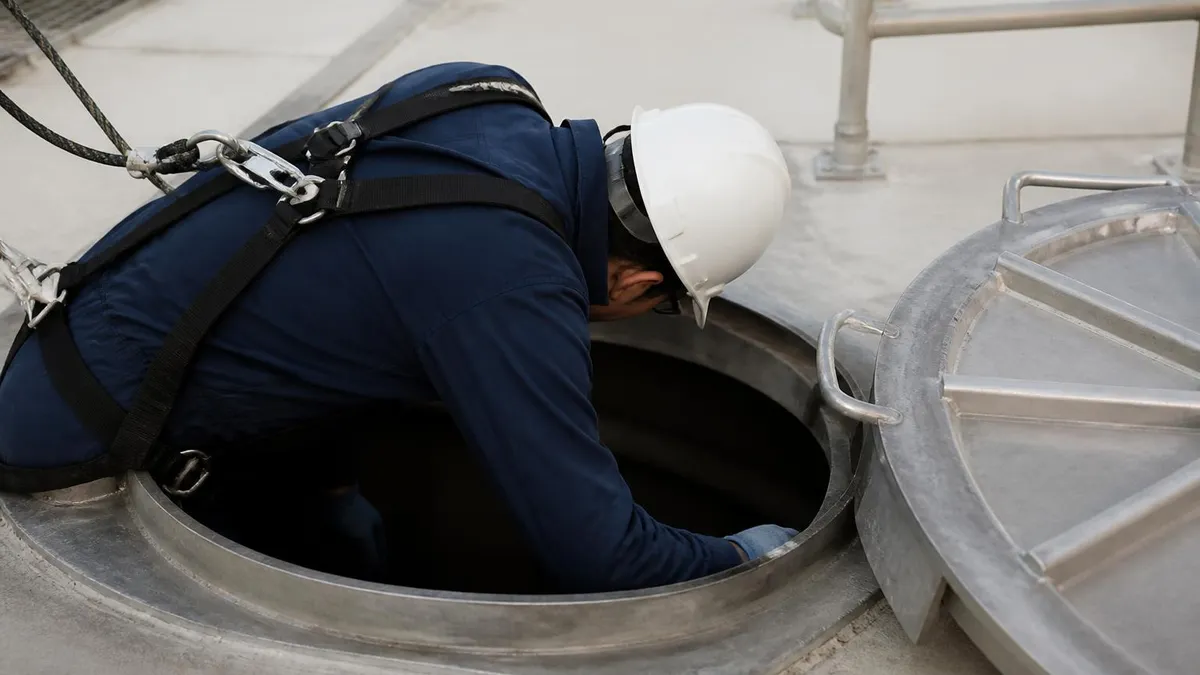
A worker climbs into a 36-inch storage tank to scrape sludge. Twenty minutes later he’s unconscious. The atmosphere held only 16% oxygen — enough to look fine, not enough to stay alive. This is exactly why OSHA built 29 CFR 1910.146, the federal rule that governs how anyone enters, works inside, or rescues people from confined spaces in general industry. Construction has its own mirror standard, Subpart AA of 29 CFR 1926, added in 2015 after years of preventable deaths in manholes, vaults and crawl spaces.
The numbers are blunt. The Bureau of Labor Statistics counted 1,030 confined space fatalities between 2011 and 2018 — about 130 per year. Roughly 60% of those deaths were would-be rescuers. People run toward a downed coworker without testing the air, breathe the same toxic mix, and don’t come back out. The OSHA confined space rule exists to stop that chain reaction.
If you supervise crews, write JSAs, audit job sites, or sit for the Safety Certificate exam, you need to know three things cold: what counts as a confined space, when it crosses the line into permit-required, and who has to do what before a single boot crosses the threshold. We’ll walk through all of it — the legal language, the practical translations, and the test questions that trip people up.
The standard isn’t suggestion. It’s federal law. Citations for confined space violations averaged $15,625 per item in fiscal 2024, and willful violations climbed past $156,000. More importantly, every line in 1910.146 was written because somebody died. Treat the rule like the autopsy report it really is.
OSHA Confined Space By the Numbers
Key figures every entrant, attendant and entry supervisor should commit to memory.
What Counts as a Confined Space Under OSHA
OSHA doesn’t care what the space is called on the blueprints. A boiler, silo, pit, vault, sewer, tank, manhole, crawl space, ventilation duct, even an open-topped tank deeper than four feet — all of them can qualify. The definition turns on function, not labels.
A space is confined when it meets all three of these tests. Miss one, and it’s just a tight workspace. Hit all three, and the full 1910.146 program kicks in.
First, it has to be large enough and so configured that an employee can bodily enter and perform assigned work. A pipe you can’t crawl into doesn’t qualify. A 30-inch sewer line that a thin worker can squeeze down? It qualifies. Second, it must have limited or restricted means for entry or exit. Bolted hatches, narrow openings, vertical shafts requiring a ladder — all restrict egress. A normal doorway doesn’t. Third, the space is not designed for continuous employee occupancy. Offices, control rooms, cabs — those are designed for people. Tanks, vessels, vaults, pits are not.
One of the most-missed test questions on the Safety Certificate exam asks exactly this: what characteristics determine a confined space according to OSHA guidelines? The trick is that you have to list all three, not two, not four. Memorize them like a credit card PIN.
A space is confined ONLY if it meets all three criteria
1. Large enough to bodily enter — you can fit your whole body inside and perform work, even if it’s a tight crawl.
2. Limited or restricted means for entry or exit — you can’t walk out the way you walked in. Hatches, narrow openings, ladders down.
3. Not designed for continuous occupancy — nobody is supposed to sit in there for eight hours doing paperwork.
Skip any one of these and the space is something else — maybe a low-ceiling room, maybe an obstructed work area — but not a confined space under OSHA. Get the test wrong on the job and you’ll either over-paper a routine task or, far worse, send people into a death trap with no controls.
Permit-Required vs Non-Permit Confined Spaces
Once a space clears the three-part test, OSHA splits it into two tiers. The dividing line isn’t size or industry — it’s hazard potential. A Permit-Required Confined Space (PRCS) is one that has, or could plausibly have, any of four hazard types: a hazardous atmosphere, a material that could engulf the entrant, an internal configuration that could trap or asphyxiate (sloping walls, tapering to a smaller cross-section), or any other recognized serious safety or health hazard.
Atmospheric hazards are the big killer. The standard sets four atmospheric limits: oxygen below 19.5% or above 23.5%, a flammable gas/vapor concentration above 10% of the Lower Flammable Limit (LFL), airborne combustible dust above its LFL, and any toxic substance above its Permissible Exposure Limit. Hit any one and the space is permit-required — full stop.
A non-permit confined space is the rare unicorn. It meets the three-part test but has no actual or potential hazards capable of causing death or serious physical harm. Think of a clean, well-ventilated electrical vault that was just opened up to swap a meter. No flammables, no toxics, no engulfment risk, oxygen fine. You document the assessment, the entrant goes in, the work happens, and no written permit is required. The phrase you’ll see on the exam is osha non permit required confined space — same thing, written backward.
Here’s the catch: a non-permit space can flip the moment conditions change. Hot work introduces fumes? Permit. New chemical stored upstream? Permit. Adjacent process leaks? Permit. The entry employer has to reassess every time something changes, and OSHA’s default assumption in any inspection is that the space is permit-required until proven otherwise.
The Four Permit-Required Hazard Categories
Oxygen below 19.5% or above 23.5%, flammable vapor above 10% LFL, combustible dust above LFL, or any toxic substance above PEL.
- Oxygen Range: 19.5% – 23.5%
- Flammable Limit: 10% LFL ceiling
- Toxic Threshold: Below PEL
Loose material like grain, sand, water or sludge that could surround and capture the entrant, causing suffocation or crushing.
- Common Materials: Grain, sand, gravel, water
- Death Mechanism: Suffocation by compression
- Key Control: Lockout/Tagout upstream
Internal walls that taper inward or floors that slope down to a smaller section. Workers can slide in and be unable to climb out.
- Typical Shape: Cone or funnel
- Risk: Trapped — cannot self-rescue
- Control: Body use + retrieval line
Electrical, mechanical, thermal, biological or any recognized hazard that could kill or seriously injure. Catch-all clause.
- Examples: Live circuits, moving parts
- Heat Stress: Inside hot vessels
- Biological: Sewers, lift stations
The Three Mandatory Roles: Entrant, Attendant, Supervisor
Once a space is classified as permit-required, OSHA forces the employer to staff three distinct roles before entry begins. You can’t shortcut this with one person wearing three hats — the attendant in particular must remain outside the space, full stop. Trying to consolidate roles is one of the most-cited violations on the entire standard.
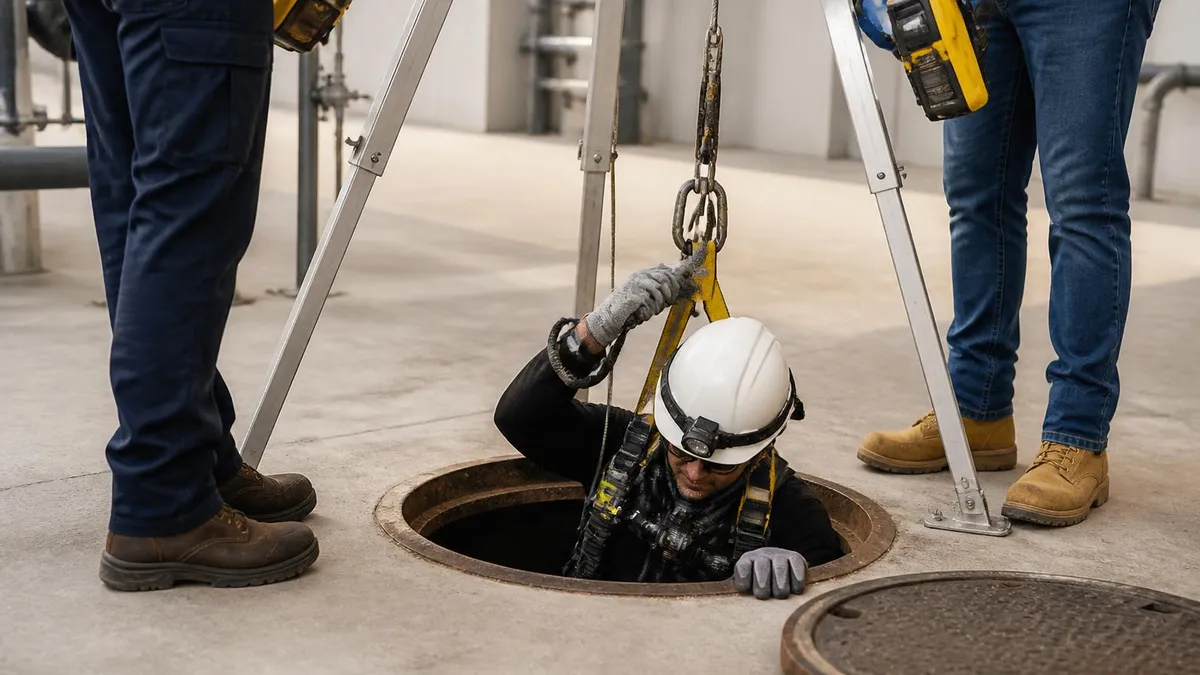
The authorized entrant is the person going in. They have to understand the hazards, know the signs and symptoms of exposure, use the equipment properly, communicate with the attendant, and exit immediately on any alarm or order to evacuate. Sounds obvious. It isn’t when you’re half-conscious from H₂S and your brain has already stopped working.
The attendant stands outside, never enters under any circumstance (except for rescue if they’ve been formally designated and trained as part of the rescue team — which is rare), monitors atmospheric readings, keeps a running count of entrants, summons rescue if anything goes sideways, and orders evacuation. The attendant’s job is judgment under pressure. A bored attendant scrolling a phone has killed more workers than the gas inside the tank.
The entry supervisor — OSHA also calls this person the entry employer’s designee — signs the permit, verifies that pre-entry tests have been done, that rescue services are available and notified, that all the required equipment is on site, and that the attendant is in place. The supervisor can be the entrant once entry begins, but they’re on the hook for the paperwork either way. On the exam, expect questions phrased as entry employer osha or entry team and reserves osha — different wording, same chain of responsibility.
Role-by-Role Responsibilities
Who they are — the worker who physically enters the permit space. Often a tank cleaner, welder, electrician, sewer crew member or maintenance tech.
Required knowledge — understand each hazard in the space, recognize the signs and symptoms of exposure (headache, dizziness, irritation, loss of coordination), know what to do if they appear, and know how to use all the entry equipment.
Required actions — maintain communication with the attendant at all times (voice, radio, line tug), alert the attendant when anything feels off, evacuate immediately if ordered, on alarm, or if symptoms appear. Use PPE and atmospheric monitors as trained.
What they cannot do — enter without a signed permit, ignore monitor alarms, remove safety equipment inside the space, or stay in past the duration listed on the permit.
Atmospheric Testing: The Order Matters
Pre-entry atmospheric testing is non-negotiable for permit spaces. The standard at 1910.146(c)(5)(ii)(C) and Appendix D spells out a specific sequence, and the order isn’t arbitrary — it’s tied to the physics of how the meter reads each gas.
Oxygen first. Combustible gas sensors and toxic sensors rely on oxygen to function accurately. If oxygen is depleted, your other readings are meaningless. Test O₂ first, every time. Acceptable range: 19.5% to 23.5%.
Combustible gases second. Once you know oxygen is normal, check for flammables. The limit is 10% of the Lower Flammable Limit (LFL). Anything higher and you have an explosive atmosphere candidate — ventilation, source isolation, or both before entry.
Toxic substances third. Hydrogen sulfide, carbon monoxide, ammonia, benzene, whatever the process introduces. Each must be below its Permissible Exposure Limit. Many four-gas meters cover O₂, LEL, CO and H₂S as standard — anything beyond that needs a specific colorimetric tube or single-gas monitor.
Continuous monitoring during entry is required if the conditions could change — and they almost always could. The meter doesn’t go in your pocket. It stays in the breathing zone of the entrant, audible alarms enabled, the attendant verifying readings every few minutes and logging anything unusual on the back of the permit.
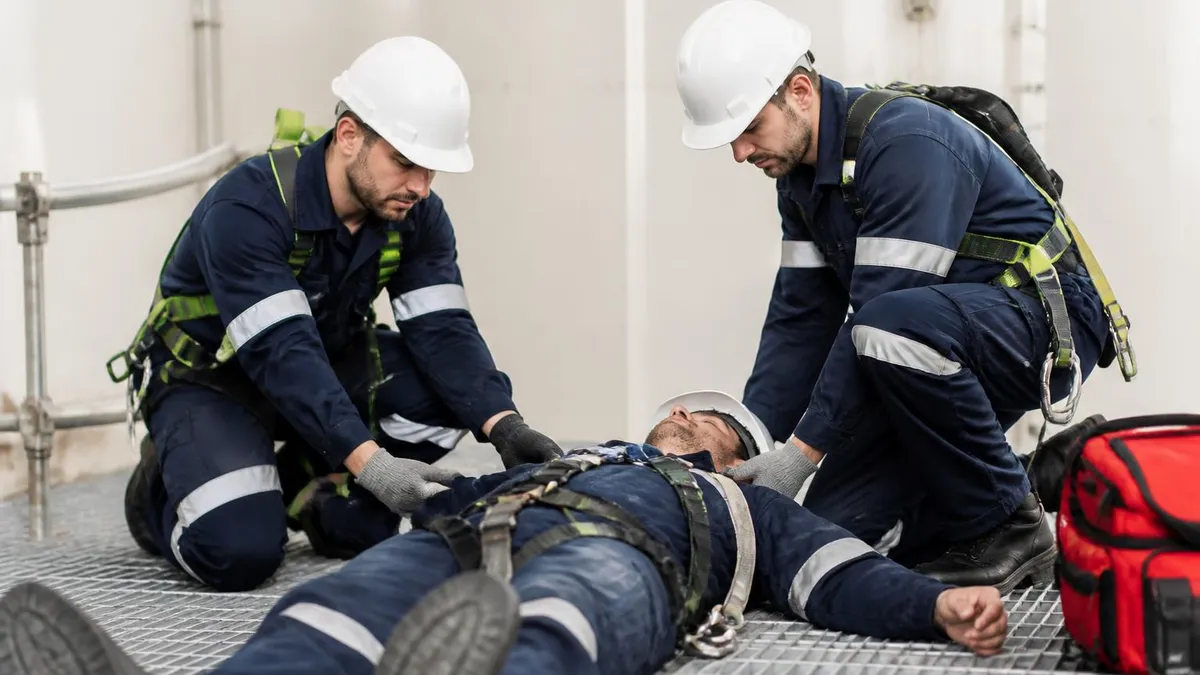
Every untrained rescue in a permit space follows the same pattern: worker collapses, coworker sees them, instinct says “grab them and pull them out,” coworker enters, breathes the same atmosphere, drops next to the first body. NIOSH calls this the cascade effect, and it kills two to four people at a time, regularly.
1910.146 requires non-entry retrieval wherever feasible — body use with attached retrieval line, mechanical hoisting device for vertical spaces deeper than 5 feet. The attendant pulls the entrant out from outside. Nobody else goes in unless they are equipped, trained, and protected by an independent air supply.
If you remember one rule from this article, make it this one: no entry rescue without a trained rescue team and the same level of protection as the original entrant. Untrained intervention is how the body count climbs from one to three.
What Goes on the Entry Permit and Who Signs It
The written entry permit is the document that proves the employer thought through every hazard before people went in. 1910.146(f) lists the required contents — sixteen specific elements in total. Inspectors will line-by-line a permit and cite any blank field. So will any half-decent contractor coordinator.
The permit must identify the space, the purpose of entry, the date and authorized duration, and the names of all authorized entrants, attendants, and the entry supervisor. It also lists the hazards present and the measures used to isolate the space and control them.
The permit then records the acceptable entry conditions — actual numbers for O₂ percent, LEL percent, and ppm of specific gases — the test results with tester initials and time, the rescue services available and how to summon them, the communication procedures, the equipment provided, any additional permits issued (hot work, lockout), and any other information necessary for safe entry.
The entry employer — the company whose employees are doing the entry — is primarily responsible. If you’re a contractor sending crews into a host facility’s permit space, you’re the entry employer. The host employer (the facility owner) has its own duties: tell the contractor about every known hazard, share past entry experience, coordinate operations, and debrief after the work is done. Skipping the coordination step is one of the most common multi-employer citations on industrial sites.
Pre-Entry Checklist for Every Permit Space
- ✓Space identified, classified, and posted with confined space warning signage
- ✓Entry permit form filled out completely — all 16 elements present
- ✓Atmospheric testing performed in correct order: oxygen, then combustibles, then toxics
- ✓Oxygen reading between 19.5% and 23.5%, recorded with time and tester initials
- ✓LEL below 10%, with continuous monitoring equipment in place for entry
- ✓Toxic substances measured below PEL, with continuous monitoring if process introduces them
- ✓Mechanical ventilation operating where required by the hazard assessment
- ✓Isolation completed — lockout/tagout, blanking, double block and bleed as applicable
- ✓Engulfment hazards controlled with upstream isolation or suspended material removal
- ✓Rescue services notified, equipped, and confirmed available within response time
- ✓Body use and retrieval line attached for vertical entries deeper than 5 feet
- ✓Communication method tested between attendant and entrant before entry begins
- ✓Authorized entrants, attendants, and entry supervisor all trained and named on permit
- ✓All PPE inspected and donned before entry — respirators fit-tested where required
- ✓Entry supervisor signs and dates the permit, terminating it on exit or hazard escalation
Training Requirements Under OSHA Confined Space Rules
You don’t get to assign someone to a permit space role until they’ve been trained for it. 1910.146(g) is explicit: training must be provided before the employee is first assigned duties, before there’s any change in their assigned duties, whenever the hazards in the permit space change, and whenever the employer believes deviations from procedures suggest inadequate knowledge.
The training has to establish proficiency, not just check a box. Employers must certify in writing that training has been provided, with each employee’s name, the trainer’s signature or initials, and the date. OSHA inspectors ask for this certification first. If it doesn’t exist, the entire confined space program is presumed deficient.
Content has to cover the duties of the specific role — entrant, attendant, supervisor, rescuer — and the hazards of the spaces the employee will work in. Generic “confined space awareness” training isn’t enough. If your facility has tanks with H₂S risk, training has to cover H₂S symptoms and response. If you have grain silos, it has to cover engulfment.
The OSHA confined space fact sheet (Publication 3138) is the freely available employer-facing summary and a solid starting point for a written program. The osha confined space training language you’ll see on the Safety Certificate exam ties directly to these proficiency rules. Don’t guess on the test — the answer is always “before assignment, plus whenever hazards or duties change.”
In-House Rescue Team vs Outside Rescue Service
Every entry employer must choose one. 1910.146(k) sets evaluation criteria for both.
- +Response time measured in seconds, not minutes
- +Team knows every quirk of your specific spaces
- +Trains in your actual environments — muscle memory matches reality
- +Available 24/7 without negotiating mutual aid
- +Cost recovered over time vs per-incident contractor fees
- +Builds genuine safety culture across operations and maintenance
- +Equipment can be sized and staged for your hazards
- −Fire departments rarely train in technical confined space rescue
- −Response times can exceed 10 minutes — too long for IDLH
- −You must verify capability annually, not assume it exists
- −Coordination requires written agreements and joint drills
- −Equipment compatibility issues at the entry point are common
- −Outside teams may refuse entry to certain hazardous spaces
- −Per-incident billing can exceed in-house program costs over time
Pros and Cons at a Glance
| Pros | Cons |
|---|---|
| Response time measured in seconds, not minutes | Fire departments rarely train in technical confined space rescue |
| Team knows every quirk of your specific spaces | You must verify capability annually, not assume it exists |
| Trains in your actual environments — muscle memory matches reality | Coordination requires written agreements and joint drills |
| Cost recovered over time vs per-incident contractor fees | Equipment compatibility issues at the entry point are common |
| Builds genuine safety culture across operations and maintenance | Outside teams may refuse entry to certain hazardous spaces |
| Equipment can be sized and staged for your hazards | Per-incident billing can exceed in-house program costs over time |
Excavations, Construction and the Special Cases
Excavations are their own animal. Trenches deeper than four feet can meet the confined space three-part test — large enough to enter, limited egress (typically just one ladder), not designed for continuous occupancy. But construction excavations primarily live under 29 CFR 1926 Subpart P, the excavation standard, not the confined space standard. Where they overlap, the more stringent rule applies.
The phrase excavation confined space osha usually shows up on test questions probing whether the candidate knows that excavations can be confined spaces, especially when atmospheric hazards exist (sewer gas, leaking utilities, decomposing material, gasoline-contaminated soil). When those hazards are present, you operate under both standards simultaneously — protective systems for cave-in plus permit entry procedures.
Construction in general moved under Subpart AA on August 3, 2015. Before that date, construction had no specific confined space rule — a serious gap that killed people in vaults, manholes and crawl spaces. Subpart AA mirrors 1910.146 but adds construction-specific elements: a competent person to identify hazards, explicit coordination among multiple contractors on the same site, and stronger requirements for early warning systems when conditions can change rapidly.
One more wrinkle: residential construction. Subpart AA applies to confined spaces in residential builds (crawl spaces, attics with restricted access), but OSHA published an enforcement memo allowing a less-paper-heavy approach in single-family work where competent persons can manage hazards in real time. Commercial and multi-family construction get the full standard.
Putting the OSHA Confined Space Standard Into Practice
If you’re building a written program from scratch, the order matters. Start with a site survey. Walk the facility with the maintenance lead and identify every space that meets the three-part test. Photograph each one, note its dimensions, its purpose, what materials it contains or has contained, and the equipment around it. That photograph file becomes the backbone of your hazard assessment.
From there, classify each space — permit-required, non-permit, or alternate-procedure entry under 1910.146(c)(5). The alternate procedure is a useful middle ground: spaces where the only hazard is atmospheric, where ventilation alone can eliminate the hazard, and where monitoring confirms it. The paperwork is lighter but the controls have to actually work.
Write the program. Designate roles. Train the people. Buy the equipment. Coordinate with your rescue service — in writing, with drills, not just a phone number. Audit the program annually and after any near-miss. The annual review is required, not optional, and inspectors will ask for it.
For the Safety Certificate exam, remember the patterns. Three-part test, four hazard categories, atmospheric testing order (oxygen first), three core roles, sixteen permit elements, and the rescue rule (no untrained entry rescue, ever). Get those down and you’ll pass any osha confined space requirements question the test throws at you — and more importantly, you’ll bring everyone home at the end of the shift.
The reading list is short. The standard itself, 29 CFR 1910.146 and 1926 Subpart AA, is freely available at osha.gov. The OSHA confined space fact sheet (Publication 3138) is plain English. NIOSH Publication 94-103, Worker Deaths in Confined Spaces, is the dose of reality that makes everything else stick. Read it. Then check your own program against what killed those workers.
One last thing about the alternate-procedure entry under 1910.146(c)(5). Some employers chase it because the paperwork looks lighter — no full permit, no attendant required in certain conditions. The catch is the data. You need documented test results showing the only hazard is atmospheric, ventilation alone can eliminate it, and monitoring confirms the controls work continuously while people are inside. Build that data set wrong and you’ll convert a permit space into a non-permit space on paper while the actual hazards stay exactly where they were.
Inspectors know this trick. They’ll ask to see the test data, the ventilation calculations, and the continuous monitoring records. If any one of those is thin, the citation lands and the alternate-procedure label gets stripped. Treat 1910.146(c)(5) as the narrow exception it is — a tool for genuinely low-risk spaces, not a workaround for permit-required ones.
Last note for new program owners. Don’t treat the OSHA standards as a ceiling. They are a federal minimum. ANSI Z117.1 — the industry consensus standard for confined space safety — covers a broader range of practical issues, including communications, hot work integration, and rescue equipment specification. Many insurers, large general contractors, and refinery owners require ANSI Z117.1 conformance as a contract condition. Building your program to meet both pays off the first time a serious incident gets investigated.
OSHA Questions and Answers
About the Author

Certified Safety Professional & OSHA Compliance Expert
Indiana University of Pennsylvania Safety SciencesDr. William Foster holds a PhD in Safety Science from Indiana University of Pennsylvania and is a Certified Safety Professional (CSP) and Certified Hazardous Materials Manager. With 20 years of occupational health and safety management experience across construction, manufacturing, and chemical industries, he coaches safety professionals through OSHA certification, CSP, CHST, and safety management licensing programs.
Join the Discussion
Connect with other students preparing for this exam. Share tips, ask questions, and get advice from people who have been there.
View discussion (8 replies)