
List of Companies with OSHA Violations: Complete Guide to OSHA Citations by Company, Penalty Histories, and Construction Industry Enforcement Records
Explore the list of companies with OSHA violations, citation histories, penalty amounts, and how to search OSHA's enforcement database by company name. 🎯
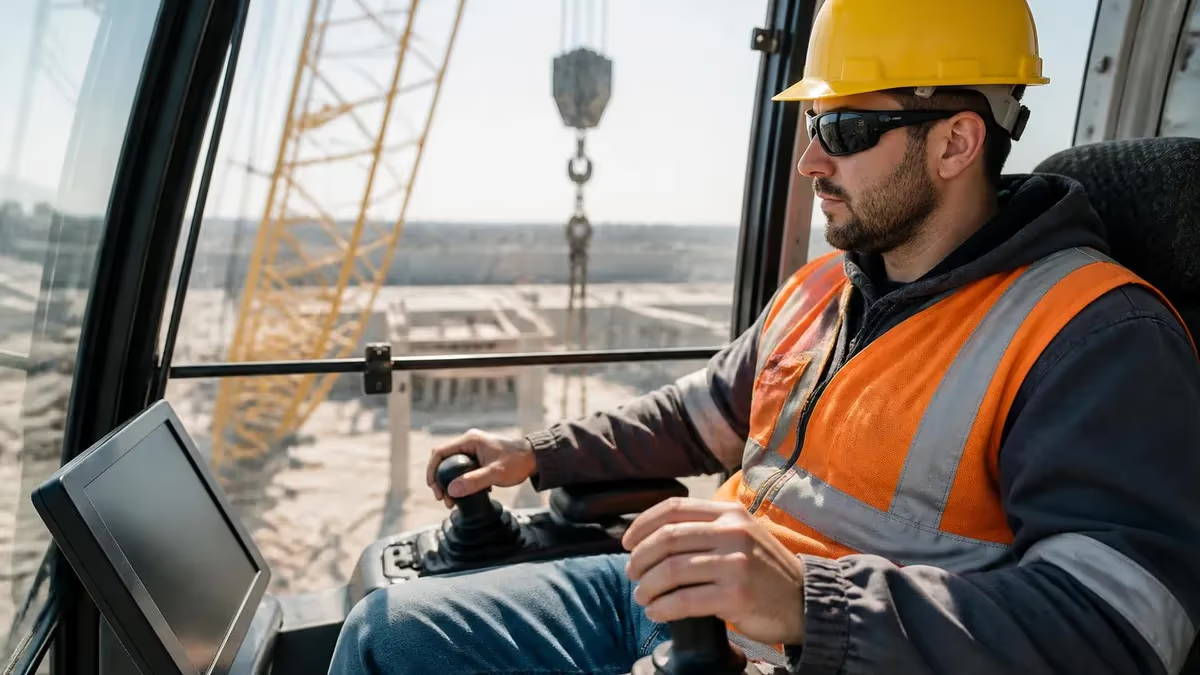
Searching for a list of companies with OSHA violations is one of the most common research tasks for construction managers, cal osha phone number, safety professionals, insurance underwriters, and journalists alike. The Occupational Safety and Health Administration publishes detailed citation histories for every employer it has inspected since 1972, and that data reveals patterns about workplace injuries, fatalities, repeat offenders, and dangerous job sites. Knowing how to find, interpret, and use these records can help you avoid hazardous employers and benchmark your own company's compliance posture.
OSHA's enforcement database currently contains more than 11 million inspection records, covering employers across construction, manufacturing, healthcare, transportation, agriculture, and the maritime industry. Each record includes the establishment name, address, NAICS code, inspection date, standards cited, proposed penalty, current penalty after settlement, and the status of any contests filed with the Occupational Safety and Health Review Commission. The system is free, searchable, and updated nightly by the federal Department of Labor.
For crane operators preparing for certification or working through OSHA standards, citation data offers an unfiltered look at how 29 CFR confined space definition osha CC violations play out on real construction sites. You can see which contractors get cited for failing to inspect cranes, which lift operators caused fatalities, and how penalties scale when a violation is classified as willful, repeat, or serious. That context turns abstract regulatory language into something tangible you can study and remember.
This article walks through the public databases that publish OSHA violation histories, the major companies with the largest cumulative penalties, how to interpret citation severity classifications, and the difference between federal OSHA inspections and state-plan enforcement. We will also cover how repeat offender programs work, why some companies appear on the Severe Violator Enforcement Program list, and what citation data tells employers about their own safety blind spots.
You will learn how to download bulk data from OSHA's Integrated Management Information System, how investigative journalists use the database to expose dangerous employers, and which third-party sites repackage federal enforcement data with search filters the government does not provide. By the end, you should be able to look up any U.S. employer's complete OSHA history in under three minutes and understand exactly what the numbers mean.
Whether you are vetting a general contractor before signing a subcontract, researching a potential employer before accepting a crane operator job, or simply curious about which Fortune 500 companies rack up the most safety citations, this guide consolidates everything published by federal sources and reputable watchdog organizations. The information shared here is sourced directly from OSHA's public records and updated to reflect current 2026 enforcement data.
OSHA Citation Enforcement by the Numbers
How OSHA Tracks and Publishes Company Violations
Every OSHA inspection generates a unique activity number and a detailed report listing the establishment, standards cited, penalty amounts, abatement status, and inspector findings. These reports become publicly searchable within days.
OSHA's establishment search lets you query by exact company name, partial name, city, state, or SIC code. Results display all inspections at that location over the past 15 years with current penalty amounts.
Researchers and developers can download the entire OSHA enforcement database as quarterly CSV files. The dataset includes inspection, violation, accident, and abatement tables linkable by activity number for custom analysis.
OSHA publishes press releases for significant citations, fatalities, and willful violations totaling over $100,000. These announcements name the company, summarize the hazard, and cite the specific standards violated.
Any workplace death triggers a mandatory OSHA inspection within eight hours of notification. The resulting fatality report names the employer, describes the incident, and lists every citation issued as a result.
While OSHA does not publish a single ranked list of worst offenders, journalists and watchdog groups have compiled aggregate citation data showing which corporations face the most enforcement actions year after year. Dollar General, Amazon, Walmart, Frito-Lay, Dollar Tree, and several large construction and meatpacking firms have consistently topped these unofficial rankings during the 2020s. Dollar General alone has accumulated over $21 million in proposed penalties since 2017, with citations for blocked exits, unsafe storage of merchandise, and electrical hazards at hundreds of stores.
Amazon has drawn substantial enforcement attention for ergonomic hazards at fulfillment centers, with multiple multi-million-dollar citation packages issued between 2022 and 2025. The company has been cited under the general duty clause for failing to protect warehouse workers from musculoskeletal disorder risks tied to fast-paced productivity quotas. These cases became foundational examples of how OSHA uses Section 5(a)(1) when no specific standard directly covers a hazard.
In the construction sector, large national contractors such as Bechtel, Fluor, Skanska, Turner, and Kiewit appear in OSHA records primarily because of the sheer scale of their projects. However, smaller and mid-size contractors generally accumulate more citations per worker. Roofing companies, scaffolding contractors, and excavation firms historically face the highest violation rates per inspection, with fall protection failures and trenching collapses driving most willful and repeat citations.
Crane and rigging companies appear less frequently on the worst-offender lists, partly because OSHA's certified operator requirement under 29 CFR 1926.1427 raised the baseline of training across the industry. Still, individual citations against crane operators or lift directors remain common when overturns, dropped loads, or contact with overhead power lines occur. These cases offer crane operators a vivid catalog of how small operational errors translate into six-figure penalties and federal investigations.
To explore how these enforcement actions relate to crane operator certification requirements, check the What Is the OSHA Rule? Complete Guide to OSHA Rules and Standards for Crane Operators for context on which regulations carry the steepest penalties. Understanding the regulatory landscape helps you read citation records like a safety auditor rather than a casual observer.
Citation data also reveals industry-specific hot spots. Meatpacking facilities owned by JBS, Tyson, and Cargill have faced multiple multi-million-dollar enforcement actions for amputation hazards and chemical exposures. Auto parts manufacturers have been cited heavily for machine guarding violations under 29 CFR 1910.212. Each industry has its own pattern of recurring hazards, and OSHA's National Emphasis Programs direct extra inspection resources toward those known problem areas.
The companies you find on these lists are not necessarily the most dangerous employers in absolute terms. They may simply operate the largest number of locations, attract the most worker complaints, or be subject to industry-specific National Emphasis Programs. Reading the underlying inspection narratives is always more revealing than the topline penalty figure.
OSHA Practice Test Questions
Prepare for the OSHA - OSHA Certified Crane Operator exam with our free practice test modules. Each quiz covers key topics to help you pass on your first try.
OSHA Crane Operation Controls & Signal Com...
OSHA Exam Questions covering Crane Operation Controls & Signal Communication. Master OSHA Test concepts for certification prep.
OSHA Crane Safety Procedures & Hazard Prev...
Free OSHA Practice Test featuring Crane Safety Procedures & Hazard Prevention. Improve your OSHA Exam score with mock test prep.
OSHA Load Handling & Rigging Techniques
OSHA Mock Exam on Load Handling & Rigging Techniques. OSHA Study Guide questions to pass on your first try.
OSHA Regulations & Equipment Inspection St...
OSHA Test Prep for Regulations & Equipment Inspection Standards. Practice OSHA Quiz questions and boost your score.
OSHA Code Compliance
OSHA Questions and Answers on Code Compliance. Free OSHA practice for exam readiness.
OSHA Crane Operator Certification & Qualif...
OSHA Mock Test covering Crane Operator Certification & Qualification Requirements. Online OSHA Test practice with instant feedback.
OSHA Environmental Standards
Free OSHA Quiz on Environmental Standards. OSHA Exam prep questions with detailed explanations.
OSHA Equipment Operation
OSHA Practice Questions for Equipment Operation. Build confidence for your OSHA certification exam.
OSHA Maintenance Protocols
OSHA Test Online for Maintenance Protocols. Free practice with instant results and feedback.
OSHA Material Selection
OSHA Study Material on Material Selection. Prepare effectively with real exam-style questions.
OSHA Pre-Lift Planning & Load Chart Interp...
Free OSHA Test covering Pre-Lift Planning & Load Chart Interpretation. Practice and track your OSHA exam readiness.
OSHA Quality Inspection
OSHA Exam Questions covering Quality Inspection. Master OSHA Test concepts for certification prep.
Searching OSHA's List of Companies With OSHA Violations
OSHA's Establishment Search at osha.gov/ords/imis/establishment.html is the primary tool for finding a specific company's citation history. Enter the company name, partial name, or a city and state to retrieve every inspection conducted at locations registered under that legal entity. The results table includes inspection numbers, dates, scope (complete, partial, records-only), and total proposed penalties after any informal settlement agreement.
Click any inspection number to drill down to the citation details, including the exact CFR section cited, classification (other-than-serious, serious, willful, repeat), and the gravity rating used to calculate the penalty. Abatement verification dates show when the employer corrected the hazard, and contest status indicates whether the citation went to the OSHRC for litigation. The interface is dated but comprehensive.
Should You Rely on Public OSHA Citation Data?
- +Free and updated nightly by the Department of Labor
- +Includes complete inspection narrative and standards cited
- +Searchable by establishment name, city, state, or SIC code
- +Bulk data downloads available for custom analysis projects
- +Reveals patterns of repeat and willful violations over time
- +Useful for vetting subcontractors and prospective employers
- +Cross-references with fatality reports and SVEP listings
- −Subsidiaries may appear under different legal entity names
- −Penalty amounts often reduced significantly after settlement
- −State plan inspections may not appear in federal database
- −Smaller employers can be underrepresented in totals
- −Old citations remain visible after abatement and may mislead
- −Citation data does not capture injury rates or near-misses
- −Contest litigation can take years to resolve and update
Checklist for Researching a Company's OSHA Violation History
- ✓Start at osha.gov/ords/imis/establishment.html with exact legal entity name
- ✓Search by both parent company name and known subsidiary names
- ✓Filter by state to capture state plan inspections separately
- ✓Review inspection scope to distinguish complete vs records-only visits
- ✓Open each inspection detail page to read specific cited standards
- ✓Note classification of each citation: serious, willful, repeat, other
- ✓Compare initial proposed penalty against current penalty after settlement
- ✓Cross-reference with Good Jobs First Violation Tracker for parent totals
- ✓Check the Severe Violator Enforcement Program list for active flags
- ✓Search OSHA press releases for fatality and willful violation announcements
- ✓Document inspection numbers and dates for any prospective subcontractor
- ✓Verify abatement status on serious and willful violations before signing
Settlement penalties tell the real story
OSHA's initial proposed penalty figure often shrinks 40-60 percent after informal settlement negotiations. When reviewing a company's violation history, focus on the current penalty column rather than the original proposed amount. Repeat and willful classifications also carry far more weight than dollar totals because they signal a pattern of disregard rather than a one-time lapse in compliance.
The Severe Violator Enforcement Program, commonly abbreviated SVEP, is OSHA's primary mechanism for flagging companies with the most egregious safety records. Established in 2010 and significantly expanded in 2022, SVEP targets employers who have committed willful, repeat, or failure-to-abate violations in connection with a fatality, catastrophe, or a high-emphasis hazard such as falls, combustible dust, trenching, lead exposure, or amputation hazards. Inclusion triggers mandatory follow-up inspections, enterprise-wide enforcement scrutiny, and public listing on OSHA's website.
Once a company lands on the SVEP list, removal typically requires three years of clean inspection results across all establishments, payment of all penalties, formal abatement of every cited hazard, and submission of a corporate-wide compliance plan reviewed by OSHA's regional office. Many companies remain on the list for five to ten years because new inspections at other facilities reset the clock. As of early 2026, more than 500 companies are actively flagged under SVEP, with construction, warehousing, and food manufacturing dominating the roster.
SVEP listings are particularly relevant for crane operators, lift directors, and signal persons because crane-related fatalities almost always trigger SVEP inclusion for the contractor involved. When a load drops, a boom contacts a power line, or a crane overturns and kills a worker, the company can expect comprehensive inspections of every active job site nationwide. The reputational damage frequently exceeds the financial penalty, as general contractors and project owners increasingly require pre-qualification reviews that include OSHA citation history.
Beyond SVEP, OSHA maintains National Emphasis Programs targeting specific hazards including amputations, lead, silica, trenching, fall protection in construction, and combustible dust. NEPs direct extra inspection resources toward industries with documented improved risk, meaning companies in those sectors face higher inspection probability even without prior incidents. osha vpps fall under the general construction emphasis but also intersect with NEPs on falls, struck-by hazards, and electrical contact.
State plan states such as California, Washington, Oregon, Michigan, and North Carolina operate their own enforcement programs that may impose stricter standards and higher penalties than federal OSHA. Cal/OSHA in particular maintains a separate citation database and a more aggressive enforcement posture, with average penalties exceeding federal levels by 30-50 percent. Anyone researching a multi-state employer must check both federal and applicable state databases to compile a complete picture.
The interplay between federal OSHA, state plans, and NEPs explains why citation totals vary so widely from year to year for the same company. A targeted inspection sweep can generate dozens of citations across multiple facilities within a quarter, while quieter periods produce relatively few new entries. Understanding this rhythm helps researchers avoid drawing misleading conclusions from a single year's data and instead focus on multi-year trends.
Investigative journalists have increasingly used SVEP data and bulk OSHA records to expose dangerous employers. Outlets like ProPublica, Reveal, BuzzFeed News, and local newspapers have produced impactful investigations naming specific companies, executives, and the workers harmed. These stories illustrate how public citation data, when combined with court records and worker interviews, can drive corporate behavior change and regulatory reform.

Citation records sometimes contain data entry errors, outdated penalty amounts, or unresolved contests pending before the OSHRC. Before making hiring, contracting, or compliance decisions based on OSHA data, verify the current status of each citation through the inspection detail page and call the regional OSHA office if any record seems inconsistent or unusually severe.
For crane operators, foremen, project managers, and safety professionals, OSHA citation data is more than a research curiosity—it is a practical career tool. Before accepting a position with a new employer, spend ten minutes reviewing the company's inspection history. Look for repeat violations of standards relevant to your role: 29 CFR 1926.1400 series for crane operations, 1926.501 for fall protection, 1926.451 for scaffolding, and 1926.652 for excavations. A pattern of citations in your area of work indicates the employer either tolerates known hazards or lacks resources for proper compliance training.
Subcontractor pre-qualification has become a standard part of bidding on commercial and public construction projects. General contractors and project owners routinely demand OSHA inspection histories, experience modification rates, and lost-time incident logs from any subcontractor before approval. If you are growing a crane and rigging business, maintaining a clean inspection record translates directly into eligibility for higher-margin work with sophisticated buyers who screen on safety performance.
Crane operator certification candidates studying for the NCCCO or NCCER exams should treat OSHA citation case studies as supplemental study material. The cited standards in real enforcement actions illustrate how regulatory language applies to actual job site conditions. For additional preparation on the standards most frequently cited in construction inspections, review the OSHA 30 Courses: Complete Guide to OSHA 30-Hour Training, Certification, Course Options, Costs, and What You'll Learn in Construction and General Industry Programs for structured training that covers the same regulations.
Workers' compensation underwriters and general liability insurers increasingly factor OSHA citation history into premium calculations. Companies with clean records may qualify for safety-based discounts of 5-15 percent, while those flagged under SVEP or with multiple willful violations can face surcharges, mandatory loss-control consulting requirements, or outright coverage denials. The financial incentive to maintain a clean OSHA record extends well beyond the citation penalties themselves.
Civic and environmental groups also use OSHA data to track corporate accountability. Worker advocacy organizations such as the National Council for Occupational Safety and Health publish annual Dirty Dozen reports highlighting the country's most dangerous employers. These reports rely heavily on OSHA data combined with worker interviews, fatality reports, and litigation records. Citation transparency creates an ecosystem of accountability that complements regulatory enforcement.
Finally, OSHA citation data is invaluable for in-house safety professionals benchmarking their own organizations. By comparing your inspection history against industry peers within the same NAICS code, you can identify whether your citation rate is above or below the norm. Aggregate analysis using the bulk data files allows safety directors to set realistic improvement targets and demonstrate progress to executive leadership and board safety committees over time.
The discipline of reviewing citation data should become routine for anyone with operational responsibility on a job site. Make it a monthly habit to check the latest enforcement actions in your region, study the cited standards, and discuss the lessons with your crews during toolbox talks. This converts public enforcement data from an abstract dataset into a continuous safety improvement loop.
Putting OSHA citation research into practice starts with a simple workflow you can repeat in under five minutes. Open OSHA's establishment search, type the company's exact legal name, select the appropriate state, and review the past 15 years of inspections. For each inspection, note the date, scope, total citations, classification mix, and current penalty. Flag any willful, repeat, or failure-to-abate citations for closer reading. Then cross-check against the SVEP list and the Good Jobs First Violation Tracker for parent-company context that the federal interface alone may miss.
When evaluating multiple subcontractor bids, compile each bidder's OSHA history into a simple comparison spreadsheet listing total inspections, total current penalties, serious citation count, willful citation count, fatality count, and SVEP status. Weight the willful and repeat counts more heavily than raw dollar totals because classification carries greater predictive value about future safety performance. A bidder with $50,000 in penalties but zero willful citations generally presents lower risk than one with $20,000 in penalties tied to repeat fall protection violations.
Document your research thoroughly. If you are a project owner or general contractor making a contract award decision partly on safety grounds, your documentation of due diligence may matter later in litigation if an incident occurs. Save PDF copies of inspection detail pages, screenshot SVEP listings, and note the date you accessed each record. This record-keeping demonstrates that you exercised reasonable care in vetting your supply chain for safety.
For prospective employees, citation history reveals leading indicators that resumes and interviews often hide. A company that has been cited three times for fall protection violations is unlikely to invest in better use systems just because you join. Conversely, an employer with a clean record over many inspections typically reflects a deeper safety culture supported by management investment, training programs, and engaged front-line supervisors. Use citation data as one of several inputs into your job decision.
Safety committees in larger organizations should incorporate competitor citation reviews into quarterly meetings. When a peer company in your industry receives a major citation, dissect the cited standards, the underlying hazard, and the corrective actions required. This exercise often uncovers parallel risks in your own operations before they become incidents. Many world-class safety programs use external citation case studies as the foundation of their continuous improvement processes.
Finally, remember that citation data, while powerful, is only one indicator. Companies that have never been inspected may still operate dangerously, and well-resourced employers can sometimes acquire citations precisely because they self-report incidents that smaller competitors would never disclose. Triangulate citation data with experience modification rates, OSHA 300 logs, employee survey results, and on-site walkthroughs to form a complete safety profile of any organization you are evaluating.
OSHA Questions and Answers
OSHA 500 Course Online: Complete Guide to Trainer Certification for Construction Industry Outreach
When Stacking Blank Interlocking Rows OSHA Requirements: Complete Guide to General Compliance, Material Storage Safety, and Crane Operator Stacking Standards
360 OSHA Training: Complete Guide to Online OSHA 10 & 30 Certification Courses for Construction and General Industry Workers
What Is the OSHA Rule? Complete Guide to OSHA Rules and Standards for Crane Operators
OSHA 30 Courses: Complete Guide to OSHA 30-Hour Training, Certification, Course Options, Costs, and What You'll Learn in Construction and General Industry Programs
About the Author

Certified Safety Professional & OSHA Compliance Expert
Indiana University of Pennsylvania Safety SciencesDr. William Foster holds a PhD in Safety Science from Indiana University of Pennsylvania and is a Certified Safety Professional (CSP) and Certified Hazardous Materials Manager. With 20 years of occupational health and safety management experience across construction, manufacturing, and chemical industries, he coaches safety professionals through OSHA certification, CSP, CHST, and safety management licensing programs.
Join the Discussion
Connect with other students preparing for this exam. Share tips, ask questions, and get advice from people who have been there.
View discussion (8 replies)