
OSHA 30 Practice Test: Complete Training Guide & Exam Requirements for 2026 September
Ace your OSHA 30 with our practice test guide. Topics, tips, schedules & free questions. ✅ Start prepping today!

An OSHA 30 practice test is one of the most effective tools you can use to prepare for your OSHA 30-Hour outreach training and its associated assessments. Whether you work in construction or general industry, the OSHA 30-Hour program covers a wide range of critical safety topics that every supervisor, foreman, and safety officer must master. Using practice questions before your course begins helps you identify gaps in your knowledge and builds the confidence you need to complete the training successfully.
The OSHA 30-Hour program is administered by the Occupational Safety and Health Administration, a federal agency tasked with ensuring safe and healthful working conditions across the United States. Unlike the OSHA 10-Hour course aimed at entry-level workers, the 30-Hour program is specifically designed for workers with management or supervisory responsibilities. Completion of this training demonstrates a higher level of commitment to workplace safety and is often required by employers on large commercial and industrial job sites.
Many people confuse the OSHA 30 with a single standardized exam, but it is actually a training course divided into multiple modules covering topics such as fall protection, electrical safety, hazard communication, and personal protective equipment. While there is no single final exam administered by OSHA itself, individual Authorized Training Providers frequently administer module-level quizzes and final assessments. Practicing with realistic questions ensures you are fully prepared for every assessment you will encounter during training.
Completing the OSHA 30-Hour course can take anywhere from four to five days when delivered in a traditional classroom setting, or several weeks when completed online through a self-paced format. Regardless of delivery method, the Department of Labor requires that you complete a minimum of 30 contact hours of instruction, spread across multiple days to ensure proper absorption of the material. Practice tests accelerate this learning by forcing active recall, which research shows improves long-term retention far better than passive review of notes or slides.
For workers in the construction industry, the OSHA 30 Construction course focuses on topics mandated by 29 CFR Part 1926, the construction industry safety standards. For general industry workers, the curriculum follows 29 CFR Part 1910. Knowing which set of standards applies to your role matters significantly when selecting study materials and practice questions. Mixing up construction and general industry questions is one of the most common preparation mistakes, so always confirm which pathway applies to your job before you begin practicing.
Employers who require OSHA 30 completion often do so because project owners, general contractors, or insurance carriers mandate it as a condition of employment or contract. Federal and state government contracts, in particular, frequently list OSHA 30 certification as a minimum qualification for site supervisors. If you are targeting project management roles in construction, manufacturing, maritime, or warehousing, having your OSHA 30 card prominently on your resume can distinguish you from other candidates and potentially unlock higher pay rates. Explore practice resources, including our osha 30 practice test study tools, to maximize your training investment.
This guide walks you through everything you need to know about the OSHA 30 program: its format, required topics, study schedules, cost, and the best strategies for passing every quiz and assessment on your first attempt. By the time you finish reading, you will have a clear, actionable preparation plan whether you are a first-time trainee or someone refreshing their credentials after several years away from formal safety training.
OSHA 30 Training by the Numbers
OSHA 30 Study Schedule: 4-Week Prep Plan
- ▸Review OSHA's history, authority, and enforcement mechanisms
- ▸Study the OSH Act of 1970 and key employer/employee rights
- ▸Take a baseline practice quiz to identify knowledge gaps
- ▸Read 29 CFR Part 1926 (construction) or 29 CFR Part 1910 (general industry) overview
- ▸Study fall protection standards including guardrail, safety net, and personal fall arrest systems
- ▸Review electrical safety basics: lockout/tagout, GFCI, and arc flash
- ▸Practice questions on struck-by and caught-in/between hazards
- ▸Watch OSHA training videos on scaffolding and ladder safety
- ▸Master the GHS hazard communication standard and SDS sections
- ▸Study PPE selection, fit testing, and inspection requirements
- ▸Review permit-required confined space entry procedures
- ▸Complete two timed practice quizzes under exam conditions
- ▸Re-take all practice quizzes and analyze any wrong answers
- ▸Focus extra study time on your three lowest-scoring topic areas
- ▸Review recordkeeping requirements under OSHA 300 logs
- ▸Complete a full-length simulated practice test to build stamina and confidence
The OSHA 30-Hour curriculum is built around the most common causes of workplace fatalities and serious injuries in the United States. OSHA has identified what it calls the Fatal Four in construction — falls, struck-by incidents, electrocutions, and caught-in or between hazards — and these four categories alone account for more than 60 percent of all construction worker deaths each year. Understanding this data is not just helpful for passing assessments; it shapes the way you should prioritize your study time and your on-the-job safety decisions going forward.
Fall protection is consistently the most-cited OSHA standard violation across both construction and general industry. The standard requires fall protection when workers are exposed to falls of six feet or more in construction (four feet in general industry). Training covers guardrail systems, safety net systems, and personal fall arrest systems including harnesses, lanyards, and anchor points. You will encounter questions about inspection intervals, load ratings, and the specific scenarios in which each system is required versus optional. Memorizing the height thresholds for different work environments is essential for answering these questions correctly.
Hazard communication, governed by 29 CFR 1910.1200, is another heavily tested topic. The Globally Harmonized System of Classification and Labelling of Chemicals, commonly called GHS, standardized how chemical hazards are communicated worldwide and was adopted by OSHA in 2012. Questions on this topic frequently ask you to identify the sixteen required sections of a Safety Data Sheet, interpret GHS pictograms, and describe employer obligations for maintaining an accessible SDS library. Workers who handle chemicals daily often find this topic intuitive, but those in dry trades should invest extra time here to avoid surprises.
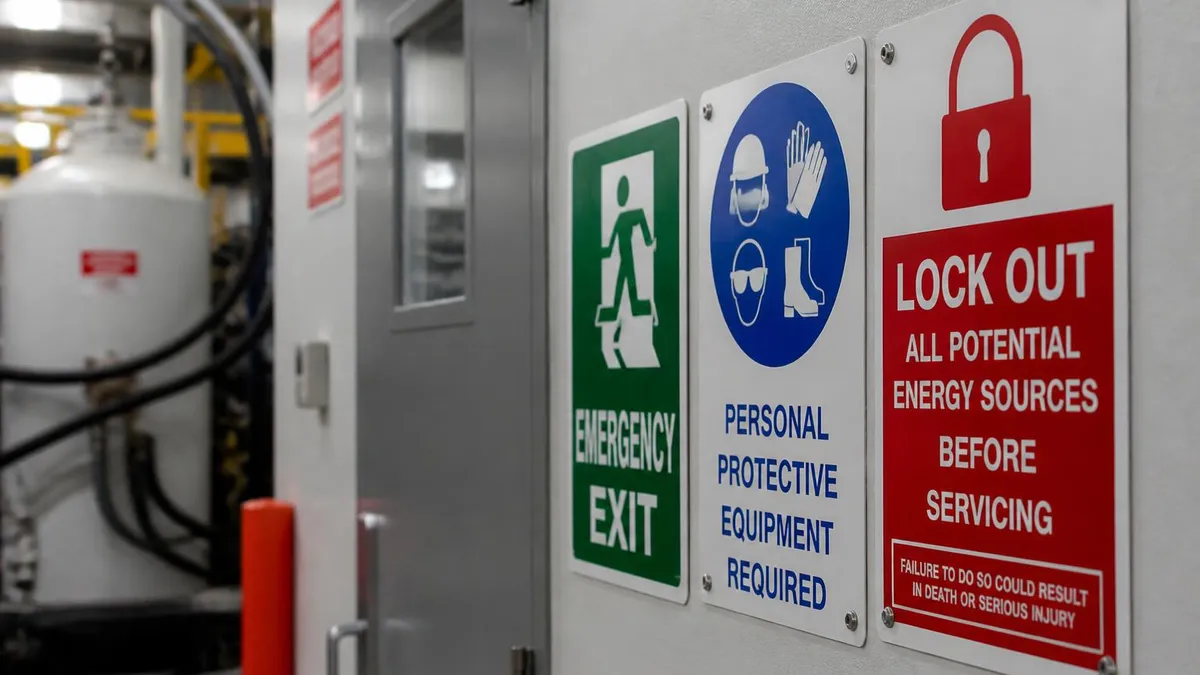
Electrical safety spans both construction and general industry curricula and includes topics such as lockout/tagout procedures, ground fault circuit interrupters, extension cord ratings, and overhead power line clearance distances. OSHA's electrical standards require that energized work be performed only when de-energizing the equipment is infeasible or would create greater hazards. Lockout/tagout, or LOTO, is one of the most procedure-heavy topics in the course, requiring you to understand the exact sequence of steps for controlling hazardous energy during equipment maintenance.
Personal protective equipment is covered extensively in OSHA 30 training because it represents the last line of defense in the hierarchy of controls. The hierarchy moves from elimination of the hazard at the top, through substitution, engineering controls, and administrative controls, before reaching PPE at the bottom.
Assessments frequently ask you to apply this hierarchy to real workplace scenarios and identify which control level should be preferred. Understanding that PPE is the least preferred option — not the first resort — is a concept that trips up many test-takers who are accustomed to simply grabbing gloves or a hard hat rather than addressing root causes.
Scaffolding, cranes and rigging, excavation and trenching, and concrete and masonry are construction-specific topics with detailed standards that require careful study. Trenching standards, for example, require a competent person to classify soil type before any worker enters an excavation, and the protection method selected depends on that classification. Getting these procedural sequences right on assessments requires not just memorizing rules but understanding the logic behind them. Ladders, another high-tested area, have specific requirements for angle, extension above landing, load capacity, and inspection that appear repeatedly across different question formats.
For general industry trainees, ergonomics, machine guarding, walking and working surfaces, and powered industrial trucks represent major topic areas not typically covered in the construction track. Machine guarding in particular is a complex subject with different guarding requirements depending on the type of hazard, the machine's operating speed, and the point of operation. Familiarizing yourself with the types of guards — fixed, interlocked, adjustable, and self-adjusting — and knowing which type is appropriate in different manufacturing contexts will prepare you for the scenario-based questions that authorized trainers frequently use to assess comprehension rather than simple memorization.
OSHA 30 Study Strategies by Training Track
The OSHA 30 Construction track follows 29 CFR Part 1926 and focuses on hazards unique to building, demolition, and civil work environments. Prioritize the Fatal Four — falls, struck-by, electrocution, and caught-in hazards — since these account for the majority of quiz questions and real-world fatalities. Use diagrams to memorize guardrail heights, ladder angles, and excavation sloping ratios. Practice applying OSHA standards to site-specific scenarios because trainers rarely ask simple definition questions; they want to know you can apply knowledge in context.
Scaffold safety, trenching and excavation, and crane and rigging topics each carry significant weight in the construction curriculum. For scaffolding, know the differences between supported and suspended scaffolding, maximum platform spans, and fall protection requirements at different heights. For excavations, focus on the four soil classifications (A, B, C, and stable rock) and the protective systems for each. Timed practice questions in these areas help you build the automatic recall you need when assessments are given at the end of a long day of training.

OSHA 30 Training: Is It Worth It for Your Career?
- +Qualifies you for supervisory and foreman roles on federally funded construction projects
- +Demonstrates a higher level of safety competency than the OSHA 10 to employers and insurers
- +Reduces on-the-job liability for supervisors by documenting safety training compliance
- +Opens doors to higher-paying safety officer and site manager positions across industries
- +DOL wallet card is nationally recognized and respected by general contractors and project owners
- +Improves your ability to identify and correct hazards before OSHA inspectors do, avoiding costly citations
- −Requires a minimum 30-hour time commitment that can be difficult to schedule around active job duties
- −Online courses can be costly, ranging from $150 to $250 or more depending on the provider
- −No official OSHA renewal requirement, but many employers informally require refresher every 3 to 5 years
- −The DOL card itself does not constitute OSHA certification in the legal sense — it confirms training completion only
- −Online format requires strong self-motivation; some trainees find the lack of instructor interaction challenging
- −Course content varies somewhat between providers, meaning the depth of coverage on specific topics can differ significantly
OSHA 30 Exam-Day Preparation Checklist
- ✓Confirm your course provider is a DOL-authorized OSHA Outreach Training Program trainer before enrolling.
- ✓Identify your training track — Construction (29 CFR 1926) or General Industry (29 CFR 1910) — and stick to it.
- ✓Complete at least three full OSHA 30 practice tests before the first day of training.
- ✓Review all OSHA Fatal Four statistics and the injury/illness prevention program framework.
- ✓Memorize the GHS hazard communication SDS's sixteen required sections and label elements.
- ✓Study lockout/tagout step sequences and be able to apply them to scenario-based questions.
- ✓Review fall protection height thresholds for both construction (6 ft) and general industry (4 ft).
- ✓Practice reading OSHA citation scenarios and identifying the correct standard that was violated.
- ✓Bring a government-issued photo ID to any in-person course session for identity verification.
- ✓Follow up with your employer after completing the course to request your DOL wallet card promptly.
70% Is the Magic Number — But Aim Higher
Most OSHA 30 training providers require a minimum score of 70 percent on module quizzes to advance through the course. However, candidates who consistently score 85 percent or above on practice tests report significantly lower test-day anxiety and complete the course faster with fewer retakes. Build a 15-point buffer in your preparation so that normal exam-day nerves do not cost you a passing score.
One of the most common questions from new enrollees is whether the OSHA 30 Construction and OSHA 30 General Industry courses are interchangeable. The short answer is no. While both courses share foundational content about OSHA's authority, the rights of workers and employers, and general hazard recognition principles, the regulatory standards they draw from are fundamentally different. If you work on construction sites, you must complete the Construction track. If you work in a manufacturing plant, distribution center, or office environment, the General Industry track applies to you.
Supervisors who oversee workers in both environments may ultimately need to complete both courses, though this is relatively rare. More commonly, employers in industries like maintenance and repair, where workers move between buildings and outdoor construction sites, will direct their employees toward the track that most closely matches their primary daily environment. When in doubt, ask your employer's safety manager or HR department before enrolling, because taking the wrong track may mean your DOL card does not satisfy your employer's specific contract requirements.
The content differences between the two tracks go beyond which regulatory citations appear on your card. Construction training spends considerably more time on scaffolding, excavation, concrete and masonry, and cranes and rigging because these are construction-specific hazards with their own detailed sub-standards under Part 1926. General industry training, by contrast, devotes more time to machine guarding, powered industrial trucks, ergonomics, and specific chemical process safety topics found only in Part 1910. If you study the wrong track, even your best preparation effort will leave significant content gaps on assessments.
State-plan states add another layer of complexity. Twenty-two states and two territories operate their own OSHA-approved workplace safety programs, sometimes called state plans. These programs must be at least as effective as federal OSHA, but they can and sometimes do adopt standards that are more stringent.
For example, California's Division of Occupational Safety and Health (Cal/OSHA) and Washington's Department of Labor and Industries (L&I) have specific requirements that go beyond federal minimums in areas such as heat illness prevention and injury and illness prevention programs. If you work in a state-plan state, be aware that your OSHA 30 training will cover federal standards, but your employer may require additional state-specific training on top of your DOL card.
The DOL wallet card you receive upon completing an OSHA 30 course is issued by the Outreach Training Program and is not the same as a professional certification or license. OSHA itself does not certify individuals; it certifies trainers. Your card documents that you successfully completed the required hours of instruction from an authorized trainer. Some employers and project owners use the terms 'OSHA certified' loosely to mean DOL card holder, but this distinction matters in legal and compliance contexts. Knowing the difference helps you answer interview questions accurately and avoid overstating your credentials.
Renewal is another area where confusion is common. OSHA does not set an official expiration date on the 30-Hour DOL card. However, industry practice, employer policies, and some state or local regulations may require periodic refresher training — typically every three to five years.
The Associated Builders and Contractors, the Associated General Contractors, and similar trade associations often recommend voluntary renewal to ensure supervisors stay current with regulatory changes. OSHA updates its standards periodically, and a significant revision — such as the updated silica rule (1926.1153) or the walking-working surfaces rule (1910.28) — may introduce material that was not covered in an older training course.
Understanding the distinction between required and elective topics within the OSHA 30 curriculum helps you prepare more efficiently. OSHA mandates certain topic hours — for example, at least two hours on OSHA focus four hazards in construction — but authorized trainers have some flexibility in how they allocate remaining hours among elective topics. This means that two different OSHA 30 classes may not cover exactly the same elective content, which is one reason why broad practice testing across all major topic areas is more useful than studying only what one provider emphasizes in its materials.
The Department of Labor does not maintain a public database of valid OSHA 30 card holders, which has made fraudulent cards a growing problem on job sites. Employers and general contractors can verify a trainer's authorization status through the OSHA Outreach Training Program online directory, but the cards themselves cannot be easily authenticated. Always enroll only with a trainer listed in the official DOL directory, and retain your course completion documentation in addition to your wallet card as proof of legitimate training.
Once you hold your OSHA 30 DOL card, the career benefits begin to compound quickly. In the construction industry, the card is often a minimum requirement for foreman, superintendent, and safety officer positions on projects valued above a certain threshold — frequently set at $1 million or more by general contractors operating under union agreements or public agency contracts. Federal construction projects in particular have explicit OSHA 30 requirements for supervisors, making the card essentially non-negotiable if you want to advance in the public works sector.
Salary data from the Bureau of Labor Statistics and industry wage surveys consistently shows that construction supervisors and safety specialists with formal OSHA training earn meaningfully more than their peers without credentials. The premium varies by region and employer, but averages between 10 and 20 percent above the base rate for comparable roles. Over a 10-year career, this premium can translate to $100,000 or more in additional earnings, making the $150 to $250 investment in an OSHA 30 course one of the highest-return professional development decisions available to tradespeople and supervisors.
Beyond construction, the OSHA 30 is increasingly valued in warehousing, logistics, and manufacturing sectors where workplace injury rates remain high and employers face growing pressure from insurers and regulators to demonstrate proactive safety management. Amazon, UPS, and numerous large manufacturing employers have made OSHA 10 or 30 training a standard part of their onboarding for supervisors. In healthcare settings, which fall under the general industry track, OSHA 30 credentials are becoming more common among facilities managers and environmental services supervisors who oversee workers exposed to bloodborne pathogens, chemical hazards, and ergonomic risks.
For workers interested in transitioning into dedicated safety roles, the OSHA 30 is typically considered the entry-level credential in a longer professional development pathway. Many safety professionals go on to earn the Construction Health and Safety Technician (CHST) credential from the Board of Certified Safety Professionals, the Associate Safety Professional (ASP), or ultimately the Certified Safety Professional (CSP) designation. Each of these advanced credentials requires documented work experience and continuing education, and the OSHA 30 training provides the regulatory knowledge foundation that supports all of them.
Employers who invest in OSHA 30 training for their workforce also see measurable business benefits beyond compliance. Companies with formally trained safety supervisors experience fewer recordable incidents, lower workers' compensation insurance premiums, reduced OSHA citation frequency, and improved project completion rates because safety incidents disrupt scheduling and workforce availability. Insurance carriers have begun offering premium discounts to construction firms that can demonstrate a certain percentage of supervisors hold OSHA 30 credentials, creating a direct financial incentive for employers to sponsor training costs. Understanding these dynamics helps you make the business case to your employer for covering your training expenses.
For supervisors managing multi-trade crews on complex projects, the OSHA 30's broad topic coverage across disciplines is particularly valuable. A concrete foreman who understands not just concrete and masonry standards but also crane rigging, scaffold safety, and electrical hazards is better equipped to coordinate safely with other trades and catch cross-disciplinary hazards before they result in incidents. This holistic safety awareness is what distinguishes a supervisor who simply holds a card from one who has genuinely internalized the OSHA 30's principles and can apply them dynamically in the field.
The investment of time and money in OSHA 30 training pays dividends throughout your career, not just in your next job search. Supervisors who complete the training consistently report feeling more confident in their ability to recognize, evaluate, and control hazards — and that confidence translates to better team leadership, stronger morale, and demonstrably safer project outcomes.
If you are ready to take the next step in your safety training journey, start with our free practice resources and build from there. For a deeper dive into required safety gear and how standards shape equipment decisions on the job site, explore our comprehensive guide on osha 30 practice test preparation tools and safety equipment compliance.
The most effective OSHA 30 test preparation strategies share one common trait: active engagement with the material rather than passive reading. Simply scrolling through a study guide or watching training videos without pausing to test yourself creates an illusion of learning that evaporates quickly under assessment conditions. The most successful candidates combine spaced repetition of key regulatory facts with scenario-based practice questions that mirror the format used by authorized trainers, who frequently present hypothetical job site situations and ask which OSHA standard applies or which action the supervisor should take.
Timing yourself on practice questions is a skill in itself. Many OSHA 30 assessments are not heavily time-pressured, but the habit of reading each question carefully and eliminating obviously wrong answers before committing to a final choice pays dividends regardless of time limits. OSHA question writers frequently include plausible-sounding distractors — answers that contain real OSHA terminology but apply it to the wrong situation or wrong standard. Training yourself to slow down and read all four answer choices completely, rather than selecting the first answer that sounds right, is one of the single highest-impact test-taking behaviors you can develop.
Group study is underutilized by most OSHA 30 candidates but can be remarkably effective, especially for covering a broad curriculum efficiently. Dividing the major topic areas among study partners and having each person teach their topics to the group leverages the well-documented learning benefit of teaching others.
When you have to explain why a standard requires a specific action — not just what the action is — you develop the deeper comprehension that allows you to answer novel scenario questions you have never seen before. Many construction firms that sponsor group OSHA 30 classes report higher first-time pass rates on module quizzes when they encourage informal peer review sessions between training days.
Take advantage of OSHA's own free educational resources as a supplement to commercial practice tests. OSHA's website provides access to the complete regulatory text of 29 CFR Parts 1910 and 1926, as well as compliance assistance publications, frequently asked questions, and inspection statistics by industry. Reviewing actual OSHA inspection data — which industries are cited most frequently and for which violations — provides real-world context that makes abstract regulatory language more concrete and memorable. OSHA's QuickTakes newsletter and the OSHA Training Institute's online catalog are also valuable free resources that many candidates overlook entirely.
On the day of your training sessions, arrive prepared to engage rather than just observe. Authorized trainers are required to provide interactive instruction — pure lecture is not compliant with OSHA Outreach Training Program requirements — which means you will have opportunities to ask questions, discuss case studies, and work through scenarios. Trainees who actively participate in these discussions consistently report higher retention of the material and greater confidence during module assessments. Bring a notebook and jot down any regulatory citation numbers or numerical thresholds your trainer emphasizes, as these specific details frequently appear in quizzes.
After completing your OSHA 30 training, do not let your knowledge stagnate. OSHA issues new standards, updates existing regulations, and publishes enforcement guidance throughout the year. Subscribing to OSHA's email updates and following the agency's news releases ensures you stay aware of changes that could affect your workplace responsibilities.
Major regulatory changes — such as the revised beryllium standards, the updated silica rule, and the walking-working surfaces rule finalized in recent years — represent the type of content that would not appear in training materials produced before those rules took effect. Staying current is not just professionally responsible; it protects you and your workers from hazards that newer standards were specifically designed to address.
Finally, remember that the OSHA 30 card is a milestone, not a destination. The most effective safety supervisors treat regulatory compliance as a floor rather than a ceiling and continuously look for opportunities to identify and eliminate hazards above and beyond what the standards technically require.
Building a genuine safety culture on your team — one where workers feel empowered to report hazards without fear of retaliation and where near-misses are treated as learning opportunities rather than embarrassments — is the ultimate goal that the OSHA 30 training is designed to support. The practice questions, the card, and the knowledge are all in service of that larger mission: bringing every worker home safely at the end of every shift.
OSHA Questions and Answers

OSHA Approved Safety Glasses: Complete 2026 Guide to ANSI Z87.1 Eye Protection Standards, Selection, and Workplace Compliance

OSHA Lightning Safety: Standards, Rules & Outdoor Worker Protection Guide for 2026

OSHA 10 Hour General Industry: Complete 2026 Guide to Training, Topics, Costs, and DOL Card

Is OSHA a Government Agency? The Federal Body Behind US Workplace Safety

How to Get OSHA Certified: Complete 2026 Guide to Training, Cards & Compliance
About the Author

Certified Safety Professional & OSHA Compliance Expert
Indiana University of Pennsylvania Safety SciencesDr. William Foster holds a PhD in Safety Science from Indiana University of Pennsylvania and is a Certified Safety Professional (CSP) and Certified Hazardous Materials Manager. With 20 years of occupational health and safety management experience across construction, manufacturing, and chemical industries, he coaches safety professionals through OSHA certification, CSP, CHST, and safety management licensing programs.
Join the Discussion
Connect with other students preparing for this exam. Share tips, ask questions, and get advice from people who have been there.
View discussion (8 replies)