
What Is the NREMT? Career Overview and Certification Guide 2026 October
What is NREMT? National Registry of EMTs explained: 1970 founding, EMR/EMT/AEMT/Paramedic levels, certification vs licensure, recert cycle, resume tips. 🎓
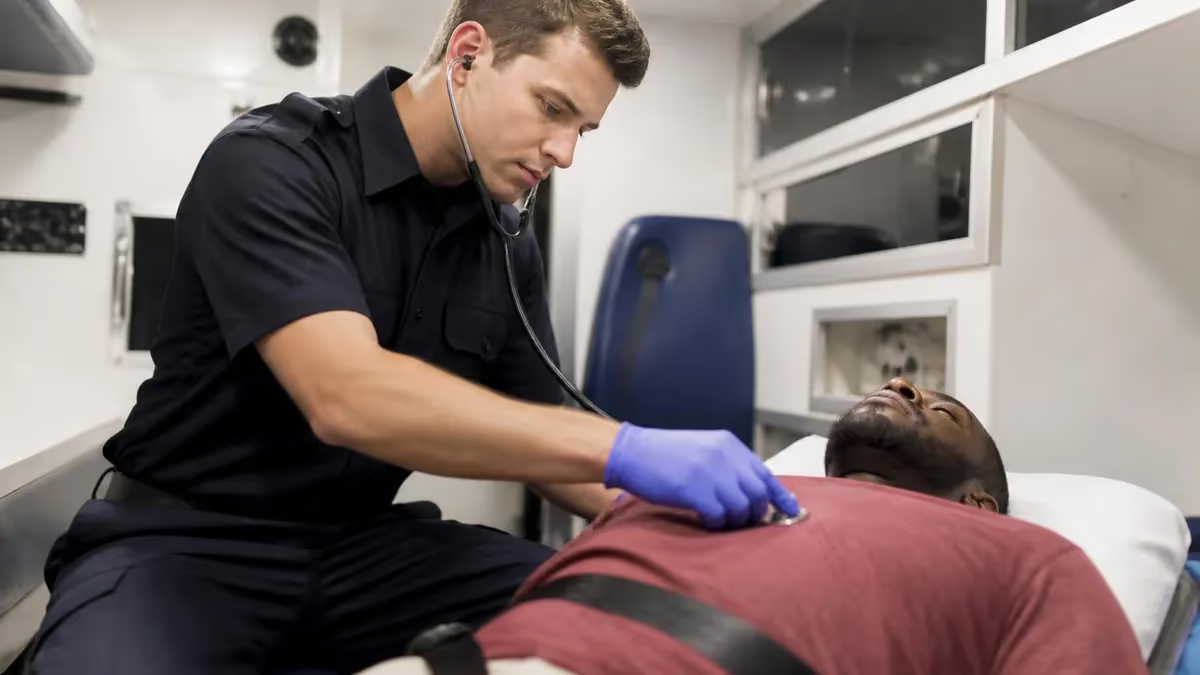
Walk into any ambulance bay in the United States and you'll find people who've been through the same gatekeeping ritual — a Pearson VUE testing seat, a state EMS office, and an organisation in Columbus, Ohio that most patients have never heard of. That organisation is the National Registry of Emergency Medical Technicians. The acronym you'll see stitched onto patches, embossed on wallet cards, and tucked into job listings is NREMT, and understanding what it actually does turns out to be surprisingly useful whether you're starting out or twenty years deep in EMS.
Most people first encounter the term as students. A community college instructor mentions it in week one of an EMT course. A career-changer reads the job description for a county ambulance service and sees "NREMT certified preferred" in the fine print. A parent of a high-school senior helping with applications notices it on a paramedic programme prospectus. The phrasing varies — what is NREMT, what is an NREMT, nremt meaning — but the underlying question is the same. Who runs this thing, what does it certify, and why does it keep showing up?
Here's the short answer before we go deeper. The NREMT is a private, non-profit certifying body founded in 1970 that issues nationally recognised credentials at four EMS practice levels: Emergency Medical Responder (EMR), Emergency Medical Technician (EMT), Advanced EMT (AEMT, sometimes called Intermediate by older state systems), and Paramedic. Forty-six states plus the District of Columbia, Puerto Rico, Guam, and the Virgin Islands use NREMT certification as part of their licensure process — meaning if you want to work as an EMT or paramedic in most of the country, the journey runs through Columbus.
That's the headline. The full picture has a lot more texture: how the NREMT differs from a state licence, why recertification cycles matter for your career, how to put the credential on a resume so recruiters actually notice, and where the organisation fits inside the bigger machine of American emergency medical services. The next sections walk through each piece so the next time someone asks you what NREMT stands for you can answer with confidence — and steer them toward the practical bits that matter for their situation.

NREMT by the Numbers
The story of the NREMT begins with a problem that sounds quaint now but mattered enormously in the late 1960s — the country had no consistent definition of what an ambulance crew member should know. A 1966 report from the National Academy of Sciences, often called the white paper on "Accidental Death and Disability," exposed how badly pre-hospital care lagged behind hospital medicine.
Ambulances were sometimes hearses with a driver and no medical training. Outcomes varied wildly by region. Federal lawmakers responded with the Highway Safety Act of 1966, and in its wake a coalition of physicians, EMS leaders, and trauma specialists pushed for a body that could test and certify ambulance personnel against a single national standard.
The National Registry of Emergency Medical Technicians launched in 1970, headquartered in Columbus, Ohio, with seed funding from the federal government and the early support of organisations like the American College of Surgeons. From the beginning it was structured as a non-profit certifying body — not a licensing authority, not a regulator.
The distinction sounds bureaucratic but it shapes everything the organisation does today. A certification is a private credential that says "this person passed our standardised exam and met our eligibility requirements." A licence is a government-issued legal right to practise. The NREMT issues the first; states issue the second.
What changed the game was state adoption. As the EMS profession matured through the 1970s and 1980s, state EMS offices realised they could outsource the heavy lifting of exam development and psychometric validation to a body that was already doing it nationally. By the 2000s, the majority of states had folded NREMT certification into their licensure pathways either as a one-time requirement at entry or as an ongoing recertification mechanism. That pattern continues today, with most state EMS offices accepting a current NREMT credential as proof of competency for licence issuance or renewal.
The result is a quietly powerful piece of infrastructure. The NREMT doesn't employ EMTs, doesn't write protocols, doesn't dispatch ambulances. It builds and administers psychometrically defensible exams, sets the eligibility criteria for who can sit those exams, and maintains a registry of currently certified providers. Everyone from the volunteer EMT in rural Montana to the flight paramedic in downtown Houston has, at some point, sat in front of an NREMT-developed cognitive exam and waited for the pass-or-fail email to land in their inbox.
NREMT Certification vs. State Licensure
This is the distinction that trips up the most people. NREMT certification is a private credential issued by a non-profit. State licensure is the legal authorisation to practise as an EMT or paramedic in a specific state. In most states the licence is granted on the basis of a current NREMT certification — but the licence itself comes from the state EMS office, not from the Registry. If you let your NREMT lapse but keep your state licence current through local CE, you can still work. If you keep your NREMT current but move to a state that doesn't accept it (a small handful, most notably parts of New York and certain reciprocity-restricted areas), you may need additional state-level steps before you can clock in.
The four levels of NREMT certification map onto the structure of the American EMS workforce, and each one represents a meaningful jump in scope and responsibility. At the entry tier sits the Emergency Medical Responder, or EMR — sometimes called "first responder" in older terminology, which is where the search phrase nremt first responder comes from.
EMRs are the people who provide initial care while waiting for transport-capable units to arrive. Think volunteer firefighters in rural districts, ski patrollers, lifeguards, industrial safety teams. Training runs roughly 50-80 hours and the scope covers bleeding control, CPR, basic airway management, and stabilisation until higher-level providers take over.
The Emergency Medical Technician — the EMT, sometimes labelled EMT-Basic by older state systems — is the workhorse of the ambulance world. EMT-level training typically runs 120-150 hours and covers all the EMR skills plus patient assessment, oxygen administration, automated defibrillation, splinting, childbirth assistance, and a wider range of medications including aspirin, oral glucose, and naloxone. This is the level most ambulance services hire at, and it's the credential most often referenced when a job listing simply says "EMT required." Roughly two-thirds of the nationally registered workforce sits at this level.
Above the EMT comes the Advanced EMT or AEMT. Historically this tier was called the EMT-Intermediate (you'll still see nremt intermediate as a search term, and some states use the old language in their licence titles). AEMT training adds intravenous access, a broader medication list, advanced airway adjuncts like the supraglottic airway, and limited cardiac monitoring. It's a sweet spot for services that want more clinical capability than basic EMTs but can't staff full paramedics on every truck — common in suburban and rural systems.
At the top of the NREMT ladder sits the Paramedic, sometimes shortened to medic or NREMT-P. Paramedic training is a serious commitment — typically 1,200-1,800 hours stretched across one to two years of full-time study, with clinical and field internships baked in. The scope includes full advanced cardiac life support, 12-lead ECG interpretation, manual defibrillation and cardioversion, a long list of medications, endotracheal intubation, and complex decision-making for critical patients.
The Four NREMT Certification Levels
Entry-tier credential, 50-80 hours of training, focused on bleeding control, CPR, AED, and basic stabilisation. Common among volunteer firefighters, ski patrol, lifeguards, and industrial safety teams. Cognitive exam: 90-110 adaptive items.
Workforce backbone, 120-150 hours of training. Adds patient assessment, oxygen, AED, splinting, childbirth, and select medications. The level most ambulance services hire at. Cognitive exam: 70-120 adaptive items.
Sometimes still called EMT-Intermediate. Adds IV access, supraglottic airways, broader medication list, and limited cardiac monitoring. Common in services bridging EMT and paramedic capability.
Top NREMT tier, 1,200-1,800 hours of training over 12-24 months. Full ACLS scope, 12-lead ECG, manual defibrillation, intubation, and a wide pharmacology kit. The clinical lead on most ALS ambulances.

One question that comes up constantly in EMS forums and reddit threads is some variation of nremt vs emt — what's the difference, are they the same thing, do you need both? The short answer is they're related but not interchangeable. EMT is a level of clinical practice; NREMT is the organisation that certifies you to practise at that (or another) level. So a person can be an EMT (level of training) who holds NREMT certification (national credential) and a state licence (legal authorisation). All three layers stack.
Where it gets confusing is informal usage. People say "I'm an EMT" when they mean "I'm certified at the EMT level and currently licensed to work as one." They say "I'm NREMT certified" when they mean their National Registry credential is current. Both are correct shorthand, but they're describing different facets of the same status. In hiring conversations the cleanest answer to "are you NREMT certified?" is to state your level and your card's expiry date — "yes, NREMT EMT, expires June 2027" tells the recruiter everything in one sentence.
There's also a regional flavour to the language. In states that don't use NREMT for licensure, providers tend to identify by their state credential alone — they're "a New York State EMT" rather than NREMT EMT. In states that lean heavily on the National Registry, the NREMT label shows up everywhere from email signatures to LinkedIn headlines. Neither approach is wrong; it reflects where the practical authority sits in each market. If you're job-hunting across state lines, having both your NREMT and state-specific credentials clearly listed prevents confusion in HR systems that sometimes filter by exact keyword matches.
NREMT Levels Compared
The EMR sits at the entry tier of the NREMT certification ladder. Training runs roughly 50-80 hours and centres on what to do in the first minutes after a 911 call before higher-level providers arrive. Scope of practice includes bleeding control, CPR, AED use, basic airway management with adjuncts, oxygen administration in some states, splinting, and patient handover. EMRs do not typically staff transport ambulances — their role is initial stabilisation. Common employers include volunteer fire departments, parks services, industrial safety teams, ski patrol, and lifeguarding operations. The cognitive exam is computer-adaptive, ranging from 90 to 110 items, and the application fee sits around $85.
One of the most practical questions people ask once they've passed an NREMT exam is how to put NREMT on resume documents in a way that actually helps. The answer depends on the field you're applying to. For EMS-specific roles, the credential belongs in two places: a dedicated certifications section near the top of the resume, and inline within the role descriptions where you used it. For non-EMS roles where the credential adds context — say, a healthcare-adjacent job in nursing, public health, or emergency management — keeping it in the certifications block is enough.
Format matters more than people realise. "NREMT-EMT, valid through MM/YYYY" or "National Registry EMT (NREMT), current" both read cleanly. Avoid the temptation to add unnecessary punctuation or to spell out the acronym in the credential line — recruiters and applicant tracking systems both scan for the abbreviation. If you're applying for paramedic roles after just upgrading, list both: "NREMT-Paramedic (current), NREMT-EMT (lapsed June 2024 on upgrade)." That shows your trajectory.
One subtle move that helps with applicant tracking systems is putting the National Registry of Emergency Medical Technicians (NREMT) full phrase somewhere in the document, usually inside a credential line or a summary paragraph. ATS systems sometimes match on the long form even when recruiters search the abbreviation, and vice versa.
The cost is one extra line of text; the upside is your resume surfaces in both keyword searches. Some hiring managers in fire-based EMS systems also appreciate seeing your state licence number listed alongside the NREMT credential — it signals you've done the full integration work, not just the national exam.
NREMT certification is not lifetime — every level requires recertification on a two-year cycle. The model used by the Registry combines continuing education hours (broken into national, local, and individual components) with maintenance of state licensure and a current CPR-BLS card. Letting any of these lapse cancels your NREMT registration and forces you to retest from scratch, which can mean another Pearson VUE appointment, another application fee, and another round of waiting for an Authorization to Test letter. Set calendar alerts 90, 60, and 30 days before your expiry date — and start logging CE hours from day one of the cycle, not in a panic at month 22.
If you're new to all this and wondering when was the NREMT established — the answer, again, is 1970. But the founding date alone tells you very little about why the organisation matters today. What matters is the way the Registry has evolved alongside the EMS profession. In the early years the cognitive exam was a paper-and-pencil instrument, scored by hand, administered at sporadic centralised sittings around the country. Pass rates were inconsistent. Item banks were small. The credential carried weight in some states and very little in others.
Three changes turned the NREMT from a useful credential into the de facto national standard. The first was the move to computer-adaptive testing through Pearson VUE, which let candidates sit the exam at any one of thousands of test centres on a date that suited them, and which gave the Registry a psychometrically rigorous engine for delivering items.
The second was the gradual alignment with the National EMS Education Standards — a curriculum framework developed by federal stakeholders that defines what each level of provider should know. State approval of EMS programmes increasingly maps to those standards, which means NREMT exam content reflects what students are actually taught.
The third change was the recertification model. By tying ongoing certification to continuing education in a structured way (the National Continued Competency Programme, with its mix of national, local, and individual hours), the Registry created an incentive structure for lifelong professional development. The system isn't perfect — plenty of providers grumble about CE tracking — but it provides a measurable baseline that employers and state regulators can rely on. A current NREMT card means more than "this person passed a test once"; it signals an active provider keeping up with the field.

NREMT Certification: Quick Checklist
- ✓Complete a state-approved EMS course at your target level (EMR, EMT, AEMT, or Paramedic)
- ✓Maintain a current CPR-BLS certification at the healthcare provider level
- ✓Have your programme director sign off on course completion in the National Registry portal
- ✓Apply for the cognitive exam at nremt.org and pay the level-specific application fee
- ✓Wait for the Authorization to Test (ATT) email — 90-day window starts on receipt
- ✓Schedule the cognitive exam through Pearson VUE within the ATT window
- ✓Complete the state psychomotor skills evaluation (handled by your state EMS office)
- ✓Apply for state licensure once both exams are passed and the credential is logged
- ✓Start logging continuing education hours on day one of your two-year recert cycle
For people weighing whether to pursue NREMT certification at all, it's worth being honest about both sides of the picture. The credential opens doors — particularly across state lines, in federal employment contexts (think military reservists, national disaster response teams, federal land management agencies), and in any role where a hiring manager wants third-party validation of clinical competence. It also signals professionalism in a field where credentialing has historically been uneven. A current NREMT card on a resume is shorthand for "this person has been verified to a national standard."
On the other side, some providers find the recertification burden genuinely frustrating, especially in low-volume rural systems where call volume alone won't generate the required CE hours. Tracking continuing education across the national, local, and individual buckets demands organisation. Application fees stack up if you upgrade levels or let credentials lapse. And in the small number of states that don't accept NREMT for licensure, the credential offers limited day-to-day utility unless you plan to move.
The honest answer for most new entrants is that NREMT certification is worth pursuing as a default — the doors it opens outnumber the inconveniences it imposes — unless you have specific, well-researched reasons to think your career will play out entirely inside a non-Registry state.
For experienced providers thinking about whether to keep recertifying versus letting it lapse, the calculus shifts. If you're settled in your state, plan to stay, and your local CE keeps the state licence renewable on its own, dropping the NREMT may be a reasonable choice. If you anticipate any cross-state movement — military, family, career — keep it current.
Holding Current NREMT Certification
- +Recognised in 46 states plus DC and US territories for licensure or reciprocity
- +Streamlines cross-state moves — many states grant licence by endorsement to current NREMT holders
- +Required or strongly preferred for federal EMS roles, military reservist positions, and disaster response teams
- +Signals to employers that you've met a third-party national standard, not just a local one
- +Centralised CE tracking through the Registry portal once you understand the system
- −Two-year recertification cycle adds administrative overhead even if your state licence is on a different schedule
- −Continuing education requirements split into national, local, and individual hours — easy to miscount
- −Application fees apply at initial registration and at every level upgrade
- −A handful of states (notably parts of New York) don't accept NREMT for primary licensure
- −Letting any layer lapse — CPR, state licence, CE hours — invalidates the entire credential
Where does the NREMT fit in the bigger machine of American emergency medical services? The answer is more nuanced than the simple "certifying body" label suggests. The Registry sits at the intersection of three larger systems — federal EMS oversight, state regulatory authority, and the professional infrastructure built up by associations like the National Association of EMTs (NAEMT), the National Association of EMS Physicians (NAEMSP), and the National EMS Management Association (NEMSMA).
Federal EMS oversight runs primarily through NHTSA's Office of EMS, which develops the National EMS Education Standards and Scope of Practice Model. The NREMT aligns its exams with those federal documents — that's the link that makes the credential meaningful across state lines. State EMS offices handle the legal authorisation to practise, the protocols you'll follow on calls, and the disciplinary side of credentialing. The NREMT handles the standardised, psychometrically validated exam that most of those state offices outsource. Professional associations handle advocacy, peer education, and the day-to-day cultural work of the profession.
For practitioners, the practical upshot is that you'll deal with three different institutions across your career — the NREMT for your national credential, your state EMS office for your licence and protocols, and (usually) at least one professional association for ongoing education and community. None of them replaces the others.
The smart move is to understand what each one does so you know who to contact when something specific comes up — a name change, a licence lapse, a continuing education question, a complaint about clinical practice. They are not the same building, even when their websites sometimes feel like they are.
So back to the original question — what does NREMT stand for? Literally, the National Registry of Emergency Medical Technicians. Practically, it's the private non-profit founded in 1970 that issues nationally recognised certifications at four levels of EMS practice and that quietly underpins the licensure process in most of the country.
Whether you're a high-school student weighing an EMS career, a career-changer eyeing your first ambulance ride, or a veteran provider helping a new hire understand the paperwork, the role of the Registry is the same: provide a standardised, defensible measure of clinical competence that travels with the practitioner across state lines and across decades of work.
The credentials it issues — EMR, EMT, AEMT, Paramedic — track the structure of the workforce itself. The recertification cycle keeps providers engaged with continuing education. The relationship with state EMS offices makes the credential meaningful in real-world hiring. And the operational reach through Pearson VUE makes sitting the exam logistically tractable for candidates wherever they live. None of that is dramatic. All of it is durable.
The next time someone asks what is the NREMT, you can give them the one-line answer (national non-profit, certifies EMS providers, four levels, two-year recert) and then point them at the practical questions that actually shape their decisions: which level fits your career goals, how the cognitive and psychomotor exams work, what continuing education looks like at your level, and how the credential plays in the specific state you plan to work. Those are the conversations that turn the acronym into useful career planning.
NREMT Questions and Answers
About the Author

Paramedic & Emergency Services Certification Trainer
George Washington UniversityCaptain Ryan O'Brien is a licensed paramedic and NREMT-certified emergency medical professional with a Bachelor of Science in Emergency Medical Services from George Washington University. He has 15 years of field experience as a paramedic and firefighter, and has coached hundreds of EMT and paramedic candidates through their NREMT written and psychomotor licensing examinations.
Join the Discussion
Connect with other students preparing for this exam. Share tips, ask questions, and get advice from people who have been there.
View discussion (2 replies)