
Police Fitness Test — Complete Guide (2026 October)
Police fitness test breakdown: 🔎 1.5-mile run, push-ups, sit-ups, sprint, vertical jump, agility. Standards by sex/age, what happens if you fail
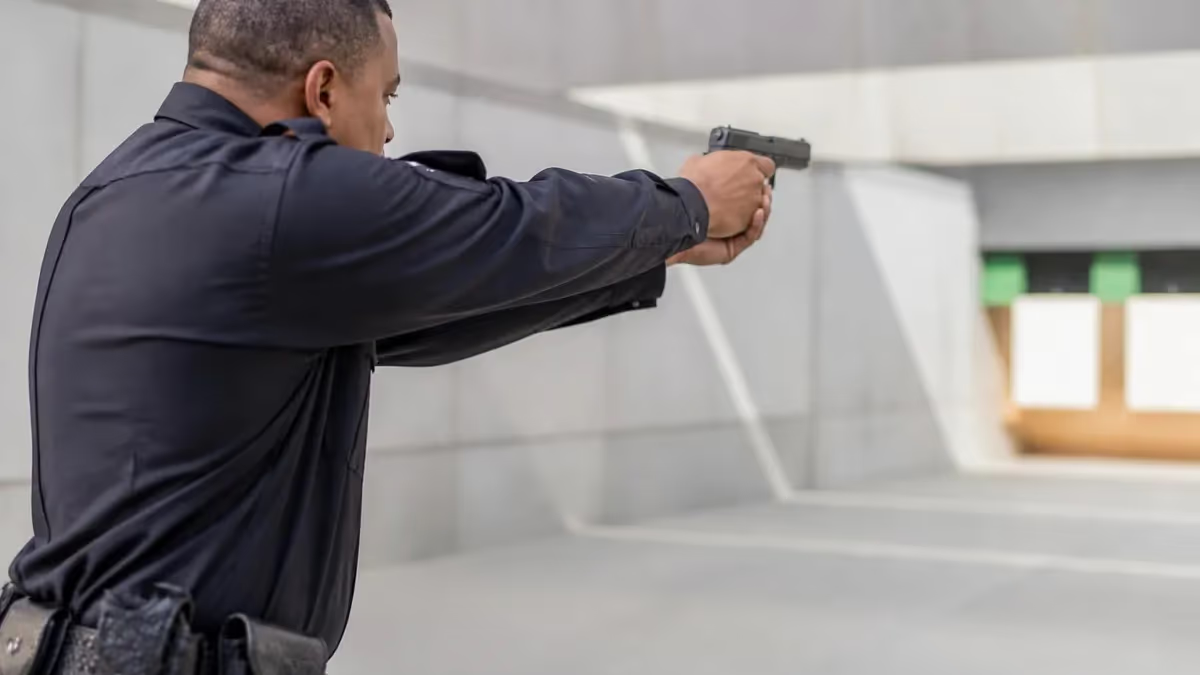
Police Fitness Test — What You're Actually Walking Into
Short answer: the police fitness test is six events on the same morning, scored against a published table that adjusts for your age and sex. Most U.S. departments use the Cooper Institute standards — the same battery the FBI uses — and most fail candidates not on strength but on the 1.5-mile run.
You'll usually see five core events: a 1.5-mile run, a timed 300-meter sprint, push-ups (max in one minute), sit-ups (max in one minute), and a vertical jump. Some agencies add an agility/obstacle course or grip dynamometer. The order varies. The standards don't.
Here's the catch: the events feed each other. If you sprint hard on the 300-meter, your legs are wrecked for the 1.5-mile run six minutes later — and that's the event that disqualifies most candidates. Smart pacing matters as much as raw fitness.
This guide walks through every event with the actual numbers you need to hit, then covers what happens when you fail (it varies wildly by state), how to train in 8–12 weeks, day-of tactics, and how the U.S. process compares to the UK National Bleep Test (level 5.4) and the firefighter CPAT. The national police officer selection test is the written half of police hiring — the fitness test is the physical half. You usually need both.
Worth knowing: the test is not the hard part. The eight weeks before it are. Most candidates who fail did exactly two runs in the month leading up to test day. Don't be that candidate.
One more thing before we dive in: the police fitness test is age-graded and sex-graded, but it's not adjusted for body weight or height. A 6'4" 240-pound candidate runs the same 14:30 as a 5'6" 160-pound candidate. That's not a bug — it's the agency saying that on patrol, a suspect doesn't care how tall you are. The fitness floor is the fitness floor. Train accordingly.
- 1.5-mile run — typical pass: 14:30 or faster for men under 30; 16:30 for women under 30
- 300-meter sprint — typical pass: 59 seconds (men under 30); 71 seconds (women under 30)
- Push-ups (1 min) — typical pass: 25+ (men under 30); 14+ (women under 30)
- Sit-ups (1 min) — typical pass: 35+ (men under 30); 30+ (women under 30)
- Vertical jump — typical pass: 16 inches (men under 30); 12 inches (women under 30)
These are the 40th-percentile Cooper Institute thresholds — the most common cutoff. Your department may use 50th or even 70th percentile.
Cooper Standards — The Numbers Most Departments Use
- 1.5-mile run: 14:30
- 300m sprint: 59 sec
- Push-ups (1 min): 25 reps
- Sit-ups (1 min): 35 reps
- Vertical jump: 16 inches
- 1.5-mile run: 16:30
- 300m sprint: 71 sec
- Push-ups (1 min): 14 reps
- Sit-ups (1 min): 30 reps
- Vertical jump: 12 inches
- 1.5-mile run: 15:24
- 300m sprint: 59 sec
- Push-ups (1 min): 22 reps
- Sit-ups (1 min): 32 reps
- Vertical jump: 15 inches
- 1.5-mile run: 17:30
- 300m sprint: 79 sec
- Push-ups (1 min): 12 reps
- Sit-ups (1 min): 22 reps
- Vertical jump: 11 inches
- 1.5-mile run: 16:30
- 300m sprint: 72 sec
- Push-ups (1 min): 17 reps
- Sit-ups (1 min): 27 reps
- Vertical jump: 13 inches
- 1.5-mile run: 19:24
- 300m sprint: 94 sec
- Push-ups (1 min): 8 reps
- Sit-ups (1 min): 17 reps
- Vertical jump: 9 inches
What Does the Police Fitness Test Consist Of — Event by Event
1.5-Mile Run — The Event That Eliminates Most Candidates
You'll run 1.5 miles on a 400-meter track or measured course. Six laps on the track. That's it. No tricks. The trick is that you have to do it after sprinting, jumping, and pushing yourself through the strength events — unless your department runs it first, which some do.
The Cooper 40th-percentile cutoff for a 25-year-old man is 14:30. That's a 9:40 mile pace. Sounds easy on paper. It is not easy when your lungs are still recovering from the 300-meter sprint you ran twelve minutes ago.
300-Meter Sprint — All-Out, No Pacing
One lap around three quarters of a standard track. Sub-60 seconds for most men under 30. Sub-72 seconds for most women under 30. This event tests anaerobic capacity — the system you use chasing a suspect for one city block.
The mistake: people sprint the first 100m and crawl the last 100m. Better strategy is 90% effort the first 200m, hold form through the line.
Push-Ups — One Minute, Strict Form
Chest to fist (or to a sponge, depending on the agency). Full lockout at the top. Hips straight — a sag and the rep doesn't count. Take a knee or pause and you can keep going, but the clock is still running.
The published number is reps in one minute, not until failure. Pace matters. Twenty-five reps in 60 seconds means one rep every 2.4 seconds with zero breaks.
Sit-Ups — Anchored Feet, Hands Crossed on Chest
Knees bent 90 degrees, partner or pad anchors your feet, hands crossed over chest with fingertips touching shoulders. Up until elbows touch thighs, back down until shoulder blades touch the floor. One minute.
Vertical Jump — Three Attempts, Best Counts
You'll chalk your fingertips, mark your standing reach against a Vertec or wall, then jump and slap the highest vane you can reach. The difference between standing reach and peak jump is your vertical. Most agencies give three attempts and count the best.
Agility / Obstacle Course — Optional but Common
Some departments add a wall climb (4–6 feet), low crawl, weighted drag (75–165 lb dummy), stair climb, and a trigger-pull station. NPOST states tend to skip this. California POST PAT requires it. The wall is the choke point — most failures here are technique, not strength.
Grip Dynamometer — The Quiet Event
A handful of agencies test grip strength with a Jamar dynamometer. You squeeze it as hard as you can with your dominant hand. Three attempts, best counts. The pass score for men is typically 96 pounds-force; for women, 58. It's a quick event but candidates underestimate it — grip strength predicts how well you'll hold onto a struggling suspect or maintain a stable shooting grip. Train with farmer carries and dead hangs from a pull-up bar.
By the Numbers
What Happens If You Fail the Police Fitness Test
Short answer: it depends entirely on the state and the agency. There's no national rule.
Most academies allow a retake. The waiting period is typically 30 days, though some agencies require 60 or 90 days. A few — mostly larger metro departments running multiple academy cohorts per year — let you retest within two weeks. Other agencies will hold your application but require you to re-test before the next academy class starts, which could be six months out.
Then there are the hard-cutoff agencies. The Massachusetts State Police, parts of NYPD academy entry, and a handful of federal agencies disqualify you outright on first attempt failure. You can reapply, but you're starting the entire hiring process over — background, polygraph, the national police officer selection test, all of it.
If you pass the academy entrance fitness test but fail the exit test, you can be held back from graduation. Most academies build in a final PT assessment at week 22 or 24 — fail it and you typically get one remediation attempt before being released from the program. Three states (Florida, Texas, Arizona) let academies set their own policy here, and the policies vary by city.
The Honest Truth About Why People Fail
The 1.5-mile run accounts for roughly 65% of all failures, the push-ups account for another 20%, and the rest split between sit-ups, vertical, and sprint. Cardio is the consistent killer. The strength events you can muscle through on adrenaline; the run, you can't fake.
Worth knowing: failure on day one doesn't end your law enforcement career. It ends this attempt. A 30-day retake window plus four weeks of focused running fixes 80% of failed candidates. The candidates who never make it back are the ones who don't restart training within a week of the failure.

What Happens If You Fail — By State Type
States: Utah, Idaho, Oklahoma, Tennessee, Indiana, Ohio (most agencies).
Policy: Fail any one event — retake in 30 days. Fail two events — retake in 60 days. Some agencies allow unlimited retakes within the academy application window (typically 6 months). Test fee may be charged on the second attempt ($25–$75).
Catch: Some sheriff's offices in these states have stricter internal policies than the state minimum.
8-Week Police Fitness Test Training Plan
Eight weeks is enough if you start from a reasonable base — say, you can already run a mile in under 10 minutes and do 12 push-ups. If you can't, you need 12 weeks, not eight. Be honest with yourself.
Weeks 1–2: Base Building
Three runs per week: a long slow distance run (2–3 miles at conversational pace), an interval session (4 × 400m at 5K pace with 2-minute rest), and a tempo run (1.5 miles at goal pace). Two strength sessions: push-up, sit-up, and bodyweight squat circuits, three rounds of 15 reps each.
Weeks 3–5: Specificity
Switch one interval session per week to 300-meter repeats — 6 sets of 300m at goal sprint pace with 90 seconds rest. Add weighted vest walks to simulate the gear load on test day. Push-up volume rises to 4 × 25 with a 60-second rest between sets. Sit-ups: 3 × 40 with strict form.
Weeks 6–7: Race-Pace and Simulation
Run a full 1.5-mile time trial each Friday morning. Track your time week over week. Mid-week: one event-stack simulation — push-ups for 1 minute, 5-minute rest, sit-ups for 1 minute, 5-minute rest, 300m sprint, 10-minute rest, then 1.5-mile run. This is the closest thing to test conditions.
Week 8: Taper
Drop volume by 50%. Two short easy runs early in the week (1 mile each at conversational pace), one light push-up/sit-up session Tuesday, then rest Thursday and Friday. Test on Saturday. Do not test new shoes, new food, or new caffeine routines this week.
The One Mistake Almost Everyone Makes
People train for the run and ignore the push-ups, or train for push-ups and ignore the run. The test scores you on every event — not your best one. Train them all. A perfect run with a failed push-up is a failed test.
Pre-Test Week Checklist
- ✓Sleep ≥7 hours each night for 5 nights before test day
- ✓No new shoes — wear what you've trained in for 4+ weeks
- ✓Carb-load the night before (rice, pasta, potato — keep it bland)
- ✓Hydrate steadily for 48 hours — not just chugging water test morning
- ✓Bring two pairs of socks, athletic tape, ibuprofen, electrolyte drink
- ✓Arrive 45 minutes early — warm-up time is non-negotiable
- ✓Dynamic warm-up: leg swings, lunges, high-knees, butt-kicks, 2 build-up sprints
- ✓Trim fingernails — a torn nail mid push-ups voids reps in some departments
- ✓Empty bladder right before the first event — no bathroom breaks once you start
- ✓Skip caffeine if you don't normally use it — today is not the day to experiment
Day-of Tactics That Save Failing Candidates
The test starts before the test starts. The candidates who pass with margin are the ones who warm up properly. Twelve minutes of dynamic stretching plus two 50-meter build-up sprints raises your heart rate, opens your hips, and gets your nervous system firing. Skip it and you're cold for the 300m sprint — which is often the first event.
Eat 90 minutes before you test. A banana, half a bagel, and a sip of coffee. Not a full breakfast. Not nothing. Test conditions for a cop are not the same as test conditions for a marathon runner. You want energy without weight in your stomach. Bring a small carb snack to nibble between events if the test runs longer than 90 minutes total. Some testing sites stretch to two hours.
Pacing the 1.5-Mile Run
Run the first quarter mile at 5 seconds slower than goal pace. Hold goal pace for the middle three quarters. Sprint the last 200 meters. Most candidates blow up because they run the first quarter mile too fast, hit oxygen debt by lap two, and crawl through laps four to six.
If your goal is 14:00, your splits should be: lap 1 in 2:25, laps 2–4 in 2:20 each, lap 5 in 2:20, lap 6 in 2:15. That's the math. Practice it. Bring a watch. If your department doesn't allow watches on the run, count laps using the lap counter at the finish line — it should be visible from the back stretch on a standard 400m oval.
If You Cramp Mid-Test
It happens. Walk for 10 seconds while breathing deeply through your nose. Cramps usually pass in 15–20 seconds. Keep moving — stopping completely makes the cramp worse in most cases. Drink your electrolyte mix between events. Plain water on its own can dilute sodium and make cramping more likely. Mustard packets sound ridiculous but they actually work for sudden calf cramps — the vinegar triggers a reflex that relaxes the muscle in about 60 seconds. Some academy candidates carry a pack in their warmup bag.

Pacing the Six Events — Order of Operations
- ✓Event 1 (sprint or push-ups): warm-up done, heart rate elevated, do not test cold
- ✓Between events: walk 60 seconds, sip electrolyte, regulate breathing
- ✓Push-ups: pace at 2.4 seconds per rep — count rhythm, don't sprint reps
- ✓Sit-ups: full ROM beats fast partial — examiner voids partials
- ✓Vertical jump: three attempts, fully rest 90 sec between, swing arms hard
- ✓300m sprint: 90% effort first 200m, hold form last 100m
- ✓Rest minimum 10 minutes before 1.5-mile run if you have any say in scheduling
- ✓1.5-mile run: even splits, slight negative split if conditions allow
- ✓Save energy for the kick — last 200m is where you bank seconds
- ✓After last event: walk it off 5 minutes before sitting down — prevents lightheadedness
Mind Game
Test anxiety burns oxygen. Box-breathe for two minutes before each event (4 seconds in, 4 hold, 4 out, 4 hold). This is the technique the FBI Academy actually teaches recruits. It works. Take this seriously and you'll start the run with a heart rate 15–20 bpm lower than panic-mode candidates. Visualize your splits before the gun. Picture lap one, lap three, lap six. See yourself crossing the line under your goal. This sounds soft. It is not soft. Olympic sprinters do it before every race for a reason.
What the Examiner Is Watching For
On push-ups, the examiner is watching your hip line — any sag and the rep is voided. On sit-ups, they're watching your shoulder blades touch the floor on every descent. On the run, they're counting laps and noting walking. Three walking steps doesn't disqualify you but it gets logged. If you're doing eight reps short on push-ups but you've still got a strong cardio number, ask politely if you can retest the failed event same day. Some agencies allow it. Most don't. The answer is always no unless you ask.
Common Mistakes I See in Academy Prep
Candidates who overtrain in the final two weeks show up to test day with sore legs and a flat heart rate. The taper exists for a reason. Other candidates skip the warm-up because they're nervous, hit the sprint cold, and pull a hamstring two minutes into the morning. Then there's the gear mistake — wearing a brand new pair of shoes you bought the day before. Blisters by event three, foot pain on lap four of the run, and a missed time you would have hit easily in your trusted trainers. Wear what you've trained in. Always.
If You Pass — What Comes Next
You'll get a score sheet showing each event's result and a pass/fail stamp. Some agencies give it to you on the spot. Others mail it within five business days. Hold onto it. If you're applying to multiple departments, that score sheet often transfers as proof of fitness — saving you a second full test cycle. Then comes the medical exam, polygraph, psychological screen, and academy class assignment. The fitness test is the gate. The academy is the door.
UK National Bleep Test & Firefighter CPAT — Related Tests
The UK police use the Bleep Test (also called the multi-stage fitness test) instead of a 1.5-mile run. You sprint 20 meters between two lines in sync with audio beeps that get faster each level. The current pass threshold for most UK forces is level 5.4 — about 3.5 minutes of progressively harder shuttles. That's a relatively low bar compared to U.S. Cooper standards, which is why some UK forces are reviewing it upward.
Specialist UK roles need more. Authorized firearms officers need level 7.6. Public order officers need level 6.5 in full kit. Detectives and most patrol roles stop at 5.4. The Met Police trial has experimented with a 10-meter shuttle version which is significantly harder on the knees but quicker to administer in indoor gyms.
The firefighter CPAT (Candidate Physical Ability Test) is a separate certification used by most U.S. fire departments — not police, but candidates often cross-train for both. CPAT is 8 events in 10 minutes 20 seconds while wearing a 50-pound weighted vest. It's significantly harder than most police PATs. If you're considering both careers, train for CPAT and the police test will feel easier. The NPOST written exam, by contrast, is the academic gate — and you'll need it whether you target police or sheriff's office work.
Cooper Standards vs Custom State Standards
- +Cooper standards are nationally validated — the same battery the FBI uses
- +Age and sex adjustments are published and transparent
- +You can find your goal numbers online before testing
- +Same standards apply across most U.S. agencies — train once, qualify many places
- +Cooper Institute data is backed by 30+ years of police academy outcomes
- −Custom state standards (California POST PAT, Texas TCOLE) test events Cooper doesn't — stair climb, dummy drag, wall scale
- −Some agencies use 50th or 70th percentile cutoffs instead of 40th — same battery, harder threshold
- −Standards change — the version published in 2018 may not match what your academy uses today
- −Agility/obstacle courses are agency-specific and you can't fully replicate them without their gear
- −Cooper alone won't tell you about agency-specific elements like the trigger-pull station
Pros and Cons at a Glance
| Pros | Cons |
|---|---|
| Cooper standards are nationally validated — the same battery the FBI uses | Custom state standards (California POST PAT, Texas TCOLE) test events Cooper doesn't — stair climb, dummy drag, wall scale |
| Age and sex adjustments are published and transparent | Agility/obstacle courses are agency-specific and you can't fully replicate them without their gear |
| You can find your goal numbers online before testing | Cooper alone won't tell you about agency-specific elements like the trigger-pull station |
NPOST Practice Test Questions
Prepare for the NPOST - Police Test exam with our free practice test modules. Each quiz covers key topics to help you pass on your first try.
NPOST Police Math
NPOST Exam Questions covering Police Math. Master NPOST Test concepts for certification prep.
NPOST Police Reading & Grammar
Free NPOST Practice Test featuring Police Reading & Grammar. Improve your NPOST Exam score with mock test prep.
NPOST Police Test Law and Legal Concepts
NPOST Mock Exam on NPOST Police Test Law and Legal Concepts. NPOST Study Guide questions to pass on your first try.
NPOST Police Test Observation and Memory S...
NPOST Test Prep for NPOST Police Test Observation and Memory Skills. Practice NPOST Quiz questions and boost your score.
NPOST Police Test Grammar and Punctuation
NPOST Mock Test covering Police Test Grammar and Punctuation. Online NPOST Test practice with instant feedback.
NPOST Police Test Grammar and Spelling
Free NPOST Quiz on Police Test Grammar and Spelling. NPOST Exam prep questions with detailed explanations.
NPOST Police Test Incident Report Writing
NPOST Practice Questions for Police Test Incident Report Writing. Build confidence for your NPOST certification exam.
NPOST Police Test Logical Reasoning and Ju...
NPOST Test Online for Police Test Logical Reasoning and Judgment. Free practice with instant results and feedback.
NPOST Police Test Mathematics and Arithmetic
NPOST Study Material on Police Test Mathematics and Arithmetic. Prepare effectively with real exam-style questions.
NPOST Police Test Police Arithmetic Skills
Free NPOST Test covering Police Test Police Arithmetic Skills. Practice and track your NPOST exam readiness.
NPOST Police Test Police Report Writing
NPOST Exam Questions covering Police Test Police Report Writing. Master NPOST Test concepts for certification prep.
NPOST Police Test Police Vocabulary and Te...
Free NPOST Practice Test featuring Police Test Police Vocabulary and Terminology. Improve your NPOST Exam score with mock test prep.
NPOST Police Test Problem-Solving Scenarios
NPOST Mock Exam on Police Test Problem-Solving Scenarios. NPOST Study Guide questions to pass on your first try.
Sample NPOST Police Test Practice Questions
Try these questions from our free NPOST Police Test practice tests. The correct answer and an explanation follow each question.
All officers in the precinct must complete firearms training. Officer Lee has not completed firearms training. What can be logically concluded?
- A. Officer Lee is not in the precinct
- B. Officer Lee failed the training
- C. Officer Lee is a new recruit
- D. Officer Lee was given an exemption
Answer: A. Officer Lee is not in the precinct
If all precinct officers must complete the training and Lee has not, then Lee cannot be a precinct officer.
Which order should events be presented in a standard police narrative report?
- A. Chronological order
- B. Most serious crime first
- C. Alphabetical by suspect name
- D. Random as remembered
Answer: A. Chronological order
Police narratives are written in chronological order so readers can follow events as they unfolded.
In a police report, the statement 'The second witness was able to corroborate the victim's account of the event' is used. What does 'corroborate' most nearly mean?
- A. Contradict or challenge
- B. Formally record or transcribe
- C. Misremember or confuse
- D. Confirm or support with additional evidence
Answer: D. Confirm or support with additional evidence
To 'corroborate' means to confirm or give support to a statement or finding by providing additional evidence. [15, 18] In a legal context, corroborating evidence strengthens a case. [12, 21]
Passage: 'An officer must complete 40 hours of training annually, with at least 8 hours in firearms.' The maximum non-firearms training hours allowed toward the requirement is:
- A. 8 hours
- B. 16 hours
- C. 32 hours
- D. 40 hours
Answer: C. 32 hours
With 8 of 40 hours required in firearms, up to 32 hours may be non-firearms.
NPOST Questions and Answers
Continue Your NPOST Preparation

National Police Officer Selection Test (NPOST): Complete Guide to the Police Officer Selection Test
National Police Officer Selection Test (NPOST): Complete Guide to Acing Your Police Test in 2026

Police Officer Test: Complete Guide to the National Police Officer Selection Test (NPOST) 2026

Police Hiring Process: Complete Guide to NPOST, Background Checks, and Polygraph Requirements 2026

Police Practice Test: Complete NPOST Prep Guide with Free Questions and Answer Keys for 2026
About the Author

Educational Psychologist & Academic Test Preparation Expert
Columbia University Teachers CollegeDr. Lisa Patel holds a Doctorate in Education from Columbia University Teachers College and has spent 17 years researching standardized test design and academic assessment. She has developed preparation programs for SAT, ACT, GRE, LSAT, UCAT, and numerous professional licensing exams, helping students of all backgrounds achieve their target scores.
Join the Discussion
Connect with other students preparing for this exam. Share tips, ask questions, and get advice from people who have been there.
View discussion (8 replies)