
Women's Health Nurse Practitioner Online Programs: Complete Training Guide and Requirements
Explore women's health nurse practitioner online programs — requirements, top schools, costs, and career outcomes. 🎓 Complete 2026 September training guide.
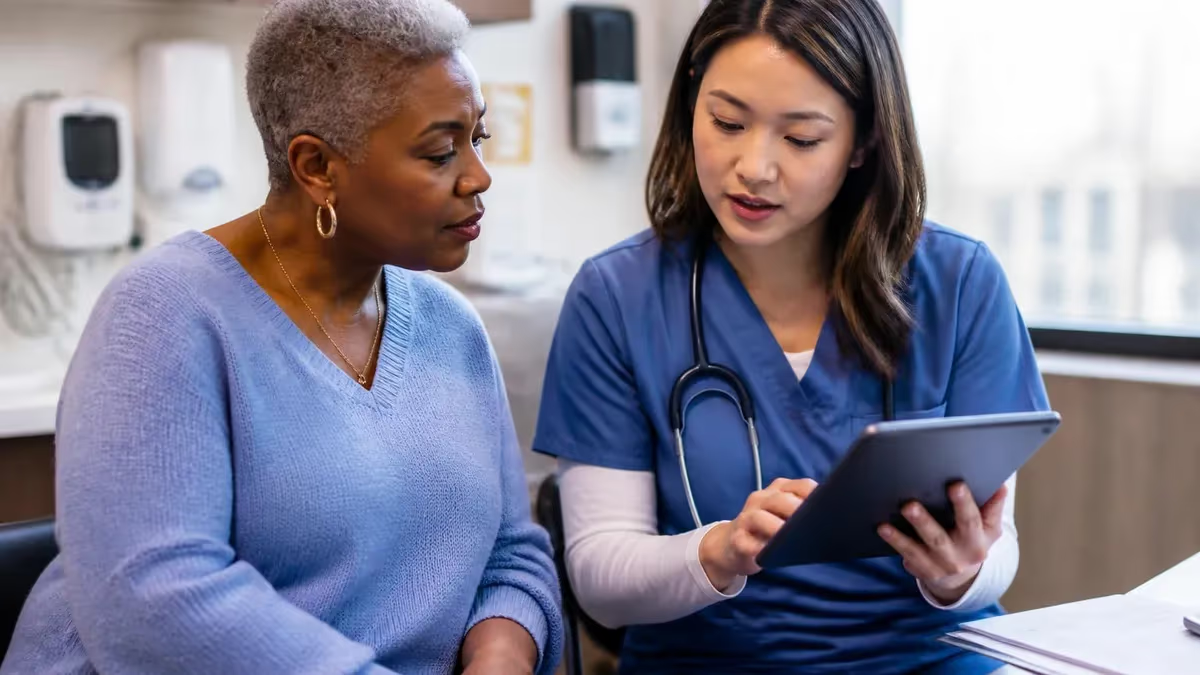
Women's health nurse practitioner online programs have become one of the most sought-after pathways for registered nurses who want to specialize in reproductive, obstetric, gynecologic, and primary care for women across the lifespan. These programs combine advanced pharmacology, pathophysiology, and clinical reasoning with a deep focus on conditions unique to female patients — from adolescent menstrual health through menopause and beyond. Graduates earn either a Master of Science in Nursing (MSN) or a Doctor of Nursing Practice (DNP) and qualify to sit for national board certification as a Women's Health Nurse Practitioner (WHNP-BC).
The online format has transformed access to these specialized programs. Nurses who work full-time or live in rural areas without a nearby university can now complete all didactic coursework through asynchronous lectures, virtual simulations, and live web conferences. Clinical hours — typically 500 to 600 — are arranged locally with preceptors, letting students stay in their home communities while earning a nationally recognized credential. Accredited programs maintain the same rigorous standards as on-campus tracks, so employers and certification boards treat the degrees identically.
Demand for WHNPs is rising sharply. The U.S. Bureau of Labor Statistics projects nurse practitioner employment to grow by roughly 45 percent through 2033, and the women's health specialty is benefiting from expanded Medicaid coverage of maternal services, growing awareness of reproductive healthcare gaps, and a nationwide shortage of OB/GYN physicians. Hospitals, federally qualified health centers, private gynecology practices, and telehealth platforms are all actively recruiting credentialed WHNPs at competitive salaries.
Before diving into specific programs, it helps to understand the two main credential pathways. The MSN-WHNP track is the traditional entry point, usually requiring 36 to 48 credit hours and 18 to 24 months of full-time study. The DNP-WHNP track, increasingly preferred by health systems and academic medical centers, adds a doctoral capstone project and extends total credit hours to 70 or more. Many online programs now offer a direct MSN-to-DNP bridge for nurses who already hold a master's degree in another NP specialty.
Prospective students should also be aware of how women's health nurse practitioner online programs differ from physician assistant programs when it comes to scope of practice, prescriptive authority, and practice philosophy. NPs are educated within a nursing model that emphasizes holistic patient relationships, whereas PAs follow a medical model and can switch specialties more easily. Understanding these distinctions helps candidates choose the career trajectory that aligns with their long-term goals in women's healthcare.
Accreditation is the single most important factor when comparing online WHNP programs. Look for programs accredited by the Commission on Collegiate Nursing Education (CCNE) or the Accreditation Commission for Education in Nursing (ACEN). Only graduates of accredited programs are eligible to sit for the WHNP-BC examination offered by the National Certification Corporation (NCC). An unaccredited degree can close doors to licensure, hospital privileges, and insurance credentialing, so verifying accreditation status before enrolling is non-negotiable.
Cost, schedule flexibility, and clinical placement support vary considerably across schools. Tuition ranges from roughly $550 per credit hour at public universities to more than $1,200 per credit hour at private institutions. Many programs offer part-time tracks that allow nurses to spread coursework over three to four years, making it financially and professionally manageable. Some schools assign a dedicated clinical placement coordinator to help students find preceptors — a significant advantage given how challenging it can be to secure supervised clinical hours in specialized women's health settings.
Women's Health NP Online Programs by the Numbers

How to Become a Women's Health Nurse Practitioner Online
Earn Your BSN & RN License
Meet Admission Prerequisites
Choose & Apply to an Accredited Program
Complete Didactic Coursework Online
Fulfill Clinical Hour Requirements
Graduate, Certify & Obtain State Licensure
The curriculum in online women's health nurse practitioner programs is carefully sequenced to build clinical competence in a logical progression. Students begin with foundation graduate courses that every NP specialty shares: advanced health assessment, advanced pathophysiology, advanced pharmacology, and nursing research or evidence-based practice. These courses typically occupy the first two semesters and establish the scientific foundation that supports all specialty-specific content that follows. Expect rigorous reading loads, virtual case studies, and written exams that mirror the rigor of the WHNP-BC certification examination.
Once the core NP foundations are complete, students enter the women's health specialty sequence. This typically includes courses in reproductive anatomy and physiology, contraception and family planning counseling, prenatal and postpartum care, gynecologic assessment and management, sexually transmitted infection diagnosis and treatment, menopause and hormone therapy, and gynecologic oncology screening. Many programs also include dedicated courses on domestic violence screening, mental health conditions common in women such as perinatal mood disorders, and culturally competent care for diverse female populations including LGBTQ+ patients.
Clinical pharmacology is woven throughout the curriculum rather than isolated in a single course. Students learn to prescribe hormonal contraceptives, manage endometriosis with progestins or GnRH agonists, treat common vulvovaginal infections, initiate antihypertensives in pregnancy, and navigate the complexities of hormone replacement therapy. Given that WHNPs prescribe medications in most states, faculty prioritize drug-drug interactions, teratogenic risk categories, and evidence-based prescribing guidelines from organizations such as the American College of Obstetricians and Gynecologists (ACOG) and the Society of Family Planning.
Telehealth modules have become standard in most online WHNP curricula following the expansion of virtual care during and after the COVID-19 pandemic. Students learn how to conduct virtual pelvic history assessments, counsel patients on self-administered medications like medication abortion protocols, and document telehealth encounters in compliance with evolving state regulations. This training is especially valuable given the rapid growth of women's telehealth platforms that routinely hire WHNPs to serve patients across multiple states using multistate compact licensure.
Research and scholarly projects vary by degree level. MSN students typically complete a capstone evidence-based practice project, selecting a clinical problem in women's health and developing an implementation plan grounded in current literature. DNP students undertake a more extensive quality improvement or translational research project that is implemented in a real clinical setting and evaluated for outcomes. These projects are valuable differentiators on the job market, demonstrating that graduates can apply evidence to practice rather than simply repeat protocols.
Simulation technology has become a cornerstone of online WHNP education. High-fidelity virtual patient scenarios allow students to practice pelvic examinations, interpret ultrasound findings, manage obstetric emergencies, and counsel patients on sensitive reproductive decisions — all before entering the clinical setting. Some programs ship simulation kits directly to students' homes, including pelvic models for examination practice. Others partner with regional simulation centers where students complete periodic on-campus intensives, usually one or two weekends per semester, to practice hands-on skills under faculty supervision.
Interprofessional education (IPE) components have also grown in prominence. WHNP students collaborate in virtual modules with medical, pharmacy, social work, and nutrition students to manage complex cases such as high-risk pregnancies, postpartum depression, or cervical cancer follow-up. These experiences reflect the collaborative practice environments graduates will enter and satisfy accreditation standards requiring demonstrated teamwork competencies. When evaluating online programs, ask faculty how IPE is structured, since the quality varies considerably from token online modules to substantive team-based case simulations.
Top Online WHNP Program Options Compared
MSN-WHNP online programs typically require 36 to 48 credit hours and can be completed in 18 to 24 months full-time or up to 36 months part-time. Universities such as Vanderbilt, University of Cincinnati, and Frontier Nursing University offer well-regarded online MSN tracks with dedicated clinical placement coordinators who help students secure preceptorships in local OB/GYN, midwifery, and reproductive health settings across the country.
Tuition for online MSN-WHNP programs ranges from approximately $600 to $1,100 per credit hour, placing total program costs between $22,000 and $52,000 before financial aid. Public in-state rates, employer tuition reimbursement, and HRSA nursing workforce scholarships can significantly reduce out-of-pocket expenses. Most MSN programs admit two cohorts per year — fall and spring — with rolling deadlines, giving applicants flexibility in timing their enrollment decision.
Online vs. On-Campus WHNP Programs: Key Trade-Offs
- +Complete all coursework from home without relocating or commuting to campus
- +Maintain full-time or part-time RN employment while studying, preserving income and benefits
- +Arrange clinical hours locally with preceptors in your community or current employer
- +Access top-ranked programs regardless of your geographic location
- +Asynchronous lectures allow you to study at peak personal productivity hours
- +Lower overall cost when you factor in eliminated housing, commuting, and childcare expenses
- −Requires exceptional self-discipline, time management, and independent motivation
- −Finding and securing qualified local preceptors in women's health can be challenging in rural areas
- −Limited spontaneous faculty interaction compared to hallway conversations in on-campus programs
- −Virtual simulation cannot fully replicate tactile learning for pelvic examination skill development
- −Technology failures — internet outages, software issues — can disrupt exams or live sessions
- −Some employers and clinical sites still perceive online degrees with unwarranted skepticism
Online WHNP Program Application Checklist
- ✓Verify the program holds active CCNE or ACEN accreditation before investing any time in the application.
- ✓Confirm your state's APRN licensing board recognizes graduates of the program you are applying to.
- ✓Request official transcripts from every college or university you have attended.
- ✓Secure three professional reference letters from supervisors, faculty, or clinical mentors who know your work closely.
- ✓Write a personal statement articulating why you are pursuing women's health specifically and your long-term clinical goals.
- ✓Update your resume to include all clinical experience, certifications (ACLS, NRP, etc.), and any women's health volunteer work.
- ✓Confirm you meet minimum RN experience requirements — typically one to two years with direct clinical care.
- ✓Identify at least two potential local preceptors in OB/GYN or women's health before contacting the admissions office.
- ✓Apply for FAFSA and investigate HRSA nursing workforce scholarships and state-specific NP incentive programs.
- ✓Schedule a call or virtual advising session with the program director to evaluate curriculum fit and clinical placement support.
Preceptor Relationships Are Your Most Valuable Asset
Securing quality clinical preceptors is the single greatest challenge for online WHNP students, yet it is what makes or breaks your clinical education. Start networking with OB/GYN physicians, midwives, and experienced WHNPs in your community at least six months before your clinical rotations begin. A strong preceptor who actively teaches and evaluates you will prepare you far better for board exams and independent practice than any textbook or simulation module can on its own.
The financial investment in an online WHNP program is substantial, but the return on investment is among the strongest in nursing. According to 2024 Bureau of Labor Statistics data, nurse practitioners overall earn a median annual wage of approximately $126,000, and WHNPs in hospital-based or academic medical center settings frequently exceed that figure. In high-demand metropolitan markets such as New York City, San Francisco, and Boston, total compensation packages including benefits can push well above $140,000 annually, particularly for those with DNP credentials and several years of post-certification experience.
Tuition is the primary cost variable when comparing programs. Public university online programs — especially those at state schools where you qualify as an in-state resident — represent the best value, with per-credit-hour rates often between $550 and $750. Private nonprofit universities typically charge $900 to $1,300 per credit hour. At 36 to 48 credit hours for an MSN, total tuition can range from $20,000 at a public school to over $60,000 at a premium private institution. Factor in books, technology fees, clinical travel, and certification examination fees when building your budget.
Several funding mechanisms can meaningfully reduce out-of-pocket costs. The Health Resources and Services Administration (HRSA) administers the Nurse Practitioner Scholarship Program, which covers tuition, fees, and a monthly stipend in exchange for a service commitment in a Health Professional Shortage Area (HPSA) after graduation. The National Health Service Corps offers loan repayment for NPs who commit to serving underserved communities. Many states operate their own NP incentive programs targeted at specialties with workforce shortages, and women's health frequently qualifies given documented shortages in OB/GYN coverage across rural America.
Employer tuition reimbursement is another major funding source that online students are particularly well-positioned to access. Because online programs allow you to maintain your current RN position while studying, you can simultaneously work for an employer who offers tuition benefits — often $5,000 to $10,000 per calendar year.
Health systems, large hospital networks, and federally qualified health centers frequently invest in training their own staff to fill APRN positions rather than competing in a tight external hiring market. Talk to your HR department before enrolling; some employers even offer service agreements that cover tuition in exchange for a two- or three-year post-graduation work commitment.
Student loans remain a reality for many WHNP students, but federal graduate PLUS loans offer income-driven repayment options and Public Service Loan Forgiveness (PSLF) eligibility for those who work in nonprofit healthcare settings after graduation. If you plan to work at a federally qualified health center, VA system, public hospital, or academic medical center, PSLF can eliminate your remaining loan balance after 120 qualifying monthly payments — potentially forgiving tens of thousands of dollars for nurses with higher debt loads from DNP programs.
The break-even analysis strongly favors investment in WHNP education. A registered nurse earning the national median RN salary of approximately $81,000 who completes an online MSN-WHNP program at a cost of $35,000 in tuition and fees can expect a salary increase of $30,000 to $45,000 annually upon certification. Even accounting for the opportunity cost of reduced working hours during study, most graduates fully recover their total program investment within 12 to 18 months of practice as a certified WHNP. Over a 20-year career, the cumulative earnings differential between RN and WHNP salaries can exceed $800,000 before accounting for career advancement.
Beyond salary, credentialed WHNPs enjoy expanded professional autonomy, greater scope of practice, and the ability to run independent practices in full-practice-authority states. Currently 27 states plus the District of Columbia grant full practice authority to nurse practitioners, meaning WHNPs can assess, diagnose, and prescribe without physician oversight. This regulatory environment creates entrepreneurial opportunities — including telehealth practices, private women's health clinics, and consulting arrangements — that add income streams unavailable to registered nurses practicing under traditional hospital employment models.

Not all states grant WHNPs the same prescriptive authority upon licensure. Reduced-practice and restricted-practice states require collaborative agreements with supervising physicians, which can limit where you can work and what you can prescribe independently. Research your state's APRN practice environment at the National Academy for State Health Policy's tracker before selecting a program, and factor in whether you are willing to relocate to a full-practice-authority state after graduation to maximize your career options.
Certification through the National Certification Corporation is the gold standard credential for women's health nurse practitioners in the United States. The WHNP-BC examination assesses competency across the full scope of women's health practice, including well-woman care, reproductive health, gynecologic conditions, obstetrics, and primary care for women. The exam consists of 175 questions — 150 scored and 25 unscored pretest items — administered over a three-hour period at Pearson VUE testing centers nationwide. Candidates must pass a cut score set through a formal standard-setting process, and the NCC publishes detailed content outlines to guide exam preparation.
Eligibility to sit for the WHNP-BC examination requires graduation from a graduate-level women's health NP program accredited by CCNE or ACEN, completion of the required clinical hours, and a current unencumbered RN license. Applications are submitted online through the NCC website, and most candidates receive approval to test within two to four weeks of submitting a complete application.
The examination fee is currently $325, with retake fees applicable if a candidate does not pass on the first attempt. NCC data shows that first-time pass rates for WHNP-BC candidates from accredited programs run approximately 85 to 90 percent, reflecting the preparedness of graduates from well-structured programs.
Maintaining WHNP-BC certification requires renewal every three years through a combination of continuing education and ongoing professional activity. Certificants must complete 45 contact hours of continuing education, including specified hours in pharmacology, and document continued clinical practice in women's health. The NCC's online renewal portal makes tracking and submitting CE credits straightforward. Many professional organizations, including the American College of Nurse Midwives, AWHONN, and the Society of OB/GYN NPs, offer CE conferences, webinars, and self-study modules that simultaneously build clinical knowledge and satisfy renewal requirements.
Career outlook for WHNPs is exceptional by virtually every measure. The combination of an aging population requiring more chronic disease management, expanded Medicaid coverage of women's preventive services, and the persistent shortage of OB/GYN physicians in rural and underserved areas creates a structural demand that shows no sign of reversing. The Association of American Medical Colleges projects a shortage of up to 22,000 OB/GYNs by 2050, and WHNPs are widely recognized as the most appropriate clinicians to fill a significant portion of that gap — particularly in primary and preventive women's care settings.
Practice settings for WHNPs are diverse. The most common employment sites include private OB/GYN practices, federally qualified health centers, hospital-based women's health clinics, maternal-fetal medicine units, family planning clinics including Planned Parenthood, oncology clinics focused on gynecologic cancers, reproductive endocrinology and infertility practices, and telehealth platforms serving women across multiple states. Some experienced WHNPs transition into clinical faculty roles at nursing schools, where the demand for qualified women's health educators closely mirrors the demand for clinicians in practice settings.
Telehealth has opened an entirely new career frontier for WHNPs. Platforms specializing in contraception management, menopause care, fertility awareness, postpartum mental health, and hormone therapy now routinely hire WHNPs to serve patients nationwide using compact licensure. These roles often offer flexible scheduling, competitive salaries, and the ability to practice from any location — making them especially attractive for WHNPs who value work-life balance or who live in areas where traditional in-person practice opportunities are limited. Some telehealth companies offer signing bonuses and student loan repayment benefits to attract certified WHNPs with experience in these high-demand service areas.
For nurses considering the broader NP landscape before committing to a specialty, understanding how the WHNP role compares to family, pediatric, and psychiatric NP roles is valuable. Each population focus has its own certification, scope of practice, and job market dynamics.
The women's health specialty is distinctive in its emphasis on reproductive care, which requires a comfort level with discussions of sexuality, contraception, pregnancy, and intimate partner violence that not all NPs develop in general practice. Those who thrive as WHNPs typically report a strong personal commitment to women's advocacy and a genuine passion for building long-term relationships with patients across reproductive life stages.
Succeeding in an online WHNP program requires a strategic approach from day one. Before classes begin, establish a dedicated study space free from distractions, invest in a reliable internet connection and a quality headset for virtual sessions, and download your program's learning management system app so you can access materials on your phone during breaks at work. Treat your online coursework with the same professional discipline you bring to your nursing shifts — show up on time for synchronous sessions, meet every deadline, and communicate proactively with faculty when you encounter obstacles.
Building a strong support network is equally critical. Connect with your cohort through the program's student discussion boards, social media groups, or virtual study sessions. Peer support from nurses navigating the same curriculum while managing full-time jobs and family responsibilities is both practically helpful — for sharing notes, comparing exam strategies, and discussing clinical cases — and emotionally sustaining during the demanding final semesters when clinical hours overlap with intensive coursework. Many online programs have student-run virtual study groups that meet weekly via video conference and prove invaluable during board exam preparation.
Engaging proactively with faculty distinguishes high-performing online students. Professors teaching asynchronous courses cannot see you nodding along or looking confused in a lecture hall, so you must initiate contact when you have questions. Most faculty hold virtual office hours weekly and respond to emails within 24 to 48 hours. Building genuine relationships with faculty members also pays dividends beyond grades: they become reference letter writers, mentors for your capstone project, and professional network connectors who can introduce you to clinical sites, job opportunities, and professional organizations in women's health.
Clinical hour preparation deserves attention starting in your very first semester, not your final year. Begin identifying potential preceptors early by networking through your current employer, professional nursing organizations such as AWHONN (Association of Women's Health, Obstetric and Neonatal Nurses), your state nurses association, and LinkedIn.
When approaching potential preceptors, come prepared with a professional email that clearly explains your program, the number of clinical hours required, and the specific competencies you need to demonstrate. Offer flexibility on scheduling, show genuine eagerness to learn, and express appreciation for their investment of time — experienced clinicians receive many preceptorship requests and respond best to candidates who demonstrate preparation and professionalism.
Board exam preparation should be integrated throughout your program rather than crammed into the final weeks before your WHNP-BC examination. Use question banks and practice tests consistently from your second semester onward to build test-taking stamina and identify knowledge gaps while you still have faculty support available to address them.
The NCC publishes a detailed content outline that maps exactly what the WHNP-BC examination covers; use it as a study guide to ensure you are not leaving any content domain underrepresented in your review. Practice sets that mirror the clinical vignette format of the actual exam are particularly valuable for building the reasoning skills the WHNP-BC rewards.
Professional membership in organizations like AWHONN, the National Association of Nurse Practitioners in Women's Health (NPWH), and the American College of Nurse Practitioners offers student discounts, access to clinical practice guidelines, annual conference networking, and CE opportunities that enhance your education beyond what any single program can provide.
NPWH in particular is the professional home for WHNPs and publishes the Women's Healthcare journal, hosts national conferences, and provides continuing education specifically tailored to women's health NP practice. Joining as a student costs a fraction of the full membership rate and gives you immediate access to a community of practicing WHNPs who can answer career questions, share practice insights, and refer you to open positions.
Finally, take care of yourself physically and mentally during the program. The combination of full-time nursing work, graduate coursework, clinical hours, and life responsibilities is genuinely demanding, and burnout is a real risk. Build recovery time into your weekly schedule as deliberately as you schedule study sessions.
Use your employee assistance program if emotional support is needed, lean on your peer cohort during stressful exam periods, and remind yourself regularly why you chose this specialty. The nurses who complete online WHNP programs successfully are not necessarily the ones with the highest GPAs — they are the ones who manage their energy, support their peers, and stay connected to their deeper purpose of improving health outcomes for women across the lifespan.
NP Questions and Answers
Nurse Practitioner vs Physician Assistant: Side-by-Side
Nurse Practitioner Taxonomy Code: Complete 2026 Guide to NPI Classification, Specialty Codes, and Billing Compliance

Family Nurse Practitioner Remote Jobs: Complete 2026 Guide to Telehealth Careers

Nursing Practitioner Online Programs: Complete Training Guide and Requirements for 2026

Psychiatric Nurse Practitioner Programs Online: Complete Training Guide and Requirements
About the Author

Registered Nurse & Healthcare Educator
Johns Hopkins University School of NursingDr. Sarah Mitchell is a board-certified registered nurse with over 15 years of clinical and academic experience. She completed her PhD in Nursing Science at Johns Hopkins University and has taught NCLEX preparation and clinical skills courses for nursing students across the United States. Her research focuses on evidence-based exam preparation strategies for healthcare certification candidates.