
Nurse Practitioner Jobs by State: Florida, Texas, California, and Beyond — A Complete 2026 October Guide
Explore nurse practitioner jobs Florida, Texas, California, and beyond. Salaries, scope of practice, demand, and hiring trends by state. 🗨️
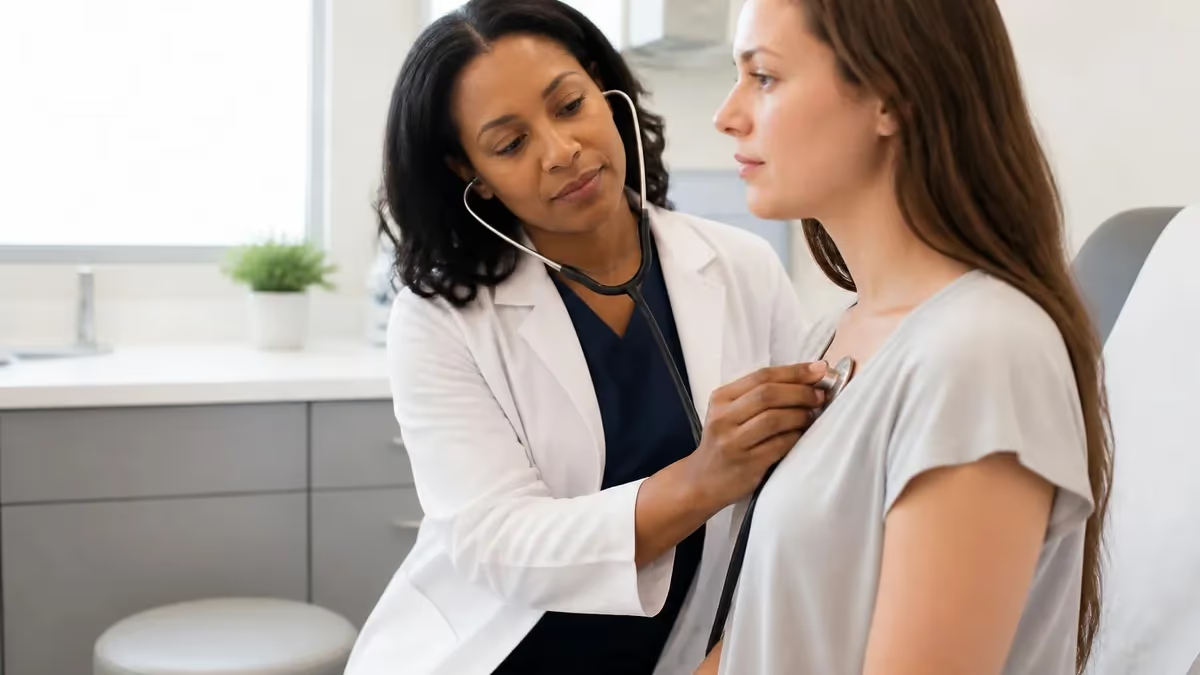
The market for nurse nurse p florida candidates is one of the hottest in the country, but Florida is only one piece of a much larger puzzle. Across the United States, NP demand is climbing faster than almost any other healthcare role, with the Bureau of Labor Statistics projecting 40% growth through 2033. Whether you trained as an FNP in Miami, an AGACNP in Houston, or a PMHNP in Sacramento, where you practice will shape your salary, your autonomy, and your daily caseload more than any other single career decision.
State borders carry enormous weight in NP practice. A nurse practitioner in Arizona can open an independent clinic on day one of certification, while a peer in Texas must maintain a written collaborative agreement with a supervising physician indefinitely. Florida sits in the middle, granting limited autonomous practice in primary care after 3,000 supervised clinical hours. These rules ripple into hiring patterns, compensation, and even the kind of patients you will see day to day.
This guide breaks the national NP labor market down state by state, beginning with the high-volume hiring hubs of Florida, Texas, California, New York, and Pennsylvania. We will cover average salaries adjusted for cost of living, scope of practice categories from full to restricted, the specialties most in demand by region, and the credentials hospital systems and federally qualified health centers actually require when they post job openings.
You will also find practical hiring intelligence: which states are recruiting most aggressively for psychiatric mental health nurse practitioner NPs, where acute care openings outpace primary care, and how rural shortage areas in the Midwest and South are quietly offering loan repayment packages that beat coastal base salaries. We pulled data from the American Association of Nurse Practitioners 2025 workforce report, BLS Occupational Employment Statistics, and active job board scans to give you current numbers.
If you are still completing your degree, this guide doubles as a relocation roadmap. Many NP students choose their first job based on familiarity rather than fit, then spend three years recovering from the mismatch. Knowing how Florida differs from Tennessee or how Washington differs from Oregon will help you target preceptorships, clinical rotations, and certification timing in a way that opens the right doors when you graduate and sit for boards.
For employers and recruiters reading this, the same data illustrates why your sourcing strategy needs to flex by region. A signing bonus that closes a candidate in Tampa may fall flat in San Francisco, where housing assistance and student loan reimbursement carry far more weight. Below we synthesize the numbers and the nuance so both sides of the hiring table can make better decisions in 2026 and beyond.
Throughout the article we link to deeper resources on certification, scope, and prescriptive authority. Start with our can nurse practitioners prescribe medication in texas overview if you want a quick map of how prescribing rules vary by state, since prescriptive authority directly shapes which jobs you can legally accept after licensure.
NP Jobs by the Numbers (2026)

Top 5 States Hiring Nurse Practitioners in 2026
Over 30,000 licensed NPs and one of the fastest-growing healthcare markets in the South. Heavy demand in geriatrics, primary care, and urgent care, especially across Miami-Dade, Tampa Bay, Orlando, and the Villages retirement corridor.
Roughly 22,000 practicing NPs concentrated in Houston, Dallas-Fort Worth, San Antonio, and Austin. Strong acute care and emergency department demand, plus rural border clinics offering loan repayment for bilingual primary care candidates.
Highest paying NP market in the nation with averages exceeding $164,000. Hiring focused on outpatient primary care, oncology, and psychiatric mental health, especially around Los Angeles, the Bay Area, San Diego, and Sacramento.
Major teaching hospitals in NYC, Rochester, and Buffalo drive specialist hiring. Acute care, cardiology, and pediatric NPs are well-compensated. Full practice authority granted after 3,600 hours of qualifying experience.
Philadelphia, Pittsburgh, and Hershey health systems hire across primary care, oncology, and women's health. Reduced practice state with collaborative agreement requirements, but strong benefits and academic NP pipelines.
Salary is the headline number most NPs check first, but the real picture only emerges when you layer in cost of living, state income tax, malpractice costs, and student loan repayment programs. National medians sit around $128,490 according to 2024 BLS data, but the spread by state is dramatic. California tops the list at roughly $164,000, followed by New Jersey, Massachusetts, Oregon, and Washington, all comfortably above $145,000. The lowest states, including Tennessee, Alabama, and West Virginia, average closer to $105,000.
Florida is a particularly interesting case. The statewide average sits near $122,000, which lags California by more than $40,000. However, Florida has no state income tax, lower housing costs outside Miami, and aggressive bonus structures from regional systems like AdventHealth, HCA, and BayCare. A net comparison often closes much of the gap, especially for NPs targeting Jacksonville, Tampa, or the Space Coast where housing remains relatively affordable.
Texas mirrors that pattern. The state average of around $124,000 looks modest until you account for the absence of state income tax and the lower cost of living in cities like San Antonio and Fort Worth. Specialty matters as well. AGACNPs working night shifts in Houston Texas Medical Center hospitals frequently clear $145,000 with differentials, while a primary care FNP in a rural Panhandle clinic might earn $115,000 but receive $50,000 in federal loan repayment from a Health Professional Shortage Area designation.
California pays more, but it also taxes more. A San Francisco Bay Area NP earning $175,000 will lose roughly 9.3% to state income tax and another large slice to housing costs that routinely exceed $4,000 monthly for a one-bedroom near work. Some Bay Area health systems offer relocation packages, retention bonuses, and housing stipends to offset the gap, but the math rarely puts a Sacramento NP financially ahead of a Tampa peer earning $30,000 less on paper.
Specialty creates another major lever. Across every state, health nurse health nurses now lead salary tables. A PMHNP in a telehealth role can clear $160,000 nationally regardless of state, because demand for behavioral health far outstrips supply. Acute care NPs in cardiac surgery, neurocritical care, and trauma command similar premiums. Family practice NPs anchor the lower end, though nurse p states allow them to open independent clinics that frequently outearn employed roles within a few years.
For a deeper look at one of the fastest-growing high-pay specialties, see our psychiatric mental health nurse practitioner. It breaks down certification pathways, common employment settings, and why this specialty is reshaping the NP labor market in every state from Florida to Washington.
One last salary nuance: pay scales inside the same city can vary by 20% between employer types. Federally qualified health centers, the Veterans Health Administration, and academic medical centers all anchor to public pay grades. Private equity-owned urgent care chains and telehealth startups often pay higher base salaries but provide thinner benefits. Always price the total package, not the headline number, when you compare offers across states.
NP Practice Test Questions
Prepare for the NP - Nurse Practitioner exam with our free practice test modules. Each quiz covers key topics to help you pass on your first try.
NP Adult-Gerontology Acute Care Nurse Prac...
NP Exam Questions covering Adult-Gerontology Acute Care Nurse Practitioner. Master NP Test concepts for certification prep.
NP Family Nurse Practitioner
Free NP Practice Test featuring Family Nurse Practitioner. Improve your NP Exam score with mock test prep.
NP Pediatric Nurse Practitioner
NP Mock Exam on Pediatric Nurse Practitioner. NP Study Guide questions to pass on your first try.
NP Case Studies & Practical Application
NP Test Prep for Case Studies & Practical Application. Practice NP Quiz questions and boost your score.
NP Communication & Stakeholder Relations
NP Questions and Answers on Communication & Stakeholder Relations. Free NP practice for exam readiness.
NP Diagnosis & Clinical Decision-Making
NP Mock Test covering NP Diagnosis & Clinical Decision-Making. Online NP Test practice with instant feedback.
NP Patient Education & Health Promotion
Free NP Quiz on NP Patient Education & Health Promotion. NP Exam prep questions with detailed explanations.
NP Pharmacology & Prescribing
NP Practice Questions for NP Pharmacology & Prescribing. Build confidence for your NP certification exam.
NP Professional Standards & Competencies
NP Test Online for Professional Standards & Competencies. Free practice with instant results and feedback.
NP Quality Control & Assurance
NP Study Material on Quality Control & Assurance. Prepare effectively with real exam-style questions.
NP Regulatory Frameworks & Compliance
Free NP Test covering Regulatory Frameworks & Compliance. Practice and track your NP exam readiness.
NP Research & Evidence-Based Practice
NP Exam Questions covering Research & Evidence-Based Practice. Master NP Test concepts for certification prep.
Florida vs Texas vs California: NP Job Market Compared
Florida offers approximately 30,540 NP positions concentrated in Miami-Dade, Broward, Tampa Bay, Orlando, and Jacksonville. Average salary sits near $122,000, with no state income tax meaningfully boosting take-home pay. The state grants autonomous practice in primary care after 3,000 supervised clinical hours, allowing experienced FNPs to open independent clinics in family medicine, pediatrics, and general practice.
Demand is strongest in geriatrics due to the state's aging population, which means AGNP and FNP candidates with experience in long-term care, home health, and Medicare Advantage panels are highly sought after. Urgent care chains, retail clinics, and house-call practices are all hiring aggressively, with signing bonuses ranging from $5,000 to $20,000 depending on specialty and location.

Pros and Cons of Practicing in a Full Practice Authority State
- +Open and operate an independent clinic without physician collaboration
- +Sign death certificates, order durable medical equipment, and certify home health independently
- +Higher long-term earning potential through ownership
- +Faster decision-making at the point of care for patients
- +Greater professional autonomy and clinical confidence
- +Easier access to rural and underserved patient populations
- +More flexibility in negotiating employment contracts
- −Greater administrative burden when running an independent practice
- −Higher personal malpractice coverage requirements
- −Less built-in physician mentorship for new graduates
- −State-specific transition periods may delay full autonomy
- −Credentialing with insurance panels can be slower as a solo NP
- −Business operations, billing, and HR fall on the practice owner
- −Continuing education and quality oversight rest entirely on the NP
Pros and Cons at a Glance
| Pros | Cons |
|---|---|
| Open and operate an independent clinic without physician collaboration | Greater administrative burden when running an independent practice |
| Sign death certificates, order durable medical equipment, and certify home health independently | Higher personal malpractice coverage requirements |
| Higher long-term earning potential through ownership | Less built-in physician mentorship for new graduates |
| Faster decision-making at the point of care for patients | State-specific transition periods may delay full autonomy |
| Greater professional autonomy and clinical confidence | Credentialing with insurance panels can be slower as a solo NP |
| Easier access to rural and underserved patient populations | Business operations, billing, and HR fall on the practice owner |
State-by-State NP Job Search Checklist
- ✓Verify state licensure requirements and APRN board application timelines
- ✓Confirm scope of practice category: full, reduced, or restricted
- ✓Check whether the state participates in the APRN Compact
- ✓Identify Health Professional Shortage Areas for loan repayment eligibility
- ✓Research average salary plus cost of living for your target cities
- ✓Confirm DEA registration and state-controlled substance schedules permitted
- ✓Review state-specific CE requirements and renewal cycles
- ✓Identify the dominant health systems and their NP hiring patterns
- ✓Connect with the state AANP chapter for networking and job leads
- ✓Validate your specialty certification is recognized for the role you want
The APRN Compact is finally activating in 2026
After years of delays, the APRN Compact will let nurse practitioners hold a single multi-state license once seven states fully enact the legislation. Florida, Utah, Delaware, North Dakota, Kansas, Wyoming, and Nebraska have already passed it. This will reshape telehealth hiring and allow border-state NPs to practice across state lines without serial licensing fees.
Scope of practice is the single most important variable shaping NP jobs by state. The American Association of Nurse Practitioners groups all U.S. states into three categories: nurse p, reduced practice, and restricted practice. Full practice means NPs can evaluate, diagnose, order tests, interpret results, and prescribe medications independently under their state board of nursing. Reduced practice requires a career-long collaborative or transition agreement, while restricted practice forces career-long physician supervision over at least one element of NP practice.
As of 2026, 27 states plus Washington DC and two territories grant full practice authority. These include Arizona, Colorado, Connecticut, Hawaii, Idaho, Iowa, Maine, Maryland, Massachusetts, Minnesota, Montana, Nebraska, Nevada, New Hampshire, New Mexico, North Dakota, Oregon, Rhode Island, South Dakota, Utah, Vermont, Washington, Wyoming, Delaware, Kansas, New York after qualifying hours, and California through AB 890 transition rules. These states are also the easiest places to launch an independent clinic.
Reduced practice states include Alabama, Arkansas, Illinois, Indiana, Louisiana, Mississippi, New Jersey, Ohio, Pennsylvania, Wisconsin, West Virginia, Kentucky, New Hampshire, and most notably Florida. In these jurisdictions, NPs can perform most clinical functions but must maintain a written collaborative protocol with a physician, often filed annually with the state board. The protocols are usually administrative rather than restrictive in daily practice, but they shape liability, billing, and the kind of jobs employers offer.
Restricted practice states currently include California for new graduates pre-transition, Florida for non-primary care specialties, Georgia, Michigan, Missouri, North Carolina, Oklahoma, South Carolina, Tennessee, Texas, and Virginia. In these states, NPs must maintain career-long physician supervision over diagnosis, prescribing, or both. Texas remains the most restrictive large state, requiring delegated prescriptive authority that must be renewed and posted with the Texas Medical Board.
Why does this matter for jobs? In full practice states, NP-only urgent care clinics, telehealth platforms, and primary care practices are common. In restricted practice states, the same NP often works inside a larger medical group that handles supervision logistics. Salaries can be similar, but autonomy, career mobility, and earning ceilings differ significantly. Many NPs choose to obtain their first job in a full practice state to build clinical confidence before relocating.
If prescribing is central to your specialty, read our breakdown of can nurse practitioners prescribe medication in texas for state-by-state details on controlled substance authority, schedule restrictions, and DEA registration requirements that affect what jobs you can legally accept.
Finally, watch for active legislation. Pennsylvania, Texas, and California have all seen scope expansion bills in recent sessions. The post-pandemic provider shortage and the growth of value-based care have pushed many state legislatures to revisit collaborative agreement requirements. NPs entering the workforce in 2026 should expect at least three to five additional states to expand authority before 2030.

State boards of nursing can take anywhere from two weeks to four months to process an APRN license application by endorsement. Apply at least 90 days before your intended start date, and never resign from a current position until your new state license number has been issued. Many candidates lose offers by underestimating processing times.
Choosing the right state for your NP career is a multi-variable decision that goes beyond salary. Start by listing your non-negotiables. Do you need to be near family, in a specific climate, or in a particular practice setting like critical care or pediatric primary care? Then layer in licensure logistics, scope of practice, and cost of living. The best job in Boston may not survive a $4,200 monthly rent, while a slightly lower-paying offer in Asheville or Boise could deliver a much better quality of life.
For new graduates, full practice authority states tend to offer a smoother on-ramp because NP-friendly orientation programs, mentorship cohorts, and structured transition-to-practice fellowships are more common. Hospitals in Oregon, Washington, Minnesota, and Arizona have invested heavily in NP residency programs that mirror physician residencies in structure. These can be career-defining experiences, especially in acute care, oncology, and psychiatric mental health.
Mid-career NPs often relocate to optimize for compensation and autonomy. A Florida NP with three years of primary care experience might move to Arizona to open a concierge clinic, or a Texas AGACNP might relocate to Washington for higher pay and full practice authority in critical care. The APRN Compact will make these moves easier starting in 2026, but specialty certification still must match the role wherever you land.
Family considerations and dual-career households frequently override pure career math. Many NPs choose New Jersey, Connecticut, or Massachusetts because their spouse works in New York City finance or pharma, even though the commute and tax burden eat into NP earnings. Similarly, NPs partnering with academics or military spouses often need APRN Compact states to allow rapid relocation every three to four years without re-licensing fees and delays.
If you are still in school, plan your final clinical rotations strategically. A preceptorship at a major employer in your target state often converts into a job offer at graduation. The Cleveland Clinic, Mayo Clinic, Kaiser Permanente, and HCA Florida have all built pipelines from preceptorship to employment. Use your school's clinical placement office to request rotations in the cities and systems where you want to work after boards.
Also pay attention to specialty saturation. Family nurse practitioners are abundant in coastal metro areas, so a recent FNP graduate may face stiffer competition in Miami or Los Angeles than in Boise or Tulsa. Conversely, psychiatric mental health NPs and acute care NPs remain in critical shortage almost everywhere, meaning specialty choice can be a stronger lever than location for high-demand placement.
For a broader career and education roadmap, see our nurse p guide, which walks through BSN to MSN pathways, DNP options, costs, and how to align your program choice with the state where you ultimately want to practice.
Once you have shortlisted your target states, the next phase is practical execution. Begin with a credentialing audit. Pull your transcripts, ANCC or AANPCB certification documents, RN license verifications, malpractice history, and any DEA registration. Many state boards now require fingerprint-based background checks through the FBI, which alone can add four to eight weeks to the process. Submit these as soon as you commit to a state, not after you receive a job offer.
Resume strategy also shifts by state. Florida and Texas recruiters prioritize bilingual Spanish, geriatric experience, and electronic health record fluency, especially with Epic and Cerner. California employers expect strong evidence of cultural competency, social determinants of health awareness, and quality improvement experience. Northeast academic medical centers often look for research exposure or DNP-level scholarly projects. Tailor your CV to the dominant employer culture in your target city.
Negotiation is the highest-use hour of your career. Most NP offers have between 8% and 18% of total compensation negotiable on the table, but only if you ask before signing. Push on base salary, signing bonus, CME stipend, license and DEA reimbursement, malpractice tail coverage, paid time off, and shift differentials. In rural and shortage areas, also negotiate loan repayment, retention bonuses, and relocation assistance.
Build a state-specific reference network. Join the state chapter of the American Association of Nurse Practitioners, attend at least one regional conference, and connect with NPs already working in your target system on LinkedIn. Most healthcare jobs in 2026 are filled through warm referrals before they reach public job boards. Three coffee chats with employed NPs at your target hospital can move you from a stack of resumes to a direct hiring manager intro.
Plan your board exam timing carefully. If you are graduating in May and planning to relocate, sit for ANCC or AANPCB boards within four to six weeks of program completion. Use that gap to study heavily with question banks that mirror the exam format. Programs like ours offer specialty practice question sets across acute care, family, pediatric, and psychiatric mental health domains so you can hit the ground running on test day.
For acute care candidates, see our acute care nurse practitioner schools online deep dive, which covers AGACNP and ACNP scope, hospital-based bookkeeper pay and certification logistics. Acute care openings concentrate heavily in Florida, Texas, and California academic medical centers, making it one of the strongest specialties for state-flexible job hunting in 2026.
Finally, build a 12-month review cadence. Once you start a new role in a new state, calendar a six-month and 12-month review of your contract, salary benchmarks, and certification renewals. The NP market is moving faster than ever, and the candidate who tracks their market value will earn 25% to 40% more over a ten-year career than the one who simply renews each year without renegotiating.
Sample NP - Nurse Practitioner Practice Questions
Try these questions from our free NP - Nurse Practitioner practice tests. The correct answer and an explanation follow each question.
The concept of 'full practice authority' for NPs means the state law allows NPs to:
- A. Practice only in federally qualified health centers
- B. Evaluate, diagnose, order tests, and prescribe without physician oversight
- C. Prescribe Schedule II substances independently
- D. Bill Medicare independently without a supervising physician
Answer: B. Evaluate, diagnose, order tests, and prescribe without physician oversight
Full practice authority states allow NPs to practice to the full extent of their education and training without required physician collaboration or supervision agreements.
A 16-year-old patient presents requesting treatment for a sexually transmitted infection. Under most state laws, the NP may treat and maintain confidentiality because:
- A. Minors have full medical decision-making rights at age 14
- B. Most states allow minors to consent to STI diagnosis and treatment without parental notification
- C. HIPAA requires parental notification for all minors under 18
- D. The treating NP has discretion to disclose regardless of state law
Answer: B. Most states allow minors to consent to STI diagnosis and treatment without parental notification
Most US states have minor consent laws that allow adolescents to consent to STI testing and treatment without parental permission to encourage care-seeking and protect confidentiality.
Which action constitutes unprofessional conduct that could result in disciplinary action by a state nursing board?
- A. Declining to prescribe a medication the NP is unfamiliar with and requesting a consult
- B. Practicing beyond one's scope of competence without seeking consultation
- C. Referring a complex patient to a specialist
- D. Disclosing a medication error to the patient and documenting it
Answer: B. Practicing beyond one's scope of competence without seeking consultation
Practicing beyond the scope of one's competence without consultation constitutes unprofessional conduct and is subject to state board disciplinary action.
Why is evidence-based practice important in Nurse Practitioner?
- A. It replaces experience
- B. It integrates best available evidence with professional expertise for optimal outcomes
- C. It only applies to academic settings
- D. It is a theoretical concept only
Answer: B. It integrates best available evidence with professional expertise for optimal outcomes
This is fundamental to Nurse Practitioner practice. It integrates best available evidence with professional expertise for optimal outcomes represents the professional standard for research in the NP certification framework.
NP Questions and Answers
Psychiatric Mental Health Nurse Practitioner Guide
Nurse Practitioner Test

Nurse Practitioner Degree Online: BSN and MSN Programs, Specialties, Costs, and Career Path for Aspiring NPs

Can Nurse Practitioners Prescribe Medication? State Rules Explained

Acute Care Nurse Practitioner (AGACNP/ACNP): Roles, Salary, Scope, and Path to Certification
About the Author

Registered Nurse & Healthcare Educator
Johns Hopkins University School of NursingDr. Sarah Mitchell is a board-certified registered nurse with over 15 years of clinical and academic experience. She completed her PhD in Nursing Science at Johns Hopkins University and has taught NCLEX preparation and clinical skills courses for nursing students across the United States. Her research focuses on evidence-based exam preparation strategies for healthcare certification candidates.