
Hospice Nurse Practitioner: Complete Career Guide to End-of-Life Care in 2026 August
Hospice nurse practitioner career guide: 🟢 duties, salary ($110K+), certification, daily workflow, and how to enter palliative care in 2026 August.

A hospice nurse practitioner is an advanced practice registered nurse who provides comprehensive end-of-life care to patients with a life expectancy of six months or less. Unlike acute care providers focused on cure, the hospice nurse practitioner manages symptoms, coordinates interdisciplinary teams, and supports families through one of life's most profound transitions. This specialty has grown rapidly as the U.S. population ages, with Medicare now covering hospice services for nearly 1.7 million beneficiaries each year and demand for skilled providers outpacing supply in most regions.
The role blends clinical expertise with deep emotional intelligence. On any given day, a hospice NP may titrate opioids for a patient with metastatic cancer, lead a family meeting about goals of care, write orders for palliative sedation, or attest face-to-face that a patient remains eligible for hospice benefits under CMS regulations. The work is unhurried compared to ICU practice but requires sharp pharmacologic knowledge, ethical clarity, and the ability to make consequential decisions with limited diagnostic data.
Career entry typically requires a Master of Science in Nursing or Doctor of Nursing Practice, plus national certification as a Family, Adult-Gerontology Primary Care, or Adult-Gerontology Acute Care NP. Most hospice agencies prefer additional credentialing through the Advanced Certified Hospice and Palliative Nurse exam, offered by the Hospice and Palliative Credentialing Center. Many NPs transition into this field after several years in oncology, geriatrics, or critical care, where they have already faced repeated end-of-life conversations.
Compensation is competitive and often misunderstood. The Bureau of Labor Statistics reports a median NP wage of $128,490, but hospice-specific roles range from $105,000 to $145,000 depending on geography, employer type, and on-call structure. Nonprofit community hospices generally pay less than for-profit corporate chains, but offer richer benefits, smaller caseloads, and lower administrative burden. Productivity expectations also vary: some employers measure billable visits per day, while others use census-based capitation models.
Daily work is structured around two primary CMS-mandated activities. The first is the recertification face-to-face encounter, which must be performed by a physician or NP no more than 30 days before the start of the third benefit period and every benefit period thereafter. The second is symptom management visits, where the NP assesses pain, dyspnea, nausea, agitation, and constipation, then adjusts the plan of care. Documentation is exacting because Medicare audits hospice claims aggressively.
The emotional load is real but manageable with the right team. Hospice NPs report higher job satisfaction than nearly any other specialty in nursing surveys, citing autonomy, meaningful relationships with patients, and freedom from insurance prior-authorization battles. Burnout exists, particularly for solo rural NPs covering large service areas, but interdisciplinary support — social workers, chaplains, bereavement counselors, and hospice aides — distributes the weight in ways acute care rarely matches.
This guide walks through everything you need to know to evaluate, enter, and excel in the hospice nurse practitioner career path. We cover certification, scope of practice, salary expectations, daily workflows, the regulatory environment, and the soft skills that separate competent providers from extraordinary ones. Whether you are a new graduate exploring specialties or an experienced NP considering a transition, the sections ahead provide a realistic, current view of what this work actually involves.
Hospice NP Career by the Numbers
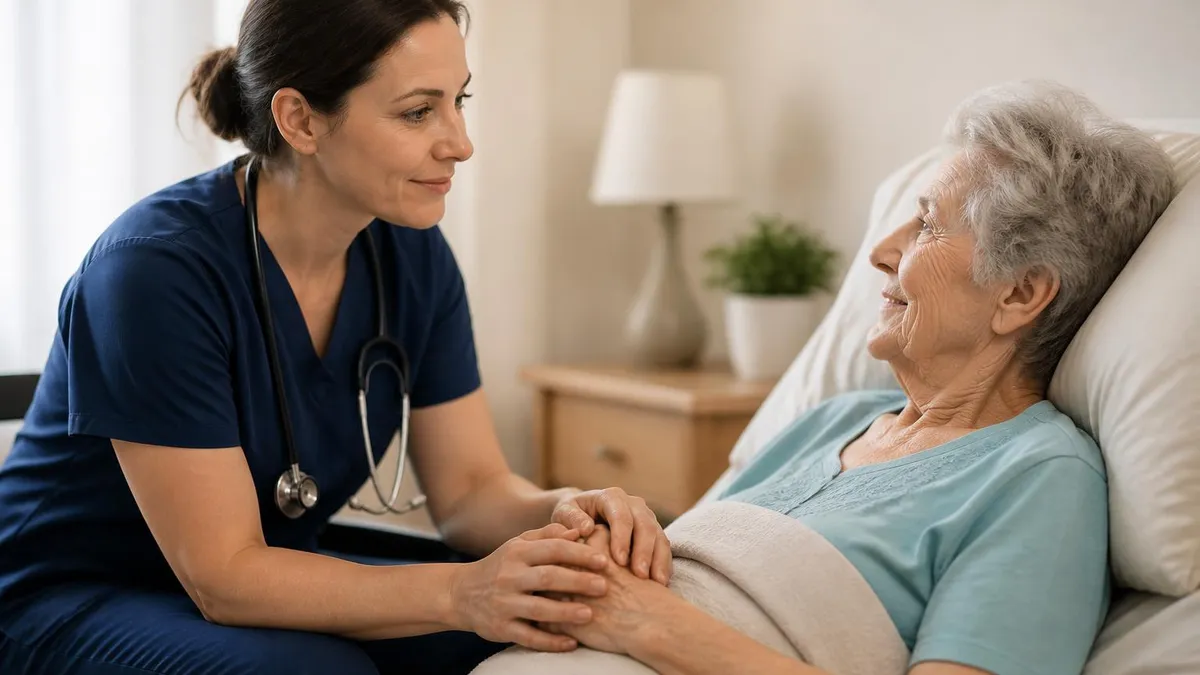
Role and Core Responsibilities of a Hospice Nurse Practitioner
Assess and treat pain, dyspnea, nausea, terminal agitation, and secretions. Titrate opioids, benzodiazepines, anticholinergics, and adjuvants based on validated palliative protocols and patient goals of care.
Conduct CMS-mandated encounters before each benefit period after the second, documenting clinical findings that support continued six-month prognosis with evidence-based functional and disease-specific decline indicators.
Lead goals-of-care conversations, explain disease trajectories, address conflicting wishes among relatives, and document advance directives clearly so the interdisciplinary team and on-call staff act consistently.
Collaborate weekly with physicians, RNs, social workers, chaplains, and aides during IDG meetings. The NP often serves as the clinical anchor translating goals into actionable, individualized care plans.
Complete narratives meeting Medicare Conditions of Participation. Sloppy notes trigger audit denials, recoupments, and surveyor citations. Skilled documentation is as essential as clinical judgment in this specialty.
Becoming a hospice nurse practitioner begins with the same foundation as any other NP specialty: a Bachelor of Science in Nursing, an active RN license, and at least one to two years of bedside experience before graduate school. While direct-entry programs exist, most successful hospice NPs report that their clinical instincts were shaped by working as staff RNs in oncology, medical-surgical, ICU, or skilled nursing settings where mortality and complex symptom burden were daily realities.
Graduate education takes the form of either a Master of Science in Nursing or a Doctor of Nursing Practice. For hospice work, three population foci are most relevant. The Adult-Gerontology Primary Care NP track suits providers who want to manage chronic, decompensated illness in homes and facilities. The Adult-Gerontology Acute Care NP track prepares NPs for hospitalized patients with rapidly changing physiology. The Family NP credential is the most flexible and allows practice across the lifespan, including the rare pediatric hospice patient.
National certification is non-negotiable. The American Nurses Credentialing Center and the American Academy of Nurse Practitioners Certification Board both administer entry-level exams. Pass rates hover near 85 percent for first-time test takers. Once certified, the NP applies for state APRN licensure, prescriptive authority, and DEA registration — the DEA number is critical because hospice practice involves daily Schedule II controlled substance prescribing.
Beyond entry-level credentialing, the gold standard for this specialty is the Advanced Certified Hospice and Palliative Nurse exam from the Hospice and Palliative Credentialing Center. Eligibility requires either 500 hours of advanced hospice and palliative practice within the prior year or 1,000 hours within the prior two years. The exam covers pain management, non-pain symptoms, psychosocial aspects, ethical issues, and care systems. Many employers offer a salary differential or signing bonus tied to this credential.
Continuing education is heavier in hospice than in many specialties because pharmacology and regulations both evolve. The CMS hospice payment system is updated annually, opioid prescribing guidelines change, and new evidence on agents like methadone, ketamine, and lidocaine for refractory symptoms emerges constantly. Plan for 75 to 100 hours of CE every two-year renewal cycle, with at least a third focused on palliative pharmacotherapy and end-of-life ethics.
Mentorship matters more than coursework once you are working. Newer hospice NPs benefit enormously from shadowing experienced colleagues on home visits, observing inpatient hospice unit rounds, and reviewing IDG cases together. Most agencies provide a structured 90-day onboarding, but the learning curve to true competence is closer to a full year. Pair this with a consistent self-study habit — textbooks like the Oxford Textbook of Palliative Medicine remain indispensable references.
For those weighing this against other career paths, a comparison with the broader landscape of nurse practitioner specialties reveals hospice as one of the most autonomous and emotionally rich tracks available. It is not a starter role for most clinicians, but for those drawn to it, the preparation pays back in years of meaningful, sustainable practice.
NP Practice Test Questions
Prepare for the NP - Nurse Practitioner exam with our free practice test modules. Each quiz covers key topics to help you pass on your first try.
NP Adult-Gerontology Acute Care Nurse Prac...
NP Exam Questions covering Adult-Gerontology Acute Care Nurse Practitioner. Master NP Test concepts for certification prep.
NP Family Nurse Practitioner
Free NP Practice Test featuring Family Nurse Practitioner. Improve your NP Exam score with mock test prep.
NP Pediatric Nurse Practitioner
NP Mock Exam on Pediatric Nurse Practitioner. NP Study Guide questions to pass on your first try.
NP Case Studies & Practical Application
NP Test Prep for Case Studies & Practical Application. Practice NP Quiz questions and boost your score.
NP Communication & Stakeholder Relations
NP Questions and Answers on Communication & Stakeholder Relations. Free NP practice for exam readiness.
NP Diagnosis & Clinical Decision-Making
NP Mock Test covering NP Diagnosis & Clinical Decision-Making. Online NP Test practice with instant feedback.
NP Patient Education & Health Promotion
Free NP Quiz on NP Patient Education & Health Promotion. NP Exam prep questions with detailed explanations.
NP Pharmacology & Prescribing
NP Practice Questions for NP Pharmacology & Prescribing. Build confidence for your NP certification exam.
NP Professional Standards & Competencies
NP Test Online for Professional Standards & Competencies. Free practice with instant results and feedback.
NP Quality Control & Assurance
NP Study Material on Quality Control & Assurance. Prepare effectively with real exam-style questions.
NP Regulatory Frameworks & Compliance
Free NP Test covering Regulatory Frameworks & Compliance. Practice and track your NP exam readiness.
NP Research & Evidence-Based Practice
NP Exam Questions covering Research & Evidence-Based Practice. Master NP Test concepts for certification prep.
Practice Settings for a Hospice Nurse Practitioner
Home-based hospice is the largest setting, accounting for roughly 55 percent of Medicare hospice days. The NP travels between patient residences within a defined service radius, performing recertification visits, urgent symptom calls, and family meetings. Expect 5 to 7 visits per day with substantial windshield time. Productivity benchmarks vary widely; nonprofit agencies often target 4 to 5 visits while corporate chains push 8.
Autonomy here is unmatched. You frequently work alone in living rooms, kitchens, and bedrooms making consequential decisions without immediate physician backup. The work demands strong communication, a reliable car, secure mobile documentation tools, and comfort with diverse home environments — from sprawling suburban houses to single-room apartments where the dying patient shares space with extended family.

Is a Hospice Nurse Practitioner Career Right for You?
- +Exceptional autonomy with minimal insurance prior-authorization friction
- +Deep, meaningful relationships with patients and families during pivotal moments
- +Predictable weekday schedules at most agencies, with optional on-call premiums
- +Strong demand and signing bonuses in nearly every U.S. region
- +Mastery of pharmacology that transfers to oncology, geriatrics, and primary care
- +Interdisciplinary team support unmatched by most clinical settings
- +High job satisfaction scores consistently above 90 percent in industry surveys
- −Significant emotional labor and exposure to grief require active self-care
- −Heavy documentation burden tied to CMS audit risk
- −Variable productivity expectations that can squeeze visit quality
- −Driving fatigue in rural and large-service-area positions
- −Limited procedural variety compared to acute care or specialty practice
- −Family conflict and unrealistic expectations occasionally complicate care
- −Lower salary ceiling than ICU or surgical NP roles in some markets
Daily Workflow Checklist for a Hospice Nurse Practitioner
- ✓Review overnight on-call notes and IDG updates before the first visit
- ✓Confirm scheduled recertification face-to-face encounters and gather supporting decline data
- ✓Pre-load mobile EHR with patient charts, problem lists, and current med profiles
- ✓Stock visit bag with stethoscope, pulse oximeter, sample comfort kits, and PPE
- ✓Verify route order to minimize travel time and reach urgent symptom calls first
- ✓Document each visit within 24 hours including narrative supporting continued eligibility
- ✓Communicate medication changes directly to the case manager RN and primary caregiver
- ✓Attend weekly interdisciplinary group meetings prepared with clinical updates on each patient
- ✓Submit DEA-compliant controlled substance orders and reconcile against pharmacy delivery logs
- ✓Debrief difficult deaths with a colleague, chaplain, or supervisor before ending the day
Eligibility, not prognosis precision, is the legal standard.
CMS requires that a hospice patient be reasonably expected to live six months or less if the disease runs its normal course. Patients who outlive that estimate are not ineligible — they simply need ongoing recertification with documented evidence of continued decline. Mastering this distinction is the single most important regulatory skill for a hospice nurse practitioner.
Compensation for hospice nurse practitioners has risen sharply since 2021 as agencies compete for experienced clinicians amid record-high demand. Glassdoor, Payscale, and Medscape data converge on a national median of roughly $118,000 in 2026, with the 25th to 75th percentile range stretching from $105,000 to $138,000 in base salary. On-call differentials, productivity bonuses, and signing incentives often add another $8,000 to $25,000 annually for full-time providers.
Geography drives much of the variance. Coastal metropolitan areas — Boston, New York, Seattle, San Francisco, and Los Angeles — sit at the top of the salary range but are offset by high cost of living. Texas, Florida, Arizona, and the Carolinas pay slightly below the national median but offer favorable tax structures and lower housing costs that frequently produce higher net income. Rural Midwest positions sometimes carry the highest pay because recruitment is so difficult; agencies in Iowa, the Dakotas, and rural Montana have been known to offer $150,000 plus mileage reimbursement.
Employer type also matters. Large for-profit chains like VITAS, Compassus, and Gentiva typically pay above-median base salaries but expect higher visit volumes and stricter productivity metrics. Nonprofit and community-based hospices often pay 5 to 10 percent less in base salary but offer richer pension contributions, more generous PTO, smaller caseloads, and a culture that emphasizes mission over margin. Hospital-affiliated palliative programs may add academic teaching opportunities and slightly different benefit structures.
Beyond base pay, benefits in this specialty are unusually strong. Medical, dental, and vision premiums tend to be subsidized aggressively. Continuing education stipends of $1,500 to $3,000 are common, as are paid certification renewals, conference travel allowances, and protected time for the Advanced Certified Hospice and Palliative Nurse exam. Retirement matching averages 4 to 6 percent of salary, slightly higher than the national NP average.
Career growth is meaningful. After three to five years, many hospice NPs move into clinical leadership roles such as Director of Clinical Services, Medical Director partner, or regional educator positions. These pay $130,000 to $175,000 and reduce direct visit volume. Some NPs build hybrid practices combining hospice with outpatient palliative care, pain management, or geriatric primary care, layering revenue streams while keeping their hospice expertise sharp.
Telehealth has expanded compensation flexibility. Since CMS relaxed certain face-to-face requirements during the public health emergency and made portions of that flexibility permanent for non-recert visits, NPs now perform some encounters virtually. This opens part-time and locum opportunities, allowing experienced hospice NPs to consult across state lines through the NLC compact for RN licensure and individual APRN state licensure. Locum hospice NP day rates frequently reach $1,000 to $1,400, particularly during summer staffing gaps.
For a state-by-state breakdown of pay and demand patterns relevant to this specialty, the comprehensive nurse practitioner jobs by state resource provides current salary ranges, licensure portability notes, and market saturation indicators that help you target the most promising regions for your career stage.

Hospice NPs prescribe Schedule II controlled substances daily. Several states still require collaborative practice agreements or physician co-signatures for certain orders. Before accepting any position, verify your state's APRN scope, your specific DEA registration requirements, and the agency's policies on emergency prescribing and electronic prescribing of controlled substances under the EPCS mandate.
The skills that distinguish exceptional hospice nurse practitioners from merely competent ones are largely interpersonal. Pharmacology and physiology can be learned from textbooks. What cannot be downloaded is the capacity to sit silently with a sobbing spouse, to ask the right question that unlocks a family's true wishes, or to recognize when continued aggressive symptom management is itself a form of harm. These skills develop through deliberate practice, mentorship, and a willingness to debrief honestly with colleagues.
Communication frameworks help. The SPIKES protocol for delivering serious news, the Ask-Tell-Ask method for goals-of-care conversations, and the NURSE statements for responding to emotion are widely taught in palliative fellowships and continuing education programs. These are not scripts but scaffolds — they keep you grounded when the conversation veers into denial, anger, or unresolved family conflict. Mastery shows in how naturally you adapt them to each patient's worldview.
Cultural humility is essential. Death rituals, decision-making hierarchies, and openness to discussing prognosis vary widely across cultures. The hospice NP who reflexively delivers Western-style autonomy-focused conversations to every family will fail patients whose traditions place authority with elders, religious leaders, or specific family members. Asking how a family typically makes important decisions before delivering information is often the single highest-yield intervention you can make.
Self-care is not optional. Cumulative grief, ethical fatigue, and witnessing suffering exact a real cost. The most sustainable hospice NPs build deliberate practices: regular exercise, protected time off, peer supervision groups, therapy when needed, and clear separation between work hours and personal life. Agencies with strong cultures support this through bereavement debriefs, ritual practices like remembering deceased patients at IDG meetings, and ample mental health benefits.
Growth opportunities extend beyond traditional career ladders. Many hospice NPs become certified palliative care educators, develop expertise in specific populations such as psychiatric mental health nurse practitioner overlap cases or pediatric perinatal hospice, or contribute to clinical research on symptom management. Others move into health policy, working with the National Hospice and Palliative Care Organization or state hospice associations to shape regulations.
Technology is reshaping the role. Mobile EHRs, telehealth check-ins, predictive analytics for hospice eligibility, and AI-assisted symptom tracking are now standard at progressive agencies. The hospice NP who embraces these tools rather than resisting them gains efficiency, reduces documentation burden, and frees up cognitive bandwidth for the irreducibly human parts of the work. Curiosity about technology has become a meaningful career advantage.
Finally, remember that this specialty values longevity. Patients and families need clinicians who have seen many deaths, who carry calm rather than performative composure, and who can teach the next generation. The hospice NP who builds a 20 or 30 year career in this field becomes a community resource — the person primary care doctors call for difficult cases, the trusted name family members pass along, the educator hospice programs lean on. Few careers offer such enduring usefulness.
For NPs preparing to enter hospice practice, the first ninety days are decisive. Resist the urge to demonstrate expertise through aggressive interventions. Instead, prioritize learning the agency's documentation templates, the medical director's communication preferences, and the named idiosyncrasies of the territory or facilities you cover. Hospice culture is local; the same medication order that is routine in one agency may trigger a phone call in another. Patience and curiosity outperform confidence in this phase.
Build a personal symptom management reference within your first month. Most experienced hospice NPs maintain a small notebook or digital file of preferred starting doses, conversion ratios, breakthrough dose calculations, and second-line agents for refractory situations. This reference becomes muscle memory after a year, but having it accessible early prevents medication errors and accelerates decision-making during home visits when you cannot pause to consult formal resources.
Develop scripted language for the hardest conversations. Phrases like "I am worried that we may be running out of time" or "Tell me what your father would have wanted if he could speak to us today" sound rehearsed only the first few times. After consistent use, they become natural and reliable openings that move conversations forward. Practicing these phrases aloud, even in the car between visits, builds the comfort that families pick up on subconsciously.
Cultivate strong relationships with hospice case manager RNs. They visit patients more frequently than you do and serve as your eyes, ears, and clinical partners. The NP who treats RN observations as authoritative data rather than secondhand reports earns trust quickly and catches problems earlier. Many agencies pair each NP with two to four case managers; investing in those relationships yields more clinical accuracy than any other practice habit.
Track your outcomes. Note how often symptom management plans require revision, how many recertifications you complete, how many family complaints arise, and how many bereavement follow-ups go smoothly. Reviewing these metrics quarterly identifies blind spots before they become patterns. Strong hospice NPs are reflective practitioners who treat each death as a small case study contributing to lifelong improvement.
Take the Advanced Certified Hospice and Palliative Nurse exam once you have 500 to 1,000 hours of advanced practice. The credential is a meaningful signal to future employers and a forcing function for organized study. Plan three to four months of structured preparation using the HPCC blueprint, the Oxford Textbook of Palliative Medicine, and case-based review materials. Most candidates pass on the first attempt with focused effort.
Finally, protect your love of the work. Take real vacations, decline unsustainable schedules, ask for mentorship when you need it, and remember why you chose this path. The patients and families you serve need you for the long term. Sustainable practice is not a luxury in hospice — it is the foundation that makes consistently excellent care possible across years and decades.
NP Questions and Answers

Nurse Practitioner Jobs by State: Florida, Texas, California, and Beyond — A Complete 2026 Guide

Nurse Practitioner Day: Honoring NPs and Celebrating the Profession in 2026

Family Nurse Practitioner: Role, Salary & How to Become One
Nurse Practitioner Specialties: Complete 2026 Guide to Every NP Track
Psychiatric Mental Health Nurse Practitioner Guide
About the Author

Registered Nurse & Healthcare Educator
Johns Hopkins University School of NursingDr. Sarah Mitchell is a board-certified registered nurse with over 15 years of clinical and academic experience. She completed her PhD in Nursing Science at Johns Hopkins University and has taught NCLEX preparation and clinical skills courses for nursing students across the United States. Her research focuses on evidence-based exam preparation strategies for healthcare certification candidates.