
Notary Public Class Online: Complete 2026 October Training Guide
Learn what is a notary public, how to become one online, exam prep tips & stamp requirements. Complete 2026 October training guide. 🎓
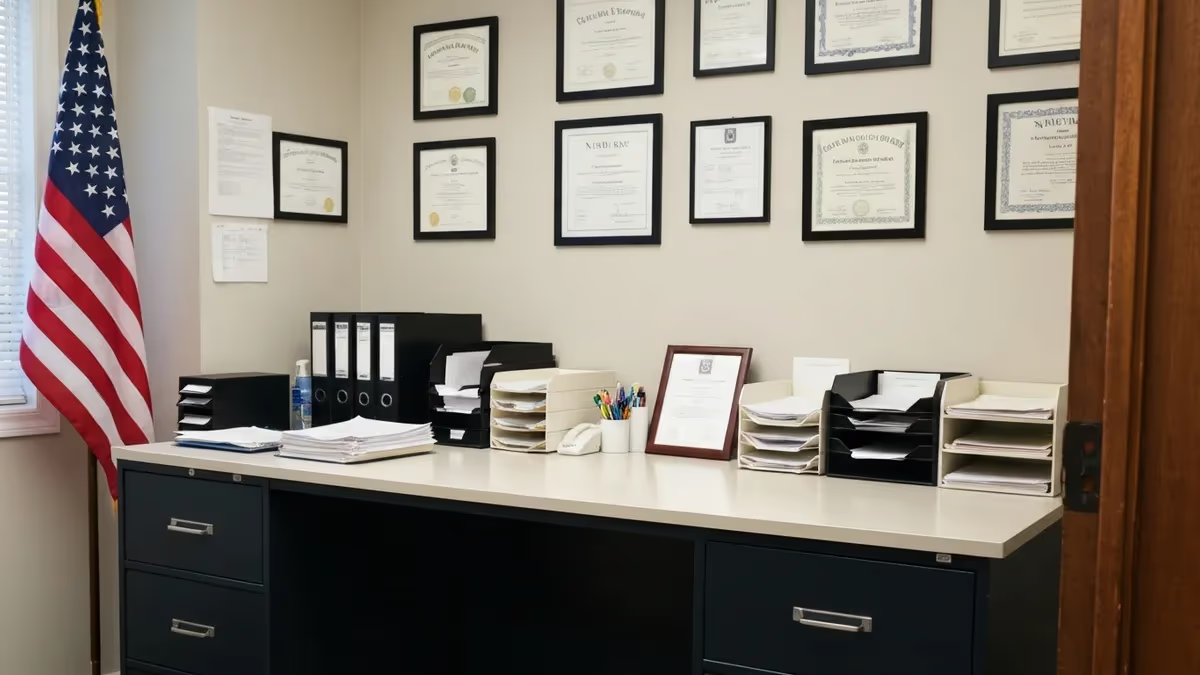
Understanding what is a notary public is the first step toward launching a rewarding legal-services career — and today, a quality notary public class online makes that journey faster and more accessible than ever before. A notary public is a state-commissioned official authorized to witness signatures, administer oaths, certify copies of documents, and perform other acts designed to deter fraud. Every U.S. state appoints notaries, though the specific powers, requirements, and fees differ considerably from one jurisdiction to another.
The demand for notaries has grown steadily over the past decade, driven by an explosion in real estate closings, remote work arrangements, and digital commerce. Lenders, title companies, law firms, hospitals, and government agencies all rely on commissioned notaries to authenticate high-stakes paperwork. Whether you want a side income, a full-time mobile signing business, or simply an additional credential that makes you more valuable at your current job, completing a notary public class online gives you the foundational knowledge you need to pass your state exam and serve the public confidently.
Most aspiring notaries are surprised to learn how simplified the commissioning process has become. In many states, the entire path — from enrollment in a notary public class online through oath of office — can be completed in four to eight weeks. The curriculum typically covers legal authority, proper identification procedures, journal-keeping requirements, notarial certificate language, and the ethical obligations that govern every seal you place. States that require an exam, such as California and New York, also demand proof of education before you sit for the test.
This guide walks you through everything you need to know: the legal definition of a notary public, step-by-step commissioning requirements, a breakdown of what online classes cover, how to prepare for the notary public exam, and practical tips for building a thriving notary practice once you receive your commission.
We also compare online training options, explain the difference between a notary public stamp and a notary public seal, and point you toward free practice resources so you can test your knowledge right now. For state-specific details, check out our guide on how to become a notary public in california and other states.
One question we hear frequently is how a notary public differs from a notario publico. In Latin American legal tradition, a notario publico is a highly trained attorney-level official with sweeping authority over property transfers, corporate formations, and estate matters. In the United States, however, the role is far more limited in scope — though no less important.
U.S. notaries are ministerial officers, meaning they follow a defined checklist of steps rather than exercising independent legal judgment. This distinction matters enormously for Spanish-speaking clients who may expect U.S. notaries to provide legal advice they are neither authorized nor qualified to give.
Beyond the legal framework, a great online class will help you understand the business side of notary work. You will learn how to set competitive fees (states cap maximum charges per notarial act, ranging from $1 in some states to $15 or more in others), how to market mobile signing services, how to work with signing services and escrow officers, and how to maintain the professional appearance and punctuality that high-volume clients expect. The notary business rewards reliability and attention to detail far more than aggressive self-promotion.
Before we dive into the details, here is a quick orientation: this article covers the training landscape for aspiring notaries across the United States, with particular attention to states that mandate education. We include real statistics, cost breakdowns, a study schedule, and links to free practice quizzes so you can gauge your readiness before exam day. Whether you are at the very beginning of your research or just weeks away from your state test, the sections below will give you a clear, accurate, and actionable roadmap.
Notary Public by the Numbers

Online Notary Class Study Schedule
- ▸Complete Module 1: Definition and authority of a notary public
- ▸Study your state's Notary Public Act or statutes
- ▸Learn the difference between acknowledgments and jurats
- ▸Take the Module 1 end-of-unit quiz
- ▸Complete Module 2: Acceptable signer identification documents
- ▸Practice completing notarial certificate language correctly
- ▸Study journal entry requirements for your state
- ▸Review credible witness procedures
- ▸Complete Module 3: Ethical obligations and prohibited conduct
- ▸Study common fraud scenarios and red flags
- ▸Review grounds for denial, refusal, and commission revocation
- ▸Take a full-length practice exam (50+ questions)
- ▸Complete remaining course modules and final course exam
- ▸Gather application materials: ID, fee, course certificate
- ▸Order surety bond and notary stamp/seal once approved
- ▸Review weak areas using free practice quizzes
Learning how to become a notary public starts with understanding that the process is entirely state-controlled — there is no federal notary commission. Each of the 50 states (plus Washington, D.C.) sets its own age requirement (always 18+), residency or employment rules, education mandates, exam requirements, bond amounts, and commission terms. Despite this variation, the overall pathway follows a predictable sequence that a good notary public class online will walk you through from start to finish.
The first step in virtually every state is confirming your eligibility. You must be a legal resident or, in some states, merely employed within the state's borders. You cannot have certain felony convictions on your record, and you must be at least 18 years old. Some states, such as Florida, also require that you read, write, and speak English. Once eligibility is confirmed, you enroll in a state-approved education course if your state requires one. California, for example, mandates six hours of approved instruction before you can sit for the exam.
After completing your notary public class online, you will typically receive a course-completion certificate that you submit along with your state application, a filing fee (usually $20–$100 depending on the state), and proof of a surety bond. The bond — commonly $5,000 to $25,000 — protects the public against errors or misconduct; it does not protect the notary personally. Most aspiring notaries purchase their bond through the same vendor that sells their official seal and journal, making the process convenient and affordable. Annual bond premiums usually run $15–$50 for the standard four-year commission term.
States that require a written exam — California, New York, Maine, and a handful of others — schedule the test through a state agency or approved testing provider. The California notary exam, for instance, consists of 45 multiple-choice questions drawn from the state's Notary Public Handbook. You need a score of 70% or higher to pass. New York's exam also uses multiple-choice format and requires at least a 70% passing score. Understanding how to become a notary public in your specific state means reviewing that state's official handbook carefully, since exam questions come directly from statutory language and official guidelines.
Once your application is approved, you will receive a commission certificate from the state. Before you can notarize anything, however, you must complete the oath of office — usually administered at your county clerk's office — within a specified window (often 30 days from commission issuance). Missing this deadline can void your commission and require you to start the process over.
Some states also require you to file your bond and, in California, your notary public seal impression with the county clerk at the same appointment. Pay close attention to these post-approval steps; they trip up more new notaries than any other part of the process.
Continuing education is another consideration, especially in states with mandatory refresher requirements. California notaries who allow their commission to lapse for more than 30 days must complete a new six-hour course before renewing. Other states require a shorter refresher course at each renewal. Staying current with legislative changes is equally important — notary laws are amended regularly, and practicing under outdated knowledge can expose you to liability. Many notary associations offer annual webinars and newsletters to keep members informed. For those interested in flexible earning opportunities, our guide on notary public jobs covers remote and online notarization in depth.
The timeline from enrollment to active commission varies, but most dedicated students complete the process in four to eight weeks. Factors that speed up the process include taking an on-demand online course (rather than waiting for a scheduled live class), submitting a complete application the first time, and scheduling your oath-of-office appointment promptly. Factors that slow things down include background-check delays, missing documents, or scheduling bottlenecks at busy county clerk offices. Planning ahead and maintaining a checklist of every required step will help you stay on track and avoid frustrating delays.
Notary Public Stamp vs. Seal: What You Need to Know
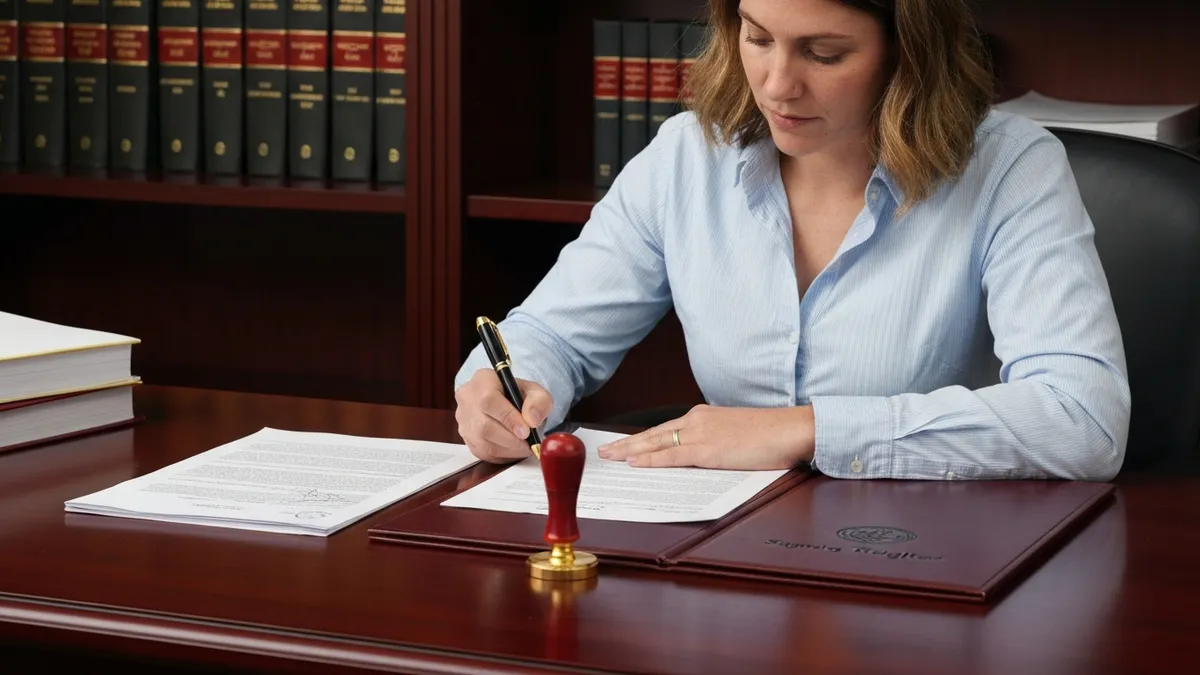
A notary public stamp is an inked rubber stamp device that imprints the notary's official information directly onto a document. Most states permit or require the stamp to include the notary's name exactly as commissioned, the state of commission, the commission number, and the commission expiration date. Ink stamps are popular because they are inexpensive (typically $15–$35), fast to use, and produce a legible, scannable impression that works well with digital document workflows.
The color of the ink matters in some jurisdictions — California, for example, requires a black or blue ink stamp for optimal legibility on photocopied documents. When ordering your notary public stamp, always verify your state's size and content requirements beforehand, since a nonconforming stamp can invalidate notarizations and require costly re-ordering. Replace ink pads regularly to avoid faded impressions, and store your stamp securely to prevent unauthorized use.
Online Notary Class vs. In-Person Classroom Training
- +Study at your own pace — pause, rewind, and revisit difficult modules anytime
- +No commute or fixed schedule — complete coursework during evenings or weekends
- +Lower cost — online courses typically run $25–$100 versus $150–$250 for live classes
- +Immediate access to updated materials when notary laws change mid-cycle
- +Built-in quizzes and progress tracking help you identify weak areas before exam day
- +Many providers bundle the course with application assistance, bond, and seal ordering
- −No real-time Q&A with an instructor — questions must wait for email responses
- −Self-discipline required — procrastination is easy without scheduled class times
- −Some states require in-person proctored exams even after completing an online course
- −Technical issues (internet outages, video buffering) can interrupt study sessions
- −Less peer interaction — no classmates to compare notes or form study groups with
- −Quality varies widely — some low-cost online courses are outdated or overly generic
Notary Public Exam Prep Checklist
- ✓Download and read your state's official Notary Public Handbook cover to cover at least twice.
- ✓Enroll in a state-approved notary public class online and complete all modules before your exam date.
- ✓Take at least three full-length timed practice exams to simulate real testing conditions.
- ✓Review every notarial certificate form in your state — acknowledgment, jurat, copy certification, and oath.
- ✓Memorize the grounds for refusal: incomplete documents, signer incapacity, and conflict of interest.
- ✓Study acceptable signer ID types — primary IDs, credible witnesses, and personally known exceptions.
- ✓Understand journal entry requirements: what information must be recorded for each notarial act.
- ✓Review your state's fee schedule so you know the maximum charge per notarial act.
- ✓Practice identifying common fraud red flags: altered documents, coerced signers, and blank spaces.
- ✓Schedule your exam appointment as soon as your course certificate is issued to maintain momentum.

Focus on Your State Handbook — Not Generic Study Guides
State notary exams pull questions directly from the official Notary Public Handbook or statutes for that state. Generic study guides can introduce conflicting information from other states' laws. Always treat your state's official publication as the primary source, and use practice quizzes only to test comprehension of material you have already studied from that source.
Effective exam preparation for the notary public exam begins with a clear understanding of what the test actually measures. Unlike a bar exam or professional licensing test in other fields, notary exams are designed to confirm that you understand the mechanics of performing notarial acts correctly, not that you can provide legal advice. The questions focus on procedural accuracy: What must appear in an acknowledgment certificate? When is a jurat the correct notarial act? What must you do when a signer cannot personally appear? These are the pillars of every state's test blueprint.
Start your preparation by mapping the major topic areas tested in your state. California's exam, for example, covers five primary domains: notary public law, general information, performing notarial acts, fees and recordkeeping, and prohibited acts. New York's test focuses heavily on the legal definition of acknowledgments, the role of the notary in real property transactions, and ethical obligations. Once you know your state's topic distribution, you can allocate study time proportionally — spending more hours on high-weight sections and less on areas where you already have intuitive knowledge.
Active recall beats passive reading every time for exam preparation. Rather than highlighting sentences in the handbook and hoping the material sticks, close the book and try to recite the key rule from memory. For example, after reading about credible witnesses, close your materials and ask yourself: How many credible witnesses are required? What must they swear to? Do they sign the journal? Testing yourself on these specifics forces your brain to retrieve information rather than merely recognize it, which dramatically improves retention and performance on exam day.
Time management during the actual exam is another underappreciated skill. Most state exams allow 90 minutes to two hours for 45–70 questions, which means you have roughly two to three minutes per question. Many test-takers lose points not because they don't know the material but because they spend too long on a single difficult question and run out of time. Practice under timed conditions during your preparation so that pacing feels natural when it counts. If you encounter a question you are unsure about, mark it, move on, and return to it with fresh eyes.
A common mistake among notary exam candidates is memorizing certificate language verbatim without understanding why each element exists. Understanding the purpose of the venue clause (it identifies which state's laws govern), the notary's signature (it authenticates the act), and the expiration date (it allows document recipients to verify commission validity at the time of signing) turns abstract memorization into logical comprehension. When you understand the why, you can answer questions about variations and edge cases that might not appear word-for-word in the handbook.
Many online notary courses include a final course exam that mirrors the style and difficulty of your state's actual test. Take this course exam seriously — treat it as a diagnostic rather than a formality. If you score below 80%, revisit the modules covering your weakest areas before scheduling your state exam appointment.
Rushing to take the official test before you are ready wastes the exam fee (typically $20–$45) and can delay your commission by weeks. Most states limit the number of times you can retake the exam within a given period, so performing well on your first attempt is worth the extra preparation time.
Beyond the handbook and your online course, several free and low-cost resources can sharpen your readiness. The National Notary Association (NNA) publishes state-specific study guides and offers a free hotline for commissioned notaries. Your county recorder's office often publishes common notarial certificate forms that you can practice completing.
And of course, free practice quizzes — like those available here at PracticeTestGeeks — let you drill on the specific knowledge domains covered by your state exam. If you want to find notary services while you are still in training, resources like free notary public library near me can help you observe experienced notaries in action before you earn your own commission.
After receiving your commission certificate, most states give you 30 to 45 days to take your oath of office at the county clerk's office. Missing this deadline typically voids your commission entirely, requiring you to reapply and repay all fees. Calendar your oath appointment the same day your commission arrives — do not wait until the last week of the window.
Once you hold an active commission, building a sustainable notary practice requires the same intentional effort as any small business. The notary landscape has two primary income tracks: general notary work (GNW) and loan signing agent (LSA) work. General notary work covers everyday signings — power of attorney documents, car title transfers, affidavits, and personal letters. Loan signing work involves coordinating mortgage closing packages with title companies and escrow officers, a specialization that typically pays $75–$200 per signing appointment.
To pursue loan signing work, you will need more than just your state commission. Most title companies and signing services require notary signing agents to pass a separate loan signing certification exam (offered through the NNA and similar providers), carry a minimum errors-and-omissions insurance policy (typically $25,000–$100,000 in coverage), and pass a background check through an approved vendor. These additional credentials add modest upfront cost ($150–$300) but dramatically increase your earning potential and the volume of work available to you through the national signing service networks.
Marketing your notary services effectively does not require a large advertising budget. A Google Business Profile listing is free and essential — most people searching for free notary public near me or free public notary near me are looking for local services, and a well-optimized listing puts your business in front of those searches.
Even if you charge for your services, appearing in local search results drives calls. Supplement your online presence with listings on notary directories such as NotaryRotary, 123Notary, and the NNA's Signing Agent database. These platforms charge modest annual fees but are actively used by signing services searching for qualified agents.
Networking with real estate professionals, attorneys, senior care facilities, auto dealerships, and financial advisors creates a steady referral pipeline for in-person general notary work. Many notaries secure anchor relationships with a single hospital or assisted living facility that generates consistent signing requests for healthcare directives, power of attorney documents, and estate planning forms. These institutional clients value reliability and professionalism above all else — arriving on time, with the correct tools, and executing each notarization accurately will earn repeat business far more effectively than any marketing campaign.
One practical tool that experienced notaries recommend to every newcomer is a professional notary journal, even in states where one is not legally required. A thorough journal entry — including the date, type of notarial act, document type, signer's name and address, identification presented, and the signer's signature — provides critical protection if a notarization is later challenged in court or if you receive a subpoena. Courts consistently view careful journal-keeping as evidence of professional conduct and good faith. Investing in a bound, sequentially numbered journal from the outset is one of the best habits you can develop.
Pricing your services appropriately is another common stumbling block for new notaries. State-mandated fee caps set the ceiling, not the floor. In states with low caps (some cap fees at $1–$2 per notarial act), general notary work alone cannot generate meaningful income, and loan signing or remote online notarization becomes the primary revenue source.
In states with higher caps or no caps at all, creative pricing packages — travel fees, after-hours surcharges, per-signature bundling — allow you to run a more profitable general practice. Research what competitors charge in your area before setting your rate card, and remember that underpricing devalues the profession for everyone. To learn more about finding signing opportunities and employment options, visit our guide on chase bank notary public training and workplace signing programs.
Finally, protect your commission by staying current with continuing education, renewing your bond and insurance on schedule, and immediately reporting any changes to your name or address to your state's commissioning authority. A lapsed bond or an address discrepancy in state records can invalidate your notarizations and expose you to personal liability.
Set calendar reminders three months before every renewal deadline — commission, bond, E&O policy, and any RON platform subscriptions — so you are never caught off guard. The most successful notaries treat their commission as a professional license worth protecting and maintaining with the same diligence they bring to every signing appointment.
Practical preparation for the notary public exam goes beyond reading the handbook and taking practice quizzes. One of the most effective — and underused — strategies is to physically practice completing notarial certificates. Download blank acknowledgment and jurat forms for your state, fill in dummy information, and check your work against the statutory requirements. This hands-on repetition makes the certificate elements second nature by the time you sit for the exam and, more importantly, by the time you perform your first real notarization.
Understanding the difference between an acknowledgment and a jurat is foundational and frequently tested. An acknowledgment is a notarial act in which the signer personally appears before the notary and acknowledges that they signed the document of their own free will — the notary does not witness the actual signing.
A jurat, by contrast, requires the signer to sign in the notary's presence and swear or affirm under penalty of perjury that the document's contents are true. Confusing these two acts — or using the wrong certificate for a given document — is one of the most common errors new notaries make and one of the most common sources of exam questions.
Another practical area worth mastering before exam day is the identification verification process. Most states accept a current state-issued driver's license or identification card, a U.S. passport, a military ID, or a permanent resident card as acceptable primary identification.
The document must be government-issued, bear the signer's photograph and signature, and be current or issued within the past five years (requirements vary). When a signer lacks acceptable ID, some states permit the use of one or two credible witnesses — people who personally know the signer and can vouch for their identity under oath. Knowing the specific rules for your state cold is essential, because exam questions frequently present edge cases designed to test your understanding of these boundaries.
Technology has also changed practical notary work in ways your online course may only partially cover. Electronic documents, digital signatures, and PDF-based closing packages are now standard in mortgage transactions. As a loan signing agent, you will receive closing packages via secure email or portal, print them on demand, guide borrowers through signing, scan completed packages, and upload them back to the title company — all within a tight timeline. Developing comfort with scanning equipment, PDF annotation tools, and secure file-transfer protocols will make you a more capable and competitive signing agent from day one.
For those interested in notary public in bank of America locations and other financial institution settings, it is worth knowing that many major banks — including Bank of America, Chase, Wells Fargo, and U.S. Bank — offer free notary services to account holders at most branch locations.
These institutional notaries are bank employees who hold individual state commissions, and their work is subject to the same rules as any other commissioned notary. If you are considering pursuing in-house notary work at a financial institution, check whether the bank reimburses commissioning fees and whether the position carries a pay premium — many do.
Free notary public near me searches reveal a rich ecosystem of no-cost or low-cost notary services beyond bank branches. Public libraries, UPS Stores, AAA offices, and credit unions frequently offer notary services at no charge or for a nominal fee.
Understanding where these free options exist is useful both for clients who ask you for referrals and for your own professional positioning — if you are building a mobile notary business, you are generally not competing with free bank notaries because you offer convenience (coming to the client's location), extended hours, and expertise in complex documents like mortgage closings. For a comprehensive list of free notary locations in your area, see our resource on free notary public library near me services.
As you move from exam candidate to active notary, the most important mindset shift is from student to professional. Every notarization you perform carries legal weight — a single error in a certificate, a missed journal entry, or a failure to verify identification properly can have significant consequences for the signer, the document recipient, and your commission.
Approach every signing appointment with the same diligence you applied to your exam preparation: verify the document is complete, confirm the signer's identity, confirm the signer is acting voluntarily and understands what they are signing, complete the correct certificate, and record the act in your journal. This disciplined routine, applied consistently, is the hallmark of a notary public who builds a lasting reputation and a thriving practice.
Notary Public Questions and Answers

Public Library Notary: Where to Find Free Notary Services Near You

Notary Public Training: Complete 2026 Guide to Requirements, Certification & Exam Prep

Remote Notary Public: The Complete Guide to Online Notarization in 2026

Notary Public Requirements: Complete 2026 Guide to Becoming a Commissioned Notary

NC Notary Public Course: Complete Training Guide for North Carolina
About the Author

Notary Public Law Expert & State Notary Exam Specialist
Georgetown University Law CenterAttorney Sarah Williams is a licensed attorney and National Notary Association (NNA) certified notary with a Juris Doctor from Georgetown University Law Center. She has 13 years of experience in notarial law, document authentication, and real estate closings. Sarah coaches candidates through state notary public examinations, notary signing agent certification, and loan signing agent training programs.