
NFPA 1006: Complete Guide to the Standard for Technical Rescue Personnel Professional Qualifications
NFPA 1006 explained: the standard for technical rescue personnel qualifications, disciplines, JPRs, certification levels, and how to prepare for the exam. 🟢
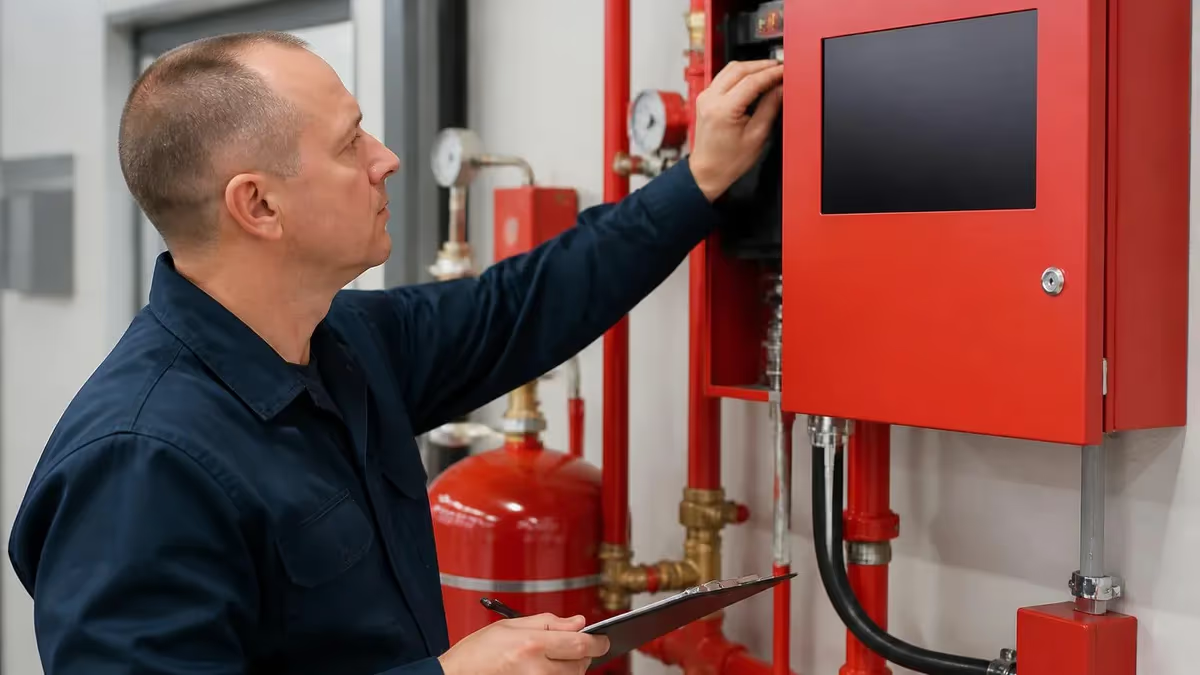
NFPA 1006 is the National Fire Protection Association standard that defines the minimum job performance requirements for technical rescue personnel across the United States. If you work in swiftwater, rope, confined space, structural collapse, or vehicle rescue, this is the document that sets the bar for what you must be able to do. Understanding nfpa 1006 matters because it underpins how agencies train, certify, and deploy rescuers to incidents where a single mistake can cost a life. It is the professional qualification benchmark the rescue community trusts. Practice with the free NFPA - National Fire Protection Association practice test on PracticeTestGeeks (100+ questions with answer explanations).
The standard answers a deceptively simple question: what does it actually mean to be qualified to perform a technical rescue? Rather than describing how to build a department or buy equipment, NFPA 1006 spells out competencies in measurable terms. Each task a rescuer must perform is written as a job performance requirement, or JPR, that states the conditions, the task, and the expected outcome. This task-based structure lets a third-party evaluator verify skill objectively instead of relying on a vague impression that someone seems capable.
NFPA 1006 was first issued to bring consistency to a field that had grown unevenly across the country. Before its adoption, one county's confined space team might train to a rigorous internal protocol while a neighboring jurisdiction operated with almost no documented standard at all. By publishing a unified set of requirements, the NFPA gave authorities a common language. Mutual aid partners arriving at a complex incident could now reasonably assume their counterparts had been measured against the same yardstick, which improves coordination and safety dramatically.
The 2021 edition reorganized the standard significantly, consolidating rescue disciplines and aligning the levels so that personnel progress logically from awareness toward operations and technician competency. This edition also clarified the relationship between general rescuer requirements and the discipline-specific chapters layered on top of them. A rescuer first satisfies the core foundation, then adds the specialized JPRs for whatever environment they operate in, building a credential that reflects exactly what they are trained and authorized to do in the field.
For individuals pursuing certification, NFPA 1006 is more than bureaucratic paperwork. It shapes the curriculum of training academies, drives the content of certification exams administered by bodies such as Pro Board and IFSAC, and often determines insurance and liability standing for a department. Employers increasingly list NFPA 1006 compliance in job postings, and grant funding frequently requires it. Knowing the standard inside and out gives a candidate a genuine advantage when competing for technical rescue positions in a crowded applicant pool.
This guide walks through everything you need to grasp the standard: its structure, the rescue disciplines it covers, the difference between awareness, operations, and technician levels, how certification works, and how to prepare effectively for the written and practical evaluations. Whether you are a probationary firefighter eyeing a special operations assignment, a seasoned rescuer renewing a credential, or an instructor designing a program, the sections below break the material into manageable, exam-ready pieces you can study at your own pace.
Free NFPA - National Fire Protection Association Study Tools
Interactive NFPA - National Fire Protection Association resources on PracticeTestGeeks, free to start:
- Free NFPA Life Safety Questions and Answers — 11 questions with instant scoring and answer explanations
- NFPA - National Fire Protection Association flashcards — review key terms and concepts card by card
- NFPA - National Fire Protection Association study guide — topic-by-topic overview of what the exam covers
- NFPA - National Fire Protection Association cheat sheet — one-page printable summary for last-minute review
NFPA 1006 by the Numbers
How NFPA 1006 Is Structured
The entry tier for personnel who may arrive first at a technical rescue. They recognize hazards, secure the scene, deny entry, and request qualified resources without performing the actual rescue themselves.
Rescuers who can directly participate in a rescue under the supervision of a technician. They perform hands-on tasks within a defined scope, support technicians, and operate as functional members of the rescue team.
The highest competency tier. Technicians lead complex evolutions, supervise operations personnel, manage rigging and risk, and demonstrate mastery of advanced discipline-specific job performance requirements at the incident.
A core foundation of common JPRs every rescuer must satisfy before adding any discipline. Covers scene size-up, victim management, PPE, communications, and documentation shared across all rescue types.
The heart of NFPA 1006 lies in its discipline-specific chapters. Each chapter targets a distinct rescue environment and layers specialized job performance requirements on top of the general rescuer foundation. Among the disciplines you will encounter are rope rescue, confined space rescue, vehicle and machinery rescue, structural collapse, trench rescue, water rescue subdivided into surface, swiftwater, dive, and surf, plus wilderness, cave, mine and tunnel, animal technical rescue, and helicopter or tower rescue. Each demands a unique blend of knowledge and physical capability.
Rope rescue is often the gateway discipline because the rigging principles transfer everywhere. A rope technician must build mechanical advantage systems, manage edge transitions, construct anchors that meet appropriate safety factors, and operate as both a litter attendant and a system manager. The standard requires demonstrated competence in high-angle and low-angle environments, knot tying under realistic conditions, and the ability to troubleshoot a stuck load mid-evolution without compromising the safety of the rescuer or the patient on the line.
Water rescue disciplines carry some of the highest fatality rates for responders, so NFPA 1006 treats them with particular rigor. Swiftwater rescuers must read hydrology, understand strainers and hydraulics, perform self-rescue swims, deploy throw bags accurately, and execute tension diagonal and boat-based rescues. The standard insists that personnel never enter moving water without the appropriate level certification, because heroic but untrained entry attempts are a recurring cause of line-of-duty deaths in flood and river incidents nationwide every single year.
Structural collapse and trench rescue introduce the engineering side of technical rescue. Here rescuers shore unstable voids, cut and breach concrete, lift heavy loads with airbags and struts, and monitor atmospheres for the same hazards found in confined spaces. The job performance requirements emphasize patient packaging in tight, dangerous environments and continuous reassessment of secondary collapse potential. These are slow, methodical operations where the discipline to avoid rushing is itself a tested competency woven through the entire chapter.
Confined space rescue ties many of these threads together because it combines atmospheric hazards, rigging, patient access, and frequently a need for supplied-air breathing systems. NFPA 1006 aligns closely with OSHA permit-required confined space regulations, so a technician must understand permits, ventilation, attendant duties, and non-entry retrieval. The standard's structure mirrors the realities of these standards much like the way the closely related nfpa 1006 discipline framework references adjacent codes that govern the broader fire-protection environment rescuers work within.
What unifies all of these chapters is the layered model: master the general requirements, then add the disciplines relevant to your assignment and authority. A department in a coastal flood zone may certify heavily in surface and swiftwater while skipping cave rescue entirely, whereas an urban search and rescue task force invests deeply in collapse and confined space. This modular approach lets agencies build exactly the capability their hazard profile demands without forcing every rescuer through irrelevant training they will never use.
Understanding NFPA 1006 Certification Levels
Every competency in NFPA 1006 is written as a job performance requirement, or JPR. A JPR has three parts: the task to be performed, the conditions under which it is performed, and the measurable outcome that defines success. This format removes ambiguity from evaluation. Instead of asking whether a rescuer is good at rigging, an evaluator asks whether the rescuer built a 3:1 mechanical advantage system within a stated time and safety factor.
Because JPRs are objective, they support legally defensible certification. When a candidate is tested, the evaluator checks specific, observable behaviors against the published criteria. This protects both the rescuer and the agency by documenting exactly what was demonstrated. It also means candidates can study with confidence, since the standard tells them precisely which tasks they will be asked to perform during the practical skills evaluation portion of certification.
Is NFPA 1006 Certification Worth Pursuing?
- +Nationally recognized credential that improves job mobility and reciprocity
- +Objective JPR structure makes training expectations clear and measurable
- +Often required for special operations assignments and grant-funded teams
- +Strengthens department liability standing and insurance positioning
- +Modular disciplines let you build exactly the skills your region needs
- +Aligns with OSHA and adjacent NFPA standards for integrated compliance
- −Training and certification can be time-consuming and physically demanding
- −Course and recertification costs can be significant for individuals
- −Maintaining proficiency across multiple disciplines requires ongoing drilling
- −Some smaller agencies struggle to fund evaluator and instructor access
- −Standard editions change, requiring periodic curriculum and skill updates
- −Equipment requirements for certain disciplines are expensive to maintain
Pros and Cons at a Glance
| Pros | Cons |
|---|---|
| Nationally recognized credential that improves job mobility and reciprocity | Training and certification can be time-consuming and physically demanding |
| Objective JPR structure makes training expectations clear and measurable | Course and recertification costs can be significant for individuals |
| Often required for special operations assignments and grant-funded teams | Maintaining proficiency across multiple disciplines requires ongoing drilling |
| Strengthens department liability standing and insurance positioning | Some smaller agencies struggle to fund evaluator and instructor access |
| Modular disciplines let you build exactly the skills your region needs | Standard editions change, requiring periodic curriculum and skill updates |
| Aligns with OSHA and adjacent NFPA standards for integrated compliance | Equipment requirements for certain disciplines are expensive to maintain |
NFPA 1006 Candidate Readiness Checklist
- ✓Confirm your target rescue discipline and required certification level
- ✓Verify the training program leads to Pro Board or IFSAC accreditation
- ✓Obtain the current 2021 edition of NFPA 1006 and study its structure
- ✓Complete all general rescuer JPRs before adding discipline-specific tasks
- ✓Drill knot tying and rigging until you can perform under time pressure
- ✓Practice scene size-up, hazard recognition, and resource requests
- ✓Review OSHA confined space and relevant regulations for your discipline
- ✓Build physical fitness for the demands of practical skills evaluations
- ✓Take written practice tests to identify knowledge gaps early
- ✓Schedule the practical evaluation with a certified, qualified evaluator
Master the general requirements first
Candidates who fail often rush into discipline-specific skills without solidifying the general rescuer foundation. Scene size-up, victim management, communications, and PPE JPRs appear in every discipline's evaluation. Build that base rock-solid first, and the specialized tasks become far easier to layer on top.
Adopting NFPA 1006 reshapes how a department operates far beyond the certification of individual rescuers. When an authority having jurisdiction formally references the standard in policy, it commits to training, evaluating, and deploying personnel against a documented benchmark. This creates accountability that flows from the chief through company officers down to probationary members. It also gives administrators a defensible answer when asked, after a difficult incident, whether their people were genuinely qualified for the rescue they attempted that day.
Liability is a major driver of adoption. In the event of a rescuer injury or a wrongful death claim, attorneys will scrutinize whether the responders met a recognized standard of care. A department that can produce JPR-based certification records demonstrates due diligence, while one relying on informal training is exposed. NFPA 1006 functions as that recognized standard, so its documentation becomes a shield. Many municipalities now require it precisely because risk managers understand the financial and reputational stakes involved.
Grant funding frequently hinges on compliance as well. Federal and state programs that finance technical rescue teams, equipment, and training often stipulate that personnel be certified to NFPA standards. A department chasing a grant for a new collapse rescue cache may find the application denied without documented NFPA 1006 technician credentials on the roster. This funding pressure has accelerated adoption even among smaller agencies that might otherwise have deferred formal certification for budgetary reasons.
Mutual aid and regional task force integration depend on shared standards too. When a swiftwater team from one county responds to a flood in another, the requesting agency needs confidence that arriving rescuers are competent. NFPA 1006 provides that assurance because everyone is measured against the same JPRs. Without it, an incident commander faces the impossible task of vetting unfamiliar responders mid-emergency. The standard effectively lets strangers trust one another's training when it matters most, under pressure.
The standard also influences how departments structure their special operations programs. Because competencies are modular, a chief can map the region's hazard profile to a deliberate capability plan, certifying enough technicians and operations personnel in each relevant discipline to staff a credible response. This prevents both gaps, where a hazard exists but no one is trained, and waste, where resources are spent certifying skills the jurisdiction will never realistically need to deploy in actual field conditions.
Finally, NFPA 1006 supports career development and morale. Clear competency tiers give rescuers a visible ladder to climb, from awareness through operations to technician and into instructor or team-leader roles. Members can set concrete goals, and supervisors can reward demonstrated progression with assignments and recognition. This structure turns technical rescue from a vague aspiration into a defined professional pathway, which helps departments retain talented, motivated personnel in a field where burnout and turnover are persistent ongoing challenges.
NFPA periodically revises and reorganizes its standards. The 2021 edition consolidated disciplines and realigned levels, so studying an outdated copy can leave you unprepared for current exam content. Always confirm you are working from the edition your certifying body references before investing serious study time.
Preparing for an NFPA 1006 certification exam requires a balanced approach that addresses both the written knowledge component and the practical skills evaluation. The written portion tests your understanding of terminology, hazards, regulations, and the reasoning behind procedures. Candidates sometimes neglect this in favor of hands-on practice, then stumble on questions about atmospheric monitoring thresholds, mechanical advantage ratios, or the legal framework governing confined space entry. A disciplined study plan gives appropriate weight to both halves of the certification process from the very start.
Begin by obtaining the relevant chapters of the current standard and mapping every JPR you will be tested on. Turn each requirement into a study objective and a self-test question. For a rope rescue technician, that might mean listing the anchors, mechanical advantage systems, and edge management techniques you must demonstrate, then drilling each until it is automatic. This reverse-engineering of the standard into a personal checklist is one of the most effective preparation methods experienced instructors recommend to candidates.
Practice tests are invaluable for the written component. Working through realistic questions reveals gaps you did not know you had and builds familiarity with how concepts are phrased on exams. Many candidates find that NFPA-focused question banks covering life safety, the National Electrical Code, and specific standards sharpen the broader knowledge base that technical rescue exams draw upon. Reviewing the related nfpa 1006 material alongside your discipline chapters reinforces how rescue work fits within the larger fire-protection code environment.
Physical readiness cannot be an afterthought. Practical evaluations often run for hours and place real demands on strength, endurance, and fine motor control under stress. A candidate who can tie a perfect knot at rest may fumble it after hauling a litter up a slope. Build discipline-relevant fitness into your preparation, and rehearse skills while fatigued so that competence holds up when your heart rate is elevated and your hands are cold, wet, or gloved during the actual evaluation.
Rehearse the soft skills too. Evaluators assess communication, teamwork, and scene management, not just technical execution. Practice giving clear commands, confirming receipt of instructions, and conducting an organized size-up out loud. In many rescue disciplines, a technically perfect rig executed with poor communication still represents an unsafe operation. Demonstrating that you can lead and coordinate, not just perform isolated tasks, often separates a confident pass from a marginal or failing performance during the test.
Finally, simulate the evaluation environment before test day. Arrange mock scenarios with peers acting as victims and an experienced rescuer playing evaluator. Time yourself, invite tough feedback, and treat each run as the real thing. This rehearsal reduces test-day anxiety, exposes weak points while there is still time to fix them, and builds the calm, methodical mindset that NFPA 1006 ultimately rewards. Candidates who train this way walk into certification prepared rather than merely hopeful about the outcome.
Beyond passing the initial exam, the most successful technical rescuers treat NFPA 1006 as a living framework that guides continuous improvement rather than a one-time hurdle. Skills decay without practice, and disciplines like swiftwater or confined space rescue are unforgiving of rust. Schedule regular drills that revisit the full range of JPRs, not just the ones you enjoy or find easy. Rotating through every competency keeps your entire skill set sharp and ready for the unpredictable nature of real emergency calls.
Documentation discipline pays dividends throughout a career. Keep a personal record of every certification, recertification, drill, and real incident you participate in. When promotion boards, hiring panels, or task force selections come around, a well-organized training history demonstrates commitment and competence in a way that a single certificate cannot. It also simplifies recertification, since you can quickly show the continuing education and skills maintenance that many accrediting bodies require to keep a credential current and valid.
Find a mentor and become one. The technical rescue community is small and relationship-driven, and the fastest way to deepen your understanding of NFPA 1006 is to teach it. Explaining why a particular mechanical advantage system suits a given load, or why an atmospheric reading dictates a specific entry decision, forces you to internalize the standard's logic. New rescuers benefit from your experience, and you benefit from the questions they ask, which often expose assumptions you had stopped examining yourself.
Stay current with edition changes and emerging hazards. The rescue landscape evolves: lithium-ion energy storage incidents, larger and more complex vehicles, and new construction methods all introduce challenges the standard adapts to over time. Subscribe to updates from your certifying body, attend conferences, and read incident reports from across the country. The rescuers who consistently perform well under pressure are usually the ones who never stopped learning after they earned that first technician patch on their shoulder.
Integrate your NFPA 1006 knowledge with the broader codes that shape your operating environment. Understanding how sprinkler systems, fire service mains, hazardous material placards, and protective ensembles function makes you a more complete responder who anticipates problems instead of merely reacting to them. Technical rescue rarely happens in isolation; it unfolds inside buildings, near electrical hazards, and amid materials governed by other standards. The rescuer who grasps that interconnected picture brings disproportionate value to any team they join.
Above all, let the standard reinforce a culture of safety rather than heroics. NFPA 1006 exists because untrained, impulsive rescue attempts have killed responders who meant well. Every JPR encodes a hard lesson learned, often at someone's expense. Honoring that means going home at the end of every shift, refusing to skip steps, and trusting the methodical process even when adrenaline screams to rush. That mindset, more than any single skill, is the true mark of a qualified technical rescue professional in the field.
Sample NFPA - National Fire Protection Association Practice Questions
Try these questions from our free NFPA - National Fire Protection Association practice tests. The correct answer and an explanation follow each question.
What does NFPA 72 specify as the maximum travel distance to a manual pull station in an educational occupancy?
- A. 100 feet
- B. 150 feet
- C. 200 feet
- D. 300 feet
Answer: B. 150 feet
NFPA 72 requires manual pull stations to be located so that travel distance from any point in the protected area does not exceed 200 feet.
According to NFPA 30, what is required around above-ground flammable liquid tanks to contain spills?
- A. Gravel bed at least 6 inches deep
- B. Secondary containment capable of holding 100% of the largest tank volume
- C. Concrete curbing 4 inches high
- D. Sand barrier 12 inches wide
Answer: B. Secondary containment capable of holding 100% of the largest tank volume
NFPA 30 requires secondary containment (diked areas or equivalent) capable of holding 100% of the volume of the largest tank within the impoundment area.
A rating of '0' in any NFPA 704 category indicates the material:
- A. Has a moderate hazard in that category
- B. Poses no significant hazard in that category
- C. Has a severe unclassified hazard
- D. Has an unknown or unstudied hazard
Answer: B. Poses no significant hazard in that category
A rating of 0 means the material poses no significant hazard in that particular category under fire conditions.
Under NFPA 10, what is the maximum travel distance to a Class B extinguisher in a low-hazard occupancy?
- A. 30 feet
- B. 50 feet
- C. 75 feet
- D. 100 feet
Answer: B. 50 feet
NFPA 10 limits travel distance to a Class B extinguisher in low-hazard areas to 50 feet.
Take the full NFPA - National Fire Protection Association practice test
NFPA Questions and Answers
NFPA 24: Complete Guide to the Standard for Private Fire Service Mains and Their Appurtenances
NFPA 1971: Complete Guide to the Standard on Protective Ensembles for Structural and Proximity Fire Fighting
NFPA 704 Diamond: Complete Guide to Hazard Identification Ratings

NFPA 855: Standard for the Installation of Stationary Energy Storage Systems
NFPA 1001 Explained: Firefighter Professional Qualifications Standard Guide
How this page was made: written with AI tools and published by Nathan Beja, founder of Practice Test Geeks, who is responsible for its content. We have not yet matched this exam's facts to an official source, so confirm fees, dates and rules with the exam body. Not reviewed by a subject-matter expert. Editorial policy