
NASM Exam Prep 2026: How to Pass the NASM-CPT Certification
Get ready for your NASM certification. Practice questions with step-by-step answer explanations and instant scoring. 📚

NASM-CPT Exam Overview
The NASM Certified Personal Trainer (NASM-CPT) exam is the certification test issued by the National Academy of Sports Medicine (NASM) — one of the most widely recognized personal trainer certifications in the fitness industry. The NASM-CPT credential is accepted by gyms, health clubs, and fitness facilities nationally and demonstrates competency in exercise science, program design, client assessment, and behavior change coaching.
Exam Format
The NASM-CPT exam consists of 120 questions: 100 scored questions and 20 unscored pretest questions that appear throughout the exam without being identified. Candidates cannot distinguish which questions are scored — treat every question as scored. The exam is administered as a computer-based test at Pearson VUE testing centers or through online proctored testing. The time limit is 2 hours (120 minutes). The passing score is 70% of the 100 scored questions — meaning candidates must answer at least 70 questions correctly to pass.
Prerequisites and Eligibility
To be eligible for the NASM-CPT exam, candidates must: be at least 18 years of age; hold a current CPR/AED certification from an accredited organization (such as the American Red Cross or American Heart Association); and have a high school diploma or equivalent. There is no prerequisite course or training program required — candidates can self-study using NASM's materials or third-party resources and sit for the exam. NASM recommends (and sells) their own study packages, but the exam tests the content, not the specific study source.
Exam Registration and Cost
The NASM-CPT exam is registered through NASM's website (nasm.org). NASM sells exam-only packages and bundled study packages. The exam-only fee is approximately $499 (though NASM frequently runs promotions). Bundled packages including study materials, practice exams, and textbook access range from $699 to $1,999. Candidates who do not pass on the first attempt can purchase exam retakes — typically $199 per retake. Pearson VUE testing center fees may apply separately for in-person testing.

NASM-CPT Exam Domains and Content
The NASM-CPT exam is organized around five performance domains that reflect the scope of practice for a NASM-certified personal trainer. Understanding the weighting of each domain guides efficient study — focus study time proportionate to each domain's representation on the exam.
Basic and Applied Sciences (20%)
This domain covers the foundational science knowledge underlying personal training: human anatomy (skeletal, muscular, nervous, cardiovascular, respiratory systems); exercise physiology (energy systems, muscle fiber types, cardiorespiratory adaptations to exercise); biomechanics and kinesiology (joint movements, force-velocity relationships, lever systems); and the NASM Optimum Performance Training (OPT) model foundations. The science content is tested in the context of how it applies to client training decisions — not purely as isolated anatomy recall.
Assessment (18%)
The Assessment domain covers the process of evaluating clients before and during training: health history screening and PAR-Q (Physical Activity Readiness Questionnaire); postural assessment and movement screening (overhead squat assessment, single-leg squat assessment, pushing and pulling assessments); cardiovascular and muscular fitness assessments; body composition assessment methods; and interpreting assessment findings to identify muscle imbalances and movement compensations. NASM places significant emphasis on the overhead squat assessment — know the common compensations (feet turning out, knees caving, arms falling forward, forward lean) and their associated overactive/underactive muscles.
Program Design (22%)
Program Design is the highest-weighted domain — it covers the application of the OPT model in designing training programs: the three phases of training (Stabilization, Strength, Power); repetition and set schemes appropriate for each phase; tempo and rest interval guidelines; exercise selection and progression principles; cardiorespiratory training programming (zones and targets); and flexibility programming (self-myofascial release, static stretching, active stretching, dynamic stretching). Questions in this domain are scenario-based — given a client's assessment findings and goals, what is the appropriate training program?
Exercise Technique and Training Instruction (22%)
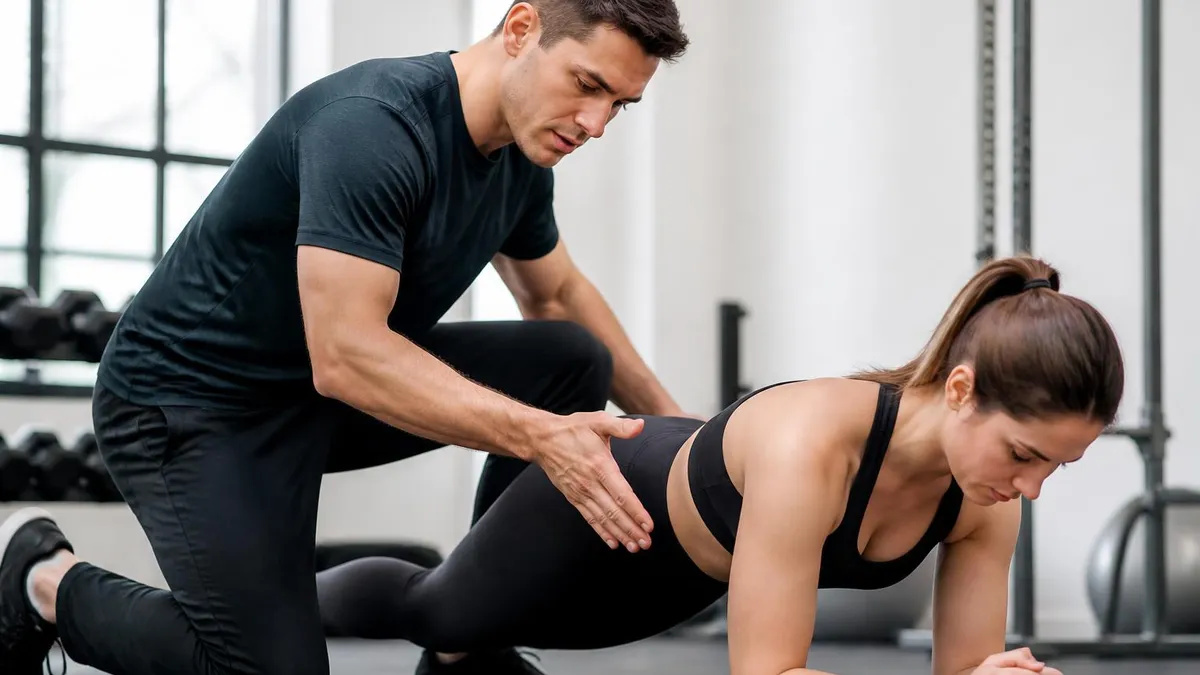
This domain tests knowledge of proper exercise technique and the ability to teach and correct it: proper form cues for major exercises (squats, lunges, deadlifts, presses, rows, core exercises); spotting techniques; identifying and correcting technique faults; and integrating exercise techniques with the OPT model phase and client ability. Exercises are tested in terms of which muscles are targeted, what compensations to watch for, and how to regress or progress an exercise for different fitness levels.
Client Relations and Behavioral Coaching (18%)
The Behavioral Coaching domain reflects NASM's recognition that technical knowledge alone does not make an effective trainer — behavior change principles are equally important: stages of change (transtheoretical model); motivational interviewing principles; goal-setting strategies (SMART goals); communication skills; identifying and overcoming barriers to exercise; and professional ethics and scope of practice for personal trainers. Scope of practice questions — what a personal trainer can and cannot do relative to registered dietitians, physical therapists, and physicians — are frequently tested.

NASM-CPT Study Strategy
The NASM-CPT exam rewards candidates who understand the OPT model deeply and can apply it to client scenarios — not just those who memorize anatomy. An effective study strategy emphasizes application over memorization and uses practice questions throughout the process.
Master the OPT Model First
The NASM Optimum Performance Training (OPT) model is the central framework of the entire certification. Everything — assessment findings, exercise selection, rep schemes, rest periods, cardio programming — flows from the OPT model's three levels and five phases. Memorize the phases (Stabilization Endurance, Strength Endurance, Hypertrophy, Maximal Strength, Power) and the key training variables for each phase (sets, reps, tempo, rest, intensity) before studying anything else. This framework makes the rest of the content significantly easier to understand and retain.
Study the Overhead Squat Assessment Thoroughly
The overhead squat assessment is arguably the most heavily tested single topic on the NASM exam. For each compensation pattern, know: which muscles are overactive (causing the compensation); which muscles are underactive (failing to prevent it); what flexibility and activation exercises address the imbalance. Common compensations to master: feet flattening or turning out (overactive: soleus, lateral gastrocnemius, biceps femoris; underactive: medial gastrocnemius, medial hamstrings, gracilis); knees caving inward (overactive: adductors, IT band; underactive: glute medius, VMO); arms falling forward (overactive: latissimus dorsi, teres major, pec minor; underactive: lower/mid trapezius, rotator cuff). Create flashcards for each compensation.
Use Active Recall with Practice Questions
Passive reading of the NASM textbook is the least efficient study method. After reading each chapter, immediately close the book and answer practice questions on that content. Active recall — retrieving information from memory — is significantly more effective for retention than re-reading. Use NASM practice exams, third-party question banks (Trainer Academy, CPT Edge, or practice resources here on PracticeTestGeeks), and flashcard systems. Track which domain each missed question falls in — this identifies where to focus additional study.
Study Timeline
Most candidates who pass the NASM-CPT on the first attempt report studying 8 to 12 weeks with consistent daily study. A structured approach: Weeks 1–3: Master foundational science (anatomy, physiology, kinesiology) and the OPT model. Weeks 4–6: Deep dive into assessment, program design, and exercise technique. Weeks 7–9: Behavioral coaching and scope of practice; begin full practice exams. Weeks 10–12: Exam simulation — take full timed practice exams, review every missed question, focus on weak domains. Do not schedule the exam until you are consistently scoring 75%+ on practice tests.
NASM Practice Tests and Resources
Practice testing is the most predictive indicator of exam readiness. Candidates who take multiple full-length practice exams under timed, exam-like conditions consistently outperform those who study content alone.
NASM Official Practice Exams
NASM offers official practice exams as part of their study packages — the official questions are closest to the actual exam format and content. If you purchased an NASM study bundle, prioritize using the official practice exams for your final exam simulations in the last two weeks of preparation. The official exams provide domain-level score breakdowns that show exactly which of the five domains you are strongest and weakest in.
Third-Party NASM Practice Resources
Multiple third-party NASM study resources offer extensive question banks: Trainer Academy (traineracademy.org) offers a large NASM practice question bank with detailed explanations; CPT Edge offers scenario-based questions specifically for the current NASM-CPT exam format; PracticeTestGeeks offers free NASM practice tests covering all major exam domains. When using third-party resources, prioritize those that explicitly align to the current NASM exam content outline and include detailed answer explanations — explanations are as valuable as the questions themselves for learning the reasoning behind correct answers.
Flashcard Systems
Flashcard systems (Anki, Quizlet) are effective for the vocabulary-heavy content in the NASM exam — muscle origins/insertions, overactive/underactive muscle pairs for common compensations, OPT phase training variables. Pre-made NASM flashcard decks are available on Quizlet. Anki's spaced repetition algorithm is particularly efficient for memorizing the large volume of assessment-related muscle pairings.

NASM Exam Day Tips
Effective exam-day strategy — beyond having studied the content — can meaningfully improve your score and reduce test anxiety.
Before the Exam
Review NASM's exam policies at Pearson VUE before your test date. Arrive at the testing center 15 to 30 minutes early — late arrivals may forfeit their exam fee. Bring your valid government-issued photo ID. You cannot bring personal items into the testing area — no notes, no phones, no watches. Testing centers provide scratch paper and a calculator if needed. Get adequate sleep the night before; cramming the night before the exam has minimal benefit and reduces the cognitive performance you need during the test.
During the Exam
Read each question carefully — NASM questions often hinge on specific details (client's current fitness level, phase of the OPT model being used, specific compensation identified). For scenario questions, identify the key clinical detail in the question stem before looking at answer choices. When you are unsure between two options, eliminate clearly wrong answers first and look for which answer best reflects the OPT model or NASM's recommended approach — the model always guides the right answer. Flag questions you are unsure about and return to them — do not spend more than 1.5 minutes on any single question during your first pass.
Managing Time
With 120 questions in 120 minutes, you have approximately one minute per question. This is generous — most candidates finish with time remaining. Aim to complete a first pass through all questions within 90 minutes, then use remaining time to review flagged questions. Do not let a difficult question consume multiple minutes — flag it and move on.
NASM Checklist
- ✓Obtain a current CPR/AED certification before scheduling the NASM exam
- ✓Master the OPT model: 3 levels, 5 phases, training variables for each phase
- ✓Memorize overhead squat assessment compensations and overactive/underactive muscle pairs
- ✓Study all five assessment types: postural, movement, cardiorespiratory, muscular fitness, body composition
- ✓Practice applying OPT model phases to client scenario questions
- ✓Review scope of practice: what trainers can and cannot advise on (nutrition, injury treatment)
- ✓Take full timed practice exams in weeks 10–12 of study — score 75%+ before scheduling
- ✓Review every missed practice question with its explanation — not just the correct answer
- ✓Learn stages of change and motivational interviewing principles for behavioral coaching domain
- ✓Arrive 15 minutes early to Pearson VUE testing center with valid government-issued ID
NASM Practice Test Questions
Prepare for the NASM - National Academy of Sports Medicine exam with our free practice test modules. Each quiz covers key topics to help you pass on your first try.
NASM Assessment
NASM Exam Questions covering Assessment. Master NASM Test concepts for certification prep.
NASM Basic
Free NASM Practice Test featuring Basic. Improve your NASM Exam score with mock test prep.
NASM: Client Relations & Behavioral Coaching
NASM Mock Exam on NASM: Client Relations & Behavioral Coaching. NASM Study Guide questions to pass on your first try.
NASM Cardiorespiratory Fitness Training
Free NASM Quiz on Cardiorespiratory Fitness Training. NASM Exam prep questions with detailed explanations.
NASM Corrective Exercise and Flexibility T...
NASM Practice Questions for Corrective Exercise and Flexibility Training. Build confidence for your NASM certification exam.
NASM - National Academy of Sports Medicine...
NASM Test Online for - National Academy of Sports Medicine Applied Sciences & Nutrition. Free practice with instant results and feedback.
NASM - National Academy of Sports Medicine...
NASM Study Material on - National Academy of Sports Medicine Behavioral Coaching and Relations. Prepare effectively with real exam-style questions.
NASM - National Academy of Sports Medicine...
Free NASM Test covering - National Academy of Sports Medicine Client Health and Fitness Assessments. Practice and track your NASM exam readiness.
NASM - National Academy of Sports Medicine...
NASM Exam Questions covering - National Academy of Sports Medicine Professional Development & Responsibility. Master NASM Test concepts for certification prep.
NASM Pros and Cons
- +NASM certification is recognized across employers as evidence of verified competency, often required for specific roles
- +Certification provides a structured framework for professional knowledge that benefits daily work, not just the credential itself
- +Many certified professionals report salary increases of 10–20% compared to non-certified peers in the same role
- +Certification maintenance requirements create ongoing professional development that keeps knowledge current
- +The certification credential differentiates candidates in competitive hiring processes and promotion decisions
- −NASM certification fees can be substantial — exam costs, study materials, and renewal fees add up over a career
- −Certification requirements change over time; candidates who delay testing may face updated content requirements
- −Not all employers or markets equally value or require certification — the salary return varies significantly by geography and industry
- −Exam preparation requires significant time investment alongside existing work and personal responsibilities
- −Certification does not guarantee competency in practice — it validates knowledge at a point in time, not ongoing performance
NASM Questions and Answers

ACLS Certification: How to Get Certified, Recertified & Stay Current

NASM Nutrition Certification: CNC Coach Credential Guide
NASM Continuing Education: CES, CEUs, and Advanced Certifications

NASM Calorie Calculator: BMR, TDEE, & Macros Tool Guide

National Academy of Sports Medicine (NASM): History, Mission, and Certifications
How this page was made: written with AI tools. Exam facts are checked against the official sources listed below. Not reviewed by a subject-matter expert. Editorial policy
Sources & references
Exam facts on this page (fees, format, dates, passing scores) are checked against these official sources; the date is our last check. Editorial policy
- nasm.org — Renewal, test delivery, eligibility, passing score, retake policy, test dates, time limit · verified Oct 2026