
MSF Course Drills: Cone Exercises, Written Test Prep & Complete Training Guide
Master MSF cones, course drills & written test prep. Learn msf course cost, what to expect, and how to pass. ✅ Full 2026 October training guide.

The MSF cones course is the heart of the Motorcycle Safety Foundation's Basic RiderCourse, and understanding exactly what those orange cones demand of you is the fastest path to passing both the riding evaluation and the msf course test. When new riders picture the BRC range, they often focus on speed and throttle control, but trained evaluators are actually watching for slow-speed precision, clutch modulation, head-and-eye positioning, and the ability to execute controlled stops inside tight markers — skills the cone drills are specifically designed to develop and assess.
Before you ever straddle a motorcycle on range day, you will sit through a knowledge session covering the MSF written test material. The msf course cost varies by state and provider — typically between $150 and $350 for the full Basic RiderCourse — and that fee covers both the classroom knowledge portion and the range riding exercises. Many students are surprised to learn that the written portion alone can disqualify you from completing the range day if your score falls below the required threshold, making written test preparation just as important as physical riding practice.
MSF course drills are sequenced deliberately. Instructors begin with low-speed balance exercises before layering in cone weaves, figure-eights inside a box, quick stops, swerves, and ultimately the combined skills evaluation that determines whether you receive your completion card. Each drill isolates a specific control skill so that by the final evaluation, riders have practiced every component multiple times in isolation before combining them under assessment conditions.
Understanding the msf written test before you arrive on range day removes one major source of anxiety. The written knowledge test covers traffic strategies, lane positioning, stopping distances, protective gear requirements, and the mental and physical effects of alcohol and fatigue. Students who complete an msf practice test at home consistently outperform those who rely solely on the classroom session, because self-testing identifies knowledge gaps that passive reading never reveals.
The msf class cost is an investment that often pays for itself immediately: in many states, completing the BRC waives the DMV riding skills test entirely, and most major insurance carriers offer a discount of five to fifteen percent for riders who hold an MSF completion card. When you factor in those savings alongside the genuine safety value of structured cone drill training, the return on investment becomes clear well before your first solo ride.
Range drills are conducted in a specific order established by the MSF curriculum, and knowing that order in advance helps you visualize success and arrive mentally prepared. This guide walks through every major cone exercise, explains the scoring criteria evaluators use, covers the msf written test in depth, and gives you a practical study schedule so you can walk into your BRC with confidence rather than apprehension.
Whether you are a complete beginner who has never touched a clutch lever or a returning rider refreshing skills after years away, this article gives you a comprehensive map of every MSF course drill, what each one tests, how points are assessed, and the specific preparation strategies that separate riders who pass cleanly from those who need a second attempt.
MSF Basic RiderCourse by the Numbers

MSF Course Drills: Range Day Sequence
Drill 1 — Bike Familiarization & Friction Zone
Drill 2 — Straight-Line Riding & Controlled Stop
Drill 3 — Cone Weave
Drill 4 — U-Turn Inside the Box
Drill 5 — Swerve Exercise
Drill 6 — Quick Stop & Final Evaluation
The MSF written test is administered during the knowledge portion of the Basic RiderCourse, typically on the morning of the first day before students ever touch a motorcycle. The test covers material from the MSF Basic RiderCourse handbook — a document that addresses everything from pre-ride inspections and clothing selection to cornering technique and alcohol's effect on riding performance.
Most providers require a score of at least 75 percent to proceed to the range; some require 80 percent. Failing the written exam ends your participation for the day, which is why msf course practice test sessions at home are so valuable before you arrive.
The msf written test typically contains between 25 and 50 questions depending on the specific curriculum module your provider uses. Questions are multiple choice with four answer options, and the content is drawn directly from the student handbook. Topics are weighted toward the areas that cause the most crash fatalities: alcohol and drug impairment, intersection hazard recognition, proper braking technique, and wearing appropriate protective gear. Questions about the SEE strategy — Search, Evaluate, Execute — appear frequently because it is the MSF's core mental framework for hazard avoidance.
One area where test-takers often lose points is the section on stopping distances. The MSF curriculum specifies that at 30 mph on dry pavement with a skilled rider, a motorcycle requires approximately 50 feet to stop. Students who confuse the stopping distance figures for different speeds, or who mix up reaction time (approximately 1.5 seconds on average) with total stopping distance, drop multiple points on questions that are straightforward once the numbers are memorized properly.
The msf course written test also includes questions about lane positioning within a single lane. The MSF divides each lane into three positions — left third, center, and right third — and evaluates when each is appropriate. The left third maximizes your visibility to oncoming traffic at intersections and creates distance from parked cars on the right. The right third works well when you are moving in the same direction as traffic in an adjacent lane and want to maximize your visibility to drivers ahead. The center position is often avoided because of oil deposits left by car drivetrains.
Group riding protocol appears in the written test as well. The MSF recommends a staggered formation in which the lead rider occupies the left third of the lane and the following rider occupies the right third, staying one second behind the rider directly ahead and two seconds behind the rider in the same lane position. Questions may ask you to identify which formation is unsafe, what minimum following distance is appropriate, or what signal protocols apply when a group approaches a traffic signal that changes to red.
Protective gear questions test students on the specific features of MSF-recommended clothing. The curriculum specifies that a helmet meeting DOT or Snell standards, a jacket with CE-rated armor at shoulders and elbows, full-fingered gloves, over-the-ankle boots, and long pants made of abrasion-resistant material are all components of the full protective gear package. Questions frequently ask which item provides the most protection in a specific type of crash scenario, so understanding why each piece matters — not just that it is on the list — is the key to answering correctly under test conditions.
Reviewing the msf basic rider course handbook pdf free download alongside targeted practice questions gives you the dual advantage of reading the source material and testing your recall in the same format you will encounter on test day. Passive reading of the handbook is far less effective than alternating between reading a chapter and immediately answering a set of practice questions on that chapter, because active retrieval creates stronger memory traces and exposes misunderstandings while you still have time to correct them.
MSF Course Cost: What You Pay and What You Get
The msf course cost varies considerably across the United States because individual states subsidize the program at different levels. In California, the state-funded California Motorcyclist Safety Program (CMSP) offers BRC courses for approximately $60 to $80 through community colleges, while private providers in the same state charge $250 to $350 for identical curriculum. Texas, Florida, and Illinois typically fall in the $150 to $250 range, with most community college sites offering lower rates than independent riding schools.
Several states offer additional financial assistance on top of the base subsidy. New York's MOTORSPORTS program has historically offered courses at little to no cost for residents who apply through the state DOT website. Active military personnel and veterans often receive discounts of $25 to $75 at participating sites nationwide. If cost is a barrier, contacting your state's motorcycle safety program office directly — rather than booking through a private site — almost always surfaces the most affordable options, since public program sites rarely appear prominently in general web searches.

MSF Basic RiderCourse: Honest Pros and Cons
- +Waives DMV riding skills test in most states, saving time and test fees
- +Insurance discount of 5–15% applies immediately upon card submission
- +Range drills build real low-speed control skills that are hard to self-teach
- +Instructors can correct bad habits before they become ingrained and dangerous
- +Course motorcycles provided at most sites — no need to own a bike before learning
- +Completion card demonstrates to family and employers that training was completed formally
- −MSF course cost of $150–$350 is a significant upfront expense for some riders
- −Weekend schedule conflicts with work and family obligations for many enrollees
- −Range drills are conducted rain or shine at most locations — weather can affect the experience
- −Minimum age requirements (typically 16) and valid permit requirements vary by state
- −The two-day format compresses a lot of new information into a very short window
- −Riders who struggle with clutch control can feel overwhelmed on a busy range with other students
Pros and Cons at a Glance
| Pros | Cons |
|---|---|
| Waives DMV riding skills test in most states, saving time and test fees | Weekend schedule conflicts with work and family obligations for many enrollees |
| Range drills build real low-speed control skills that are hard to self-teach | Range drills are conducted rain or shine at most locations — weather can affect the experience |
| Instructors can correct bad habits before they become ingrained and dangerous | The two-day format compresses a lot of new information into a very short window |
| Course motorcycles provided at most sites — no need to own a bike before learning | Riders who struggle with clutch control can feel overwhelmed on a busy range with other students |
MSF Range Day Preparation Checklist
- ✓Complete at least one full msf practice test before your knowledge session day.
- ✓Read the MSF Basic RiderCourse handbook from cover to cover at least 48 hours before class.
- ✓Wear over-the-ankle boots with non-slip soles to every range session — sandals are an automatic disqualification.
- ✓Bring a DOT or Snell-certified helmet even if the site provides loaners, since fit dramatically affects comfort.
- ✓Eat a full meal before the range day — low blood sugar causes the loss of fine motor control.
- ✓Practice clutch friction zone feel on a friend's stationary bike or a bicycle to build muscle memory.
- ✓Memorize the MSF stopping distance figures: 50 feet at 30 mph, 120 feet at 45 mph on dry pavement.
- ✓Study the SEE strategy (Search, Evaluate, Execute) until you can recite and explain each step cold.
- ✓Arrive 20 minutes early to sign paperwork, get gear fitted, and observe how cones are arranged.
- ✓Keep your eyes and head turning toward where you want to go — not at the cone or obstacle directly in front of you.
Look Where You Want to Go — Not Where You Are
Every MSF RiderCoach will repeat this cue dozens of times on range day because it is the one habit that separates riders who sail through the cone drills from those who knock cones over and lose evaluation points. Your motorcycle follows your eyes — when you look at a cone, your hands unconsciously steer toward it. When you look through the gap toward your exit, the bike finds the line naturally. Practice this head-turn habit in parking lots before range day and the cone weave, U-turn box, and swerve exercise all become dramatically easier.
Scoring on the MSF riding evaluation follows a demerit point system. Each rider starts with zero points and accumulates deductions for specific errors.
The most commonly penalized errors during the cone drills are foot touches during the U-turn box exercise (3 points each), stopping past the marked line on the quick stop (5 points), running over or displacing a cone (5 points), and stalling the engine (3 points). Riders who accumulate 22 or more points during the evaluation do not receive a completion card, though many sites offer a single remediation opportunity or a re-ride of the evaluation within the same course enrollment.
The quick stop exercise is statistically where the most points are lost by first-time BRC participants. The exercise requires riders to accelerate to at least 20 mph — confirmed visually by the evaluator using a speed trap or visual reference — and then execute a smooth, coordinated stop using both front and rear brakes simultaneously, bringing the motorcycle to rest within a painted stopping zone approximately 25 feet long.
Riders who brake too early and enter the zone already slowing, who use only the rear brake, or who release the brakes and roll past the far line all receive point deductions.
The U-turn box is the second most common source of evaluation points lost. The box is painted on the range surface and measures approximately 24 feet by 60 feet, with the entrance and exit on the short sides. Riders enter in the left or right third of the entrance, execute a complete U-turn, and exit through the far short side.
The challenge is that the maneuver demands very slow speed — walking pace or slightly above — which requires the rider to balance the clutch in the friction zone against gentle throttle to prevent stalling, while simultaneously turning the handlebars to a near-full-lock position and counterbalancing with the upper body.
Eye position during the U-turn box is critical in a way that surprises many first-time riders. The natural instinct is to look down at the painted box boundary to gauge your position. This is exactly the wrong technique. Looking down drops your speed, tightens your turn radius, and destabilizes the motorcycle. The correct technique is to immediately look toward the exit as you enter the turn — turning your head a full 180 degrees toward where you want to go — which naturally guides the motorcycle through the correct arc without consciously managing the steering input.
The cone weave, while not always scored in the final evaluation, appears in the range curriculum because it develops the clutch modulation and counterbalance skills that directly transfer to real-world slow-speed riding situations: parking lot navigation, construction zone passages, and low-speed U-turns in traffic. During the weave, riders move at roughly 5 to 10 mph between evenly spaced cones, leaning the upper body opposite the direction of travel while keeping the motorcycle leaning into the turn. The head and eyes move immediately to the next gap as each cone is cleared.
The swerve exercise teaches countersteering at speeds that actually require it. Below approximately 12 mph, a motorcycle turns by simply pushing the handlebars in the direction of the turn. Above 12 mph — the range at which gyroscopic and centrifugal forces dominate — the physics reverse: pushing the right handlebar forward initiates a right turn, and vice versa.
The MSF swerve drill at 20 to 25 mph makes countersteering feel immediate and powerful, and riders who have never consciously countersteered often experience a genuine moment of revelation when they feel how much turning force a small bar push generates at that speed.
Preparation strategies that specifically target the scored evaluation include watching instructional videos of each drill performed correctly, which builds a mental model of the target performance before you arrive. Riding a bicycle through improvised cone courses in a parking lot develops the fundamental balance and head-turn habits in a lower-stakes environment where stalling and foot touches have no penalty.
Most importantly, asking your RiderCoach during the practice phases of range day to identify your specific error patterns gives you personalized feedback you cannot get from any book or video, and the practice drills happen before the scored evaluation so that feedback has time to be applied.

Most states require you to hold a valid motorcycle learner's permit before attending the MSF Basic RiderCourse range day. If you arrive without your permit, you will typically be turned away and may forfeit your enrollment fee. Check your state DMV website at least two weeks before your course date, obtain your permit at a DMV visit after passing the written knowledge test, and bring the physical permit document — not just a photo of it — to range day registration.
Understanding how the msf test material is organized helps you build a study plan rather than reading the handbook as a single undifferentiated wall of text. The MSF curriculum groups its written content into distinct modules: motorcycle controls and riding positions, shifting and braking, turns and curves, managing risk and visibility, carrying passengers and cargo, and the physical and mental factors that impair riding. Each module builds on the previous one, so studying them in order rather than jumping to the most interesting sections first produces better retention overall.
The module on turns and curves is particularly important for the msf written test because it connects directly to the cone drills on the range.
The handbook explains the concept of the path of travel — the arc your motorcycle follows through a corner — and distinguishes between turning too early (which pushes you wide at the exit), turning correctly (which allows you to accelerate out of the corner), and turning too late (which causes you to run wide mid-corner and requires braking in the turn, a high-risk action). Questions on the written test about cornering almost always test whether you understand these path-of-travel principles, not just the surface-level rule that you should look through the turn.
The impairment module covers alcohol, fatigue, medications, and carbon monoxide exposure. The MSF handbook specifies that a blood alcohol concentration (BAC) of 0.08% is the legal limit in all 50 states, but also emphasizes that measurable impairment of motorcycle-specific skills — balance, throttle control, reaction time — begins at BAC levels well below 0.08%. Written test questions often ask about the number of drinks required to reach 0.08% BAC for a given body weight, or what factor eliminates alcohol from the body (only time — coffee, exercise, and water do not accelerate the process).
Risk management questions on the msf test focus on the SIPDE process — Scan, Identify, Predict, Decide, Execute — which is the broader risk management framework that encompasses the SEE strategy. Students who confuse SIPDE with SEE sometimes lose points on questions that specifically reference one or the other. The key distinction is that SIPDE is the five-step cognitive cycle and SEE is a simplified three-step version used during the riding exercises; both are valid MSF vocabulary and both appear in test questions.
Visibility strategies are another high-frequency topic. The MSF handbook distinguishes between being visible to other drivers and being able to see the road ahead yourself. Being visible involves lane positioning that keeps you out of blind spots, using headlights at all times, wearing bright or reflective gear, and avoiding lingering in zones where drivers might not check for motorcycles. Seeing the road ahead involves adjusting following distance for your speed, scanning left-right-left at intersections, and positioning yourself to maximize sight lines through curves before committing to a corner.
For riders who want to review all these topics in an interactive format before the actual course date, the best resource is a structured how much does the msf course cost comparison page that links to the enrollment portal for your state, giving you the official handbook link and practice assessment tools in one location. Cross-referencing the handbook with targeted practice questions on every topic above — rather than reading the handbook once and hoping for the best — is the preparation pattern consistently associated with clean first-attempt passes on both the written test and the range evaluation.
Riders who have completed the BRC report that the written test, while comprehensive, is not designed to trick you. The questions are straightforward recalls of handbook content rather than complex scenario analysis. The challenge is the volume of material covered in a short classroom session, which is why self-directed study before the course day is the single highest-use preparation action available to any BRC enrollee. Every hour you invest in pre-study reduces the cognitive load on course day, leaving more mental bandwidth for processing range instructions and performing drills correctly.
Final preparation for the MSF course should follow a structured timeline rather than a last-minute cram. Ideally, begin studying the handbook at least one week before your scheduled course date, covering one module per day and following each reading session with a targeted practice quiz on that module's content. By the day before the course, you should have read all modules, completed at least two full practice test sets, and identified any specific knowledge gaps for focused review on the final evening.
On the morning of range day, eat breakfast and hydrate adequately before arriving. Fine motor control — essential for clutch modulation and precise braking — degrades noticeably with even mild dehydration or low blood sugar. Wear your full protective gear from the moment you arrive: jacket, gloves, helmet, and over-the-ankle boots. Some sites allow riders to carry their helmet until the range briefing, but having your gear on early normalizes its weight and reduces the distraction of adjusting unfamiliar equipment while trying to listen to instructor briefings.
During the practice drills — which occur before the scored evaluation — ask your RiderCoach specific questions rather than general ones. Instead of asking whether you are doing the U-turn correctly, ask whether your head turn is happening early enough and whether your clutch position during the turn is consistent. Specific questions elicit specific feedback, and specific feedback is what drives rapid skill improvement in the short practice window available on range day.
After completing each drill practice, mentally replay the run while standing at the staging area. Identify one thing you did well and one specific movement to change on the next attempt. This micro-review habit — borrowed from motor learning research — consolidates the correct movement pattern and prevents the brain from overwriting a good previous run with a poor subsequent one. Many riders find it helpful to close their eyes briefly and visualize the ideal line and head position before remounting for the next practice attempt.
During the scored evaluation, focus exclusively on each drill as it occurs rather than running a mental tally of accumulated points. Riders who try to track their score mid-evaluation introduce anxiety that disrupts the smooth motor execution they practiced all day. If you knock over a cone or put a foot down, acknowledge the error internally and immediately redirect your attention to the next drill. A single five-point deduction does not prevent you from passing — the buffer to the 22-point threshold is generous enough to absorb one significant error as long as the remaining drills are clean.
Post-course, use your MSF completion card within 30 days at your state DMV if you want to waive the riding skills test. Completion cards have a one-year validity for insurance discount purposes in most states, but DMV waivers often require a shorter window. Submit your card to your insurance carrier via their online portal or by calling your agent directly — the discount is not applied automatically, and many riders miss weeks or months of savings simply because they delay submitting documentation they already have in hand.
The skills developed in the MSF cone drills do not expire when you leave the range, but they do degrade without reinforcement. Plan a solo practice session in a large, empty parking lot within the first two weeks after completing your BRC, using traffic cones or similar markers to repeat the weave and U-turn box exercises. Each self-directed practice session extends the value of your course investment and builds the automatic muscle memory that makes slow-speed control feel effortless rather than effortful on real roads.
Sample MSF - Motorcycle Safety Foundation Practice Questions
Try these questions from our free MSF - Motorcycle Safety Foundation practice tests. The correct answer and an explanation follow each question.
During an MSF BRC cone weave exercise, what throttle technique keeps the bike stable?
- A. Varying throttle aggressively between each cone
- B. Keeping a constant, smooth throttle throughout
- C. Applying throttle only on the straight sections
- D. Cutting throttle completely before each turn
Answer: B. Keeping a constant, smooth throttle throughout
Smooth, steady throttle stabilizes the motorcycle's suspension and allows you to use handlebar steering for precise weaving.
The term 'risk offset' in MSF training refers to:
- A. Adding speed to move through a hazard zone faster
- B. Compensating for one risk by reducing another, such as slowing down in poor visibility
- C. Offsetting your lane position to the left at all times
- D. Canceling a ride when any single hazard is present
Answer: B. Compensating for one risk by reducing another, such as slowing down in poor visibility
Risk offset means managing total risk by reducing controllable factors — like speed — when uncontrollable factors — like weather — increase danger.
Which type of helmet provides the most complete head and face protection for motorcyclists?
- A. Half helmet (beanie style)
- B. Three-quarter helmet
- C. Full-face helmet
- D. Open-face helmet with visor
Answer: C. Full-face helmet
A full-face helmet protects the entire head, face, and chin — areas that are commonly injured in crashes.
What body position is recommended when stopping on a steep downhill grade?
- A. Lean forward and use only the front brake
- B. Shift weight slightly back and apply both brakes progressively
- C. Stand on the pegs to raise the center of gravity
- D. Turn the handlebars sideways to create drag
Answer: B. Shift weight slightly back and apply both brakes progressively
Shifting weight rearward compensates for the forward weight transfer that gravity causes on downhill grades, improving rear-wheel grip.
Take the full MSF - Motorcycle Safety Foundation practice test
MSF Questions and Answers

MSF eCourse: Complete Guide to Online Training, Written Test Prep & Course Costs
MSF Practice Test Video Answers
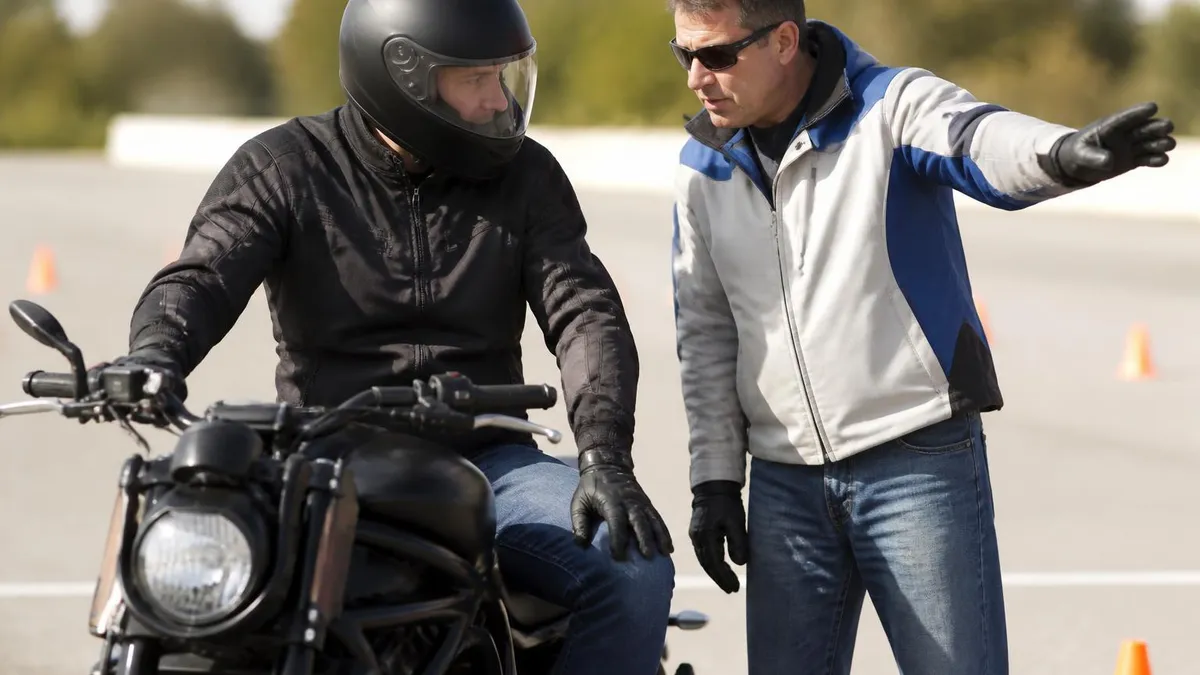
Motorcycle Safety Foundation Course: Complete 2026 Training Guide

MSF Card & Basic Rider Course: Complete 2026 Guide to Test Prep, Costs & Your Certificate

MSF Question and Answer: Complete Practice Test Guide for the Motorcycle Safety Foundation Course
About the Author

Business Consultant & Professional Certification Advisor
Wharton School, University of PennsylvaniaKatherine Lee earned her MBA from the Wharton School at the University of Pennsylvania and holds CPA, PHR, and PMP certifications. With a background spanning corporate finance, human resources, and project management, she has coached professionals preparing for CPA, CMA, PHR/SPHR, PMP, and financial services licensing exams.