
MSF Basic Riders Course: Complete 2026 October Training Guide, Written Test Prep & Course Costs
Everything about the MSF Basic Riders Course: cost, written test prep, what to expect, and free practice tests. 🏆 Start riding with confidence.

The MSF Basic Riders Course is the gold standard for new motorcycle riders in the United States, combining classroom instruction, online eLearning, and hands-on riding exercises into one comprehensive training program. Whether you are a complete beginner who has never touched a motorcycle or someone returning to riding after years away, this course gives you the foundational skills and knowledge you need to ride safely.
Understanding the msf course cost upfront is one of the first things prospective students want to know, and the good news is that most states price the BRC between $150 and $350 — often subsidized by state highway safety offices.
The MSF written test, formally known as the knowledge evaluation, covers everything from basic motorcycle controls and pre-ride inspections to defensive riding strategies and hazard recognition. Many students feel nervous about the test, but the material is straightforward when you study systematically. The MSF practice test resources available online — including the free quizzes here on PracticeTestGeeks — mirror the format and difficulty of the real evaluation so you know exactly what to expect on test day. Consistent practice is the single most reliable predictor of first-attempt success.
The course itself is structured so that knowledge and skills reinforce each other. You begin with the eCourse or classroom session, where you absorb the rules of the road, gear selection, and situational awareness principles. From there, you move to the range — a controlled off-street environment where certified coaches guide you through exercises like slow-speed maneuvers, quick stops, swerving, and cornering. The progression is deliberate and confidence-building, not sink-or-swim. By the end of range day two, most students are surprised by how much their abilities have improved.
One critical advantage of completing the MSF BRC is the downstream benefit it provides. In most states, finishing the course waives the motorcycle skills test at the DMV and may reduce your insurance premium by 10 to 15 percent. Some states also offer a discount on the motorcycle endorsement fee itself. These financial incentives, combined with the genuine safety value of professional training, make the MSF Basic Riders Course one of the smartest investments a new rider can make before hitting public roads.
Preparing for the written test does not require memorizing an encyclopedia. The MSF curriculum is organized around a handful of core principles — the Search, Evaluate, Execute (SEE) strategy, proper body positioning, braking technique, and risk management. If you understand these frameworks deeply rather than just memorizing bullet points, you will be able to answer novel test questions confidently. Use the msf course practice test resources on this site to identify your weak areas and focus your study time where it counts most.
This guide walks you through every aspect of the MSF Basic Riders Course: what it costs, what the written test covers, how the range exercises are structured, and how to prepare so you pass on the first try. We have pulled together data from MSF's official training statistics, state rider education program reports, and feedback from thousands of students to give you the most accurate and actionable picture possible. By the time you finish reading, you will have a clear roadmap from registration to endorsement.
Whether your goal is a sport bike, a cruiser, or an adventure touring machine, every journey starts with safe fundamentals. The MSF BRC is where those fundamentals are built. Dive into the sections below, take the practice quizzes, and arrive on range day ready to focus entirely on riding — not on wondering what comes next.
MSF Basic Riders Course by the Numbers
Key Facts at a Glance
| Item | Value | Details |
|---|---|---|
| Typical Course Cost | $150–$350 | Varies by state subsidy |
| Total Training Time | 15–20 hrs | eLearning + range days |
| Written Test Questions | 25 | Must score 21/25 to pass |

MSF Basic Riders Course: Step-by-Step Structure
Register & Complete the eCourse
Attend the Knowledge Assessment
Range Session 1 — Fundamentals
Range Session 2 — Advanced Skills
Receive Your Completion Card
The msf course cost is one of the most-searched questions prospective students have before registering, and the answer depends heavily on which state you live in. States that fund their Motorcycle Safety Program through DMV fees or federal highway safety grants often subsidize the BRC significantly, bringing student out-of-pocket costs as low as $20 in some regions.
At the other end of the spectrum, states with no public subsidy can charge $300 to $350 for the full course. The national average lands somewhere around $250 to $280 when you average across all 50 states. For a detailed state-by-state comparison of fees and what they cover, see our guide to the cost of msf course.
What does the course fee actually include? In most programs, registration covers the eCourse access code, all classroom or range instructional time, motorcycle and helmet rental for the range (you do not need to own a bike), and the course completion card. A few programs charge separately for the eCourse access ($25–$35) or for helmet rental. When you are comparing prices between providers in your area, make sure you are comparing apples to apples by asking what is bundled into the quoted fee. Surprise add-ons are rare but worth confirming before you register.
The MSF class cost often looks steep at first glance compared to simply scheduling a DMV road test. However, when you factor in the insurance discount — typically 10 to 15 percent per year on your motorcycle policy — the course pays for itself within 12 to 24 months for most riders. Many insurers require you to pass an approved safety course within 60 days of policy issuance to qualify for the discount, so check your policy terms as soon as you start shopping for coverage. The MSF BRC is on every major insurer's approved list.
Some employers, unions, and military branches reimburse the MSF course fee for employees who ride motorcycles to work. If you are active duty military, check with your base's safety office — the Army, Navy, and Marine Corps all require BRC completion for service members who want to ride on base, and many bases offer subsidized or free sections. The Air Force often funds 100% of the course fee for airmen. Even if your employer does not have a formal reimbursement program, the safety angle often makes it worth asking HR.
There are a small number of cost waivers and scholarships available at the state level, typically for low-income applicants or students enrolled in vocational programs. California's DMV-administered program, for example, has offered hardship fee waivers in certain counties. The MSF itself does not administer waivers at the national level, but contacting your state's Motorcycle Safety Program office directly is the best way to ask about available assistance. These programs are underutilized because riders do not know to ask.
If the cost of a BRC is a genuine barrier, consider the eCourse-only pathway first. The MSF eCourse can be purchased standalone for around $25 and will prepare you for the written knowledge test used at some state DMVs. However, most states require the full BRC — including range days — for the endorsement waiver benefit. Skipping the range training also means you miss the most valuable part of the program: hands-on coached practice in a zero-consequence environment, where mistakes cost nothing except a brief coaching correction rather than a crash on a public road.
Cancellation and rescheduling policies vary by training site. Most MSF providers allow one free reschedule if you give 48 hours' notice. Same-day cancellations may forfeit part or all of your registration fee. Weather cancellations initiated by the provider are always rescheduled at no cost. Read the registration terms before you pay, keep your confirmation email, and note the provider's phone number in case you need to make a last-minute change. Range sessions happen rain or shine in mild weather, so pack appropriate gear regardless of the forecast.
MSF Written Test: What to Expect on the MSF Course Written Test
The MSF written test consists of 25 multiple-choice questions drawn from the eCourse curriculum. Students must answer at least 21 questions correctly — an 84% passing score — to proceed to the range portion of the BRC. The test is administered on paper or a tablet at the training site, and most students complete it in 20 to 30 minutes. There is no time limit, so read each question carefully before selecting your answer.
Questions are distributed across the core subject areas of the eCourse: motorcycle controls and operation, personal protective equipment, the SEE strategy, hazard recognition, cornering and braking technique, and special riding situations such as carrying passengers or riding in groups. Approximately 30% of questions involve a scenario — a brief description of a traffic situation — that asks you to apply the SEE strategy or identify the safest response. These scenario questions trip up students who memorized facts but did not internalize the underlying principles.

MSF Basic Riders Course: Benefits and Limitations
- +Waives the DMV motorcycle road skills test in nearly every state
- +Provides 10–15% annual insurance premium discount with most major insurers
- +Motorcycles and helmets provided — no gear or bike required on day one
- +Coached range environment means mistakes have no real-world consequences
- +eCourse completion serves as valid written-test prep in most states
- +Completion card accepted nationwide, even if you move to a different state
- −Course fee of $150–$350 is a barrier for some budget-conscious riders
- −Range sessions run on a fixed schedule — limited flexibility for shift workers
- −Two consecutive range days is a significant time commitment for busy adults
- −Course bikes are often smaller than the motorcycle you plan to ride daily
- −Weather-related reschedules can delay endorsement by weeks in some regions
- −Passing the course does not guarantee real-world proficiency — practice is still essential
MSF BRC Pre-Course Preparation Checklist
- ✓Register through your state's official rider education site or MSF.org and pay the course fee.
- ✓Complete the full MSF eCourse online before your first scheduled class date.
- ✓Take at least two full MSF practice tests and review every incorrect answer.
- ✓Purchase or borrow an approved motorcycle helmet (DOT-certified at minimum) for range days.
- ✓Wear long pants, long sleeves, ankle-covering boots, and full-fingered gloves to every range session.
- ✓Bring a valid government-issued photo ID and any required pre-registration paperwork.
- ✓Eat a solid meal and stay hydrated the morning of each range day — physical exertion is real.
- ✓Arrive 15 minutes early so you can sign waivers and gear up without rushing.
- ✓Store the provider's phone number in your contacts in case you need to reschedule.
- ✓Review the T-CLOCS inspection checklist the night before the knowledge evaluation.
Students who take 2+ practice tests pass the MSF written test at a 90%+ rate
According to aggregated data from MSF training sites, students who complete the full eCourse AND take at least two scored practice tests before the knowledge evaluation pass on their first attempt at rates exceeding 90%. Students who only read the material without practice testing pass at roughly 72%. Ten minutes of practice testing per study session is one of the highest-ROI habits you can build before your course date. Use the free quizzes on this site to close that gap.
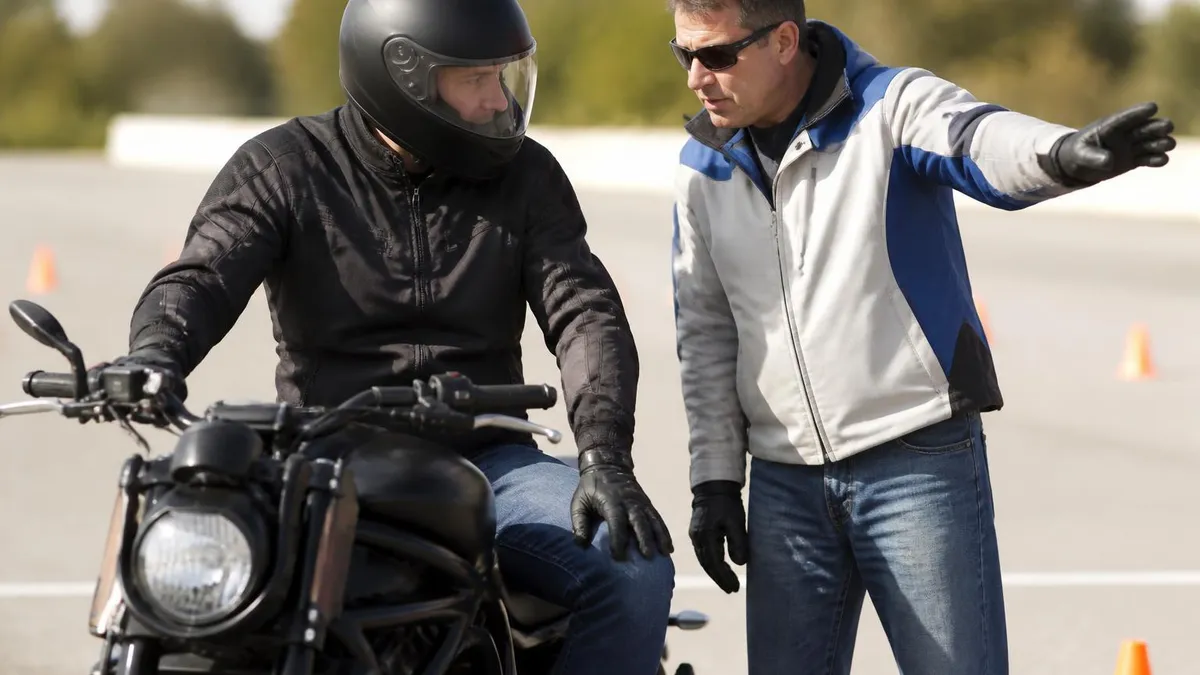
The range portion of the MSF Basic Riders Course is where knowledge becomes skill, and it is the part most first-time students both anticipate and fear. Day one on the range begins with a bike orientation: coaches walk you through the exact motorcycle you will ride, pointing out the clutch lever, throttle, front and rear brakes, gear shifter, and kill switch.
You will sit on the bike, find your balance point, and walk it around before ever starting the engine. This deliberate pacing is intentional — it removes the chaos of unfamiliarity so your brain can focus on technique rather than logistics.
The first major skill block covers the friction zone — the narrow throttle-and-clutch engagement range where the motorcycle begins to move but has not fully engaged. Mastering the friction zone is the gateway to every other slow-speed skill: U-turns, parking lot maneuvers, and stop-and-go traffic all depend on your ability to modulate clutch engagement smoothly. Coaches will have you practice riding in the friction zone at walking speed repeatedly before introducing any other technique. Students who struggle with slow-speed control almost universally trace it back to an inconsistent friction zone.
Braking is the second pillar of range day one. The MSF teaches simultaneous application of both front and rear brakes for normal stops, with an emphasis on progressive pressure — squeeze, do not grab. The front brake provides 70 to 80 percent of stopping power on a well-designed motorcycle, but abrupt application can cause the front wheel to lock and the bike to fall. Coaches demonstrate correct technique and then have students practice stopping from increasingly higher speeds until smooth, straight stops become reflexive. For the skills evaluation, you must stop within a marked box from 20 mph.
Day two introduces the higher-speed exercises that truly separate the MSF BRC from informal parking-lot practice with a friend. The swerve exercise teaches you to steer around a sudden obstacle — a child running into the road, a piece of debris — without braking simultaneously, which would destabilize the bike.
You approach a cone at 20 mph and, at a trigger cone, execute a sharp two-counter-steer swerve to one side. The first time students do this drill, the speed and precision required feel impossible; by the fourth repetition, it begins to feel natural. That transformation is exactly what range training is designed to produce.
Cornering on day two builds on the turning basics from day one. Students learn to identify the entry point, apex, and exit of a curve, and practice the look-lean-roll technique: look through the turn first, lean the bike by pressing the handlebar on the inside, then roll on the throttle smoothly to stabilize mid-corner.
The MSF BRC does not take students to race-track lean angles, but it does teach the correct technique that scales to any speed and any corner. Riders who never learned to look through curves and instead stare at the road immediately in front of the wheel are at significantly higher risk of running wide on unfamiliar roads.
The riding skills evaluation at the end of day two consists of five or six exercises completed in sequence on the range. Coaches score each exercise on a point-deduction system: you start with a perfect score and lose points for putting a foot down, leaving the marked area, failing to stop within the box, or not completing a swerve cleanly.
Students with 20 or fewer deduction points pass. The threshold is generous enough that a few minor errors will not fail you, but a pattern of balance issues or missed braking marks will. Students who struggle during exercises should speak to their coach during breaks — coaches are there to help, not just observe.
One frequently overlooked aspect of range training is the debrief sessions between exercises. After each drill, the lead coach gathers the group for a two-to-three-minute discussion of what went well and what needs attention. Pay close attention during these debriefs even when your personal execution was solid — understanding why other students made specific errors builds your hazard-recognition vocabulary for real riding. Many BRC graduates cite the group debrief moments as among the most instructive parts of the entire course, precisely because they expose failure modes you might not encounter in your own riding until much later.

MSF range sessions require over-the-ankle boots, long pants, long-sleeved jacket, full-fingered gloves, and a DOT-certified helmet. Students who arrive without proper protective equipment will not be permitted to ride and may forfeit their registration fee. Some sites loan helmets but cannot provide boots or gloves. Check your training site's gear policy when you register, and do not wait until the night before to assemble your kit.
After completing the MSF Basic Riders Course and receiving your completion card, the path to your motorcycle endorsement is straightforward in nearly every state. Take your completion card — along with your driver's license, the endorsement application, and the applicable fee — to any DMV location. Present the card as proof of course completion and the clerk will add the motorcycle endorsement to your license, typically the same day. In most states, the road skills test is automatically waived for BRC graduates; a handful of states still require a reduced-fee DMV test, so confirm your state's specific policy before visiting.
The completion card is time-sensitive in some jurisdictions. Most states require you to apply for your endorsement within 12 months of your BRC completion date. A few states allow 18 months or have no expiration at all. Check your state DMV website or call the rider education program hotline to confirm the window that applies to you. If you let the card expire, you will need to retake the course — there is no grace period or renewal option for an expired BRC card.
Once you have your endorsement, the real education begins. The MSF BRC gives you the technical foundation to operate a motorcycle safely, but it cannot replicate the judgment that comes from thousands of miles of real-world riding experience. New riders should spend their first several months on low-traffic roads, gradually expanding to higher-speed and more complex environments.
Avoid highways, heavy urban traffic, and night riding for at least the first 500 miles. Your risk of a serious crash is disproportionately high in your first year of riding, and a conservative approach during that window pays enormous dividends over a lifetime of riding.
Consider the MSF's Experienced RiderCourse (ERC) or the Advanced Riders Course (ARC) once you have logged some real-world miles. These follow-on programs build on BRC fundamentals with more challenging exercises and updated curriculum. Many insurers offer a second discount for completing an advanced MSF course, and some states provide continuing education credits toward endorsement renewal.
The ERC is particularly valuable if you purchase a new, more powerful motorcycle — the transition from a small course bike to a 650cc or larger machine introduces new handling dynamics worth practicing in a structured setting. For more information on what to study before these advanced programs, check our guide to msf basic rider course test answers and the eLearning portal resources.
Insurance is a topic that deserves focused attention immediately after endorsement. Motorcycle insurance in the US is mandatory in 49 states (Florida is the outlier, though financial responsibility requirements apply there as well). At minimum, you need liability coverage; collision and comprehensive are optional but strongly recommended for any bike worth more than a few thousand dollars.
Call your auto insurer first — many offer motorcycle riders a multi-policy discount of 5 to 10 percent on top of the safety course discount. Gather at least three quotes before binding coverage, and make sure your policy includes uninsured motorist protection, which is critical given the high rate of uninsured drivers on US roads.
Gear selection after passing the BRC is another area where new riders benefit from deliberate decision-making rather than impulse purchases. The minimum acceptable kit for street riding — full-face helmet, jacket with CE Level 1 or 2 armor at shoulders and elbows, back protector, gloves, and over-the-ankle boots — can be assembled for $400 to $600 if you shop sales.
Airbag vests and motorcycle-specific pants with hip and knee armor round out the full ATGATT (All The Gear, All The Time) philosophy that MSF coaches preach throughout the BRC. Gear degrades with use and UV exposure — plan to replace your helmet every five years and inspect your jacket's armor every two years for cracking.
Route planning is a skill new riders often underestimate. Use Google Maps or dedicated motorcycle routing apps to preview unfamiliar roads before you ride them. Satellite view reveals surface quality, intersection complexity, and whether roads are shaded (which can mean moss or ice in cool weather). Riding a route mentally before you ride it physically reduces the cognitive load on unfamiliar roads, allowing you to focus entirely on vehicle dynamics and hazard scanning rather than navigation.
This habit — mental rehearsal plus pre-ride route review — is one of the practical techniques that experienced riders consistently recommend to anyone who has just finished the msf course test and is preparing for their first real-world miles.
Building your study routine around MSF practice tests is the most time-efficient way to prepare for both the written knowledge evaluation and the conceptual understanding that powers good riding decisions on public roads. The best practice test sessions last 20 to 30 minutes — long enough to cover meaningful material, short enough that focus stays sharp throughout. Start each session by taking a full 25-question practice test under timed conditions, then spend an equal amount of time reviewing every question you missed, working through the explanation until the concept is genuinely clear rather than just familiar.
One of the most valuable meta-skills you can develop during MSF test prep is learning to identify distractor answer choices — the options that look plausible but contain a subtle error. MSF test writers frequently create distractors that are true in isolation but wrong in the specific context of the question.
For example, a question about rear-brake use might have a distractor stating that the rear brake should never be used, which is wrong — it should be used simultaneously with the front brake for normal stops, just not in isolation during emergency braking. Training yourself to read each answer choice against the full question stem eliminates many distractor traps.
Group study is an underused resource for MSF preparation. If you registered with a friend, family member, or coworker, quiz each other verbally on eCourse concepts. Explaining a concept aloud — why does looking through a corner improve your line? why is the friction zone critical for slow-speed control? — forces you to organize your understanding in ways that silent reading does not. Students who can explain SEE, T-CLOCS, and the quick-stop sequence in their own words to another person reliably demonstrate deeper retention than those who studied alone, according to peer-learning research in driver education contexts.
Physical preparation matters more than most students anticipate. Range days involve two to four hours of active riding in motorcycle gear, which is physically demanding even though you are moving relatively slowly. You will use your core for balance, your arms and hands for precise throttle and brake control, and your legs for supporting the bike during slow maneuvers.
Arrive well-rested and well-fed. Avoid alcohol the night before range days — dehydration and impaired reaction time are the last things you want when you are learning to control a two-wheeled vehicle for the first time. Staying hydrated during the range session is equally important, especially in summer months.
On the day of the knowledge evaluation, arrive with confidence built on preparation rather than hoping the material will feel familiar. Read each question fully before looking at the answer choices — the test writers sometimes include important context at the end of the question stem that changes which answer is correct.
If you are uncertain between two answers, eliminate the obvious wrong choices first and then apply the SEE framework: which answer would a defensive, hazard-aware rider choose? That filter resolves most close calls in favor of the correct answer because the MSF curriculum is built entirely around that defensive-riding philosophy.
After passing the written evaluation and range assessment, take a moment to reflect on how much you learned in a relatively short time. The MSF BRC typically spans one or two days of range work, yet it covers material that informal self-taught riding might never address — the physics of braking, the geometry of cornering, the perceptual habit of scanning intersections systematically. That knowledge has a measurable impact on crash statistics: MSF data consistently shows that trained riders have lower rates of at-fault crashes than untrained riders in the critical first year of riding.
Finally, make use of every MSF and state-level resource available to you after the course. The MSF website offers additional free study materials, video libraries, and state-specific DMV information. Your state's Motorcycle Safety Program office can answer questions about endorsement timelines, advanced course schedules, and subsidy programs.
Rider community organizations like the American Motorcyclist Association (AMA) provide advocacy, group rides, and continuing education events that keep skill development going long after the BRC completion card is in your wallet. The BRC is the beginning of a riding education, not the end — approach it with that mindset and you will be a safer, more confident rider for decades.
Sample MSF - Motorcycle Safety Foundation Practice Questions
Try these questions from our free MSF - Motorcycle Safety Foundation practice tests. The correct answer and an explanation follow each question.
Which footwear provides the best protection for motorcycle riders?
- A. Athletic sneakers with good traction
- B. Open-toed sandals for comfort
- C. Over-the-ankle motorcycle boots
- D. Flip-flops with ankle straps
Answer: C. Over-the-ankle motorcycle boots
Over-the-ankle motorcycle boots protect the feet, ankles, and lower legs from abrasion, impact, and gear/brake lever contact.
Why is it important to complete braking BEFORE entering a curve?
- A. Braking in a curve is impossible because the front brake disengages
- B. Completing braking before the curve frees full traction for cornering once leaned
- C. Braking in a curve always activates ABS and overrides the throttle
- D. Front braking is not needed before curves—only rear brake matters
Answer: B. Completing braking before the curve frees full traction for cornering once leaned
Tires have a finite traction budget; when that budget is spent on braking before the curve, full grip is available for cornering, reducing the risk of losing control.
In MSF training, what does the phrase 'slow, look, press, roll' refer to?
- A. The steps for an emergency stop on a straight road
- B. A four-step cornering process: reduce speed, look through turn, press handlebar, roll on throttle
- C. The procedure for a U-turn in a parking lot only
- D. A fuel-saving technique for highway riding
Answer: B. A four-step cornering process: reduce speed, look through turn, press handlebar, roll on throttle
MSF's 'slow, look, press, roll' is the foundational cornering sequence: manage speed before the turn, aim your eyes through it, countersteer to lean, and smoothly apply throttle.
When riding in a group and an emergency stop is needed, riders should:
- A. All brake simultaneously and maintain formation
- B. Each brake independently and allow space between bikes to expand
- C. Follow the lead rider's braking exactly with no gap
- D. Use only engine braking to avoid rear-end collisions
Answer: B. Each brake independently and allow space between bikes to expand
Each rider must brake independently, and the natural gap between bikes in formation allows room for everyone to stop safely.
Take the full MSF - Motorcycle Safety Foundation practice test
MSF Questions and Answers

MSF eCourse: Complete Guide to Online Training, Written Test Prep & Course Costs

MSF eLearning Portal: How to Use elearning.msf-usa, MSF Course Cost & Written Test Prep
MSF Practice Test Video Answers
Motorcycle Safety Foundation Course: Complete 2026 Training Guide

MSF Card & Basic Rider Course: Complete 2026 Guide to Test Prep, Costs & Your Certificate
About the Author

Business Consultant & Professional Certification Advisor
Wharton School, University of PennsylvaniaKatherine Lee earned her MBA from the Wharton School at the University of Pennsylvania and holds CPA, PHR, and PMP certifications. With a background spanning corporate finance, human resources, and project management, she has coached professionals preparing for CPA, CMA, PHR/SPHR, PMP, and financial services licensing exams.