
MRI of Knee: What It Shows, Common Findings and What to Expect 2026 September
📗 MRI of knee — what it shows, common findings (ACL, meniscus, cartilage), what to expect during the scan, sports medicine use and how to read your results.
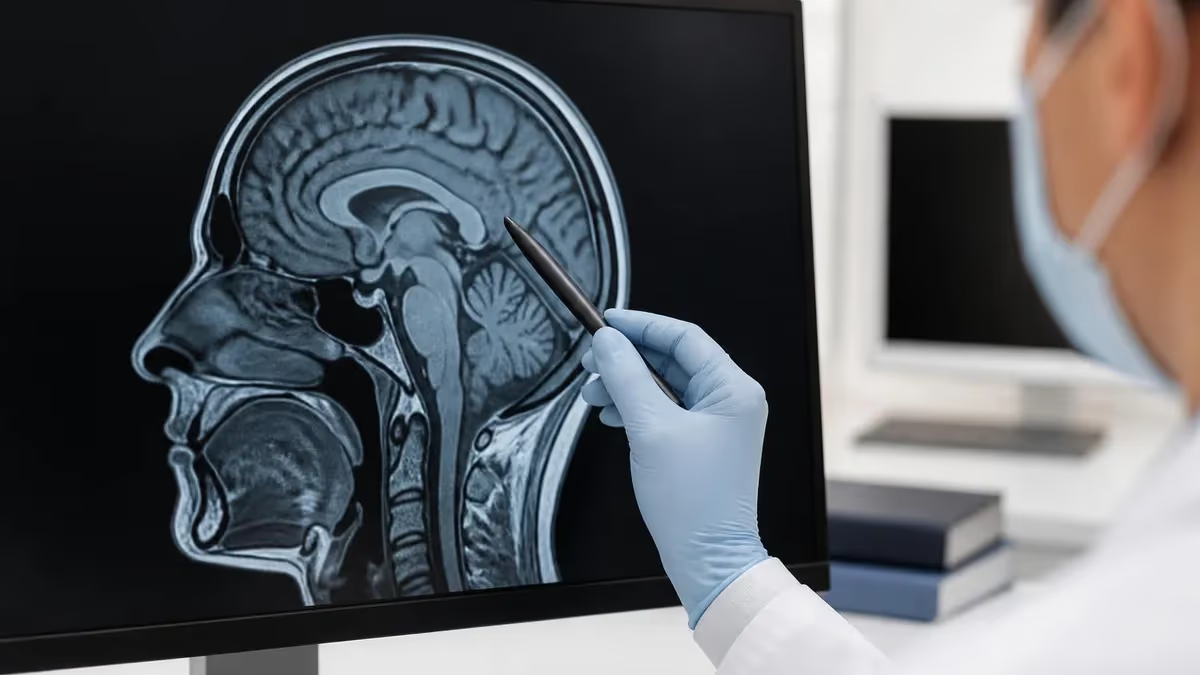
What an MRI of the Knee Actually Shows
An MRI of the knee is the imaging study orthopaedic surgeons, sports medicine physicians and primary care doctors order when they need a detailed look at the soft tissues inside the knee joint. X-rays show bones, but ligament, meniscus, cartilage, tendon and muscle injuries are invisible on plain x-ray and require MRI for diagnostic clarity. The knee MRI captures all four major ligaments (ACL, PCL, MCL, LCL), both menisci (medial and lateral), articular cartilage on the femur and tibia, the patellar and quadriceps tendons, the surrounding muscles, joint effusion and any cysts or unusual masses around the joint.
This guide walks through what a knee MRI shows in detail, the most common findings the radiologist looks for, the patient experience during the scan, the differences between knee MRI for sports injuries versus chronic pain, and the typical cost and timing for non-emergency outpatient knee imaging. The aim is to give patients and family members a clear picture of what to expect when a knee MRI is ordered, so the imaging produces useful information for clinical decisions rather than just an expensive next step in the workup.
Knee MRI is one of the most-ordered MRI studies in the United States, behind only brain and spine MRI in annual volume. The combination of common knee injuries, the failure of x-ray to show soft tissue, and the relative affordability of knee imaging compared to other body parts makes it a high-frequency imaging order. Sports medicine clinics, orthopaedic practices and primary care offices order knee MRI continuously, with most US adults likely to have at least one knee MRI across their lifetime.
Knee MRI at a glance
Scan time: 20–40 minutes typical, no contrast usually required. Common indications: ACL tear, meniscus tear, MCL/LCL injury, cartilage damage, persistent knee pain. Cost: $500–$2,000 cash pay at freestanding imaging centres, $1,500–$4,000 hospital-based. No ionizing radiation. Read by: radiologist or musculoskeletal subspecialist. Most reports return within 24 to 72 hours.
The Major Knee Structures the MRI Captures
The four ligaments are the structures most commonly imaged. The anterior cruciate ligament (ACL) is the central ligament that prevents forward translation of the tibia. It is the most commonly torn knee ligament, particularly during pivoting sports — basketball, soccer, football, skiing. The posterior cruciate ligament (PCL) is its counterpart, less commonly injured but harder to assess clinically.
The medial collateral ligament (MCL) runs along the inner side of the knee and is injured when force pushes the knee inward (valgus stress). The lateral collateral ligament (LCL) on the outer side tears under varus stress and is less common but can occur from contact sports.
The medial and lateral menisci are crescent-shaped fibrocartilage discs between the femur and tibia that act as shock absorbers. Meniscus tears are the most common knee MRI finding, with several distinct tear patterns — radial tears, horizontal cleavage tears, complex tears and bucket-handle tears that flip the displaced fragment into the joint.
Articular cartilage covers the joint surfaces of the femur, tibia and patella. Cartilage damage ranges from mild softening (chondromalacia) through partial-thickness defects to full-thickness loss exposing bone. Bone marrow edema beneath damaged cartilage signals stress and microfracture in the underlying bone, which is often missed on x-ray but clearly visible on MRI.
The patellofemoral joint deserves separate mention. The articulation between the patella (kneecap) and the femoral trochlear groove is a frequent site of cartilage damage and pain in younger patients without specific traumatic injury. Patellofemoral pain syndrome, chondromalacia patellae and patellar maltracking all show on knee MRI through specific findings — patellar cartilage softening or thinning, abnormal patellar position, joint effusion. Many patients with vague anterior knee pain are surprised to learn that the underlying problem traces back to the patellofemoral joint rather than the more commonly discussed cruciate or meniscal pathologies.
Common Knee MRI Findings
Most common ligament injury imaged on knee MRI. Complete tear shows discontinuous fibres on sagittal images. Partial tears show fibre disruption without complete loss. Often paired with bone bruises on lateral femoral condyle and posterior lateral tibia from the pivot mechanism.
Multiple patterns: radial, horizontal cleavage, complex, bucket-handle. Medial meniscus tears more common than lateral due to less mobility. The radiologist describes location (anterior horn, body, posterior horn), pattern type and whether the tear extends to the meniscal surface (clinically significant) or stays internal.
Modified Outerbridge grading from 0 (normal) through 4 (full-thickness loss exposing bone). Most commonly seen on the medial femoral condyle and patellofemoral joint. Bone marrow edema beneath damaged cartilage signals underlying bone stress that often correlates with pain.
MCL injuries graded 1 (sprain), 2 (partial tear) or 3 (complete tear). MCL injuries usually heal without surgery; complete LCL tears more often require surgical repair. Often paired with ACL injuries in high-energy injuries.
Bone marrow edema patterns on fat-suppressed sequences indicate bone stress, microfracture or full fracture lines. Often paired with ACL tear patterns. Subchondral bone bruises sometimes explain knee pain even when cartilage and ligaments look intact.
Joint effusion (excess fluid in the knee) is non-specific but indicates inflammation. Baker cysts (popliteal cysts) collect in the back of the knee from joint fluid extruding through a posterior capsular weakness. Common in patients with chronic knee pathology.
Why Doctors Order a Knee MRI
Sports injuries are the most common reason for knee MRI in younger active patients. A pivot or twist injury during basketball, soccer, football, skiing or recreational sports — the patient feels a pop, the knee swells immediately, weight bearing is painful — typically prompts an MRI within days to confirm or rule out an ACL tear. The clinical exam (Lachman test, anterior drawer, pivot shift) is highly suggestive but the MRI provides the definitive evaluation that surgical decisions require. Meniscus tears from twisting injuries follow a similar pattern but with delayed onset of symptoms in some cases.
Chronic knee pain without specific traumatic event is the second common indication. Patients in their 40s, 50s and 60s with persistent knee pain that has not responded to conservative treatment — physical therapy, NSAIDs, weight management — get MRI to evaluate for cartilage damage, degenerative meniscus tears, or unsuspected osteochondral lesions. Post-surgical follow-up is the third common indication.
Patients 6 to 24 months out from ACL reconstruction, meniscectomy or cartilage repair occasionally need MRI to confirm graft integrity, evaluate retear risk or assess persistent symptoms. Pre-operative planning for partial or total knee replacement is the fourth common indication, particularly when the surgeon wants to evaluate cartilage status or rule out other contributing pathology.
Workplace and motor vehicle injuries are another common indication category. Construction workers, warehouse workers and others in physically demanding jobs occasionally injure their knees in ways that prompt MRI for diagnosis and worker compensation documentation. The MRI finding shapes both treatment planning and the documentation needed to support disability or workers comp claims. Documentation requirements for these scenarios are stricter than routine clinical imaging because the imaging report becomes part of a legal and insurance record.
Knee MRI Sequences and What They Show
Anatomical reference sequence. Fat appears bright; water appears dark. Best for general anatomy, ligament structure and basic bone shape. Less sensitive to subtle cartilage and bone abnormalities than other sequences.
Setup: What the Scan Itself Is Like
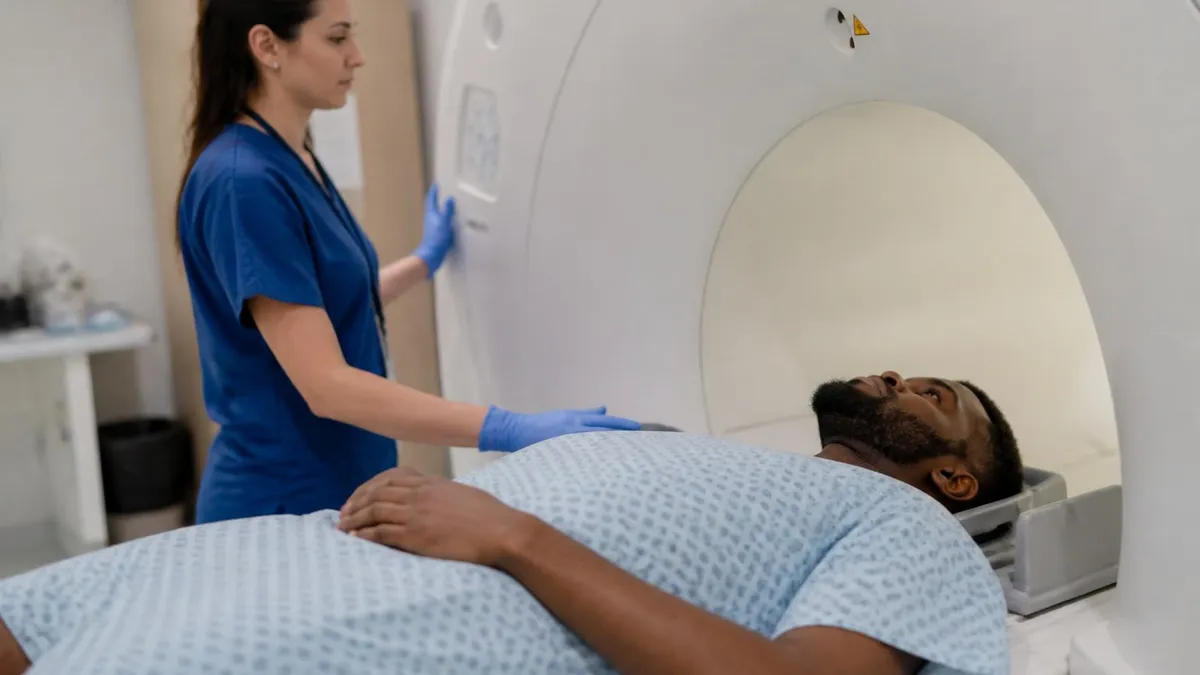
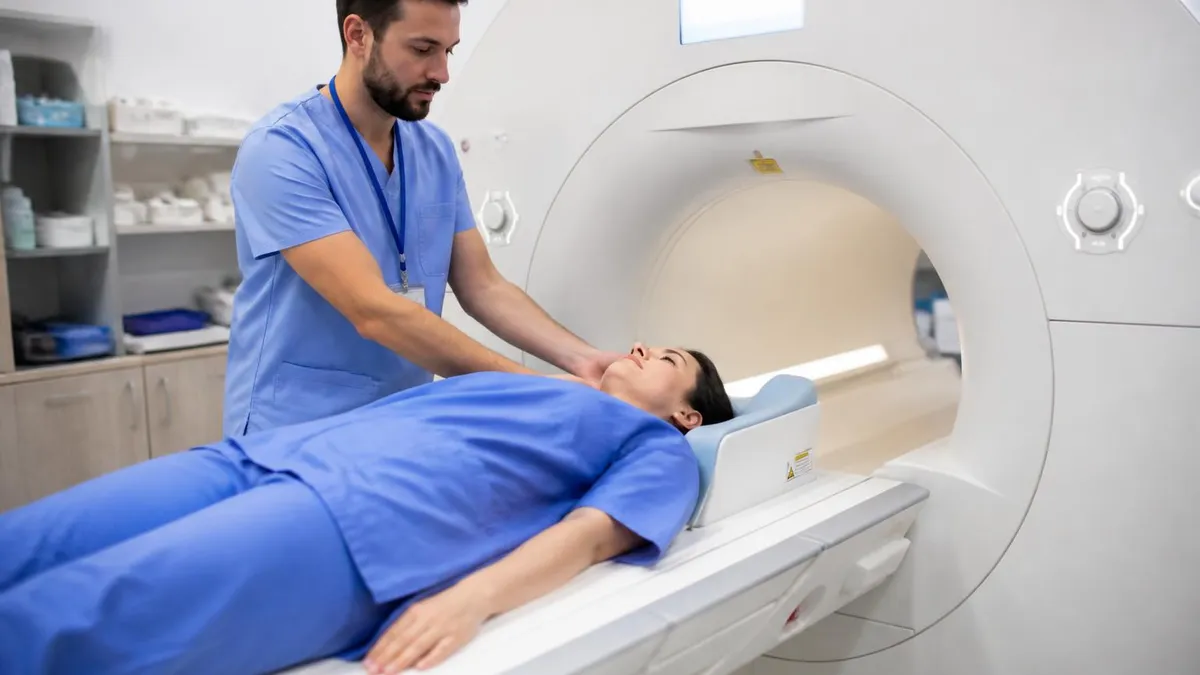
The patient lies supine on the scanner table with the affected knee positioned inside a dedicated knee coil — a cylindrical or rigid receiver that fits around the knee to maximise image quality. The leg can be straight or slightly bent depending on the protocol. The opposite leg is usually positioned outside the coil for comfort. Foam wedges and Velcro straps stabilise the knee because even small movements blur the images. The technologist confirms positioning, communicates through an intercom, and starts the sequences.
Total scan time runs 20 to 40 minutes for routine knee MRI, with each sequence taking 3 to 7 minutes. The knee MRI is generally easier to tolerate than head or whole-body MRI because the rest of the body is not enclosed in the magnet bore — only the leg is fully inside. Many patients find this less claustrophobic than full-body imaging. Earplugs or headphones are provided because the gradient noise is loud during sequences. The technologist communicates between sequences and reminds the patient to remain still. Most patients leave the scanner feeling fine, with no specific recovery needed.
One detail worth noting is that some imaging centres position both knees in the coil even when only one knee is the clinical focus. Comparing the symptomatic knee to the asymptomatic one provides useful context for the radiologist. Other centres scan only the affected knee. The choice depends on the specific imaging order and the centre's protocol. Either approach produces an adequate clinical study; the side-by-side comparison is helpful but not strictly necessary in most cases.
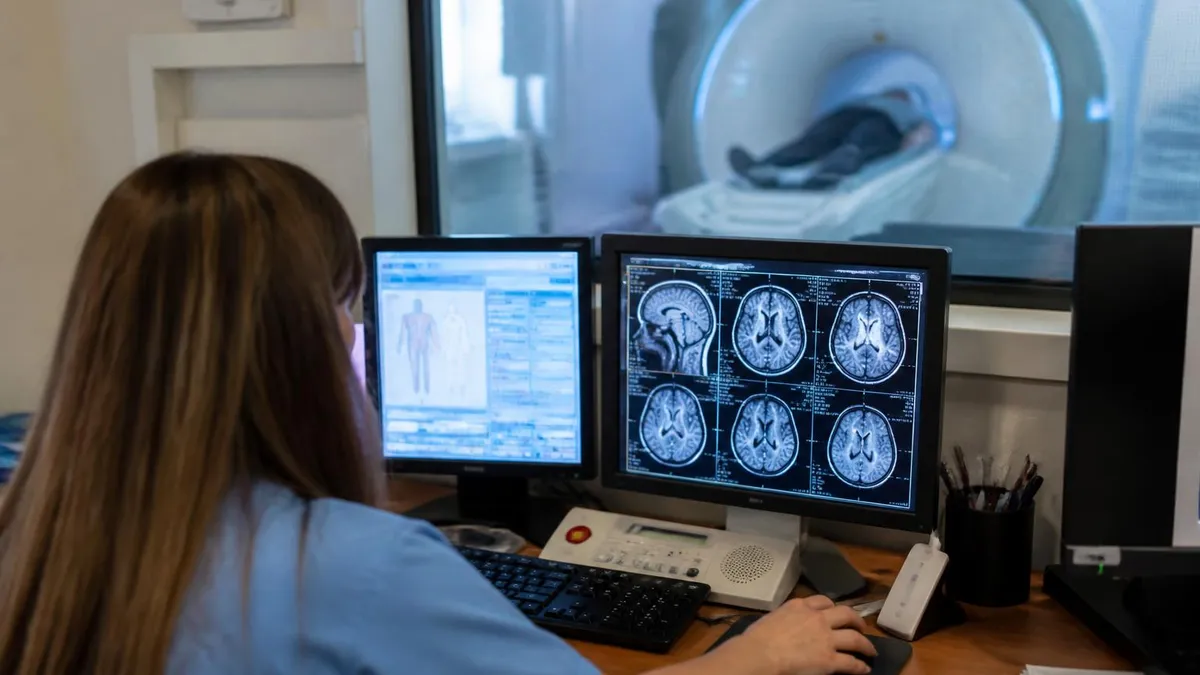
Routine knee MRI for ligament, meniscus or cartilage evaluation does not require gadolinium contrast. Contrast is added only for specific situations — suspected tumour, infection, or evaluating post-surgical complications. If your imaging order specifies MRI without contrast, you do not need an IV line during the scan. The scan time is also slightly shorter without contrast because the post-contrast sequences are skipped.
Sports Medicine Context
Knee MRI plays a central role in sports medicine. Professional sports leagues — NFL, NBA, NHL, MLS — use knee MRI extensively for injury assessment, recovery monitoring and return-to-play decisions. The familiar cycle of "player undergoes MRI today, results expected tomorrow" follows nearly every reported knee injury at the professional level. Team physicians use the scan to confirm clinical suspicion, grade injury severity, and shape rehab and surgical decisions. The same workflow applies at college and increasingly at high school competitive sports levels.
For weekend warriors and recreational athletes, the use case is similar but the urgency is usually less. A clear ACL tear suspicion typically gets imaged within a few days to a week, with surgical consultation following the imaging if reconstruction is appropriate.
Less obvious injuries — moderate sprains, suspected meniscus tears with intermittent symptoms — sometimes wait several weeks for MRI while conservative treatment is attempted. The clinical decision rule is that MRI is most useful when its result will change treatment, which is true for most acute injuries with clear surgical indications and less reliably true for chronic vague symptoms.
The economics of professional sports has produced a unique sub-specialty within musculoskeletal radiology. Team radiologists at major sports franchises often subspecialise in MSK imaging and review imaging from team trainers and physicians as part of their clinical practice. The same subspecialty radiologists work in academic medical centres and major sports medicine clinics, providing high-volume specialist reads on knee MRI. The expertise difference between an MSK fellowship-trained radiologist and a generalist radiologist is sometimes meaningful for complex findings.
Preparing for Your Knee MRI
- ✓Confirm whether contrast is part of the order — most knee MRIs do not need it
- ✓Disclose any metal implants, surgical clips or shrapnel from prior injuries
- ✓Wear comfortable clothing without metal — gym clothes work well, gowns provided if needed
- ✓Remove jewellery, watches and any metal accessories before the scan
- ✓Take any pre-scan pain medication you have been prescribed for the affected knee
- ✓Bring a knee brace if you wear one — it will need to come off for imaging
- ✓Arrive 30 minutes early to complete the safety questionnaire and check-in
- ✓Plan for a quiet 20–40 minute session inside the scanner with the leg in the coil
- ✓Have a driver if pre-scan pain medication includes anything sedating
- ✓Confirm how you will receive the results — patient portal, doctor's office, or both
Reading the Knee MRI Report
The radiologist's report follows a structured format covering each major knee structure in turn. The findings section describes the ACL, PCL, MCL and LCL each with terms like "intact", "sprain", "partial tear" or "complete tear". The menisci are described by tear pattern, location, and whether they extend to the meniscal surface. Articular cartilage is graded by severity and location. Joint effusion is noted as small, moderate or large. Any incidental findings like Baker cysts, bone marrow edema or unsuspected lesions are described separately.
The impression at the end of the report synthesises the findings into a clinical picture. "Complete ACL tear with associated bone bruising of the lateral femoral condyle and posterior lateral tibial plateau. Meniscal contour intact. Mild joint effusion." This sentence, repeated across thousands of reports, captures the typical pivot-injury MRI finding pattern.
Patients reading their own reports through patient portals sometimes find the medical language alarming when the clinical context is missing. The ordering physician is the right person to interpret the report's significance for the specific situation, and most physicians schedule a follow-up call or visit specifically to review MRI results with the patient.
Patient portal access to MRI reports has changed how patients receive imaging results. Many patients now read the radiologist's report through their hospital or imaging centre's online portal before any conversation with the ordering physician. The technical language can be alarming without context. Common phrases like "signal abnormality", "high-grade tear", "chondral fissure" or "subchondral cyst" sound severe in isolation but often represent findings the physician interprets routinely. Resisting the temptation to research individual phrases on the internet before the physician follow-up call usually produces calmer, more accurate understanding of what the report actually means.
Cost Without Insurance
Knee MRI is one of the lower-cost MRI studies because it does not require contrast in most cases and the scan time is shorter than full-body or detailed brain protocols. Cash-pay rates at freestanding outpatient imaging centres typically run $500 to $1,500 in most US markets. Hospital-based imaging often costs 2 to 4 times more for the same study because of facility fees. Major freestanding chains include RadNet, Akumin, Touchstone Medical Imaging and SimonMed, with availability varying by region.
Imaging marketplaces like MDsave and New Choice Health aggregate cash-pay knee MRI offerings from multiple centres at competitive bundled rates. Cash-pay shopping pays back substantially for non-emergency knee imaging — a $500 freestanding scan saves $1,000 to $3,000 versus a hospital scan, and the diagnostic quality is essentially identical for routine ligament and meniscus evaluation. Sports medicine clinics and orthopaedic groups often have preferred imaging partners with bundled rates that the practice arranges on the patient's behalf, which simplifies the logistics for patients who do not want to compare-shop themselves.
Knee MRI Numbers
When to Consider Open MRI for Knee Imaging
Open or wide-bore MRI scanners eliminate the tunnel sensation that triggers panic in claustrophobic patients. Image quality is generally lower than closed 1.5T or 3T scanners but adequate for routine knee imaging. Worth requesting if prior closed-bore MRI attempts have failed.
Patients exceeding standard scanner weight or body size limits may need open or extra-wide-bore systems to fit the scanner. Most modern wide-bore 3T systems accommodate up to 550 lb; open systems sometimes go higher. Confirm capacity with the imaging facility before scheduling.
Some patients tolerate closed MRI but experience meaningful anxiety. Wide-bore (70 cm) closed systems feel substantially more open than older 60 cm bore systems while preserving image quality. Request wide-bore when available; full open MRI is rarely necessary for moderate anxiety.
Some children tolerate open MRI better than the closed format. Pediatric-specific imaging centres often have specialised setups including video distraction and parent presence during scans. Open MRI is one option among several for paediatric knee imaging.
For straightforward knee MRI questions — ACL tear, simple meniscus tear, basic cartilage evaluation — open MRI image quality is typically adequate. The trade-off of slightly lower image quality versus dramatically improved patient comfort is reasonable for many candidates.
For complex multi-ligament injuries, post-surgical evaluation, suspected subtle cartilage abnormalities or pre-operative planning, the higher image quality of closed 3T systems usually justifies the discomfort. Discuss with the ordering physician if image quality matters for the specific clinical question.
What Knee MRI Cannot Do
Knee MRI has real limitations worth understanding. The scan provides static structural imaging at one moment in time, which means dynamic instability — the abnormal joint movement that causes symptoms during specific activities — does not appear on the scan. A knee that feels unstable during running may show structurally intact ligaments on MRI because the imaging cannot capture the abnormal motion. Functional assessment by the physician through clinical examination remains essential alongside the structural imaging, and one cannot substitute for the other.
Subtle cartilage abnormalities sometimes hide on standard sequences. Modern protocols using fat-suppressed PD and 3D sequences improve cartilage assessment substantially compared to older techniques, but the most subtle abnormalities still escape routine imaging. Arthroscopic evaluation (a small camera inserted into the joint surgically) remains the gold standard for detailed cartilage and meniscal assessment, although the invasiveness reserves it for cases where MRI findings are non-diagnostic and clinical suspicion remains high. Knee MRI also cannot reliably distinguish between symptomatic and asymptomatic abnormalities — many patients have meniscus tears or cartilage changes on MRI that produce no clinical symptoms whatsoever.
Standing or weight-bearing MRI is an emerging imaging option that addresses some of these limitations. Specialised scanners image the knee in a weight-bearing position rather than supine, capturing some of the joint loading that everyday symptoms produce. The technology is not widely available, and the image quality is somewhat lower than conventional supine MRI. For most clinical questions, the trade-off does not favour weight-bearing MRI; for specific cases where positional symptoms dominate the clinical picture, it can add useful information that conventional imaging misses.
Knee MRI ultimately serves as one input among several in clinical decision-making rather than a standalone answer. The combination of clinical examination, patient history and structural imaging produces the diagnostic picture that drives treatment. Treating the MRI as the entire diagnostic event misses the broader assessment that orthopaedic and sports medicine specialists routinely combine to reach decisions about surgery, rehab or conservative care.
The synthesis is what creates real clinical value.
Knee MRI: Honest Trade-offs
- +Highest soft-tissue contrast available for ligament, meniscus and cartilage evaluation
- +No ionizing radiation — safe for repeated imaging across rehab and recovery
- +Most knee MRIs do not require contrast, simplifying the experience
- +Cash-pay knee MRI is one of the lower-cost MRI studies — $500 to $1,500 typical
- +Scan time of 20–40 minutes is shorter than many other MRI protocols
- −Static imaging — cannot assess dynamic instability during activity
- −Subtle cartilage abnormalities may escape routine sequences
- −Many incidental MRI findings do not correlate with symptoms
- −Closed-bore scanners trigger claustrophobia in some patients
- −Hospital-based knee MRI is dramatically more expensive than freestanding for the same study
MRI Questions and Answers
About the Author

Medical Laboratory Scientist & Clinical Certification Expert
Johns Hopkins UniversityDr. Sandra Kim holds a PhD in Clinical Laboratory Science from Johns Hopkins University and is certified as a Medical Technologist (MT) and Medical Laboratory Scientist (MLS) through ASCP. With 16 years of clinical laboratory experience spanning hematology, microbiology, and molecular diagnostics, she prepares candidates for ASCP board exams, MLT, MLS, and specialist certification tests.
Join the Discussion
Connect with other students preparing for this exam. Share tips, ask questions, and get advice from people who have been there.
View discussion (8 replies)