
Baltimore MEPS: Complete Recruit Processing Station Guide 2026 October
💡 Baltimore MEPS at 850 Chesapeake Park Plaza: arrival times, overnight hotel, dress code, ASVAB room, and what to bring for a smooth processing day.
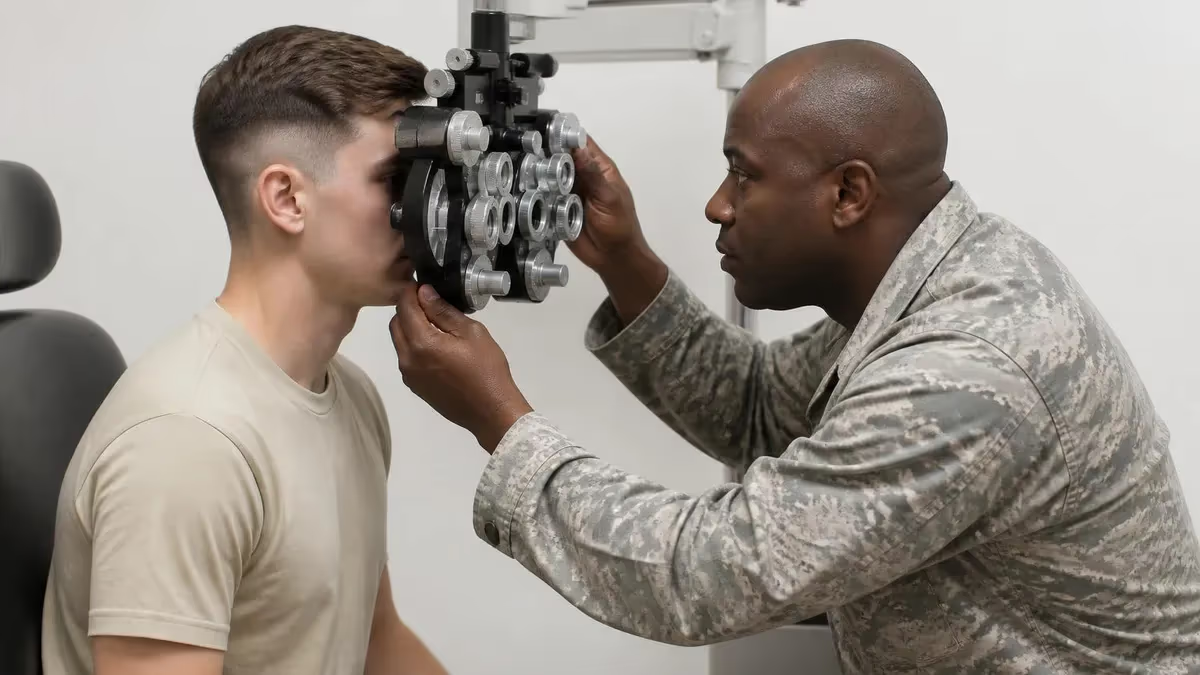
You got the call from your recruiter, packed an overnight bag, and now you're staring at a confirmation slip that says Baltimore MEPS. Maybe you're driving in from York, hopping the MARC train, or flying into BWI from out of state. The same questions hit everyone walking into 850 Chesapeake Park Plaza. What time does it start? Do they really weigh you in your underwear? Will the duck walk be on camera? Is the hotel okay?
This guide walks you through Baltimore Military Entrance Processing Station the way a recruit who already swore in would explain it — no boilerplate from the MEPS brochure. You'll learn where the building sits, how the overnight hotel works, what to wear, which service liaisons keep offices upstairs, and the small mistakes that send recruits home with a temporary disqualification letter.
The Baltimore station is one of 65 MEPS facilities run by the U.S. Military Entrance Processing Command, processing applicants from Maryland, Delaware, the Eastern Shore, and parts of southern Pennsylvania. On a typical Tuesday or Wednesday you might share the medical floor with 80 or 90 other applicants — Army, Navy, Marines, Air Force, Space Force, and Coast Guard all funneling through the same hallway.

Baltimore MEPS At a Glance
Baltimore MEPS lives in Towson, technically — not downtown Baltimore. The address most recruiters give you is 850 Chesapeake Park Plaza, Baltimore, MD 21220, sitting in the Aberdeen Proving Ground corridor just off I-695 (the Beltway) and minutes from Martin State Airport. It is not the building you'd picture for a federal processing station.
There's no fence, no guard tower, no concertina wire. It looks like a 1990s suburban office park, because that's what it is. The entrance is on the south side of the building near the parking lot, marked with a small Department of Defense seal and a sign reading "Military Entrance Processing Station."
The MEPS itself occupies two full floors. The first floor is reception, fingerprinting, and the medical exam wings — vision, hearing, blood draws, vitals, and the duck walk room. The second floor holds the ASVAB test room (computer-based CAT-ASVAB, 20 stations), the service-branch liaison offices, contract signing rooms, and the oath ceremony room with its flag wall. Most applicants spend their first day downstairs and their second day upstairs, but the order flips depending on whether you've already taken your ASVAB at a satellite Mobile Exam Test (MET) site near you.
If you're driving in, parking is free in the lot directly in front of the building. Don't park in the spaces marked "Liaison" or "Government Vehicle Only" — they'll have you towed by the Baltimore County police. If you're using public transit, you're going to struggle. There's no Light Rail or Metro Subway stop within walking distance.
The closest MTA bus is the CityLink Yellow line, which drops you about a mile from the door, and you do not want to walk that mile at 4:00 a.m. carrying an overnight bag. This is why almost every Baltimore MEPS applicant uses the contracted hotel and shuttle system — covered below.
Quick Reference
Location: 850 Chesapeake Park Plaza, Baltimore, MD 21220
Doors Open: 4:30 a.m. (shuttle from contracted hotel departs 4:15 a.m.)
Service Branches Processed: Army, Navy, Marines, Air Force, Space Force, Coast Guard
Region Served: Maryland, Delaware, the Eastern Shore, parts of southern Pennsylvania
The single most useful fact about MEPS is the clock. Baltimore MEPS doors open at 4:30 a.m. sharp, and the shuttle from the contracted hotel leaves at 4:15 a.m. Miss the shuttle and you've already started the day with a problem. Plan on being downstairs in the hotel lobby, fully dressed, ID in hand, by 4:00 a.m. That means setting two alarms — phone and front-desk wake-up call — for 3:15 a.m. or earlier.
From 4:30 to about 5:15 a.m. you're in check-in: ID verification, fingerprint scanning, paperwork review, and the medical pre-screen questionnaire. If you brought paperwork your recruiter gave you (and you should have), this is where it gets stamped and routed. If you forgot something — your Social Security card, your high school diploma, a court-ordered document, a prescription bottle — this is the hour where it costs you. Some missing items can be resolved by phone. Others mean you go home and come back another day.
Your Baltimore MEPS Day Hour by Hour
Photo ID verification at the security desk, electronic fingerprint scan against the federal background system, paperwork stamp from your recruiter package, and the medical pre-screen questionnaire that covers childhood injuries, surgeries, medications, mental health visits, and prescriptions going back to early childhood. Bring your Social Security card, driver's license, birth certificate, and every document your recruiter handed you. Missing items get caught here and either resolved by phone or send you home for the day.
Standing height measurement, body weight on a calibrated scale, vision with and without correction, color vision using Ishihara plates, depth perception, hearing inside a soundproof booth, blood draw for metabolic panel and pregnancy screening, urine sample for the drug screen, blood pressure and pulse, body composition tape test if needed, and the underwear-only doctor exam including the duck walk for knee and hip range of motion.
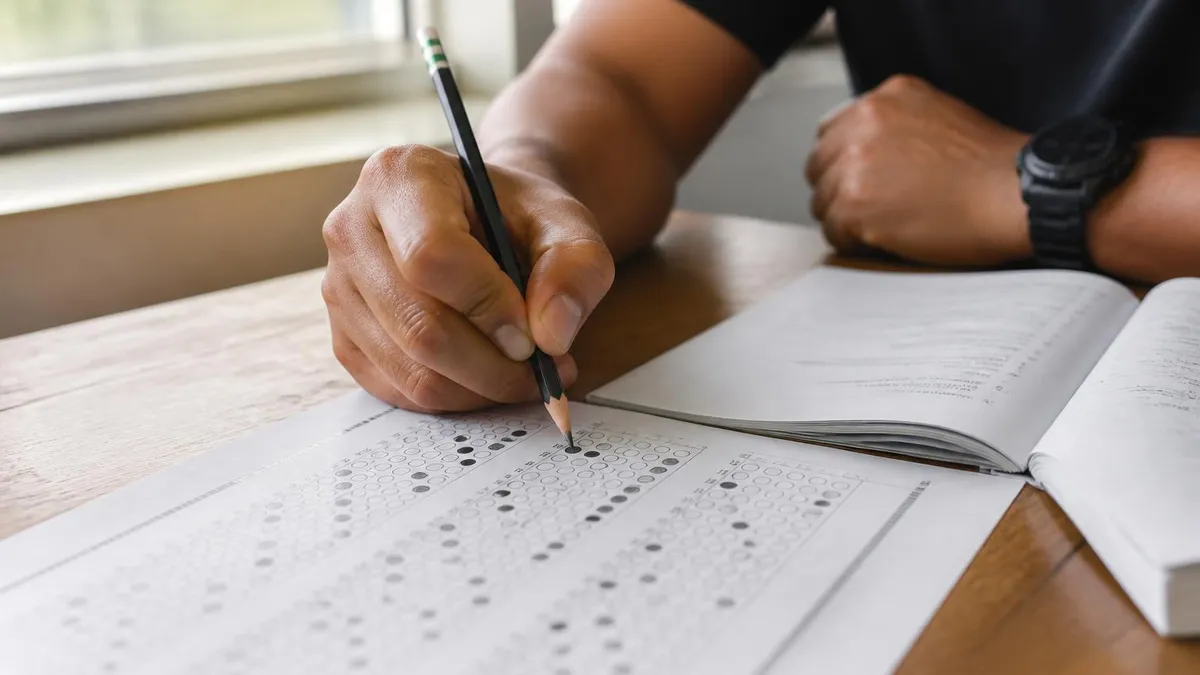
If you have not taken the ASVAB at a MET site, this is when you sit for the CAT-ASVAB at one of 20 computer stations on the second floor. Two-hour adaptive test that auto-adjusts question difficulty as you go. AFQT percentile and individual line scores by domain print within 15 minutes of finishing. If you already tested at a MET site, this block is when your scores get pulled into the system for your counselor.
One-on-one session with your branch's job counselor. Army uses Guidance Counselors. Navy uses Classifiers. Marines have a Career Planner. Air Force and Space Force share an Enlisted Accessions counselor. They pull your line scores, your medical clearance, your background results, and show you available jobs and ship dates that match. You select an MOS, rating, or AFSC and sign your enlistment contract that day or decline and walk out.
Small ceremony room on the second floor with a flag wall. A commissioned officer administers the enlistment oath while applicants raise their right hands and recite together. Each applicant signs the final contract page. A photo is taken and emailed to whatever address the recruit listed on the paperwork. From the moment the pen leaves the page, the applicant is in the Delayed Entry Program until their ship date for basic training.

Around 5:30 a.m. they call the first group for medical. This is the long part of the day, and it's where most stories get told later. The standard MEPS medical includes height and weight, vision (with and without correction), color vision (the Ishihara plates), depth perception, hearing in a sound booth, blood draw for a metabolic panel and pregnancy test if applicable, urine sample for drug screening, blood pressure, pulse, and the dreaded body composition tape test if you don't make weight on the scale.
Then comes the underwear portion. You'll strip to bra and underwear (women) or boxers/briefs (men) for the doctor's exam. The doctor checks posture, scars, tattoos (yes, they document them), range of motion, and — yes — has you do the duck walk. The duck walk is a squat-and-waddle across a small room to check knee and hip function. It looks ridiculous. It feels worse. Everyone does it. No one is filming.
The full MEPS process from arrival to oath ceremony typically runs 12 to 14 hours if everything goes smoothly. If you need additional consults — a cardiology read on an EKG, an orthopedic recheck, a psych follow-up — you may be told to return on a second day. Returning is normal. About a quarter of Baltimore applicants do at least one return visit.
Inside Each MEPS Station
Plan to spend four to six hours on the medical floor. Drink water the night before but stop drinking by midnight to avoid bladder issues during the morning blood pressure check. Bring corrective lenses if you wear them because they test you with and without. If you take a prescription, bring the original labeled bottle so the doctor can verify dose and frequency. Anything you have ever been treated for that you didn't disclose to your recruiter should be disclosed to the MEPS doctor before they find it themselves in your records. The medical floor is the single longest stretch of your day and the place where most disqualifications and waiver requests get triggered.
If you haven't taken the ASVAB yet at a MET site, you'll take it at MEPS — usually before the medical so your score is back by the time you sit down with a job counselor in the afternoon. The CAT-ASVAB at Baltimore is computer-adaptive, scored as you go, and runs about two hours for most applicants. You'll get a printed score sheet with your AFQT percentile and your line scores by domain. Those line scores are what determines which jobs in your chosen branch you actually qualify for, so this is the test that matters more than people think.
Right after the ASVAB results post, you'll sit with a service-branch job counselor. Army calls them Guidance Counselors. Navy uses Classifiers. Marines have a Career Planner. Air Force and Space Force share an Enlisted Accessions counselor. Coast Guard runs out of a smaller office at the end of the hall and isn't always staffed daily at Baltimore — confirm with your recruiter before you arrive expecting a Coast Guard rate selection on the day.
Caffeine the morning of MEPS can spike your blood pressure into the temporary disqualification range. Skip coffee, soda, and pre-workout supplements for at least 12 hours before arrival. The same applies to nicotine and energy drinks. Show up calm and hydrated, not wired.
The job counselor will pull up your line scores, your medical clearance, your security background, and your contract preferences. From there you'll pick a Military Occupational Specialty (Army), Rating (Navy/Coast Guard), Air Force Specialty Code, or MOS (Marines). You'll see ship dates — when boot camp starts — and you'll lock one in.
The number of jobs visible to you depends entirely on your ASVAB line scores. A 50 AFQT with mediocre line scores opens maybe 40% of the job book. A 90 AFQT with strong technical scores opens nearly all of it. This is why your recruiter pushed you so hard on ASVAB prep.
If you're not satisfied with what shows up on the screen — say you wanted Crypto Linguist but your General Technical line score is two points short — you can decline to sign. Some applicants walk out of MEPS without a contract, retake the ASVAB after additional study, and come back. Your recruiter would rather you sign today. That's a tension you should know about going in.
What to Bring to Baltimore MEPS
- ✓Government-issued photo ID such as a current driver's license, a state-issued non-driver ID card, or a valid United States passport that has not expired
- ✓Original Social Security card with your printed name and full number — a phone screenshot or a number written on paper does not satisfy the federal verification requirement
- ✓High school diploma, official sealed transcript, or General Educational Development certificate showing graduation status and date of completion
- ✓Certified copy of your birth certificate showing the raised seal — hospital souvenir certificates from your parents' baby book are not accepted by MEPS verification
- ✓Eyeglasses or contact lenses if you wear them daily, plus the case and saline solution for contact lenses since you will be tested both with and without correction
- ✓Original prescription bottles for every current medication you take, including over-the-counter inhalers, insulin pens, ADHD medications, and any controlled substance
- ✓Any medical records, doctor's notes, or specialist letters your recruiter specifically requested ahead of time, including surgical reports, asthma test results, or psychiatric evaluations
- ✓Court documents in original form for any traffic citations, juvenile records, civil lawsuits, restraining orders, or expungements — even sealed records must be disclosed
- ✓Marriage certificate and Social Security cards for any dependents if you are married, divorced with custody, or have biological or adopted children of any age
- ✓Small overnight bag with toiletries, deodorant, toothbrush, toothpaste, phone charger, and one clean change of clothes for the morning shuttle and the oath ceremony photo
The hotel is the second thing nobody tells you about. MEPS uses contracted hotels around Baltimore to house applicants who arrive the night before. The primary hotel is the DoubleTree by Hilton Baltimore-Belmont, about 15 minutes from the MEPS building. Rooms are double-occupancy — you'll share with another applicant of the same gender, usually from a different branch. Meals are provided: dinner that night and a packed breakfast bag for the shuttle.
House rules are stricter than a normal stay. No alcohol on premises. No leaving the hotel after check-in. No guests in rooms. Lights-out is generally 10:00 p.m., and the shuttle's 4:15 a.m. departure enforces itself. An MEPS liaison sits in the lobby until late evening to handle problems and paperwork issues. If your roommate is disruptive or brought contraband, go straight to the liaison.
If you're flying in, your recruiter will book a flight that lands at BWI Thurgood Marshall Airport on the afternoon or evening before your processing date. A MEPS-contracted ground transportation service meets you at baggage claim and shuttles you to the DoubleTree. Don't deviate from the shuttle.
Don't grab an Uber and tell the driver you'll meet the group at the hotel. The liaison needs to physically check you in, verify your travel paperwork, and account for you on the manifest. Skipping the shuttle has resulted in applicants being marked as no-shows even when they made it to MEPS the next morning under their own power.
What you wear matters more than people think. Baltimore MEPS has a written dress code — no flip-flops, no tank tops, no clothing with offensive imagery, no pajamas. Beyond the dress code, there's the practical question: what's actually comfortable for a 14-hour day that includes stripping down in front of a doctor and putting your clothes back on a half-dozen times?
The right answer for most applicants is loose athletic shorts or sweatpants, a plain t-shirt, slip-on sneakers, and a hoodie or zip-up. You'll be hot in the medical wing (it runs warm) and cold in the ASVAB room (they crank the AC). Anything you can take on and off quickly is gold. Skip the belt. Skip the laces if you can. Skip anything with metal that might set off security wands.
One more wardrobe note — if you're going to swear in and ship the same day (Day Ship), bring or wear something presentable for the oath ceremony photo. Some applicants change in the bathroom into a button-down or a clean polo. The photo goes on your service record and gets sent to your family. Some recruits regret showing up to their oath ceremony in basketball shorts.
Processing at Baltimore: Pros and Cons
- +Modern, well-staffed facility with all six service branches on site daily so any applicant from any branch can complete their entire process at one location
- +Free unrestricted parking directly in front of the building with no validation required and no shuttle needed for local applicants who drive themselves in
- +Contracted DoubleTree by Hilton hotel with built-in shuttle service, included meals, and onsite MEPS liaison for overnight applicants from outside the immediate area
- +Quick 15-minute access from BWI Thurgood Marshall Airport for out-of-state recruits flying in the day before their scheduled processing appointment
- +Large applicant volume means experienced doctors, counselors, and liaisons who move you through each station efficiently with minimal training delays
- +Multiple liaison officers per branch reduces job-counseling bottlenecks compared to smaller MEPS stations where one counselor handles every applicant in turn
- −Limited public transit access — driving your own vehicle or using the contracted shuttle from the hotel are the only realistic options for most applicants
- −Medical floor runs cold year-round and the building has weak applicant Wi-Fi, so download anything you want to read on your phone before arriving
- −High volume on Tuesdays and Wednesdays means longer waits in common areas, with some applicants spending two to three hours in a holding lounge before their next station
- −Hotel pairs you with a random roommate of the same gender from a different service branch, which can be awkward if your roommate is loud, anxious, or has very different sleep habits
- −No personal phones, smartwatches, or fitness trackers allowed on secure floors during testing or contracting, which means you cannot text family members during the day
Pros and Cons at a Glance
| Pros | Cons |
|---|---|
| Modern, well-staffed facility with all six service branches on site daily so any applicant from any branch can complete their entire process at one location | Limited public transit access — driving your own vehicle or using the contracted shuttle from the hotel are the only realistic options for most applicants |
| Free unrestricted parking directly in front of the building with no validation required and no shuttle needed for local applicants who drive themselves in | Medical floor runs cold year-round and the building has weak applicant Wi-Fi, so download anything you want to read on your phone before arriving |
| Contracted DoubleTree by Hilton hotel with built-in shuttle service, included meals, and onsite MEPS liaison for overnight applicants from outside the immediate area | High volume on Tuesdays and Wednesdays means longer waits in common areas, with some applicants spending two to three hours in a holding lounge before their next station |
| Large applicant volume means experienced doctors, counselors, and liaisons who move you through each station efficiently with minimal training delays | Hotel pairs you with a random roommate of the same gender from a different service branch, which can be awkward if your roommate is loud, anxious, or has very different sleep habits |
| Multiple liaison officers per branch reduces job-counseling bottlenecks compared to smaller MEPS stations where one counselor handles every applicant in turn | No personal phones, smartwatches, or fitness trackers allowed on secure floors during testing or contracting, which means you cannot text family members during the day |
The day ends — for those who pass everything — with the enlistment oath in a small ceremony room on the second floor. A commissioned officer administers the oath. You raise your right hand, recite, sign your contract. You're now Future Soldier, Sailor, Marine, Airman, Guardian, or Coastguardsman. From that moment, you're in the Delayed Entry Program until your ship date.
Baltimore MEPS sends 12,000 to 15,000 applicants per year through this exact sequence. Most pass on the first try. The ones who don't usually fall into three categories: a medical finding that requires a waiver, an ASVAB score that didn't open the jobs they wanted, or a moral or background flag that requires additional documentation. None of these are the end of the road. Waivers happen. Retakes happen. MEPS is not a one-shot gate.
The single best piece of advice anyone gives you about Baltimore MEPS is this: sleep the night before. Sleep is the variable that ruins more applicants than anything else. Caffeine on no sleep elevates your blood pressure into the disqualifying range. Anxiety on no sleep crashes your performance on the ASVAB. Dehydration from skipping water on no sleep makes the urine drug screen take three tries. If you can sleep at the hotel, sleep. If you can't sleep at the hotel, at least lie down with your eyes closed at 9:30 p.m. Rest matters.
The second-best piece of advice: be honest on the medical questionnaire. The questionnaire asks about every doctor's visit, every prescription, every counseling session, every surgery, every broken bone since childhood. If you lie and they catch you — through records, through a contradiction in a later exam, through a remark you made on day one that contradicts day two — that's fraudulent enlistment, which is a federal offense and a permanent disqualification from all branches. If you tell the truth and there's something disqualifying, you can usually get a waiver or at minimum know what the rules are.
One last operational note. Baltimore MEPS has its own quirks. The medical floor runs cold. The Army liaison office is the busiest by a wide margin. The Marine office is the smallest and moves fast. Skip caffeine and heavy sodium the night before — both can spike your morning blood pressure. And the building has limited Wi-Fi, so download anything you want to read on your phone before you walk in.
The simple version: show up rested, hydrated, with your paperwork, on time, in comfortable clothes, ready to be honest. Do those five things and Baltimore MEPS is a long day, not a hard one.
Your recruiter will have run you through the basics, but here is the consolidated list of what every Baltimore MEPS applicant needs in hand. This is not a wishlist. Missing items send you home.
The same way every job has trade-offs, so does processing at Baltimore versus the other Mid-Atlantic MEPS stations. Some applicants from southern Maryland get sent to Fort Meade MEPS instead, or from northern Maryland up to Harrisburg MEPS in Pennsylvania. Each station has its own feel. Baltimore is busy, modern, and well-staffed. Here's the honest pros-and-cons of going through Baltimore specifically.
You've seen the building, the schedule, the hotel, the dress code, the contract floor, and the wins-and-losses of processing through Baltimore. The remaining piece is preparation — the actual studying, the medical document gathering, the conversations with your recruiter about what jobs you're hoping for and what your line scores need to be to get them. That preparation work doesn't happen at MEPS. It happens in the weeks before, sitting at your kitchen table with practice tests and a notebook.
The ASVAB is the single most controllable variable in your enlistment process. Your medical history is what it is. Your background check is what it is. But the ASVAB? You can study for it. Applicants who walk in with a 75 AFQT and strong line scores have their pick of jobs. Applicants who walk in with a 40 AFQT and weak technical scores get whatever's left.
Below are the questions Baltimore MEPS applicants email us about most often. If your question isn't here, your recruiter is your best first stop — they've been through this hundreds of times. If your recruiter is stumped, the MEPS liaison desk at 850 Chesapeake Park Plaza answers phones during business hours.
Sample MEPS - Military Entrance Processing Stations Practice Questions
Try these questions from our free MEPS - Military Entrance Processing Stations practice tests. The correct answer and an explanation follow each question.
Which DoD form is used to formally record a recruit's declination of a specific job offer during MEPS processing?
- A. A statement of understanding documented on the DD Form 4 or attached waiver paperwork
- B. DD Form 2808 – Report of Medical Examination
- C. SF-86 – Questionnaire for National Security Positions
- D. DD Form 1966 – Record of Military Processing
Answer: D. DD Form 1966 – Record of Military Processing
DD Form 1966 is the Record of Military Processing used to document the full history of a recruit's MEPS processing, including job offers made and accepted or declined.
A recruit has a history of asthma with no symptoms or treatment after age 13. How is this typically handled at MEPS?
- A. Automatically disqualified regardless of symptom-free period
- B. May be qualified if documented symptom-free and treatment-free since age 13
- C. Requires a pulmonary function test waiver regardless of history
- D. Granted automatic waiver without additional documentation
Answer: B. May be qualified if documented symptom-free and treatment-free since age 13
Per DoDI 6130.03, asthma or reactive airway disease after age 13 is disqualifying, but those with no symptoms or treatment after that age may be found qualified.
Why is it important for applicants to get adequate sleep the night before MEPS processing?
- A. Sleep deprivation can cause the audiogram to show hearing loss
- B. Being well-rested ensures the applicant can perform physical and cognitive tasks accurately
- C. MEPS staff can detect sleep deprivation through blood tests
- D. Medical examiners will ask about sleep habits as part of the mental health screening
Answer: B. Being well-rested ensures the applicant can perform physical and cognitive tasks accurately
Adequate sleep helps applicants perform accurately on all assessments and handle the lengthy, demanding processing day.
Which factor most directly influences what jobs are available to a recruit at MEPS?
- A. The recruiter's seniority
- B. Current military job vacancies and the recruit's ASVAB scores
- C. The recruit's geographic location
- D. The recruit's family military history
Answer: B. Current military job vacancies and the recruit's ASVAB scores
Job availability at MEPS is determined by current military vacancies (the 'job board') and whether the recruit meets the ASVAB line score requirements for each position.
Take the full MEPS - Military Entrance Processing Stations practice test
MEPS Questions and Answers
About the Author
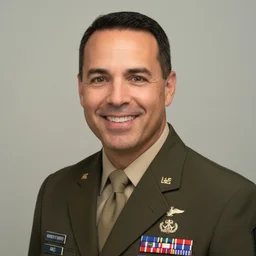
Retired Military Officer & Armed Forces Test Preparation Specialist
United States Army War CollegeColonel Steven Harris (Ret.) served 28 years in the US Army, earning a Master of Arts in Military Science from the Army War College and a Bachelor of Science in Criminal Justice. He has coached thousands of military enlistment and officer candidate program applicants through the ASVAB, AFQT, AFCT, OAR, and officer selection assessment processes across all military branches.
Join the Discussion
Connect with other students preparing for this exam. Share tips, ask questions, and get advice from people who have been there.
View discussion (8 replies)