
Is the Mensa Test Free? Complete Guide to Mensa Costs, Membership, and IQ Testing
Is the Mensa test free? Learn exact costs, what Mensa is, qualification scores, and how to prepare. 🧠 Full US guide for 2026.
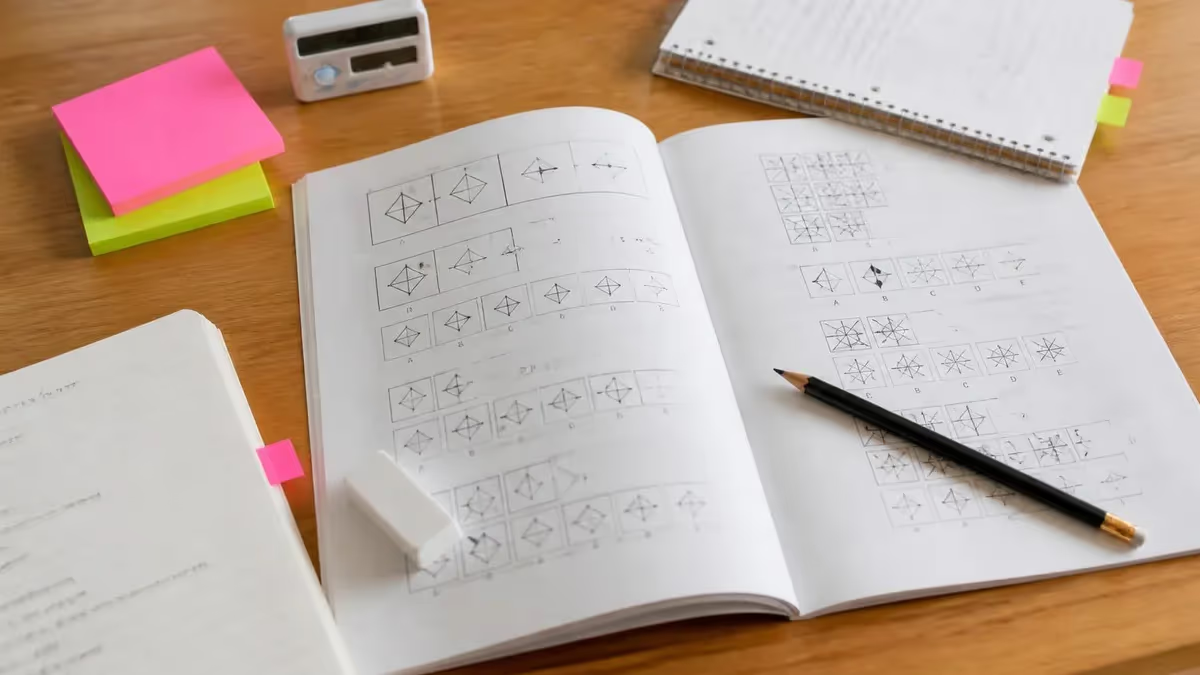
If you have been searching for answers about whether is mensa free or whether joining this elite high-IQ society comes with a price tag, you are not alone. Millions of curious, intellectually driven Americans wonder every year whether they can take the official Mensa admission test without spending a dime. The short answer is no — the official Mensa Admission Test costs money — but there are legitimate free pathways, free practice resources, and cost-saving strategies worth knowing before you commit to anything. Practice with the free Mensa practice test on PracticeTestGeeks (1,050+ questions with answer explanations).
To fully appreciate the cost structure, it helps to understand what Mensa is in the first place. Mensa is the world's oldest and largest high-IQ society, founded in Oxford, England, in 1946. American Mensa, headquartered in Garland, Texas, serves more than 50,000 members across the United States. Membership is open to anyone who scores in the top 2% of the general population on a standardized, supervised intelligence test. That threshold corresponds roughly to an IQ of 130 or higher on most major scales.
The menses meaning of the word itself is unrelated to the organization — Mensa is Latin for "table," reflecting the society's founding ideal of a round-table equality among members of all backgrounds. Whether you are a student, a working professional, or a retiree, your IQ score is the only credential that matters. Age, education, income, and career history are irrelevant to qualification, which is part of what makes the society so appealing to people from every walk of life in the United States.
Many people discover Mensa after noticing signs of high intelligence in themselves or after a friend mentions it. Others stumble onto it while researching what is mensa during a late-night curiosity spiral. Whatever brings you here, the first practical question is almost always about money. The official Mensa Admission Test, administered in person at supervised testing sessions across the country, costs $40 for adults and $25 for minors as of 2026. That fee covers the two-part test battery and your first score report.
However, cost is only one dimension of the decision. Before paying anything, many candidates want to find out whether they are likely to qualify. This is where free practice tests become enormously valuable. PracticeTestGeeks.com offers a full suite of free Mensa-style IQ practice tests covering critical thinking, spatial visualization, number series, memory and concentration, word problems, and mixed challenge formats. These tools let you benchmark your readiness before investing in the official exam or annual membership dues.
There is also an important alternative pathway that completely bypasses the Mensa Admission Test fee: submitting prior qualifying evidence. If you have already taken a widely accepted standardized test — such as the SAT, ACT, GRE, or a professionally administered IQ test — and scored in the top 2%, American Mensa may accept that score as proof of qualification. Submitting prior evidence costs only $25, saving you $15 compared to sitting the official test. This pathway is underused and underappreciated, especially among recent college graduates who took the SAT or GRE within the past few years.
Understanding the full picture — from test fees to annual dues to the free resources available to you right now — is the key to making an informed decision. You can explore is the mensa test free in full detail on our dedicated benefits page, which breaks down every cost and perk associated with joining American Mensa. Throughout this guide, we will walk you through every dimension of the Mensa cost structure, what to expect from the test itself, how to prepare effectively, and whether membership is worth the investment for your personal and professional goals.
Free Mensa Study Tools
Interactive Mensa resources on PracticeTestGeeks, free to start:
- Free Mensa IQ Critical Thinking Practice Test — 37 questions with instant scoring and answer explanations
- Mensa flashcards — review key terms and concepts card by card
- Mensa study guide — topic-by-topic overview of what the exam covers
- Mensa cheat sheet — one-page printable summary for last-minute review
Mensa Testing by the Numbers
Mensa: upcoming dates and official changes
- Oct 1, 2026: American Mensa is running a 50% discount on Local Group testing for October 2026, so it costs $30 instead of $60 through Oct. 31. (American Mensa, Ltd.)
Facts verified Oct 20, 2026 against American Mensa, Ltd.. Dates that have passed are removed automatically.
- A qualifying score on the Mensa Admission Test means scoring at or above 98 percent of the general population. (American Mensa, Ltd.)
- The Mensa Admission Test costs $60 when taken at a session proctored by American Mensa Local Group volunteers. (American Mensa, Ltd.)
- The Mensa Admission Test costs $99 when taken as a private session at one of American Mensa's 400+ approved testing facilities. (American Mensa, Ltd.)
- Candidates may take a Mensa Admission Test or test battery only once every eight weeks. (American Mensa, Ltd.)
- American Mensa membership dues are $107 per year, with additional family members at $72, a three-year membership at $290 and a five-year membership at $475. (American Mensa, Ltd.)
- The Mensa Admission Test is offered at sessions proctored by Local Group volunteers or as private sessions at more than 400 approved testing facilities nationwide. (American Mensa, Ltd.)
- American Mensa does not offer the Mensa Admission Test to anyone under 14, and test-takers must bring a photo ID with proof of date of birth. (American Mensa, Ltd.)
- Private Mensa Admission Test results arrive in two to three business days, while Local Group testing results take two to three weeks. (American Mensa, Ltd.)
Facts verified Oct 20, 2026 against American Mensa, Ltd.. Dates that have passed are removed automatically.
Mensa Exam at a Glance
| Item | Detail | Official source |
|---|---|---|
| Passing score | 98th percentile (top 2%) | American Mensa, Ltd. |
| Exam fee (Local Group testing) | $60 (Local Group session) | American Mensa, Ltd. |
| Exam fee (Private testing) | $99 (private testing center) | American Mensa, Ltd. |
| Retake policy | Once every 8 weeks | American Mensa, Ltd. |
| Renewal | $107/year dues; $72 additional family member; $290 three-year; $475 five-year | American Mensa, Ltd. |
| Delivery | Local Group proctored sessions or private sessions at 400+ testing facilities | American Mensa, Ltd. |
| Eligibility | Age 14+ with photo ID showing date of birth | American Mensa, Ltd. |
| Score release | 2–3 business days (private); 2–3 weeks (Local Group) | American Mensa, Ltd. |
Facts verified Oct 20, 2026 against American Mensa, Ltd.. Dates that have passed are removed automatically.

Mensa Test Cost Breakdown: Every Fee You Need to Know
The supervised in-person test administered by American Mensa costs $40 for adults (18+) and $25 for minors. This fee covers your two-part timed test battery and your official score report. Sessions are held throughout the year at local Mensa chapters nationwide.
If you already have a qualifying score from an accepted test (SAT, ACT, GRE, Stanford-Binet, etc.), you can submit prior evidence for just $25. American Mensa maintains a detailed list of qualifying tests and the minimum scores accepted for each instrument.
Once you qualify, annual dues are approximately $79 per year for adults, with discounted rates for students, seniors, and life membership options. Some local chapters charge a small additional fee on top of national dues to fund local events and activities.
PracticeTestGeeks.com and the official Mensa website offer free sample questions and practice tests at no cost. These are not the official admission test, but they provide an excellent benchmark for your current ability level before you invest in the formal exam.
American Mensa once offered a supervised home test, but it has since been discontinued. All official qualifying tests must now be taken at in-person proctored sessions or submitted as prior qualifying evidence from accepted third-party institutions.
Understanding what the Mensa admission test actually measures is essential before you sit down to take it. The official Mensa Admission Test is not a single IQ test in the traditional sense — it is a two-part battery designed to assess general cognitive ability across multiple dimensions. The two tests used are the Mensa Wonderlic Personnel Test and the Mensa Admission Test Form 1 and Form 2, each timed separately. Together, they evaluate your speed and accuracy of reasoning across verbal, numerical, and abstract problem types.
The test is deliberately designed to be culturally fair, meaning it minimizes advantages tied to specific educational backgrounds or vocabulary knowledge. You will not be tested on history, geography, literature, or science facts. Instead, you will face pattern recognition problems, logical sequences, spatial reasoning challenges, and number series questions. This format is why people with very different educational backgrounds — from high school graduates to PhDs — can all qualify for Mensa based purely on cognitive horsepower.
Menses irregular periods and other health-related search terms sometimes appear alongside Mensa searches due to the phonetic similarity between the words — but the Mensa IQ society has nothing to do with menstrual health topics. It is worth clarifying this because many first-time searchers end up confused when health content appears in their results. Mensa (the society) derives its name from the Latin word for table, while menses (the plural of mensis) refers to the menstrual cycle in medical terminology. They are entirely unrelated concepts that happen to share similar spelling.
The content areas of the Mensa test can be grouped into six broad cognitive categories: abstract/logical reasoning, numerical reasoning and number series, spatial visualization and pattern recognition, verbal analogies and word relationships, memory and concentration tasks, and applied mathematics or word problems. Each of these categories is represented in the free Mensa-style practice tests available on PracticeTestGeeks.com, allowing you to identify your strongest and weakest areas before testing day arrives.
One of the most common misconceptions about the Mensa test is that it can be studied for in the same way you study for a history exam. You cannot memorize answers in advance because the test presents novel problems you have never seen before. However, what you can do is train your brain to approach these problem types more efficiently. Regular practice with timed IQ-style questions genuinely improves your processing speed and pattern-recognition instincts — exactly the skills that determine your score on test day.
Another important dimension is test anxiety. Many highly intelligent people underperform on standardized tests not because of lack of ability but because of stress-induced cognitive interference. Research consistently shows that familiarity with test format dramatically reduces anxiety. When you have taken dozens of practice questions in the same format as the official test, the real exam feels less threatening and your working memory is freed up to focus on the actual problem-solving rather than nervousness about the unfamiliar format.
The Mensa test is also strictly timed, which surprises many first-time takers. You do not have unlimited time to deliberate on each question — you must work quickly and accurately under real time pressure. This is why practicing with timed simulations is so much more valuable than leisurely reviewing answer explanations. Speed combined with accuracy under pressure is exactly what the test rewards, and that combination is a trainable skill. Building that skill through consistent practice is the single most effective preparation strategy available to any Mensa candidate.
What Is Mensa? Membership, Testing, and Qualification Explained
Mensa membership is open to anyone in the world who can demonstrate that their score on an accepted standardized intelligence test falls within the top 2% of the general population. There are no age restrictions — the youngest American Mensa member on record was just two years old. There are no educational requirements, no professional credentials needed, and no application essays. Your cognitive score is the sole criterion for membership eligibility.
In practical terms, that top-2% threshold corresponds to an IQ of approximately 130 or higher on the Wechsler Adult Intelligence Scale, a score of 132 or higher on the Stanford-Binet, or roughly 1300 on the pre-2016 SAT. American Mensa publishes a comprehensive list of qualifying tests and the exact minimum scores required for each instrument. If you have taken any of these tests and believe your score qualifies, you can submit that prior evidence for $25 rather than taking the official Mensa Admission Test.

Is Joining Mensa Worth the Cost? Pros and Cons
- +Access to a global network of 140,000+ high-IQ individuals across 100+ countries
- +Intellectual stimulation through local chapter events, national gatherings, and special interest groups
- +Scholarship opportunities for members and their children through the Mensa Foundation
- +Member-only discounts on products, services, travel, and educational resources
- +Career networking benefits in specialized professional fields and industries
- +Sense of community and belonging among intellectually curious, like-minded peers
- −The official Mensa Admission Test costs $40 for adults — it is not free
- −Annual membership dues of approximately $79 per year are an ongoing expense
- −Membership alone does not guarantee career advancement or professional recognition
- −Local chapter quality varies significantly depending on where you live
- −The IQ-only qualification criterion means some highly accomplished people are excluded
- −Social events and networking value depends heavily on your personal participation level
Mensa Preparation Checklist: Steps Before Test Day
- ✓Verify your eligibility by reviewing the American Mensa list of accepted prior qualifying tests and scores.
- ✓Submit prior qualifying evidence for $25 if you already have a top-2% score on an accepted standardized test.
- ✓Register for an official Mensa Admission Test session through the American Mensa website if no prior evidence applies.
- ✓Complete at least three full-length Mensa-style practice tests on PracticeTestGeeks.com before your test date.
- ✓Time yourself strictly during every practice session to build speed and comfort with the timed format.
- ✓Review your practice test results to identify the specific question types where you lose the most points.
- ✓Focus supplemental practice on your weakest category — spatial reasoning, number series, or verbal analogies.
- ✓Get a full night of sleep (at least 7-8 hours) on the night before your official test session.
- ✓Eat a balanced meal and stay hydrated before your test — cognitive performance is significantly affected by nutrition.
- ✓Arrive at the testing location at least 15 minutes early with valid photo ID and any required registration confirmation.
Practice Tests Are Your Most Powerful Free Tool
Research on cognitive test performance consistently shows that familiarity with test format is one of the strongest predictors of score improvement. Candidates who complete five or more Mensa-style timed practice tests before the official exam report significantly lower anxiety and measurably faster response times on test day. The content is free — the only investment is your time.
The value proposition of Mensa membership extends well beyond a certificate and a bumper sticker. American Mensa operates more than 130 local chapters across the United States, each running its own calendar of events ranging from casual coffee meetups and board game nights to formal lectures, pub quizzes, and regional weekend retreats. For intellectually curious people who sometimes feel out of place in conventional social settings, these events can provide a rare and genuinely refreshing sense of community.
The Mensa Foundation, the philanthropic arm of American Mensa, awards more than $100,000 in scholarships each year to students who demonstrate academic excellence and intellectual curiosity. These scholarships are available to Mensa members and non-members alike, though members often have an advantage through early notification and access to chapter-level awards in addition to national competitions. If you have children heading toward college, the scholarship ecosystem alone can justify the cost of membership many times over.
Menses postpone tablets and related medical topics sometimes confuse people searching for Mensa information — but for those genuinely exploring the society, the member benefits are more concrete and practical than many outsiders realize. Member discounts cover a surprisingly wide range of products and services including car rentals, hotels, electronics, software subscriptions, educational platforms, and insurance products. American Mensa's purchasing power as a large member organization allows it to negotiate rates that individual consumers could never access on their own.
The Mensa International publication, the Mensa Bulletin, is a bi-monthly magazine delivered to all American members covering intellectual topics, puzzles, member profiles, chapter news, and research articles across science, technology, philosophy, and culture. It is a high-quality publication that rivals many paid magazines in content depth, and it is included in membership dues at no extra cost. Local chapters also publish their own newsletters, adding another layer of content for engaged members.
Special Interest Groups, known as SIGs, are one of the most underrated benefits of Mensa membership. These are member-organized subgroups built around shared intellectual passions — everything from astronomy and artificial intelligence to creative writing, genealogy, philosophy, chess, and ancient history. There are more than 150 active SIGs in American Mensa alone, most of which maintain active online discussion forums and occasional real-world meetups. For many members, their SIG is where they find their deepest connections within the organization.
The annual Mensa Annual Gathering, held in a different US city each July, is a four-day event featuring hundreds of lectures, workshops, games, and social activities. Past gatherings have included sessions led by Nobel laureates, technology entrepreneurs, published scientists, and prominent public intellectuals. For serious members, attending the Annual Gathering is described as one of the most stimulating intellectual experiences available to a civilian outside of an academic conference. Tickets typically cost several hundred dollars, but many members report that a single gathering converts them from casual members into lifelong devotees of the organization.
Whether Mensa membership is worth the annual dues ultimately depends on how actively you engage with what the organization offers. Passive members who simply hold a card and never attend events or engage with SIGs will find the value modest. Active members who dive into their local chapter, join two or three SIGs, and attend at least one national event per year consistently report that the intellectual and social returns far outweigh the roughly $79 annual investment. The return on investment scales directly with your level of participation and curiosity.

Some accepted prior qualifying tests have time limits on how long ago they were taken. For example, the SAT scores from before 1994 use a different scoring scale that requires special conversion review. Additionally, certain clinical IQ tests must have been administered by a licensed psychologist within a specified time window. Always verify the current requirements on the official American Mensa website before submitting prior evidence, as policies are updated periodically and an invalid submission is non-refundable.
Building an effective Mensa test preparation strategy requires understanding which cognitive skills are most heavily weighted in the battery and which resources give you the most efficient return on your practice time. The two-part Mensa test battery places particularly heavy emphasis on abstract pattern recognition and logical sequencing — the two areas where untrained test-takers most consistently underperform relative to their actual cognitive ability. These are also the areas most responsive to targeted practice.
Abstract pattern recognition questions present you with a series of shapes, symbols, or figures and ask you to identify the rule governing the sequence and select the next element. Many candidates make the mistake of looking for overly complicated rules when the answer usually follows a simple, elegant pattern. The most effective practice technique is to force yourself to articulate the rule in plain English before selecting your answer — this verbal articulation engages your working memory in a way that dramatically reduces careless errors caused by visual assumptions.
Number series questions, another heavily tested category, follow a similar logic. The sequence 2, 4, 8, 16, 32 follows a doubling rule; the sequence 100, 90, 81, 73, 66 follows a diminishing-gap rule where the gap shrinks by one each step. With practice, your brain learns to identify the most common sequence types — arithmetic progressions, geometric progressions, alternating patterns, and Fibonacci-style sequences — instantly, freeing up cognitive bandwidth for the genuinely tricky novel sequences that appear in the harder questions.
Spatial visualization questions ask you to mentally rotate, fold, or transform two-dimensional and three-dimensional objects. These questions are notoriously difficult for people who have not practiced them specifically, because spatial reasoning is a use-it-or-lose-it cognitive skill that atrophies without regular exercise. The good news is that it also improves dramatically with practice. Regular exposure to spatial visualization problems for even 15 to 20 minutes per day over four to six weeks produces measurable improvements in the speed and accuracy of spatial reasoning for most candidates.
Verbal analogies test your ability to perceive relationships between concepts and apply those relationships to new word pairs. The classic format is "A is to B as C is to ___" where you must identify the relationship type (part-to-whole, cause-to-effect, synonym, antonym, function, etc.) and find the word that replicates that relationship. Expanding your vocabulary helps, but the more important skill is relationship classification — being able to rapidly and accurately identify what type of relationship connects two concepts, regardless of the specific words involved.
Time management during the actual test is a critical and often overlooked element of preparation. The Mensa test is designed so that most candidates will not finish every question — it is intentionally more questions than the average person can complete in the allotted time. The correct strategy is to move confidently through questions you can answer quickly, flag ones that require more deliberation, and return to flagged questions only after you have captured all the easy points available to you. Never spend three minutes on a single difficult question when ten easier questions are waiting.
Mock test simulations under real conditions — sitting at a desk, using only a pencil and scratch paper, with a timer counting down — are the closest approximation to the actual test experience and should be part of your preparation in the final two weeks before your official session.
After each mock test, analyze not just which questions you got wrong but why you got them wrong. Was it a knowledge gap, a reasoning error, a misread of the question, or a time pressure mistake? Each error type requires a different corrective strategy, and self-diagnosis is the fastest path to improvement.
On the day of your test, mental and physical readiness matter as much as preparation. Cognitive performance research shows that even mild dehydration — a fluid deficit of just 1-2% of body weight — measurably impairs working memory and processing speed.
Eat a meal with complex carbohydrates and protein two to three hours before your session, drink 16 ounces of water in the morning, and avoid caffeine if you are sensitive to it, as high doses can increase anxiety and impair fine-motor performance. These evidence-based practices give your brain the physiological foundation it needs to perform at its absolute best when it matters most.
For a fuller set of questions on this topic, see our mensa iq challenge resource.
For a fuller set of questions on this topic, see our mensa norway resource.
For a fuller set of questions on this topic, see our mensa iq challenge resource.
As you approach your final week of Mensa preparation, the focus should shift from learning new skills to consolidating and sharpening the skills you have already built. This is not the time to cram new question types or attempt difficult problems you have never practiced before. Instead, review your strongest question categories to build confidence, do one or two light timed practice sets per day to maintain your processing speed, and prioritize rest and recovery so your brain arrives at the test session in optimal condition.
Many experienced Mensa candidates recommend taking a complete rest day — no practice, no IQ puzzles, no brain games — exactly two days before your official test session. This counterintuitive strategy allows your working memory to consolidate the patterns and skills you have been building, much like the way athletes taper their training in the days before a major competition. Over-training right up to the day before a test often leads to mental fatigue and slower processing on test day, while a brief rest period frequently produces a noticeable sharpness on the morning of the exam.
It is also worth noting that menses diarrhea and other stress-related physical symptoms are a real phenomenon for test-takers experiencing significant anxiety. Gastrointestinal distress before high-stakes tests is common and is driven by the same fight-or-flight hormones that can impair cognitive performance. If you experience diarrhea and menses-related discomfort or any other stress symptoms before tests, the most effective intervention is systematic familiarity with the test format — the more familiar the test feels, the less threat response your nervous system generates, and the fewer physical stress symptoms you experience.
After your test, regardless of the outcome, take pride in the intellectual investment you made in yourself. Attempting the Mensa test is itself a signal of the kind of intellectual curiosity and self-knowledge that characterizes the society's members. If you qualify on your first attempt, congratulations — begin exploring your local chapter and the SIG network immediately to get maximum value from membership. If you do not qualify on your first attempt, remember that you may retest after 30 days, and many eventual Mensa members qualified on their second or third attempt after more focused preparation.
The financial investment in Mensa testing and membership is modest relative to the potential returns for the right person. The $40 test fee and $79 annual dues total less than $120 in your first year — comparable to a few months of a streaming service subscription.
For someone who actively engages with the intellectual community, scholarship resources, member discounts, and networking opportunities, that $120 delivers returns that are difficult to quantify but easy to appreciate. For a more passive member, the value is more abstract but still real — the credential, the community identity, and the access to resources that activate whenever you need them.
The free resources available through PracticeTestGeeks.com make it possible to assess your readiness before spending a single dollar. Completing a few free Mensa-style practice tests takes less than an hour and gives you a clear, honest signal about whether you are in the range that would suggest qualification. If your practice scores consistently cluster near or above the 95th percentile on our timed assessments, you are likely a strong candidate for official testing. If you are scoring well below that range, it signals that more focused practice is needed before committing to the test fee.
The most important mindset to carry into your Mensa journey is one of curiosity rather than ego. Mensa is not primarily a status symbol or a credential for professional advancement — it is a community of people who love thinking hard about interesting problems and connecting with others who share that passion.
Whether you qualify on your first attempt or your fourth, whether you become an active chapter member or a quietly proud card holder, the journey of discovering your intellectual potential and engaging seriously with challenging cognitive problems is valuable in itself. That journey starts right now, with a single free practice test.
Sample Mensa Practice Questions
Try these questions from our free Mensa practice tests. The correct answer and an explanation follow each question.
Complete the sequence: 1, 1, 2, 3, 5, 8, 13, ___?
- A. 21
- B. 18
- C. 20
- D. 26
Answer: A. 21
This is the Fibonacci sequence where each number is the sum of the two preceding numbers: 5+8=13, 8+13=21. The Fibonacci sequence appears frequently in nature and mathematics.
A bat and ball cost $1.10 together. The bat costs $1 more than the ball. How much does the ball cost?
- A. A. $0.10
- B. B. $0.05
- C. C. $0.15
- D. D. $0.20
Answer: B. B. $0.05
Let ball = x. Bat = x + $1. Together: x + (x + 1) = 1.10. So 2x = 0.10, x = $0.05. The ball costs 5 cents. (Many people intuitively say $0.10 but that's wrong — the bat would then cost $1.10 and total $1.20.)
Complete the series: B, D, G, K, P, ?
- A. U
- B. V
- C. W
- D. X
Answer: B. V
Gaps increase by 1: +2(B→D), +3(D→G), +4(G→K), +5(K→P), +6(P→V).
A spiral pattern starts at the center and winds outward. Each complete revolution adds 4 more dots than the previous revolution. Revolution 1 has 6 dots. How many dots does Revolution 3 have?
- A. 14
- B. 10
- C. 12
- D. 16
Answer: A. 14
Revolution 1: 6 dots. Revolution 2: 6+4 = 10 dots. Revolution 3: 10+4 = 14 dots. The count increases by a constant 4 per revolution.
Mensa Questions and Answers

Mensa Membership Benefits: What You Actually Get When You Join

Mensa Sverige Test: Complete Study Guide to IQ Testing and Membership

Is the Mensa IQ Test Accurate? What the Science Actually Says

Why Join Mensa: Everything You Need to Know About the World's Top IQ Society

Mensa Society: What It Is, How to Join, and What Membership Means
How this page was made: written with AI tools. Exam facts are checked against the official sources listed below. Not reviewed by a subject-matter expert. Editorial policy
Sources & references
Exam facts on this page (fees, format, dates, passing scores) are checked against these official sources; the date is our last check. Editorial policy
- us.mensa.org — Score release, test delivery, eligibility, fees, passing score, retake policy, renewal, exam information · verified Oct 2026