
Pearson MBLEx: Complete Guide to the MBLEx Exam, Registration, and Test Prep
Master the Pearson MBLEx exam 🏆 — registration steps, exam format, study strategies, and free practice tests to pass on your first attempt.

The Pearson MBLEx — formally known as the Massage and Bodywork Licensing Examination — is the nationally recognized licensure exam that aspiring massage therapists must pass before practicing legally in the United States. Administered by Pearson VUE on behalf of the Federation of State Massage Therapy Boards (FSMTB), this computer-based mblex exam tests your mastery of anatomy, physiology, kinesiology, pathology, client assessment, and professional ethics. Understanding how the Pearson testing system works is the first step toward building a successful mblex test prep strategy that puts you ahead of the curve.
Pearson VUE operates one of the largest professional testing networks in the world, with hundreds of authorized test centers spread across every U.S. state. When you register for the mblex exam through the FSMTB portal, your application is routed through Pearson's scheduling system, which allows you to select a convenient test center location and choose a date that aligns with your study timeline. Most candidates find that centers in major metropolitan areas offer the most flexible scheduling windows, often with appointments available within one to two weeks of eligibility confirmation.
The mblex test carries significant weight in your professional journey. All 50 states plus the District of Columbia accept the MBLEx as the primary pathway to licensure, making it the most widely used massage therapy examination in the country. Unlike older, state-specific exams, the MBLEx provides a standardized benchmark that ensures every licensed massage therapist meets a consistent national competency standard. This matters not just for initial licensure but for reciprocity when you move between states later in your career.
Many candidates underestimate the preparation required before sitting for the mblex exam. The test is psychometrically designed to assess applied clinical reasoning, not just memorized facts. This means that simply reading a textbook is rarely sufficient. Effective mblex test prep combines structured content review, frequent mblex practice test sessions, and targeted work on the content domains where you score below average. Candidates who invest in a systematic study plan consistently outperform those who cram during the final week before their appointment.
A strong foundation in the exam's content outline is essential. The FSMTB publishes a detailed content blueprint specifying exactly what percentage of questions come from each domain. Anatomy and physiology, kinesiology and biomechanics, pathology, client assessment and treatment planning, benefits and physiological effects of massage, and ethics and professional practice each represent distinct weighted sections. Knowing these weights allows you to allocate your study hours strategically, spending proportionally more time on high-weight domains. If you want a curated mblex study guide in digital form, dedicated prep apps can help you track exactly which domains need the most attention.
One critical insight that separates passing candidates from repeaters is understanding the difference between recognition-level and application-level knowledge. The mblex test frequently presents scenario-based questions where you must decide the appropriate course of action for a specific client situation. For example, a question might describe a client who presents with a localized skin rash and ask which massage protocol is most appropriate — a question that requires you to integrate pathology knowledge with clinical judgment rather than recall an isolated fact. Building this applied reasoning skill through regular practice is non-negotiable.
This guide walks you through every dimension of the Pearson MBLEx process: how to register, what to expect on exam day, how to build a winning study plan, and how free mblex practice exam resources can sharpen your readiness before you sit for the real thing. Whether you are weeks away from your appointment or just beginning your licensing journey, the information here will help you approach the exam with clarity and confidence.
Pearson MBLEx by the Numbers

MBLEx Exam Format & Structure
| Section | Questions | Time | Weight | Notes |
|---|---|---|---|---|
| Anatomy & Physiology | 11 | N/A | 11% | Body systems, tissue types, organ functions |
| Kinesiology & Biomechanics | 12 | N/A | 12% | Joint mechanics, muscle actions, movement patterns |
| Pathology, Contraindications & Cautions | 13 | N/A | 13% | Conditions, endangerment sites, red flags |
| Benefits & Physiological Effects of Massage | 15 | N/A | 15% | Circulatory, neurological, musculoskeletal effects |
| Client Assessment, Reassessment & Treatment Planning | 25 | N/A | 25% | Largest domain — intake, SOAP notes, goal-setting |
| Ethics, Boundaries, Laws & Regulations | 24 | N/A | 24% | Professional conduct, scope of practice, consent |
| Total | 125 | 2 hours | 100% |
Registering for the MBLEx through Pearson VUE is a multi-step process that begins on the FSMTB website, not the Pearson portal. You must first submit your candidate application to the FSMTB along with documentation showing that you have completed the required massage therapy training — typically a minimum of 500 hours from an accredited program, though individual state requirements vary and some states mandate 1,000 hours or more. The FSMTB reviews your application and, upon approval, issues an Authorization to Test (ATT) letter, which is your ticket to schedule through Pearson VUE.
Once you receive your ATT, log in to the Pearson VUE website and locate the FSMTB sponsor page. From there, you can search for test center locations by zip code, view real-time seat availability, and lock in your preferred date and time. Pearson's scheduling interface is straightforward, and most candidates are able to book an appointment within minutes. If no seats are available at your nearest center, try expanding your search radius or checking for cancellations on weekday mornings, which tend to open up more frequently than weekend slots.
Your ATT is valid for a specific eligibility window — commonly 90 to 180 days depending on your state — so do not delay scheduling after receiving it. If your window expires before you test, you will need to reapply and pay any applicable reapplication fees.
To avoid losing time or money, aim to schedule your appointment within the first two weeks after receiving your ATT, targeting a test date that gives you three to six weeks of focused mblex study test preparation before sitting for the real exam. A mblex study test resource can help you benchmark your readiness before locking in that final date.
On the day you book, pay close attention to the identification requirements posted by Pearson VUE. You must bring two forms of valid ID, and the primary ID must be a government-issued photo document such as a driver's license or passport. The name on your ID must exactly match the name on your FSMTB account — even a minor discrepancy, like a middle name abbreviation, can prevent you from testing. Resolving ID mismatches can take days or weeks, so verify this match well before your appointment date.
Pearson VUE test centers maintain strict security protocols. You will be required to empty your pockets, store personal belongings in a provided locker, and submit to a palm-vein biometric scan or fingerprint verification before entering the testing room. No food, phones, watches, or study materials are permitted inside. The testing room itself contains individual computer workstations with noise-canceling headphones available upon request, which many candidates find helpful for maintaining focus in a shared testing environment.
After completing the exam, Pearson VUE immediately delivers your unofficial pass/fail result on the testing center screen. The result is labeled "Pass" or "Fail" — you will not see your numerical score at the center. Official score reports are posted to your FSMTB account within 24 to 48 hours and include a diagnostic breakdown showing your performance in each content domain. This breakdown is invaluable if you need to retake the exam, as it tells you precisely which areas to target in your next round of preparation.
The $195 exam fee is paid directly to the FSMTB at the time of application, not to Pearson VUE at the time of scheduling. This distinction trips up many first-time candidates. Additionally, your state's massage therapy licensing board may charge a separate licensure application fee on top of the FSMTB exam fee. Budget accordingly when planning your total licensing costs. For a complete breakdown of all associated fees, including application, rescheduling, and retake costs, reviewing a dedicated mblex practice exam cost guide can save you from financial surprises.
MBLEx Study Strategies by Domain
Anatomy and kinesiology together account for 23 percent of the MBLEx, making them a high-priority study area. Begin by mastering the major body systems — skeletal, muscular, nervous, cardiovascular, and lymphatic — focusing on how they interact during massage. For kinesiology, prioritize joint actions, prime movers, antagonists, and synergists for the shoulder, hip, knee, and spine, since these regions appear most frequently on the mblex test.
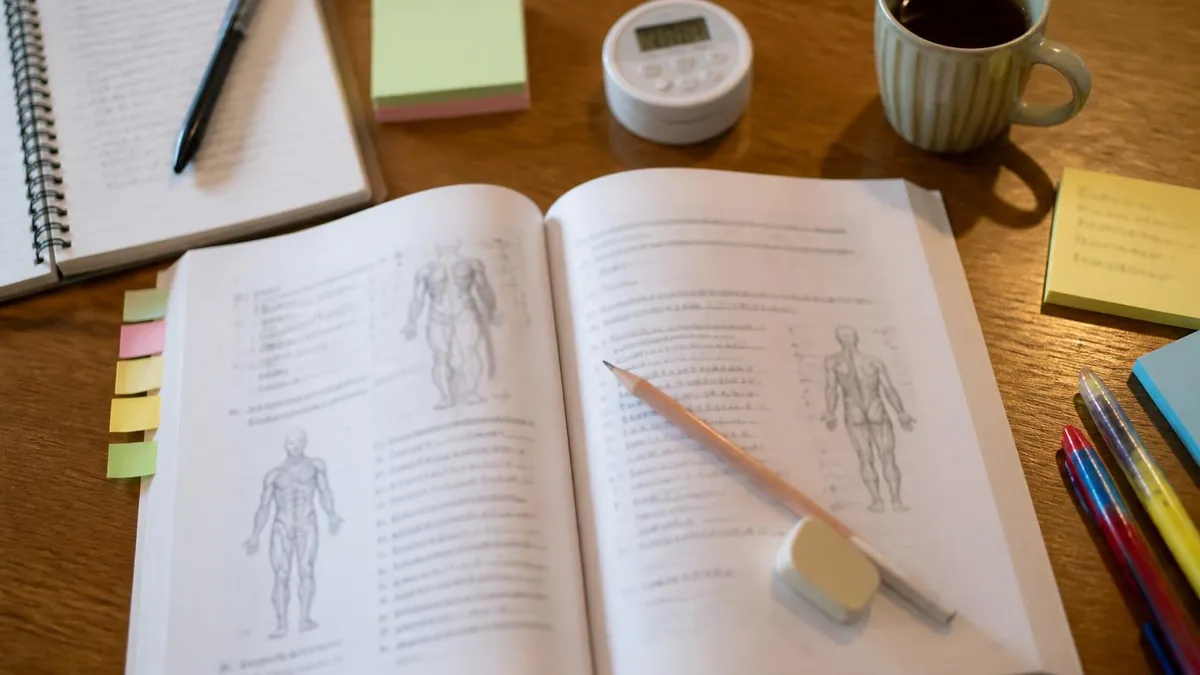
Effective study tactics for these domains include drawing muscle origin-insertion diagrams from memory and then checking your work against an atlas. Flashcard apps work well for memorizing nerve plexuses and muscle innervations. Time yourself answering ten anatomy questions per session to simulate real exam pacing. Candidates who practice active recall rather than passive re-reading consistently retain this material longer and score higher on the mblex practice test when these domains appear.
Pearson VUE Testing: Advantages and Drawbacks for MBLEx Candidates
- +Hundreds of test center locations nationwide offer flexible scheduling options close to home
- +Immediate unofficial pass/fail result delivered on-screen the moment you finish the exam
- +Biometric security protocols prevent impersonation and protect the integrity of your credential
- +Computer-based format with adjustable font size and built-in timer helps manage pacing during the two-hour test
- +Online rescheduling portal allows date changes up to 24 hours before your appointment without a fee
- +Noise-canceling headphones available at all centers to reduce distraction from other test-takers
- −Test center environment can feel high-pressure, especially for candidates with testing anxiety
- −$195 exam fee plus any state licensure fees creates a significant upfront financial burden
- −ATT eligibility windows (commonly 90-180 days) create time pressure to schedule and prepare quickly
- −No scratch paper provided — candidates use an erasable board, which some find uncomfortable for complex calculations
- −Official score reports with domain breakdowns take 24-48 hours after testing, extending the wait for nervous candidates
- −Test center availability in rural areas can be limited, requiring long drives for some candidates
MBLEx Test Prep Checklist: 10 Steps Before Exam Day
- ✓Download the official FSMTB Content Outline and highlight the weight percentage for each of the six domains.
- ✓Complete at least three full-length timed mblex practice test sessions under realistic exam conditions.
- ✓Review your diagnostic score breakdowns after each practice exam and rank domains from weakest to strongest.
- ✓Create a daily study schedule that allocates proportionally more hours to your lowest-scoring domains.
- ✓Memorize the major muscle origins, insertions, and primary actions for the shoulder, hip, knee, and spine.
- ✓Build a pathology flashcard deck covering at least 40 common conditions with their massage contraindications.
- ✓Read the FSMTB Code of Ethics and your state board's professional practice standards in their entirety.
- ✓Confirm your two government-issued IDs and verify your name matches your FSMTB account exactly.
- ✓Drive or map your route to the Pearson VUE test center at least three days before your appointment.
- ✓Complete a final light review session the evening before your exam, then get a full eight hours of sleep.

Passive Reading Alone Will Not Pass the MBLEx
Candidates who rely exclusively on textbook reading without completing timed mblex practice test sessions fail at a significantly higher rate than those who combine active recall with practice questions. The MBLEx is designed to test applied clinical reasoning, meaning you must demonstrate how to use knowledge in client scenarios — not just recite it. Aim for at least 500 practice questions across all domains before your exam date.
Walking into a Pearson VUE test center for the first time can feel intimidating, but knowing exactly what to expect removes the uncertainty and lets you direct all of your mental energy toward the exam itself. Arrive at least 30 minutes before your scheduled appointment time. This buffer allows you to complete the check-in process, store your belongings, submit to biometric verification, and get seated without feeling rushed. Arriving late — even by five minutes — can result in forfeiture of your appointment and loss of your exam fee, so plan your route carefully and account for traffic.
The check-in process at Pearson VUE is thorough. A test center administrator will verify your two forms of ID, photograph you, and collect a palm-vein or fingerprint scan that is matched each time you enter and exit the testing room. You will be given a laminated erasable board and a marker for any calculations or notes during the exam. All personal items, including your phone, watch, wallet, and keys, must be secured in a provided locker before you enter the testing area.
Once seated at your workstation, you will complete a brief on-screen tutorial that demonstrates how to navigate the exam interface — how to flag questions for review, how to move forward and back between items, and how to access the timer. This tutorial does not count against your two-hour exam time, so take the full tutorial even if you feel comfortable with computers. Use those minutes to settle your breathing, adjust your chair, and put on the available headphones if background noise bothers you.
The 125-question exam includes up to 25 unscored pretest items that Pearson VUE uses to evaluate new questions for future exams. You will not know which questions are scored and which are pretest items, so treat every single question with equal attention and effort. Time management is critical: with 125 questions in 120 minutes, you have approximately 57 seconds per question. Most candidates find they can complete the exam in 75 to 90 minutes, which leaves a comfortable buffer for reviewing flagged items before submitting.
A common test-day strategy is the two-pass approach. On the first pass, answer every question you feel confident about immediately and flag any question where you are uncertain or need more time. On the second pass, return to flagged questions and work through them more deliberately. Research on multiple-choice exam performance consistently shows that your first instinct is correct more often than not — change a flagged answer only when you have a specific, logical reason to do so, not simply because the second option feels safer in the moment.
After submitting your exam, you will complete a brief Pearson survey before your result appears on the screen. The result is displayed as "Pass" or "Fail" with no numerical score shown at the testing center. If you pass, take a moment to appreciate the milestone — you have cleared one of the most significant hurdles in your massage therapy career. If you receive a fail result, resist the urge to make snap judgments about what went wrong.
Wait for the official score report with domain breakdowns, which provides the diagnostic data you need to build a more targeted plan for your next attempt. Remember that the national first-time pass rate is approximately 54 percent, and many highly competent therapists ultimately earn their license on a second or third attempt with better-directed preparation.
Ergonomics and physical comfort also deserve attention on exam day. The testing room is typically kept cool — bring a light layer if you tend to feel cold under air conditioning. Do not consume a heavy meal immediately before the exam, as post-meal drowsiness can impair concentration during the second half of the two-hour session.
Hydrate well the morning of your test, use the restroom before check-in, and remember that you may raise your hand to request a restroom break during the exam, though your timer will continue running while you are out of the room. Small logistical preparations like these are often what separate a calm, focused test experience from a distracted one.
Your Authorization to Test (ATT) issued by the FSMTB has a hard expiration date — typically 90 to 180 days depending on your state. If you do not schedule and complete your MBLEx exam before this window closes, your ATT becomes invalid and you must reapply and pay applicable fees again. Check your ATT letter for the exact expiration date immediately upon receipt and schedule your Pearson VUE appointment within the first two weeks.
For candidates who do not pass the MBLEx on their first attempt, the retake process is well-defined but requires patience and strategic recalibration. The FSMTB mandates a mandatory waiting period between exam attempts — currently set at 30 days after a failed attempt. After three failed attempts within a 12-month period, the FSMTB may require additional remediation steps, such as completing additional coursework hours or obtaining a supervisor's endorsement, before authorizing a fourth attempt. Understanding these rules before you need them reduces stress if you do find yourself in a retake situation.
The most important thing you can do after a failed attempt is study your official diagnostic score report carefully. This report breaks down your performance by domain and shows whether your scores in each area were above average, average, or below average relative to the overall candidate population. Treat this breakdown as a precision roadmap. If your client assessment scores were below average but your anatomy scores were strong, shifting 60 to 70 percent of your remaining study time toward client assessment scenarios will yield the greatest improvement on your next attempt.
Working with a mblex tutor is one of the most effective accelerators for retake candidates. A qualified tutor can identify not just which content areas you are missing, but also flawed reasoning patterns that cause you to choose plausible-but-incorrect answers on scenario-based questions. Many candidates fail not because they lack content knowledge but because they misapply what they know under the pressure of exam formatting. A tutor who is experienced with the MBLEx can model the precise reasoning process that high-scoring answers require and help you internalize it through guided practice before your next Pearson appointment.
Free mblex practice exam resources available online can supplement paid tutoring without significant additional financial burden. Platforms like PracticeTestGeeks offer question banks organized by content domain, allowing you to drill specifically on pathology, ethics, or kinesiology rather than taking only full-length mixed exams. Using domain-specific practice sets during the first half of your retake preparation and then transitioning to full-length timed exams during the final two weeks gives your brain both the targeted reinforcement and the integrated pacing practice it needs to perform under real exam conditions.
Psychological preparation matters just as much as content review for retake candidates. Many people who fail the MBLEx on a first attempt experience heightened anxiety going into their second test, which impairs working memory and slows processing speed during the exam — exactly the opposite of what you need. Establish a pre-exam routine that includes light exercise, adequate sleep in the days leading up to the test, and brief mindfulness or breathing exercises on the morning of your appointment. Anxiety is manageable when you have a concrete protocol for addressing it rather than simply hoping the feeling goes away.
Consider using the mblex test prep download free resources available through your massage school alumni network or through professional associations like the American Massage Therapy Association (AMTA). Many schools provide alumni access to additional practice question banks and updated content reviews specifically aligned with the current FSMTB content outline. These materials are often more current and content-accurate than generic test prep materials because they are maintained by educators with direct knowledge of the exam domains. Always verify that any free resource you use references the most current content outline version, as the FSMTB updates the exam blueprint periodically.
Finally, remember that passing the MBLEx is the beginning of your professional journey, not the summit. Every study hour you invest in truly understanding anatomy, pathology, and ethical practice builds the clinical competence that your future clients will trust with their health and well-being.
The most successful massage therapists approach the MBLEx not as a hoop to jump through but as a genuine calibration of their readiness to serve. That mindset shift — from test survival to professional development — often makes the difference between a candidate who barely scrapes by and one who passes confidently and enters practice with real knowledge depth that shows in every session.
Building an effective daily study routine in the weeks before your Pearson MBLEx appointment requires more than good intentions — it requires a structured schedule that balances content review with active practice and adequate recovery. The most productive study blocks for most candidates run 45 to 90 minutes, followed by a short break. Attempting to study for four or five consecutive hours tends to produce diminishing returns after the first 90 minutes as cognitive fatigue sets in and retention drops sharply. Shorter, high-quality sessions spaced across the day are significantly more effective than marathon cramming.
Start each study session with a brief retrieval practice exercise: write down everything you can remember about the topic you studied in your previous session before opening any notes or study materials. This deliberate retrieval strengthens memory consolidation more powerfully than re-reading alone. Then spend the first 20 to 30 minutes of each session on active review of targeted content, followed by 30 to 45 minutes of mblex practice test questions in that domain. Finish each session by reviewing every question you got wrong — not just noting the correct answer, but understanding precisely why the wrong answers were wrong.
Group study sessions can be valuable but require careful structure to avoid becoming unfocused social gatherings. Effective group study for the mblex exam works best when participants take turns quizzing each other from flashcard decks, discuss the reasoning behind specific answer choices on practice questions, or role-play client scenarios to test pathology and ethics knowledge in a conversational format. Passive group reading or video watching together is rarely as productive as these interactive formats. Limit group sessions to 90 minutes and always set a specific content agenda before meeting.
Your final week before the Pearson MBLEx appointment should look different from your earlier preparation weeks. Avoid introducing new material in the last five to seven days before your exam — new information introduced too close to test day is poorly consolidated and can actually interfere with better-established memories.
Instead, focus entirely on review and confidence-building through practice questions you have already seen, light re-reading of content summaries, and one final full-length timed practice exam approximately three days before your appointment. This final simulation tells you your current readiness level and highlights any last-minute gaps while still leaving you time to address them.
Sleep is perhaps the most underrated mblex test prep tool. Sleep is when your brain consolidates the day's learning into long-term memory, and even one night of poor sleep significantly impairs working memory, processing speed, and decision-making on the following day. Prioritize seven to nine hours of quality sleep throughout your entire preparation period, and absolutely protect your sleep in the 48 hours before your exam. Candidates who sacrifice sleep to squeeze in extra study hours in the final days before their appointment routinely underperform relative to their practice test scores — the inverse of what they intended.
Nutrition and physical movement also influence cognitive performance in ways that matter for a two-hour exam requiring sustained concentration. Regular aerobic exercise during your preparation period has been shown to improve memory consolidation and reduce anxiety, both of which directly benefit MBLEx performance. Even 20 to 30 minutes of walking or light exercise daily can produce meaningful cognitive benefits. On exam morning, eat a balanced meal containing protein and complex carbohydrates at least 90 minutes before your scheduled appointment time to ensure stable blood sugar throughout the exam without the discomfort of a full stomach.
Technology-based study tools have become increasingly powerful for MBLEx candidates in recent years. Adaptive question banks that track your performance domain by domain and automatically serve you more questions in your weakest areas are particularly valuable because they approximate the efficiency of personalized tutoring at a fraction of the cost. Spaced repetition flashcard systems like Anki are ideal for high-density memorization tasks like muscle anatomy and pathology conditions. Combining these digital tools with a strong core mblex study guide gives you a comprehensive preparation ecosystem that addresses both breadth of content and depth of understanding across all six exam domains.
Mblex Questions and Answers

MBLEx Test Price: Complete Guide to MBLEx Exam Costs, Fees & Financial Prep

MBLEx Study Guide Free PDF: Complete Test Prep & Practice Resources for 2026

Best MBLEx Study Guide: Complete MBLEx Test Prep for 2026

MBLEx Pocket Prep: The Complete Guide to MBLEx Practice Tests and Study Apps

MBLEx Practice Test Questions: Free MBLEx Practice Exam Questions for 2026
About the Author

Board Certified Massage Therapist & MBLEx Exam Specialist
Pacific College of Health and ScienceChristine Lee is a Board Certified Therapeutic Massage and Bodywork professional (BCTMB) and Licensed Massage Therapist with a Bachelor of Science in Massage Therapy from Pacific College of Health and Science. With 14 years of clinical practice and exam coaching experience, she specializes in helping massage therapy graduates pass the MBLEx, NCBTMB, and state massage therapy licensing examinations.
Join the Discussion
Connect with other students preparing for this exam. Share tips, ask questions, and get advice from people who have been there.
View discussion (6 replies)