
Reviews for MD Exam: What Is LTO and How to Ace Your Driver's License Test in 2026 October
What is LTO? Get top reviews for MD exam prep, study tips, and free practice tests to pass your LTO driver's license exam in 2026 October. 📚
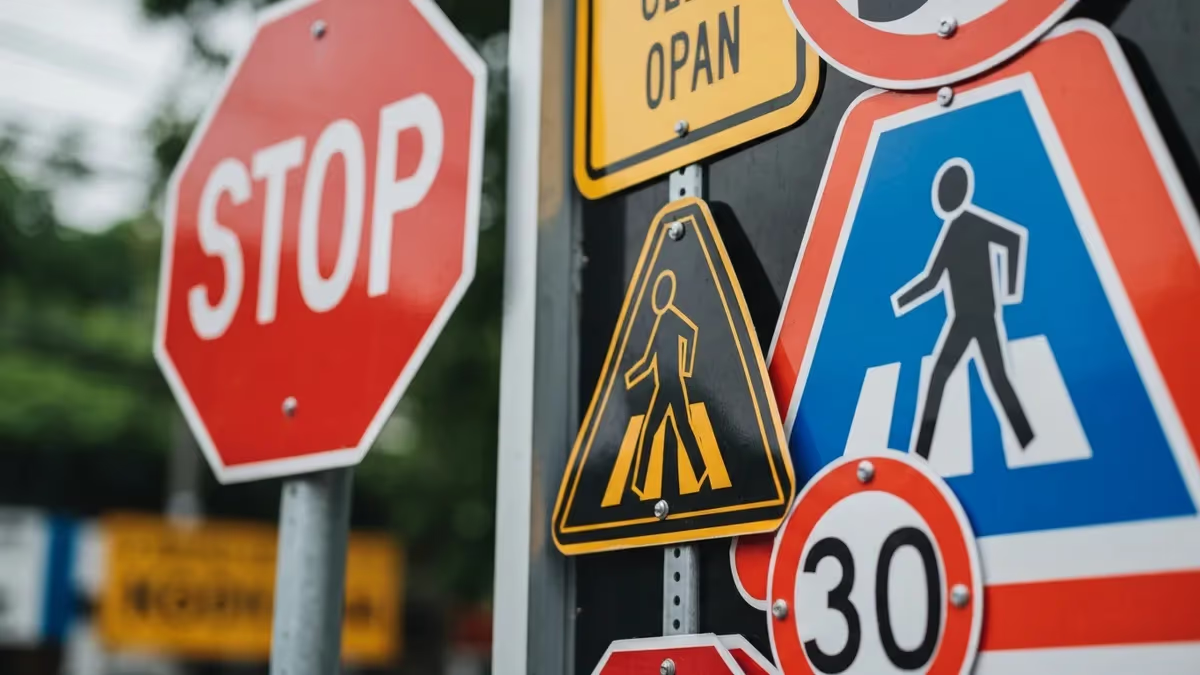
If you have been searching for reliable reviews for MD exam preparation, you are not alone. Thousands of Filipino drivers and new license applicants ask every year: what is LTO, what does LTO stand for, and how do the written exams actually work? The Land Transportation Office — commonly abbreviated as LTO — is the Philippine government agency responsible for regulating land transportation, issuing driver's licenses, and enforcing road safety standards across the country. Understanding how LTO operates is the essential first step before you sit for any license examination.
The term LTO stands for Land Transportation Office, a bureau under the Department of Transportation (DOTr) in the Philippines. When people ask what does LTO mean in the context of everyday life, the answer goes beyond bureaucracy: LTO is the agency that literally decides whether you are qualified to operate a motor vehicle on public roads. From student permits to professional driver's licenses, every stage of the licensing journey passes through LTO's examination and accreditation processes, making solid exam reviews an indispensable part of your preparation toolkit.
Many applicants also wonder what is an LTO exam and how it differs from other standardized tests they may have taken in school. The LTO written exam is a multiple-choice test covering traffic laws, road signs, defensive driving techniques, driver duties and responsibilities, and traffic violation penalties. The questions are drawn from the Republic Act 4136 (Land Transportation and Traffic Code) and the guidelines issued by the Land Transportation Office itself. Knowing the source material is half the battle — the other half is consistent, targeted review using quality study resources.
One common point of confusion among first-time test-takers is the difference between reviewing for the MD (Motor Driver) exam versus other license categories. In LTO terminology, MD refers to licenses issued to drivers of motorcycles and other light vehicles. A comprehensive review for the MD exam covers the same core subject areas as other categories but places particular emphasis on motorcycle safety, two-wheeled vehicle regulations, and specific road-sharing rules that apply to motorcyclists navigating Philippine highways and urban streets.
Effective review for the MD exam requires more than simply memorizing answers. You need to understand the reasoning behind each traffic rule so that you can apply it correctly even when a question is phrased in an unfamiliar way. This is why experienced reviewers recommend studying the actual text of RA 4136 alongside practice questions, rather than relying solely on question banks. Context-based understanding consistently outperforms rote memorization when it comes to LTO exam performance and long-term road safety awareness.
For anyone wondering whether is princeton review harder than real ap exam comparisons translate to the LTO context, the answer is nuanced. LTO practice tests from reputable review sites tend to mirror the real exam closely in format and difficulty level, especially when the questions are sourced from official LTO reviewer materials. The goal of this article is to give you a thorough, accurate, and actionable guide to the best MD exam reviews available, what to expect on test day, and exactly how to structure your preparation for maximum success.
Throughout this guide you will find practical strategies, study schedules, key topic breakdowns, and curated free practice quizzes designed specifically for LTO exam candidates. Whether you are a first-time applicant, a license renewal candidate brushing up on the rules, or someone who failed a previous attempt and is determined to pass this time, the information here will give you a clear, confident path forward. Let us start by understanding the numbers behind the LTO exam so you know exactly what you are preparing for.
LTO MD Exam by the Numbers
Key Facts at a Glance
| Item | Value | Details |
|---|---|---|
| Total Exam Questions | 40 | Multiple choice format |
| Passing Score | 30/40 | 75% correct required |
| Time Limit | 40 min | Approx. 1 min per question |
| Retake Attempts Allowed | 3x | Before re-enrollment required |

LTO MD Exam Format Breakdown
| Section | Questions | Time | Weight | Notes |
|---|---|---|---|---|
| Traffic Laws and Regulations | 10 | 10 min | 25% | RA 4136 and MMDA rules |
| Road Signs and Pavement Markings | 10 | 10 min | 25% | Warning, regulatory, informational signs |
| Driver's Duties and Responsibilities | 8 | 8 min | 20% | Safe driving conduct and obligations |
| Defensive Driving and Road Safety | 7 | 7 min | 17.5% | Hazard perception and response |
| Traffic Violations and Penalties | 5 | 5 min | 12.5% | Fines, demerit points, license sanctions |
| Total | 40 | 40 minutes | 100% |
Choosing the right reviews for MD exam preparation can feel overwhelming given the sheer volume of study materials available online and in bookstores. Not all reviewers are created equal, and using outdated or inaccurate materials is one of the most common reasons candidates underperform on the actual LTO exam. The most reliable reviews are those that are regularly updated to reflect the latest LTO memorandum circulars, that draw directly from RA 4136, and that include detailed answer explanations rather than just answer keys. Explanation-based reviewing builds genuine understanding, which translates directly to better exam performance.
When evaluating an MD exam reviewer, look for several quality indicators. First, check whether the reviewer explicitly cites its source material — reputable resources will reference RA 4136, LTO administrative orders, and the MMDA traffic regulations that apply in Metro Manila and urban zones. Second, verify that the road sign images used in the reviewer match the actual Philippine standard signs, not generic international ones. Third, assess whether the reviewer covers motorcycle-specific regulations such as mandatory helmet use, lane-splitting rules, and the restrictions on expressway use for small-displacement motorcycles.
Online review platforms have become the dominant format for LTO exam preparation, and for good reason. Digital reviewers allow you to simulate timed test conditions, track your performance by topic area, and revisit questions you got wrong without flipping through hundreds of pages. The best platforms generate randomized question sets so that you are not simply memorizing question order but actually learning the underlying rules. Free practice quizzes on sites like PracticeTestGeeks give you immediate feedback and allow you to identify weak areas before you sit for the real exam at an LTO testing center.
Some candidates still prefer printed reviewers, and there is genuine value in having a physical book you can annotate and review during commutes or breaks. The LTO Reviewer published by accredited driving schools remains a popular choice, particularly the editions that include color photographs of all official road signs. If you choose a printed reviewer, make sure the edition was published within the last two years to ensure it reflects current penalty schedules and any regulatory updates issued by the Land Transportation Office since the previous edition.
Driving school review classes represent a third option, particularly valuable for candidates who struggle with self-directed study. Accredited driving schools are required by LTO to conduct both theoretical and practical instruction, and their classroom sessions typically cover the exact subject matter tested on the written exam. The structured environment, live Q&A with instructors, and peer learning dynamics make driving school classes especially effective for candidates who found self-study materials confusing or who failed a previous exam attempt and need a more guided approach to their review.
For those wondering about ati testing nursing education nclex exam review teas testing parallels — meaning structured, curriculum-based review programs — the LTO equivalent is the Pre-Driver Education (PDE) course now required for new applicants. The PDE course covers the same content areas as the MD exam and includes a curriculum mandated by the Land Transportation Office, making it both a legal prerequisite and a built-in review program for first-time license applicants. Completing the PDE course seriously, rather than treating it as a formality, gives you a significant head start on your written exam preparation.
Whichever review format you choose, consistency matters more than intensity. Spreading your review over two to three weeks with daily 30-minute sessions produces better retention than cramming everything into a single weekend. Cognitive science research consistently shows that spaced repetition — reviewing material at increasing intervals — dramatically improves long-term recall compared to massed practice. Apply this principle to your LTO MD exam review by revisiting road signs daily, working through a new set of practice questions each session, and spending extra time on the topic areas where your practice test scores are lowest.
LTO Exam Review Methods: What Works Best?
Online practice tests are the most accessible and efficient way to review for the LTO MD exam. They replicate the real exam format with timed, multiple-choice questions drawn from the same subject areas tested by the Land Transportation Office. The best platforms randomize questions from large question banks, preventing you from memorizing item order rather than learning the actual rules. Immediate feedback after each answer helps you correct misconceptions before they become ingrained habits that could cost you points on exam day.
The practical advantage of online reviewing is the ability to track your progress by topic area. If your scores on road signs questions are consistently lower than your scores on traffic violations, you can allocate more study time accordingly. Many platforms also allow you to create custom quiz sets focused on your weakest areas, making your preparation targeted and efficient. Aim to complete at least five full-length 40-question practice tests under timed conditions before your scheduled LTO exam appointment, and ensure your average score exceeds 85% to give yourself a comfortable buffer above the 75% passing threshold.

LTO MD Exam Online Review: Pros and Cons
- +Immediate feedback after each question accelerates learning and corrects mistakes fast
- +Timed practice tests accurately simulate real exam pressure and pacing
- +Topic-based performance tracking reveals weak areas for targeted study
- +Large randomized question banks prevent answer-order memorization
- +Accessible 24/7 on any device, enabling review during commutes or breaks
- +Free platforms like PracticeTestGeeks eliminate cost barriers to quality preparation
- −Screen fatigue can reduce focus during long study sessions
- −Internet connectivity issues may interrupt timed practice sessions
- −Some free platforms use outdated or inaccurate question banks not aligned with current LTO rules
- −Lacks the tactile annotation benefits of printed study materials
- −No live instructor to clarify confusing questions or resolve regulatory ambiguities
- −Can create false confidence if the platform's questions are significantly easier than the real LTO exam
MD Exam Preparation Checklist: 10 Steps Before Test Day
- ✓Obtain a copy of Republic Act 4136 and read the core provisions on traffic rules and penalties
- ✓Complete the LTO-mandated Pre-Driver Education (PDE) course at an accredited driving school
- ✓Take an initial diagnostic practice test to identify your weakest subject areas
- ✓Study all official Philippine road signs in color, including warning, regulatory, and informational categories
- ✓Review the complete schedule of LTO traffic violation fines and demerit point penalties
- ✓Complete at least five full 40-question timed practice exams under realistic test conditions
- ✓Score consistently above 85% on practice tests before scheduling your official LTO appointment
- ✓Prepare all required documents: valid ID, recent passport-size photos, and medical certificate
- ✓Confirm your LTO testing center appointment online to avoid long walk-in queues
- ✓Get adequate sleep the night before and arrive at the testing center at least 30 minutes early

75% Is the Passing Threshold — But Aim for 90%
The LTO written exam requires a minimum score of 30 out of 40 questions correct, which equals exactly 75%. However, experienced review instructors consistently advise candidates to target 90% or higher on practice tests before exam day. This buffer accounts for unfamiliar question phrasings, test anxiety, and the small percentage of items on the real exam that may cover edge-case scenarios not prominently featured in standard reviewers. Aiming higher on practice tests virtually guarantees you will clear the passing threshold comfortably when it counts.
Understanding the core topics covered by any credible MD exam review is essential for allocating your study time effectively. The LTO written exam draws questions from five main subject areas, and each area requires a distinct approach. Traffic laws and regulations — the largest topic block — demand that you understand not just the rules themselves but the reasoning behind them, so that you can apply principles correctly to scenario-based questions that describe specific road situations rather than asking you to recite statutes verbatim.
Road signs and pavement markings represent the most visually intensive portion of the LTO exam review, and they are also the area where many candidates underestimate the preparation required. The Philippines uses a standardized set of signs derived from the Vienna Convention on Road Signs and Signals, but there are local variations and additional signs specific to Philippine road conditions.
Regulatory signs — which use red borders and white backgrounds — carry the highest legal weight because they define mandatory behavior. Warning signs use yellow diamonds to alert drivers to hazards ahead. Informational signs in blue or green provide guidance on destinations, distances, and services. Knowing these categories instinctively, not just conceptually, is what the exam tests.
Driver's duties and responsibilities is a subject area that often trips up candidates who assume it is simply common sense. LTO exam questions on this topic probe specific legal obligations: what a driver must do after a road accident, the proper procedure for yielding at uncontrolled intersections, the responsibilities of drivers toward pedestrians in crosswalks, and the specific duties that apply when operating a motorcycle as opposed to a four-wheeled vehicle. The answers to these questions are defined by law, not personal judgment, which is why reviewing the actual text of RA 4136 alongside practice questions is so important.
Defensive driving and road safety questions assess your ability to apply proactive hazard management principles rather than simply reactive rule-following. Common question types include: identifying the safest following distance at various speeds, determining the correct course of action when approaching a slippery road surface, understanding the concept of the two-second rule for maintaining safe spacing, and recognizing the warning signs of driver fatigue. These questions reward candidates who have not only memorized rules but have internalized the underlying logic of safe driving behavior — exactly the kind of understanding that good MD exam reviews are designed to build.
Traffic violations and penalties may seem like a simple memorization task, but the LTO exam approach to this topic is more nuanced. Questions frequently present scenarios where multiple violations occur simultaneously and ask you to identify the correct penalty or the sequence of consequences. Understanding how the demerit point system works, which violations trigger automatic license suspension versus a fine, and how repeat offenses escalate consequences is essential for answering these questions correctly. The penalty schedule is updated periodically, so always verify that your reviewer reflects the current fine amounts issued by the most recent LTO administrative orders.
One area that dedicated MD exam reviewers cover more thoroughly than general LTO reviewers is motorcycle-specific legislation. The Anti-Drunk and Drugged Driving Act (RA 10586) applies to all vehicle operators including motorcyclists, and several exam questions specifically address blood alcohol concentration limits, sobriety test procedures, and the penalties for operating any motor vehicle while impaired. Similarly, the Motorcycle Helmet Act and its implementing rules and regulations are frequently tested, covering not just the requirement to wear helmets but the specific standards helmets must meet to be considered legally compliant under Philippine transportation law.
Finally, understanding what does LTO mean in the context of the broader transportation regulatory environment gives your exam preparation important context. LTO does not operate in isolation — it coordinates with the MMDA in Metro Manila, with local government units on municipal traffic ordinances, and with the DOTr on national transportation policy. Questions that reference MMDA traffic schemes, coding regulations, or local ordinances require you to understand the layered regulatory structure that governs Philippine roads. A thorough MD exam review will address this regulatory landscape explicitly, helping you answer jurisdiction-based questions that sometimes catch unprepared candidates off guard.
As of 2025, the Land Transportation Office requires all new applicants and renewal candidates to book an appointment through the official LTO Online Appointment System (LOAS) before visiting any testing center. Walk-in transactions are extremely limited and often unavailable at high-traffic LTO offices. Book your appointment at least two to three weeks in advance, especially in Metro Manila and other urban centers where appointment slots fill up quickly. Arriving without a confirmed appointment may result in being turned away and losing your exam preparation momentum.
Passing your LTO MD exam on the first attempt is an achievable goal for any candidate who approaches preparation strategically, and test-day performance is where all your review work either pays off or falls short. One of the most common mistakes examinees make is rushing through the exam in an attempt to finish quickly. With 40 minutes for 40 questions, you have approximately one minute per question — enough time to read each item carefully, eliminate obviously wrong answer choices, and select the best response without feeling rushed. Pacing yourself calmly and methodically consistently outperforms anxious speed-reading.
When you encounter a question you are not immediately sure about, use process of elimination rather than guessing randomly. LTO exam questions typically include two clearly incorrect answer choices and two plausible-sounding options. Eliminating the obviously wrong answers first narrows your decision to a 50-50 choice at worst, dramatically improving your odds compared to a random four-option guess. After eliminating the distractors, apply the rule or principle you studied that is most directly relevant to the scenario described in the question stem, then commit to your answer and move on.
Many candidates lose unnecessary points on road sign questions because they second-guess their initial recognition. Your visual memory for road signs is actually quite reliable after adequate review — if a sign looks familiar and your gut identifies it correctly, trust that instinct. Where candidates go wrong is when they override an accurate initial recognition with overthought analysis. Practice enough road sign questions during your review that recognition becomes automatic, and you will find that the exam's road sign items take less time and mental energy than any other section.
For motorcycle-specific questions on the MD exam, remember that the correct answers almost always prioritize safety over convenience or speed. When a question presents a scenario where a motorcyclist must choose between a faster but riskier action and a slower but safer one, the LTO exam will virtually always select the safer option as correct. This heuristic is particularly useful on questions about lane positioning, overtaking maneuvers, and responses to road hazards where the safest course of action might feel overly cautious in real-world riding conditions but is legally and formally correct by LTO standards.
After completing your practice review sessions, it is worth spending time understanding the consequences of failing the LTO exam so that you remain appropriately motivated. Candidates who fail the written exam on their first attempt are allowed to retake it, but repeated failures trigger additional requirements including potential re-enrollment in the PDE course and extended waiting periods before a new exam attempt is permitted.
For haven life no medical exam life insurance reviews parallels, just as some insurance applications require additional documentation after initial denial, failed LTO exam attempts require additional steps that delay your licensing timeline by weeks or months.
Candidates who approach the LTO MD exam with a structured review plan, consistent practice, and a clear understanding of the exam format pass at significantly higher rates than those who rely on last-minute cramming or outdated materials. The investment you make in thorough preparation is not just about passing a test — it is about becoming a genuinely knowledgeable, safer driver who understands the rules of Philippine roads at a level that protects both you and every other road user you share the highway with. That broader purpose gives your exam review meaningful stakes beyond simply obtaining a laminated card.
Understanding what does exam review not performed mean in the LTO context is also relevant for renewal applicants. In some cases, LTO records may indicate that a written examination review was not completed or was not entered into the system, which can create complications during license renewal processing. If you encounter this notation on your LTO records, visit the LTO office that originally processed your license with your original exam documentation to have the records corrected before your renewal appointment. Proactive records management prevents this administrative issue from becoming a barrier to timely license renewal.
The final phase of your MD exam preparation should shift from broad content review to focused test-taking strategy refinement. By the week before your scheduled LTO exam, you should have completed enough full-length practice tests to feel genuinely confident in your knowledge. At this point, rather than introducing new review materials, focus on reinforcing your strongest areas and doing final targeted review of any remaining weak spots identified by your practice test performance data. Introducing entirely new materials in the final days before the exam can introduce unnecessary confusion and undermine the confidence you have built through consistent preparation.
Sleep and nutrition have a surprisingly significant impact on standardized test performance, including the LTO written exam. Research on cognitive performance consistently shows that candidates who get seven to eight hours of sleep in the nights leading up to an exam perform measurably better than sleep-deprived candidates with equivalent knowledge levels. The night before your LTO exam, avoid late-night cramming sessions and instead do a brief 20-minute review of road signs and key traffic rules before getting to bed at your normal time. A well-rested mind processes multiple-choice questions more accurately and recalls studied material more reliably under pressure.
On the morning of your LTO exam appointment, arrive at the testing center at least 30 minutes before your scheduled time. Use this buffer to complete any administrative processing — document verification, biometric capture, and fee payment — without feeling rushed. Rushing through administrative steps before the exam creates anxiety that can negatively affect your performance during the actual test.
Bring all required documents in a folder: your birth certificate or valid government ID, your medical certificate from an accredited clinic, your Pre-Driver Education certificate, and your appointment confirmation. Missing any of these documents will result in your appointment being rescheduled, wasting all your preparation effort.
During the exam itself, read every question completely before looking at the answer choices. Many candidates make avoidable errors by reading only part of a question and selecting an answer that would be correct for a different scenario. LTO exam questions are carefully worded, and a single qualifier — words like "never," "always," "except," or "only" — can completely change which answer is correct. Full, careful reading of every question stem is one of the simplest and most impactful habits you can develop during your practice test sessions and apply on exam day.
After completing the exam, the LTO testing system typically scores your result immediately and displays your pass or fail status on screen. If you pass, you will proceed to the next steps in the licensing process: payment of licensing fees, biometric data capture, and submission of your photo and signature.
The actual license card may be released on the same day at some offices or mailed to your registered address within a specified period depending on current LTO operational procedures. Always request and keep the temporary license document issued on exam day as proof of your licensed status while the physical card is being processed.
For candidates who do not pass on their first attempt, it is important to approach the experience constructively rather than with discouragement. Request your exam results breakdown if available — some LTO offices can provide information on which subject areas you scored poorly in — and use that information to restructure your review strategy for the retake.
Failed attempts are genuinely informative: they reveal exactly where your preparation was insufficient and give you a clear roadmap for improvement. Most candidates who fail the first attempt and then follow a structured remedial review plan pass on their second attempt with a significantly higher score.
The knowledge you build through thorough LTO MD exam reviews is not just a means to passing a test — it is practical road safety knowledge that you will use every day you operate a motor vehicle. Understanding traffic laws, recognizing road signs instantly, knowing your duties to other road users, and being able to identify and avoid hazardous driving scenarios are skills that protect lives.
The Philippines has one of the highest road accident rates in Southeast Asia, and every well-prepared, well-informed driver who passes the LTO exam and applies that knowledge responsibly on the road contributes in a real, measurable way to making Philippine roads safer for everyone.
Sample LTO - Exam Reviewer Practice Questions
Try these questions from our free LTO - Exam Reviewer practice tests. The correct answer and an explanation follow each question.
What does Restriction Code 1 on a Philippine driver's license indicate?
- A. Driver may operate vehicles with manual transmission only
- B. Driver may operate vehicles with automatic transmission only
- C. Driver may operate motorcycles only
- D. Driver may operate all vehicle types
Answer: B. Driver may operate vehicles with automatic transmission only
Restriction Code 1 means the driver is restricted to vehicles with automatic transmission only.
Under the Anti-Drunk and Drugged Driving Act (RA 10586), what blood alcohol concentration (BAC) level triggers automatic suspension of a professional driver's license?
- A. 0.05%
- B. 0.08%
- C. 0.10%
- D. 0.15%
Answer: A. 0.05%
Professional drivers face license suspension at a BAC of 0.05%, half the 0.10% threshold applied to non-professional drivers.
Which agency in a U.S. state is most commonly responsible for issuing driver's licenses?
- A. The Federal Highway Administration (FHWA)
- B. The Department of Motor Vehicles (DMV) or equivalent
- C. The National Highway Traffic Safety Administration (NHTSA)
- D. The state's Department of Transportation (DOT)
Answer: B. The Department of Motor Vehicles (DMV) or equivalent
Driver's licenses are issued by state-level agencies, most commonly called the DMV, though names vary by state.
A driver is caught driving with a license that expired 3 years ago. Under RA 4136, this is classified as:
- A. A minor violation
- B. Driving without a license
- C. A correctable violation
- D. A warning offense
Answer: B. Driving without a license
An expired license beyond the grace period is treated as driving without a license, a serious violation.
LTO Questions and Answers

LTO License Renewal Guide Philippines 2026 — Requirements and Process
LTO Traffic Violations Philippines 2026 — Fines and Penalties Guide

LTO Plate Number Tracker: What Is LTO, What Does LTO Stand For, and How to Track Your Vehicle Registration in 2026

FE Exam Review Course: What Is LTO and How to Pass Your Driver's License Exam in 2026

VA Exam Review: Complete LTO Driver's License Exam Guide for 2026
About the Author

Educational Psychologist & Academic Test Preparation Expert
Columbia University Teachers CollegeDr. Lisa Patel holds a Doctorate in Education from Columbia University Teachers College and has spent 17 years researching standardized test design and academic assessment. She has developed preparation programs for SAT, ACT, GRE, LSAT, UCAT, and numerous professional licensing exams, helping students of all backgrounds achieve their target scores.
Join the Discussion
Connect with other students preparing for this exam. Share tips, ask questions, and get advice from people who have been there.
View discussion (8 replies)