
LTO Meaning: What the Land Transportation Office Does 2026 September
LTO stands for Land Transportation Office — 💯 the Philippine agency that issues driver's licences, registers vehicles, and enforces road safety laws.
What Is LTO?
LTO stands for Land Transportation Office — the Philippine government agency responsible for regulating land transportation in the Philippines. The LTO is an attached agency of the Department of Transportation (DOTr) and holds authority over the registration of motor vehicles, the licensing of drivers, and the enforcement of the country's traffic laws and land transportation policies. Every motor vehicle legally operating on Philippine roads must be registered with the LTO, and every licensed driver in the Philippines holds an LTO-issued licence.
The LTO was formally established under Republic Act 4136 (the Land Transportation and Traffic Code of 1964) and has been reorganised and expanded several times since. Today it operates over 600 offices nationwide — district offices, extension offices, and satellite offices — and serves millions of Filipinos seeking driver's licences, vehicle registrations, and related transactions annually. The agency's mandate covers both private and commercial vehicles across all categories: motorcycles, private cars, public utility vehicles (jeepneys, buses, UV Express), and trucks.
In everyday usage, Filipinos say 'LTO' to refer to any transaction related to vehicle registration or driver licensing — 'I'm going to the LTO' means visiting an LTO district office to process a registration renewal, apply for a new licence, or handle a related transaction. Understanding what the LTO does and what it requires helps drivers navigate the requirements for getting and keeping a valid Philippine driver's licence.
The LTO has undergone significant modernisation efforts in recent years, driven by the government's mandate to reduce corruption, improve service delivery, and digitise government transactions. These reforms include the shift to computer-based testing at many district offices, the rollout of the LTO Online Portal for digital transactions, integration of biometric data into licence cards, and the Motor Vehicle Inspection System (MVIS) for standardised vehicle roadworthiness assessments.
Despite these improvements, the agency still faces challenges including processing backlogs for plate releases, long queues at high-volume district offices during peak periods, and regional disparities in service availability. Drivers in metropolitan areas typically have more transaction options — including accredited testing centres and satellite offices — than those in more remote provincial areas and rural regions.
The LTO works alongside other agencies in the land transportation ecosystem. The Metropolitan Manila Development Authority (MMDA) enforces traffic rules in Metro Manila and administers the Number Coding scheme. The Land Transportation Franchising and Regulatory Board (LTFRB) handles franchises for public utility vehicles. Local government units (LGUs) enforce traffic ordinances on local roads. Understanding which agency handles which function helps drivers direct complaints, inquiries, and violation disputes to the correct body — the LTO handles licensing and registration matters, while the MMDA and LGUs handle local traffic enforcement.
- Full name: Land Transportation Office (Opisina ng Transportasyong Panlupa)
- Parent agency: Department of Transportation (DOTr)
- Legal basis: Republic Act 4136 (Land Transportation and Traffic Code, 1964)
- Key functions: Driver licensing, vehicle registration, road safety enforcement, testing and inspection
- Offices: 600+ district, extension, and satellite offices nationwide
- Online services: LTO Online portal (ltoportal.gov.ph) for renewal, appointment booking, and status verification
- Common transactions: New licence, licence renewal, vehicle registration, registration renewal, plate release, OR/CR replacement
How to Get a Philippine Driver's Licence
Get a Student Permit
Complete a Driving Course (recommended or required for some)
Pass the LTO Examination
Receive Your Non-Professional or Professional Licence
LTO Driver's Licence Types and Categories
The LTO issues different categories of driver's licences based on the type of vehicles the holder is authorised to drive. Understanding licence categories — and the restriction codes that appear on each licence — helps drivers ensure they're legally authorised for the vehicles they operate.
Student Permit (SP) is issued to learner drivers. It authorises driving practice only under the direct supervision of a duly licensed driver seated beside the Student Permit holder. A Student Permit is not a standalone driving licence and does not authorise independent driving.
Non-Professional Driver's Licence authorises driving for personal, non-commercial purposes. The licence card displays restriction codes that specify which vehicle categories the holder can drive — restriction codes 1 and 2 for motorcycles, restriction code 4 for manual transmission passenger vehicles, restriction code 5 for automatic transmission vehicles. Knowing your LTO restriction codes is essential for understanding exactly what your licence authorises and what additional codes you may need to acquire for specific vehicle types.
Professional Driver's Licence authorises driving for hire or compensation — operating taxis, jeepneys, buses, trucks, and other commercial and public utility vehicles. Professional licences require applicants to have held a Non-Professional Licence for at least one year, provide proof of driving experience, and pass additional practical examinations. Professional licence holders can apply for additional restriction codes that expand their authorised vehicle categories as they accumulate experience.
Licence renewal is required every five years. The LTO driver's licence renewal process requires presenting the expiring licence, completing a medical certificate, paying the renewal fee, and (in many cases) taking an abbreviated eye examination at the LTO office. Renewal can now be done through the LTO's Online Renewal System for eligible licence categories, reducing the time spent at district offices. Driving with an expired licence is a traffic violation subject to fines and confiscation of the licence card.
LTO Services and Transactions
All motor vehicles operating on Philippine roads must be registered with the LTO annually. Registration involves presenting the vehicle for inspection (for new registrations) or presenting valid documents (for renewals), paying registration fees and taxes, and obtaining the Official Receipt (OR) and Certificate of Registration (CR). The OR/CR pair is the primary proof of vehicle ownership and registration — losing either requires immediate replacement. Registration renewal follows a schedule based on the last digit of the vehicle's plate number.
The LTO issues motor vehicle number plates after registration. Newly registered vehicles initially operate with conduction stickers while their plates are produced, which can take months to years depending on LTO production and processing backlogs. When plates are ready, the owner collects them at the district office where the vehicle was registered. Plate release has historically been subject to significant delays — checking your plate status through the LTO portal or by visiting your district office is the best way to track availability.
Lost or damaged Official Receipts or Certificates of Registration can be replaced at the LTO district office where the vehicle is registered. Replacement requires an affidavit of loss (for lost documents), a police blotter report (depending on circumstances), payment of replacement fees, and presentation of supporting documentation establishing the vehicle's registration history. Driving without OR/CR or with photocopies is a violation — originals must be carried at all times.
The LTO Online Portal (ltoportal.gov.ph) provides digital access to several transactions including licence renewal appointment booking, vehicle registration renewal for certain categories, licence verification and status checking, and motor vehicle transaction history. The online system reduces physical visits to LTO offices for eligible transactions, though in-person appearance is still required at some steps. Creating an LTO Online account links your transactions to a digital profile for easier future access.
LTO Number Coding and Traffic Enforcement
The LTO Number Coding Scheme (also called the Unified Vehicular Volume Reduction Program, or UVVRP) restricts vehicle use in Metro Manila based on the last digit of the licence plate number to reduce traffic congestion during peak hours:
- Monday: Plates ending in 1 and 2
- Tuesday: Plates ending in 3 and 4
- Wednesday: Plates ending in 5 and 6
- Thursday: Plates ending in 7 and 8
- Friday: Plates ending in 9 and 0
- Saturday and Sunday: No coding in effect (subject to local government variations)
- Hours: Typically 7:00–8:00 AM and 5:00–8:00 PM on major Metro Manila roads — hours and coverage vary by local ordinance
- Exemptions: Emergency vehicles, public utility vehicles, hybrid and electric vehicles (subject to current MMDA and LTO rules), and vehicles with special permits issued for coding day operation
Checking LTO number coding rules is especially important for drivers who have acquired new vehicles with unfamiliar plate numbers — a plate ending in an unexpected digit may create unplanned coding restrictions on specific weekdays.

LTO Examination: What to Expect
The LTO theoretical examination is one of the most-searched topics related to LTO transactions, particularly among first-time licence applicants. Understanding the exam format, content, and requirements removes the uncertainty that makes many applicants anxious about the process.
The LTO theoretical exam covers three main subject areas: knowledge of traffic laws and regulations (drawn from Republic Act 4136 and its implementing rules), recognition and understanding of road signs (warning, regulatory, and informational signs), and safe driving principles including defensive driving concepts, right-of-way rules, and procedures at intersections. The exam is administered at LTO district offices or LTO-accredited Testing Centre Locations (TCLs). Some metropolitan offices have computer-based testing; regional offices may still use paper-based formats.
The exam consists of 40 questions — typically 30 multiple choice and 10 true/false — with a 70% passing score requirement (28 out of 40 correct). Applicants who fail may retake the examination, though a waiting period and additional fees apply. Items on the exam are drawn from the pool of official LTO test questions, which are publicly available and used extensively in LTO practice test preparation materials.
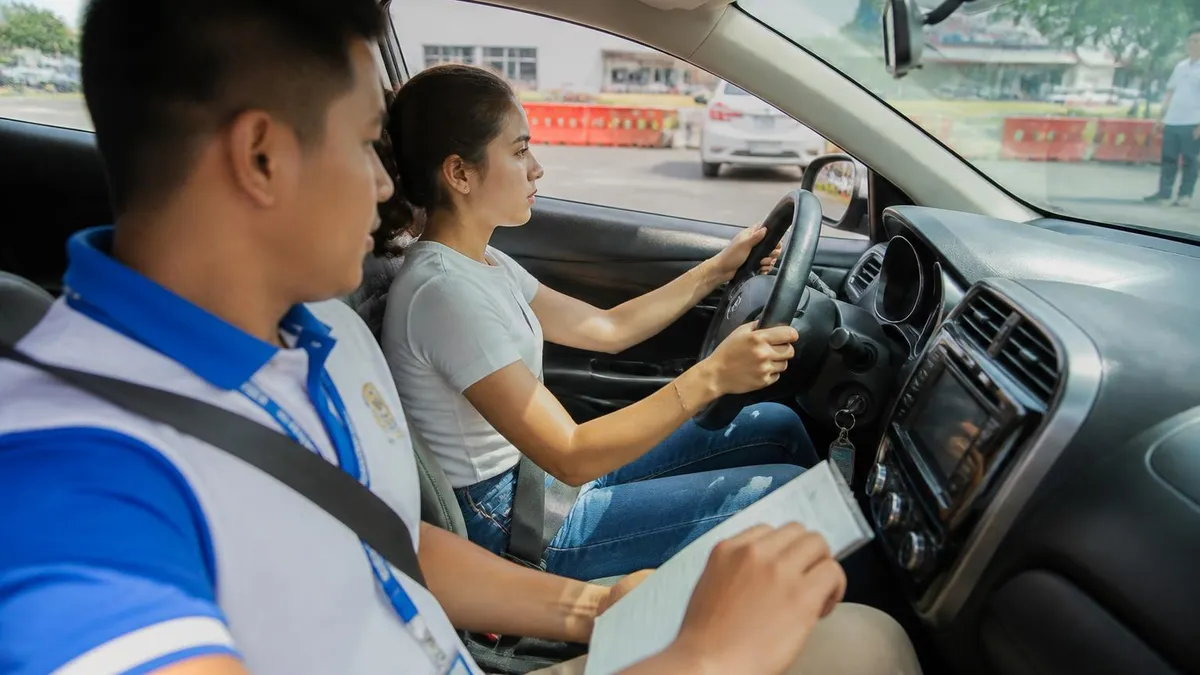
After the written exam, first-time Non-Professional Licence applicants must pass a practical driving test demonstrating basic vehicle control and observation of traffic rules. The practical test covers a standard route designated by each testing location and includes manoeuvres such as parking, lane changes, and intersection navigation. Applicants who fail the practical test may retake it on a separate visit.
For applicants who've held a LTO Student Permit and want to pass on their first attempt, systematic study of LTO practice questions covering all three subject areas is the most reliable preparation strategy. The exam draws from a finite pool of questions, and candidates who have practised extensively with representative questions approach the actual examination with familiarity rather than uncertainty. Many testing centres post current passing rates, and candidate feedback consistently identifies unfamiliarity with specific sign types and RA 4136 provisions as the most common sources of errors.
LTO Transactions: Document Checklist
- ✓Student Permit application: completed form, valid government ID (passport, UMID, PSA birth certificate, or other accepted ID), medical certificate from an LTO-accredited physician
- ✓Non-Professional Licence application: Student Permit, completed application form, medical certificate, drug test result from accredited testing facility, payment of licence fees
- ✓Licence renewal: expiring licence card, medical certificate, eye examination result (conducted at some LTO offices), renewal fee payment
- ✓New vehicle registration: sales invoice, deed of sale or proof of ownership, PNP-HPG clearance (for used vehicles), insurance policy, completed registration form, payment of taxes and fees
- ✓Registration renewal: OR/CR, current insurance policy, emission test certificate, payment of renewal fees
- ✓OR/CR replacement: affidavit of loss, police blotter (for theft), supporting ownership documents, replacement fee payment
In-Person LTO vs LTO Online Services
- +The LTO Online Portal allows licence renewal appointment booking in advance, reducing waiting time at district offices compared to walk-in transactions during peak periods
- +Motor vehicle registration renewal for eligible vehicle categories can be processed online through the portal, with payments made digitally and documents mailed or collected at designated pick-up points
- +Vehicle registration and licence status can be verified online through the LTO portal using licence number or plate number — useful for confirming renewal dates and checking if a transaction has been completed
- −Not all LTO transactions are available online — new licence applications, initial registrations, and many document replacements still require in-person appearance at a district office
- −System availability issues and peak-period slowdowns on the LTO portal are commonly reported — transacting early in the renewal window (several weeks before expiry) avoids the busiest periods
- −In-person transactions at district offices often involve long queues, particularly on Mondays and Fridays and during the months approaching mass renewal deadlines — planning around off-peak times and arriving early reduces waiting
LTO Vehicle Registration: Key Requirements
Vehicle registration is a core LTO service. All motor vehicles — private cars, motorcycles, trucks, and public utility vehicles — must be registered with the LTO and have their registration renewed annually. Understanding the registration process helps vehicle owners avoid the fines and impoundment that result from operating unregistered or improperly registered vehicles.
For new vehicle registrations, the LTO requires proof of ownership (typically a sales invoice and deed of sale), a Motor Vehicle Inspection Certificate from an LTO-accredited testing centre, proof of comprehensive insurance (the vehicle must be covered by an active insurance policy from an LTO-accredited insurer), and payment of registration fees, Motor Vehicle User's Charge (MVUC), and applicable taxes. New vehicles also receive motor vehicle number plates — a process that has historically involved significant delays.
For annual registration renewals, the requirements simplify. Owners need the previous year's Official Receipt and Certificate of Registration (OR/CR), a valid insurance policy, an Emission Test Certificate (ETC) from an accredited emission testing centre, and payment of renewal fees. The renewal schedule follows the plate number's last digit — vehicles with plates ending in specific digits renew during designated months to distribute demand evenly through the year. Missing the renewal deadline results in a surcharge; operating past the grace period subjects the vehicle to apprehension and impoundment.
The OR/CR (Official Receipt and Certificate of Registration) is the most important document related to vehicle registration. The OR proves payment of registration fees; the CR is the certificate itself. Both must be carried whenever operating the vehicle. Vehicles without valid OR/CR or with documents that don't match the vehicle's details are subject to apprehension. The LTO has been rolling out digital verification systems for OR/CR authenticity — QR codes on newer documents allow officers to verify registration validity in the field without requiring physical documents to be presented for extended examination.
Insurance is a mandatory component of LTO vehicle registration. The Compulsory Third Party Liability (CTPL) insurance policy covers third-party bodily injury claims arising from accidents involving the vehicle. CTPL is the minimum coverage required for LTO registration; many vehicle owners also carry comprehensive insurance that extends coverage to own-vehicle damage, theft, and other risks.
When processing registration renewal, the insurance certificate must be valid for the upcoming registration period. Expired insurance at registration time requires immediate renewal before the LTO can process the transaction. LTO-accredited insurers have representatives at many district offices and accredited renewal centres to simplify obtaining CTPL coverage as part of the registration process.
LTO by the Numbers
Key Facts at a Glance
| Item | Value | Details |
|---|---|---|
| Minimum passing score for the LTO theoretical examination — 28 out of 40 questions answered correctly on the written driver's licence test | 70% | |
| Validity period of Philippine driver's licences — renewal required every five years at any LTO district office or through the online renewal system | 5 years | |
| Number of questions on the LTO theoretical examination — typically 30 multiple choice and 10 true/false covering traffic laws, road signs, and safe driving | 40 | |
| Frequency of vehicle registration renewal in the Philippines — all motor vehicles must renew registration every year regardless of vehicle age or condition | Annual |
LTO Online Services and Digital Transactions
The LTO has progressively expanded its digital services through the LTO Online Portal (ltoportal.gov.ph), which allows registered users to access many LTO transactions from a computer or mobile device without visiting a district office. The portal requires creating an account linked to your existing licence number, which connects your driver's licence history and upcoming renewal dates to the digital profile.
Key services available through the portal include appointment booking for in-person transactions (reducing walk-in queue time), licence renewal processing for eligible licence holders (subject to system availability), vehicle registration renewal for certain vehicle categories, driver's licence verification using the licence number, and transaction history review. The LTO App, available for Android and iOS, extends some of these services to mobile devices with a simplified interface designed for common transactional queries.
LTO SMS services allow certain queries without internet access — texting the LTO hotline with a specific format returns plate number status, registration validity, and licence information responses. This is particularly useful in the field when digital access is limited. The LTO periodically updates its digital service offerings, so checking the official LTO website (lto.gov.ph) for current service availability before planning transactions is advisable — the range of available online transactions has expanded significantly over recent years and continues to actively grow and develop.
The LTO has been actively cracking down on 'fixers' — unauthorised individuals who offer to process LTO transactions for a fee, often at or near LTO offices. Using a fixer is illegal, exposes you to fraud, and can result in invalid documents that appear legitimate but don't pass verification. All LTO transactions should be processed directly at LTO offices, through the official LTO Online Portal, or through LTO-authorised government service facilities. If someone approaches you near an LTO office offering to 'help' process your papers for an additional fee, decline and proceed to the official transaction counter. Legitimate facilitators — like LTO-accredited insurance companies handling registration — work transparently within the official system, not in queues outside it.
Preparing for the LTO Examination
The LTO theoretical examination has a reputation for being straightforward for well-prepared applicants and confusing for those who rely on general driving knowledge without systematic study. The exam draws from a specific question pool covering RA 4136 provisions, traffic sign recognition, and road safety principles — and preparation materials that mirror this question pool produce significantly better outcomes than general studying.
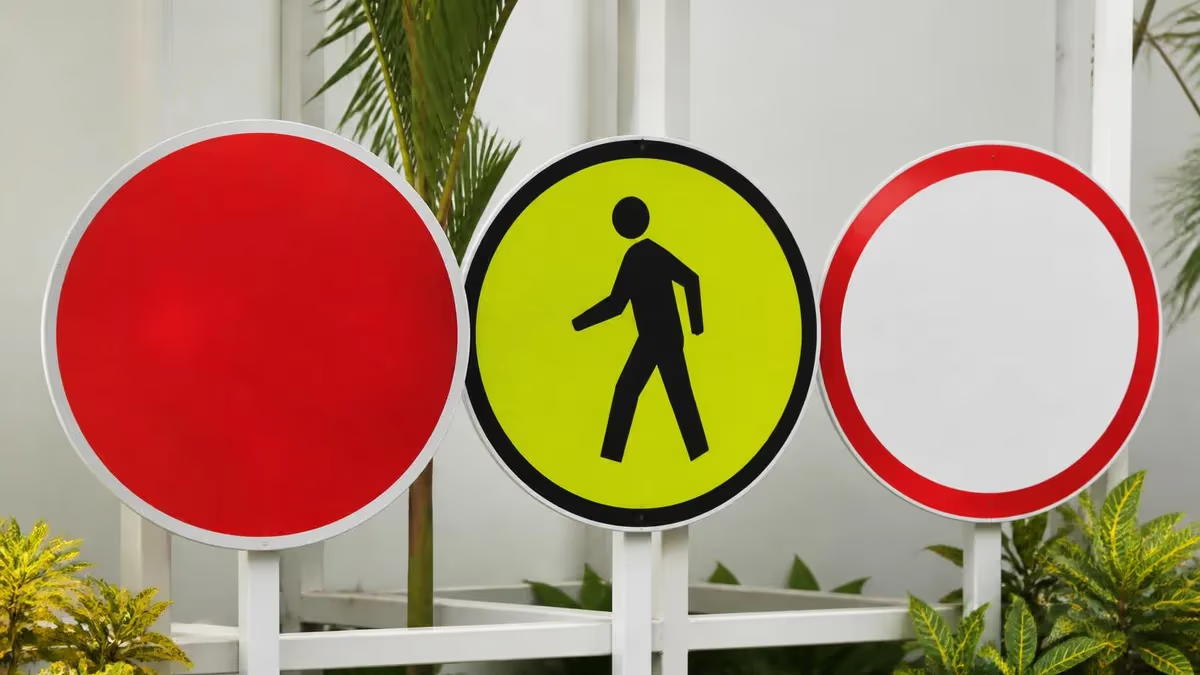
The most effective preparation combines three elements: reading the official Philippine Land Transportation and Traffic Code (Republic Act 4136) to understand the legal basis for the rules being tested; reviewing all traffic sign categories including warning signs (diamond-shaped), regulatory signs (circular), and informational signs (rectangular); and practising with representative LTO exam questions that reflect the actual test format and difficulty level.
Common areas where unprepared candidates lose points include: specific numerical values in traffic regulations (stopping distances, speed limits in specific zones, BAC limits), less common road sign types that appear infrequently in everyday driving, and situational right-of-way questions involving multiple vehicles. Candidates who have practised extensively with LTO-style questions develop familiarity with the phrasing and format of both the written and situational questions that frequently generate incorrect answers from first-time test-takers.
The practical driving test, conducted after the written examination, evaluates basic vehicle control, observation habits (mirror checking, signalling, head checks), and compliance with traffic rules during a standard route. Candidates who have practised with their supervising driver before the test date, specifically reviewing the manoeuvres required at the testing location, consistently perform better than those who arrive at the practical test without specific preparation for the test route conditions.
Candidates who fail the LTO exam on their first attempt often cite the same categories of questions as their weak points: numerical values in traffic regulations (specific speed limits, stopping distances, or blood alcohol concentration thresholds), less-familiar road sign designs that look similar to one another, and multi-vehicle right-of-way scenarios at four-way intersections.
Focused review of these categories in the days before the exam — rather than general re-reading of the entire code — makes the most efficient use of limited study time. Writing down specific numerical values on a simple reference card and reviewing it repeatedly creates stronger retention than reading paragraphs of regulation text that include those same numbers embedded in longer passages.
LTO-accredited Driving School completion also provides practical benefits beyond the certification it may require. Driving school instructors are familiar with the specific routes and manoeuvres used at local testing centres, and their coaching on pre-drive inspection protocols, signalling procedures, and emergency stop techniques directly prepares students for the examiner's checklist. Candidates who complete a full driving school programme — rather than just the minimum hours needed for certification — arrive at the practical test with more confidence and fewer technical gaps than those who did the minimum required before testing.
LTO Questions and Answers
About the Author

Educational Psychologist & Academic Test Preparation Expert
Columbia University Teachers CollegeDr. Lisa Patel holds a Doctorate in Education from Columbia University Teachers College and has spent 17 years researching standardized test design and academic assessment. She has developed preparation programs for SAT, ACT, GRE, LSAT, UCAT, and numerous professional licensing exams, helping students of all backgrounds achieve their target scores.
Join the Discussion
Connect with other students preparing for this exam. Share tips, ask questions, and get advice from people who have been there.
View discussion (8 replies)