
LTO Number Coding Scheme Philippines: Complete Guide 2026
Prepare for the LTO Number Coding Scheme Philippines: 🎓 certification. Practice questions with answer explanations covering all exam domains.
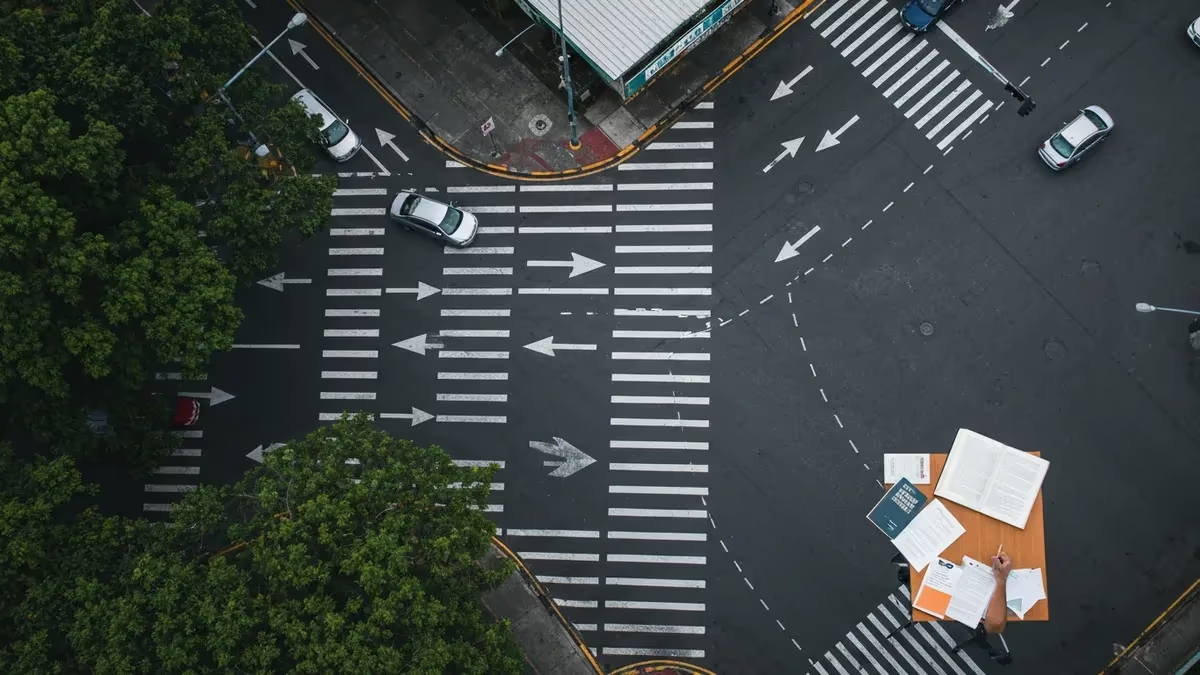
What Is the Number Coding Scheme?
The MMDA number coding scheme — also called the Unified Vehicular Volume Reduction Program (UVVRP) — was launched in 1995 to reduce traffic congestion on Metro Manila's major thoroughfares. Each weekday, vehicles with license plates ending in specific digits are prohibited from using covered roads during peak hours. Practice with the free LTO - Exam Reviewer practice test on PracticeTestGeeks (600+ questions with answer explanations).
The restriction is based on the last digit of your vehicle's license plate. This applies to both private and public utility vehicles that fall under the MMDA's coverage area. Before you get behind the wheel, it's worth reviewing your plate number carefully — many motorists unknowingly violate the scheme and receive apprehension tickets.
Knowing the number coding rules is also tested in the official LTO driver's license examination. Our LTO practice test includes sample questions on traffic regulations including the coding scheme, helping you pass on your first attempt. For a broader overview of traffic rules and requirements, check our LTO complete guide.
- The LTO CDE Online Validation Exam, used for driver's license renewal applications, has 25 questions. (Land Transportation Office (LTO), Department of Transportation, Republic of the Philippines)
- Under LTO Memorandum Circular No. AHS-2008-949, the LTO written exam for a non-professional driver's license has 40 questions. (elibrary.judiciary.gov.ph)
- The LTO CDE Online Validation Exam has no time limit for answering the questions. (Land Transportation Office (LTO), Department of Transportation, Republic of the Philippines)
- To get a certificate from the LTO CDE Online Validation Exam, you need 80%, or at least 20 correct answers out of 25 questions. (Land Transportation Office (LTO), Department of Transportation, Republic of the Philippines)
- To pass the LTO written exam for a non-professional driver's license, an applicant needs at least 30 correct answers out of 40 questions. (elibrary.judiciary.gov.ph)
- The LTO CDE Online Validation Exam is taken online through the LTMS portal, and you must log in to an LTMS account to take it. (Land Transportation Office (LTO), Department of Transportation, Republic of the Philippines)
Facts verified Oct 17, 2026 against Land Transportation Office (LTO), Department of Transportation, Republic of the Philippines. Dates that have passed are removed automatically.
LTO Exam at a Glance
| Item | Detail | Official source |
|---|---|---|
| Number of questions (CDE Online Validation Exam (license renewal)) | 25 questions | Land Transportation Office (LTO), Department of Transportation, Republic of the Philippines |
| Number of questions (Non-professional driver's license written exam) | 40 questions | elibrary.judiciary.gov.ph |
| Number of questions (Professional driver's license written exam) | 60 questions | elibrary.judiciary.gov.ph |
| Time limit (CDE Online Validation Exam (license renewal)) | No time limit | Land Transportation Office (LTO), Department of Transportation, Republic of the Philippines |
| Passing score (CDE Online Validation Exam (license renewal)) | 80% (20 of 25 correct) | Land Transportation Office (LTO), Department of Transportation, Republic of the Philippines |
| Passing score (Non-professional driver's license written exam) | 30 of 40 correct (75%) | elibrary.judiciary.gov.ph |
| Passing score (Practical driving exam) | 70 points (start at 100, deductions for errors) | elibrary.judiciary.gov.ph |
| Passing score (Professional driver's license written exam) | 45 of 60 correct (75%) | elibrary.judiciary.gov.ph |
| Delivery (CDE Online Validation Exam (license renewal)) | Online via LTMS portal (login required) | Land Transportation Office (LTO), Department of Transportation, Republic of the Philippines |
Facts verified Oct 17, 2026 against Land Transportation Office (LTO), Department of Transportation, Republic of the Philippines. Dates that have passed are removed automatically.
Free LTO - Exam Reviewer Study Tools
Interactive LTO - Exam Reviewer resources on PracticeTestGeeks, free to start:
- Free LTO Traffic Safety Questions and Answers — 16 questions with instant scoring and answer explanations
- LTO - Exam Reviewer flashcards — review key terms and concepts card by card
- LTO - Exam Reviewer study guide — topic-by-topic overview of what the exam covers
- LTO - Exam Reviewer cheat sheet — one-page printable summary for last-minute review
Coding Hours and Covered Areas
The number coding restriction is enforced from 7:00 AM to 8:00 PM, Monday through Friday. The scheme covers major roads, avenues, and expressways within Metro Manila that fall under MMDA jurisdiction. Key roads include EDSA, C-5, Commonwealth Avenue, Quezon Avenue, España Boulevard, Taft Avenue, and Roxas Boulevard, among others.
Not all cities in Metro Manila apply the MMDA coding in the same way. Some Local Government Units (LGUs) such as Makati, Pasig, and Mandaluyong have their own supplemental coding ordinances that may extend hours or cover additional roads within their jurisdiction. Always check local city ordinances in addition to the MMDA baseline rules.
If you're renewing your license or registering a new vehicle, understanding road restrictions is essential. Visit our LTO license renewal guide and review the TPL insurance requirements before your next LTO appointment. You should also familiarize yourself with Philippine road signs that indicate coding restriction zones.
Number Coding Exemptions Checklist
- ✓Vehicles with provincial license plates (outside Metro Manila)
- ✓Motorcycles with engine displacement below 400cc
- ✓Public utility buses (PUBs) on franchise routes
- ✓Emergency vehicles: ambulances, fire trucks, police cars
- ✓Vehicles transporting the President, Vice President, or foreign dignitaries
- ✓Vehicles with a valid MMDA special permit or window sticker
- ✓Vehicles used for medical emergencies with proof
- ✓Vehicles operating during officially declared coding suspension days
LTO Pros and Cons
- +LTO has a defined, publicly available content blueprint — candidates know exactly what to prepare for
- +Multiple preparation pathways (self-study, courses, coaching) accommodate different learning styles and schedules
- +A growing ecosystem of study resources means candidates at any budget level can access quality preparation materials
- +Clear score reporting allows candidates to identify specific strengths and weaknesses for targeted remediation
- +Professional recognition associated with strong performance provides tangible career and academic benefits
- −The scope of tested content requires substantial preparation time that competes with existing professional or academic commitments
- −No single resource covers the full content scope — candidates typically need multiple study tools for comprehensive preparation
- −Test anxiety and exam-day performance variability mean preparation effort does not always translate linearly to scores
- −Registration, preparation, and potential retake costs accumulate into a significant financial investment
- −Content and format can change between exam versions, making older preparation materials less reliable
Pros and Cons at a Glance
| Pros | Cons |
|---|---|
| LTO has a defined, publicly available content blueprint — candidates know exactly what to prepare for | The scope of tested content requires substantial preparation time that competes with existing professional or academic commitments |
| Multiple preparation pathways (self-study, courses, coaching) accommodate different learning styles and schedules | No single resource covers the full content scope — candidates typically need multiple study tools for comprehensive preparation |
| A growing ecosystem of study resources means candidates at any budget level can access quality preparation materials | Test anxiety and exam-day performance variability mean preparation effort does not always translate linearly to scores |
| Clear score reporting allows candidates to identify specific strengths and weaknesses for targeted remediation | Registration, preparation, and potential retake costs accumulate into a significant financial investment |
| Professional recognition associated with strong performance provides tangible career and academic benefits | Content and format can change between exam versions, making older preparation materials less reliable |
Sample LTO - Exam Reviewer Practice Questions
Try these questions from our free LTO - Exam Reviewer practice tests. The correct answer and an explanation follow each question.
What shape and color scheme is used for 'Warning' signs in the Philippines?
- A. Square with a blue background
- B. Circular with a red border
- C. Triangle shape with a yellow or orange background
- D. Rectangular with a green background
Answer: C. Triangle shape with a yellow or orange background
Warning signs use an equilateral triangle with a yellow or orange background, alerting drivers to hazards ahead.
What does a circular red-bordered sign with a number (e.g., 60) inside it indicate in the Philippines?
- A. Minimum speed of 60 kph required
- B. Maximum speed limit of 60 kph
- C. Distance to next town in kilometers
- D. Road number designation
Answer: B. Maximum speed limit of 60 kph
A circular sign with a red border and a number indicates the maximum speed limit in kilometers per hour for that road section.
When driving through a tunnel in the Philippines, a driver should:
- A. Turn off headlights to conserve battery
- B. Turn on headlights, maintain speed, and stay in lane
- C. Accelerate to pass through quickly
- D. Sound the horn regularly to warn other drivers
Answer: B. Turn on headlights, maintain speed, and stay in lane
In tunnels, headlights are mandatory, lane discipline must be maintained, and speed should be consistent with posted limits.
Drag racing or street racing on public roads in the Philippines is classified under which violation?
- A. Minor traffic infraction
- B. Reckless driving — a major violation under RA 4136
- C. Only a barangay-level ordinance violation
- D. It is only illegal if an accident occurs
Answer: B. Reckless driving — a major violation under RA 4136
Racing on public roads constitutes reckless driving under RA 4136 — a major traffic violation with serious penalties.
LTO Number Coding Questions and Answers


How this page was made: written with AI tools. Exam facts are checked against the official sources listed below. Not reviewed by a subject-matter expert. Editorial policy
Sources & references
Exam facts on this page (fees, format, dates, passing scores) are checked against these official sources; the date is our last check. Editorial policy
- portal.lto.gov.ph — Test delivery, exam format, passing score, time limit · verified Oct 2026
- elibrary.judiciary.gov.ph — Exam format, passing score · verified Oct 2026