
What Is LTO and LTO License Renewal Requirements: The Complete 2026 October Guide
What is LTO and what are the license renewal requirements? ✅ Complete guide covering documents, fees, and exam tips for 2026 October.
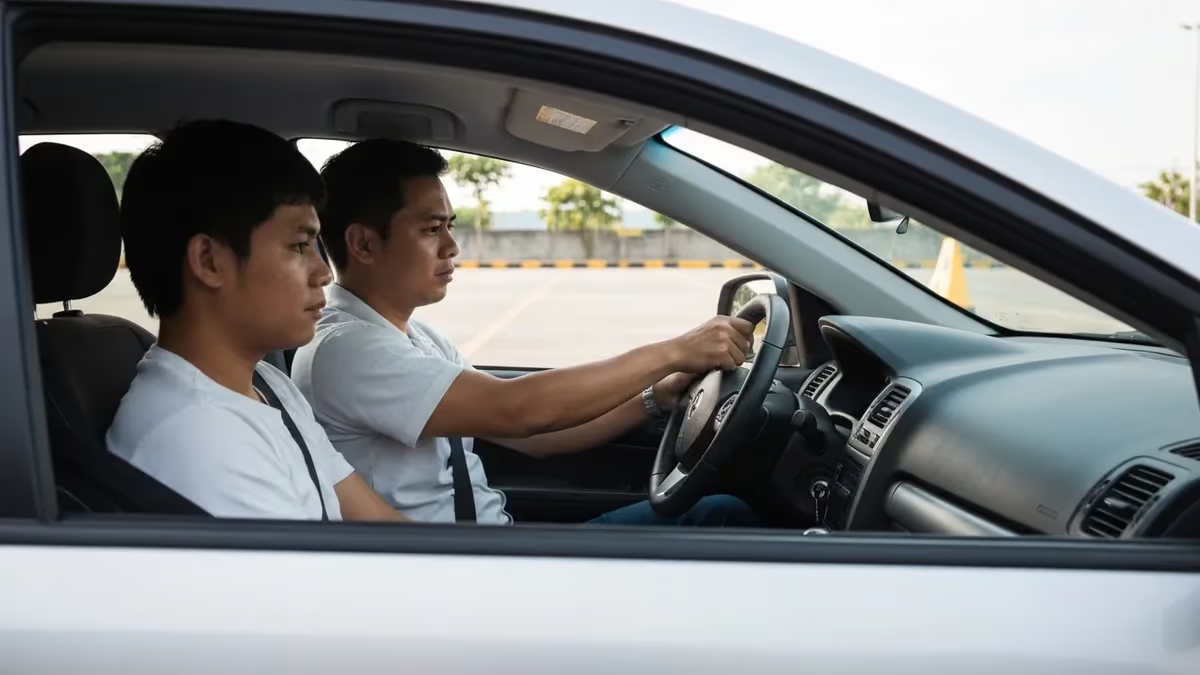
If you have ever asked what is LTO and why it matters for drivers in the Philippines, you are not alone. LTO stands for the Land Transportation Office, the government agency responsible for regulating motor vehicles, issuing driver's licenses, and enforcing road safety laws across the country. Understanding the license renewal requirements LTO mandates is essential for every driver who wants to stay legal on the road, avoid costly fines, and keep their driving privileges intact through 2026 and beyond.
The LTO was established under the Department of Transportation and is empowered by Republic Act 4136, also known as the Land Transportation and Traffic Code. Its core mandate is to ensure that all drivers operating on Philippine roads are qualified, properly licensed, and informed about road safety rules. The agency operates dozens of district offices and extension offices nationwide, making it one of the most widely accessed government agencies in the country.
Many drivers confuse the LTO with other agencies or wonder what does LTO stand for in the context of their license documents. Simply put, LTO is the issuing authority for your Non-Professional Driver's License (NPDL) and Professional Driver's License (PDL). Whether you are renewing a license that expired recently or one that lapsed several years ago, the LTO sets the procedures, documentary requirements, and examination standards you must meet.
When people search for what does LTO mean in everyday life, the most practical answer is the office where you go to get or renew your license, register your vehicle, and settle traffic violation records. The LTO also maintains the national database of registered vehicles and licensed drivers, which law enforcement agencies use during traffic stops and investigations across every region of the Philippines.
One common point of confusion is the term LTO in other industries. In the food and beverage world, LTO stands for Limited Time Offer, which explains why keywords like what is lto food and what is lto on a burger appear in search data. On a burger menu, an LTO means a seasonal or promotional item available only for a short window, completely unrelated to the Land Transportation Office. This article focuses exclusively on the LTO as the Philippine licensing authority.
For drivers approaching their renewal date, knowing exactly what documents to prepare, what fees to pay, and what exam topics to study can save hours of wasted trips to the LTO office. The renewal process involves submitting valid IDs, passing a medical examination, completing a drug test, and in many cases passing a written examination on traffic rules and road safety. Learn more about how to get student license lto and the full renewal pathway before you visit your nearest LTO office.
This guide walks you through every aspect of what the LTO is, what the renewal requirements are for 2026, what to expect during the written exam, and how practice tests can dramatically improve your chances of passing on your first attempt. Whether you are a first-time renewal applicant or someone whose license has lapsed, the information below will give you a clear, step-by-step roadmap to compliance.
LTO License Renewal by the Numbers
Key Facts at a Glance
| Item | Value | Details |
|---|---|---|
| Documents Required | 5+ | For standard renewal |
| License Validity | 5 Years | Standard term for most licenses |
| Basic Renewal Fee | ₱585 | Non-professional license |
| Written Exam Questions | 60 | Typical LTO exam length |
| Required Passing Score | 90% | 54 out of 60 correct |
LTO License Renewal Requirements: Step-by-Step Process
Gather Required Documents
Complete Medical and Drug Testing
Pay the Renewal Fees
Take the Written Examination
Biometrics and Photo Capture
Claim Your Renewed License
Understanding each step of the renewal process in detail can prevent costly mistakes and unnecessary return visits. The first and most critical step is document preparation. The LTO requires applicants to present their current or most recently expired driver's license, a clear photocopy of the same, and at least one valid government-issued ID such as a passport, PhilSys national ID, SSS card, or GSIS card. Applicants without the original license due to loss must secure an affidavit of loss and file for a replacement simultaneously with the renewal.
The medical examination is a non-negotiable requirement for all renewal applicants. You must visit an LTO-accredited medical clinic and undergo a physical exam that checks your vision, hearing, and general health. The examining physician will issue a medical certificate valid for use at the LTO. Crucially, this certificate must not be older than 30 days at the time of your renewal submission. Some clinics near LTO offices offer same-day processing, but it is advisable to complete the medical exam a day or two in advance to avoid long queues on your renewal date.
Drug testing is another mandatory component of the LTO renewal process, introduced to promote road safety by ensuring drivers are not under the influence of prohibited substances. You must take your drug test at an LTO-accredited drug testing laboratory and present the negative result certificate during your renewal. Like the medical certificate, the drug test result must be current — check with your local LTO office for the exact validity period, which is typically 30 to 60 days from the test date.
Fee payment must be completed before your documents are processed. The LTO accepts payment at its cashier windows and through authorized payment partners including certain banks, payment centers, and online channels. Always keep your official receipt because it serves as proof of payment and may be used as a temporary driving document if your license expires during the processing period. Fees vary depending on license type, number of vehicle categories, and whether any penalties for late renewal apply to your account.
One of the most misunderstood aspects of the LTO renewal process is who must take the written examination. As of current LTO guidelines, applicants renewing a license that has been expired for more than a year are generally required to retake the written examination. First-time renewal applicants and those with clean records on active licenses may be exempted, but policies can vary by district office. Always confirm the examination requirement with your local LTO office or check the official LTO website before your appointment.
For those who must take the written exam, thorough preparation is key. The exam covers traffic signs and pavement markings, road safety principles, defensive driving concepts, traffic violations and penalties, and driver duties and responsibilities. Review the official LTO Reviewer booklet, take practice tests online, and focus on the categories where you feel least confident. Reviewing lto license renewal requirements related to violations and penalties is especially important because these questions appear frequently on the actual exam and carry significant practical weight for everyday driving.
After passing the exam and submitting all documents, you will proceed through the biometrics capture process and then wait for your license to be released. Processing times at LTO offices vary widely depending on location, day of the week, and current application volume. Arriving early in the morning on a weekday typically results in faster processing. Some LTO district offices also offer appointment-based systems through their online portal, which can significantly reduce your waiting time and ensure a smoother renewal experience overall.
What Does LTO Stand For — Roles, Functions, and Exam Facts
LTO stands for the Land Transportation Office, a Philippine government agency under the Department of Transportation. Its primary mandate is to regulate the operation of land transportation, issue and renew driver's licenses, register motor vehicles, and enforce the provisions of Republic Act 4136. The LTO operates through a network of regional, district, and extension offices spread across all provinces and major cities in the Philippines, serving millions of drivers and vehicle owners annually.
What is an LTO in practical terms? It is the single government body that determines whether you are legally qualified to operate a motor vehicle on public roads. If your driver's license was issued in the Philippines, the LTO issued it. If your vehicle carries a Philippine plate number, the LTO registered it. The agency also maintains records of traffic violations, apprehensions, and demerit points associated with each licensed driver in the country.

Renewing Early vs. Waiting Until the Last Minute
- +Avoid late renewal surcharges that add to your total fees
- +More appointment slots available when you renew weeks in advance
- +Less stress with ample time to gather documents and complete medical tests
- +No risk of driving with an expired license and facing apprehension
- +Online scheduling is easier to access before peak renewal periods
- +Fresh biometrics and updated photo captured while your ID is still current
- −Requires planning ahead rather than handling it only when prompted
- −Medical certificate must be obtained close to the renewal date anyway
- −Some applicants prefer to batch errands and renew only when necessary
- −Earlier renewal slightly shortens the validity window of the new license
- −May require taking time off work during office hours sooner than expected
- −Renewal systems occasionally experience downtime that could affect early attempts
LTO License Renewal Requirements Checklist for 2026
- ✓Bring your original driver's license (expiring or recently expired)
- ✓Prepare a clear photocopy of your current driver's license
- ✓Obtain a medical certificate from an LTO-accredited clinic dated within 30 days
- ✓Complete drug testing at an LTO-accredited laboratory and secure your negative result
- ✓Bring at least one valid government-issued ID (passport, PhilSys ID, SSS, or GSIS card)
- ✓Prepare the correct renewal fees in cash or check with available electronic payment options
- ✓Confirm with your LTO district office whether a written exam is required for your renewal
- ✓If exam is required, review the LTO Reviewer booklet and take at least three full practice tests
- ✓Check your LTO records online for any unpaid fines or violations that must be settled before renewal
- ✓Schedule your appointment through the LTO online portal to minimize waiting time at the office
Unpaid Violations Block Your Renewal
Many applicants arrive at the LTO office fully prepared with documents and fees only to discover that outstanding traffic violations on their record are preventing the renewal from being processed. Before your renewal date, log in to the LTO's online portal or visit your district office to check for any recorded violations, apprehensions, or unpaid fines. Settling these in advance saves you from making a wasted trip and potentially missing your renewal window.
The LTO written examination is one of the most discussed — and most feared — aspects of the renewal process, particularly for drivers who have not taken a formal road safety review in years. Understanding exactly what the exam covers and how it is structured gives you a significant advantage on test day. The exam is divided into several topic categories, each weighted according to its importance for safe driving. Traffic signs and pavement markings constitute a large portion of questions, reflecting the LTO's emphasis on visual recognition skills that every driver must demonstrate.
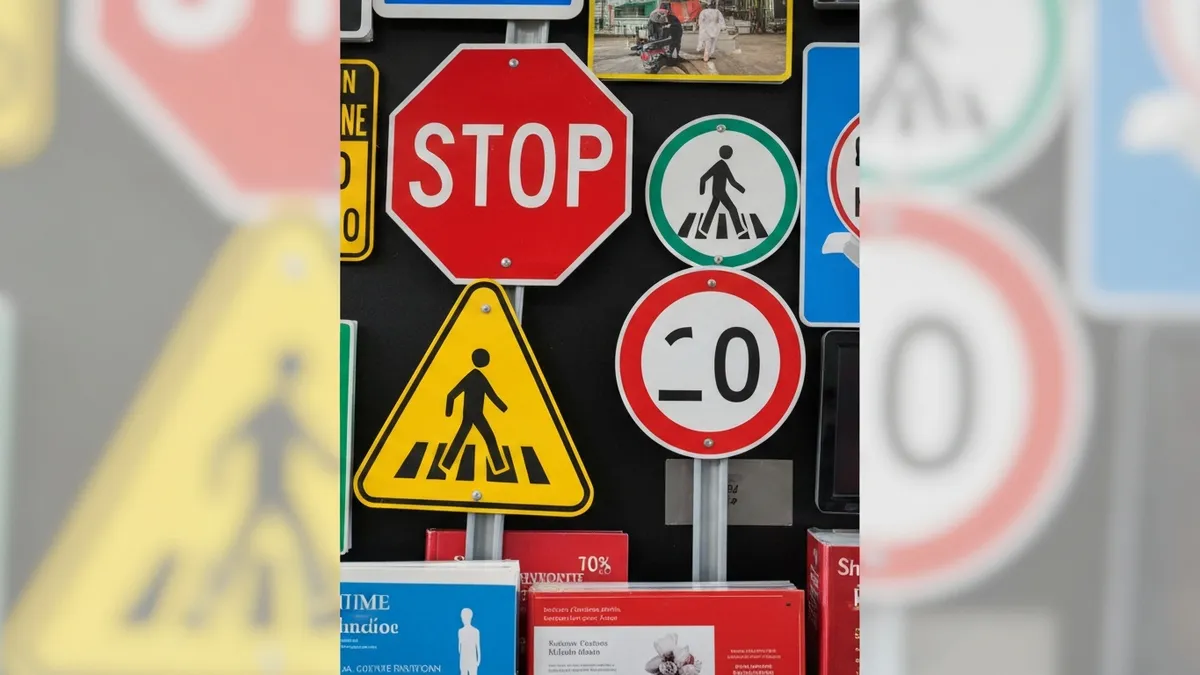
Road signs tested on the LTO exam fall into three main categories: regulatory signs, warning signs, and informational or guide signs. Regulatory signs (usually white or red) instruct drivers on what they must or must not do — stop signs, no U-turn signs, and speed limit signs fall into this category. Warning signs (typically yellow or orange diamond shapes) alert drivers to hazards or changing road conditions ahead. Informational signs provide directions, distances, and service locations. Memorizing the color coding, shape conventions, and specific symbols of each category is an efficient way to prepare for this section.
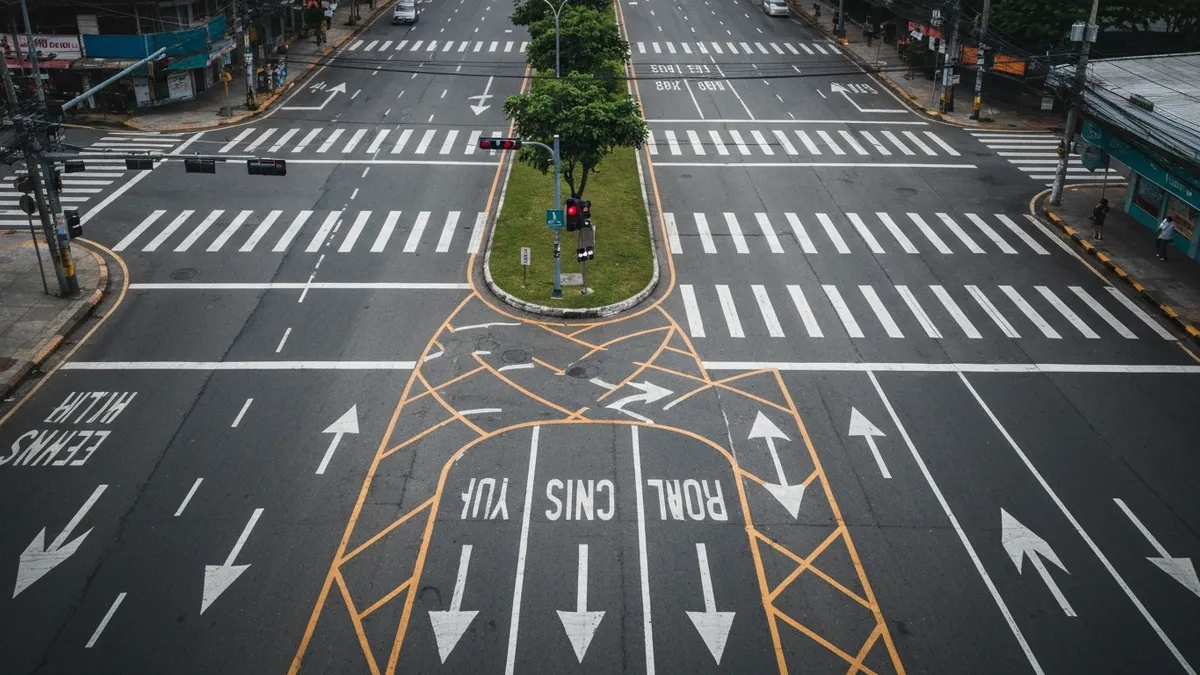
Pavement markings are another frequently tested area. Yellow center lines, white edge lines, crosswalk markings, directional arrows, and no-overtaking zones are all covered. The LTO exam expects drivers to understand not just what these markings look like but what actions they require. For example, a solid yellow center line prohibits overtaking from either direction, while a broken yellow line permits overtaking when it is safe to do so. These distinctions matter for both the exam and real-world driving decisions made in fractions of a second.
Traffic violations and their corresponding penalties represent another major exam topic. The LTO and the Metropolitan Manila Development Authority (MMDA) have established a schedule of fines for offenses including reckless driving, illegal parking, beating a red light, driving without a license, and driving under the influence. Applicants are expected to know the penalty ranges for common violations and understand which offenses can result in license confiscation or cancellation. This knowledge not only helps you pass the exam but also protects you from making costly mistakes on the road.
Defensive driving principles are integrated throughout the LTO exam rather than isolated in a single section. These include maintaining safe following distances, anticipating hazards before they develop, adjusting speed for weather and road conditions, proper use of mirrors and blind-spot checks, and the two-second rule for maintaining adequate spacing behind the vehicle ahead. The LTO emphasizes defensive driving because it is the single most effective behavior for preventing accidents, reducing road fatalities, and protecting all road users including pedestrians and cyclists.
Driver duties and responsibilities questions on the LTO exam test your knowledge of the legal obligations every license holder must fulfill. These include carrying your license whenever you operate a vehicle, obeying the instructions of traffic enforcement officers, yielding to pedestrians at crosswalks, and reporting accidents to the LTO and relevant authorities within 24 hours. Understanding these duties is not just an exam requirement — it reflects the legal framework that governs your rights and obligations every time you get behind the wheel in the Philippines.
First aid and emergency response questions may also appear on certain versions of the LTO exam. Applicants may be asked about basic accident scene management, how to call for emergency assistance, and the priority of actions when a road accident occurs.
While these questions are less common than traffic sign or violation questions, they are worth reviewing because they can mean the difference between a passing and failing score when the overall exam result is close to the 90 percent threshold. Practice tests that simulate the full 60-question format are the best way to build familiarity with the complete range of topics covered.
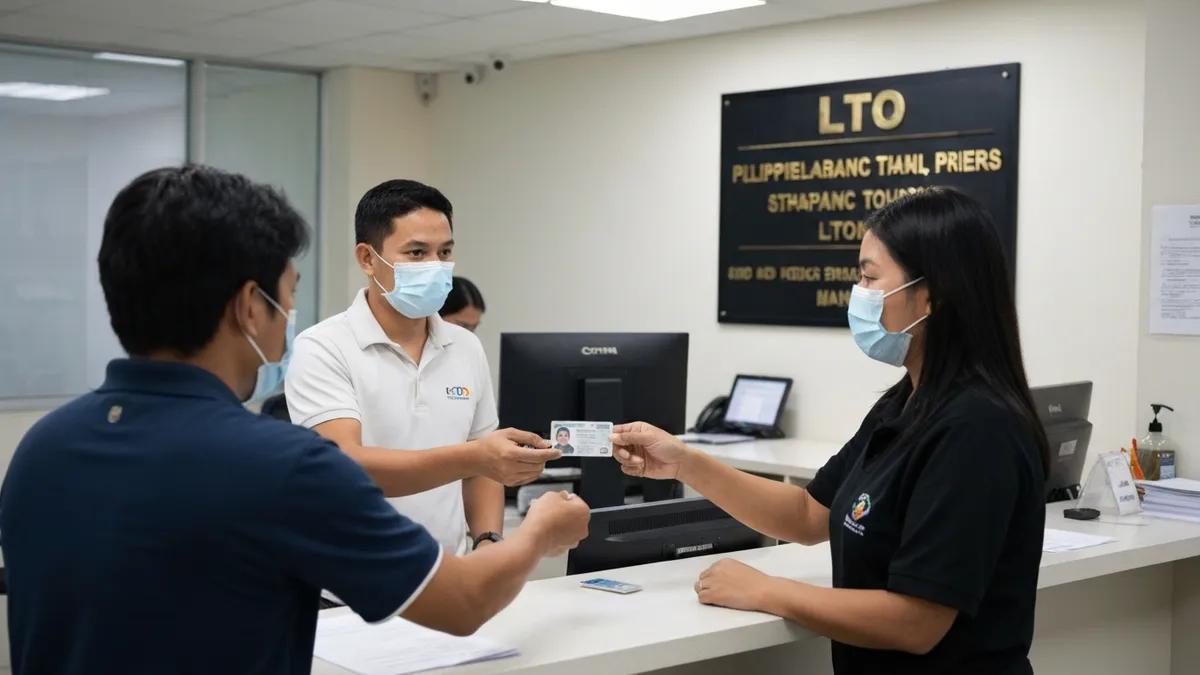
Driving with an expired license in the Philippines is a traffic violation that can result in fines and license confiscation. The LTO also imposes a late renewal surcharge for licenses renewed after their expiration date. If your license expired more than one year ago, you are typically required to retake the written examination in addition to paying the standard renewal fees plus applicable penalties. Do not wait until you are stopped by traffic enforcers to discover your license has lapsed — check your expiration date now and schedule your renewal promptly.
Many applicants wonder how the LTO exam compares to standardized tests they may have taken in other contexts — for example, whether practice test platforms overstate difficulty similar to how some students ask whether Princeton Review is harder than the real AP exam. The honest answer is that well-designed practice tests closely mirror the actual LTO exam in both format and difficulty, and the primary benefit of taking them is not to experience a harder version but to identify gaps in your knowledge before they cost you on test day.
The most effective study approach for the LTO exam combines reading the official reviewer, watching video explanations for topics you find confusing, and taking timed practice tests under realistic conditions. Setting a timer to complete 60 questions in a reasonable window — similar to the actual exam environment — trains your brain to process questions efficiently without second-guessing. Applicants who report failing the exam often describe rushing through questions or being caught off guard by the specific phrasing of certain sign or violation questions, both of which practice tests help address directly.
Beyond the written exam, some drivers find the drug testing requirement to be the most logistically challenging part of the renewal. Accredited drug testing centers can have varying wait times depending on demand, and results may take anywhere from a few hours to a full business day depending on the laboratory.
Planning to complete your drug test at least two to three days before your LTO appointment ensures that any delays in result processing do not push back your renewal. Keep the original copy of your drug test result certificate and make photocopies in case the LTO requires one for their records.
The medical examination requirement is similarly straightforward but must be approached systematically. LTO-accredited physicians will check your visual acuity, color vision, and general physical fitness. If you wear corrective lenses, bring them to the exam and note that a restriction code will be added to your license requiring you to wear glasses or contacts while driving. Failure to wear your prescribed corrective lenses while driving is itself a traffic violation, so it is important to comply with any restrictions encoded on your renewed license card.
For professional driver's license holders — those with categories covering trucks, buses, articulated vehicles, or motorcycles beyond a certain engine displacement — the renewal requirements may include additional documentation such as proof of employment or operator certification depending on the license category. Professional drivers should confirm the specific requirements for their license type at their district LTO office well in advance, as the requirements for PDL holders can differ from those for NPDL holders in important ways that affect both the documents needed and the fees payable.
The LTO has been expanding its digital services to reduce the time drivers spend queuing in offices. The LTO's LTMS (Land Transportation Management System) portal allows applicants in selected areas to pre-register, upload documents, pay fees online, and schedule appointments. Using the online portal does not eliminate the need for an in-person visit — you still need to appear for biometrics, the written exam (if required), and license card claiming — but it can dramatically shorten the time you spend at the office on renewal day.
Finally, it is worth understanding what happens to your driving privileges if you miss your renewal window entirely. A license that has been expired for more than three years is typically treated as a lapsed license, requiring the applicant to go through a process closer to a new license application rather than a simple renewal.
This can mean additional requirements, higher fees, and mandatory attendance at a driver's education seminar. Staying current with your renewal is always the path of least resistance and least cost, making it worth the effort to plan ahead and comply with the LTO's schedule on time.
Practical preparation strategies make a measurable difference in LTO exam outcomes. Drivers who approach the renewal exam as a formality without reviewing often find themselves caught off guard by specific regulatory details that are not part of everyday driving knowledge.
The LTO exam tests not just what you do habitually on the road but what the law requires you to do — and those two things are not always identical. For example, many experienced drivers are uncertain about the exact legal following distance, the precise penalty for a first-offense reckless driving citation, or the correct procedure when encountering a four-way stop with no traffic signal.
One of the most practical preparation tools available is a full-length timed practice test that covers all five major exam categories simultaneously. This simulates the cognitive challenge of the actual exam, where you must switch between traffic sign questions, violation penalty questions, and defensive driving scenarios without losing focus or momentum. Many applicants who take three or more full practice tests before their exam report finishing the actual LTO exam with time to spare and confidence in their answers, rather than the uncertainty that often accompanies under-preparation.
Community resources can also supplement your preparation. Driver's license renewal forums, social media groups, and community boards often share recent exam takers' experiences, flagging which question categories appeared most frequently in a given month or district office. While the LTO periodically updates its question pool, the core topics remain stable across versions, meaning that community insights are generally reliable for identifying areas worth extra focus in your own review sessions.
Scheduling your renewal appointment strategically can also reduce stress and improve the overall experience. Mid-week mornings — particularly Tuesday through Thursday — tend to be less crowded than Mondays (which attract applicants who were unavailable over the weekend) and Fridays (which see a pre-weekend rush). Avoiding the first and last weeks of the month, when many agencies process payroll and accounting deadlines that bring additional traffic to government offices, is another useful scheduling heuristic that experienced renewal applicants often share.
If you have questions about specific requirements that apply to your personal situation — such as a license with a restriction code, a vehicle category that requires a special endorsement, or a history of recorded violations — calling your local LTO district office directly is always the most reliable approach. LTO staff are generally able to answer specific questions about what documents apply to unusual situations, and getting clarity in advance prevents surprises on your renewal day that could derail an otherwise well-prepared application.
Finally, remember that passing the LTO renewal exam is not just a bureaucratic hurdle — it is a reaffirmation of your commitment to being a responsible, informed, and safety-conscious driver. The knowledge tested on the LTO exam directly corresponds to behaviors that protect your life, the lives of your passengers, and the safety of other road users every time you drive. Approaching your renewal preparation with that mindset transforms the process from an inconvenience into an opportunity to refresh and strengthen the skills that matter most on Philippine roads.
Use the quiz tiles and practice resources linked throughout this guide to build your exam readiness one topic at a time. Consistent daily review sessions of 20 to 30 minutes over one to two weeks are far more effective than a single cramming session the night before your appointment. Start early, focus on your weak areas, and arrive at the LTO office confident in your preparation and your documents. Your renewed license is the result — but the knowledge you carry forward is the real long-term benefit of taking the process seriously.
Sample LTO - Exam Reviewer Practice Questions
Try these questions from our free LTO - Exam Reviewer practice tests. The correct answer and an explanation follow each question.
Under federal REAL ID requirements, what is the minimum age to obtain a REAL ID-compliant driver's license?
- A. 14
- B. 16
- C. 18
- D. 21
Answer: B. 16
REAL ID-compliant licenses can be issued to those who meet their state's minimum driving age, which is typically 16.
What is the penalty for driving without a valid driver's license in the US?
- A. Warning only
- B. Fine up to $500 and possible jail time
- C. License suspension only
- D. Community service only
Answer: B. Fine up to $500 and possible jail time
Driving without a valid license typically results in fines up to $500 and potential jail time depending on the state.
Under RA 4136, what must a driver do when an authorized officer asks to see their license?
- A. Ignore the request if they are in a hurry
- B. Present the license for inspection immediately
- C. Show only a photocopy of the license
- D. Call their lawyer first
Answer: B. Present the license for inspection immediately
Under RA 4136, drivers must present their valid driver's license upon demand by any authorized law enforcement officer.
What offense occurs when a driver operates a vehicle under a suspended license?
- A. Simple traffic violation
- B. Criminal offense with possible jail time
- C. Administrative warning only
- D. Minor infraction with no penalty
Answer: B. Criminal offense with possible jail time
Driving with a suspended license is a criminal offense in most jurisdictions and can result in arrest, fines, and extended suspension.
LTO Questions and Answers

LTO License Renewal Guide Philippines 2026 — Requirements and Process
LTO Traffic Violations Philippines 2026 — Fines and Penalties Guide

LTO Plate Number Tracker: What Is LTO, What Does LTO Stand For, and How to Track Your Vehicle Registration in 2026

FE Exam Review Course: What Is LTO and How to Pass Your Driver's License Exam in 2026

VA Exam Review: Complete LTO Driver's License Exam Guide for 2026
About the Author

Educational Psychologist & Academic Test Preparation Expert
Columbia University Teachers CollegeDr. Lisa Patel holds a Doctorate in Education from Columbia University Teachers College and has spent 17 years researching standardized test design and academic assessment. She has developed preparation programs for SAT, ACT, GRE, LSAT, UCAT, and numerous professional licensing exams, helping students of all backgrounds achieve their target scores.
Join the Discussion
Connect with other students preparing for this exam. Share tips, ask questions, and get advice from people who have been there.
View discussion (8 replies)