
LPN Training Programs: Complete 2026 September Guide to Schools, Costs, Curriculum & Career Paths
LPN training programs guide: 🟢 program length, tuition costs, curriculum, NCLEX-PN prep, accreditation, and how to choose the right school in 2026 September.
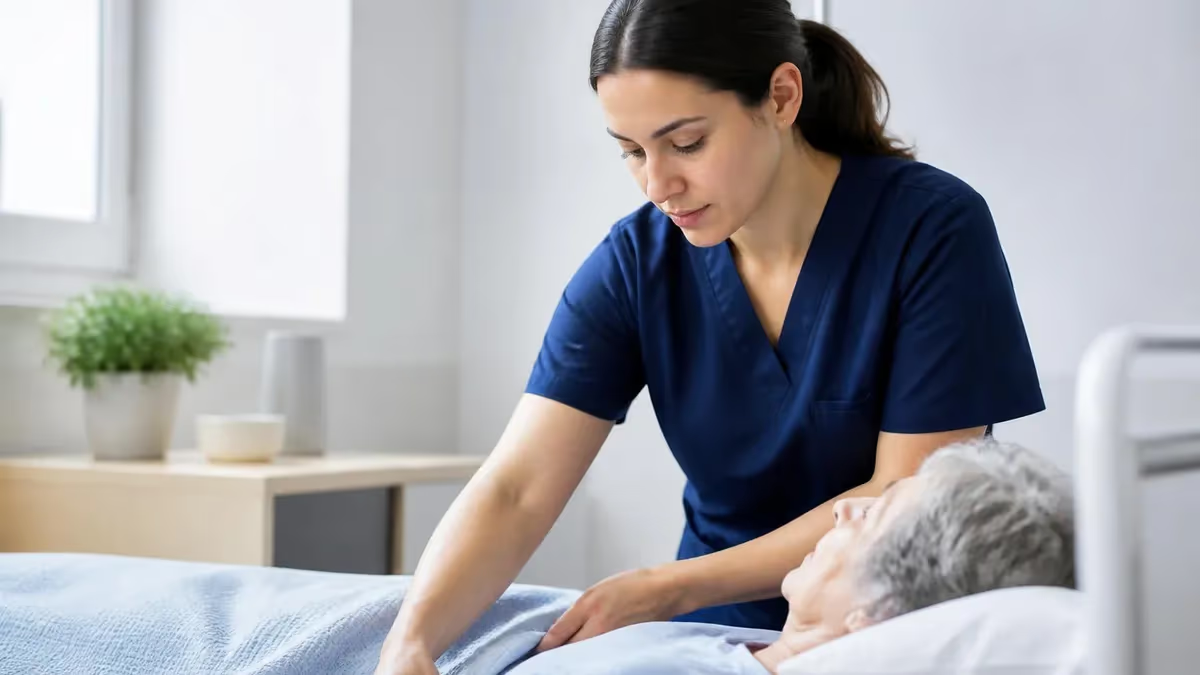
LPN training programs are accelerated nursing pathways that prepare students to deliver hands-on patient care under the supervision of registered nurses and physicians, and they remain one of the fastest, most affordable entry points into the healthcare workforce. Most programs run 12 to 18 months at a community college, vocational school, or hospital-based campus, and graduates qualify to sit for the NCLEX-PN, the national licensing exam required to practice as a licensed practical nurse (or licensed vocational nurse in California and Texas).
Demand for LPNs has rebounded sharply since 2023, with the Bureau of Labor Statistics projecting roughly 54,400 new job openings each year through 2032 as the aging population drives expansion in long-term care, home health, and hospice. The median LPN salary climbed past $59,000 in 2024, and many states now report sign-on bonuses of $5,000 to $15,000 for new graduates willing to work in skilled nursing facilities, dialysis clinics, or rural hospitals where staffing shortages are most severe.
Choosing the right program matters more than ever because accreditation, NCLEX-PN pass rates, and clinical placement quality vary dramatically between schools. A program with a 95 percent first-time pass rate and strong hospital partnerships gives you a measurably better launch than one with a 60 percent pass rate, even if tuition looks identical on paper. Before you enroll, you should verify approval by your state board of nursing and look for additional accreditation from ACEN, the only national accreditor for practical nursing programs.
Costs range widely. Public community college programs often run $5,000 to $15,000 for the entire diploma, while private career colleges can charge $25,000 to $40,000 for the same credential. Financial aid eligibility, payment plans, and employer tuition reimbursement can shrink your out-of-pocket cost substantially, and many hospitals now pay for LPN training in exchange for a two-year service commitment after licensure. We cover funding strategies in detail later in this guide.
This guide breaks down everything you need to know in 2026: program formats, admission requirements, curriculum structure, clinical hours, NCLEX-PN preparation, accreditation flags, salary expectations, and the bridge pathways that let you stack your LPN credential into an RN or BSN later. You will also find quizzes pulled from current NCLEX-PN question banks so you can pressure-test your readiness as you research schools.
Whether you are a recent high school graduate, a career changer leaving retail or food service, a CNA looking to climb the clinical ladder, or a parent returning to the workforce, an LPN credential opens doors quickly. The median time from enrollment to first paycheck is under 18 months, and most graduates report starting wages between $24 and $32 per hour depending on geography and setting.
Read through the full guide, take the free practice quizzes at the end of each section, and use the checklist in section four to vet any program you are considering. By the time you finish, you will know exactly which questions to ask admissions counselors, which red flags to walk away from, and how to position yourself for a strong NCLEX-PN result on your first attempt.
LPN Training Programs by the Numbers
Types of LPN Training Programs Available in 2026
Most common format. 12-15 months, $5,000-$15,000 total. Strong clinical placements, evening/weekend tracks, and seamless LPN-to-RN bridge options at the same campus. Accepts federal aid.
Career-focused 11-14 month programs at trade schools. Higher tuition ($15,000-$30,000) but faster start dates, smaller cohorts, and intensive hands-on training. Verify ACEN or state-board approval before enrolling.
Sponsored by health systems. Tuition is often subsidized in exchange for a 1-2 year work commitment. Excellent clinical exposure, near-guaranteed job placement, and strong NCLEX-PN pass rates above 90%.
Didactic theory delivered online with on-site labs and clinicals at partner facilities. Ideal for working adults and rural students. Requires self-discipline and reliable broadband; clinicals remain fully in-person.
Available in 19 states. Juniors and seniors complete prerequisites and graduate ready to enter a 9-12 month bridge to LPN licensure at age 18. Tuition-free in most participating districts.
Admission requirements for LPN training programs are designed to confirm you can handle a fast-paced clinical curriculum and meet the legal requirements to practice nursing in your state. The baseline almost everywhere includes a high school diploma or GED, a minimum overall GPA between 2.0 and 2.5, and proof you are at least 18 years old by program start. Many programs also require completed prerequisite coursework in anatomy and physiology, biology, English composition, and basic algebra before you can move into nursing-specific classes.
Most schools require an entrance exam, and the two you will see most often are the TEAS (Test of Essential Academic Skills) and the HESI A2. The TEAS covers reading, math, science, and English language usage, and competitive programs expect scores in the 60th to 70th percentile or higher. The HESI A2 adds a learning style and personality profile section. Some smaller vocational schools accept the Wonderlic or PSB-PN exam instead. Plan to study for four to six weeks and use full-length practice tests to identify weak content areas.
Background checks and drug screenings are universal because clinical facilities will not allow you onto the floor without them. A felony conviction does not automatically disqualify you, but you must disclose it on every application and your state board of nursing will conduct an individual review. Common dealbreakers include unresolved drug-related felonies, recent violent crimes, and convictions involving vulnerable populations. Misdemeanors more than seven years old are usually approvable with documentation of rehabilitation.
Health documentation is extensive. You will need a complete immunization record covering MMR, varicella, hepatitis B series, Tdap, annual influenza, and current COVID-19 vaccination at most facilities. A two-step PPD or QuantiFERON-Gold tuberculosis screening, a physical exam within the last 12 months, and proof of health insurance are typically mandatory. Budget around $300 to $500 for these items if you do not already have insurance coverage.
CPR certification at the Basic Life Support (BLS) Provider level from the American Heart Association is required before clinical rotations begin. Online-only or Red Cross courses are not accepted by most hospitals, so verify your school's specific requirement before paying for a class. The certification lasts two years and costs $60 to $90. Some programs include it in tuition; others require you to obtain it independently before week one.
Many competitive programs use a point-based admission rubric instead of first-come-first-served waitlists. Points are awarded for prerequisite GPA, entrance exam score, prior healthcare experience (CNA work counts heavily), residency in the school's service district, and sometimes veteran status. Understanding the rubric before you apply lets you strengthen weak areas — for example, retaking an A&P course to raise a C to a B can add enough points to move you from waitlist to admit.
Finally, do not underestimate the importance of a polished application packet. Three professional references, a personal statement explaining your motivation for nursing, and a clean transcript review go a long way. Admissions committees are looking for evidence that you understand the rigor ahead and have the support systems to finish. Vague answers like "I want to help people" hurt more than they help; specific stories about caregiving, healthcare experience, or overcoming hardship stand out.
LPN Practice Test Questions
Prepare for the LPN - Certified Practical Nurse exam with our free practice test modules. Each quiz covers key topics to help you pass on your first try.
LPN - Certified Practical Nurse Basic Care...
LPN Exam Questions covering - Certified Practical Nurse Basic Care and Comfort. Master LPN Test concepts for certification prep.
LPN - Certified Practical Nurse Coordinate...
Free LPN Practice Test featuring - Certified Practical Nurse Coordinated Care. Improve your LPN Exam score with mock test prep.
LPN - Certified Practical Nurse Health Pro...
LPN Mock Exam on - Certified Practical Nurse Health Promotion and Maintenance. LPN Study Guide questions to pass on your first try.
LPN - Certified Practical Nurse Pharmacolo...
LPN Test Prep for - Certified Practical Nurse Pharmacological Therapies. Practice LPN Quiz questions and boost your score.
LPN - Certified Practical Nurse Physiologi...
LPN Questions and Answers on - Certified Practical Nurse Physiological Adaptation. Free LPN practice for exam readiness.
LPN - Certified Practical Nurse Psychosoci...
LPN Mock Test covering - Certified Practical Nurse Psychosocial Integrity. Online LPN Test practice with instant feedback.
LPN - Certified Practical Nurse Reduction ...
Free LPN Quiz on - Certified Practical Nurse Reduction of Risk Potential. LPN Exam prep questions with detailed explanations.
LPN - Certified Practical Nurse Safety and...
LPN Practice Questions for - Certified Practical Nurse Safety and Infection Control. Build confidence for your LPN certification exam.
LPN Ethical, Legal & Professional Standards
LPN Test Online for Ethical, Legal & Professional Standards. Free practice with instant results and feedback.
LPN Health Evaluation & Monitoring
LPN Study Material on Health Evaluation & Monitoring. Prepare effectively with real exam-style questions.
LPN Training Program Curriculum & Clinical Hours
The classroom portion of LPN training programs covers fundamentals of nursing, pharmacology, medical-surgical nursing, maternal-child health, mental health nursing, and gerontology. Expect 800 to 1,200 didactic hours spread across two or three semesters. Anatomy and physiology, microbiology, and human growth and development are typically completed as prerequisites or co-requisites alongside nursing theory.
Pharmacology is the course most students underestimate. You will memorize drug classifications, mechanisms of action, side effects, contraindications, and patient teaching points for hundreds of medications. Strong programs integrate pharmacology across every clinical rotation rather than confining it to a single semester, which helps students retain content for both clinical practice and NCLEX-PN preparation later.
Pros and Cons of Pursuing LPN Training
- +Fast credential — most programs finish in 12 to 18 months versus 2 to 4 years for RN paths
- +Lower total tuition than ADN or BSN programs, often under $15,000 at community colleges
- +Immediate employability with sign-on bonuses common in long-term care and home health
- +Strong stackability into LPN-to-RN bridge programs that grant credit for prior coursework
- +Hands-on patient care from day one of clinicals, ideal for tactile learners
- +Flexible schedules including evening, weekend, and hybrid program formats
- −Lower salary ceiling than RNs, with median pay roughly $25,000 less per year
- −Limited scope of practice — cannot assess, develop care plans, or administer IV push medications in many states
- −Some hospitals are phasing out LPN roles in acute care, shifting jobs to long-term care
- −NCLEX-PN failure means a mandatory 45-day wait before retest plus retake fees
- −Clinical schedules can conflict with childcare, second jobs, and family obligations
- −Physical demands include lifting, long shifts on your feet, and exposure to infectious disease
Choosing an LPN Training Program: 10-Point Vetting Checklist
- ✓Confirm the program is approved by your state board of nursing — required to sit for NCLEX-PN
- ✓Verify ACEN accreditation or equivalent regional accreditation for transfer credit acceptance
- ✓Check NCLEX-PN first-time pass rate published on the state board website — aim for 80% or higher
- ✓Ask for the most recent on-time graduation rate; below 60% is a red flag
- ✓Tour the skills lab in person and observe equipment quality, manikin fidelity, and lab hours available
- ✓Request the list of clinical partner facilities and verify they include hospital settings, not only nursing homes
- ✓Confirm total program cost including books, uniforms, lab fees, background checks, and testing
- ✓Ask about job placement support, resume coaching, and employer recruitment events on campus
- ✓Verify the program offers an LPN-to-RN bridge pathway or has formal articulation agreements with local colleges
- ✓Read independent reviews on Indeed, Reddit r/LPN, and your state nursing board complaint database
State-board approval is non-negotiable; ACEN accreditation is the gold standard
A school can have glossy marketing and impressive facilities, but if it is not approved by your state board of nursing, you cannot sit for the NCLEX-PN and your tuition is essentially wasted. ACEN accreditation adds another layer of quality assurance and is required if you ever plan to transfer credits into an ADN, BSN, or military nursing program. Verify both on official state and ACEN websites before signing any enrollment agreement.
Tuition is only one piece of the total cost of LPN training programs, and many students underestimate the additional expenses until they are halfway through enrollment paperwork. Community college diploma programs charge $5,000 to $15,000 for in-district residents, with out-of-district rates running 50 to 100 percent higher. Private career colleges and for-profit vocational schools typically charge $20,000 to $40,000 for the same credential, and a handful of accelerated 11-month programs at premium schools push past $45,000.
Beyond tuition you should budget for textbooks ($800 to $1,500), uniforms and shoes ($200 to $400), a stethoscope and basic equipment ($150 to $300), background checks and drug screens ($150 to $250), immunizations and physical exam ($200 to $500 without insurance), CPR certification ($60 to $90), liability insurance ($30 to $50 per year), the NCLEX-PN exam fee ($200), and your state licensure application ($75 to $200). All in, expect another $2,000 to $3,500 on top of tuition.
Federal financial aid is available at any program eligible to participate in Title IV. Submit the FAFSA as soon as the application opens each October to maximize Pell Grant eligibility — currently up to $7,395 per academic year for students from lower-income households. Subsidized and unsubsidized Stafford loans can cover the rest, though loan totals add up quickly at private schools. Be cautious about borrowing more than your projected first-year salary as a new LPN.
State-level grants are often overlooked. Nearly every state has a nursing workforce grant or scholarship aimed at LPN and CNA students, frequently administered through the state department of health. Awards range from $1,000 to $10,000 and many do not require repayment if you commit to working in a designated shortage area or facility for one to two years after licensure. Your school's financial aid office should have the current list; if they don't, that is itself a red flag about the program.
Employer tuition reimbursement has expanded dramatically since 2022. Hospitals, long-term care chains, and dialysis providers all offer up-front tuition payment or end-of-semester reimbursement in exchange for service commitments. Companies like Genesis HealthCare, Brookdale Senior Living, Encompass Health, and most regional hospital systems have formal programs covering 80 to 100 percent of LPN training in exchange for a 12 to 24 month employment agreement post-licensure.
Workforce Innovation and Opportunity Act (WIOA) funding through your local American Job Center can cover full tuition plus stipends for childcare and transportation if you qualify as a displaced or low-income worker. The application process takes 4 to 8 weeks and requires meeting with a career counselor before enrollment, so start early. Veterans should use VA Chapter 33 (Post-9/11 GI Bill) benefits, which often cover the full cost of LPN training plus a monthly housing stipend.
Finally, do not borrow money for a program that has a low NCLEX-PN pass rate. If you fail the licensing exam, you have student loan payments without the income to support them. The math is brutal: a $30,000 loan at 7 percent interest on a 10-year repayment plan costs about $348 per month. New LPNs earning $24 per hour take home roughly $3,300 monthly after taxes — meaning loan payments could eat 10 percent of your paycheck for a decade. Stay conservative with borrowing and prioritize value programs with strong outcomes.
Several for-profit schools market "LPN preparation" or "nursing assistant plus" certificates that do not actually qualify graduates to sit for the NCLEX-PN. Before paying any deposit, search your state board of nursing's approved program list by name and confirm the school is listed in good standing. If a program promises licensure without state-board approval, walk away — you will lose your tuition and your time.
NCLEX-PN preparation begins the day you start your LPN training program, not after graduation. The students with the highest first-time pass rates are those who treat every classroom test as practice for the licensing exam and review the rationales behind both correct and incorrect answers. The NCLEX-PN uses computerized adaptive testing, meaning the algorithm raises or lowers question difficulty based on your responses, and the exam can end anywhere between 85 and 205 questions depending on your performance pattern.
The test plan covers four major client-needs categories: Safe and Effective Care Environment (24-30 percent of questions, split into coordinated care and safety/infection control), Health Promotion and Maintenance (6-12 percent), Psychosocial Integrity (9-15 percent), and Physiological Integrity (49-58 percent, including basic care/comfort, pharmacology, reduction of risk, and physiological adaptation). Understanding these weights helps you prioritize study time toward the categories that drive most questions.
The most effective NCLEX-PN study strategy combines a comprehensive review book like Saunders or Kaplan with a high-quality question bank that delivers 2,000 to 4,000 practice questions with detailed rationales. Aim to complete 75 to 125 questions per day in the six weeks before your test date. Track your performance by category and double down on weak areas using targeted content review rather than re-reading every chapter from the start.
Question-style fluency matters as much as content knowledge. The NCLEX-PN now includes Next Generation NCLEX (NGN) item types: extended multiple response, drag-and-drop, cloze (drop-down), matrix grids, and bowtie items that test clinical judgment. Practice these formats specifically — they trip up otherwise well-prepared students because the answer mechanics differ from traditional multiple-choice. NCSBN's official prep platform and Archer Review both offer NGN-heavy question banks.
Test anxiety derails capable test-takers every cycle. Build a realistic exam-day rehearsal two weeks out: full-length 5-hour practice session, no phone, single bathroom break, identical breakfast you plan to eat that morning, and the same clothing layers. Repeat once more a week later. Familiarity reduces the stress response so your working memory stays available for clinical reasoning instead of being hijacked by adrenaline. Sleep, hydration, and avoiding cramming the night before are non-negotiable.
After passing the NCLEX-PN, your state board issues your license within two to ten business days and you can begin working immediately. New graduates should target their first year of employment carefully — a strong orientation program with 6 to 12 weeks of preceptorship beats a higher hourly wage at a facility that throws you onto the floor solo after one week. Long-term care, skilled nursing, and rehab facilities generally offer better orientations for new LPNs than home health agencies.
The smart long-game move for most LPNs is the LPN-to-RN bridge. After 6 to 24 months of clinical experience, you can enter a bridge program that grants credit for your LPN coursework and licensure. Most bridges take 12 to 18 months part-time and lead to an associate degree in nursing (ADN) and RN licensure. Your LPN salary funds tuition, your employer often reimburses costs, and your clinical confidence makes RN school dramatically easier than starting fresh.
Practical strategies separate students who finish strong from those who struggle in the final months of LPN training programs. The single most predictive habit of NCLEX-PN passers is consistent daily practice — even 30 questions per day for 60 days builds more durable knowledge than a single 1,500-question cram week. Schedule it on your calendar at the same time each day, treat it like a clinical shift you cannot skip, and track your category-level performance in a simple spreadsheet so you can see weak areas trending up over time.
Form a study group of three to five classmates and assign rotating teaching duties. The student who teaches a topic learns it most deeply, and explaining pharmacology mnemonics or care prioritization rules to peers exposes the gaps in your own understanding. Schedule weekly two-hour sessions with a specific agenda — randomly chosen study groups that just "hang out" rarely produce results. Use video calls during exam crunch so members with childcare or work conflicts can still participate.
Master test-taking strategy alongside content. ABCs (airway, breathing, circulation), Maslow's hierarchy, the nursing process (ADPIE), and safety-first prioritization rules answer a surprising percentage of NCLEX-PN questions when you cannot decide between two equally tempting choices. Eliminate absolutes — answers containing always, never, all, or none are almost always wrong. Choose assessment over intervention unless the question stem describes an immediate life threat requiring action first.
Take advantage of every clinical opportunity to handle real patient situations because muscle memory and pattern recognition matter on test day. Volunteer for medication passes, wound care, catheter insertions, and patient teaching whenever your instructor allows. Ask your preceptor to quiz you on the rationale behind each task. Real-world reps build the kind of confident clinical judgment that question banks alone cannot deliver, and they pay dividends during the NGN bowtie and case-study items.
Manage your finances during the program with the same rigor as your studies. Set up a separate checking account for school expenses, track every dollar of financial aid disbursement, and avoid the trap of using student loans for non-essential lifestyle spending. Many students finish LPN training with $5,000 to $10,000 more debt than necessary because they treated refund checks as bonus income. That money compounds against you for the next decade.
Plan your job search before graduation. Update your resume by month nine of your program, add clinical rotations as experience entries with specific skills performed, and start networking with charge nurses at every clinical site. Half of new LPN graduates accept job offers at facilities where they completed clinicals because the staff already know their work ethic. Apply to three to five positions in the two months before licensure and time interviews to follow your NCLEX-PN pass date by one to two weeks.
Finally, protect your mental and physical health throughout the program. LPN training is intense — burnout, depression, and physical exhaustion are common in the final clinical semester. Sleep seven to eight hours per night, schedule at least one full day off per week, eat actual meals, and use your school's free counseling services without shame if you feel yourself slipping. Students who graduate healthy and rested launch their careers with momentum; those who finish depleted often quit nursing within the first year of practice.
LPN Questions and Answers

LPN Practice Test PDF (Free Printable 2026)
Wound Care Certification for LPN: 2026 Complete Guide to WCC, CWCA & Specialty Credentials
LPN Program Cost: Complete 2026 Tuition & Fees Guide
LPN Programs Near Me 2026: Find Accredited Schools & Costs
Macomb LPN Program: Complete 2026 Guide to Specific LPN Programs, Admission Requirements, Cost & Career Outcomes
About the Author

Registered Nurse & Healthcare Educator
Johns Hopkins University School of NursingDr. Sarah Mitchell is a board-certified registered nurse with over 15 years of clinical and academic experience. She completed her PhD in Nursing Science at Johns Hopkins University and has taught NCLEX preparation and clinical skills courses for nursing students across the United States. Her research focuses on evidence-based exam preparation strategies for healthcare certification candidates.
Join the Discussion
Connect with other students preparing for this exam. Share tips, ask questions, and get advice from people who have been there.
View discussion (7 replies)