
LPN to BSN Online: 2026 October Guide to Bridge Programs, Cost & Timeline
LPN to BSN online programs in 2026 October: accredited schools, tuition costs, 24-36 month timelines, admission requirements, and how to bridge your nursing ✍🏼
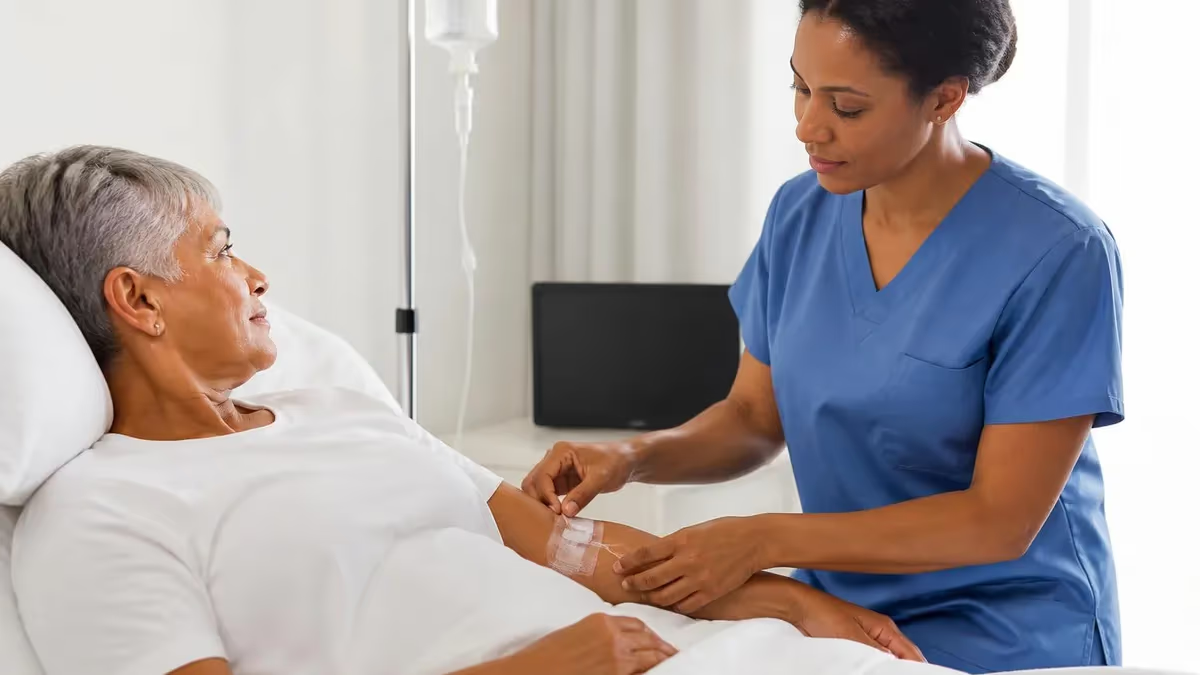
An lpn to bsn online program lets a Licensed Practical Nurse earn a Bachelor of Science in Nursing without leaving the workforce, offering the flexibility to keep working clinical shifts while completing coursework on a laptop. As of 2026, more than 140 accredited universities in the United States offer fully or partially online LPN to BSN bridges, and demand has surged because the Bureau of Labor Statistics still projects 6% growth for registered nurses through 2032, with most magnet hospitals now requiring or strongly preferring BSN-prepared RNs at the bedside.
For working LPNs, the online format solves the biggest obstacle to advancement: time. Traditional brick-and-mortar BSN programs require daytime lecture attendance, which is incompatible with 12-hour shifts and family responsibilities. Online bridges deliver theory through asynchronous modules, schedule clinicals at partner facilities near your home, and let you progress at a pace that ranges from accelerated 24-month tracks to part-time 48-month plans, depending on transfer credit and prior learning assessments.
This guide walks through every decision point: accreditation standards, realistic tuition ranges, NCLEX-RN preparation built into the curriculum, clinical hour requirements, and the differences between LPN to BSN and the shorter LPN to RN associate option. We also cover prerequisite courses, transfer credit policies, employer tuition reimbursement, and the questions admissions officers expect when you submit your application packet for fall, spring, or summer cohorts.
The financial picture matters too. Average tuition for an online LPN to BSN ranges from $14,000 at public state universities to $52,000 at private nonprofits, with most working LPNs financing through a combination of federal Direct Loans, employer reimbursement, and HRSA Nurse Corps scholarships that pay full tuition in exchange for two years of service at a critical-shortage facility. Knowing how to stack these funding sources can cut your out-of-pocket cost by 40 to 70 percent.
Beyond money, there is the question of fit. Not every LPN benefits from a BSN immediately — some work environments compensate ADN nurses identically, and some bridge directly to MSN programs without the BSN stop. We will help you decide whether the online BSN path makes sense for your career goals, your state's scope-of-practice rules, and the hospitals where you most want to work after graduation.
By the end of this guide you will know which programs are CCNE or ACEN accredited, how to interpret cost-per-credit-hour pricing, what the typical 30-week clinical rotation looks like, and how to balance NCLEX-RN review with full-time work. We also include sample weekly schedules from real LPNs who completed their bridges between 2023 and 2025, plus a checklist of documents you need before clicking submit. For free practice questions to test your readiness for nursing fundamentals, you can also explore our LPN Nursing Care & Clinical Skills Practice Test to benchmark your current knowledge before applying.
Whether you are an LPN with two years of long-term care experience or a recent practical nursing graduate eyeing the next step, this 2026 guide gives you the data, deadlines, and decision framework to choose the right online LPN to BSN program — and finish it.
LPN to BSN Online by the Numbers
Typical Online LPN to BSN Program Phases
Bridge Coursework
Prerequisite Completion
Upper-Division Nursing
Clinical Rotations
Capstone & NCLEX Prep
Admission to an online LPN to BSN program is more competitive than most LPNs expect, because seats are limited by the number of clinical placement contracts a university can secure in your geographic area. Schools typically require an unencumbered LPN license, a minimum cumulative GPA of 2.5 to 3.0 from your practical nursing program, and at least one full year of paid LPN experience — though some accelerated tracks waive the experience rule for recent graduates with strong academic records.
Beyond licensure and GPA, prerequisite coursework matters enormously. Almost every accredited bridge requires Anatomy and Physiology I and II with labs, Microbiology with lab, Introductory Statistics, English Composition I and II, General Psychology, Developmental Psychology, and a humanities or ethics elective. If you completed these as part of your LPN diploma you may receive transfer credit, but science prerequisites older than five to seven years usually have to be retaken because nursing knowledge evolves rapidly.
Many programs also require a standardized entrance exam, most commonly the TEAS (Test of Essential Academic Skills) or HESI A2, with minimum composite scores between 60 and 75 depending on competitiveness. The TEAS covers reading, mathematics, science, and English language usage and takes about 3.5 hours. Plan to spend 6-8 weeks studying before sitting for it, because retakes are limited to two or three attempts per cycle at most schools.
Background checks, drug screens, current immunizations including a recent two-step PPD or QuantiFERON-TB Gold, hepatitis B series documentation, MMR titers, varicella proof, annual flu vaccine, and now in many states COVID-19 boosters are required before clinical placement. Schools coordinate with services like CastleBranch or Verified Credentials to track these documents, and a single missing record can delay your clinical start by a full term.
References, personal statements, and resumes round out the application packet. Strong applicants submit two professional references — one from a current nursing supervisor and one from a former instructor — plus a 500 to 750 word essay explaining why a BSN aligns with their long-term career goals. Admissions committees look for evidence of clinical judgment, leadership potential, and clear reasoning about specialty interests such as critical care, public health, or pediatrics.
International or out-of-state LPNs face additional hurdles. NLC (Nurse Licensure Compact) states recognize multistate LPN licenses, but if your home state is not in the compact you may need to apply for licensure by endorsement in the state where your clinicals will occur. Allow 8-12 weeks for that process and budget $150-$350 in endorsement fees. Confirm clinical placement availability before paying any application fees. For a deeper look at finding programs in your area, see our guide on LPN programs near me which covers regional accreditation and clinical site networks.
Finally, application timing follows nursing-school rhythms rather than general university calendars. Fall cohort deadlines typically close between February 1 and April 15. Spring cohorts close August 1 to October 15. Summer accelerated tracks may close as early as November of the prior year. Apply to three or four programs simultaneously to maximize your chance of securing a seat in your target term.
LPN Practice Test Questions
Prepare for the LPN - Certified Practical Nurse exam with our free practice test modules. Each quiz covers key topics to help you pass on your first try.
LPN - Certified Practical Nurse Basic Care...
LPN Exam Questions covering - Certified Practical Nurse Basic Care and Comfort. Master LPN Test concepts for certification prep.
LPN - Certified Practical Nurse Coordinate...
Free LPN Practice Test featuring - Certified Practical Nurse Coordinated Care. Improve your LPN Exam score with mock test prep.
LPN - Certified Practical Nurse Health Pro...
LPN Mock Exam on - Certified Practical Nurse Health Promotion and Maintenance. LPN Study Guide questions to pass on your first try.
LPN - Certified Practical Nurse Pharmacolo...
LPN Test Prep for - Certified Practical Nurse Pharmacological Therapies. Practice LPN Quiz questions and boost your score.
LPN - Certified Practical Nurse Physiologi...
LPN Questions and Answers on - Certified Practical Nurse Physiological Adaptation. Free LPN practice for exam readiness.
LPN - Certified Practical Nurse Psychosoci...
LPN Mock Test covering - Certified Practical Nurse Psychosocial Integrity. Online LPN Test practice with instant feedback.
LPN - Certified Practical Nurse Reduction ...
Free LPN Quiz on - Certified Practical Nurse Reduction of Risk Potential. LPN Exam prep questions with detailed explanations.
LPN - Certified Practical Nurse Safety and...
LPN Practice Questions for - Certified Practical Nurse Safety and Infection Control. Build confidence for your LPN certification exam.
LPN Ethical, Legal & Professional Standards
LPN Test Online for Ethical, Legal & Professional Standards. Free practice with instant results and feedback.
LPN Health Evaluation & Monitoring
LPN Study Material on Health Evaluation & Monitoring. Prepare effectively with real exam-style questions.
Online LPN to BSN Program Delivery Formats
Fully asynchronous programs let you watch lectures, complete discussion posts, and submit assignments on your own schedule within weekly deadlines, usually Sunday at 11:59 p.m. This is the most popular format among working LPNs because you can study at 6 a.m. before a shift or at 11 p.m. after putting kids to bed. There are no required live class meetings beyond occasional faculty office hours.
The trade-off is self-discipline. Without scheduled class times, procrastination becomes the biggest threat to completion. Successful asynchronous students block 15-20 hours of weekly study time on a calendar and treat it like work. Programs in this format include Western Governors University, Capella, and many state university online divisions. Expect proctored exams via ProctorU or Honorlock for high-stakes assessments.

Is an Online LPN to BSN Right for You?
- +Keep working full-time as an LPN while earning the BSN credential
- +Clinical hours scheduled flexibly at facilities near your home
- +Tuition cheaper than traditional on-campus BSN programs in many cases
- +Direct path to magnet hospital eligibility and specialty certification
- +Foundation for graduate study (MSN, NP, CRNA, nurse leadership)
- +No commute means more study and family time on most weekdays
- +Eligible for federal financial aid, employer reimbursement, and HRSA scholarships
- −Requires strong self-discipline and time management without daily class structure
- −Proctored online exams demand a quiet, monitored space at home
- −Clinical placement can be delayed if local hospital contracts are full
- −Less hands-on instructor feedback than traditional in-person labs
- −Some employers still favor brick-and-mortar BSN graduates for residencies
- −Technology issues (internet outages, software bugs) can disrupt deadlines
- −Loneliness and isolation are common — peer connection requires effort
Pros and Cons at a Glance
| Pros | Cons |
|---|---|
| Keep working full-time as an LPN while earning the BSN credential | Requires strong self-discipline and time management without daily class structure |
| Clinical hours scheduled flexibly at facilities near your home | Proctored online exams demand a quiet, monitored space at home |
| Tuition cheaper than traditional on-campus BSN programs in many cases | Clinical placement can be delayed if local hospital contracts are full |
| Direct path to magnet hospital eligibility and specialty certification | Less hands-on instructor feedback than traditional in-person labs |
| Foundation for graduate study (MSN, NP, CRNA, nurse leadership) | Some employers still favor brick-and-mortar BSN graduates for residencies |
| No commute means more study and family time on most weekdays | Technology issues (internet outages, software bugs) can disrupt deadlines |
Online LPN to BSN Application Checklist
- ✓Verify current unencumbered LPN license in your state of residence
- ✓Request official transcripts from every postsecondary institution attended
- ✓Confirm minimum cumulative GPA of 2.5-3.0 per program requirements
- ✓Complete prerequisite courses: A&P I/II, Microbiology, Statistics, English Comp
- ✓Schedule and pass TEAS or HESI A2 entrance exam with target composite score
- ✓Gather two professional references including one nursing supervisor
- ✓Draft and revise a 500-750 word personal statement on BSN career goals
- ✓Update resume highlighting LPN clinical settings, certifications, and leadership
- ✓Submit immunization records, PPD, drug screen, and background check documentation
- ✓Complete FAFSA early to qualify for federal aid before priority deadlines
The 30-credit transfer advantage can shave a full year off your timeline
Most accredited online LPN to BSN programs award 25-32 transition credits in recognition of your LPN licensure and practical nursing diploma. That is essentially a full academic year of credit without retaking coursework. Always request a detailed transfer credit evaluation in writing before paying tuition — programs that award fewer than 20 transition credits add 6-12 months and thousands of dollars to your degree path.
The financial math of an online LPN to BSN is more favorable than most LPNs assume, but only if you plan carefully. Tuition at public state universities averages $300-$500 per credit hour for online programs, and a typical bridge curriculum requires 60-72 credits beyond LPN-equivalent transfer, putting total tuition between $18,000 and $36,000. Private nonprofit universities charge $550-$900 per credit hour, pushing total tuition to $35,000-$65,000 — though many offer institutional grants that bring the net cost closer to public-school pricing.
Beyond tuition, budget for fees and ancillary costs that catch many students off guard. Technology fees run $200-$600 per term. Clinical placement fees, malpractice insurance, ATI or HESI testing packages, and uniform allowances add $1,500-$3,500 over the program. Background checks and drug screens cost $50-$150 per occurrence and may be required twice if your program spans more than 18 months. NCLEX-RN application fees, state licensing fees, and Pearson VUE testing fees add another $400-$650 at graduation.
Federal financial aid is the workhorse for most students. Filing the FAFSA opens access to Direct Subsidized Loans up to $5,500 per year, Unsubsidized Loans up to $20,500 per year for independent students, and Pell Grants up to $7,395 for qualifying low-income applicants. Federal Work-Study is rarely useful for online students but Direct PLUS Loans can cover any remaining gap. Always exhaust federal aid before considering private student loans, which carry higher interest rates and less flexible repayment.
Employer tuition reimbursement is the single most underused benefit in nursing. Most hospitals, long-term care chains, and home health agencies offer $2,500-$10,000 per year in tax-advantaged tuition assistance under IRS Section 127. Some magnet hospitals reimburse 100 percent of tuition for nurses who commit to two or three years of post-graduation employment. Ask your HR department for the written policy, and confirm whether reimbursement is paid upfront or only after course completion with a passing grade.
Scholarships specifically for LPN-to-BSN students are abundant but require effort to find. The HRSA Nurse Corps Scholarship pays full tuition, fees, and a monthly stipend in exchange for two to three years of service at a critical-shortage facility — primary care clinics, rural hospitals, federally qualified health centers. The Foundation of the National Student Nurses Association awards $1,000-$10,000 grants, and state-level nursing associations often offer awards of $500-$5,000 targeted at bridge students.
Veterans and active-duty service members have additional options. The Post-9/11 GI Bill covers tuition at public schools at the in-state rate plus a housing stipend, and Yellow Ribbon Program participation at private schools can eliminate out-of-pocket costs entirely. Military spouses qualify for MyCAA funds up to $4,000. Verify program eligibility on the VA's WEAMS portal before enrolling, because online-only programs sometimes pay a reduced housing allowance.
Finally, consider the opportunity cost of your time. An LPN earning $52,000 per year who shifts to part-time during a 24-month bridge sacrifices roughly $26,000 in income but gains a credential that boosts earning capacity by $20,000-$35,000 annually as an RN. Within 18 months of graduation, most students recover the income gap and begin netting higher lifetime earnings. For a complete breakdown of upfront program pricing, see our LPN program cost guide covering tuition, fees, and hidden expenses for practical nursing pathways.

Only enroll in an LPN to BSN program accredited by CCNE (Commission on Collegiate Nursing Education) or ACEN (Accreditation Commission for Education in Nursing). Non-accredited programs may be cheaper, but graduates are blocked from NCLEX-RN in most states, ineligible for federal financial aid, and rejected by virtually all hospitals and graduate programs. Always verify accreditation directly on ccneaccreditation.org or acenursing.org before applying.
The career outcomes after completing an online LPN to BSN justify the investment for most nurses. Bureau of Labor Statistics data from 2024 shows registered nurses earning a median annual salary of $86,070, with the top 10 percent earning above $132,680. BSN-prepared RNs in magnet hospitals, particularly in California, Massachusetts, Oregon, and the Pacific Northwest, frequently exceed $110,000 in base pay before differentials, sign-on bonuses, and overtime. LPNs by comparison earned a median of $59,730 in 2024 — a gap of roughly $26,000 per year.
Salary is only part of the picture. BSN nurses qualify for clinical ladder advancement, specialty certifications, charge nurse roles, and the bridge to advanced practice. Within five years of BSN completion, many graduates pursue an MSN or DNP track to become Nurse Practitioners (median salary $126,260), Nurse Anesthetists ($212,650), Nurse Midwives ($129,650), or Clinical Nurse Specialists. The BSN is the gateway credential — without it, these graduate doors stay closed in nearly every U.S. state.
Hospital hiring preferences have shifted dramatically over the past decade. The Institute of Medicine's 2010 Future of Nursing report set a national goal of 80 percent BSN-prepared RNs by 2020, and while the country fell short of that target, more than 65 percent of staff RNs nationally now hold a BSN. Magnet-designated hospitals require all newly hired nurses to hold a BSN or to complete one within five years of hire, and many academic medical centers have made BSN the minimum for any RN role.
Specialty practice opens up dramatically with a BSN. Critical care, emergency, labor and delivery, perioperative, oncology, neonatal intensive care, and flight nursing typically require BSN credentials plus 1-3 years of medical-surgical experience. Certifications like CCRN, CEN, RNC-OB, OCN, and CFRN all require BSN prerequisites in most cases. Public health nursing, school nursing, occupational health, and case management are similarly BSN-gated employment categories in many states.
Geographic flexibility improves with the BSN as well. RN licensure compact reciprocity is straightforward, but employer preferences for BSN nurses vary by region. New York and New Jersey now require all RNs to earn a BSN within 10 years of initial licensure under the BSN-in-10 laws. California, while not legally requiring BSN, has effectively made it standard in urban hospitals. Rural and underserved areas remain more flexible, often hiring ADN nurses while supporting BSN completion.
Leadership and management pathways accelerate with a BSN. Charge nurse, unit educator, clinical coordinator, nurse manager, and director roles almost universally require BSN minimum, with most senior leadership positions expecting MSN credentials. The progression from staff RN to nurse manager typically takes 5-8 years post-BSN, and from nurse manager to director takes another 3-7 years. Online BSN graduates often advance faster because they have already demonstrated the time-management skills senior leaders prize.
Job satisfaction data also favors BSN nurses. Surveys from the American Nurses Association show higher reported autonomy, clinical decision-making latitude, and career fulfillment among BSN-prepared RNs compared to ADN counterparts in equivalent roles. The BSN curriculum's emphasis on evidence-based practice, leadership, public health, and research prepares nurses to influence patient outcomes at a systems level — work that LPN scope simply does not permit.
Practical tips from LPNs who have completed online BSN bridges in 2024 and 2025 boil down to a handful of habits. First, treat the program as a part-time job with its own calendar. Successful students block 15-20 hours per week of dedicated study time on a shared family calendar, color-coded and protected from interruption. Treat lectures, discussion posts, and assigned reading as appointments you cannot miss, not flexible tasks that can slide to Sunday night.
Second, build a clinical preceptor relationship early. Online programs match you with a clinical site and preceptor, but the depth of learning you extract from rotations depends almost entirely on the working relationship you build. Arrive 15 minutes early, bring a reflective journal, ask one strategic question per shift, and follow up with a thank-you note at rotation end. Strong preceptor evaluations open doors to nurse residencies after graduation, and bad ones can derail your final term.
Third, invest in NCLEX-RN preparation from day one rather than waiting for the final term. The NCLEX-RN tests integrated nursing judgment across all client needs categories, and the questions are written at an application or analysis level rather than recall. Use UWorld, Kaplan Q-Bank, or the ATI review packages bundled with your program. Aim for 75-100 practice questions per week throughout the program, scaling up to 150-200 per week in the final eight weeks before testing.
Fourth, manage your sleep and nutrition aggressively. Working LPNs who try to add a full BSN load on top of 36-40 clinical hours per week without sacrificing some sleep, social time, or weekend hours burn out by month nine. Negotiate shorter shifts during high-load semesters, ask family for explicit support in covering meals and childcare, and treat sleep as a non-negotiable performance input — not a luxury you can shortchange when deadlines stack up.
Fifth, build a peer accountability group. Online programs feel isolating because you rarely see classmates in person. Join the program's Discord or Slack channel within the first week, identify 3-5 classmates with similar work schedules and goals, and form a weekly study group on Zoom or Microsoft Teams. Quiz each other on pharmacology, discuss case studies, and share study guides. The students who finish without this community are the exception, not the rule.
Sixth, plan for the credentialing window before graduation. NCLEX-RN application processing varies by state from 4-12 weeks, so start your Authorization to Test paperwork during your final term, not after graduation. Order official transcripts directly to your state board the week after final grades post. Schedule your NCLEX-RN test date within 30-45 days of receiving your ATT — knowledge retention drops sharply after that window, and pass rates fall about 8-12 percent for students who delay testing beyond 60 days.
Finally, celebrate milestones. The LPN to BSN journey is 24-36 months of sustained effort while balancing work and family. Mark course completions, clinical-hour milestones, and successful preceptor evaluations with deliberate rewards. Burnout is the leading reason for non-completion, and the antidote is small consistent wins that remind you why you started. Pin your acceptance letter and your goal salary number above your desk — they will get you through the hardest weeks.
Sample Certified Practical Nurse Practice Questions
Try these questions from our free Certified Practical Nurse practice tests. The correct answer and an explanation follow each question.
When administering an oral medication to an elderly patient with dysphagia, which of the following is the most important initial action for the LPN to take?
- A. Crush the tablet and mix it with a large amount of water.
- B. Administer the medication in its original form and encourage the patient to swallow.
- C. Check the facility's policy and consult with the pharmacist about crushing the medication.
- D. Dissolve the medication in the patient's favorite juice.
Answer: C. Check the facility's policy and consult with the pharmacist about crushing the medication.
Patient safety is the priority. Not all medications can be crushed (e.g., enteric-coated or sustained-release tablets). The LPN must first verify if the medication can be safely altered. Consulting facility policy and the pharmacist is the correct and safest initial action before modifying the form of any medication.
Which document serves as the primary legal record guiding a patient's end-of-life care wishes?
- A. Medical power of attorney designation
- B. Advance directive
- C. Discharge summary
- D. Care coordination plan
Answer: B. Advance directive
An advance directive is the primary legal document that outlines a patient's wishes regarding end-of-life care, including resuscitation and life support preferences.
A patient has a clean surgical cut made by a scalpel. This wound type is best classified as a(n):
- A. Laceration
- B. Abrasion
- C. Incision
- D. Puncture
Answer: C. Incision
An incision is a clean wound made intentionally by a sharp surgical instrument with smooth, well-approximated edges.
Which of the following clients is at the highest risk for developing accidental hypothermia?
- A. A 30-year-old athlete who is jogging in 50°F (10°C) weather.
- B. An 82-year-old client with hypothyroidism who lives in a poorly heated home.
- C. A 45-year-old client with a well-controlled diabetic diet.
- D. A 25-year-old who is recovering from anesthesia in a warm post-operative unit.
Answer: B. An 82-year-old client with hypothyroidism who lives in a poorly heated home.
Older adults are at a higher risk for hypothermia due to a slower metabolism, a thinner subcutaneous fat layer, and a decreased ability to regulate body temperature. Chronic conditions like hypothyroidism further impair the body's ability to generate heat, and living in a cold environment is a major contributing factor.
LPN Questions and Answers

About the Author

Registered Nurse & Healthcare Educator
Johns Hopkins University School of NursingDr. Sarah Mitchell is a board-certified registered nurse with over 15 years of clinical and academic experience. She completed her PhD in Nursing Science at Johns Hopkins University and has taught NCLEX preparation and clinical skills courses for nursing students across the United States. Her research focuses on evidence-based exam preparation strategies for healthcare certification candidates.
Join the Discussion
Connect with other students preparing for this exam. Share tips, ask questions, and get advice from people who have been there.
View discussion (7 replies)