
LPN Programs Oklahoma 2026: Complete Guide to OKC, Tulsa & Statewide Schools
LPN programs OKC and statewide Oklahoma — accredited schools, tuition, NCLEX-PN pass rates, admission requirements, and career outlook for 2026. 💡
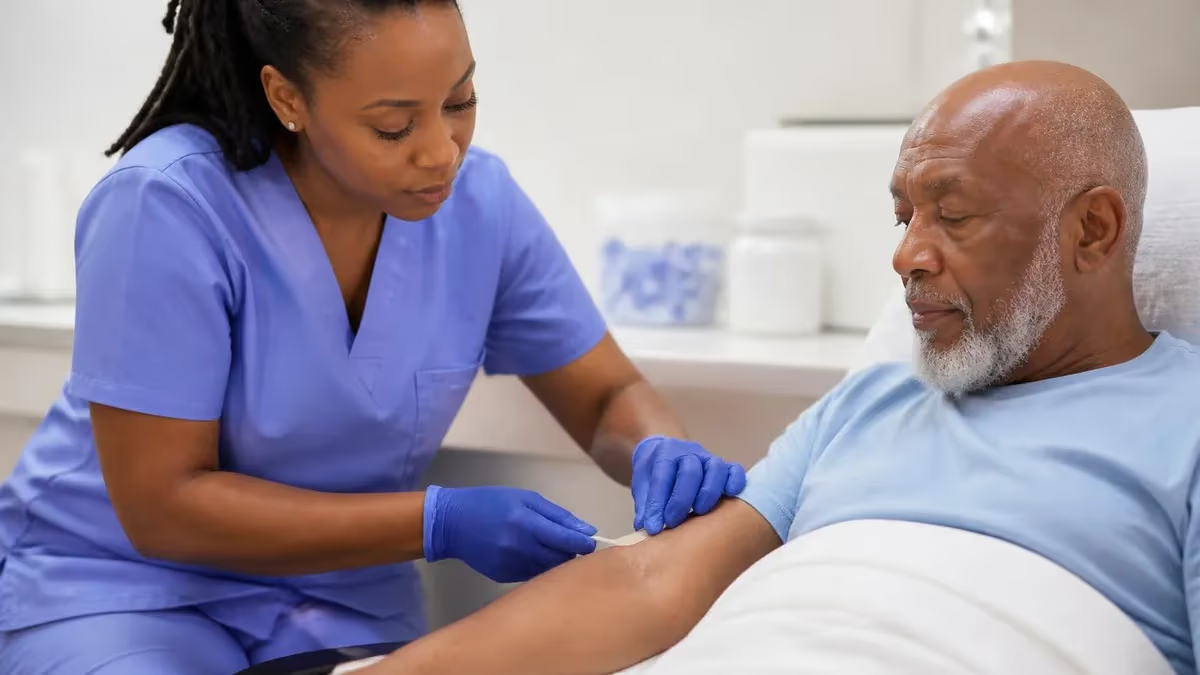
If you are searching for lpn programs okc or anywhere across the Sooner State, you are entering one of the most affordable and accessible pathways into healthcare in the entire country. Oklahoma trains practical nurses through a network of CareerTech technology centers, community colleges, and private vocational schools, with tuition costs that are dramatically lower than national averages. The Oklahoma Board of Nursing oversees all approved programs and licensure, ensuring that graduates are prepared to sit for the NCLEX-PN examination and enter the workforce as Licensed Practical Nurses with confidence and clinical competence. Practice with the free Certified Practical Nurse practice test on PracticeTestGeeks (550+ questions with answer explanations).
Oklahoma City alone hosts several outstanding LPN training pathways, including the well-known practical nursing track at Metro Technology Centers and the Francis Tuttle Technology Center program in nearby Oklahoma County. These technology center programs typically run 10 to 12 months full-time, blending classroom instruction with hands-on clinical rotations at major OKC hospitals like Mercy, INTEGRIS Health, and OU Medical Center. The combination of low tuition, rapid completion, and strong employer demand makes these programs particularly attractive to career changers and recent high school graduates.
Beyond the metro, Tulsa Technology Center, Moore Norman Technology Center, Great Plains Technology Center in Lawton, and Pioneer Technology Center in Ponca City all operate state-approved practical nursing programs that lead directly to NCLEX-PN eligibility. Each program is regulated under Oklahoma Administrative Code Title 485 and must maintain minimum pass rate standards or face probationary review. Knowing which schools currently exceed the state benchmark — and which are trending downward — is essential intelligence for any prospective student.
Tuition for Oklahoma LPN programs ranges from roughly $4,500 at CareerTech centers for in-district residents to about $15,000 at private institutions. When you add books, uniforms, lab fees, background checks, drug screens, immunizations, and NCLEX examination costs, most students should budget between $7,000 and $18,000 for the complete journey from application to licensure. Financial aid through Pell Grants, Oklahoma's Tuition Aid Grant (OTAG), and workforce development funding through programs like WIOA can significantly reduce this out-of-pocket burden for eligible applicants.
Employment prospects for Oklahoma LPNs remain strong heading into 2026. The Oklahoma Employment Security Commission projects continued growth for practical nursing roles, especially in long-term care facilities, rural hospitals, home health agencies, correctional health, and outpatient clinics. The median LPN wage in Oklahoma sits around $51,000 annually, with metropolitan OKC and Tulsa employers often offering sign-on bonuses, shift differentials, and tuition reimbursement for LPN-to-RN bridge programs as recruitment incentives.
This guide walks you through every meaningful decision point: which schools to consider, what admission tests and prerequisites you need, how long each program takes, how much you should expect to pay, what licensure requirements the Oklahoma Board of Nursing enforces, and how to position yourself for NCLEX-PN success on your first attempt. Whether you live in downtown Oklahoma City, suburban Edmond, the Tulsa metro, or a small town in the Panhandle, there is a realistic pathway for you within driving distance.
We will also compare Oklahoma's offerings against neighboring states, discuss the realistic timeline from application to first paycheck, and provide a checklist of everything you should accomplish before submitting your first application. By the end of this guide, you should have a clear, actionable plan for entering an Oklahoma LPN program in the next 12 months and beginning your nursing career with confidence and proper preparation.
Free Certified Practical Nurse Study Tools
Interactive Certified Practical Nurse resources on PracticeTestGeeks, free to start:
- Certified Practical Nurse practice test — 550+ questions with instant scoring and answer explanations
- Certified Practical Nurse flashcards — review key terms and concepts card by card
- Certified Practical Nurse study guide — topic-by-topic overview of what the exam covers
- Certified Practical Nurse cheat sheet — one-page printable summary for last-minute review
Oklahoma LPN Programs by the Numbers
Top LPN Programs in Oklahoma City and Statewide
Located in central Oklahoma City, Metro Tech offers a 12-month practical nursing program with strong clinical partnerships at OU Medical, INTEGRIS, and Mercy. In-district tuition runs approximately $5,200, and historical NCLEX-PN pass rates consistently exceed 85%.
Serving northwest Oklahoma County, Francis Tuttle's practical nursing program is highly competitive with limited seats. The 11-month curriculum emphasizes medical-surgical, maternal-child, and geriatric clinical experiences with rotations across the OKC metro health systems.
The largest CareerTech district in the state offers practical nursing across multiple campuses. Tulsa Tech graduates fill positions throughout Saint Francis, Hillcrest, and Ascension St. John facilities, with rolling admissions and evening cohorts available.
Located between Norman and south OKC, Moore Norman serves a large suburban catchment. The program features state-of-the-art simulation labs, low instructor-to-student ratios, and a tuition-friendly structure for in-district students under $5,000 per year.
Lawton's Great Plains Technology Center and Ponca City's Pioneer Technology Center serve southwest and north-central Oklahoma respectively. Both programs are ideal for rural students seeking affordable practical nursing training without relocating to a major metro area.
Admission into Oklahoma practical nursing programs is competitive but achievable for well-prepared applicants. Every Board-approved program requires applicants to be at least 18 years old by graduation, hold a high school diploma or GED, and submit official transcripts. Most CareerTech programs also require a passing score on the Test of Essential Academic Skills (TEAS) or the HESI A2 entrance examination, with minimum composite scores typically ranging between 58 and 65 percent depending on the school's competitiveness and current applicant pool size.
Prerequisite coursework varies between institutions but commonly includes high school biology, chemistry, algebra, and English with grades of C or better. Several programs strongly prefer or require completion of medical terminology, basic anatomy and physiology, or Certified Nursing Assistant (CNA) certification before applying. Holding an active Oklahoma CNA credential can significantly boost your application strength and often shortens your clinical orientation period during the first weeks of the program substantially.
Background checks are mandatory and conducted through the Oklahoma State Bureau of Investigation (OSBI) along with an FBI fingerprint-based federal background check. Certain criminal convictions — particularly felonies involving violence, fraud, or controlled substances — may disqualify applicants from clinical placement and ultimately from Oklahoma Board of Nursing licensure. If you have any concerning history, contact the Board directly for a pre-licensure review before investing in tuition or relocating for school.
Health requirements include a complete physical examination, current immunizations (MMR, Tdap, Varicella, Hepatitis B series, annual influenza, and updated COVID-19 vaccination per clinical site policy), tuberculosis screening, and CPR for Healthcare Provider certification through the American Heart Association. Drug screening at admission and randomly throughout the program is standard. A positive result for any substance not supported by a current prescription typically results in immediate dismissal from the program without tuition refund.
Many programs require applicants to attend a mandatory information session before the application window opens. These sessions cover curriculum expectations, clinical site requirements, tuition payment schedules, and application timelines. Skipping the information session often results in automatic application disqualification. Mark your calendar early, register online through each school's admissions portal, and treat these sessions as professional interviews — admissions counselors absolutely take note of applicant punctuality, professionalism, and engagement during the Q&A portion.
Letters of recommendation, personal statements, and structured admissions interviews are increasingly common at competitive Oklahoma programs. Strong candidates typically secure recommendations from a current healthcare supervisor, a prior nursing instructor, or a community professional who can attest to reliability and work ethic. Your personal statement should clearly articulate why practical nursing — not registered nursing or another healthcare field — aligns with your immediate career goals and personal life circumstances at this particular moment.
Application timing matters enormously in Oklahoma. Most CareerTech programs admit one or two cohorts per year, typically starting in August and January. Application windows close 60 to 120 days before each start date, and seats fill on a rolling basis at many schools. Plan to submit a complete application — including TEAS scores, transcripts, immunization records, and any required essays — at least four months before your intended start date to maximize your probability of acceptance.
LPN Practice Test Questions
Prepare for the LPN - Certified Practical Nurse exam with our free practice test modules. Each quiz covers key topics to help you pass on your first try.
LPN - Certified Practical Nurse Basic Care...
LPN Exam Questions covering - Certified Practical Nurse Basic Care and Comfort. Master LPN Test concepts for certification prep.
LPN - Certified Practical Nurse Coordinate...
Free LPN Practice Test featuring - Certified Practical Nurse Coordinated Care. Improve your LPN Exam score with mock test prep.
LPN - Certified Practical Nurse Health Pro...
LPN Mock Exam on - Certified Practical Nurse Health Promotion and Maintenance. LPN Study Guide questions to pass on your first try.
LPN - Certified Practical Nurse Pharmacolo...
LPN Test Prep for - Certified Practical Nurse Pharmacological Therapies. Practice LPN Quiz questions and boost your score.
LPN - Certified Practical Nurse Physiologi...
LPN Questions and Answers on - Certified Practical Nurse Physiological Adaptation. Free LPN practice for exam readiness.
LPN - Certified Practical Nurse Psychosoci...
LPN Mock Test covering - Certified Practical Nurse Psychosocial Integrity. Online LPN Test practice with instant feedback.
LPN - Certified Practical Nurse Reduction ...
Free LPN Quiz on - Certified Practical Nurse Reduction of Risk Potential. LPN Exam prep questions with detailed explanations.
LPN - Certified Practical Nurse Safety and...
LPN Practice Questions for - Certified Practical Nurse Safety and Infection Control. Build confidence for your LPN certification exam.
LPN Ethical, Legal & Professional Standards
LPN Test Online for Ethical, Legal & Professional Standards. Free practice with instant results and feedback.
LPN Health Evaluation & Monitoring
LPN Study Material on Health Evaluation & Monitoring. Prepare effectively with real exam-style questions.
Oklahoma LPN Tuition and Financial Aid Breakdown
Oklahoma CareerTech technology centers offer the most affordable practical nursing pathway in the state. In-district residents typically pay between $4,500 and $5,800 in tuition for the complete program, while out-of-district students pay roughly 1.5 to 2 times that amount. Districts are determined by your home address relative to the technology center boundary lines, so a small change in residence can produce significant tuition savings for eligible Oklahoma residents.
Additional CareerTech costs include uniforms ($200-$400), textbooks and digital resources ($800-$1,200), lab fees ($300-$600), clinical badge and ID fees, background checks ($75-$125), drug screens ($45), immunizations if not already complete ($200-$500), and NCLEX-PN application and examination fees totaling about $350. Total all-in costs at a CareerTech program typically land between $7,000 and $9,500 for in-district Oklahoma residents starting from scratch.
Should You Pursue an LPN Program in Oklahoma?
- +Among the most affordable practical nursing tuition in the United States
- +CareerTech network provides access in nearly every region of the state
- +Strong employer demand in long-term care, hospitals, and rural clinics
- +NCLEX-PN pass rates at most Oklahoma programs exceed the national average
- +Multiple LPN-to-RN bridge programs available at OCCC, TCC, OSU-OKC, and Rose State
- +Lower cost of living statewide stretches your nursing salary much further than coastal markets
- −Competitive admissions with limited seats at top OKC and Tulsa programs
- −Clinical rotations may require travel up to 45-60 miles in rural districts
- −Some private programs carry higher tuition without proportionally better outcomes
- −LPN scope of practice in Oklahoma hospitals continues to narrow each year
- −Salary ceiling lower than RN — most LPNs eventually pursue RN bridge programs
- −Background check disqualifications can derail applicants late in the process
Pros and Cons at a Glance
| Pros | Cons |
|---|---|
| Among the most affordable practical nursing tuition in the United States | Competitive admissions with limited seats at top OKC and Tulsa programs |
| CareerTech network provides access in nearly every region of the state | Some private programs carry higher tuition without proportionally better outcomes |
| Strong employer demand in long-term care, hospitals, and rural clinics | LPN scope of practice in Oklahoma hospitals continues to narrow each year |
| NCLEX-PN pass rates at most Oklahoma programs exceed the national average | Salary ceiling lower than RN — most LPNs eventually pursue RN bridge programs |
| Multiple LPN-to-RN bridge programs available at OCCC, TCC, OSU-OKC, and Rose State | Background check disqualifications can derail applicants late in the process |
Pre-Application Checklist for Oklahoma LPN Programs
- ✓Complete the FAFSA at studentaid.gov before exploring tuition payment options
- ✓Obtain official high school transcripts or GED certificate documentation
- ✓Register for and complete the TEAS or HESI A2 entrance exam with passing score
- ✓Schedule a comprehensive physical exam and update all required immunizations
- ✓Obtain or renew American Heart Association BLS for Healthcare Provider certification
- ✓Submit fingerprints for OSBI and FBI background check at least 60 days early
- ✓Attend the mandatory program information session at each school you apply to
- ✓Secure two to three professional letters of recommendation from supervisors or instructors
- ✓Draft and proofread a focused, sincere personal statement about your nursing goals
- ✓Confirm transportation and childcare arrangements for clinical rotation schedule demands
Oklahoma's $5,000 LPN Pathway
Oklahoma's CareerTech system is one of the few state-funded networks in the country that delivers a complete, NCLEX-eligible practical nursing education for under $6,000 in tuition for in-district residents. Comparable programs in California, New York, or Massachusetts can cost three to five times more, making Oklahoma an exceptional value for residents committed to staying in-state for their nursing career launch.
Clinical rotations form the heart of every Oklahoma LPN program and typically begin in the second or third month of study after foundational classroom instruction is complete. Students rotate through medical-surgical units, long-term care facilities, maternal-child health departments, pediatrics, mental health units, and community-based settings such as outpatient clinics or school nursing offices. Each rotation typically lasts two to six weeks and requires anywhere from 16 to 32 clinical hours per week depending on the school's curriculum design.
Oklahoma City students rotate primarily through INTEGRIS Baptist, INTEGRIS Southwest, OU Health, Mercy Hospital OKC, SSM Health St. Anthony, and various skilled nursing facilities including Brookdale, Touchmark, and Grace Living Centers throughout the metro area. Tulsa-based programs use Saint Francis Health System, Ascension St. John, Hillcrest Medical Center, and a wide network of long-term care providers. Rural programs often partner with critical access hospitals and county-level nursing homes within a 60-mile driving radius of the school campus.
The Oklahoma practical nursing curriculum is structured around the National Council of State Boards of Nursing's NCLEX-PN test plan, which means every accredited program teaches the same core content domains. These include safe and effective care environment, health promotion and maintenance, psychosocial integrity, and physiological integrity. Programs that align tightly with the NCLEX blueprint consistently produce higher first-time pass rates and better-prepared graduates ready for the realities of bedside practical nursing work.
Simulation labs have become a major component of modern Oklahoma LPN training. Most CareerTech facilities now feature high-fidelity manikins that simulate vital sign changes, cardiac rhythms, breath sounds, and pharmacological reactions in real time. Simulation typically accounts for 25 to 35 percent of total clinical hours and allows students to safely practice high-risk skills like medication administration, sterile dressing changes, IV initiation, and emergency response protocols before performing them on actual patients in the hospital.
Coursework runs in parallel with clinicals throughout the program. Major didactic blocks include anatomy and physiology, microbiology basics, pharmacology, nutrition, medical-surgical nursing, maternal-newborn nursing, pediatric nursing, mental health nursing, gerontology, and leadership and management for the LPN scope of practice. Most programs assess students through weekly quizzes, comprehensive unit exams, ATI or HESI standardized practice tests, and an end-of-program predictor exam that signals NCLEX readiness for each individual graduating student.
Attendance policies in Oklahoma LPN programs are notoriously strict because the Board of Nursing requires documented completion of every clinical hour for licensure eligibility. Most schools allow only 8 to 16 hours of absence across the entire program, and missing more than that threshold typically triggers a remediation plan, course failure, or program dismissal. Plan your life — childcare backup, vehicle reliability, second job hours — around the assumption that you cannot miss class or clinical except in genuine medical emergencies with documentation.
Successful Oklahoma LPN students consistently report dedicating 25 to 35 hours per week to study and review outside of scheduled class and clinical time. The volume of content moves quickly during the compressed 10 to 12 month format, and falling behind by even a week or two can be extremely difficult to recover from before the next major examination. Form a small study group early, use commercial NCLEX-PN prep resources such as UWorld, Kaplan, or Saunders, and never skip post-clinical reflection assignments that reinforce daily learning.
The Oklahoma Board of Nursing places any practical nursing program on probation if its NCLEX-PN first-time pass rate falls below 80% for any single calendar year. Before enrolling, always check the program's most recent three-year pass rate history on the Board's website at nursing.ok.gov. A program on probation may lose approval entirely, leaving enrolled students unable to sit for licensure.
Once you complete an approved Oklahoma practical nursing program, the final hurdle to becoming a licensed LPN is the NCLEX-PN examination administered by Pearson VUE testing centers across the state. Oklahoma uses the standardized national NCLEX-PN test plan, meaning the exam content is identical whether you take it in Oklahoma City, Tulsa, Lawton, Enid, or any other state. The exam is computer-adaptive, ranges from 85 to 150 questions, and tests your minimum competency to practice safe, effective nursing care under registered nurse or physician supervision.
The Oklahoma Board of Nursing licensure application process begins before graduation. Most programs help students submit Form A (application for licensure by examination) approximately 30 to 60 days before the program completion date. Required documentation includes the program completion certificate, official transcripts, fingerprint background check results, application fee of $85, and Pearson VUE NCLEX registration fee of $200. Plan to budget approximately $285 total for the licensure and examination process, plus any retake fees if needed.
Once your application is reviewed and approved, you will receive an Authorization to Test (ATT) email from Pearson VUE. The ATT is valid for 90 days, during which you must schedule and sit for the NCLEX-PN at any approved Pearson VUE testing center in Oklahoma or elsewhere in the country. Most successful candidates schedule their exam within four to six weeks of receiving the ATT, allowing time for focused review without losing the urgency and momentum from program completion.
Pass rates in Oklahoma have generally tracked at or slightly above the national average over the past five years. The 2024 first-time pass rate for Oklahoma LPN candidates was approximately 84 percent, compared to a national average near 82 percent. Individual school pass rates vary widely — top CareerTech programs regularly produce 90 percent or higher first-time pass rates, while struggling programs sometimes fall below 75 percent and trigger Board of Nursing probationary review and corrective action plans for the school administration.
If you do not pass on your first attempt, Oklahoma permits unlimited retakes, with a mandatory 45-day waiting period between attempts. Most candidates who fail on the first try and complete a structured remediation program — such as Kaplan NCLEX-PN Review, UWorld self-assessment, or Hurst Review — pass on the second attempt. Do not let a first-attempt failure discourage you from continuing; statistical data consistently shows that focused remediation and a second attempt produce successful licensure for most candidates.
After licensure, Oklahoma LPNs must renew their license every two years through the Board of Nursing's online portal at nursing.ok.gov. Renewal requires payment of a $50 fee, attestation of practice hours, and completion of any continuing education or compliance requirements in effect at the time. Oklahoma has historically not required continuing education hours for LPN renewal, though this policy is periodically reviewed and may change in future legislative or regulatory cycles, so always check current requirements.
Looking ahead in your career, many Oklahoma LPNs eventually pursue LPN-to-RN bridge programs at Oklahoma City Community College, Tulsa Community College, OSU-OKC, Rose State College, or Northern Oklahoma College. These bridge programs typically run 12 to 18 months and award an Associate Degree in Nursing (ADN), which qualifies graduates to sit for the NCLEX-RN. For additional career planning and broader cost comparisons, the LPN Program Cost guide breaks down national tuition averages alongside Oklahoma figures for context.
Practical tips for success start long before your first day of class. Begin by visiting each program you are considering in person — walk the campus, tour the simulation lab, speak with current students, and ask the program director about historical NCLEX-PN pass rates over the past five years. Programs that proudly share their data and welcome difficult questions about attrition rates and clinical site quality are generally more confident and transparent than those that deflect or provide vague generalities about outcomes and graduate success.
Create a realistic budget that extends well beyond tuition. Many Oklahoma LPN students underestimate the cost of fuel for clinical commutes, lost wages from reducing work hours, childcare during evening study sessions, and unexpected expenses like replacement stethoscopes or last-minute textbook editions. A realistic monthly cash flow plan covering all 12 months of the program — including a small emergency fund of $1,000 to $2,000 — significantly reduces the risk of having to drop out for purely financial reasons mid-program.
Invest in NCLEX-PN preparation resources from day one rather than waiting until graduation. UWorld's NCLEX-PN QBank, Saunders Comprehensive Review for the NCLEX-PN, and Kaplan's NCLEX-PN Strategies books are widely used by successful Oklahoma graduates. Doing 25 to 50 practice questions per day from the first month of class — even when the content feels overwhelming — builds the question-pattern recognition that makes the actual NCLEX-PN feel familiar rather than intimidating on examination day.
Build relationships with your clinical instructors and preceptors early. Strong recommendations from nursing instructors carry significant weight when applying for your first LPN position, especially at competitive employers like Mercy, INTEGRIS, OU Health, and Saint Francis. Many Oklahoma graduates report that their first job came directly from a clinical rotation where they impressed a charge nurse or unit manager — sometimes within the first week of orientation as a brand-new LPN on the floor working independently.
Take care of your physical and mental health throughout the program. Nursing school is physically demanding — 12-hour clinical shifts on your feet, late-night study sessions, and emotional exposure to suffering patients all add up quickly over 10 to 12 months. Prioritize 7 to 8 hours of sleep, regular exercise, and a sustainable diet. Many Oklahoma programs have student support services, including counseling and academic tutoring at no additional cost, and using them early is a strength, not a weakness, throughout your training.
Network with practicing Oklahoma LPNs through the Oklahoma Nurses Association, local chapters of the National Federation of Licensed Practical Nurses, and Facebook groups specific to your school or region. Experienced LPNs share invaluable practical wisdom about which units to target for new graduates, how to negotiate sign-on bonuses, which long-term care facilities provide quality orientation, and which employers chronically understaff and burn out new nurses within six months of being hired and starting their first job.
Finally, remember that the LPN credential is rarely the end of a nursing career — it is most often a launching pad. The vast majority of Oklahoma LPNs eventually advance to RN, BSN, or specialty certification within five to ten years of initial licensure. Plan that pathway from the beginning, document your work hours and continuing education carefully, and align your early career choices — employer tuition reimbursement, schedule flexibility, exposure to varied clinical settings — with your long-term goals as a healthcare professional advancing in your nursing career.
Sample Certified Practical Nurse Practice Questions
Try these questions from our free Certified Practical Nurse practice tests. The correct answer and an explanation follow each question.
A school-age child receives a tympanostomy tube (ear tube) and is being discharged. Which instruction should the LPN include?
- A. The child may swim freely but must avoid submerging ears in the bathtub
- B. Keep water out of the ear with earplugs during bathing and swimming until the provider clears it
- C. The tubes will dissolve in 2 weeks — no follow-up is needed
- D. Apply antibiotic ear drops twice daily for 6 months
Answer: B. Keep water out of the ear with earplugs during bathing and swimming until the provider clears it
Water in the ear canal can travel through the tympanostomy tube into the middle ear, causing otitis media. Earplugs or cotton with petroleum jelly protect the ear during water exposure.
A school-age child with type 1 diabetes is found unresponsive in the classroom. After confirming hypoglycemia, which action should the LPN take first?
- A. Give oral glucose gel if the child can swallow
- B. Administer IM glucagon
- C. Start an IV and give dextrose
- D. Call 911 and wait for EMS
Answer: B. Administer IM glucagon
An unresponsive child cannot safely swallow; IM glucagon is the appropriate first action outside a hospital setting.
The LPN is caring for a 6-year-old child with nephrotic syndrome. Which finding is the primary characteristic of this condition?
- A. Hypertension and hematuria
- B. Massive proteinuria, hypoalbuminemia, and generalized edema (anasarca)
- C. Oliguria and elevated creatinine
- D. Polyuria and polydipsia
Answer: B. Massive proteinuria, hypoalbuminemia, and generalized edema (anasarca)
Nephrotic syndrome is defined by the triad of massive proteinuria (>3.5 g/day), hypoalbuminemia (<3 g/dL), and generalized edema from reduced oncotic pressure.
During a skin assessment, the LPN notes a wound with black, hard, dry necrotic tissue. This tissue type is classified as:
- A. Slough
- B. Granulation tissue
- C. Eschar
- D. Fibrinous exudate
Answer: C. Eschar
Eschar is black, hard, dry necrotic tissue that must be documented accurately to guide wound care decisions.
LPN Questions and Answers

LPN Practice Test PDF (Free Printable 2026)
Wound Care Certification for LPN: 2026 Complete Guide to WCC, CWCA & Specialty Credentials
LPN Program Cost: Complete 2026 Tuition & Fees Guide
LPN Programs Near Me 2026: Find Accredited Schools & Costs
LPN Programs Houston 2026: Best Schools, Costs & Requirements
About the Author

Registered Nurse & Healthcare Educator
Johns Hopkins University School of NursingDr. Sarah Mitchell is a board-certified registered nurse with over 15 years of clinical and academic experience. She completed her PhD in Nursing Science at Johns Hopkins University and has taught NCLEX preparation and clinical skills courses for nursing students across the United States. Her research focuses on evidence-based exam preparation strategies for healthcare certification candidates.
Join the Discussion
Connect with other students preparing for this exam. Share tips, ask questions, and get advice from people who have been there.
View discussion (7 replies)